Klein Tunneling PHYS 503 Physics Colloquium Fall 2008 9/11 Deepak Rajput Graduate Research Assistant Center for Laser Applications University of Tennessee Space Institute Email:  [email_address] Web:  http://drajput.com
Outline Classical picture Tunneling Klein Tunneling Bipolar junctions with graphene Applications
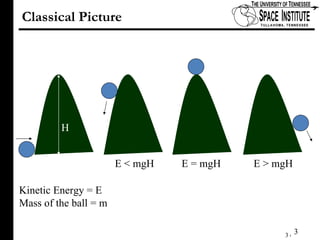
Classical Picture Kinetic Energy = E Mass of the ball = m H E < mgH E = mgH E > mgH
Tunneling Transmission of a particle through a potential barrier higher than its kinetic energy (V>E). It violates the principles of classical mechanics. It is a  quantum  effect.
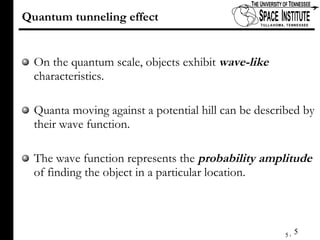
Quantum tunneling effect On the quantum scale, objects exhibit  wave-like  characteristics. Quanta moving against a potential hill can be described by their wave function. The wave function represents the  probability amplitude  of finding the object in a particular location.
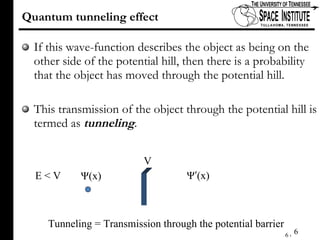
Quantum tunneling effect If this wave-function describes the object as being on the other side of the potential hill, then there is a probability that the object has moved through the potential hill.  This transmission of the object through the potential hill is termed as  tunneling .  Tunneling = Transmission through the potential barrier V Ψ (x) Ψ ʹ (x) E < V
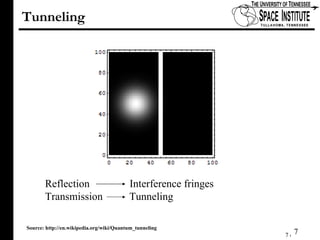
Tunneling Source: http://en.wikipedia.org/wiki/Quantum_tunneling Reflection  Interference fringes Transmission  Tunneling
Klein Tunneling In quantum mechanics, an electron can tunnel from the conduction into the valence band. Such tunneling from an electron-like to hole-like state is called as interband tunneling or  Klein  tunneling. Here, electron avoids backscattering
Tunneling in Graphene In graphene, the massless carriers behave differently than ordinary massive carriers in the presence of an electric field.  Here, electrons avoid backscattering because the carrier velocity is  independent  of the energy.  The absence of backscattering is responsible for the high conductivity in carbon nanotubes (Ando et al, 1998).
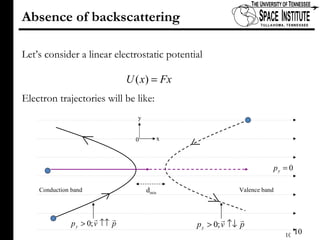
Absence of backscattering Let’s consider a linear electrostatic potential Electron trajectories will be like: Conduction band Valence band d min 0 x y
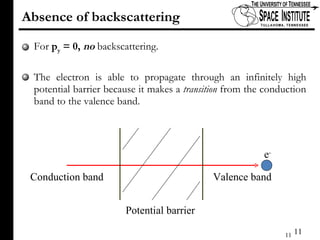
Absence of backscattering For  p y  = 0,   no  backscattering.  The electron is able to propagate through an infinitely high potential barrier because it makes a  transition  from the conduction band to the valence band. Conduction band Valence band e - Potential barrier
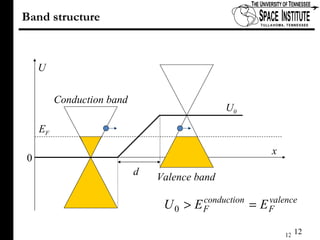
Band structure d U E F Conduction band Valence band U 0 0 x
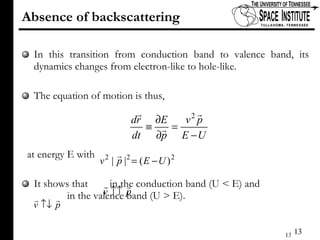
Absence of backscattering In this transition from conduction band to valence band, its dynamics changes from electron-like to hole-like. The equation of motion is thus, at energy E with  It shows that  in the conduction band (U < E) and    in the valence band (U > E).
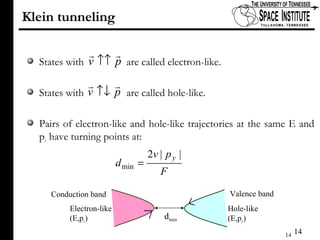
Klein tunneling States with  are called electron-like. States with  are called hole-like. Pairs of electron-like and hole-like trajectories at the same E and p y  have turning points at: d min Electron-like (E,p y ) Hole-like (E,p y ) Conduction band Valence band
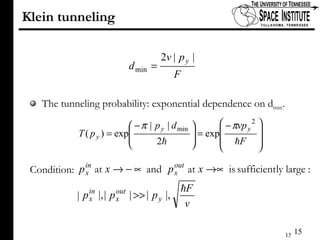
Klein tunneling The tunneling probability: exponential dependence on d min . Condition:
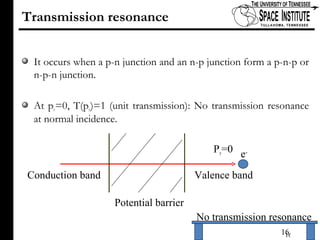
Transmission resonance It occurs when a p-n junction and an n-p junction form a p-n-p or n-p-n junction.  At p y =0, T(p y )=1 (unit transmission): No transmission resonance at normal incidence.  No transmission resonance Conduction band Valence band e - Potential barrier P y =0
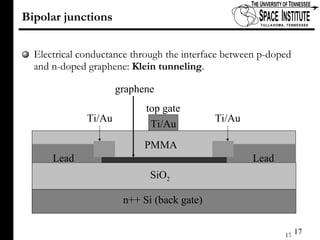
Bipolar junctions Electrical conductance through the interface between p-doped and n-doped graphene:  Klein tunneling . n++ Si (back gate) top gate SiO 2 PMMA Ti/Au graphene Ti/Au Ti/Au Lead Lead
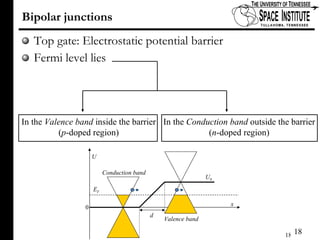
Bipolar junctions Top gate: Electrostatic potential barrier Fermi level lies In the  Valence band  inside the barrier ( p -doped region) In the  Conduction band  outside the barrier ( n -doped region) d U E F Conduction band Valence band U 0 0 x
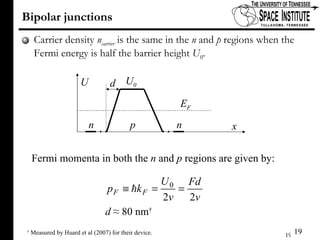
Bipolar junctions Carrier density  n carrier  is the same in the  n  and  p  regions when the Fermi energy is half the barrier height  U 0 . U 0 E F x n n p d U Fermi momenta in both the  n  and  p  regions are given by: d   ā‰ˆ  80 nm † †   Measured by Huard et al (2007) for their device.
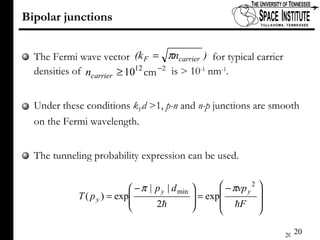
Bipolar junctions The Fermi wave vector  for typical carrier densities of  is > 10 -1  nm -1 .  Under these conditions  k F d  >1,  p-n  and  n-p  junctions are smooth on the Fermi wavelength. The tunneling probability expression can be used.
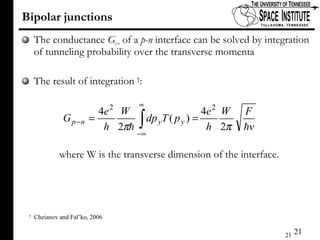
Bipolar junctions The conductance  G p-n  of a  p-n  interface can be solved by integration of tunneling probability over the transverse momenta The result of integration  † : where W is the transverse dimension of the interface. †   Cheianov and Fal’ko, 2006
Applications of tunneling Atomic clock Scanning Tunneling Microscope Tunneling diode Tunneling transistor
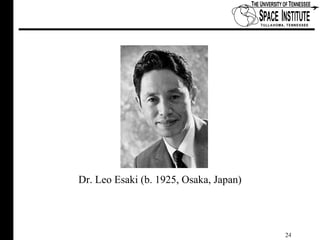
  Questions ? Who got the Nobel prize (1973) in Physics for his pioneering work on electron tunneling in solids?
Dr. Leo Esaki (b. 1925, Osaka, Japan)
Thanks !!

Klein Tunneling

  • 1.
    Klein Tunneling PHYS503 Physics Colloquium Fall 2008 9/11 Deepak Rajput Graduate Research Assistant Center for Laser Applications University of Tennessee Space Institute Email: [email_address] Web: http://drajput.com
  • 2.
    Outline Classical pictureTunneling Klein Tunneling Bipolar junctions with graphene Applications
  • 3.
    Classical Picture KineticEnergy = E Mass of the ball = m H E < mgH E = mgH E > mgH
  • 4.
    Tunneling Transmission ofa particle through a potential barrier higher than its kinetic energy (V>E). It violates the principles of classical mechanics. It is a quantum effect.
  • 5.
    Quantum tunneling effectOn the quantum scale, objects exhibit wave-like characteristics. Quanta moving against a potential hill can be described by their wave function. The wave function represents the probability amplitude of finding the object in a particular location.
  • 6.
    Quantum tunneling effectIf this wave-function describes the object as being on the other side of the potential hill, then there is a probability that the object has moved through the potential hill. This transmission of the object through the potential hill is termed as tunneling . Tunneling = Transmission through the potential barrier V Ψ (x) Ψ ʹ (x) E < V
  • 7.
    Tunneling Source: http://en.wikipedia.org/wiki/Quantum_tunnelingReflection Interference fringes Transmission Tunneling
  • 8.
    Klein Tunneling Inquantum mechanics, an electron can tunnel from the conduction into the valence band. Such tunneling from an electron-like to hole-like state is called as interband tunneling or Klein tunneling. Here, electron avoids backscattering
  • 9.
    Tunneling in GrapheneIn graphene, the massless carriers behave differently than ordinary massive carriers in the presence of an electric field. Here, electrons avoid backscattering because the carrier velocity is independent of the energy. The absence of backscattering is responsible for the high conductivity in carbon nanotubes (Ando et al, 1998).
  • 10.
    Absence of backscatteringLet’s consider a linear electrostatic potential Electron trajectories will be like: Conduction band Valence band d min 0 x y
  • 11.
    Absence of backscatteringFor p y = 0, no backscattering. The electron is able to propagate through an infinitely high potential barrier because it makes a transition from the conduction band to the valence band. Conduction band Valence band e - Potential barrier
  • 12.
    Band structure dU E F Conduction band Valence band U 0 0 x
  • 13.
    Absence of backscatteringIn this transition from conduction band to valence band, its dynamics changes from electron-like to hole-like. The equation of motion is thus, at energy E with It shows that in the conduction band (U < E) and in the valence band (U > E).
  • 14.
    Klein tunneling Stateswith are called electron-like. States with are called hole-like. Pairs of electron-like and hole-like trajectories at the same E and p y have turning points at: d min Electron-like (E,p y ) Hole-like (E,p y ) Conduction band Valence band
  • 15.
    Klein tunneling Thetunneling probability: exponential dependence on d min . Condition:
  • 16.
    Transmission resonance Itoccurs when a p-n junction and an n-p junction form a p-n-p or n-p-n junction. At p y =0, T(p y )=1 (unit transmission): No transmission resonance at normal incidence. No transmission resonance Conduction band Valence band e - Potential barrier P y =0
  • 17.
    Bipolar junctions Electricalconductance through the interface between p-doped and n-doped graphene: Klein tunneling . n++ Si (back gate) top gate SiO 2 PMMA Ti/Au graphene Ti/Au Ti/Au Lead Lead
  • 18.
    Bipolar junctions Topgate: Electrostatic potential barrier Fermi level lies In the Valence band inside the barrier ( p -doped region) In the Conduction band outside the barrier ( n -doped region) d U E F Conduction band Valence band U 0 0 x
  • 19.
    Bipolar junctions Carrierdensity n carrier is the same in the n and p regions when the Fermi energy is half the barrier height U 0 . U 0 E F x n n p d U Fermi momenta in both the n and p regions are given by: d ā‰ˆ 80 nm † † Measured by Huard et al (2007) for their device.
  • 20.
    Bipolar junctions TheFermi wave vector for typical carrier densities of is > 10 -1 nm -1 . Under these conditions k F d >1, p-n and n-p junctions are smooth on the Fermi wavelength. The tunneling probability expression can be used.
  • 21.
    Bipolar junctions Theconductance G p-n of a p-n interface can be solved by integration of tunneling probability over the transverse momenta The result of integration † : where W is the transverse dimension of the interface. † Cheianov and Fal’ko, 2006
  • 22.
    Applications of tunnelingAtomic clock Scanning Tunneling Microscope Tunneling diode Tunneling transistor
  • 23.
    Questions? Who got the Nobel prize (1973) in Physics for his pioneering work on electron tunneling in solids?
  • 24.
    Dr. Leo Esaki(b. 1925, Osaka, Japan)
  • 25.