Polarization Spectroscopy Seminar by  Deepak Rajput PHYS 605   Advanced Topics: Laser Spectroscopy July 10, 2007 Center for Laser Applications University of Tennessee Space Institute Tullahoma, TN 37388 Email:  [email_address]   Web:  http://drajput.com
Polarization Spectroscopy A set of spectroscopic techniques based on polarization properties of light.
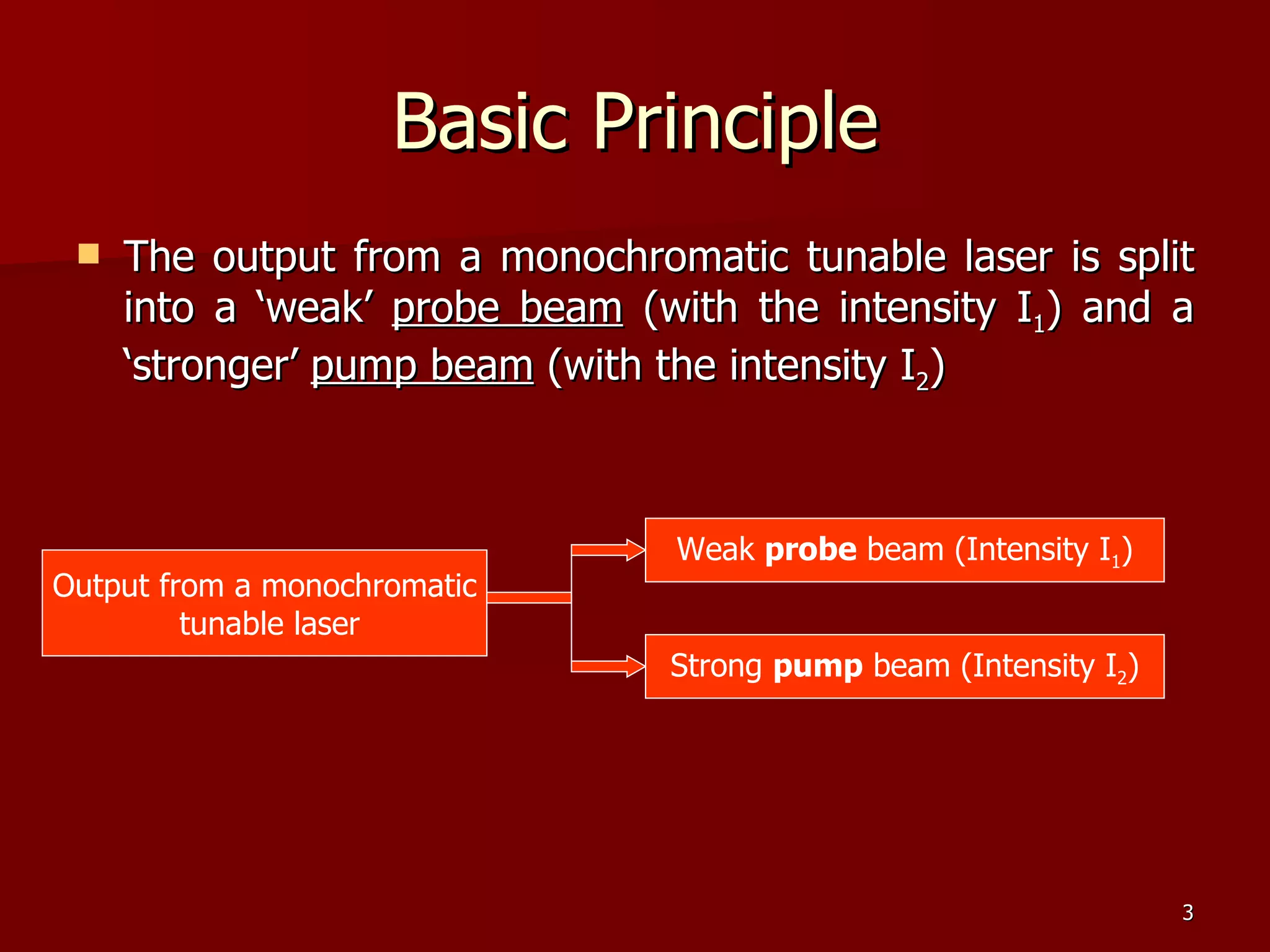
Basic Principle The output from a monochromatic tunable laser is split into a ‘weak’  probe beam  (with the intensity I 1 ) and a ‘stronger’  pump beam  (with the intensity I 2 ) Output from a monochromatic tunable laser Weak  probe  beam (Intensity I 1 ) Strong  pump  beam (Intensity I 2 )
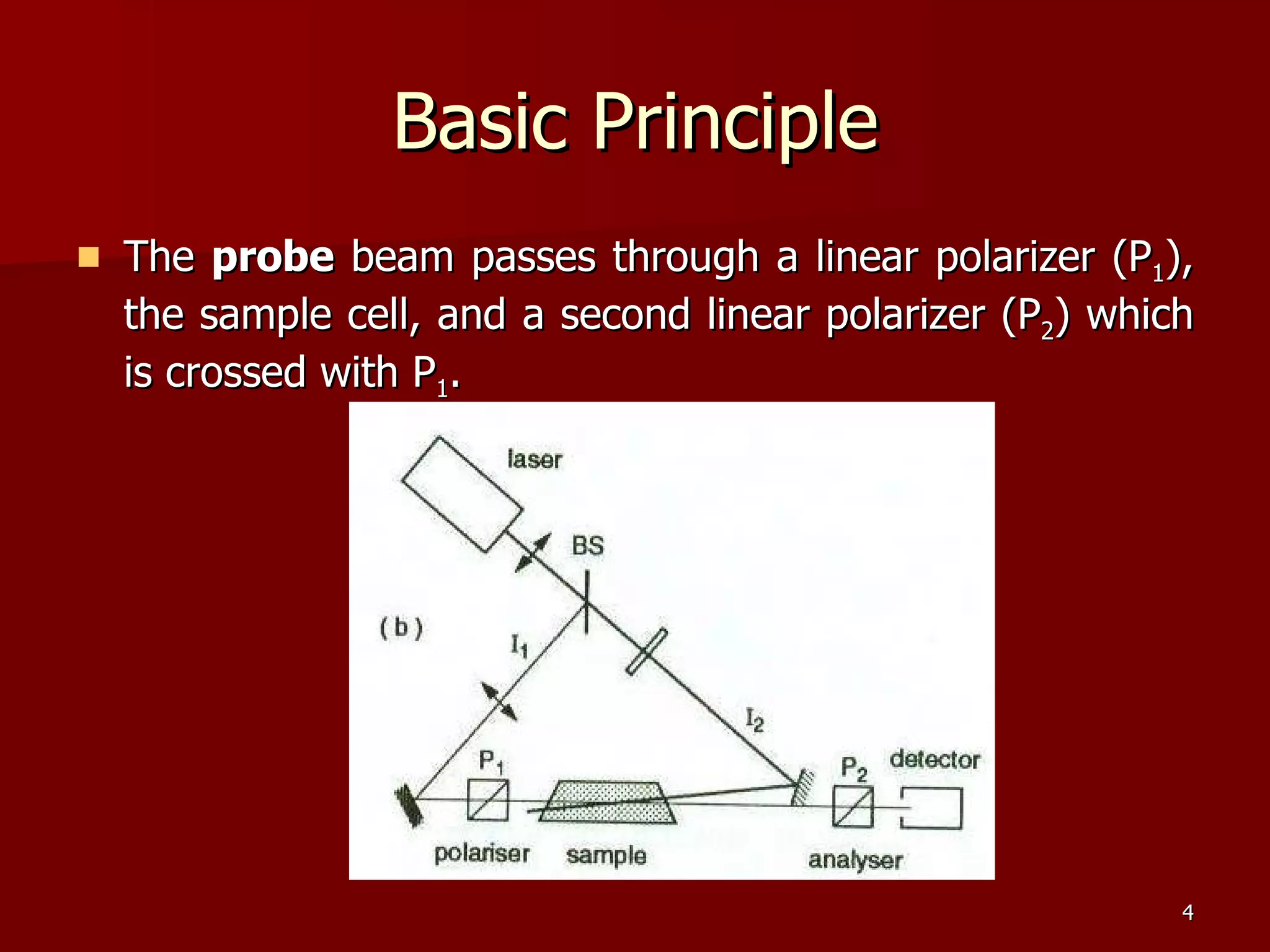
Basic Principle The  probe  beam passes through a linear polarizer (P 1 ), the sample cell, and a second linear polarizer (P 2 ) which is crossed with P 1 .
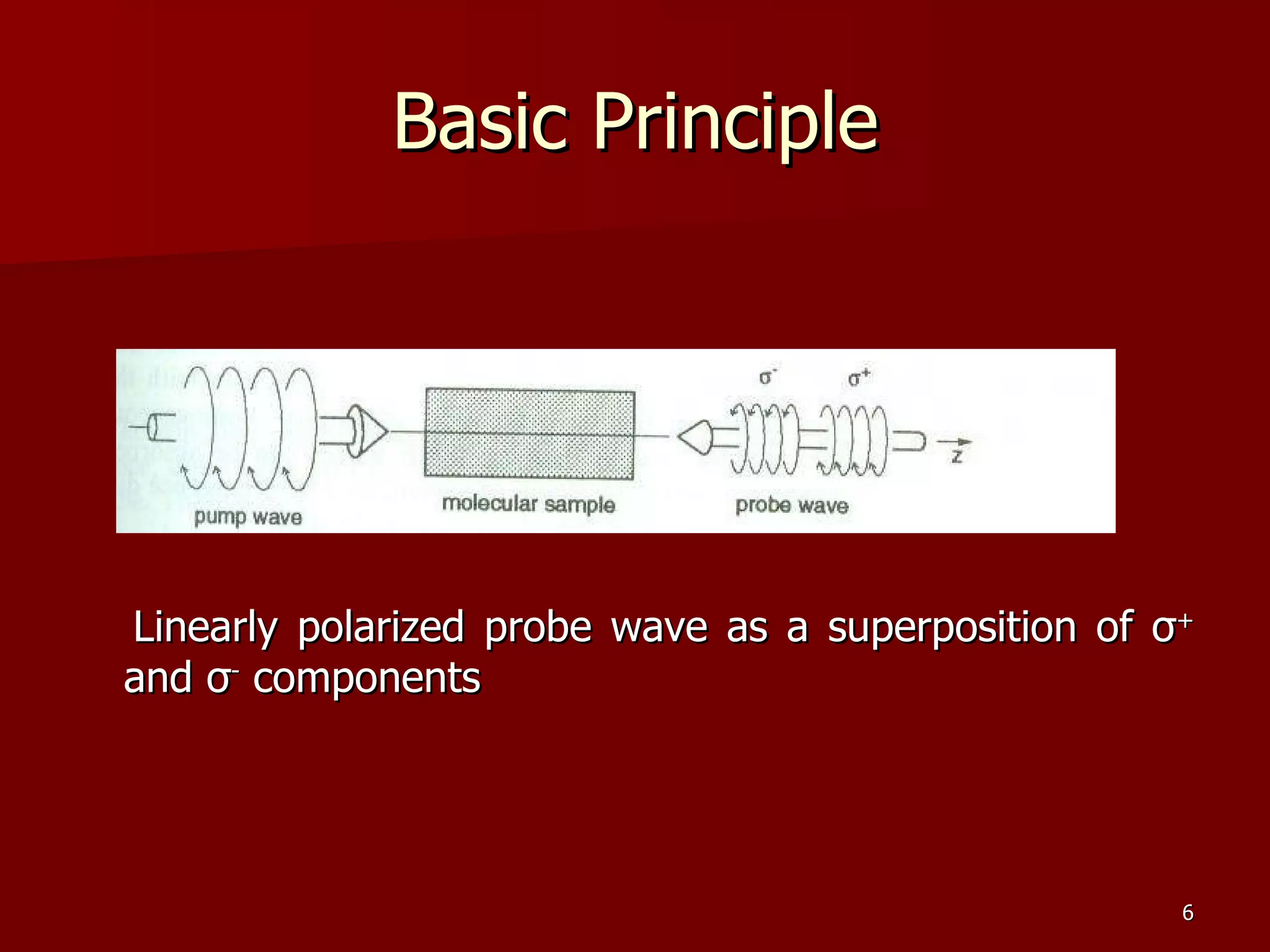
Basic Principle Without the pump laser the sample is isotropic and the detector D behind P 2  receives only a very small signal caused by the residual transmission of the crossed polarizer. After having passed through a  λ /4 plate which produces a circular polarization, the pump beam travels in the opposite direction through the sample cell. When the laser frequency  ω   is tuned to a molecular transition (J”,M”)  (J’,M’), molecules in the lower level (J”,M”) can absorb the pump wave. The quantum number M which describes the projection of J onto the direction of light propagation, follows the selection rule  Δ M = ±1  for the transitions M”  M induced by  σ + -circularly polarized light (M”  M’=M”+1).
Linearly polarized probe wave as a superposition of  σ +  and  σ -  components Basic Principle
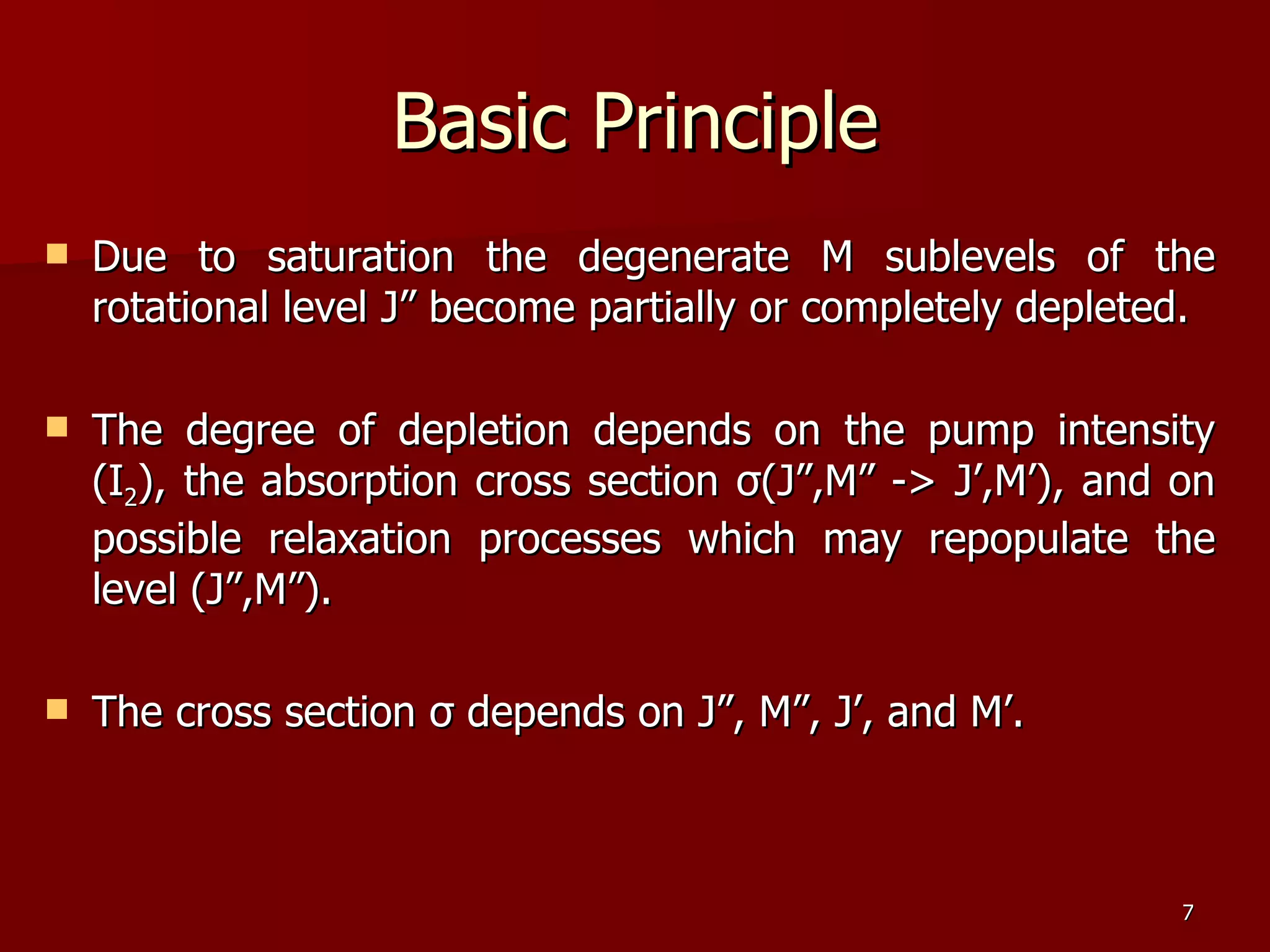
Due to saturation the degenerate M sublevels of the rotational level J” become partially or completely depleted. The degree of depletion depends on the pump intensity (I 2 ), the absorption cross section  σ (J”,M” -> J’,M’), and on possible relaxation processes which may repopulate the level (J”,M”). The cross section  σ  depends on J”, M”, J’, and M’. Basic Principle
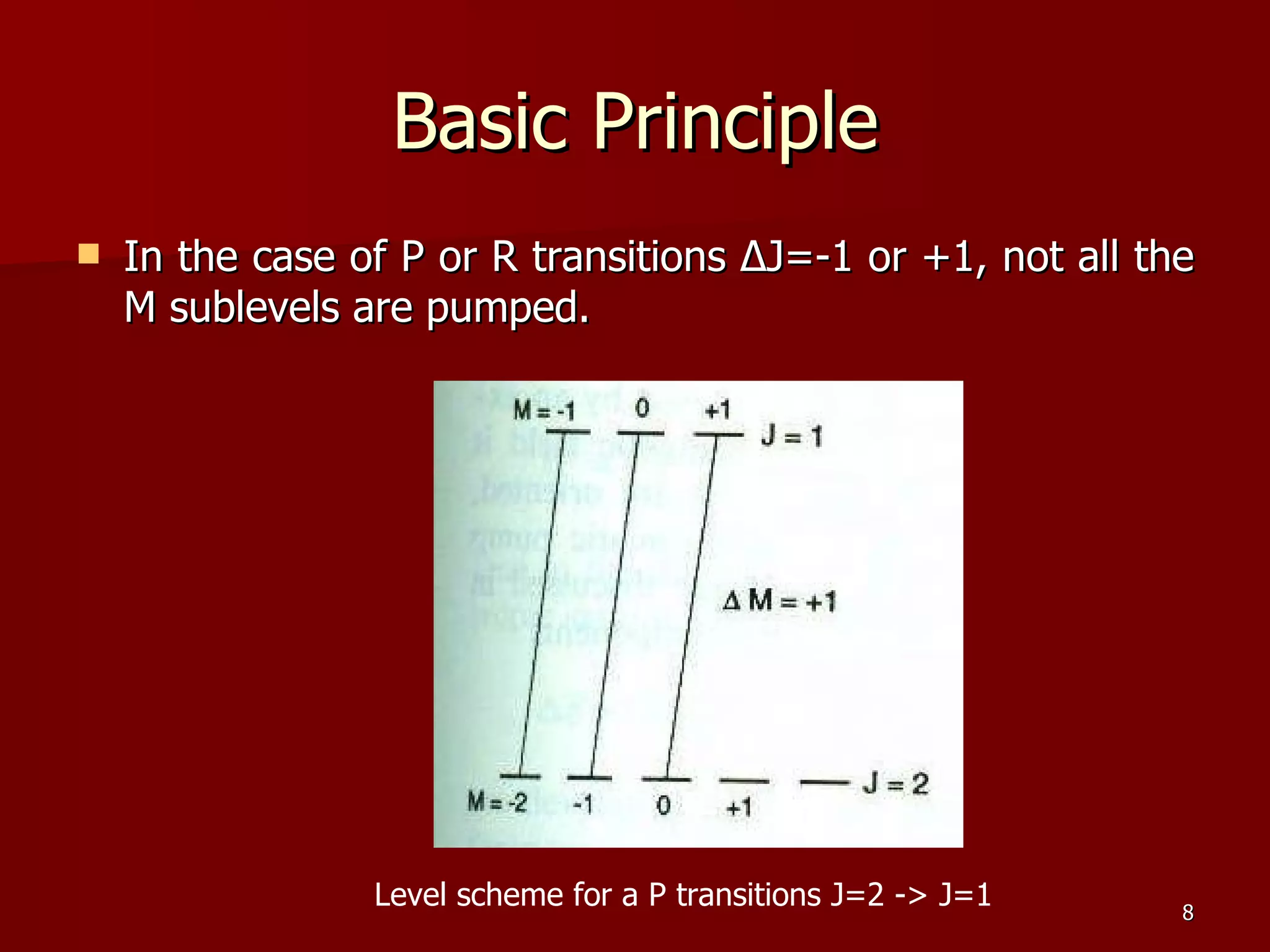
In the case of P or R transitions  Δ J=-1 or +1, not all the M sublevels are pumped.  Basic Principle Level scheme for a P transitions J=2 -> J=1
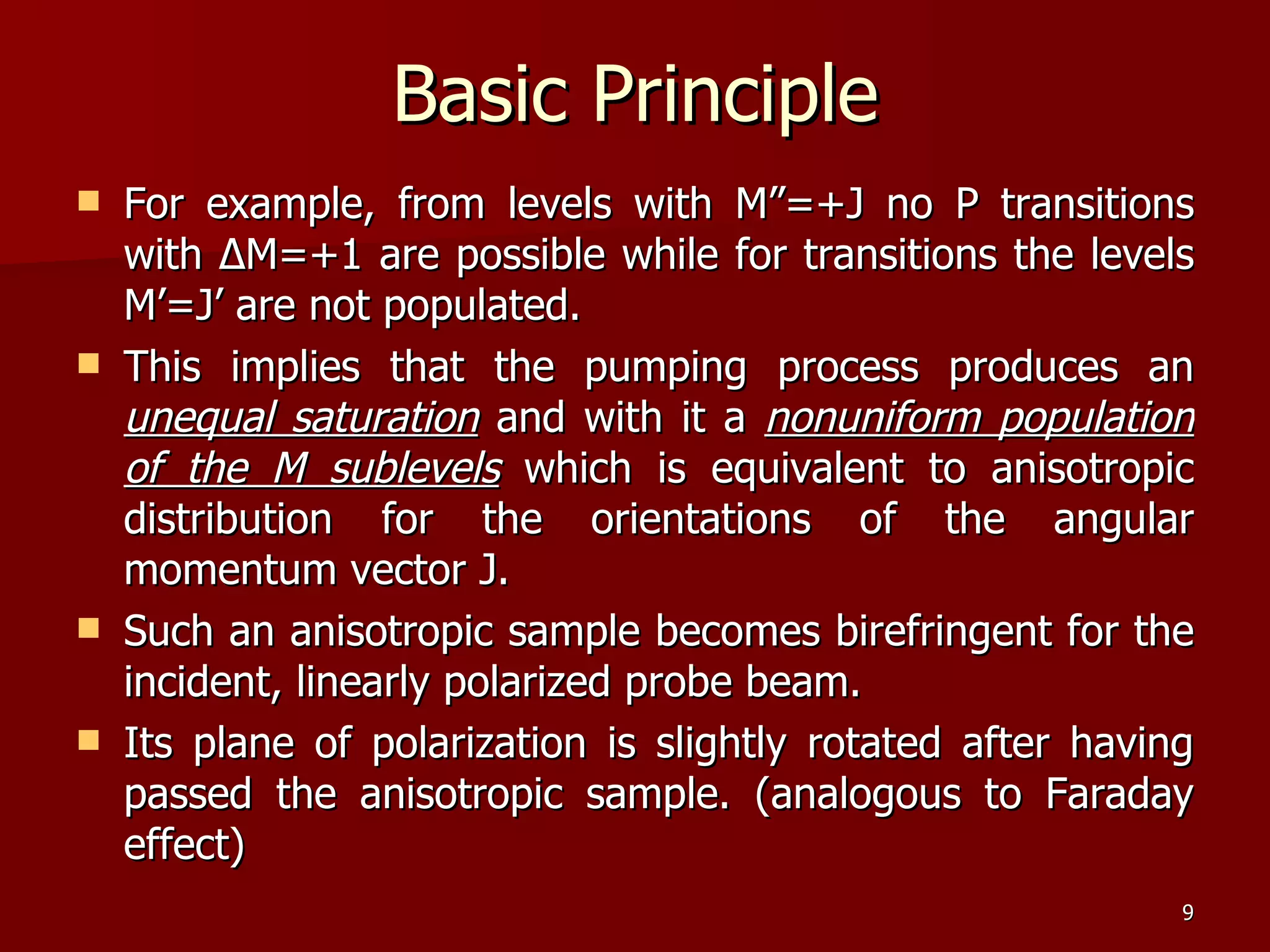
For example, from levels with M”=+J no P transitions with  Δ M=+1 are possible while for transitions the levels M’=J’ are not populated.  This implies that the pumping process produces an  unequal saturation  and with it a  nonuniform population of the M sublevels  which is equivalent to anisotropic distribution for the orientations of the angular momentum vector J.  Such an anisotropic sample becomes birefringent for the incident, linearly polarized probe beam.  Its plane of polarization is slightly rotated after having passed the anisotropic sample. (analogous to Faraday effect)  Basic Principle
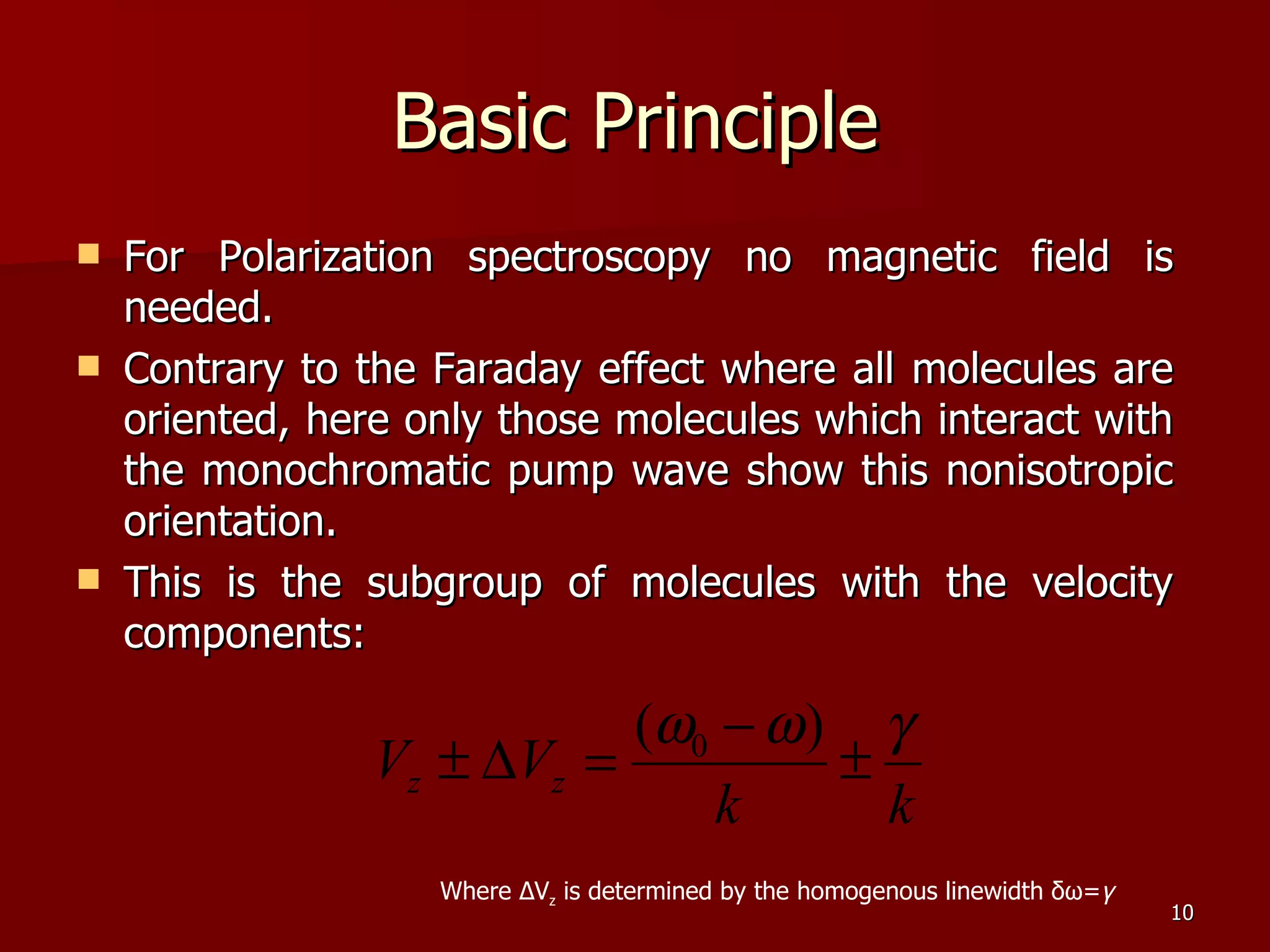
Basic Principle For Polarization spectroscopy no magnetic field is needed. Contrary to the Faraday effect where all molecules are oriented, here only those molecules which interact with the monochromatic pump wave show this nonisotropic orientation. This is the subgroup of molecules with the velocity components: Where  Δ V z  is determined by the homogenous linewidth  δω = γ
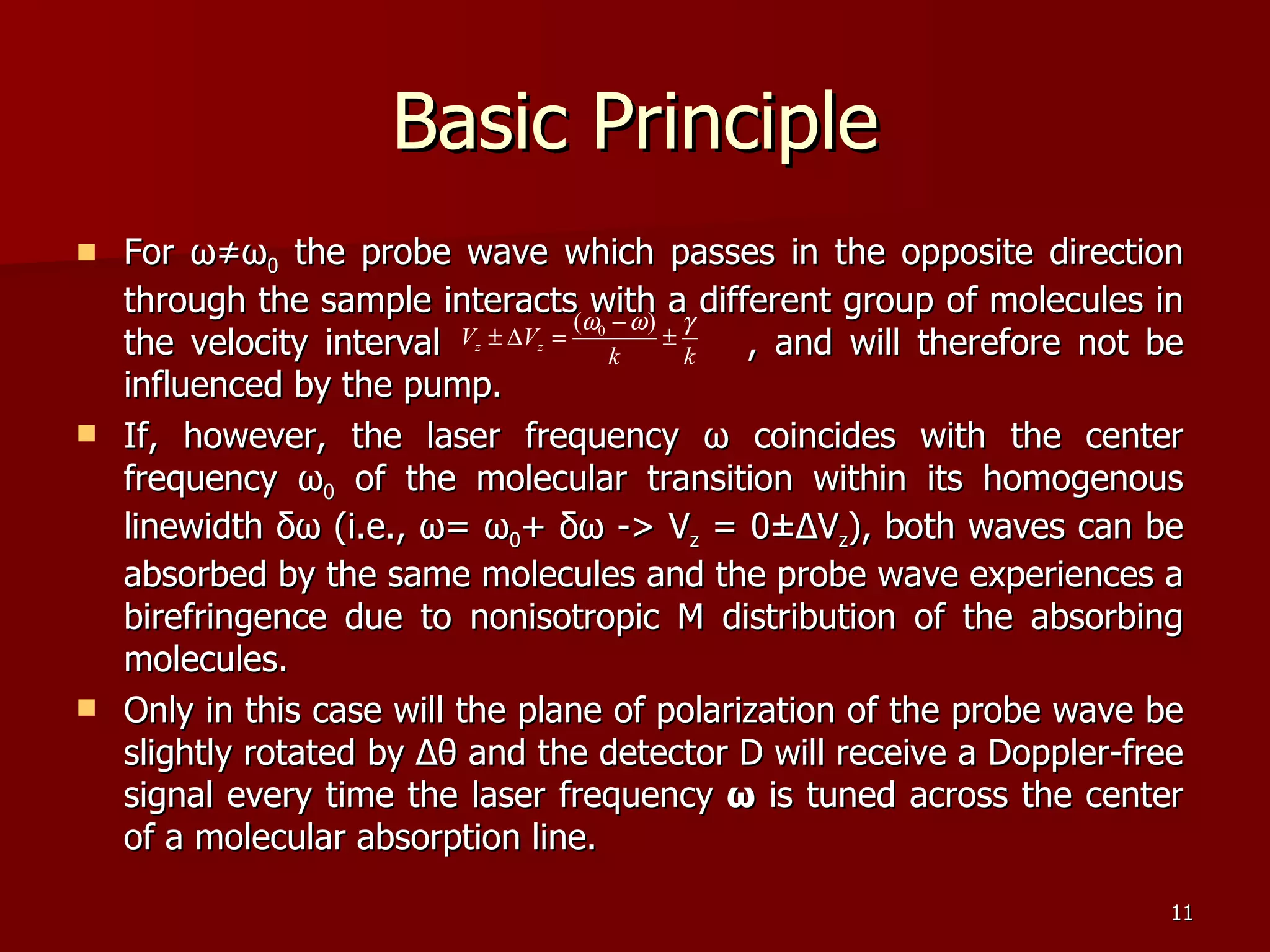
Basic Principle For  ω≠ω 0  the probe wave which passes in the opposite direction through the sample interacts with a different group of molecules in the velocity interval  , and will therefore not be influenced by the pump.  If, however, the laser frequency  ω  coincides with the center frequency  ω 0  of the molecular transition within its homogenous linewidth  δω  (i.e.,  ω =  ω 0 +  δω  -> V z  = 0± Δ V z ), both waves can be absorbed by the same molecules and the probe wave experiences a birefringence due to nonisotropic M distribution of the absorbing molecules. Only in this case will the plane of polarization of the probe wave be slightly rotated by  Δθ  and the detector D will receive a Doppler-free signal every time the laser frequency  ω  is tuned across the center of a molecular absorption line.
References 7.4, Polarization Spectroscopy,  Laser Spectroscopy  by Wolfgang Demtr ö der
Thank You

Polarization Spectroscopy

  • 1.
    Polarization Spectroscopy Seminarby Deepak Rajput PHYS 605 Advanced Topics: Laser Spectroscopy July 10, 2007 Center for Laser Applications University of Tennessee Space Institute Tullahoma, TN 37388 Email: [email_address] Web: http://drajput.com
  • 2.
    Polarization Spectroscopy Aset of spectroscopic techniques based on polarization properties of light.
  • 3.
    Basic Principle Theoutput from a monochromatic tunable laser is split into a ‘weak’ probe beam (with the intensity I 1 ) and a ‘stronger’ pump beam (with the intensity I 2 ) Output from a monochromatic tunable laser Weak probe beam (Intensity I 1 ) Strong pump beam (Intensity I 2 )
  • 4.
    Basic Principle The probe beam passes through a linear polarizer (P 1 ), the sample cell, and a second linear polarizer (P 2 ) which is crossed with P 1 .
  • 5.
    Basic Principle Withoutthe pump laser the sample is isotropic and the detector D behind P 2 receives only a very small signal caused by the residual transmission of the crossed polarizer. After having passed through a λ /4 plate which produces a circular polarization, the pump beam travels in the opposite direction through the sample cell. When the laser frequency ω is tuned to a molecular transition (J”,M”) (J’,M’), molecules in the lower level (J”,M”) can absorb the pump wave. The quantum number M which describes the projection of J onto the direction of light propagation, follows the selection rule Δ M = ±1 for the transitions M” M induced by σ + -circularly polarized light (M” M’=M”+1).
  • 6.
    Linearly polarized probewave as a superposition of σ + and σ - components Basic Principle
  • 7.
    Due to saturationthe degenerate M sublevels of the rotational level J” become partially or completely depleted. The degree of depletion depends on the pump intensity (I 2 ), the absorption cross section σ (J”,M” -> J’,M’), and on possible relaxation processes which may repopulate the level (J”,M”). The cross section σ depends on J”, M”, J’, and M’. Basic Principle
  • 8.
    In the caseof P or R transitions Δ J=-1 or +1, not all the M sublevels are pumped. Basic Principle Level scheme for a P transitions J=2 -> J=1
  • 9.
    For example, fromlevels with M”=+J no P transitions with Δ M=+1 are possible while for transitions the levels M’=J’ are not populated. This implies that the pumping process produces an unequal saturation and with it a nonuniform population of the M sublevels which is equivalent to anisotropic distribution for the orientations of the angular momentum vector J. Such an anisotropic sample becomes birefringent for the incident, linearly polarized probe beam. Its plane of polarization is slightly rotated after having passed the anisotropic sample. (analogous to Faraday effect) Basic Principle
  • 10.
    Basic Principle ForPolarization spectroscopy no magnetic field is needed. Contrary to the Faraday effect where all molecules are oriented, here only those molecules which interact with the monochromatic pump wave show this nonisotropic orientation. This is the subgroup of molecules with the velocity components: Where Δ V z is determined by the homogenous linewidth δω = γ
  • 11.
    Basic Principle For ω≠ω 0 the probe wave which passes in the opposite direction through the sample interacts with a different group of molecules in the velocity interval , and will therefore not be influenced by the pump. If, however, the laser frequency ω coincides with the center frequency ω 0 of the molecular transition within its homogenous linewidth δω (i.e., ω = ω 0 + δω -> V z = 0± Δ V z ), both waves can be absorbed by the same molecules and the probe wave experiences a birefringence due to nonisotropic M distribution of the absorbing molecules. Only in this case will the plane of polarization of the probe wave be slightly rotated by Δθ and the detector D will receive a Doppler-free signal every time the laser frequency ω is tuned across the center of a molecular absorption line.
  • 12.
    References 7.4, PolarizationSpectroscopy, Laser Spectroscopy by Wolfgang Demtr ö der
  • 13.