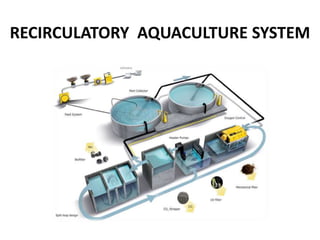
RECIRCULATORY AQUACULTURE SYSTEM
Group
members.
2
• Aquaculture is one of the fastest growing sectors of
food production in the world.
• To meet the increasing global demand for protein
source and to overcome the dependence on capture
fisheries resource AQUACULTURE is the best
alternative.
Introduction
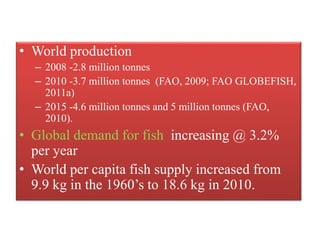
• World production
– 2008 -2.8 million tonnes
– 2010 -3.7 million tonnes (FAO, 2009; FAO GLOBEFISH,
2011a)
– 2015 -4.6 million tonnes and 5 million tonnes (FAO,
2010).
• Global demand for fish increasing @ 3.2%
per year
• World per capita fish supply increased from
9.9 kg in the 1960’s to 18.6 kg in 2010.
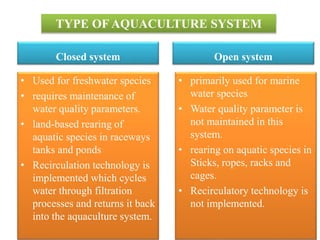
Closed system
• Used for freshwater species
• requires maintenance of
water quality parameters.
• land-based rearing of
aquatic species in raceways
tanks and ponds
• Recirculation technology is
implemented which cycles
water through filtration
processes and returns it back
into the aquaculture system.
Open system
• primarily used for marine
water species
• Water quality parameter is
not maintained in this
system.
• rearing on aquatic species in
Sticks, ropes, racks and
cages.
• Recirculatory technology is
not implemented.
TYPE OF AQUACULTURE SYSTEM
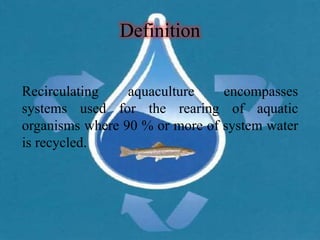
Definition
Recirculating aquaculture encompasses
systems used for the rearing of aquatic
organisms where 90 % or more of system water
is recycled.
Why Recirculating Aquaculture?
• Scarcity of good quality water for aquaculture.
• Land is expensive, especially near good areas with
plenty of water.
• Greater control over effluents and treatment.
• Permits the culture of aquatic organisms outside
of natural range.
continued
• It is practiced with limited source of water
• Require minimum area
• Multiple use of waste materials like water and
fertilizer.
• Threat to pollution is minimised
• land and water is conserved
Background
• 1950s First RAS started in japan
• 1970s started experimentally in Europe
• 1980s Commercial utilisation started in
northern Europe, especially in the
Netherlands, Denmark and Germany
Principle of Recirculatory systems
• A recirculation system is a closed system. It
involves fish tanks, filtration and water treatment
systems. The fish are housed in tanks and the
water is exchanged continuously which
guarantees optimum growing conditions.
• Water is pumped into the tanks, through
biological and mechanical filtration systems and
then returned into the tanks.
• There is no complete water exchange, rather only
5% to 10% water exchange rate per day is being
done, depending on stocking and feeding rates.
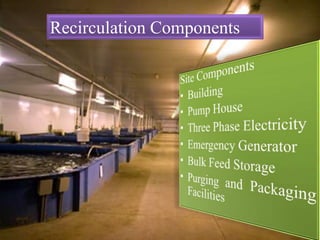
Recirculation Components
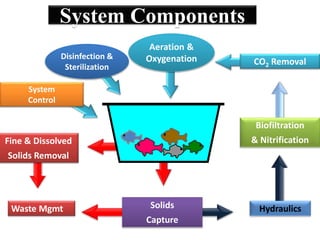
Fine & Dissolved
Solids Removal
Solids
Capture
Waste Mgmt
Biofiltration
& Nitrification
Hydraulics
CO2 Removal
Aeration &
OxygenationDisinfection &
Sterilization
System Components
System
Control
System Components
• Source of Aeration
– Fish require optimum levels of oxygen to survive.
– Oxygen can be added to the system via an oxygen
generator, to maintain suitable oxygen levels at
high stocking rates.
– Aeration pumps will provide the tanks with both
oxygen and water circulation.
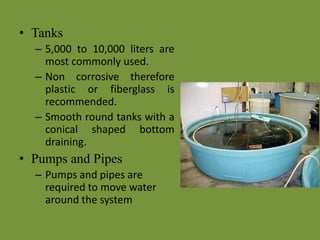
• Tanks
– 5,000 to 10,000 liters are
most commonly used.
– Non corrosive therefore
plastic or fiberglass is
recommended.
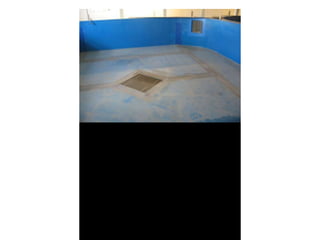
– Smooth round tanks with a
conical shaped bottom
draining.
• Pumps and Pipes
– Pumps and pipes are
required to move water
around the system
Mechanical Filtration
• Removes suspended solids
• Pipes and equipment components do not become
clogged with waste material.
• Decomposing waste matter left in the fish tanks will
consume available oxygen within the water column.
• Some types include drum filtration, screen filtration,
foam fractionation, settlement tanks, sand filters.
• regular back-flushing to prevent the accumulation of
sludge.
Biological Filtration
• Fish produce ammonia and nitrites as
metabolic waste products which are
toxic.
• Bio-filters consist of a medium with a
large surface area upon which
nitrifying bacteria will colonize after
a few weeks.
• These bacteria will convert toxic
ammonia and nitrites into non-toxic
nitrates via oxidation. This process is
known as nitrification.
• It will usually take a few weeks to a
month before nitrifying bacteria
colonize and the bio-filter becomes
active.
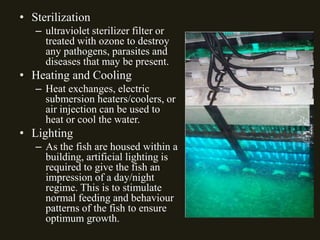
• Sterilization
– ultraviolet sterilizer filter or
treated with ozone to destroy
any pathogens, parasites and
diseases that may be present.
• Heating and Cooling
– Heat exchanges, electric
submersion heaters/coolers, or
air injection can be used to
heat or cool the water.
• Lighting
– As the fish are housed within a
building, artificial lighting is
required to give the fish an
impression of a day/night
regime. This is to stimulate
normal feeding and behaviour
patterns of the fish to ensure
optimum growth.
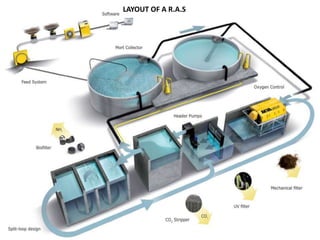
LAYOUT OF A R.A.S
Water Quality Management
• Temperature
– Maintaining temperature.
– Fish are also less stressed when held at their
optimum temperatures and therefore become less
prone to disease.
– Temperature is maintained using artificial heating
or cooling device.
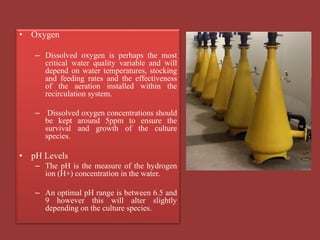
• Oxygen
– Dissolved oxygen is perhaps the most
critical water quality variable and will
depend on water temperatures, stocking
and feeding rates and the effectiveness
of the aeration installed within the
recirculation system.
– Dissolved oxygen concentrations should
be kept around 5ppm to ensure the
survival and growth of the culture
species.
• pH Levels
– The pH is the measure of the hydrogen
ion (H+) concentration in the water.
– An optimal pH range is between 6.5 and
9 however this will alter slightly
depending on the culture species.
• Carbon Dioxide
– Produced by the respiration of fish and bacteria
within the system.
– High levels it--respiratory problems as it will
interfere with oxygen uptake and cause stress to
the fish.
– High carbon dioxide concentrations within the
water column can also cause pH levels to decrease
as mentioned previously.
Stock Management
• Culture stock must be managed carefully to
ensure the health, survival and growth of the
animals.
• Stock management consists of :
– Breeding technology
– Availability of fingerlings
– Schooling fish
– Known culture technology
– Rapid growth rates
– Market acceptability
Grading
• Grading is a particularly important exercise when
farming fish using a recirculating system.
• Fish will grow at varying rates therefore it is necessary
to seperate the faster growing fish from the slower
growing fish to prevent cannibalism.
• The frequency of grading will depend on the species of
fish however grading is generally performed more
frequently when the fish are younger.
Feeding
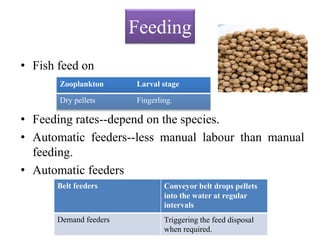
• Fish feed on
• Feeding rates--depend on the species.
• Automatic feeders--less manual labour than manual
feeding.
• Automatic feeders
Zooplankton Larval stage
Dry pellets Fingerling.
Belt feeders Conveyor belt drops pellets
into the water at regular
intervals
Demand feeders Triggering the feed disposal
when required.
Disease and Stress
• As fish are held at high densities within the
recirculation system they are more at risk of
becoming stressed and therefore prone to disease.
• It is important to monitor fish health continuously
as, if a disease outbreak does occur it can spread
extremely rapidly throughout the culture tank.
• Fish farmers usually ensure that tanks can be
isolated from one another to prevent a disease
from spreading throughout the entire system.
Harvesting and Purging
• Harvesting is done using nets which are dragged
through the tanks.
• As possible to prevent further stress on the animals.
• Purging tanks -filled - clean and fresh water.
• Fish are kept within the purging tanks.
• This ensures that the "off-flavor" that is often
associated with farmed fish is removed and thus will
increase their market acceptance.
ADVANTAGES
• Growing season under
control.
• Labor costs automation
• Stock security (predators,
disease, theft, pollution)
• Less dependency on
natural resources
• Production control
• Marketing control
DISADVANTAGES
• High construction costs
• High production costs
• Complexity (electrical.,
Mechanical., Hydraulic)
• Need for trained
operatives.
• Electrical reliability
• Back-up components
RAS systems have been further modified for
achieving higher productivity by incorporating
the technique of AQUAPONICS.
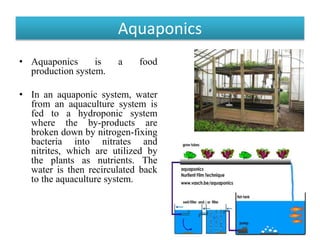
Aquaponics
• Aquaponics is a food
production system.
• In an aquaponic system, water
from an aquaculture system is
fed to a hydroponic system
where the by-products are
broken down by nitrogen-fixing
bacteria into nitrates and
nitrites, which are utilized by
the plants as nutrients. The
water is then recirculated back
to the aquaculture system.
CONCLUSION
• Recirculating aquaculture system is the key to the
future of aquaculture. Its merits outweighs its
disadvantages.
• It makes sustainable use of the water resources, and in
places where there is scarcity of good quality water.
• Even though it has high establishment cost, but the
scope of RAS is vast. It is environment friendly, there is
control over the production, and the supply can meet
the demand according to the market conditions.
• There is low pollution to the surroundings in
recirculating aquaculture systems.
References
Adler, P.R. 2001. Overview of economic evaluation of phosphorus
removal by plants. Aquaponics Journal. Vol. 5, No. 4. p. 15–18.
Balderston,W.L. and Sieburth,J.M. 1976. Nitrate removal in closed-
system aquaculture by columnar denitrification. Applied and
Environmental Microbiology 32: 808-818.
Beecher, L.E., C.G. Lutz, and R. Malone. 2001. “Tiltrech Aquafarm: A
prototypical greenwater greenhouse recirculating systems.” Pp
271-283. In: 2001 AES Issues Form, Aquacultural Engineering
Society proceedings IV. NRAES Publication No. 157. Natural
Resource, Agriculture, and engineering Service, Cornell University.
Ithaca, New York.
Chen, S., M.B. Timmons, D.J. Aneshansley, and J.J. Bisogni, Jr. 1993.
“Suspended solids characteristics from recirculating aquacultural
systems and design implications.” Aquaculture 112:143-155.
Colt, J. 1986. “An introduction to water quality management in
intensive Aquaculture.” Pages 1-16. In:H. Lorz, convener. Section
6. Uses of supplemental oxygen. Northwest Fish Culture
Conference, Eugene, Oregon.
www.emperoraquatics.com/aquaculture-
recirculationsystems.php#.Uo3Mp9JHJqU
www.dpi.vic.gov.au/fisheries/aquaculture/aquacu
lture-management/guidelines-for-
recirculating-aquaculture-systems
web1.cnre.vt.edu/extension/fiw/fisheries/fishfar
ming/RecirculateAquaSys.html
RECIRCULATORY  AQUACULTURE SYSTEM