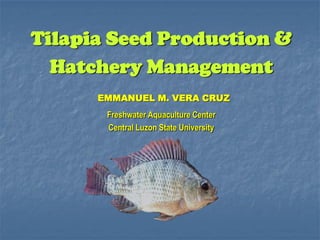
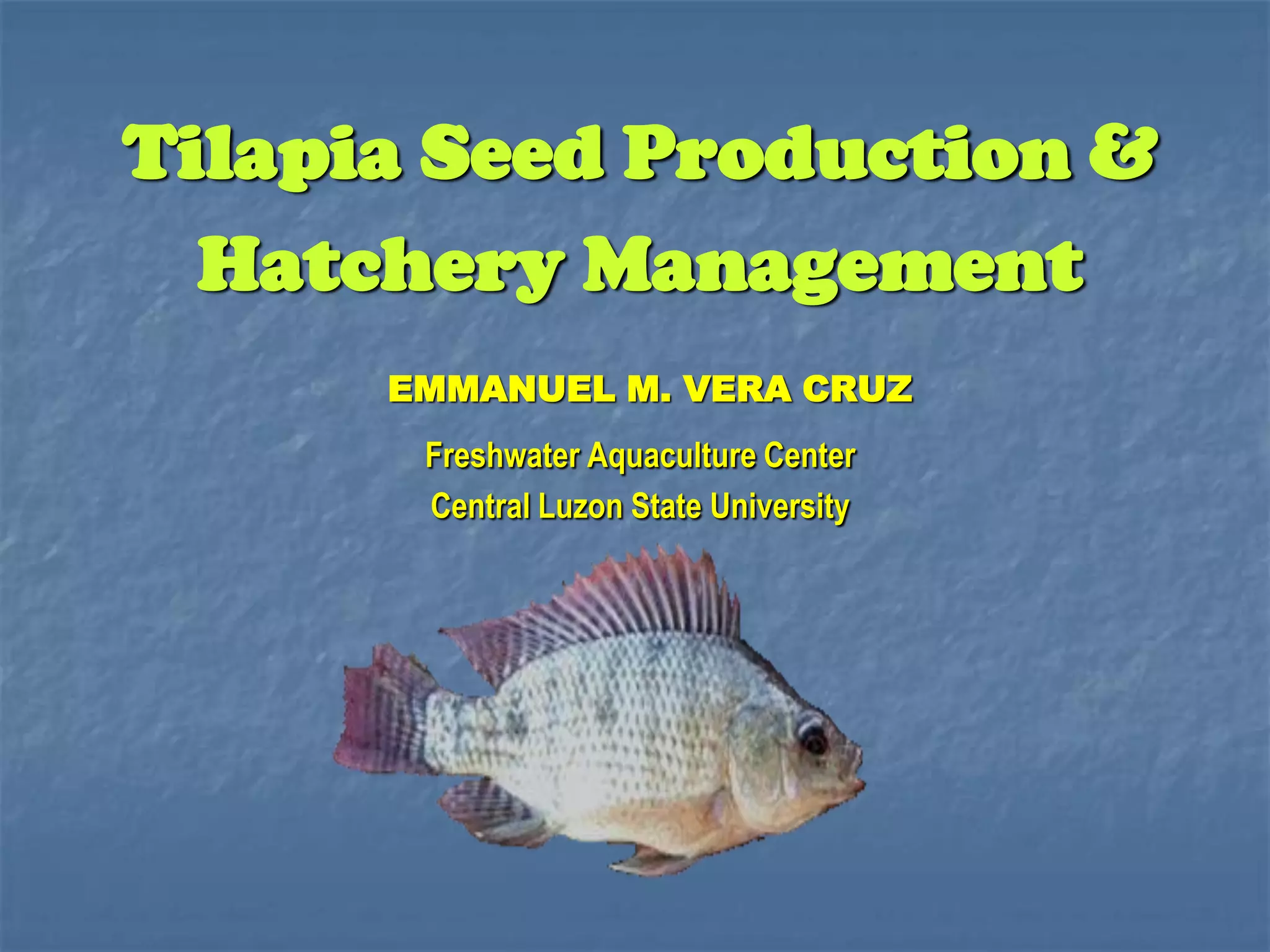
Tilapia Seed Production &
Hatchery Management
EMMANUEL M. VERA CRUZ
Freshwater Aquaculture Center
Central Luzon State University
2
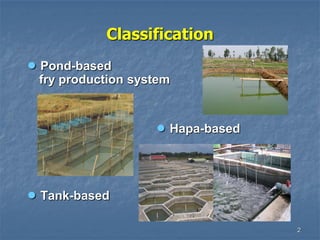
Classification
• Pond-based
fry production system
• Hapa-based
• Tank-based
3
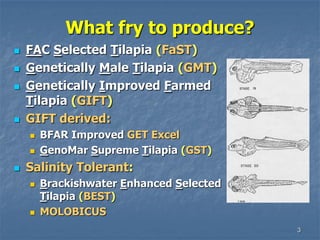
What fry to produce?
 FAC Selected Tilapia (FaST)
 Genetically Male Tilapia (GMT)
 Genetically Improved Farmed
Tilapia (GIFT)
 GIFT derived:
 BFAR Improved GET Excel
 GenoMar Supreme Tilapia (GST)
 Salinity Tolerant:
 Brackishwater Enhanced Selected
Tilapia (BEST)
 MOLOBICUS
4
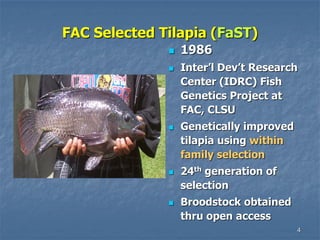
FAC Selected Tilapia (FaST)
 1986
 Inter’l Dev’t Research
Center (IDRC) Fish
Genetics Project at
FAC, CLSU
 Genetically improved
tilapia using within
family selection
 24th generation of
selection
 Broodstock obtained
thru open access
5
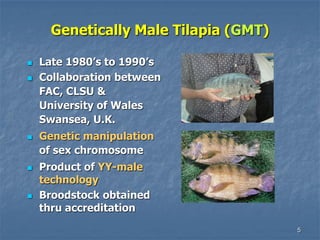
Genetically Male Tilapia (GMT)
 Late 1980’s to 1990’s
 Collaboration between
FAC, CLSU &
University of Wales
Swansea, U.K.
 Genetic manipulation
of sex chromosome
 Product of YY-male
technology
 Broodstock obtained
thru accreditation
6
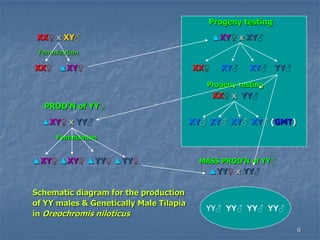
Progeny testing
XX♀ x XY♂ ▲XY♀ x XY♂
Feminization
XX♀ ▲XY♀ XX♀ XY♂ XY♂ YY♂
Progeny testing
XX♀ x YY♂
PROD’N of YY♀
▲XY♀ x YY♂ XY♂ XY♂ XY♂ XY♂ (GMT)
Feminization
▲XY♀ ▲XY♀ ▲YY♀ ▲YY♀ MASS PROD’N of YY♂
▲YY♀ x YY♂
Schematic diagram for the production
of YY males & Genetically Male Tilapia YY♂ YY♂ YY♂ YY♂
in Oreochromis niloticus
YY♂ YY♂ YY♂ YY♂
7
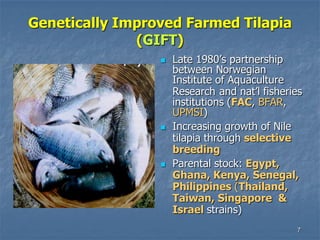
Genetically Improved Farmed Tilapia
(GIFT)
 Late 1980’s partnership
between Norwegian
Institute of Aquaculture
Research and nat’l fisheries
institutions (FAC, BFAR,
UPMSI)
 Increasing growth of Nile
tilapia through selective
breeding
 Parental stock: Egypt,
Ghana, Kenya, Senegal,
Philippines (Thailand,
Taiwan, Singapore &
Israel strains)
8
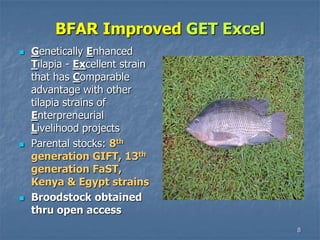
BFAR Improved GET Excel
 Genetically Enhanced
Tilapia - Excellent strain
that has Comparable
advantage with other
tilapia strains of
Enterpreneurial
Livelihood projects
 Parental stocks: 8th
generation GIFT, 13th
generation FaST,
Kenya & Egypt strains
 Broodstock obtained
thru open access
9
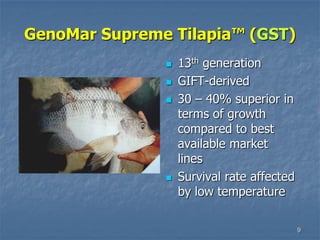
GenoMar Supreme Tilapia™ (GST)
 13th generation
 GIFT-derived
 30 – 40% superior in
terms of growth
compared to best
available market
lines
 Survival rate affected
by low temperature
10
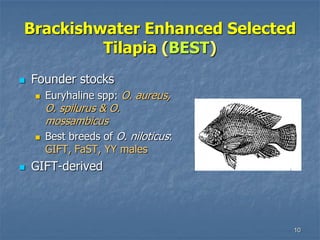
Brackishwater Enhanced Selected
Tilapia (BEST)
 Founder stocks
 Euryhaline spp: O. aureus,
O. spilurus & O.
mossambicus
 Best breeds of O. niloticus:
GIFT, FaST, YY males
 GIFT-derived
11
Saline Tilapia MOLOBICUS
 Can tolerate 35 ppt
 Product of
crossbreeding &
backcrossing of O.
mossambicus & O.
niloticus
 BFAR-NIFTDC
(Dagupan City)
12
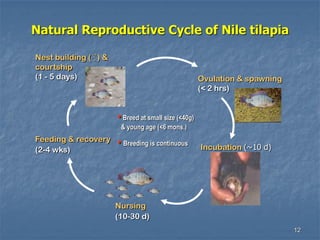
Natural Reproductive Cycle of Nile tilapia
Nest building (♂) &
courtship
(1 - 5 days) Ovulation & spawning
(< 2 hrs)
Incubation (~10 d)
Nursing
(10-30 d)
Feeding & recovery
(2-4 wks)
• Breed at small size (<40g)
& young age (<6 mons.)
• Breeding is continuous
13
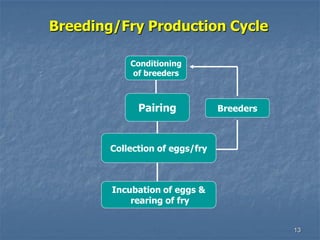
Breeding/Fry Production Cycle
Conditioning
of breeders
Pairing
Collection of eggs/fry
Incubation of eggs &
rearing of fry
Breeders
14
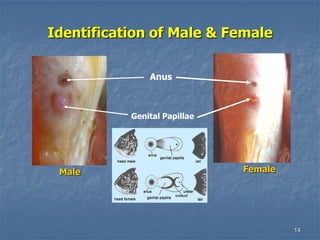
Identification of Male & Female
Anus
Genital Papillae
Male Female
15
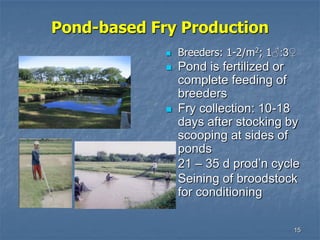
Pond-based Fry Production
 Breeders: 1-2/m2; 1♂:3♀
 Pond is fertilized or
complete feeding of
breeders
 Fry collection: 10-18
days after stocking by
scooping at sides of
ponds
 21 – 35 d prod’n cycle
 Seining of broodstock
for conditioning
16
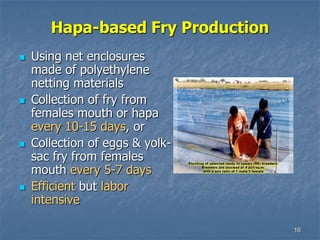
Hapa-based Fry Production
 Using net enclosures
made of polyethylene
netting materials
 Collection of fry from
females mouth or hapa
every 10-15 days, or
 Collection of eggs & yolk-
sac fry from females
mouth every 5-7 days
 Efficient but labor
intensive
17
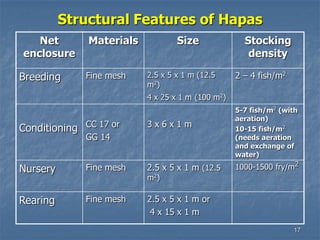
Structural Features of Hapas
Net
enclosure
Materials Size Stocking
density
Breeding Fine mesh 2.5 x 5 x 1 m (12.5
m2)
4 x 25 x 1 m (100 m2)
2 – 4 fish/m2
Conditioning CC 17 or
GG 14
3 x 6 x 1 m
5-7 fish/m2 (with
aeration)
10-15 fish/m2
(needs aeration
and exchange of
water)
Nursery Fine mesh 2.5 x 5 x 1 m (12.5
m2)
1000-1500 fry/m2
Rearing Fine mesh 2.5 x 5 x 1 m or
4 x 15 x 1 m
18
Breeding Cycle…
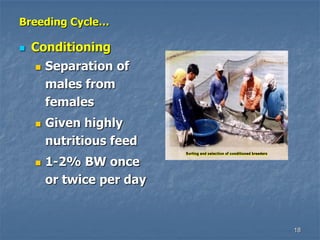
 Conditioning
 Separation of
males from
females
 Given highly
nutritious feed
 1-2% BW once
or twice per day
19
Breeding Cycle…
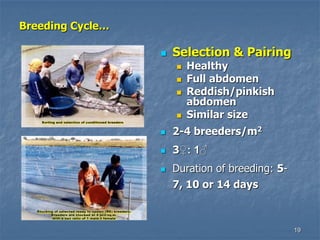
 Selection & Pairing
 Healthy
 Full abdomen
 Reddish/pinkish
abdomen
 Similar size
 2-4 breeders/m2
 3♀: 1♂
 Duration of breeding: 5-
7, 10 or 14 days
20
Breeding Cycle…
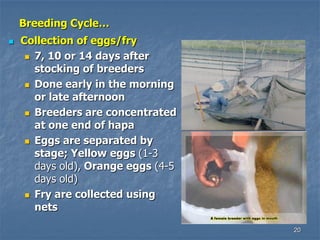
 Collection of eggs/fry
 7, 10 or 14 days after
stocking of breeders
 Done early in the morning
or late afternoon
 Breeders are concentrated
at one end of hapa
 Eggs are separated by
stage; Yellow eggs (1-3
days old), Orange eggs (4-5
days old)
 Fry are collected using
nets
21
Production Cycle…
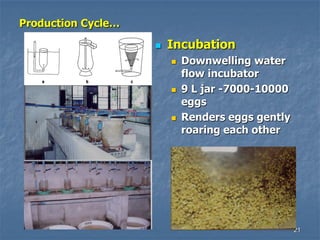
 Incubation
 Downwelling water
flow incubator
 9 L jar -7000-10000
eggs
 Renders eggs gently
roaring each other
22
Factors Contributing to Success in Artificial
Incubation
 Maintenance of good water quality
 Clean with low levels of infective organisms
 Should be inspected daily to remove dead eggs
 Age of seed
 Early stages are the most delicate periods
 Interval between seed collection should be >7 days
 Density of eggs
 Avoid egg clumping & damage to the egg chorion
 Constant rate of flow of water
 Breeding & maternal effects
 Egg size, clutch size & rate of fertilization are affected by
the size & age of female broodstock
23
Production Cycle…
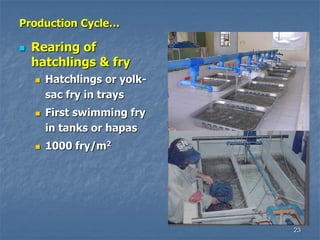
 Rearing of
hatchlings & fry
 Hatchlings or yolk-
sac fry in trays
 First swimming fry
in tanks or hapas
 1000 fry/m2
24
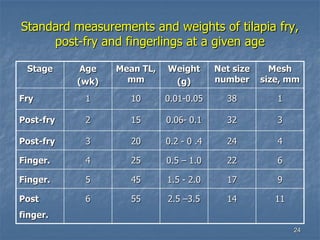
Standard measurements and weights of tilapia fry,
post-fry and fingerlings at a given age
Stage Age
(wk)
Mean TL,
mm
Weight
(g)
Net size
number
Mesh
size, mm
Fry 1 10 0.01-0.05 38 1
Post-fry 2 15 0.06- 0.1 32 3
Post-fry 3 20 0.2 - 0 .4 24 4
Finger. 4 25 0.5 – 1.0 22 6
Finger. 5 45 1.5 - 2.0 17 9
Post
finger.
6 55 2.5 –3.5 14 11
25
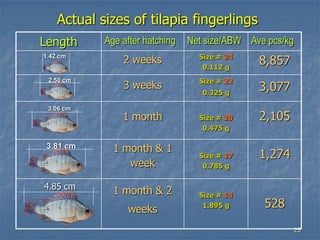
Actual sizes of tilapia fingerlings
Length Age after hatching Net size/ABW Ave pcs/kg
1.42 cm
2 weeks Size # 24
0.112 g
8,857
2.50 cm
3 weeks Size # 22
0.325 g
3,077
3.06 cm
1 month Size # 20
0.475 g
2,105
3.81 cm 1 month & 1
week
Size # 17
0.785 g
1,274
4.85 cm
1 month & 2
weeks
Size # 14
1.895 g 528
26
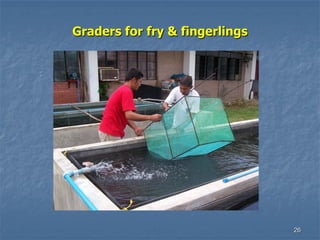
Graders for fry & fingerlings
27
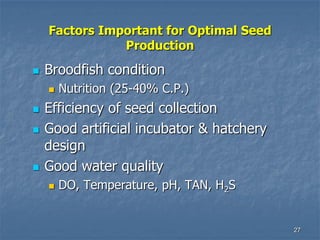
Factors Important for Optimal Seed
Production
 Broodfish condition
 Nutrition (25-40% C.P.)
 Efficiency of seed collection
 Good artificial incubator & hatchery
design
 Good water quality
 DO, Temperature, pH, TAN, H2S
28
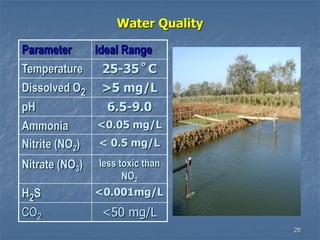
Water Quality
Parameter Ideal Range
Temperature 25-35˚C
Dissolved O2 >5 mg/L
pH 6.5-9.0
Ammonia <0.05 mg/L
Nitrite (NO2) < 0.5 mg/L
Nitrate (NO3) less toxic than
NO2
H2S <0.001mg/L
CO2 <50 mg/L
29
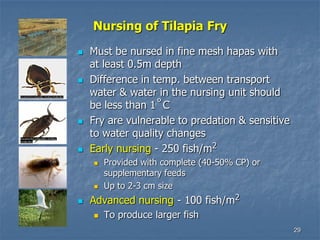
Nursing of Tilapia Fry
 Must be nursed in fine mesh hapas with
at least 0.5m depth
 Difference in temp. between transport
water & water in the nursing unit should
be less than 1˚C
 Fry are vulnerable to predation & sensitive
to water quality changes
 Early nursing - 250 fish/m2
 Provided with complete (40-50% CP) or
supplementary feeds
 Up to 2-3 cm size
 Advanced nursing - 100 fish/m2
 To produce larger fish
30
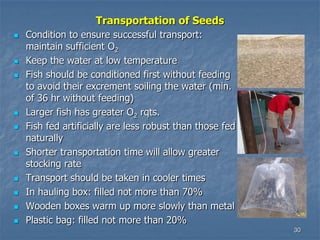
Transportation of Seeds
 Condition to ensure successful transport:
maintain sufficient O2
 Keep the water at low temperature
 Fish should be conditioned first without feeding
to avoid their excrement soiling the water (min.
of 36 hr without feeding)
 Larger fish has greater O2 rqts.
 Fish fed artificially are less robust than those fed
naturally
 Shorter transportation time will allow greater
stocking rate
 Transport should be taken in cooler times
 In hauling box: filled not more than 70%
 Wooden boxes warm up more slowly than metal
 Plastic bag: filled not more than 20%
31
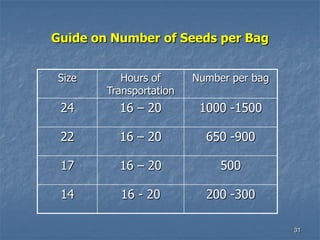
Guide on Number of Seeds per Bag
Size Hours of
Transportation
Number per bag
24 16 – 20 1000 -1500
22 16 – 20 650 -900
17 16 – 20 500
14 16 - 20 200 -300
Refinements in Hatchery
Management
32
Program Leader/Project Leader
Emmanuel M. Vera Cruz, PhD
Project Staffs
Jose S. Abucay, PhD
Eng. Zaldy Bartolome
Research Assistants
Eddie Boy T. Jimenez
Bethzaida M. Apongol
NATIONAL TILAPIA RESEARCH & DEVELOPMENT PROGRAM
Program B: Innovative approaches in Nile tilapia culture
Project 2: Refinements in grow-out and hatchery
management of Nile tilapia
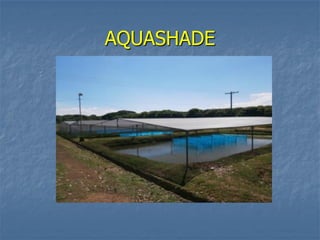
AQUASHADE
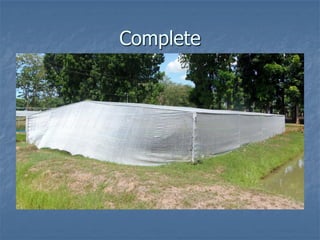
Complete
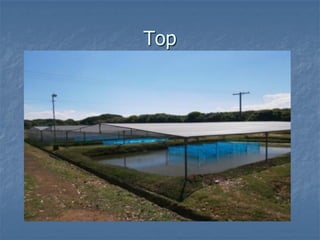
Top
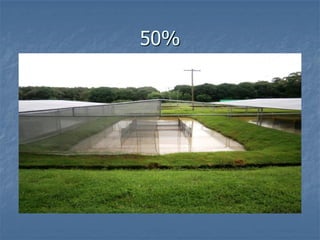
50%
o 2m x 1m x 1m breeding hapas
o Sex ratio: 1male:3 females
o Stocking density: 4 breeders·m-3
o Fry were collected after 15 days
Highlights
 Shading can reduce water temperature by
as much as 4.2 C during the hottest
period of the day
 Shading can increase spawning rate by as
much as 28 times (mean: 2.8% vs 77.8%)
during hot season
 Shading can increase seed production by
as much as 75.5 times (mean: 143 vs
10803) during hot season
Nursing fingerling for higher
growout yield
 Problem: only around 30% survival rate
during growout
 Solution: growing fingerling for 30-45 days
to achieve larger size post fingerlings prior
to stocking
40

Tilapia seed prodn &amp; hatchery mgt

  • 1.
    Tilapia Seed Production& Hatchery Management EMMANUEL M. VERA CRUZ Freshwater Aquaculture Center Central Luzon State University
  • 2.
    2 Classification • Pond-based fry productionsystem • Hapa-based • Tank-based
  • 3.
    3 What fry toproduce?  FAC Selected Tilapia (FaST)  Genetically Male Tilapia (GMT)  Genetically Improved Farmed Tilapia (GIFT)  GIFT derived:  BFAR Improved GET Excel  GenoMar Supreme Tilapia (GST)  Salinity Tolerant:  Brackishwater Enhanced Selected Tilapia (BEST)  MOLOBICUS
  • 4.
    4 FAC Selected Tilapia(FaST)  1986  Inter’l Dev’t Research Center (IDRC) Fish Genetics Project at FAC, CLSU  Genetically improved tilapia using within family selection  24th generation of selection  Broodstock obtained thru open access
  • 5.
    5 Genetically Male Tilapia(GMT)  Late 1980’s to 1990’s  Collaboration between FAC, CLSU & University of Wales Swansea, U.K.  Genetic manipulation of sex chromosome  Product of YY-male technology  Broodstock obtained thru accreditation
  • 6.
    6 Progeny testing XX♀ xXY♂ ▲XY♀ x XY♂ Feminization XX♀ ▲XY♀ XX♀ XY♂ XY♂ YY♂ Progeny testing XX♀ x YY♂ PROD’N of YY♀ ▲XY♀ x YY♂ XY♂ XY♂ XY♂ XY♂ (GMT) Feminization ▲XY♀ ▲XY♀ ▲YY♀ ▲YY♀ MASS PROD’N of YY♂ ▲YY♀ x YY♂ Schematic diagram for the production of YY males & Genetically Male Tilapia YY♂ YY♂ YY♂ YY♂ in Oreochromis niloticus YY♂ YY♂ YY♂ YY♂
  • 7.
    7 Genetically Improved FarmedTilapia (GIFT)  Late 1980’s partnership between Norwegian Institute of Aquaculture Research and nat’l fisheries institutions (FAC, BFAR, UPMSI)  Increasing growth of Nile tilapia through selective breeding  Parental stock: Egypt, Ghana, Kenya, Senegal, Philippines (Thailand, Taiwan, Singapore & Israel strains)
  • 8.
    8 BFAR Improved GETExcel  Genetically Enhanced Tilapia - Excellent strain that has Comparable advantage with other tilapia strains of Enterpreneurial Livelihood projects  Parental stocks: 8th generation GIFT, 13th generation FaST, Kenya & Egypt strains  Broodstock obtained thru open access
  • 9.
    9 GenoMar Supreme Tilapia™(GST)  13th generation  GIFT-derived  30 – 40% superior in terms of growth compared to best available market lines  Survival rate affected by low temperature
  • 10.
    10 Brackishwater Enhanced Selected Tilapia(BEST)  Founder stocks  Euryhaline spp: O. aureus, O. spilurus & O. mossambicus  Best breeds of O. niloticus: GIFT, FaST, YY males  GIFT-derived
  • 11.
    11 Saline Tilapia MOLOBICUS Can tolerate 35 ppt  Product of crossbreeding & backcrossing of O. mossambicus & O. niloticus  BFAR-NIFTDC (Dagupan City)
  • 12.
    12 Natural Reproductive Cycleof Nile tilapia Nest building (♂) & courtship (1 - 5 days) Ovulation & spawning (< 2 hrs) Incubation (~10 d) Nursing (10-30 d) Feeding & recovery (2-4 wks) • Breed at small size (<40g) & young age (<6 mons.) • Breeding is continuous
  • 13.
    13 Breeding/Fry Production Cycle Conditioning ofbreeders Pairing Collection of eggs/fry Incubation of eggs & rearing of fry Breeders
  • 14.
    14 Identification of Male& Female Anus Genital Papillae Male Female
  • 15.
    15 Pond-based Fry Production Breeders: 1-2/m2; 1♂:3♀  Pond is fertilized or complete feeding of breeders  Fry collection: 10-18 days after stocking by scooping at sides of ponds  21 – 35 d prod’n cycle  Seining of broodstock for conditioning
  • 16.
    16 Hapa-based Fry Production Using net enclosures made of polyethylene netting materials  Collection of fry from females mouth or hapa every 10-15 days, or  Collection of eggs & yolk- sac fry from females mouth every 5-7 days  Efficient but labor intensive
  • 17.
    17 Structural Features ofHapas Net enclosure Materials Size Stocking density Breeding Fine mesh 2.5 x 5 x 1 m (12.5 m2) 4 x 25 x 1 m (100 m2) 2 – 4 fish/m2 Conditioning CC 17 or GG 14 3 x 6 x 1 m 5-7 fish/m2 (with aeration) 10-15 fish/m2 (needs aeration and exchange of water) Nursery Fine mesh 2.5 x 5 x 1 m (12.5 m2) 1000-1500 fry/m2 Rearing Fine mesh 2.5 x 5 x 1 m or 4 x 15 x 1 m
  • 18.
    18 Breeding Cycle…  Conditioning Separation of males from females  Given highly nutritious feed  1-2% BW once or twice per day
  • 19.
    19 Breeding Cycle…  Selection& Pairing  Healthy  Full abdomen  Reddish/pinkish abdomen  Similar size  2-4 breeders/m2  3♀: 1♂  Duration of breeding: 5- 7, 10 or 14 days
  • 20.
    20 Breeding Cycle…  Collectionof eggs/fry  7, 10 or 14 days after stocking of breeders  Done early in the morning or late afternoon  Breeders are concentrated at one end of hapa  Eggs are separated by stage; Yellow eggs (1-3 days old), Orange eggs (4-5 days old)  Fry are collected using nets
  • 21.
    21 Production Cycle…  Incubation Downwelling water flow incubator  9 L jar -7000-10000 eggs  Renders eggs gently roaring each other
  • 22.
    22 Factors Contributing toSuccess in Artificial Incubation  Maintenance of good water quality  Clean with low levels of infective organisms  Should be inspected daily to remove dead eggs  Age of seed  Early stages are the most delicate periods  Interval between seed collection should be >7 days  Density of eggs  Avoid egg clumping & damage to the egg chorion  Constant rate of flow of water  Breeding & maternal effects  Egg size, clutch size & rate of fertilization are affected by the size & age of female broodstock
  • 23.
    23 Production Cycle…  Rearingof hatchlings & fry  Hatchlings or yolk- sac fry in trays  First swimming fry in tanks or hapas  1000 fry/m2
  • 24.
    24 Standard measurements andweights of tilapia fry, post-fry and fingerlings at a given age Stage Age (wk) Mean TL, mm Weight (g) Net size number Mesh size, mm Fry 1 10 0.01-0.05 38 1 Post-fry 2 15 0.06- 0.1 32 3 Post-fry 3 20 0.2 - 0 .4 24 4 Finger. 4 25 0.5 – 1.0 22 6 Finger. 5 45 1.5 - 2.0 17 9 Post finger. 6 55 2.5 –3.5 14 11
  • 25.
    25 Actual sizes oftilapia fingerlings Length Age after hatching Net size/ABW Ave pcs/kg 1.42 cm 2 weeks Size # 24 0.112 g 8,857 2.50 cm 3 weeks Size # 22 0.325 g 3,077 3.06 cm 1 month Size # 20 0.475 g 2,105 3.81 cm 1 month & 1 week Size # 17 0.785 g 1,274 4.85 cm 1 month & 2 weeks Size # 14 1.895 g 528
  • 26.
    26 Graders for fry& fingerlings
  • 27.
    27 Factors Important forOptimal Seed Production  Broodfish condition  Nutrition (25-40% C.P.)  Efficiency of seed collection  Good artificial incubator & hatchery design  Good water quality  DO, Temperature, pH, TAN, H2S
  • 28.
    28 Water Quality Parameter IdealRange Temperature 25-35˚C Dissolved O2 >5 mg/L pH 6.5-9.0 Ammonia <0.05 mg/L Nitrite (NO2) < 0.5 mg/L Nitrate (NO3) less toxic than NO2 H2S <0.001mg/L CO2 <50 mg/L
  • 29.
    29 Nursing of TilapiaFry  Must be nursed in fine mesh hapas with at least 0.5m depth  Difference in temp. between transport water & water in the nursing unit should be less than 1˚C  Fry are vulnerable to predation & sensitive to water quality changes  Early nursing - 250 fish/m2  Provided with complete (40-50% CP) or supplementary feeds  Up to 2-3 cm size  Advanced nursing - 100 fish/m2  To produce larger fish
  • 30.
    30 Transportation of Seeds Condition to ensure successful transport: maintain sufficient O2  Keep the water at low temperature  Fish should be conditioned first without feeding to avoid their excrement soiling the water (min. of 36 hr without feeding)  Larger fish has greater O2 rqts.  Fish fed artificially are less robust than those fed naturally  Shorter transportation time will allow greater stocking rate  Transport should be taken in cooler times  In hauling box: filled not more than 70%  Wooden boxes warm up more slowly than metal  Plastic bag: filled not more than 20%
  • 31.
    31 Guide on Numberof Seeds per Bag Size Hours of Transportation Number per bag 24 16 – 20 1000 -1500 22 16 – 20 650 -900 17 16 – 20 500 14 16 - 20 200 -300
  • 32.
  • 33.
    Program Leader/Project Leader EmmanuelM. Vera Cruz, PhD Project Staffs Jose S. Abucay, PhD Eng. Zaldy Bartolome Research Assistants Eddie Boy T. Jimenez Bethzaida M. Apongol NATIONAL TILAPIA RESEARCH & DEVELOPMENT PROGRAM Program B: Innovative approaches in Nile tilapia culture Project 2: Refinements in grow-out and hatchery management of Nile tilapia
  • 34.
  • 35.
  • 36.
  • 37.
  • 38.
    o 2m x1m x 1m breeding hapas o Sex ratio: 1male:3 females o Stocking density: 4 breeders·m-3 o Fry were collected after 15 days
  • 39.
    Highlights  Shading canreduce water temperature by as much as 4.2 C during the hottest period of the day  Shading can increase spawning rate by as much as 28 times (mean: 2.8% vs 77.8%) during hot season  Shading can increase seed production by as much as 75.5 times (mean: 143 vs 10803) during hot season
  • 40.
    Nursing fingerling forhigher growout yield  Problem: only around 30% survival rate during growout  Solution: growing fingerling for 30-45 days to achieve larger size post fingerlings prior to stocking 40