Culture of Tilapia
Background
• Tilapia is native to Africa and Middle East, and has
emerged from mere obscurity to one of the most
productive and internationally traded food fish in the
world.
• The farming of tilapias, especially of Nile tilapia
(Oreochromis niloticus) in its crudest form is believed
to have originated more than 4000 years ago from
Egypt.
• The first recorded scientifically oriented culture of
tilapia was conducted in Kenya in 1924 and soon
spread to many parts of the world.
Critical problems
• The uncontrolled breeding of tilapia in ponds, which
led to excessive recruitment, stunting and a low
percentage of marketable-sized fish, dampened the
initial enthusiasm for tilapia as a food fish.
• However, the development of hormonal sex-reversal
techniques in the 1970s, followed with research on
nutrition and culture systems, along with market
development and processing advances, led to rapid
expansion of the industry since the mid-1980s.
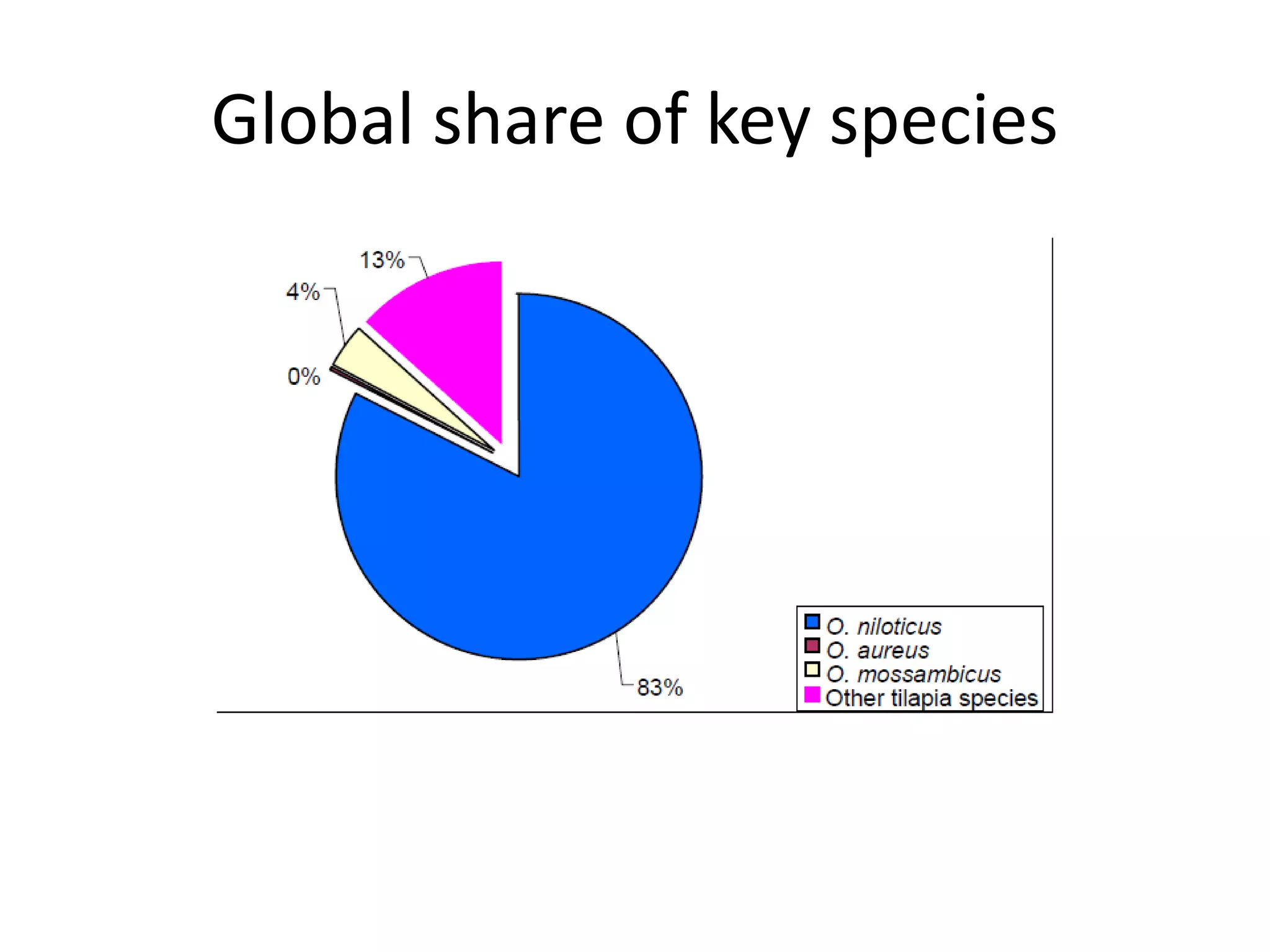
• Though several species of tilapia are cultured
commercially Nile tilapia is the predominant cultured
species worldwide
Global status
• The last three decades have seen significant
developments in farming of tilapias
worldwide.
• They are being farmed in about 85 countries
worldwide (FAO, 2008) and about 98% of
tilapia produced in these countries are grown
outside their original habitats (Shelton, 2002).
• Global tilapia aquaculture production in 2009
was 3.08 million mt, with China, Indonesia,
Egypt and the Philippines being the top
producers.
Global trade
• Tilapia now almost everywhere around the
world (140+ countries farming it)
• Bulk of tilapia production now comes from
aquaculture
• Aquaculture ~ 6.5 million metric tonnes
(2017)
• Capture fisheries <1 million tonnes (2017)
• China being world’s largest producer,
consumer and exporter
• Egypt being the largest producer of tilapia in
Africa (wild and farmed)
• Several large scale commercial farms in Africa
mostly Nile tilapia
Species for Aquaculture
• Tilapia belongs to the family Cichlidae under order
Perciformes. The tilapias have recently been classified into
three genera, based on parental incubation of eggs.
• The species of the genera Sarotherodon and Oreochromis
are mouth brooders, while Tilapia incubates eggs in
• a lake or pond bottom built-in “nest”.
• There are about 70 species of tilapias, of which nine species
are used in aquaculture worldwide (FAO 2008).
• Important commercial species include: the Mozambique
tilapia (Oreochromis mossambicus), blue tilapia (O. aureus),
Nile tilapia (O. niloticus), Zanzibar tilapia (O. hornorum),
and the red belly tilapia (O. zilli).
Commercially important tilapias
Global share of key species
Habitat and Biology
• Nile tilapia is a tropical species that prefers to live in
shallow water.
• It is an omnivorous grazer that feeds on phytoplankton,
periphyton, aquatic plants, small invertebrates, benthic
fauna, detritus and bacterial films associated with detritus.
• Sexual maturity in ponds is reached at an age of 5-6 months.
• Spawning begins when the water temperature reaches 24°C.
• The female incubates the eggs in her mouth and broods the
fry after hatching until the yolk sac is absorbed.
• Fecundity is proportional to the body weight of the female.
A 100 g female will produce about 100 eggs per spawn,
while a female weighing 600-1000 g can produce 1000 to
1500 eggs.
• Nile tilapia can live longer than 10 years and reach a weight
exceeding 5 kg.
Development of Farming
Technologies
• In populations of tilapia, males grow faster
and are more uniform in size than females.
• Thus, the farming of monosex populations of
tilapias which is achieved either by manual
sexing, direct hormonal sex reversal,
hybridization or genetic manipulation, has
been reported as solutions to the problem of
early sexual maturation and unwanted
reproduction.
• Manual sexing which entails elimination of
females based on sexual dimorphism
observed in the urogenital papilla, is simple
but is time consuming, requires qualified
personnel and usually results in 3-10% errors
• Manual sexing which entails elimination of
females based on sexual dimorphism
observed in the urogenital papilla, is simple
but is time consuming, requires qualified
personnel and usually results in 3-10% errors
Farming Systems
• Tilapia farming ranges from a rural subsistence
(extensive, low input practices, non-
commercial and for household consumption)
to a large-scale (capital intensive, commercial
purpose and market driven) level, depending
on the intensity of management employed.
Cage farming
• Cage culture of tilapia avoids problems with over breeding because
eggs fall through the cage meshes.
• The other main advantage is that the farmer does not necessarily
need to own the water body where the cages are placed.
• The cages can be made of netting or are sometimes made from
bamboo or other locally available materials.
• The fish derive most of their nutrition from the surrounding water;
however they may also be fed supplementary feeds.
• Typical stocking rates are 10 kg/m3 maximum. Intensive cage
culture with stocking rates of around 25 kg/m3 is also getting
popular.
• Average production levels are variable in different systems and
countries.
• Under intensified cage culture production levels of 100-305 kg/m3
are reported
Ponds
• The most widespread, but most unproductive are
low input ponds with uncontrolled breeding and
irregular harvesting; yields are typically 500-2000
kg/ha/yr of uneven sized fish.
• If monosex fish are stocked and regular manuring
and supplementary feeding is practiced yields can
be up to 8000 kg/ha/yr of even sized fish.
• Polyculture of tilapia with other native fishes in
freshwater ponds is also widely integrated with
agriculture and animal farming.
Intensive tanks
• Intensive tank culture avoids problems with
overbreeding because there is no space for
males to set up territories.
• It requires a constant supply of water, either
gravity fed or pumped.
• Usual maximum stocking rates in tanks where
the water is changed every 1-2 hours would
be around at 25-50 kg/m3
Indian scenario
• In India, tilapia (Oreochromis mossambicus) was
introduced in 1952, with a view to filling up
unoccupied niches, such as ponds and reservoirs
• Introduction of O. mossambicus in Jaisamand
lake not only resulted in reduction of average
weight of major carps, but also posed threat to
species like mahseers (Tor tor and T. putitora),
which are on the verge of extinction.
• The Fisheries Research Committee of India had
imposed ban on tilapia propagation in 1959
• The Nile tilapia was introduced to India during
late 1970s
• However, tilapia holds vast promise to become
an important species for aquaculture in India,
considering the demand for more fish
• In the Kolkata Wetlands, some farmers are
producing mono sex tilapia on commercial
scale in waste water
• Studies carried out at CIFA for a period of
three years during 1998 to 2000 with GIFT
tilapia had demonstrated production levels of
5-6 mt per crop of 4-6 months duration.
• Further, the study also showed the possibility
of tilapia farming under polyculture with the
three Indian major carps and showed higher
growth over rohu and mrigal at similar
stocking levels.
• Monosex population (all male) also could be
produced with provision of 17± Methyl
testosterone treated feed for four weeks
• Only four fish farmer groups, M/s Aresen Bio
Tech, A.P, Vijaywada, M/s Ananda Aqua Exports
(P) Ltd., Bhimavaram, A.P, M/s Indepesca Pvt.
Ltd., Mumbai M/s CP Aqua (India) Pvt. Ltd.,
Chennai, and M/s Rajiv Gandhi Centre for
Aquaculture (RGCA), the R & D arm of the Marine
Products Export Development Authority (MPEDA)
are already permitted by Government of India for
the seed production and farming of tilapia (Mono
sex and mono culture of Nile/GIFT/golden tilapia)
in accordance with the guidelines for the
hatchery operation and farming of tilapia,
developed by the Sub-Committee under the
National Committee on Introduction of Exotic
Aquatic Species into Indian Waters
Potential for Tilapia Culture in India
• Introduction of tilapia in our culture systems is
advantageous because it represents lower
level in food chain, and thus its culture will be
economical and eco-friendly.
• Mono sex culture of tilapia is advantageous
because of faster growth and larger and more
uniform size of males.
• The development of Genetically Improved Tilapia
(GIFT) technology is based on traditional selective
breeding and is meant to improve commercially
important traits of tropical farmed fish which is a
major milestone in the history of tilapia
aquaculture.
• Through combined selection technology, the GIFT
program achieved 12-17% average genetic gain
per generation over five generations and
cumulative increase in growth rate of 85% in O.
niloticus
• Other varieties like ‘red tilapia’ also hold promise
Problems
• The shortage of fry production
• Poor broodstock productivity owing to low
fecundity and asynchronous spawning cycles
• Deterioration in genetic quality

Tilapia culture1.pptx

  • 1.
  • 3.
    Background • Tilapia isnative to Africa and Middle East, and has emerged from mere obscurity to one of the most productive and internationally traded food fish in the world. • The farming of tilapias, especially of Nile tilapia (Oreochromis niloticus) in its crudest form is believed to have originated more than 4000 years ago from Egypt. • The first recorded scientifically oriented culture of tilapia was conducted in Kenya in 1924 and soon spread to many parts of the world.
  • 4.
    Critical problems • Theuncontrolled breeding of tilapia in ponds, which led to excessive recruitment, stunting and a low percentage of marketable-sized fish, dampened the initial enthusiasm for tilapia as a food fish. • However, the development of hormonal sex-reversal techniques in the 1970s, followed with research on nutrition and culture systems, along with market development and processing advances, led to rapid expansion of the industry since the mid-1980s. • Though several species of tilapia are cultured commercially Nile tilapia is the predominant cultured species worldwide
  • 5.
    Global status • Thelast three decades have seen significant developments in farming of tilapias worldwide. • They are being farmed in about 85 countries worldwide (FAO, 2008) and about 98% of tilapia produced in these countries are grown outside their original habitats (Shelton, 2002). • Global tilapia aquaculture production in 2009 was 3.08 million mt, with China, Indonesia, Egypt and the Philippines being the top producers.
  • 7.
    Global trade • Tilapianow almost everywhere around the world (140+ countries farming it) • Bulk of tilapia production now comes from aquaculture • Aquaculture ~ 6.5 million metric tonnes (2017) • Capture fisheries <1 million tonnes (2017)
  • 8.
    • China beingworld’s largest producer, consumer and exporter • Egypt being the largest producer of tilapia in Africa (wild and farmed) • Several large scale commercial farms in Africa mostly Nile tilapia
  • 9.
    Species for Aquaculture •Tilapia belongs to the family Cichlidae under order Perciformes. The tilapias have recently been classified into three genera, based on parental incubation of eggs. • The species of the genera Sarotherodon and Oreochromis are mouth brooders, while Tilapia incubates eggs in • a lake or pond bottom built-in “nest”. • There are about 70 species of tilapias, of which nine species are used in aquaculture worldwide (FAO 2008). • Important commercial species include: the Mozambique tilapia (Oreochromis mossambicus), blue tilapia (O. aureus), Nile tilapia (O. niloticus), Zanzibar tilapia (O. hornorum), and the red belly tilapia (O. zilli).
  • 10.
  • 13.
    Global share ofkey species
  • 14.
    Habitat and Biology •Nile tilapia is a tropical species that prefers to live in shallow water. • It is an omnivorous grazer that feeds on phytoplankton, periphyton, aquatic plants, small invertebrates, benthic fauna, detritus and bacterial films associated with detritus. • Sexual maturity in ponds is reached at an age of 5-6 months. • Spawning begins when the water temperature reaches 24°C. • The female incubates the eggs in her mouth and broods the fry after hatching until the yolk sac is absorbed. • Fecundity is proportional to the body weight of the female. A 100 g female will produce about 100 eggs per spawn, while a female weighing 600-1000 g can produce 1000 to 1500 eggs. • Nile tilapia can live longer than 10 years and reach a weight exceeding 5 kg.
  • 15.
    Development of Farming Technologies •In populations of tilapia, males grow faster and are more uniform in size than females. • Thus, the farming of monosex populations of tilapias which is achieved either by manual sexing, direct hormonal sex reversal, hybridization or genetic manipulation, has been reported as solutions to the problem of early sexual maturation and unwanted reproduction.
  • 16.
    • Manual sexingwhich entails elimination of females based on sexual dimorphism observed in the urogenital papilla, is simple but is time consuming, requires qualified personnel and usually results in 3-10% errors • Manual sexing which entails elimination of females based on sexual dimorphism observed in the urogenital papilla, is simple but is time consuming, requires qualified personnel and usually results in 3-10% errors
  • 17.
    Farming Systems • Tilapiafarming ranges from a rural subsistence (extensive, low input practices, non- commercial and for household consumption) to a large-scale (capital intensive, commercial purpose and market driven) level, depending on the intensity of management employed.
  • 19.
    Cage farming • Cageculture of tilapia avoids problems with over breeding because eggs fall through the cage meshes. • The other main advantage is that the farmer does not necessarily need to own the water body where the cages are placed. • The cages can be made of netting or are sometimes made from bamboo or other locally available materials. • The fish derive most of their nutrition from the surrounding water; however they may also be fed supplementary feeds. • Typical stocking rates are 10 kg/m3 maximum. Intensive cage culture with stocking rates of around 25 kg/m3 is also getting popular. • Average production levels are variable in different systems and countries. • Under intensified cage culture production levels of 100-305 kg/m3 are reported
  • 20.
    Ponds • The mostwidespread, but most unproductive are low input ponds with uncontrolled breeding and irregular harvesting; yields are typically 500-2000 kg/ha/yr of uneven sized fish. • If monosex fish are stocked and regular manuring and supplementary feeding is practiced yields can be up to 8000 kg/ha/yr of even sized fish. • Polyculture of tilapia with other native fishes in freshwater ponds is also widely integrated with agriculture and animal farming.
  • 21.
    Intensive tanks • Intensivetank culture avoids problems with overbreeding because there is no space for males to set up territories. • It requires a constant supply of water, either gravity fed or pumped. • Usual maximum stocking rates in tanks where the water is changed every 1-2 hours would be around at 25-50 kg/m3
  • 22.
    Indian scenario • InIndia, tilapia (Oreochromis mossambicus) was introduced in 1952, with a view to filling up unoccupied niches, such as ponds and reservoirs • Introduction of O. mossambicus in Jaisamand lake not only resulted in reduction of average weight of major carps, but also posed threat to species like mahseers (Tor tor and T. putitora), which are on the verge of extinction. • The Fisheries Research Committee of India had imposed ban on tilapia propagation in 1959
  • 23.
    • The Niletilapia was introduced to India during late 1970s • However, tilapia holds vast promise to become an important species for aquaculture in India, considering the demand for more fish • In the Kolkata Wetlands, some farmers are producing mono sex tilapia on commercial scale in waste water
  • 24.
    • Studies carriedout at CIFA for a period of three years during 1998 to 2000 with GIFT tilapia had demonstrated production levels of 5-6 mt per crop of 4-6 months duration. • Further, the study also showed the possibility of tilapia farming under polyculture with the three Indian major carps and showed higher growth over rohu and mrigal at similar stocking levels. • Monosex population (all male) also could be produced with provision of 17± Methyl testosterone treated feed for four weeks
  • 25.
    • Only fourfish farmer groups, M/s Aresen Bio Tech, A.P, Vijaywada, M/s Ananda Aqua Exports (P) Ltd., Bhimavaram, A.P, M/s Indepesca Pvt. Ltd., Mumbai M/s CP Aqua (India) Pvt. Ltd., Chennai, and M/s Rajiv Gandhi Centre for Aquaculture (RGCA), the R & D arm of the Marine Products Export Development Authority (MPEDA) are already permitted by Government of India for the seed production and farming of tilapia (Mono sex and mono culture of Nile/GIFT/golden tilapia) in accordance with the guidelines for the hatchery operation and farming of tilapia, developed by the Sub-Committee under the National Committee on Introduction of Exotic Aquatic Species into Indian Waters
  • 26.
    Potential for TilapiaCulture in India • Introduction of tilapia in our culture systems is advantageous because it represents lower level in food chain, and thus its culture will be economical and eco-friendly. • Mono sex culture of tilapia is advantageous because of faster growth and larger and more uniform size of males.
  • 27.
    • The developmentof Genetically Improved Tilapia (GIFT) technology is based on traditional selective breeding and is meant to improve commercially important traits of tropical farmed fish which is a major milestone in the history of tilapia aquaculture. • Through combined selection technology, the GIFT program achieved 12-17% average genetic gain per generation over five generations and cumulative increase in growth rate of 85% in O. niloticus • Other varieties like ‘red tilapia’ also hold promise
  • 29.
    Problems • The shortageof fry production • Poor broodstock productivity owing to low fecundity and asynchronous spawning cycles • Deterioration in genetic quality