How to Solve Linkage Map
Problems
Determining Linkage/Independence
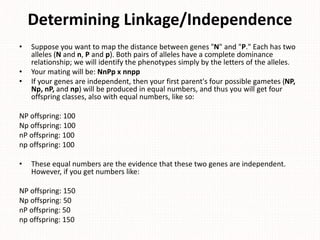
• Suppose you want to map the distance between genes "N" and "P." Each has two
alleles (N and n, P and p). Both pairs of alleles have a complete dominance
relationship; we will identify the phenotypes simply by the letters of the alleles.
• Your mating will be: NnPp x nnpp
• If your genes are independent, then your first parent's four possible gametes (NP,
Np, nP, and np) will be produced in equal numbers, and thus you will get four
offspring classes, also with equal numbers, like so:
NP offspring: 100
Np offspring: 100
nP offspring: 100
np offspring: 100
• These equal numbers are the evidence that these two genes are independent.
However, if you get numbers like:
NP offspring: 150
Np offspring: 50
nP offspring: 50
np offspring: 150
Determining Linkage/Independence
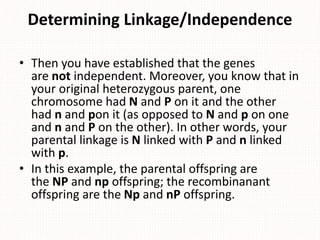
• Then you have established that the genes
are not independent. Moreover, you know that in
your original heterozygous parent, one
chromosome had N and P on it and the other
had n and pon it (as opposed to N and p on one
and n and P on the other). In other words, your
parental linkage is N linked with P and n linked
with p.
• In this example, the parental offspring are
the NP and np offspring; the recombinanant
offspring are the Np and nP offspring.
Three-point Cross I
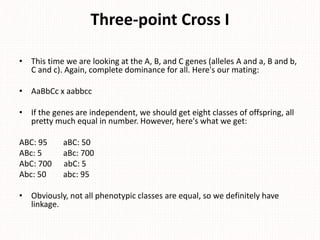
• This time we are looking at the A, B, and C genes (alleles A and a, B and b,
C and c). Again, complete dominance for all. Here's our mating:
• AaBbCc x aabbcc
• If the genes are independent, we should get eight classes of offspring, all
pretty much equal in number. However, here's what we get:
ABC: 95 aBC: 50
ABc: 5 aBc: 700
AbC: 700 abC: 5
Abc: 50 abc: 95
• Obviously, not all phenotypic classes are equal, so we definitely have
linkage.
Determining Gene Order
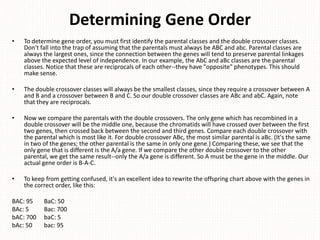
• To determine gene order, you must first identify the parental classes and the double crossover classes.
Don't fall into the trap of assuming that the parentals must always be ABC and abc. Parental classes are
always the largest ones, since the connection between the genes will tend to preserve parental linkages
above the expected level of independence. In our example, the AbC and aBc classes are the parental
classes. Notice that these are reciprocals of each other--they have "opposite" phenotypes. This should
make sense.
• The double crossover classes will always be the smallest classes, since they require a crossover between A
and B and a crossover between B and C. So our double crossover classes are ABc and abC. Again, note
that they are reciprocals.
• Now we compare the parentals with the double crossovers. The only gene which has recombined in a
double crossover will be the middle one, because the chromatids will have crossed over between the first
two genes, then crossed back between the second and third genes. Compare each double crossover with
the parental which is most like it. For double crossover ABc, the most similar parental is aBc. (It's the same
in two of the genes; the other parental is the same in only one gene.) Comparing these, we see that the
only gene that is different is the A/a gene. If we compare the other double crossover to the other
parental, we get the same result--only the A/a gene is different. So A must be the gene in the middle. Our
actual gene order is B-A-C.
• To keep from getting confused, it's an excellent idea to rewrite the offspring chart above with the genes in
the correct order, like this:
BAC: 95 BaC: 50
BAc: 5 Bac: 700
bAC: 700 baC: 5
bAc: 50 bac: 95
Map Distance
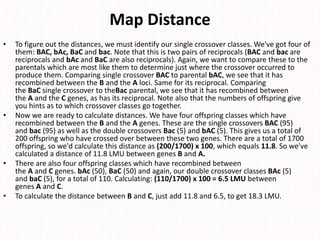
• To figure out the distances, we must identify our single crossover classes. We've got four of
them: BAC, bAc, BaC and bac. Note that this is two pairs of reciprocals (BAC and bac are
reciprocals and bAc and BaC are also reciprocals). Again, we want to compare these to the
parentals which are most like them to determine just where the crossover occurred to
produce them. Comparing single crossover BAC to parental bAC, we see that it has
recombined between the B and the A loci. Same for its reciprocal. Comparing
the BaC single crossover to theBac parental, we see that it has recombined between
the A and the C genes, as has its reciprocal. Note also that the numbers of offspring give
you hints as to which crossover classes go together.
• Now we are ready to calculate distances. We have four offspring classes which have
recombined between the B and the A genes. These are the single crossovers BAC (95)
and bac (95) as well as the double crossovers Bac (5) and bAC (5). This gives us a total of
200 offspring who have crossed over between these two genes. There are a total of 1700
offspring, so we'd calculate this distance as (200/1700) x 100, which equals 11.8. So we've
calculated a distance of 11.8 LMU between genes B and A.
• There are also four offspring classes which have recombined between
the A and C genes. bAc (50), BaC (50) and again, our double crossover classes BAc (5)
and baC (5), for a total of 110. Calculating: (110/1700) x 100 = 6.5 LMU between
genes A and C.
• To calculate the distance between B and C, just add 11.8 and 6.5, to get 18.3 LMU.
Additive?
• Linkage map units don't actually correspond to a specific length of chromosome. The exact distance
calculated between two genes depends upon how much information you have about what's going
on in the region between the genes.
• For example, consider the problem above. If we'd been following only the two end genes (B and C),
and disregarding the A gene, of the offspring in our example, only the single crossovers would have
counted as recombinants. The only reason we know that the double crossovers recombined (twice)
between B and C is because we see that the A gene is switched; the B and C genes are still in the
parental formation. If we are ignoring A, they become parentals. Thus, if we calculate the B-C
distance without regard to the information about the A gene, we get:
• Recombinants: BC {B(A)C [95] + B(a)C [50]} and bc {b(a)c [95] + b(A)c [50]} for a total of 290.
• All the rest would score as parentals. We we'd calculate the distance between B and C as:
(290/1700) x 100 - 17.1 LMU. Compare this to the 18.3 LMU we calculated between the same
genes when we were paying attention to the A locus.
• Keep in mind that when you are calculating linkage map distance, there will virtually always be
many genes between each pair that you are considering--genes that you are ignoring in your
calculations. So linkage map units are often not strictly additive, and you will often get different
precise distances, depending upon the specifics of the calculation method.
Three Point Cross II
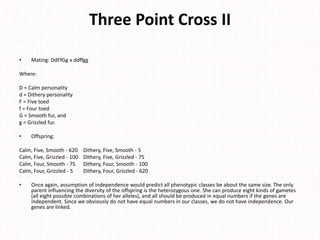
• Mating: DdFfGg x ddffgg
Where:
D = Calm personality
d = Dithery personality
F = Five toed
f = Four toed
G = Smooth fur, and
g = Grizzled fur.
• Offspring:
Calm, Five, Smooth - 620 Dithery, Five, Smooth - 5
Calm, Five, Grizzled - 100 Dithery, Five, Grizzled - 75
Calm, Four, Smooth - 75 Dithery, Four, Smooth - 100
Calm, Four, Grizzled - 5 Dithery, Four, Grizzled - 620
• Once again, assumption of independence would predict all phenotypic classes be about the same size. The only
parent influencing the diversity of the offspring is the heterozygous one. She can produce eight kinds of gametes
(all eight possible combinations of her alleles), and all should be produced in equal numbers if the genes are
independent. Since we obviously do not have equal numbers in our classes, we do not have independence. Our
genes are linked.
Three Point Cross II
• How do you tell what the gene order is?
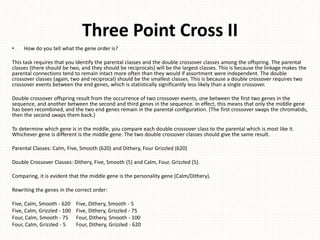
This task requires that you identify the parental classes and the double crossover classes among the offspring. The parental
classes (there should be two, and they should be reciprocals) will be the largest classes. This is because the linkage makes the
parental connections tend to remain intact more often than they would if assortment were independent. The double
crossover classes (again, two and reciprocal) should be the smallest classes. This is because a double crossover requires two
crossover events between the end genes, which is statistically significantly less likely than a single crossover.
Double crossover offspring result from the occurrence of two crossover events, one between the first two genes in the
sequence, and another between the second and third genes in the sequence. In effect, this means that only the middle gene
has been recombined, and the two end genes remain in the parental configuration. (The first crossover swaps the chromatids,
then the second swaps them back.)
To determine which gene is in the middle, you compare each double crossover class to the parental which is most like it.
Whichever gene is different is the middle gene. The two double crossover classes should give the same result.
Parental Classes: Calm, Five, Smooth (620) and Dithery, Four Grizzled (620)
Double Crossover Classes: Dithery, Five, Smooth (5) and Calm, Four, Grizzled (5).
Comparing, it is evident that the middle gene is the personality gene (Calm/Dithery).
Rewriting the genes in the correct order:
Five, Calm, Smooth - 620 Five, Dithery, Smooth - 5
Five, Calm, Grizzled - 100 Five, Dithery, Grizzled - 75
Four, Calm, Smooth - 75 Four, Dithery, Smooth - 100
Four, Calm, Grizzled - 5 Four, Dithery, Grizzled - 620
Three Point Cross II
• How do your calculate the map distances?
Before you can calculate map distance, you have to figure out which single crossover classes represent which region of crossing
over. This is done by identifying the reciprocal pairs of single crossovers, then once again comparing each to the parental class
most like it. Noting which of the three genes has been switched will tell you where the crossover occurred.
The single crossovers between the toes and personality genes are Four, Calm, Smooth (75) and Five, Dithery, Grizzled (75). Note
that both of these are different from the parentals only in the first trait.
The single crossovers between the personality and fur genes are Five, Calm, Grizzled (100) and Four, Dithery, Smooth (100). these
differ from the parentals by only the final trait.
Linkage map distance is calculated just as for the two point cross, by calculating the percentage of the offspring showing
recombination between the two genes in question.
Between the toes and personality genes, our two single crossover classes total 150 offspring (75 + 75). But recall that the double
crossovers also recombined in this region, and thus need to be added to the single crossovers. There are 10 of them (5 + 5). So
the total number of offspring which have recombined in this region is 160.
So the percent recombination is (160/1600)x100, or 10%; the linkage map distance between these two genes is 10 LMU.
Repeat the process with the second and third genes, again remembering that the double crossovers also recombined in this
region, so the total number of recombinants is 210 (100 + 100 + 5 + 5).
Percent recombination is (210/1600)x100 = 13.125, or 13.125 LMU.
Finally, the distance between the end genes is 10 + 13.125 or 23.125 LMU.
Three Point Cross III
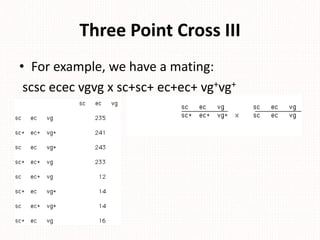
• For example, we have a mating:
scsc ecec vgvg x sc+sc+ ec+ec+ vg+vg+
Three Point Cross III
• If these genes were on separate chromosomes, they should be
assorting independently and all the classes should be equally
frequent.
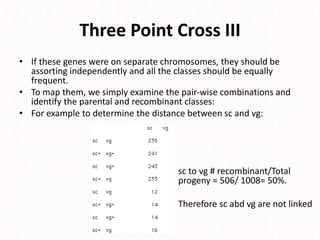
• To map them, we simply examine the pair-wise combinations and
identify the parental and recombinant classes:
• For example to determine the distance between sc and vg:
sc to vg # recombinant/Total
progeny = 506/ 1008= 50%.
Therefore sc abd vg are not linked
Three Point Cross III
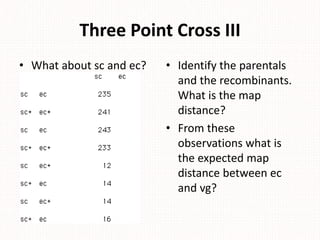
• What about sc and ec? • Identify the parentals
and the recombinants.
What is the map
distance?
• From these
observations what is
the expected map
distance between ec
and vg?
Three Point Cross IV
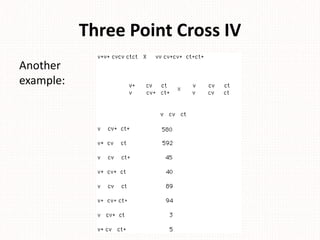
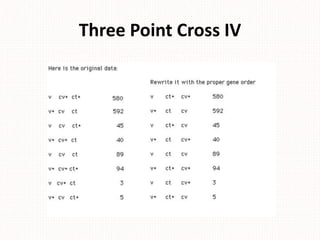
Another
example:
Three Point Cross IV
1. Identify the two parental combinations of alleles
2. The two rarest classes usually represent the product of
double crossover With this knowledge, you can establish
a gene order in which a double cross producing the allelic
combination observed in the rarest class
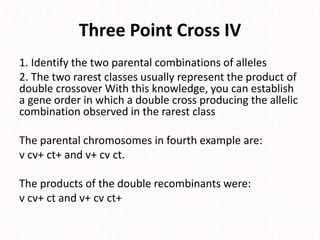
The parental chromosomes in fourth example are:
v cv+ ct+ and v+ cv ct.
The products of the double recombinants were:
v cv+ ct and v+ cv ct+
Three Point Cross IV
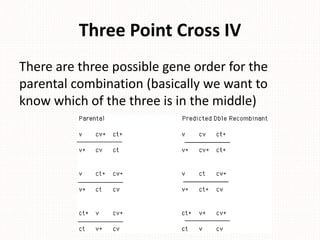
There are three possible gene order for the
parental combination (basically we want to
know which of the three is in the middle)
Three Point Cross IV
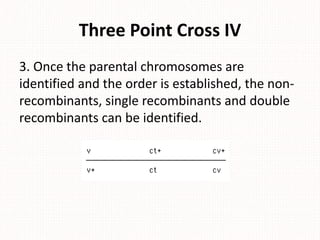
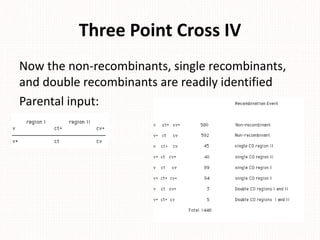
3. Once the parental chromosomes are
identified and the order is established, the non-
recombinants, single recombinants and double
recombinants can be identified.
Three Point Cross IV
Now the non-recombinants, single recombinants,
and double recombinants are readily identified
Parental input:
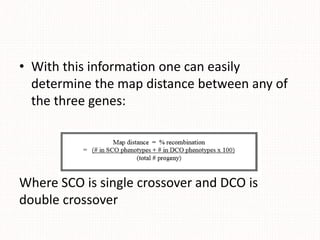
• With this information one can easily
determine the map distance between any of
the three genes:
Where SCO is single crossover and DCO is
double crossover
Big thanks to
http://www.cod.edu/people/faculty/fancher/ge
netics/LinkageMappingExamples.htm
and
http://bio.classes.ucsc.edu/bio105/winter%200
8/Bio105_W08/Lectures/Lecture6/Lecture6.htm
l

How to solve linkage map problems

  • 1.
    How to SolveLinkage Map Problems
  • 2.
    Determining Linkage/Independence • Supposeyou want to map the distance between genes "N" and "P." Each has two alleles (N and n, P and p). Both pairs of alleles have a complete dominance relationship; we will identify the phenotypes simply by the letters of the alleles. • Your mating will be: NnPp x nnpp • If your genes are independent, then your first parent's four possible gametes (NP, Np, nP, and np) will be produced in equal numbers, and thus you will get four offspring classes, also with equal numbers, like so: NP offspring: 100 Np offspring: 100 nP offspring: 100 np offspring: 100 • These equal numbers are the evidence that these two genes are independent. However, if you get numbers like: NP offspring: 150 Np offspring: 50 nP offspring: 50 np offspring: 150
  • 3.
    Determining Linkage/Independence • Thenyou have established that the genes are not independent. Moreover, you know that in your original heterozygous parent, one chromosome had N and P on it and the other had n and pon it (as opposed to N and p on one and n and P on the other). In other words, your parental linkage is N linked with P and n linked with p. • In this example, the parental offspring are the NP and np offspring; the recombinanant offspring are the Np and nP offspring.
  • 4.
    Three-point Cross I •This time we are looking at the A, B, and C genes (alleles A and a, B and b, C and c). Again, complete dominance for all. Here's our mating: • AaBbCc x aabbcc • If the genes are independent, we should get eight classes of offspring, all pretty much equal in number. However, here's what we get: ABC: 95 aBC: 50 ABc: 5 aBc: 700 AbC: 700 abC: 5 Abc: 50 abc: 95 • Obviously, not all phenotypic classes are equal, so we definitely have linkage.
  • 5.
    Determining Gene Order •To determine gene order, you must first identify the parental classes and the double crossover classes. Don't fall into the trap of assuming that the parentals must always be ABC and abc. Parental classes are always the largest ones, since the connection between the genes will tend to preserve parental linkages above the expected level of independence. In our example, the AbC and aBc classes are the parental classes. Notice that these are reciprocals of each other--they have "opposite" phenotypes. This should make sense. • The double crossover classes will always be the smallest classes, since they require a crossover between A and B and a crossover between B and C. So our double crossover classes are ABc and abC. Again, note that they are reciprocals. • Now we compare the parentals with the double crossovers. The only gene which has recombined in a double crossover will be the middle one, because the chromatids will have crossed over between the first two genes, then crossed back between the second and third genes. Compare each double crossover with the parental which is most like it. For double crossover ABc, the most similar parental is aBc. (It's the same in two of the genes; the other parental is the same in only one gene.) Comparing these, we see that the only gene that is different is the A/a gene. If we compare the other double crossover to the other parental, we get the same result--only the A/a gene is different. So A must be the gene in the middle. Our actual gene order is B-A-C. • To keep from getting confused, it's an excellent idea to rewrite the offspring chart above with the genes in the correct order, like this: BAC: 95 BaC: 50 BAc: 5 Bac: 700 bAC: 700 baC: 5 bAc: 50 bac: 95
  • 6.
    Map Distance • Tofigure out the distances, we must identify our single crossover classes. We've got four of them: BAC, bAc, BaC and bac. Note that this is two pairs of reciprocals (BAC and bac are reciprocals and bAc and BaC are also reciprocals). Again, we want to compare these to the parentals which are most like them to determine just where the crossover occurred to produce them. Comparing single crossover BAC to parental bAC, we see that it has recombined between the B and the A loci. Same for its reciprocal. Comparing the BaC single crossover to theBac parental, we see that it has recombined between the A and the C genes, as has its reciprocal. Note also that the numbers of offspring give you hints as to which crossover classes go together. • Now we are ready to calculate distances. We have four offspring classes which have recombined between the B and the A genes. These are the single crossovers BAC (95) and bac (95) as well as the double crossovers Bac (5) and bAC (5). This gives us a total of 200 offspring who have crossed over between these two genes. There are a total of 1700 offspring, so we'd calculate this distance as (200/1700) x 100, which equals 11.8. So we've calculated a distance of 11.8 LMU between genes B and A. • There are also four offspring classes which have recombined between the A and C genes. bAc (50), BaC (50) and again, our double crossover classes BAc (5) and baC (5), for a total of 110. Calculating: (110/1700) x 100 = 6.5 LMU between genes A and C. • To calculate the distance between B and C, just add 11.8 and 6.5, to get 18.3 LMU.
  • 7.
    Additive? • Linkage mapunits don't actually correspond to a specific length of chromosome. The exact distance calculated between two genes depends upon how much information you have about what's going on in the region between the genes. • For example, consider the problem above. If we'd been following only the two end genes (B and C), and disregarding the A gene, of the offspring in our example, only the single crossovers would have counted as recombinants. The only reason we know that the double crossovers recombined (twice) between B and C is because we see that the A gene is switched; the B and C genes are still in the parental formation. If we are ignoring A, they become parentals. Thus, if we calculate the B-C distance without regard to the information about the A gene, we get: • Recombinants: BC {B(A)C [95] + B(a)C [50]} and bc {b(a)c [95] + b(A)c [50]} for a total of 290. • All the rest would score as parentals. We we'd calculate the distance between B and C as: (290/1700) x 100 - 17.1 LMU. Compare this to the 18.3 LMU we calculated between the same genes when we were paying attention to the A locus. • Keep in mind that when you are calculating linkage map distance, there will virtually always be many genes between each pair that you are considering--genes that you are ignoring in your calculations. So linkage map units are often not strictly additive, and you will often get different precise distances, depending upon the specifics of the calculation method.
  • 8.
    Three Point CrossII • Mating: DdFfGg x ddffgg Where: D = Calm personality d = Dithery personality F = Five toed f = Four toed G = Smooth fur, and g = Grizzled fur. • Offspring: Calm, Five, Smooth - 620 Dithery, Five, Smooth - 5 Calm, Five, Grizzled - 100 Dithery, Five, Grizzled - 75 Calm, Four, Smooth - 75 Dithery, Four, Smooth - 100 Calm, Four, Grizzled - 5 Dithery, Four, Grizzled - 620 • Once again, assumption of independence would predict all phenotypic classes be about the same size. The only parent influencing the diversity of the offspring is the heterozygous one. She can produce eight kinds of gametes (all eight possible combinations of her alleles), and all should be produced in equal numbers if the genes are independent. Since we obviously do not have equal numbers in our classes, we do not have independence. Our genes are linked.
  • 9.
    Three Point CrossII • How do you tell what the gene order is? This task requires that you identify the parental classes and the double crossover classes among the offspring. The parental classes (there should be two, and they should be reciprocals) will be the largest classes. This is because the linkage makes the parental connections tend to remain intact more often than they would if assortment were independent. The double crossover classes (again, two and reciprocal) should be the smallest classes. This is because a double crossover requires two crossover events between the end genes, which is statistically significantly less likely than a single crossover. Double crossover offspring result from the occurrence of two crossover events, one between the first two genes in the sequence, and another between the second and third genes in the sequence. In effect, this means that only the middle gene has been recombined, and the two end genes remain in the parental configuration. (The first crossover swaps the chromatids, then the second swaps them back.) To determine which gene is in the middle, you compare each double crossover class to the parental which is most like it. Whichever gene is different is the middle gene. The two double crossover classes should give the same result. Parental Classes: Calm, Five, Smooth (620) and Dithery, Four Grizzled (620) Double Crossover Classes: Dithery, Five, Smooth (5) and Calm, Four, Grizzled (5). Comparing, it is evident that the middle gene is the personality gene (Calm/Dithery). Rewriting the genes in the correct order: Five, Calm, Smooth - 620 Five, Dithery, Smooth - 5 Five, Calm, Grizzled - 100 Five, Dithery, Grizzled - 75 Four, Calm, Smooth - 75 Four, Dithery, Smooth - 100 Four, Calm, Grizzled - 5 Four, Dithery, Grizzled - 620
  • 10.
    Three Point CrossII • How do your calculate the map distances? Before you can calculate map distance, you have to figure out which single crossover classes represent which region of crossing over. This is done by identifying the reciprocal pairs of single crossovers, then once again comparing each to the parental class most like it. Noting which of the three genes has been switched will tell you where the crossover occurred. The single crossovers between the toes and personality genes are Four, Calm, Smooth (75) and Five, Dithery, Grizzled (75). Note that both of these are different from the parentals only in the first trait. The single crossovers between the personality and fur genes are Five, Calm, Grizzled (100) and Four, Dithery, Smooth (100). these differ from the parentals by only the final trait. Linkage map distance is calculated just as for the two point cross, by calculating the percentage of the offspring showing recombination between the two genes in question. Between the toes and personality genes, our two single crossover classes total 150 offspring (75 + 75). But recall that the double crossovers also recombined in this region, and thus need to be added to the single crossovers. There are 10 of them (5 + 5). So the total number of offspring which have recombined in this region is 160. So the percent recombination is (160/1600)x100, or 10%; the linkage map distance between these two genes is 10 LMU. Repeat the process with the second and third genes, again remembering that the double crossovers also recombined in this region, so the total number of recombinants is 210 (100 + 100 + 5 + 5). Percent recombination is (210/1600)x100 = 13.125, or 13.125 LMU. Finally, the distance between the end genes is 10 + 13.125 or 23.125 LMU.
  • 11.
    Three Point CrossIII • For example, we have a mating: scsc ecec vgvg x sc+sc+ ec+ec+ vg+vg+
  • 12.
    Three Point CrossIII • If these genes were on separate chromosomes, they should be assorting independently and all the classes should be equally frequent. • To map them, we simply examine the pair-wise combinations and identify the parental and recombinant classes: • For example to determine the distance between sc and vg: sc to vg # recombinant/Total progeny = 506/ 1008= 50%. Therefore sc abd vg are not linked
  • 13.
    Three Point CrossIII • What about sc and ec? • Identify the parentals and the recombinants. What is the map distance? • From these observations what is the expected map distance between ec and vg?
  • 14.
    Three Point CrossIV Another example:
  • 15.
    Three Point CrossIV 1. Identify the two parental combinations of alleles 2. The two rarest classes usually represent the product of double crossover With this knowledge, you can establish a gene order in which a double cross producing the allelic combination observed in the rarest class The parental chromosomes in fourth example are: v cv+ ct+ and v+ cv ct. The products of the double recombinants were: v cv+ ct and v+ cv ct+
  • 16.
    Three Point CrossIV There are three possible gene order for the parental combination (basically we want to know which of the three is in the middle)
  • 17.
    Three Point CrossIV 3. Once the parental chromosomes are identified and the order is established, the non- recombinants, single recombinants and double recombinants can be identified.
  • 18.
  • 19.
    Three Point CrossIV Now the non-recombinants, single recombinants, and double recombinants are readily identified Parental input:
  • 20.
    • With thisinformation one can easily determine the map distance between any of the three genes: Where SCO is single crossover and DCO is double crossover
  • 21.