

Tick Identification Guide
Dr Karan Veer Singh,
Scientist
ICAR-NBAGR
ICAR-NBAGR
Kingdom: Animalia
Phylum: Arthropoda
Class: Arachnida
Subclass: Acari
Order: Ixodida
Family: Ixodidae
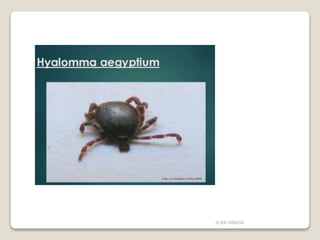
Genus/ Species:
Guide to Tick ID
Morphological features
Geographical distribution
Host
Life cycle
Pathogenesis
ICAR-NBAGR
ICAR-NBAGR
ICAR-NBAGR
ICAR-NBAGR
ICAR-NBAGR
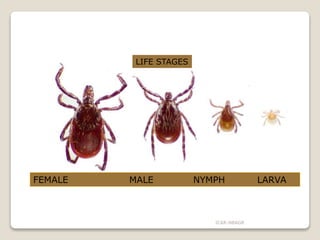
FEMALE MALE NYMPH LARVA
LIFE STAGES
ICAR-NBAGR
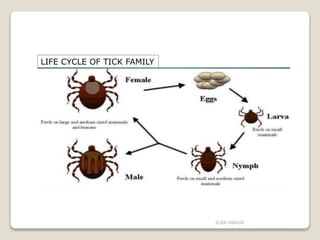
LIFE CYCLE OF TICK FAMILY
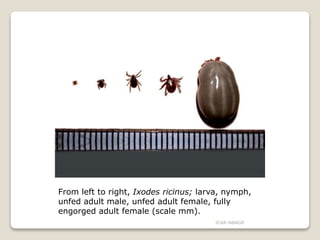
From left to right, Ixodes ricinus; larva, nymph,
unfed adult male, unfed adult female, fully
engorged adult female (scale mm).
ICAR-NBAGR
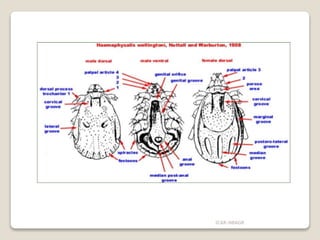
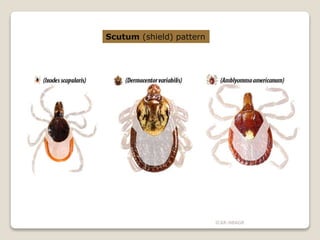
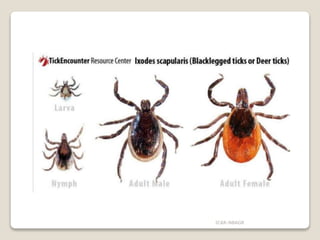
Scutum (shield) pattern
Ticks have a dorsal scutum or "shield" and each species has a unique
pattern or color. Ixodes ticks often have a black/brown solid colored
scutum. Whereas, Dermacentor and Amblyomma ticks each have a
patterned scutum.
Unfed adult stage characteristics
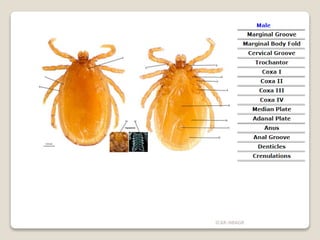
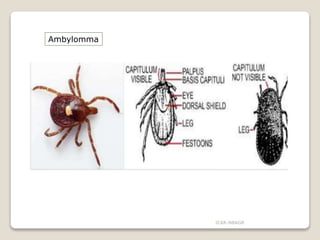
Festoons
Festoons are small areas separated by short grooves on the back
margin of the tick and helps distinguish all other ticks from Ixodes
ticks, which lack festoons.
Other characteristics to consider
The length of the tick's Capitulum (Mouthparts) can help determine
the type of tick. Dermacentor ticks have shorter mouthparts than Ixodes or
Amblyomma .
This also contributes to how easy it is to remove each species of tick. In
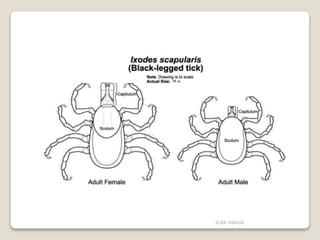
order to tell the gender of a tick, you can look at the size of the scutum.
Female adult stage ticks have a smaller scutum, whereas a male's scutum
covers nearly the entire dorsal (top) of their body.
ICAR-NBAGR
ICAR-NBAGR
Scutum (shield) pattern
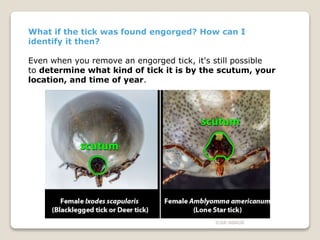
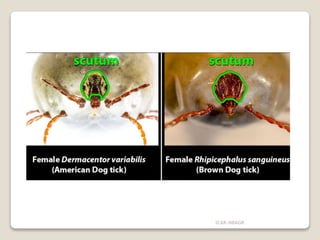
What if the tick was found engorged? How can I
identify it then?
Even when you remove an engorged tick, it's still possible
to determine what kind of tick it is by the scutum, your
location, and time of year.
ICAR-NBAGR
ICAR-NBAGR
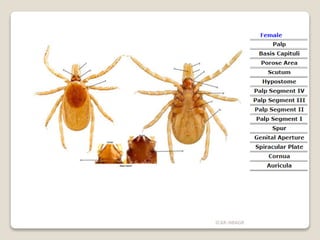
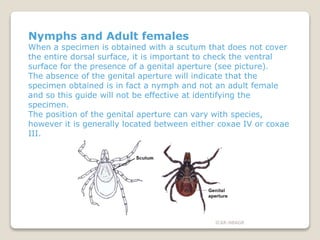
Nymphs and Adult females
When a specimen is obtained with a scutum that does not cover
the entire dorsal surface, it is important to check the ventral
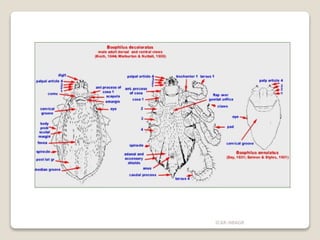
surface for the presence of a genital aperture (see picture).
The absence of the genital aperture will indicate that the
specimen obtained is in fact a nymph and not an adult female
and so this guide will not be effective at identifying the
specimen.
The position of the genital aperture can vary with species,
however it is generally located between either coxae IV or coxae
III.
ICAR-NBAGR
ICAR-NBAGR
ICAR-NBAGR
Ambylomma
ICAR-NBAGR
ICAR-NBAGR
ICAR-NBAGR

Tick identification guide

  • 1.
    Tick Identification Guide DrKaran Veer Singh, Scientist ICAR-NBAGR
  • 2.
    ICAR-NBAGR Kingdom: Animalia Phylum: Arthropoda Class:Arachnida Subclass: Acari Order: Ixodida Family: Ixodidae Genus/ Species: Guide to Tick ID Morphological features Geographical distribution Host Life cycle Pathogenesis
  • 3.
  • 4.
  • 5.
  • 6.
  • 7.
  • 8.
  • 9.
    From left toright, Ixodes ricinus; larva, nymph, unfed adult male, unfed adult female, fully engorged adult female (scale mm). ICAR-NBAGR
  • 10.
    Scutum (shield) pattern Tickshave a dorsal scutum or "shield" and each species has a unique pattern or color. Ixodes ticks often have a black/brown solid colored scutum. Whereas, Dermacentor and Amblyomma ticks each have a patterned scutum. Unfed adult stage characteristics Festoons Festoons are small areas separated by short grooves on the back margin of the tick and helps distinguish all other ticks from Ixodes ticks, which lack festoons. Other characteristics to consider The length of the tick's Capitulum (Mouthparts) can help determine the type of tick. Dermacentor ticks have shorter mouthparts than Ixodes or Amblyomma . This also contributes to how easy it is to remove each species of tick. In order to tell the gender of a tick, you can look at the size of the scutum. Female adult stage ticks have a smaller scutum, whereas a male's scutum covers nearly the entire dorsal (top) of their body. ICAR-NBAGR
  • 11.
  • 12.
    What if thetick was found engorged? How can I identify it then? Even when you remove an engorged tick, it's still possible to determine what kind of tick it is by the scutum, your location, and time of year. ICAR-NBAGR
  • 13.
  • 14.
    Nymphs and Adultfemales When a specimen is obtained with a scutum that does not cover the entire dorsal surface, it is important to check the ventral surface for the presence of a genital aperture (see picture). The absence of the genital aperture will indicate that the specimen obtained is in fact a nymph and not an adult female and so this guide will not be effective at identifying the specimen. The position of the genital aperture can vary with species, however it is generally located between either coxae IV or coxae III. ICAR-NBAGR
  • 15.
  • 16.
  • 17.
  • 18.
  • 19.