Class Arachnida
1
Arachnida:
• Contains 3 orders of medical importance:
1. Parasitiforms (Ticks)
2. Acarina (Mites)
3. Araneida (Spiders)
Characteristics:
 Body is divided into cephalothorax & abdomen,
 Adults have 4 pairs of legs,
 Wingless, Antennae absent,
 Undergo incomplete metamorphosis,
Arachnida . . .
2
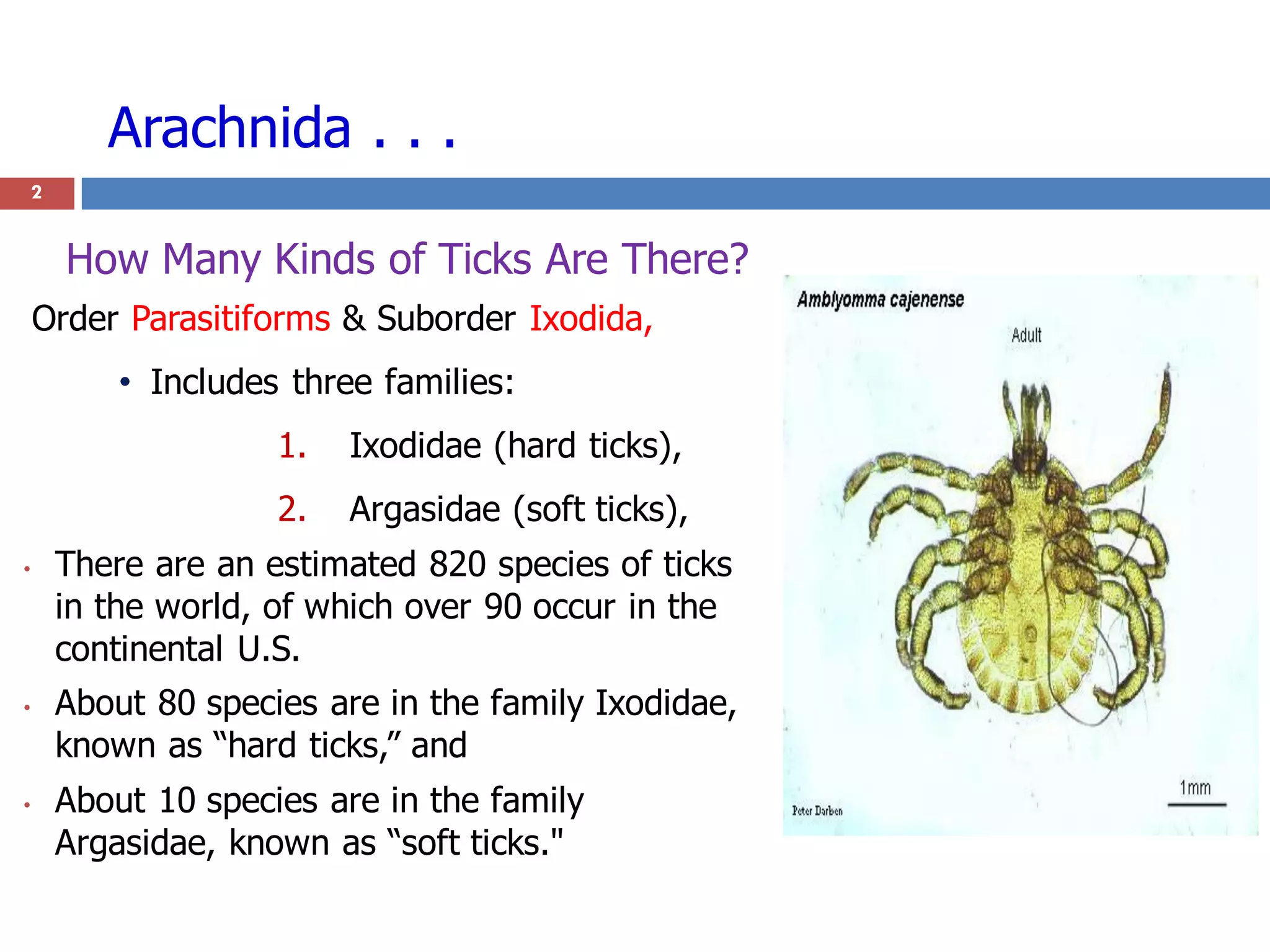
Order Parasitiforms & Suborder Ixodida,
• Includes three families:
1. Ixodidae (hard ticks),
2. Argasidae (soft ticks),
• There are an estimated 820 species of ticks
in the world, of which over 90 occur in the
continental U.S.
• About 80 species are in the family Ixodidae,
known as “hard ticks,” and
• About 10 species are in the family
Argasidae, known as “soft ticks."
How Many Kinds of Ticks Are There?
Arachnida . . .
3
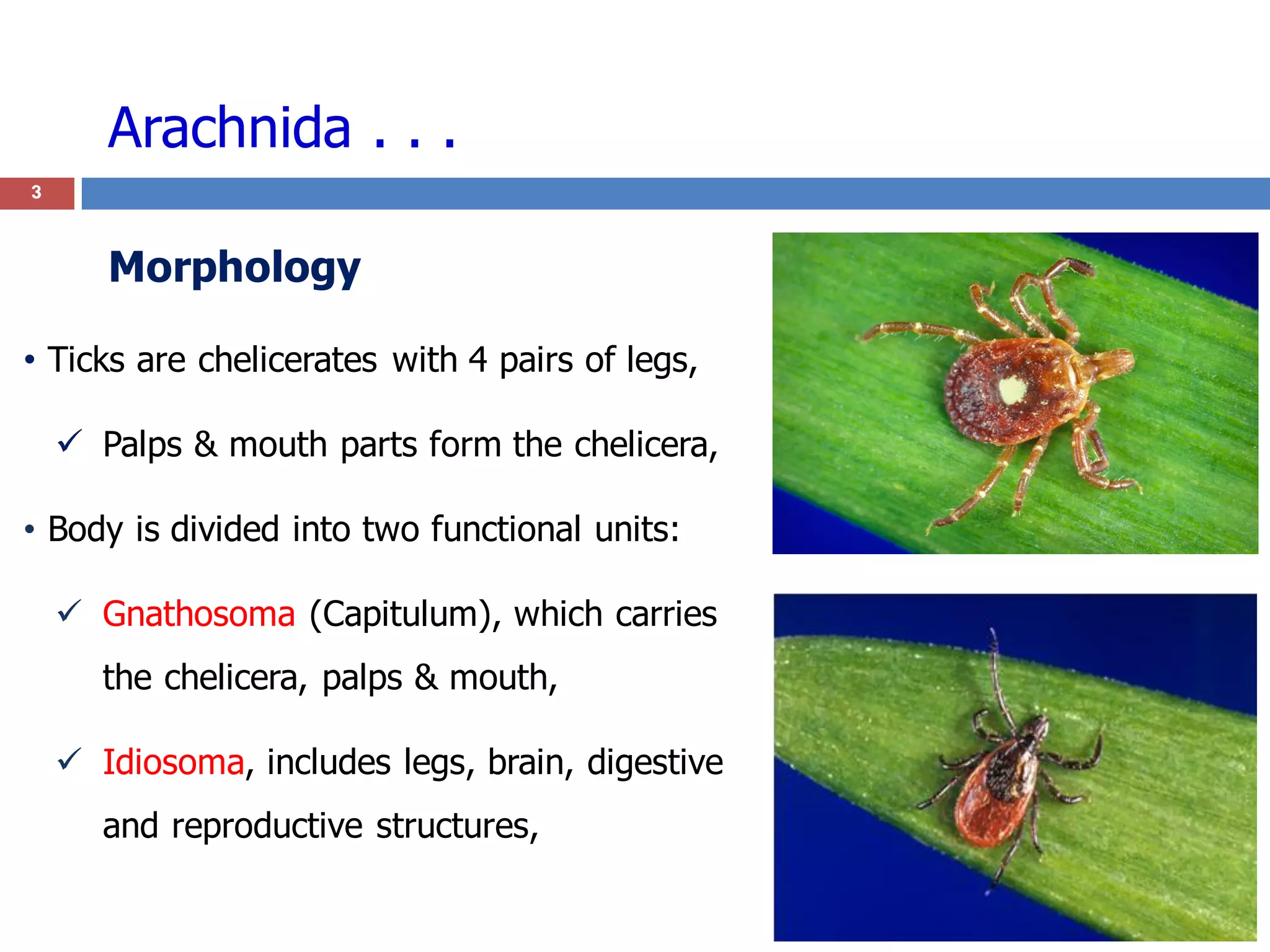
• Ticks are chelicerates with 4 pairs of legs,
 Palps & mouth parts form the chelicera,
• Body is divided into two functional units:
 Gnathosoma (Capitulum), which carries
the chelicera, palps & mouth,
 Idiosoma, includes legs, brain, digestive
and reproductive structures,
Morphology
Arachnida . . .
4
Biological features:
• Obligate parasites where all active instars are blood feeders.
• Non permanent parasites; find a new host every time they feed.
• Many species live for 2-4 years or >10 years,
• Unfed ticks may survive for more than a year; off-host.
• Wide host range with passive host searching strategy,
i.e. waiting, climbing on, attaching and feeding,
Ticks . . .
Arachnida . . .
5
Biological features . . .
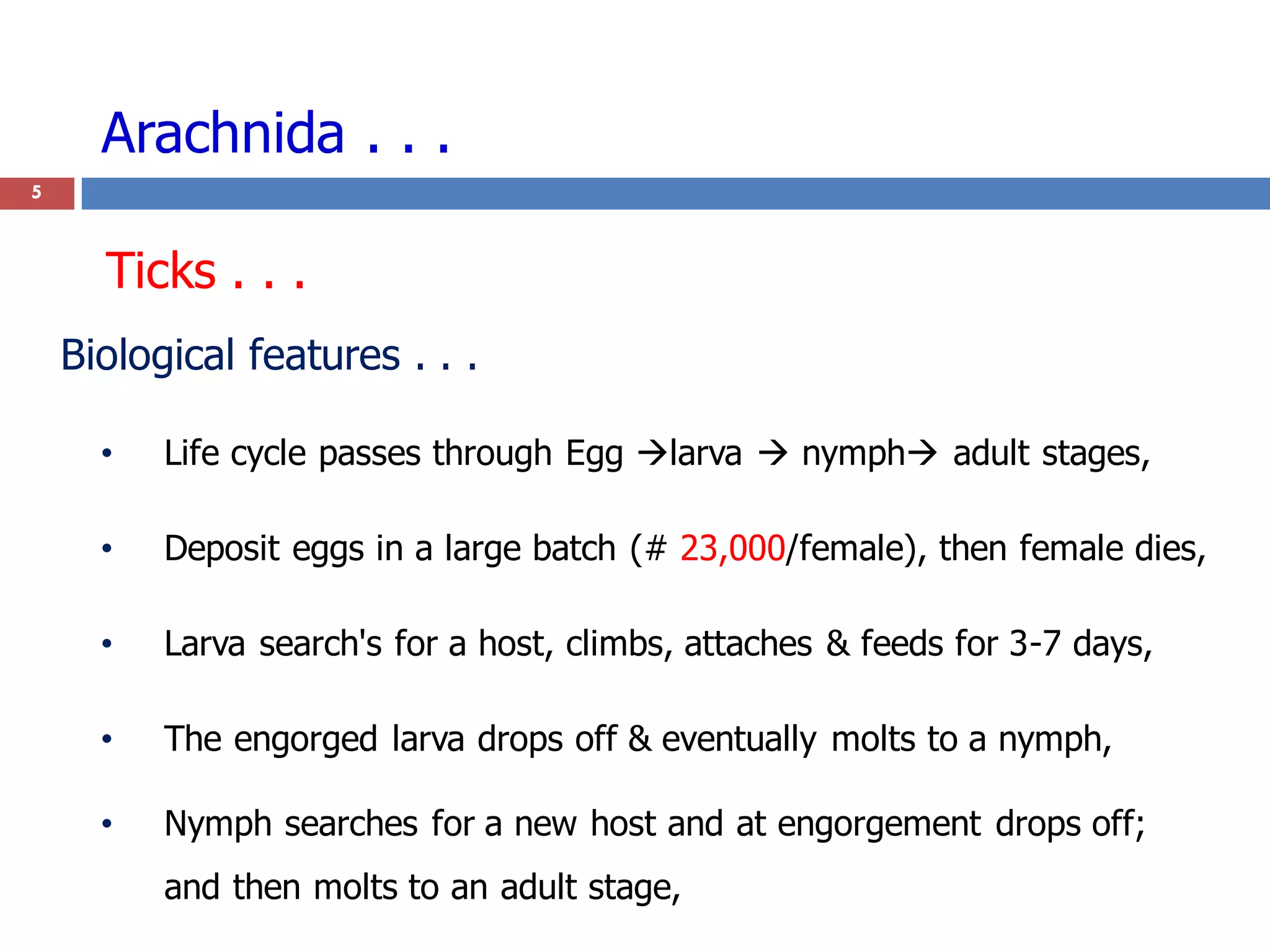
• Life cycle passes through Egg larva  nymph adult stages,
• Deposit eggs in a large batch (# 23,000/female), then female dies,
• Larva search's for a host, climbs, attaches & feeds for 3-7 days,
• The engorged larva drops off & eventually molts to a nymph,
• Nymph searches for a new host and at engorgement drops off;
and then molts to an adult stage,
Ticks . . .
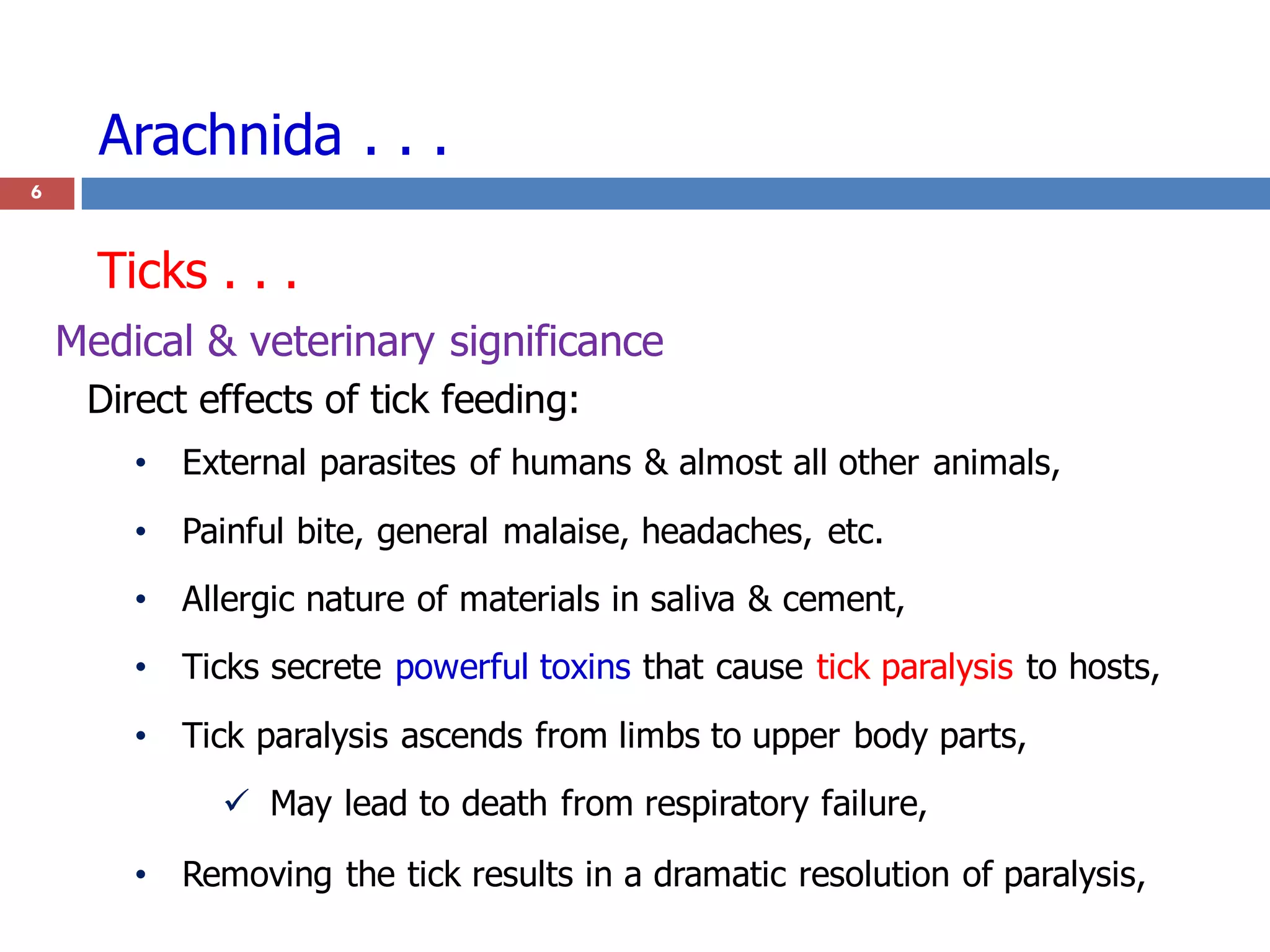
Medical & veterinary significance
Direct effects of tick feeding:
• External parasites of humans & almost all other animals,
• Painful bite, general malaise, headaches, etc.
• Allergic nature of materials in saliva & cement,
• Ticks secrete powerful toxins that cause tick paralysis to hosts,
• Tick paralysis ascends from limbs to upper body parts,
 May lead to death from respiratory failure,
• Removing the tick results in a dramatic resolution of paralysis,
Arachnida . . .
6
Ticks . . .
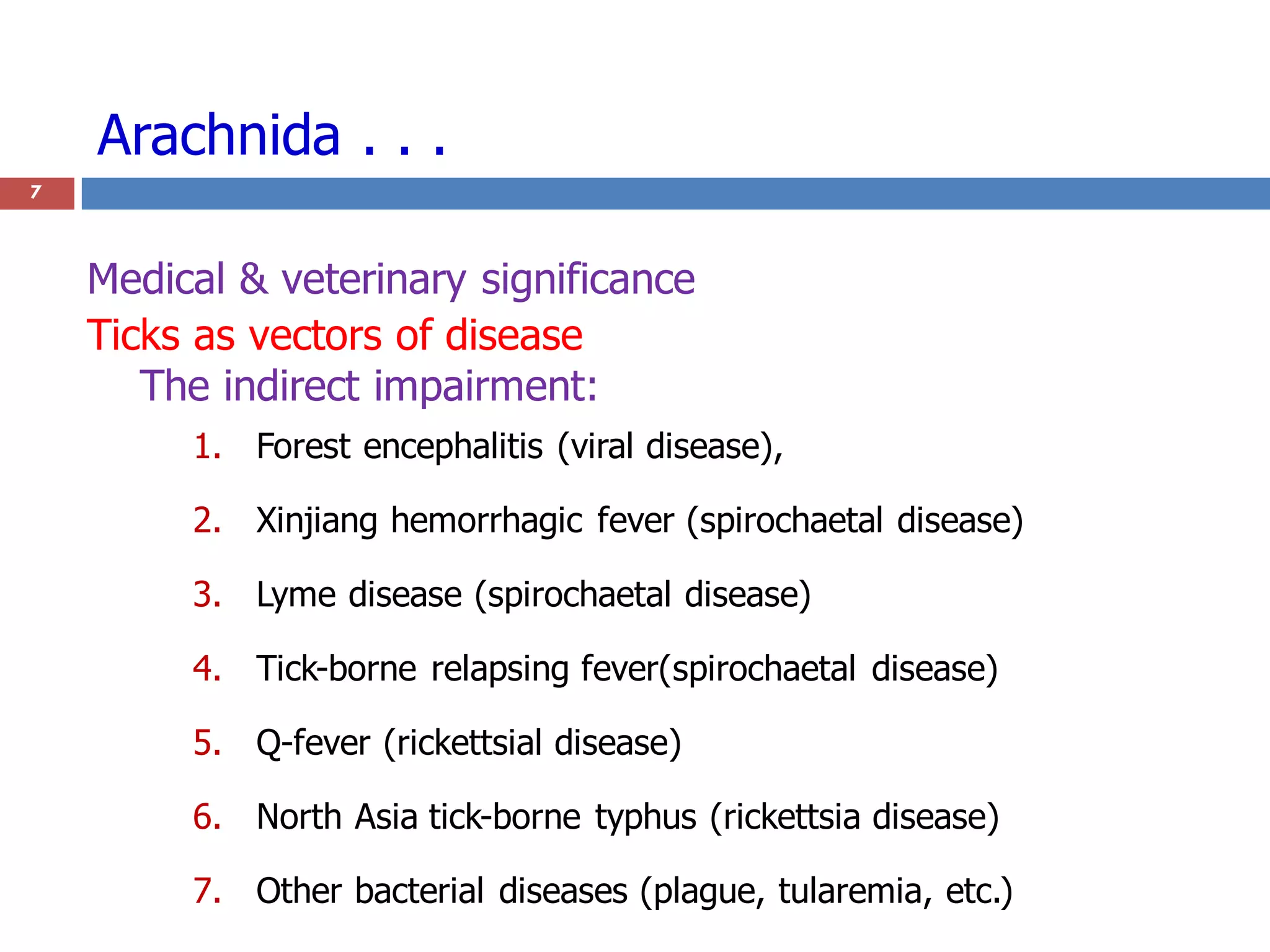
1. Forest encephalitis (viral disease),
2. Xinjiang hemorrhagic fever (spirochaetal disease)
3. Lyme disease (spirochaetal disease)
4. Tick-borne relapsing fever(spirochaetal disease)
5. Q-fever (rickettsial disease)
6. North Asia tick-borne typhus (rickettsia disease)
7. Other bacterial diseases (plague, tularemia, etc.)
Arachnida . . .
7
Medical & veterinary significance
Ticks as vectors of disease
The indirect impairment:
Arachnida . . .
8
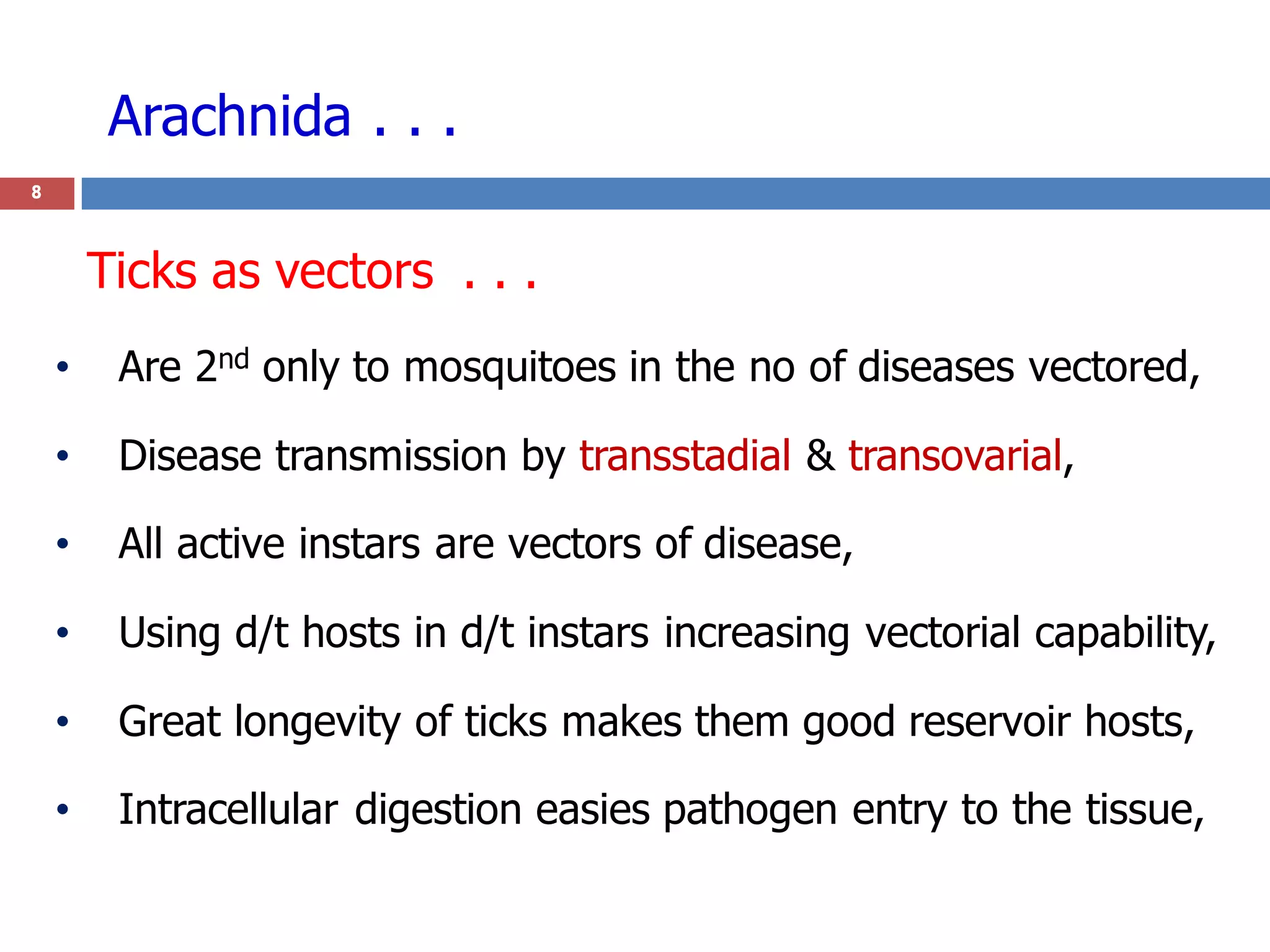
• Are 2nd only to mosquitoes in the no of diseases vectored,
• Disease transmission by transstadial & transovarial,
• All active instars are vectors of disease,
• Using d/t hosts in d/t instars increasing vectorial capability,
• Great longevity of ticks makes them good reservoir hosts,
• Intracellular digestion easies pathogen entry to the tissue,
Ticks as vectors . . .
9
• Human babesiosis & theileriosis are a tick born diseases,
• Human infections are mostly by B. microti & B. bovis,
• Babesia Species invade RBCs causing human babesiosis,
• Theileria species invade T- cells & B- cells causing theileriosis,
 Theileriosis is a disease that displays malaria like symptoms
but without periodicity,
Ticks as vectors of intra-erythrocytic protozoa parasites
Arachnida . . .
Arachnida . . .
10
• Tick-associated pathogens in Rickettsia group,
e.g., Ehrlichia
• The two main types of human ehrlichiosis:-
I. Human Monocytic Ehrlichiosis (HME),
 has a particular affinity to lymphocytes,
monocytes and macrophages,
II. Human Granulocytic Anaplasmosis (HGA),
 favors neutrophils, basophils & eosinophils,
Ticks as a vector of intracellular bacteria
Arachnida . . .
11
• The spirochaete genus Borelia, e.g., B. burgdorferi,
 Lyme boreliosis is the most commonly reported,
• Causes human muscle pain or aching,
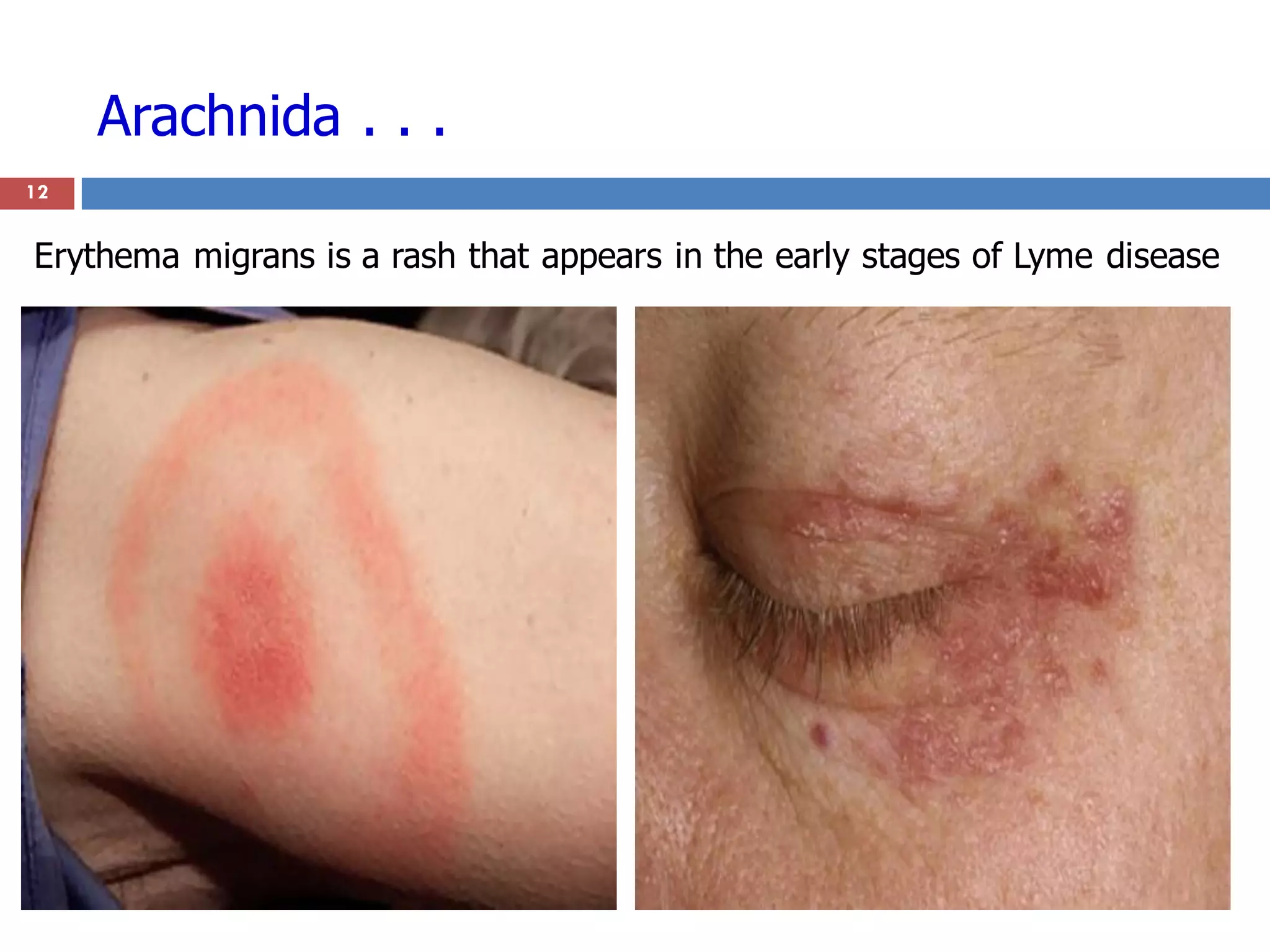
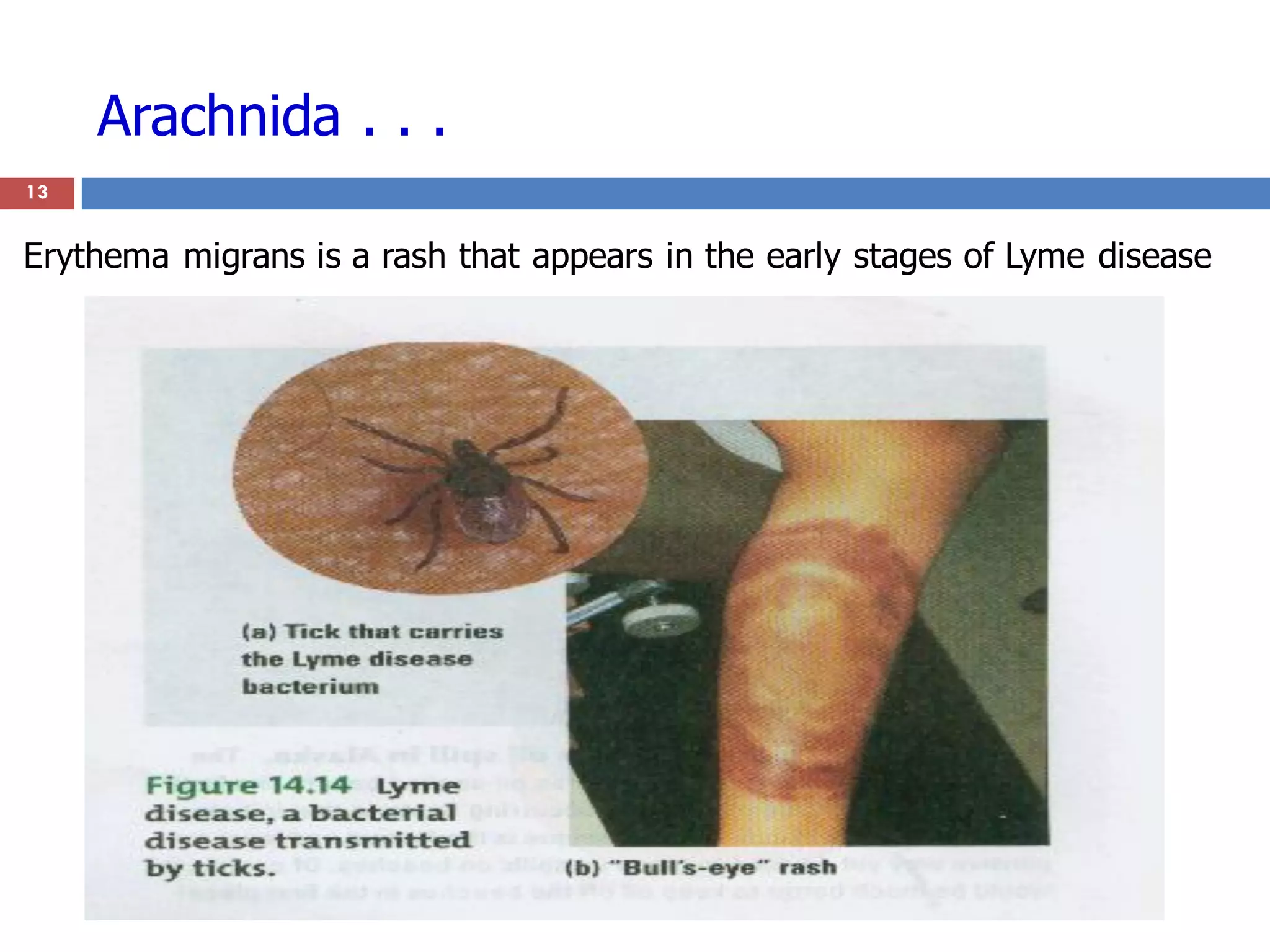
 Erythema migrans is a rash that appears in the early
stages of Lyme disease,
 Lyme arthritis as oligo-articular relapsing arthritis,
primarily affecting large joints,
 Transmitted through the bites of hard ticks.
Ticks as a vector of intracellular bacteria . . .
Arachnida . . .
12
Erythema migrans is a rash that appears in the early stages of Lyme disease
Arachnida . . .
13
Erythema migrans is a rash that appears in the early stages of Lyme disease
Arachnida . . .
14
Arboviruses
The list of arboviral disease vectored by ticks:
• The Russian spring-summer encephalitis,
• Louping ill and Kyasanur forest disease,
• Crimean Congo hemorrhagic fever,
• Colorado tick fever produce a generalized
systemic infection,
Ticks as a vector of viruses. . .
Arachnida . . .
15
Arachnida . . .
16
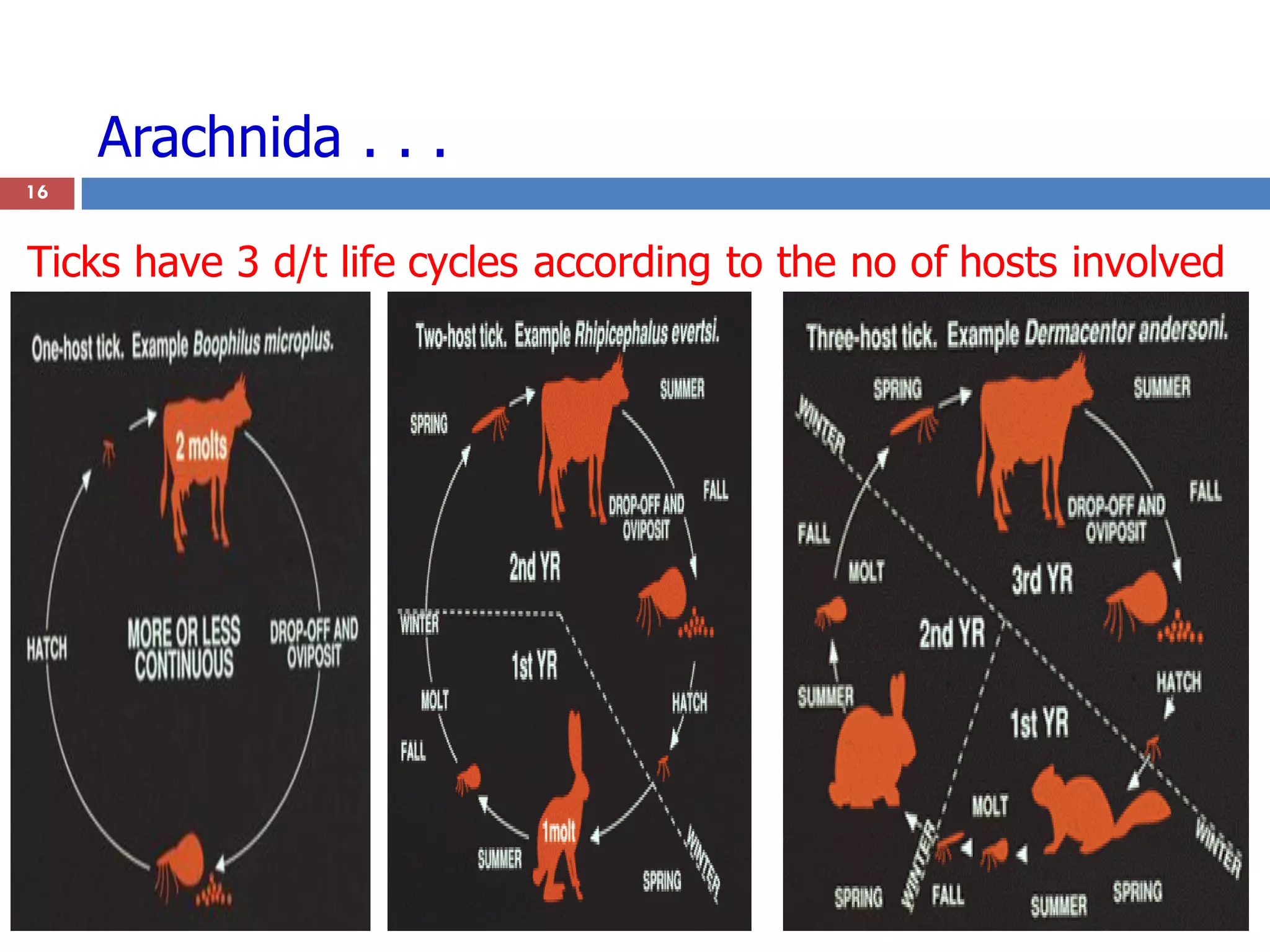
Ticks have 3 d/t life cycles according to the no of hosts involved
Arachnida . . .
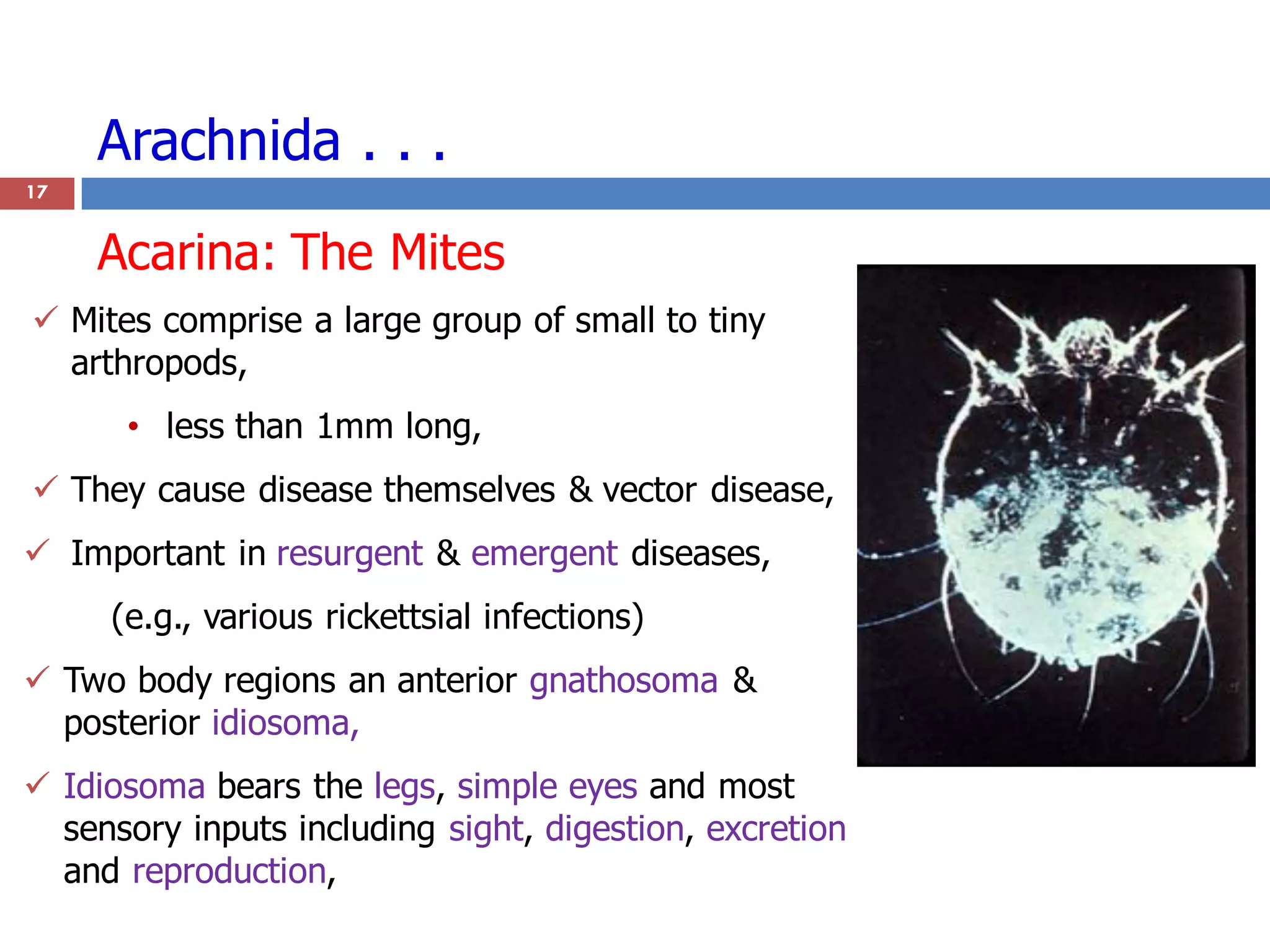
 Mites comprise a large group of small to tiny
arthropods,
• less than 1mm long,
 They cause disease themselves & vector disease,
 Important in resurgent & emergent diseases,
(e.g., various rickettsial infections)
 Two body regions an anterior gnathosoma &
posterior idiosoma,
 Idiosoma bears the legs, simple eyes and most
sensory inputs including sight, digestion, excretion
and reproduction,
17
Acarina: The Mites
Arachnida . . .
18
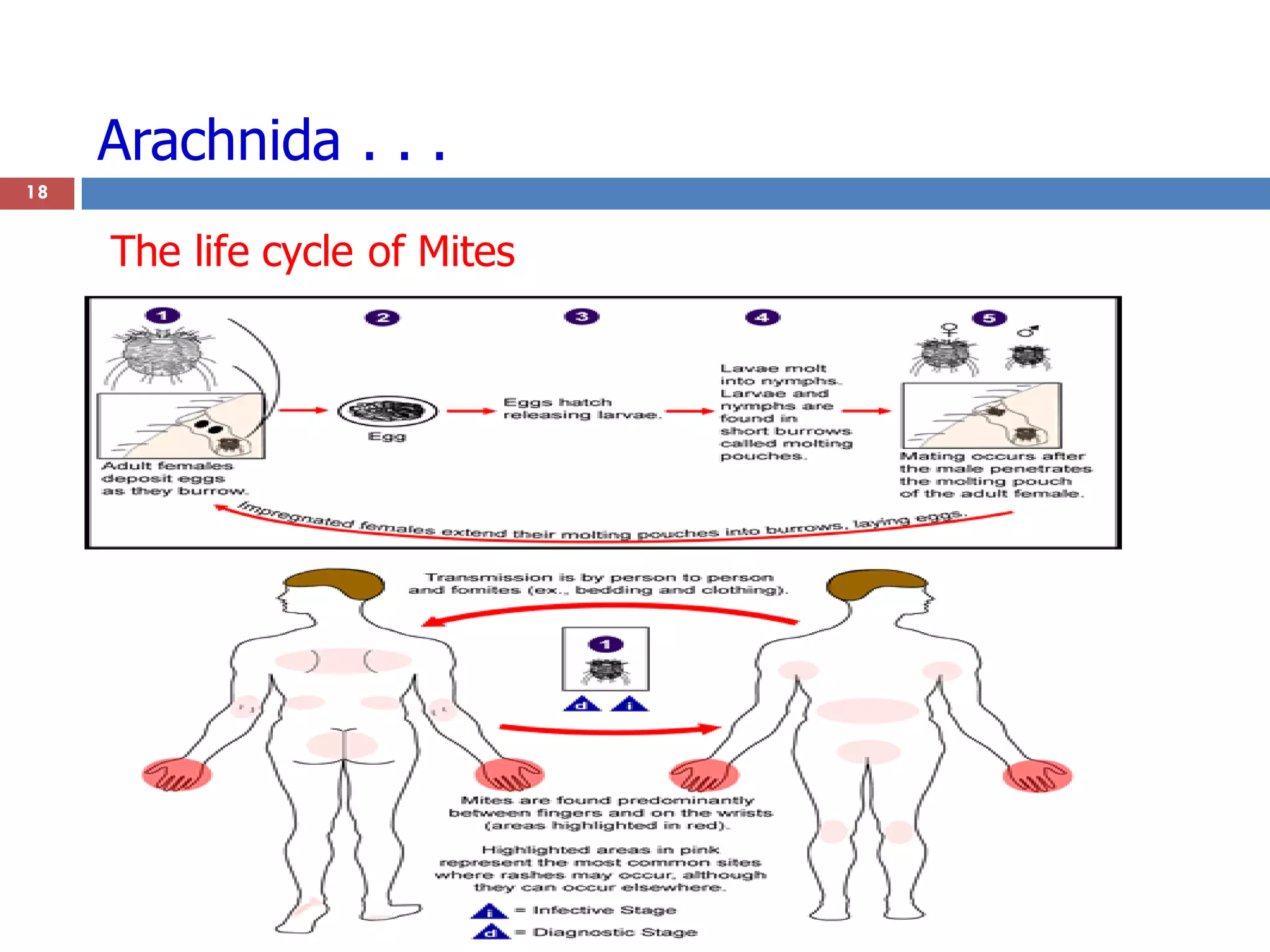
The life cycle of Mites
Arachnida . . .
19
• Many parasitic mites feed only on body fluids,
• Digestion is external; predigested skin is sucked up,
• The house-dust mite bite off & swallow solid foods,
 Its fecal pellet is a primary source of allergens,
• Mite eggs may be laid singly on or off the host,
Mites . . .
Arachnida . . .
20
• Human itch mites and scaly leg mites of birds lay their
eggs in the burrow created by the females in the skin.
• Mites have the following developmental stages:
 egg, pre-larvae, larva, protonymph, deutonymph, tritonyph & adult.
• Migration from host to host occurs as mated adult females or
as wandering adult males move,
Mites . . .
Arachnida . . .
• Two species of mites infect humans:
1. Demodex folliculorium, the hair follicle mite,
2. D. brevis, the subaceous gland mite,
• Mites are parasites that feed on human epithelial cells
and subaceous gland cells,
 leading to swelling and keratinization of skin,
• Mite infection is common on cheeks, eyelashes and
foreheads of men,
 Cases of scaly skin, granuloma of the eyelid,
21
Mites and human disease
Arachnida . . .
• Live in our homes & feed on cast skin scales, hair, etc…
• More than 20 species of mites inhabit house dust,
• Affect 50-100 million people worldwide,
• Are the most important source of allergens in house dust,
 Severe allergies,
 Fever-like symptoms,
 Skin inflammation,
 Asthma,
• Mite feces are dry capsules with allergenic enzymes,
22
House-Dust mites
Arachnida . . .
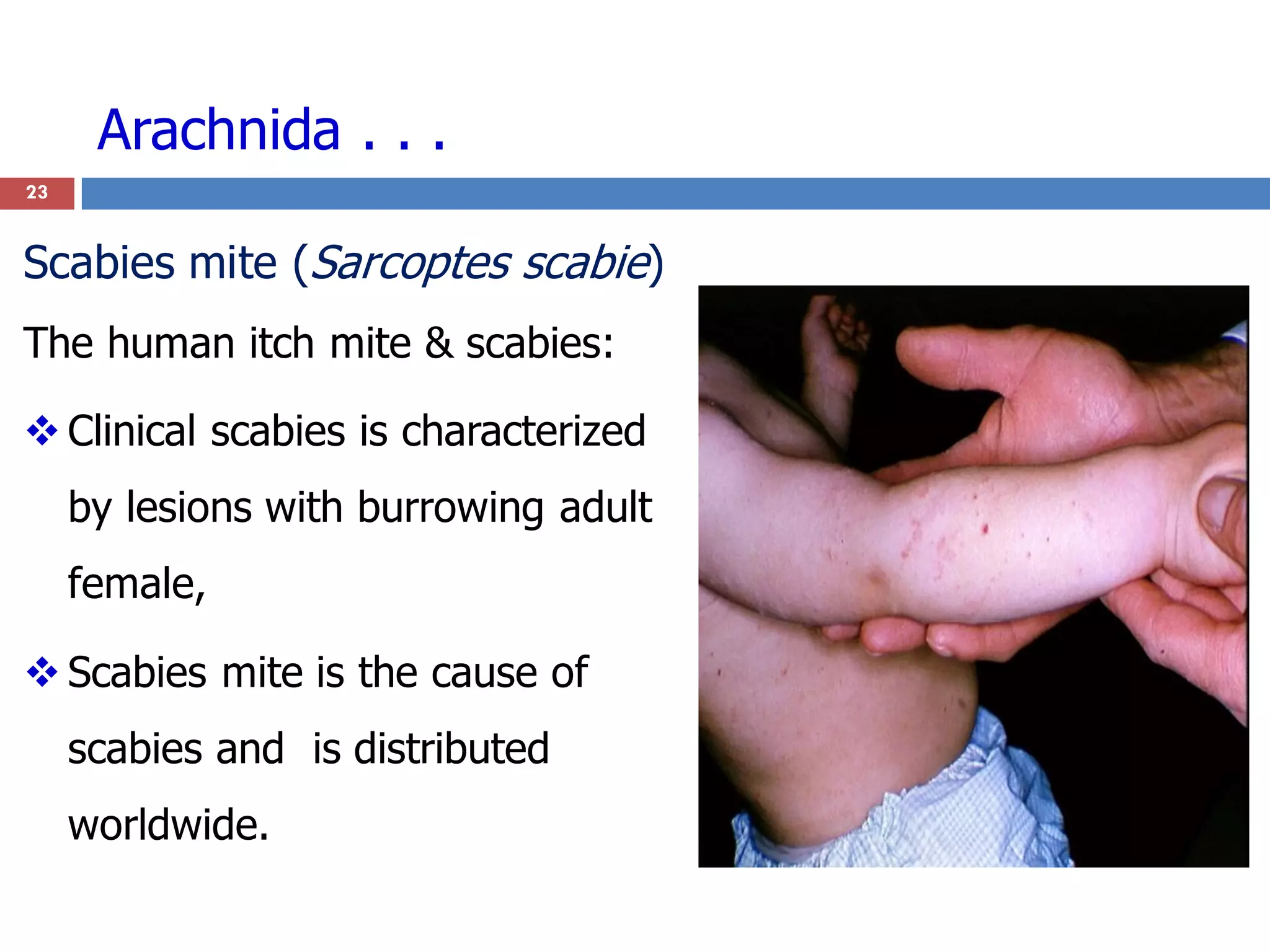
Scabies mite (Sarcoptes scabie)
The human itch mite & scabies:
 Clinical scabies is characterized
by lesions with burrowing adult
female,
 Scabies mite is the cause of
scabies and is distributed
worldwide.
23
Arachnida . . .
• Clinical scabies is characterized by lesions with burrowing adult female
Sarcoptes scabiei, which is commonly called egg laying machines.
• Ovigerous females secrete lytic enzymes and dig their way into the skin,
• Transmission occurs when mated mites move from person to person,
• Most infestations are associated with the wrinkled areas of forearms,
hands, wrists & elbows or any susceptible areas that hands may touch.
• Secondary infections are common, and scabies-initiated streptococcal
infections in children may be associated chronic renal disease later in life.
24
The human itch mite and scabies:
THANKS
25

F. Arachnida.pdf

  • 1.
    Class Arachnida 1 Arachnida: • Contains3 orders of medical importance: 1. Parasitiforms (Ticks) 2. Acarina (Mites) 3. Araneida (Spiders) Characteristics:  Body is divided into cephalothorax & abdomen,  Adults have 4 pairs of legs,  Wingless, Antennae absent,  Undergo incomplete metamorphosis,
  • 2.
    Arachnida . .. 2 Order Parasitiforms & Suborder Ixodida, • Includes three families: 1. Ixodidae (hard ticks), 2. Argasidae (soft ticks), • There are an estimated 820 species of ticks in the world, of which over 90 occur in the continental U.S. • About 80 species are in the family Ixodidae, known as “hard ticks,” and • About 10 species are in the family Argasidae, known as “soft ticks." How Many Kinds of Ticks Are There?
  • 3.
    Arachnida . .. 3 • Ticks are chelicerates with 4 pairs of legs,  Palps & mouth parts form the chelicera, • Body is divided into two functional units:  Gnathosoma (Capitulum), which carries the chelicera, palps & mouth,  Idiosoma, includes legs, brain, digestive and reproductive structures, Morphology
  • 4.
    Arachnida . .. 4 Biological features: • Obligate parasites where all active instars are blood feeders. • Non permanent parasites; find a new host every time they feed. • Many species live for 2-4 years or >10 years, • Unfed ticks may survive for more than a year; off-host. • Wide host range with passive host searching strategy, i.e. waiting, climbing on, attaching and feeding, Ticks . . .
  • 5.
    Arachnida . .. 5 Biological features . . . • Life cycle passes through Egg larva  nymph adult stages, • Deposit eggs in a large batch (# 23,000/female), then female dies, • Larva search's for a host, climbs, attaches & feeds for 3-7 days, • The engorged larva drops off & eventually molts to a nymph, • Nymph searches for a new host and at engorgement drops off; and then molts to an adult stage, Ticks . . .
  • 6.
    Medical & veterinarysignificance Direct effects of tick feeding: • External parasites of humans & almost all other animals, • Painful bite, general malaise, headaches, etc. • Allergic nature of materials in saliva & cement, • Ticks secrete powerful toxins that cause tick paralysis to hosts, • Tick paralysis ascends from limbs to upper body parts,  May lead to death from respiratory failure, • Removing the tick results in a dramatic resolution of paralysis, Arachnida . . . 6 Ticks . . .
  • 7.
    1. Forest encephalitis(viral disease), 2. Xinjiang hemorrhagic fever (spirochaetal disease) 3. Lyme disease (spirochaetal disease) 4. Tick-borne relapsing fever(spirochaetal disease) 5. Q-fever (rickettsial disease) 6. North Asia tick-borne typhus (rickettsia disease) 7. Other bacterial diseases (plague, tularemia, etc.) Arachnida . . . 7 Medical & veterinary significance Ticks as vectors of disease The indirect impairment:
  • 8.
    Arachnida . .. 8 • Are 2nd only to mosquitoes in the no of diseases vectored, • Disease transmission by transstadial & transovarial, • All active instars are vectors of disease, • Using d/t hosts in d/t instars increasing vectorial capability, • Great longevity of ticks makes them good reservoir hosts, • Intracellular digestion easies pathogen entry to the tissue, Ticks as vectors . . .
  • 9.
    9 • Human babesiosis& theileriosis are a tick born diseases, • Human infections are mostly by B. microti & B. bovis, • Babesia Species invade RBCs causing human babesiosis, • Theileria species invade T- cells & B- cells causing theileriosis,  Theileriosis is a disease that displays malaria like symptoms but without periodicity, Ticks as vectors of intra-erythrocytic protozoa parasites Arachnida . . .
  • 10.
    Arachnida . .. 10 • Tick-associated pathogens in Rickettsia group, e.g., Ehrlichia • The two main types of human ehrlichiosis:- I. Human Monocytic Ehrlichiosis (HME),  has a particular affinity to lymphocytes, monocytes and macrophages, II. Human Granulocytic Anaplasmosis (HGA),  favors neutrophils, basophils & eosinophils, Ticks as a vector of intracellular bacteria
  • 11.
    Arachnida . .. 11 • The spirochaete genus Borelia, e.g., B. burgdorferi,  Lyme boreliosis is the most commonly reported, • Causes human muscle pain or aching,  Erythema migrans is a rash that appears in the early stages of Lyme disease,  Lyme arthritis as oligo-articular relapsing arthritis, primarily affecting large joints,  Transmitted through the bites of hard ticks. Ticks as a vector of intracellular bacteria . . .
  • 12.
    Arachnida . .. 12 Erythema migrans is a rash that appears in the early stages of Lyme disease
  • 13.
    Arachnida . .. 13 Erythema migrans is a rash that appears in the early stages of Lyme disease
  • 14.
    Arachnida . .. 14 Arboviruses The list of arboviral disease vectored by ticks: • The Russian spring-summer encephalitis, • Louping ill and Kyasanur forest disease, • Crimean Congo hemorrhagic fever, • Colorado tick fever produce a generalized systemic infection, Ticks as a vector of viruses. . .
  • 15.
  • 16.
    Arachnida . .. 16 Ticks have 3 d/t life cycles according to the no of hosts involved
  • 17.
    Arachnida . ..  Mites comprise a large group of small to tiny arthropods, • less than 1mm long,  They cause disease themselves & vector disease,  Important in resurgent & emergent diseases, (e.g., various rickettsial infections)  Two body regions an anterior gnathosoma & posterior idiosoma,  Idiosoma bears the legs, simple eyes and most sensory inputs including sight, digestion, excretion and reproduction, 17 Acarina: The Mites
  • 18.
    Arachnida . .. 18 The life cycle of Mites
  • 19.
    Arachnida . .. 19 • Many parasitic mites feed only on body fluids, • Digestion is external; predigested skin is sucked up, • The house-dust mite bite off & swallow solid foods,  Its fecal pellet is a primary source of allergens, • Mite eggs may be laid singly on or off the host, Mites . . .
  • 20.
    Arachnida . .. 20 • Human itch mites and scaly leg mites of birds lay their eggs in the burrow created by the females in the skin. • Mites have the following developmental stages:  egg, pre-larvae, larva, protonymph, deutonymph, tritonyph & adult. • Migration from host to host occurs as mated adult females or as wandering adult males move, Mites . . .
  • 21.
    Arachnida . .. • Two species of mites infect humans: 1. Demodex folliculorium, the hair follicle mite, 2. D. brevis, the subaceous gland mite, • Mites are parasites that feed on human epithelial cells and subaceous gland cells,  leading to swelling and keratinization of skin, • Mite infection is common on cheeks, eyelashes and foreheads of men,  Cases of scaly skin, granuloma of the eyelid, 21 Mites and human disease
  • 22.
    Arachnida . .. • Live in our homes & feed on cast skin scales, hair, etc… • More than 20 species of mites inhabit house dust, • Affect 50-100 million people worldwide, • Are the most important source of allergens in house dust,  Severe allergies,  Fever-like symptoms,  Skin inflammation,  Asthma, • Mite feces are dry capsules with allergenic enzymes, 22 House-Dust mites
  • 23.
    Arachnida . .. Scabies mite (Sarcoptes scabie) The human itch mite & scabies:  Clinical scabies is characterized by lesions with burrowing adult female,  Scabies mite is the cause of scabies and is distributed worldwide. 23
  • 24.
    Arachnida . .. • Clinical scabies is characterized by lesions with burrowing adult female Sarcoptes scabiei, which is commonly called egg laying machines. • Ovigerous females secrete lytic enzymes and dig their way into the skin, • Transmission occurs when mated mites move from person to person, • Most infestations are associated with the wrinkled areas of forearms, hands, wrists & elbows or any susceptible areas that hands may touch. • Secondary infections are common, and scabies-initiated streptococcal infections in children may be associated chronic renal disease later in life. 24 The human itch mite and scabies:
  • 25.