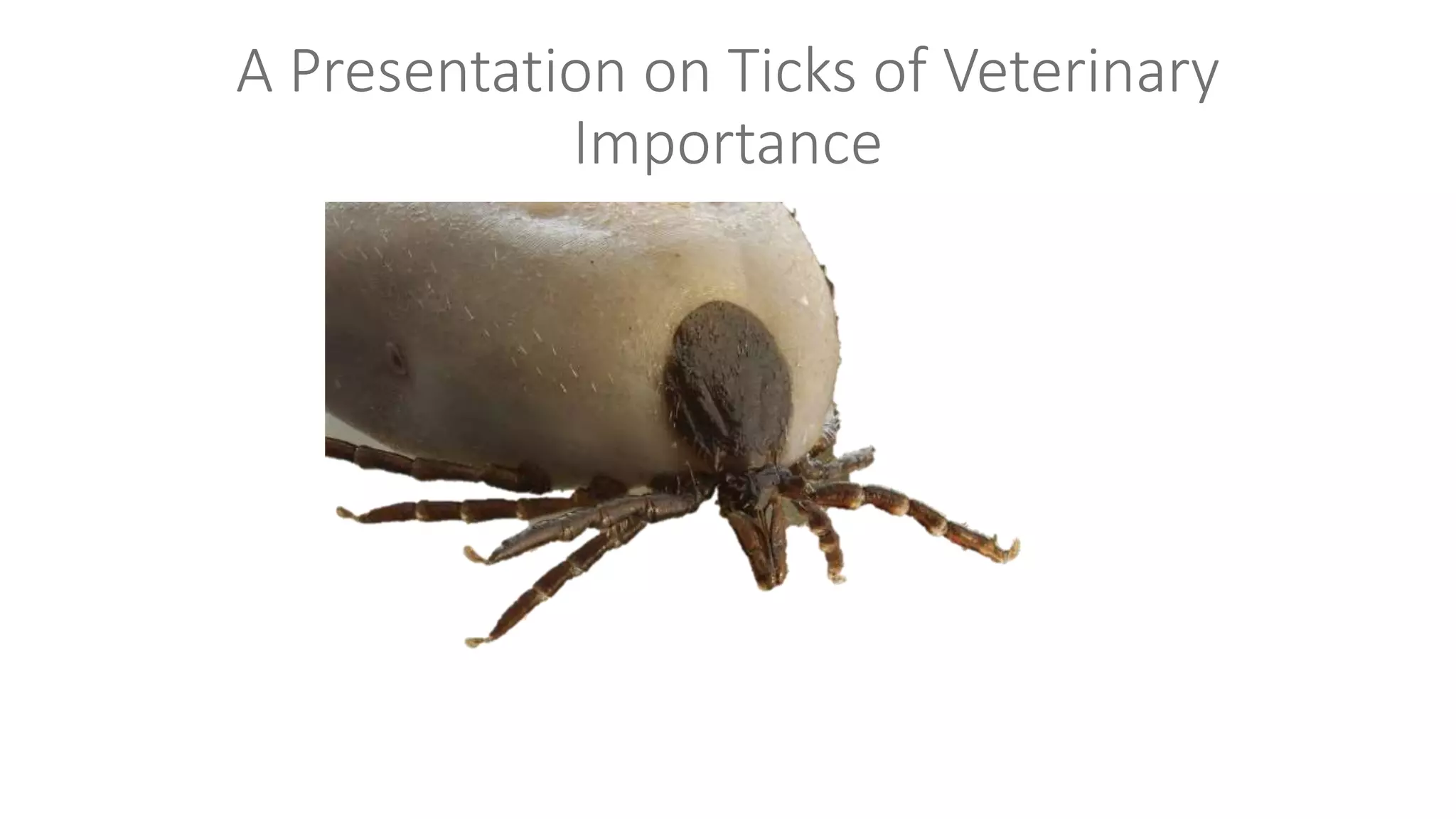
A Presentation on Ticks of Veterinary
Importance
Introduction
❖ Blood sucking arthopods
❖ Most important vectors of human and animal diseases
❖ Life threatening vector (rank second; 1st Mosquitos)
❖Transmit greater variety of infections agents
❖Pest of man, animal and wildlife
❖ Causes Severe toxic condition (Tick Parasysis, Tick Toxicosis)
❖Tick-borne diseases major threat to livestock industry
❖Costs billions of dollars annually to protect livestock from ticks
and tick-borne diseases
Order: Acarina (Tick)
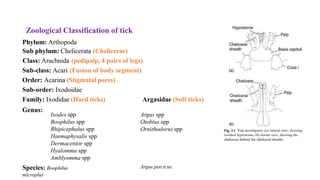
Zoological Classification of tick
Phylum: Arthopoda
Sub phylum: Chelicerata (Chelicerae)
Class: Arachnida (pedipalp, 4 pairs of legs)
Sub-class: Acari (Fusion of body segment)
Order: Acarina (Stigmatal pores)
Sub-order: Ixodoidae
Family: Ixodidae (Hard ticks) Argasidae (Soft ticks)
Genus:
Ixodes spp
Boophilus spp
Rhipicephalus spp
Haemaphysalis spp
Dermacentor spp
Hyalomma spp
Amblyomma spp
Argus spp
Otobius spp
Ornithodorus spp
Species: Boophilus
microplus
Argus percicus
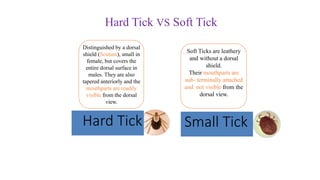
Distinguished by a dorsal
shield (Scutum), small in
female, but covers the
entire dorsal surface in
males. They are also
tapered anteriorly and the
mouthparts are readily
visible from the dorsal
view.
Soft Ticks are leathery
and without a dorsal
shield.
Their mouthparts are
sub- terminally attached
and not visible from the
dorsal view.
Hard Tick Small Tick
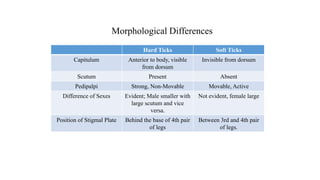
Hard Tick VS Soft Tick
Hard Ticks Soft Ticks
Capitulum Anterior to body, visible
from dorsum
Invisible from dorsum
Scutum Present Absent
Pedipalpi Strong, Non-Movable Movable, Active
Difference of Sexes Evident; Male smaller with
large scutum and vice
versa.
Not evident, female large
Position of Stigmal Plate Behind the base of 4th pair
of legs
Between 3rd and 4th pair
of legs.
Morphological Differences
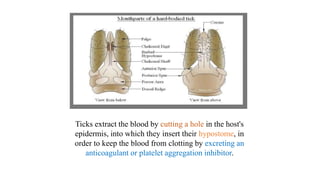
Ticks extract the blood by cutting a hole in the host's
epidermis, into which they insert their hypostome, in
order to keep the blood from clotting by excreting an
anticoagulant or platelet aggregation inhibitor.
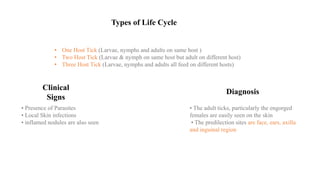
Types of Life Cycle
• One Host Tick (Larvae, nymphs and adults on same host )
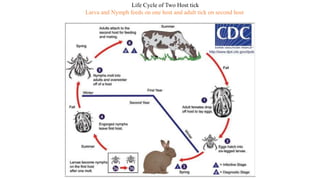
• Two Host Tick (Larvae & nymph on same host but adult on different host)
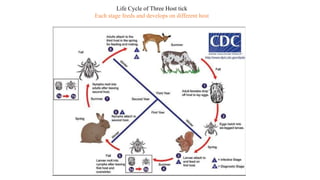
• Three Host Tick (Larvae, nymphs and adults all feed on different hosts)
Clinical
Signs
• Presence of Parasites
• Local Skin infections
• inflamed nodules are also seen
Diagnosis
• The adult ticks, particularly the engorged
females are easily seen on the skin
• The predilection sites are face, ears, axilla
and inguinal region
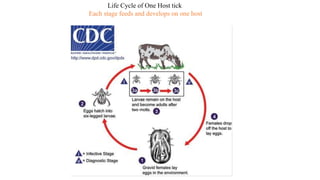
Life Cycle of One Host tick
Each stage feeds and develops on one host
Life Cycle of Two Host tick
Larva and Nymph feeds on one host and adult tick on second host
Life Cycle of Three Host tick
Each stage feeds and develops on different host
Family Ixodidae
• Important vectors of protozoal, bacterial, viral and rickettsial diseases
• The ixodids have a chitinous covering or scutum which extends over the whole
dorsal surface of the male, but covers only a small area behind the head in the larva,
nymph or female.
• Festoons (a row of notches ) is on posterior boarder of the body
• Ixodidae the anal groove is either absent or present at posterior to the anus
• Some ticks have coloured enamel-like areas on the body and these are called
'ornate ticks’.
• The adults have a pair of spiracles behind the fourth pair of legs.
• If the scutum has a pattern of grey and white on a dark background, it is described
as ornate, if not it is described as inornate.
• The anterior gnathosoma (or capitulum) and posterior idiosoma, which bears the
legs.
Generas
• Ixodes
• Haemaphysalis
• Dermacentor
Host
• Mammals and Birds Species
Common Tick
• Ixodes ricinus; castor bean tick/ European sheep tick
• Ixodes canisuga; British dog tick
• Ixodes hexagonus; hedgehog tick.
Some other species:
• Ixodes holocyclus; the paralysis tick of Auslralia
• Ixodes rubicundus; the paralysis tick of South Africa
• Ixorles scupularis (Black-legged Tick); the shoulder tick
of North America
• Inornate ticks
• No eyes
• No festoons
• Palps are long
• Anal groove is present anterior to
the anus
Identification
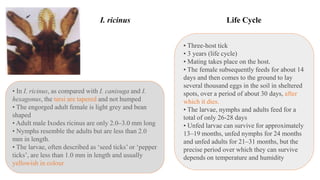
• In I. ricinus, as compared with I. canisuga and I.
hexagonus, the tarsi are tapered and not humped
• The engorged adult female is light grey and bean
shaped
• Adult male Ixodes ricinus are only 2.0–3.0 mm long
• Nymphs resemble the adults but are less than 2.0
mm in length.
• The larvae, often described as ‘seed ticks’ or ‘pepper
ticks’, are less than 1.0 mm in length and usually
yellowish in colour
• Three-host tick
• 3 years (life cycle)
• Mating takes place on the host.
• The female subsequently feeds for about 14
days and then comes to the ground to lay
several thousand eggs in the soil in sheltered
spots, over a period of about 30 days, after
which it dies.
• The larvae, nymphs and adults feed for a
total of only 26-28 days
• Unfed larvae can survive for approximately
13–19 months, unfed nymphs for 24 months
and unfed adults for 21–31 months, but the
precise period over which they can survive
depends on temperature and humidity
Life Cycle
I. ricinus
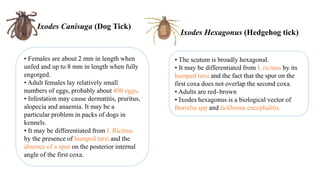
• Females are about 2 mm in length when
unfed and up to 8 mm in length when fully
engorged.
• Adult females lay relatively small
numbers of eggs, probably about 400 eggs.
• Infestation may cause dermatitis, pruritus,
alopecia and anaemia. It may be a
particular problem in packs of dogs in
kennels.
• It may be differentiated from I. Ricinus
by the presence of humped tarsi and the
absence of a spur on the posterior internal
angle of the first coxa.
Ixodes Canisuga (Dog Tick)
• The scutum is broadly hexagonal.
• It may be differentiated from I. ricinus by its
humped tarsi and the fact that the spur on the
first coxa does not overlap the second coxa.
• Adults are red–brown
• Ixodes hexagonus is a biological vector of
Borrelia spp and tickborne encephalitis.
Ixodes Hexagonus (Hedgehog tick)
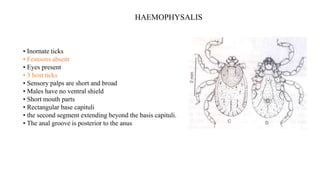
• Inornate ticks
• Festoons absent
• Eyes present
• 3 host ticks
• Sensory palps are short and broad
• Males have no ventral shield
• Short mouth parts
• Rectangular base capituli
• the second segment extending beyond the basis capituli.
• The anal groove is posterior to the anus
HAEMOPHYSALIS
• The transmission of Babesia major,
Babesia bigemina, Theileria mutans
(T. buffeli/orientalis), Anaplasma
marginale and A. centrale in cattle.
• In sheep, it transmits Babesia motasi
and the benign Theileria ovis.
• Cause tick paralysis
Haemaphysalis punctata
This species is responsible for the
transmission of
• Canine piroplasmosis (B. canis) in
dogs,
• Tickbite fever (Rickettsia conorii)
• Coxiella burnetii
Haemaphysalis leachi (Yellow dog tick)
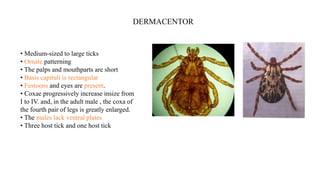
• Medium-sized to large ticks
• Ornate patterning
• The palps and mouthparts are short
• Basis capituli is rectangular
• Festoons and eyes are present.
• Coxae progressively increase insize from
I to IV. and, in the adult male , the coxa of
the fourth pair of legs is greatly enlarged.
• The males lack ventral plates
• Three host tick and one host tick
DERMACENTOR
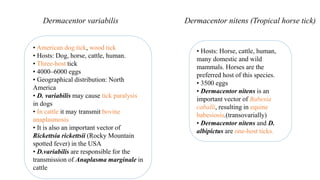
• American dog tick, wood tick
• Hosts: Dog, horse, cattle, human.
• Three-host tick
• 4000–6000 eggs
• Geographical distribution: North
America
• D. variabilis may cause tick paralysis
in dogs
• In cattle it may transmit bovine
anaplasmosis
• It is also an important vector of
Rickettsia rickettsii (Rocky Mountain
spotted fever) in the USA
• D.variabilis are responsible for the
transmission of Anaplasma marginale in
cattle
Dermacentor variabilis
• Hosts: Horse, cattle, human,
many domestic and wild
mammals. Horses are the
preferred host of this species.
• 3500 eggs
• Dermacentor nitens is an
important vector of Babesia
caballi, resulting in equine
babesiosis.(transovarially)
• Dermacentor nitens and D.
albipictus are one-host ticks.
Dermacentor nitens (Tropical horse tick)
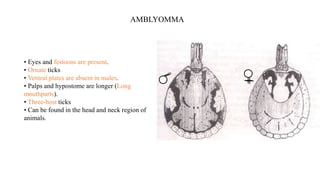
• Eyes and festoons are present.
• Ornate ticks
• Ventral plates are absent in males.
• Palps and hypostome are longer (Long
mouthparts).
• Three-host ticks
• Can be found in the head and neck region of
animals.
AMBLYOMMA
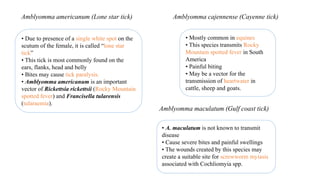
• Due to presence of a single white spot on the
scutum of the female, it is called “lone star
tick”
• This tick is most commonly found on the
ears, flanks, head and belly
• Bites may cause tick paralysis.
• Amblyomma americanum is an important
vector of Rickettsia rickettsii (Rocky Mountain
spotted fever) and Francisella tularensis
(tularaemia).
Amblyomma americanum (Lone star tick)
• Mostly common in equines
• This species transmits Rocky
Mountain spotted fever in South
America
• Painful biting
• May be a vector for the
transmission of heartwater in
cattle, sheep and goats.
Amblyomma cajennense (Cayenne tick)
• A. maculatum is not known to transmit
disease
• Cause severe bites and painful swellings
• The wounds created by this species may
create a suitable site for screwworm myiasis
associated with Cochliomyia spp.
Amblyomma maculatum (Gulf coast tick)
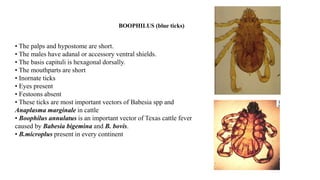
• The palps and hypostome are short.
• The males have adanal or accessory ventral shields.
• The basis capituli is hexagonal dorsally.
• The mouthparts are short
• Inornate ticks
• Eyes present
• Festoons absent
• These ticks are most important vectors of Babesia spp and
Anaplasma marginale in cattle
• Boophilus annulatus is an important vector of Texas cattle fever
caused by Babesia bigemina and B. bovis.
• B.microplus present in every continent
BOOPHILUS (blue ticks)
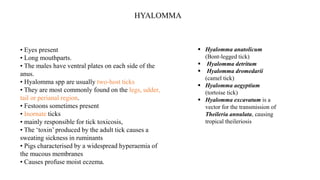
• Eyes present
• Long mouthparts.
• The males have ventral plates on each side of the
anus.
• Hyalomma spp are usually two-host ticks
• They are most commonly found on the legs, udder,
tail or perianal region.
• Festoons sometimes present
• Inornate ticks
• mainly responsible for tick toxicosis,
• The ‘toxin’ produced by the adult tick causes a
sweating sickness in ruminants
• Pigs characterised by a widespread hyperaemia of
the mucous membranes
• Causes profuse moist eczema.
HYALOMMA
 Hyalomma anatolicum
(Bont-legged tick)
 Hyalomma detritum
 Hyalomma dromedarii
(camel tick)
 Hyalomma aegyptium
(tortoise tick)
 Hyalomma excavatum is a
vector for the transmission of
Theileria annulata, causing
tropical theileriosis
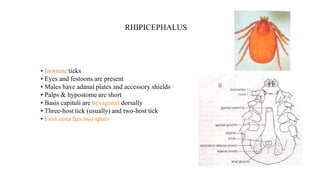
• Inornate ticks
• Eyes and festoons are present
• Males have adanal plates and accessory shields
• Palps & hypostome are short
• Basis capituli are hexagonal dorsally
• Three-host tick (usually) and two-host tick
• First coxa has two spurs
RHIPICEPHALUS
• Common name: Brown dog tick, kennel
tick
• Three-host tick
• Rhipicephalus sanguineus is primarily
parasitic on dogs and is responsible for the
transmission of Babesia canis and
Ehrlichia canis and can also cause tick
paralysis in the dog.
Rhipicephalus sanguineus
• Common name: Red-legged tick
• Black scutum,
• Two-host species of tick
• Can also transmit theilerial infections
and Babesia bigemina and B. equi.
Rhipicephalus evertsi
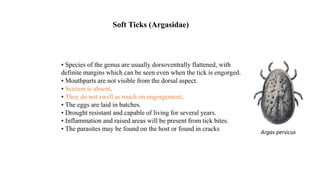
• Species of the genus are usually dorsoventrally flattened, with
definite margins which can be seen even when the tick is engorged.
• Mouthparts are not visible from the dorsal aspect.
• Scutum is absent.
• They do not swell as much on engorgement.
• The eggs are laid in batches.
• Drought resistant and capable of living for several years.
• Inflammation and raised areas will be present from tick bites.
• The parasites may be found on the host or found in cracks
Soft Ticks (Argasidae)
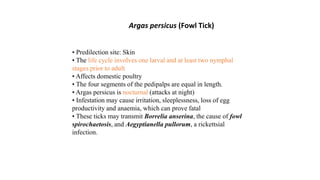
Argas persicus
• Predilection site: Skin
• The life cycle involves one larval and at least two nymphal
stages prior to adult
• Affects domestic poultry
• The four segments of the pedipalps are equal in length.
• Argas persicus is nocturnal (attacks at night)
• Infestation may cause irritation, sleeplessness, loss of egg
productivity and anaemia, which can prove fatal
• These ticks may transmit Borrelia anserina, the cause of fowl
spirochaetosis, and Aegyptianella pullorum, a rickettsial
infection.
Argas persicus (Fowl Tick)
• Use of chemical acaricides applied either by total immersion in a dipping bath or in the form of
a spray, shower, spot-on or slow release ear tags.
• A wide variety of formulations of organophosphate and pyrethroid insecticides are available for
application as sprays, dips, spot-on or showers
• Macrocyclic lactones or closantel given by the parenteral route have also been shown to be a
useful aid in control of ticks.
• The avermectins & milbemycins may play an increasing role in the control of one-host ticks.
• Severely parasitised animals require individual treatment, special formulations of acaricides
suspended in a greasy base may be applied to affected areas.
• Topical acaricidal compounds, such as fipronil (phenylpyrazole), imidacloprid
(chloronicotinyl), selamectin (macrocyclic lactone), amitraz (formamidine) and the
organophosphates (e.g. malathion, ronnel, chlorpyrifos, fenthion, dichlorvos, cythoate, diazinon,
propetamphos, phosmet) and carbamates can be used to kill ticks on the host.
Control
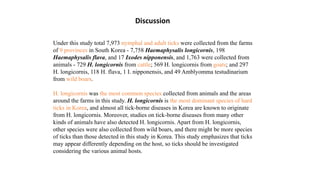
Under this study total 7,973 nymphal and adult ticks were collected from the farms
of 9 provinces in South Korea - 7,758 Haemaphysalis longicornis, 198
Haemaphysalis flava, and 17 Ixodes nipponensis, and 1,763 were collected from
animals - 729 H. longicornis from cattle; 569 H. longicornis from goats; and 297
H. longicornis, 118 H. flava, 1 I. nipponensis, and 49 Amblyomma testudinarium
from wild boars.
H. longicornis was the most common species collected from animals and the areas
around the farms in this study. H. longicornis is the most dominant species of hard
ticks in Korea, and almost all tick-borne diseases in Korea are known to originate
from H. longicornis. Moreover, studies on tick-borne diseases from many other
kinds of animals have also detected H. longicornis. Apart from H. longicornis,
other species were also collected from wild boars, and there might be more species
of ticks than those detected in this study in Korea. This study emphasizes that ticks
may appear differently depending on the host, so ticks should be investigated
considering the various animal hosts.
Discussion
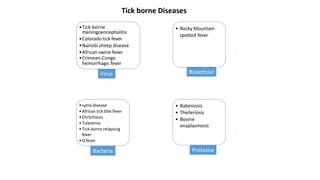
•Tick-borne
meningoencephalitis
•Colorado tick fever
•Nairobi sheep disease
•African swine fever
•Crimean-Congo
hemorrhagic fever
•Lyme disease
•African tick bite fever
•Ehrlichiosis
•Tularemia
•Tick-borne relapsing
fever
•Q fever
• Rocky Mountain
spotted fever
• Babesiosis
• Theileriosis
• Bovine
anaplasmosis
Virus Rickettsial
Bacteria Protozoa
Tick borne Diseases

Course presentation - Vet Ectoparasitology.pptx

  • 1.
    A Presentation onTicks of Veterinary Importance
  • 2.
    Introduction ❖ Blood suckingarthopods ❖ Most important vectors of human and animal diseases ❖ Life threatening vector (rank second; 1st Mosquitos) ❖Transmit greater variety of infections agents ❖Pest of man, animal and wildlife ❖ Causes Severe toxic condition (Tick Parasysis, Tick Toxicosis) ❖Tick-borne diseases major threat to livestock industry ❖Costs billions of dollars annually to protect livestock from ticks and tick-borne diseases Order: Acarina (Tick)
  • 3.
    Zoological Classification oftick Phylum: Arthopoda Sub phylum: Chelicerata (Chelicerae) Class: Arachnida (pedipalp, 4 pairs of legs) Sub-class: Acari (Fusion of body segment) Order: Acarina (Stigmatal pores) Sub-order: Ixodoidae Family: Ixodidae (Hard ticks) Argasidae (Soft ticks) Genus: Ixodes spp Boophilus spp Rhipicephalus spp Haemaphysalis spp Dermacentor spp Hyalomma spp Amblyomma spp Argus spp Otobius spp Ornithodorus spp Species: Boophilus microplus Argus percicus
  • 4.
    Distinguished by adorsal shield (Scutum), small in female, but covers the entire dorsal surface in males. They are also tapered anteriorly and the mouthparts are readily visible from the dorsal view. Soft Ticks are leathery and without a dorsal shield. Their mouthparts are sub- terminally attached and not visible from the dorsal view. Hard Tick Small Tick Hard Tick VS Soft Tick
  • 5.
    Hard Ticks SoftTicks Capitulum Anterior to body, visible from dorsum Invisible from dorsum Scutum Present Absent Pedipalpi Strong, Non-Movable Movable, Active Difference of Sexes Evident; Male smaller with large scutum and vice versa. Not evident, female large Position of Stigmal Plate Behind the base of 4th pair of legs Between 3rd and 4th pair of legs. Morphological Differences
  • 6.
    Ticks extract theblood by cutting a hole in the host's epidermis, into which they insert their hypostome, in order to keep the blood from clotting by excreting an anticoagulant or platelet aggregation inhibitor.
  • 7.
    Types of LifeCycle • One Host Tick (Larvae, nymphs and adults on same host ) • Two Host Tick (Larvae & nymph on same host but adult on different host) • Three Host Tick (Larvae, nymphs and adults all feed on different hosts) Clinical Signs • Presence of Parasites • Local Skin infections • inflamed nodules are also seen Diagnosis • The adult ticks, particularly the engorged females are easily seen on the skin • The predilection sites are face, ears, axilla and inguinal region
  • 8.
    Life Cycle ofOne Host tick Each stage feeds and develops on one host
  • 9.
    Life Cycle ofTwo Host tick Larva and Nymph feeds on one host and adult tick on second host
  • 10.
    Life Cycle ofThree Host tick Each stage feeds and develops on different host
  • 11.
    Family Ixodidae • Importantvectors of protozoal, bacterial, viral and rickettsial diseases • The ixodids have a chitinous covering or scutum which extends over the whole dorsal surface of the male, but covers only a small area behind the head in the larva, nymph or female. • Festoons (a row of notches ) is on posterior boarder of the body • Ixodidae the anal groove is either absent or present at posterior to the anus • Some ticks have coloured enamel-like areas on the body and these are called 'ornate ticks’. • The adults have a pair of spiracles behind the fourth pair of legs. • If the scutum has a pattern of grey and white on a dark background, it is described as ornate, if not it is described as inornate. • The anterior gnathosoma (or capitulum) and posterior idiosoma, which bears the legs.
  • 12.
    Generas • Ixodes • Haemaphysalis •Dermacentor Host • Mammals and Birds Species Common Tick • Ixodes ricinus; castor bean tick/ European sheep tick • Ixodes canisuga; British dog tick • Ixodes hexagonus; hedgehog tick. Some other species: • Ixodes holocyclus; the paralysis tick of Auslralia • Ixodes rubicundus; the paralysis tick of South Africa • Ixorles scupularis (Black-legged Tick); the shoulder tick of North America • Inornate ticks • No eyes • No festoons • Palps are long • Anal groove is present anterior to the anus Identification
  • 13.
    • In I.ricinus, as compared with I. canisuga and I. hexagonus, the tarsi are tapered and not humped • The engorged adult female is light grey and bean shaped • Adult male Ixodes ricinus are only 2.0–3.0 mm long • Nymphs resemble the adults but are less than 2.0 mm in length. • The larvae, often described as ‘seed ticks’ or ‘pepper ticks’, are less than 1.0 mm in length and usually yellowish in colour • Three-host tick • 3 years (life cycle) • Mating takes place on the host. • The female subsequently feeds for about 14 days and then comes to the ground to lay several thousand eggs in the soil in sheltered spots, over a period of about 30 days, after which it dies. • The larvae, nymphs and adults feed for a total of only 26-28 days • Unfed larvae can survive for approximately 13–19 months, unfed nymphs for 24 months and unfed adults for 21–31 months, but the precise period over which they can survive depends on temperature and humidity Life Cycle I. ricinus
  • 14.
    • Females areabout 2 mm in length when unfed and up to 8 mm in length when fully engorged. • Adult females lay relatively small numbers of eggs, probably about 400 eggs. • Infestation may cause dermatitis, pruritus, alopecia and anaemia. It may be a particular problem in packs of dogs in kennels. • It may be differentiated from I. Ricinus by the presence of humped tarsi and the absence of a spur on the posterior internal angle of the first coxa. Ixodes Canisuga (Dog Tick) • The scutum is broadly hexagonal. • It may be differentiated from I. ricinus by its humped tarsi and the fact that the spur on the first coxa does not overlap the second coxa. • Adults are red–brown • Ixodes hexagonus is a biological vector of Borrelia spp and tickborne encephalitis. Ixodes Hexagonus (Hedgehog tick)
  • 15.
    • Inornate ticks •Festoons absent • Eyes present • 3 host ticks • Sensory palps are short and broad • Males have no ventral shield • Short mouth parts • Rectangular base capituli • the second segment extending beyond the basis capituli. • The anal groove is posterior to the anus HAEMOPHYSALIS
  • 16.
    • The transmissionof Babesia major, Babesia bigemina, Theileria mutans (T. buffeli/orientalis), Anaplasma marginale and A. centrale in cattle. • In sheep, it transmits Babesia motasi and the benign Theileria ovis. • Cause tick paralysis Haemaphysalis punctata This species is responsible for the transmission of • Canine piroplasmosis (B. canis) in dogs, • Tickbite fever (Rickettsia conorii) • Coxiella burnetii Haemaphysalis leachi (Yellow dog tick)
  • 17.
    • Medium-sized tolarge ticks • Ornate patterning • The palps and mouthparts are short • Basis capituli is rectangular • Festoons and eyes are present. • Coxae progressively increase insize from I to IV. and, in the adult male , the coxa of the fourth pair of legs is greatly enlarged. • The males lack ventral plates • Three host tick and one host tick DERMACENTOR
  • 18.
    • American dogtick, wood tick • Hosts: Dog, horse, cattle, human. • Three-host tick • 4000–6000 eggs • Geographical distribution: North America • D. variabilis may cause tick paralysis in dogs • In cattle it may transmit bovine anaplasmosis • It is also an important vector of Rickettsia rickettsii (Rocky Mountain spotted fever) in the USA • D.variabilis are responsible for the transmission of Anaplasma marginale in cattle Dermacentor variabilis • Hosts: Horse, cattle, human, many domestic and wild mammals. Horses are the preferred host of this species. • 3500 eggs • Dermacentor nitens is an important vector of Babesia caballi, resulting in equine babesiosis.(transovarially) • Dermacentor nitens and D. albipictus are one-host ticks. Dermacentor nitens (Tropical horse tick)
  • 19.
    • Eyes andfestoons are present. • Ornate ticks • Ventral plates are absent in males. • Palps and hypostome are longer (Long mouthparts). • Three-host ticks • Can be found in the head and neck region of animals. AMBLYOMMA
  • 20.
    • Due topresence of a single white spot on the scutum of the female, it is called “lone star tick” • This tick is most commonly found on the ears, flanks, head and belly • Bites may cause tick paralysis. • Amblyomma americanum is an important vector of Rickettsia rickettsii (Rocky Mountain spotted fever) and Francisella tularensis (tularaemia). Amblyomma americanum (Lone star tick) • Mostly common in equines • This species transmits Rocky Mountain spotted fever in South America • Painful biting • May be a vector for the transmission of heartwater in cattle, sheep and goats. Amblyomma cajennense (Cayenne tick) • A. maculatum is not known to transmit disease • Cause severe bites and painful swellings • The wounds created by this species may create a suitable site for screwworm myiasis associated with Cochliomyia spp. Amblyomma maculatum (Gulf coast tick)
  • 21.
    • The palpsand hypostome are short. • The males have adanal or accessory ventral shields. • The basis capituli is hexagonal dorsally. • The mouthparts are short • Inornate ticks • Eyes present • Festoons absent • These ticks are most important vectors of Babesia spp and Anaplasma marginale in cattle • Boophilus annulatus is an important vector of Texas cattle fever caused by Babesia bigemina and B. bovis. • B.microplus present in every continent BOOPHILUS (blue ticks)
  • 22.
    • Eyes present •Long mouthparts. • The males have ventral plates on each side of the anus. • Hyalomma spp are usually two-host ticks • They are most commonly found on the legs, udder, tail or perianal region. • Festoons sometimes present • Inornate ticks • mainly responsible for tick toxicosis, • The ‘toxin’ produced by the adult tick causes a sweating sickness in ruminants • Pigs characterised by a widespread hyperaemia of the mucous membranes • Causes profuse moist eczema. HYALOMMA  Hyalomma anatolicum (Bont-legged tick)  Hyalomma detritum  Hyalomma dromedarii (camel tick)  Hyalomma aegyptium (tortoise tick)  Hyalomma excavatum is a vector for the transmission of Theileria annulata, causing tropical theileriosis
  • 23.
    • Inornate ticks •Eyes and festoons are present • Males have adanal plates and accessory shields • Palps & hypostome are short • Basis capituli are hexagonal dorsally • Three-host tick (usually) and two-host tick • First coxa has two spurs RHIPICEPHALUS
  • 24.
    • Common name:Brown dog tick, kennel tick • Three-host tick • Rhipicephalus sanguineus is primarily parasitic on dogs and is responsible for the transmission of Babesia canis and Ehrlichia canis and can also cause tick paralysis in the dog. Rhipicephalus sanguineus • Common name: Red-legged tick • Black scutum, • Two-host species of tick • Can also transmit theilerial infections and Babesia bigemina and B. equi. Rhipicephalus evertsi
  • 25.
    • Species ofthe genus are usually dorsoventrally flattened, with definite margins which can be seen even when the tick is engorged. • Mouthparts are not visible from the dorsal aspect. • Scutum is absent. • They do not swell as much on engorgement. • The eggs are laid in batches. • Drought resistant and capable of living for several years. • Inflammation and raised areas will be present from tick bites. • The parasites may be found on the host or found in cracks Soft Ticks (Argasidae) Argas persicus
  • 26.
    • Predilection site:Skin • The life cycle involves one larval and at least two nymphal stages prior to adult • Affects domestic poultry • The four segments of the pedipalps are equal in length. • Argas persicus is nocturnal (attacks at night) • Infestation may cause irritation, sleeplessness, loss of egg productivity and anaemia, which can prove fatal • These ticks may transmit Borrelia anserina, the cause of fowl spirochaetosis, and Aegyptianella pullorum, a rickettsial infection. Argas persicus (Fowl Tick)
  • 27.
    • Use ofchemical acaricides applied either by total immersion in a dipping bath or in the form of a spray, shower, spot-on or slow release ear tags. • A wide variety of formulations of organophosphate and pyrethroid insecticides are available for application as sprays, dips, spot-on or showers • Macrocyclic lactones or closantel given by the parenteral route have also been shown to be a useful aid in control of ticks. • The avermectins & milbemycins may play an increasing role in the control of one-host ticks. • Severely parasitised animals require individual treatment, special formulations of acaricides suspended in a greasy base may be applied to affected areas. • Topical acaricidal compounds, such as fipronil (phenylpyrazole), imidacloprid (chloronicotinyl), selamectin (macrocyclic lactone), amitraz (formamidine) and the organophosphates (e.g. malathion, ronnel, chlorpyrifos, fenthion, dichlorvos, cythoate, diazinon, propetamphos, phosmet) and carbamates can be used to kill ticks on the host. Control
  • 29.
    Under this studytotal 7,973 nymphal and adult ticks were collected from the farms of 9 provinces in South Korea - 7,758 Haemaphysalis longicornis, 198 Haemaphysalis flava, and 17 Ixodes nipponensis, and 1,763 were collected from animals - 729 H. longicornis from cattle; 569 H. longicornis from goats; and 297 H. longicornis, 118 H. flava, 1 I. nipponensis, and 49 Amblyomma testudinarium from wild boars. H. longicornis was the most common species collected from animals and the areas around the farms in this study. H. longicornis is the most dominant species of hard ticks in Korea, and almost all tick-borne diseases in Korea are known to originate from H. longicornis. Moreover, studies on tick-borne diseases from many other kinds of animals have also detected H. longicornis. Apart from H. longicornis, other species were also collected from wild boars, and there might be more species of ticks than those detected in this study in Korea. This study emphasizes that ticks may appear differently depending on the host, so ticks should be investigated considering the various animal hosts. Discussion
  • 30.
    •Tick-borne meningoencephalitis •Colorado tick fever •Nairobisheep disease •African swine fever •Crimean-Congo hemorrhagic fever •Lyme disease •African tick bite fever •Ehrlichiosis •Tularemia •Tick-borne relapsing fever •Q fever • Rocky Mountain spotted fever • Babesiosis • Theileriosis • Bovine anaplasmosis Virus Rickettsial Bacteria Protozoa Tick borne Diseases