Prof. Dr. Mohamed Ghanem
Prof Vet. Internal Medicine
Dean, Faculty Vet Medicine, Benha University
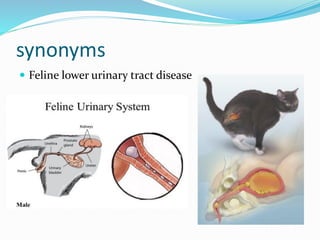
synonyms
 Feline lower urinary tract disease
Definition
It is a combination of different
affections of the urinary tract of
cats. It usually occurs in male cats
1-5 years old (cystitis, urolithiasis,
urethral obstruction and uremia)
Causes of FUS
 The castration will affect the testosterone
secretion and consequently play an
important role in the precipitation of
crystals and formation of the calculi.
 Lack of fluid intake leads to increase urine
concentration and so calculi formation.
 Hereditary factors may predispose for this
condition.
 Struvite calculi (magnesium phosphate) is
common form due to feeding dry food
 Calcium oxalate calculi are currently more
dangerous because it does not dissolve I
acidic media
Pathogenesis:
 Most cases occurs in male cats because of long
narrow urethra (female cat may have cystitis
form)
 Mostly occur in cats feed dry commercial food
 Normally the struvite crystals are soluble in the
acidic urine.
 Urine stagnation or retention will give chance for
some micro-organisms to multiplicate and
changing the pH to the alkaline side.
 Alkaline pH makes the struvite crystals insoluble
which led struvite formation ad calculi.
 Both crystal formation, calculi and UT infection
may block the urethra leading to dysuria, pain,
bloody urine and anorexia
Clinical symptoms
1. The cat showed signs of pain which began mild then
become severe (crying during urination)..dysuria
2. Increased frequency of urination
3. After that the male cat may lick the penis (due to
inflammed urethra).
4. Bloody tinged urine either may occur on ground of house
or noticed dripping from the penis indicating
haematuria.
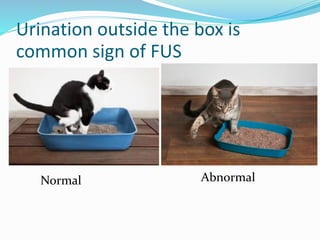
5. Inappropriate urination (that is, outside of the litter
box)
6. Physical examination or palpation revealed painful
distended urinary bladder.
7. In the female cat the signs may be directed to cystitis
form, with abnormal sites of urination, anorexia and
severe weight loss.
Urination outside the box is
common sign of FUS
Normal Abnormal
Lab. Findings
 Urine exam, if excreted, may reveal blood, proteinurea:
or crystals.
 Blood showed high urea and creatinine levels.
 Serum K, Cl, HCO3 were elevated.
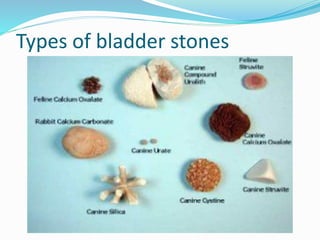
Types of bladder stones
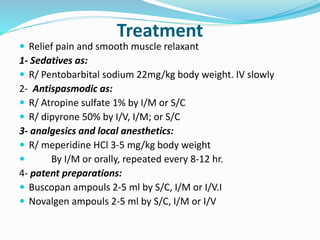
Treatment
 Relief pain and smooth muscle relaxant
1- Sedatives as:
 R/ Pentobarbital sodium 22mg/kg body weight. IV slowly
2- Antispasmodic as:
 R/ Atropine sulfate 1% by I/M or S/C
 R/ dipyrone 50% by I/V, I/M; or S/C
3- analgesics and local anesthetics:
 R/ meperidine HCl 3-5 mg/kg body weight
 By I/M or orally, repeated every 8-12 hr.
4- patent preparations:
 Buscopan ampouls 2-5 ml by S/C, I/M or I/V.I
 Novalgen ampouls 2-5 ml by S/C, I/M or I/V
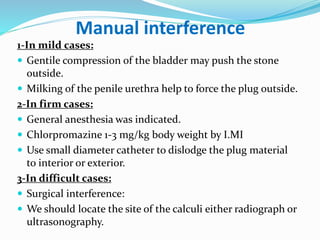
Manual interference
1-In mild cases:
 Gentile compression of the bladder may push the stone
outside.
 Milking of the penile urethra help to force the plug outside.
2-In firm cases:
 General anesthesia was indicated.
 Chlorpromazine 1-3 mg/kg body weight by I.MI
 Use small diameter catheter to dislodge the plug material
to interior or exterior.
3-In difficult cases:
 Surgical interference:
 We should locate the site of the calculi either radiograph or
ultrasonography.
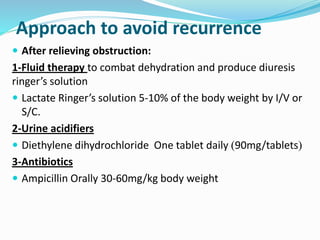
Approach to avoid recurrence
 After relieving obstruction:
1-Fluid therapy to combat dehydration and produce diuresis
ringer’s solution
 Lactate Ringer’s solution 5-10% of the body weight by I/V or
S/C.
2-Urine acidifiers
 Diethylene dihydrochloride One tablet daily (90mg/tablets)
3-Antibiotics
 Ampicillin Orally 30-60mg/kg body weight

Feline urological syndrome 2018

  • 1.
    Prof. Dr. MohamedGhanem Prof Vet. Internal Medicine Dean, Faculty Vet Medicine, Benha University
  • 2.
    synonyms  Feline lowerurinary tract disease
  • 3.
    Definition It is acombination of different affections of the urinary tract of cats. It usually occurs in male cats 1-5 years old (cystitis, urolithiasis, urethral obstruction and uremia)
  • 4.
    Causes of FUS The castration will affect the testosterone secretion and consequently play an important role in the precipitation of crystals and formation of the calculi.  Lack of fluid intake leads to increase urine concentration and so calculi formation.  Hereditary factors may predispose for this condition.  Struvite calculi (magnesium phosphate) is common form due to feeding dry food  Calcium oxalate calculi are currently more dangerous because it does not dissolve I acidic media
  • 5.
    Pathogenesis:  Most casesoccurs in male cats because of long narrow urethra (female cat may have cystitis form)  Mostly occur in cats feed dry commercial food  Normally the struvite crystals are soluble in the acidic urine.  Urine stagnation or retention will give chance for some micro-organisms to multiplicate and changing the pH to the alkaline side.  Alkaline pH makes the struvite crystals insoluble which led struvite formation ad calculi.  Both crystal formation, calculi and UT infection may block the urethra leading to dysuria, pain, bloody urine and anorexia
  • 6.
    Clinical symptoms 1. Thecat showed signs of pain which began mild then become severe (crying during urination)..dysuria 2. Increased frequency of urination 3. After that the male cat may lick the penis (due to inflammed urethra). 4. Bloody tinged urine either may occur on ground of house or noticed dripping from the penis indicating haematuria. 5. Inappropriate urination (that is, outside of the litter box) 6. Physical examination or palpation revealed painful distended urinary bladder. 7. In the female cat the signs may be directed to cystitis form, with abnormal sites of urination, anorexia and severe weight loss.
  • 7.
    Urination outside thebox is common sign of FUS Normal Abnormal
  • 8.
    Lab. Findings  Urineexam, if excreted, may reveal blood, proteinurea: or crystals.  Blood showed high urea and creatinine levels.  Serum K, Cl, HCO3 were elevated.
  • 9.
  • 10.
    Treatment  Relief painand smooth muscle relaxant 1- Sedatives as:  R/ Pentobarbital sodium 22mg/kg body weight. IV slowly 2- Antispasmodic as:  R/ Atropine sulfate 1% by I/M or S/C  R/ dipyrone 50% by I/V, I/M; or S/C 3- analgesics and local anesthetics:  R/ meperidine HCl 3-5 mg/kg body weight  By I/M or orally, repeated every 8-12 hr. 4- patent preparations:  Buscopan ampouls 2-5 ml by S/C, I/M or I/V.I  Novalgen ampouls 2-5 ml by S/C, I/M or I/V
  • 11.
    Manual interference 1-In mildcases:  Gentile compression of the bladder may push the stone outside.  Milking of the penile urethra help to force the plug outside. 2-In firm cases:  General anesthesia was indicated.  Chlorpromazine 1-3 mg/kg body weight by I.MI  Use small diameter catheter to dislodge the plug material to interior or exterior. 3-In difficult cases:  Surgical interference:  We should locate the site of the calculi either radiograph or ultrasonography.
  • 12.
    Approach to avoidrecurrence  After relieving obstruction: 1-Fluid therapy to combat dehydration and produce diuresis ringer’s solution  Lactate Ringer’s solution 5-10% of the body weight by I/V or S/C. 2-Urine acidifiers  Diethylene dihydrochloride One tablet daily (90mg/tablets) 3-Antibiotics  Ampicillin Orally 30-60mg/kg body weight