1

1/26/2014

NGS
Data Formats & QC Analysis

Karan Veer Singh
Scientist, NBAGR
2

1/26/2014

Sequence Formats
 All

Sequence formats are ASCII text
containing sequence ID, Quality Scores,
Annotation details, comments, and other
descriptions about sequence

 Formats

are designed to hold sequence
data and other information about
sequence
3

1/26/2014

Why so many formats?


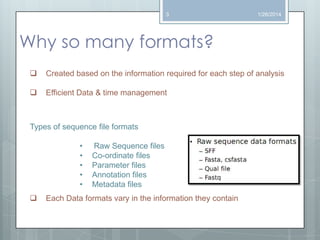
Created based on the information required for each step of analysis



Efficient Data & time management

Types of sequence file formats
•
•
•
•
•


Raw Sequence files
Co-ordinate files
Parameter files
Annotation files
Metadata files

Each Data formats vary in the information they contain
4

Read output formats
 454

 Solexa/Illumina
 SOLiD

1/26/2014
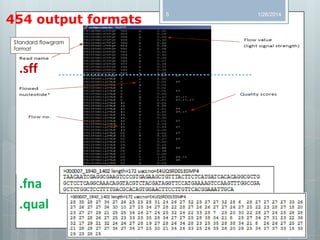
454 output formats
Standard flowgram
format

.sff

.fna
.qual

5

1/26/2014
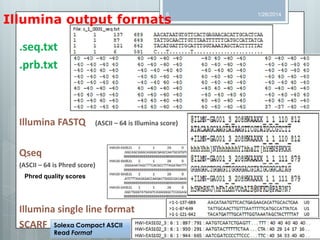
Illumina output formats
6

.seq.txt
.prb.txt

Illumina FASTQ

(ASCII – 64 is Illumina score)

Qseq
(ASCII – 64 is Phred score)
Phred quality scores

Illumina single line format
SCARF Solexa Compact ASCII
Read Format

1/26/2014
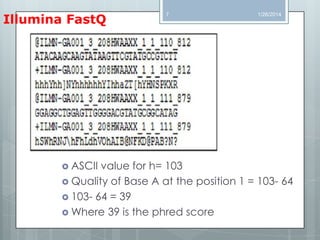
Illumina FastQ

 ASCII

7

1/26/2014

value for h= 103
 Quality of Base A at the position 1 = 103- 64
 103- 64 = 39
 Where 39 is the phred score
8

1/26/2014

SOLiD output format(s)

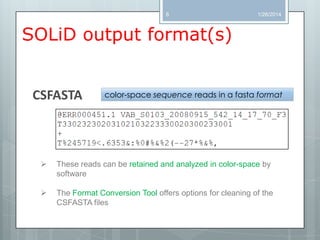
CSFASTA

color-space sequence reads in a fasta format



These reads can be retained and analyzed in color-space by
software



The Format Conversion Tool offers options for cleaning of the
CSFASTA files
Read Length
• Sanger reads lengths ~ 800-2000bp
• Generally we define short reads as anything below 200bp
−Illumina (100bp – 250bp)
−SoLID (75bp max)
−Ion Torrent (200-300bp max – currently...)
−Roche 454 – 400-800bp
• Even with these platforms it is cheaper to produce short reads (e.g. 50bp)
rather than 100 or 200bp reads
• Diminishing returns:
−For some applications 50bp is more than sufficient
−Resequencing of smaller organisms
−Bacterial de-novo assembly
−ChIP-Seq
−Digital Gene Expression profiling
−Bacterial RNA-seq
10

1/26/2014

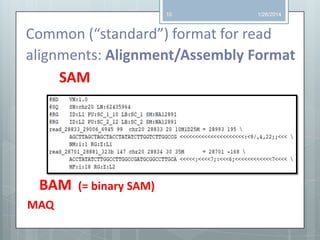
Common (“standard”) format for read
alignments: Alignment/Assembly Format
SAM

BAM
MAQ

(= binary SAM)
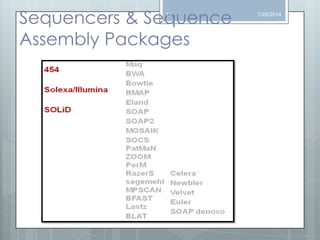
Sequencers & Sequence
Assembly Packages
11

1/26/2014
12

1/26/2014

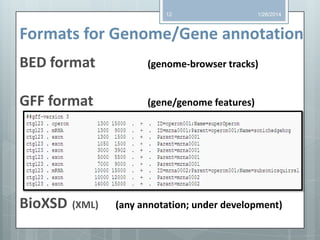
Formats for Genome/Gene annotation
BED format

(genome-browser tracks)

GFF format

(gene/genome features)

BioXSD

(XML)

(any annotation; under development)
13

1/26/2014

If reads should be deposited in a public
repository:
SRA (Short Read Archive) at NCBI
14

1/26/2014

Points to remember on Data Formats
 For base-call data, “standard” FASTQ (Sanger, Phred)
 For read alignments, SAM/BAM/MAQ format
 For annotation results (e.g. GFF or BED format)
15

QC analysis

1/26/2014
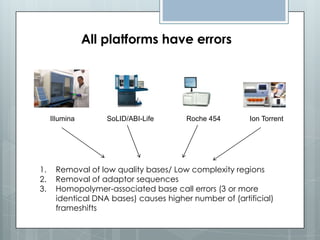
All platforms have errors

Illumina

1.
2.
3.

SoLID/ABI-Life

Roche 454

Ion Torrent

Removal of low quality bases/ Low complexity regions
Removal of adaptor sequences
Homopolymer-associated base call errors (3 or more
identical DNA bases) causes higher number of (artificial)
frameshifts
Illumina artefacts

 under represented GC rich regions
 PCR
 Sequencing
 GGC/GCC motif is associated with low
quality and mismatches
 Low quality reads < 20% phred score
18

1/26/2014

Need for QC & Preprocessing
QC analysis of sequence data is extremely important for meaningful
downstream analysis


To analyze problems in quality scores/ statistics of sequencing data



To check whether further analysis with sequence is possible



To remove redundancy (filtering)



To remove low quality reads from analysis



To remove adapter contamination

Highly efficient and fast processing tools are required to handle large volume
of datasets
19

1/26/2014

Need for QC & Preprocessing
 The

quality of data is very important for various
downstream analyses, such as sequence assembly,
single nucleotide polymorphisms identification

 Most

of the programs available for downstream
analyses do not provide the utility for quality check
and filtering of NGS data before processing
20

1/26/2014

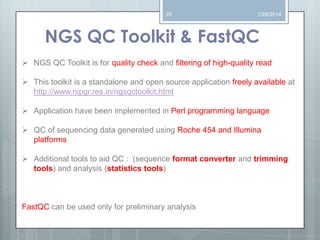
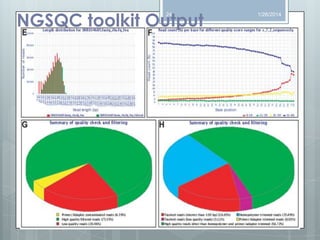
NGS QC Toolkit & FastQC
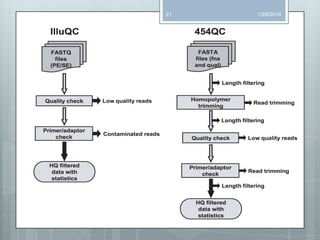
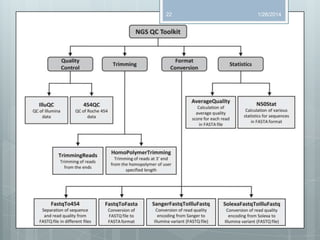
 NGS QC Toolkit is for quality check and filtering of high-quality read

 This toolkit is a standalone and open source application freely available at
http://www.nipgr.res.in/ngsqctoolkit.html
 Application have been implemented in Perl programming language
 QC of sequencing data generated using Roche 454 and Illumina
platforms
 Additional tools to aid QC : (sequence format converter and trimming
tools) and analysis (statistics tools)

FastQC can be used only for preliminary analysis
21

1/26/2014
22

1/26/2014
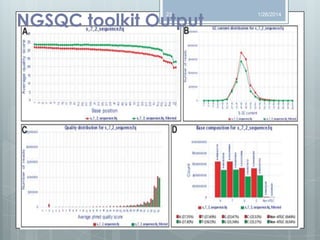
NGSQC toolkit Output
23

1/26/2014
NGSQC toolkit Output
24

1/26/2014
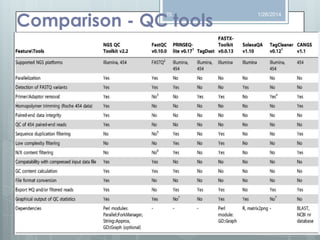
Comparison - QC tools
25

1/26/2014
26

1/26/2014

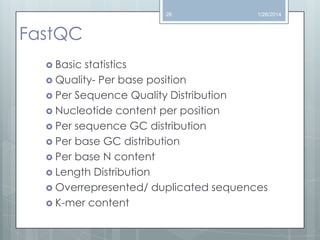
FastQC
 Basic

statistics
 Quality- Per base position
 Per Sequence Quality Distribution
 Nucleotide content per position
 Per sequence GC distribution
 Per base GC distribution
 Per base N content
 Length Distribution
 Overrepresented/ duplicated sequences
 K-mer content
27

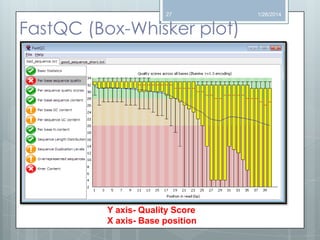
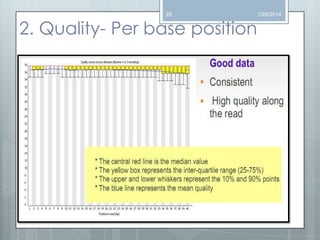
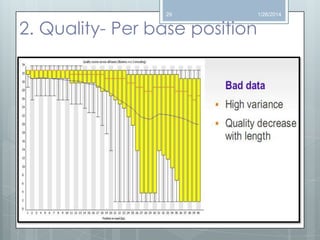
FastQC (Box-Whisker plot)

Y axis- Quality Score
X axis- Base position

1/26/2014
28

2. Quality- Per base position

1/26/2014
29

2. Quality- Per base position

1/26/2014
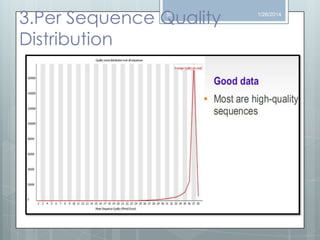
3.Per Sequence Quality
Distribution
30

1/26/2014
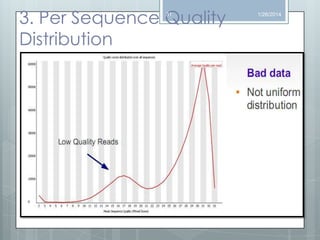
3. Per Sequence Quality
Distribution
31

1/26/2014
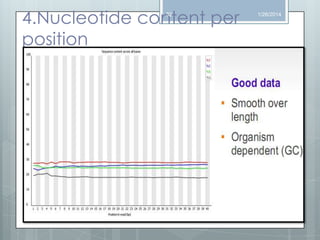
4.Nucleotide content per
position
32

1/26/2014
33

1/26/2014

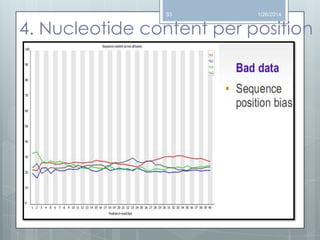
4. Nucleotide content per position
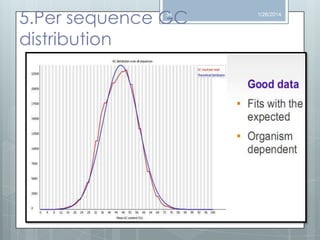
5.Per sequence GC
distribution
34

1/26/2014
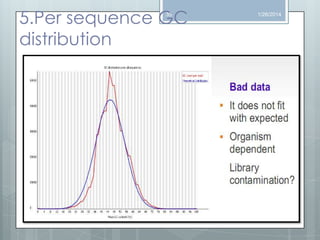
5.Per sequence GC
distribution
35

1/26/2014
36

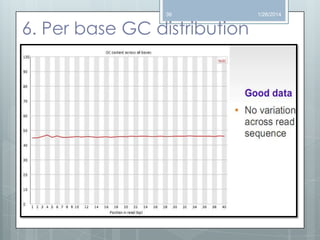
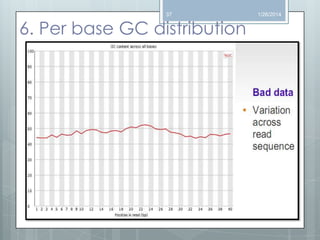
6. Per base GC distribution

1/26/2014
37

6. Per base GC distribution

1/26/2014
38

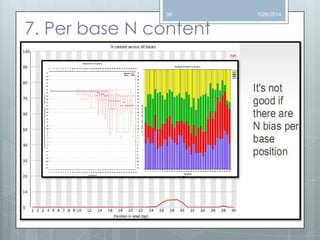
7. Per base N content

1/26/2014
39

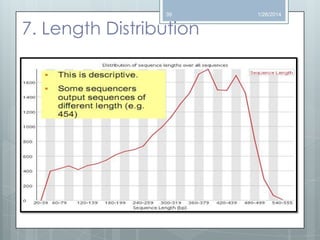
7. Length Distribution

1/26/2014
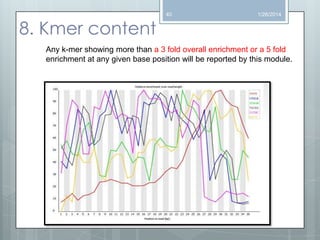
8. Kmer content

40

1/26/2014

Any k-mer showing more than a 3 fold overall enrichment or a 5 fold
enrichment at any given base position will be reported by this module.
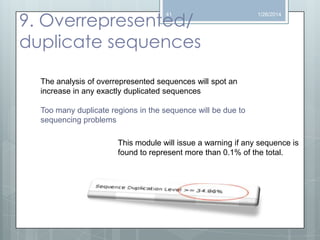
9. Overrepresented/
duplicate sequences
41

1/26/2014

The analysis of overrepresented sequences will spot an
increase in any exactly duplicated sequences
Too many duplicate regions in the sequence will be due to
sequencing problems
This module will issue a warning if any sequence is
found to represent more than 0.1% of the total.
42

1/26/2014

QC Report
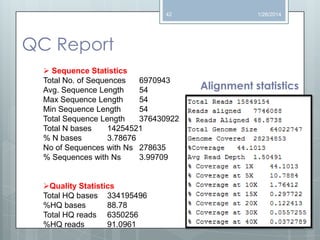
 Sequence Statistics
Total No. of Sequences
6970943
Avg. Sequence Length
54
Max Sequence Length
54
Min Sequence Length
54
Total Sequence Length
376430922
Total N bases
14254521
% N bases
3.78676
No of Sequences with Ns 278635
% Sequences with Ns
3.99709
Quality Statistics
Total HQ bases 334195496
%HQ bases
88.78
Total HQ reads 6350256
%HQ reads
91.0961

Alignment statistics

NGS - QC & Dataformat

  • 1.
    1 1/26/2014 NGS Data Formats &QC Analysis Karan Veer Singh Scientist, NBAGR
  • 2.
    2 1/26/2014 Sequence Formats  All Sequenceformats are ASCII text containing sequence ID, Quality Scores, Annotation details, comments, and other descriptions about sequence  Formats are designed to hold sequence data and other information about sequence
  • 3.
    3 1/26/2014 Why so manyformats?  Created based on the information required for each step of analysis  Efficient Data & time management Types of sequence file formats • • • • •  Raw Sequence files Co-ordinate files Parameter files Annotation files Metadata files Each Data formats vary in the information they contain
  • 4.
    4 Read output formats 454  Solexa/Illumina  SOLiD 1/26/2014
  • 5.
    454 output formats Standardflowgram format .sff .fna .qual 5 1/26/2014
  • 6.
    Illumina output formats 6 .seq.txt .prb.txt IlluminaFASTQ (ASCII – 64 is Illumina score) Qseq (ASCII – 64 is Phred score) Phred quality scores Illumina single line format SCARF Solexa Compact ASCII Read Format 1/26/2014
  • 7.
    Illumina FastQ  ASCII 7 1/26/2014 valuefor h= 103  Quality of Base A at the position 1 = 103- 64  103- 64 = 39  Where 39 is the phred score
  • 8.
    8 1/26/2014 SOLiD output format(s) CSFASTA color-spacesequence reads in a fasta format  These reads can be retained and analyzed in color-space by software  The Format Conversion Tool offers options for cleaning of the CSFASTA files
  • 9.
    Read Length • Sangerreads lengths ~ 800-2000bp • Generally we define short reads as anything below 200bp −Illumina (100bp – 250bp) −SoLID (75bp max) −Ion Torrent (200-300bp max – currently...) −Roche 454 – 400-800bp • Even with these platforms it is cheaper to produce short reads (e.g. 50bp) rather than 100 or 200bp reads • Diminishing returns: −For some applications 50bp is more than sufficient −Resequencing of smaller organisms −Bacterial de-novo assembly −ChIP-Seq −Digital Gene Expression profiling −Bacterial RNA-seq
  • 10.
    10 1/26/2014 Common (“standard”) formatfor read alignments: Alignment/Assembly Format SAM BAM MAQ (= binary SAM)
  • 11.
    Sequencers & Sequence AssemblyPackages 11 1/26/2014
  • 12.
    12 1/26/2014 Formats for Genome/Geneannotation BED format (genome-browser tracks) GFF format (gene/genome features) BioXSD (XML) (any annotation; under development)
  • 13.
    13 1/26/2014 If reads shouldbe deposited in a public repository: SRA (Short Read Archive) at NCBI
  • 14.
    14 1/26/2014 Points to rememberon Data Formats  For base-call data, “standard” FASTQ (Sanger, Phred)  For read alignments, SAM/BAM/MAQ format  For annotation results (e.g. GFF or BED format)
  • 15.
  • 16.
    All platforms haveerrors Illumina 1. 2. 3. SoLID/ABI-Life Roche 454 Ion Torrent Removal of low quality bases/ Low complexity regions Removal of adaptor sequences Homopolymer-associated base call errors (3 or more identical DNA bases) causes higher number of (artificial) frameshifts
  • 17.
    Illumina artefacts  underrepresented GC rich regions  PCR  Sequencing  GGC/GCC motif is associated with low quality and mismatches  Low quality reads < 20% phred score
  • 18.
    18 1/26/2014 Need for QC& Preprocessing QC analysis of sequence data is extremely important for meaningful downstream analysis  To analyze problems in quality scores/ statistics of sequencing data  To check whether further analysis with sequence is possible  To remove redundancy (filtering)  To remove low quality reads from analysis  To remove adapter contamination Highly efficient and fast processing tools are required to handle large volume of datasets
  • 19.
    19 1/26/2014 Need for QC& Preprocessing  The quality of data is very important for various downstream analyses, such as sequence assembly, single nucleotide polymorphisms identification  Most of the programs available for downstream analyses do not provide the utility for quality check and filtering of NGS data before processing
  • 20.
    20 1/26/2014 NGS QC Toolkit& FastQC  NGS QC Toolkit is for quality check and filtering of high-quality read  This toolkit is a standalone and open source application freely available at http://www.nipgr.res.in/ngsqctoolkit.html  Application have been implemented in Perl programming language  QC of sequencing data generated using Roche 454 and Illumina platforms  Additional tools to aid QC : (sequence format converter and trimming tools) and analysis (statistics tools) FastQC can be used only for preliminary analysis
  • 21.
  • 22.
  • 23.
  • 24.
  • 25.
    Comparison - QCtools 25 1/26/2014
  • 26.
    26 1/26/2014 FastQC  Basic statistics  Quality-Per base position  Per Sequence Quality Distribution  Nucleotide content per position  Per sequence GC distribution  Per base GC distribution  Per base N content  Length Distribution  Overrepresented/ duplicated sequences  K-mer content
  • 27.
    27 FastQC (Box-Whisker plot) Yaxis- Quality Score X axis- Base position 1/26/2014
  • 28.
    28 2. Quality- Perbase position 1/26/2014
  • 29.
    29 2. Quality- Perbase position 1/26/2014
  • 30.
  • 31.
    3. Per SequenceQuality Distribution 31 1/26/2014
  • 32.
  • 33.
  • 34.
  • 35.
  • 36.
    36 6. Per baseGC distribution 1/26/2014
  • 37.
    37 6. Per baseGC distribution 1/26/2014
  • 38.
    38 7. Per baseN content 1/26/2014
  • 39.
  • 40.
    8. Kmer content 40 1/26/2014 Anyk-mer showing more than a 3 fold overall enrichment or a 5 fold enrichment at any given base position will be reported by this module.
  • 41.
    9. Overrepresented/ duplicate sequences 41 1/26/2014 Theanalysis of overrepresented sequences will spot an increase in any exactly duplicated sequences Too many duplicate regions in the sequence will be due to sequencing problems This module will issue a warning if any sequence is found to represent more than 0.1% of the total.
  • 42.
    42 1/26/2014 QC Report  SequenceStatistics Total No. of Sequences 6970943 Avg. Sequence Length 54 Max Sequence Length 54 Min Sequence Length 54 Total Sequence Length 376430922 Total N bases 14254521 % N bases 3.78676 No of Sequences with Ns 278635 % Sequences with Ns 3.99709 Quality Statistics Total HQ bases 334195496 %HQ bases 88.78 Total HQ reads 6350256 %HQ reads 91.0961 Alignment statistics