SRI KRISHNA COLLEGE OF ENGINEERING AND TECHNOLOGY
DEPARTMENT OF MECHATRONICS ENGINEERING
Session: CATALYTIC CONVERTER
11/24/2020 16MT407 - Theory of Automobile Engineering 1
MODULE 1
SESSION OBJECTIVES
11/24/2020 16MT407 - Theory of Automobile Engineering 2
 On the completion of this session, the students might
be able to understand,
 Function of catalytic Converter
Topics
 Introduction
 History
 Construction of catalytic Converter
 Working of catalytic Converter
 Types of catalytic converter
 Advantages
 Conclusion
11/24/2020 16MT407 - Theory of Automobile Engineering 3
INTRODUCTION
11/24/2020 16MT407 - Theory of Automobile Engineering 4
VEHICLE EMISSION:
 Vehicular emission is a substance
discharged into air, especially by an
internal combustion engine
 It includes a number of biologically active
substance CO, HC, and NOx.
INTRODUCTION
11/24/2020 16MT407 - Theory of Automobile Engineering 5
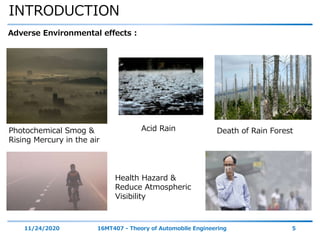
Adverse Environmental effects :
Photochemical Smog &
Rising Mercury in the air
Acid Rain Death of Rain Forest
Health Hazard &
Reduce Atmospheric
Visibility
INTRODUCTION
11/24/2020 16MT407 - Theory of Automobile Engineering 6
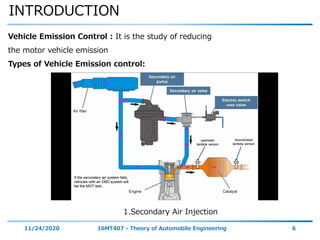
Vehicle Emission Control : It is the study of reducing
the motor vehicle emission
Types of Vehicle Emission control:
1.Secondary Air Injection
INTRODUCTION
11/24/2020 16MT407 - Theory of Automobile Engineering 7
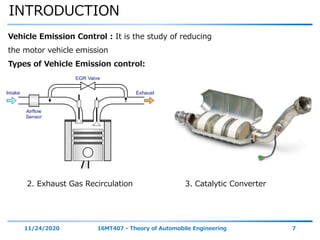
Vehicle Emission Control : It is the study of reducing
the motor vehicle emission
Types of Vehicle Emission control:
2. Exhaust Gas Recirculation 3. Catalytic Converter
INTRODUCTION
11/24/2020 16MT407 - Theory of Automobile Engineering 8
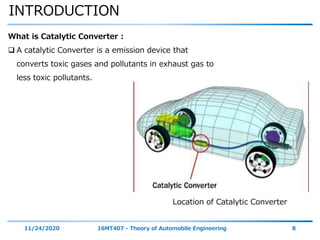
What is Catalytic Converter :
 A catalytic Converter is a emission device that
converts toxic gases and pollutants in exhaust gas to
less toxic pollutants.
Location of Catalytic Converter
HISTORY
11/24/2020 16MT407 - Theory of Automobile Engineering 9
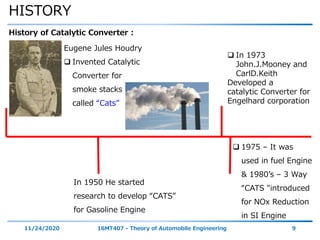
History of Catalytic Converter :
Eugene Jules Houdry
 Invented Catalytic
Converter for
smoke stacks
called “Cats”
In 1950 He started
research to develop “CATS”
for Gasoline Engine
 In 1973
John.J.Mooney and
CarlD.Keith
Developed a
catalytic Converter for
Engelhard corporation
 1975 – It was
used in fuel Engine
& 1980’s – 3 Way
“CATS "introduced
for NOx Reduction
in SI Engine
CONSTRUCTION OF CATS
11/24/2020 16MT407 - Theory of Automobile Engineering 10
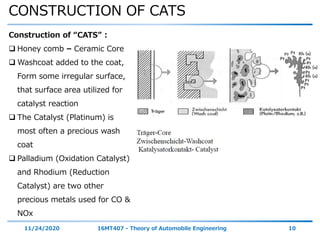
Construction of “CATS” :
 Honey comb – Ceramic Core
 Washcoat added to the coat,
Form some irregular surface,
that surface area utilized for
catalyst reaction
 The Catalyst (Platinum) is
most often a precious wash
coat
 Palladium (Oxidation Catalyst)
and Rhodium (Reduction
Catalyst) are two other
precious metals used for CO &
NOx
WORKING OF CATS
11/24/2020 16MT407 - Theory of Automobile Engineering 11
Working of “CATS” :
 In chemistry, a catalyst is substance that causes or
accelerates a chemical reaction without itself being
affected
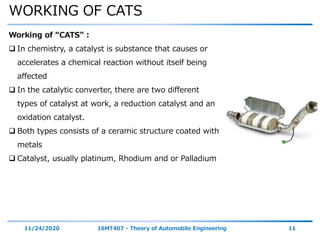
 In the catalytic converter, there are two different
types of catalyst at work, a reduction catalyst and an
oxidation catalyst.
 Both types consists of a ceramic structure coated with
metals
 Catalyst, usually platinum, Rhodium and or Palladium
TYPES OF CATALYTIC CONVERTER
11/24/2020 16MT407 - Theory of Automobile Engineering 12
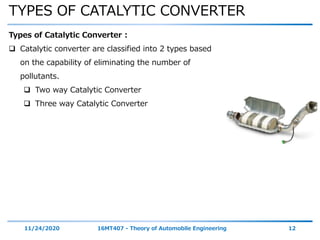
Types of Catalytic Converter :
 Catalytic converter are classified into 2 types based
on the capability of eliminating the number of
pollutants.
 Two way Catalytic Converter
 Three way Catalytic Converter
TYPES OF CATALYTIC CONVERTER
11/24/2020 16MT407 - Theory of Automobile Engineering 13
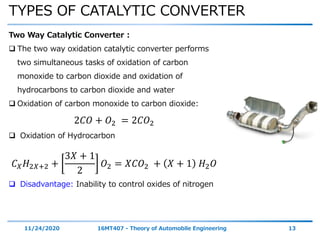
Two Way Catalytic Converter :
 The two way oxidation catalytic converter performs
two simultaneous tasks of oxidation of carbon
monoxide to carbon dioxide and oxidation of
hydrocarbons to carbon dioxide and water
 Oxidation of carbon monoxide to carbon dioxide:
2𝐶𝑂 + 𝑂2 = 2𝐶𝑂2
 Oxidation of Hydrocarbon
𝐶 𝑋 𝐻2𝑋+2 +
3𝑋 + 1
2
𝑂2 = 𝑋𝐶𝑂2 + 𝑋 + 1 𝐻2 𝑂
 Disadvantage: Inability to control oxides of nitrogen
TYPES OF CATALYTIC CONVERTER
11/24/2020 16MT407 - Theory of Automobile Engineering 14
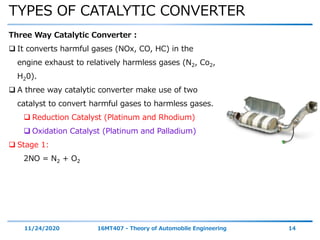
Three Way Catalytic Converter :
 It converts harmful gases (NOx, CO, HC) in the
engine exhaust to relatively harmless gases (N2, Co2,
H20).
 A three way catalytic converter make use of two
catalyst to convert harmful gases to harmless gases.
 Reduction Catalyst (Platinum and Rhodium)
 Oxidation Catalyst (Platinum and Palladium)
 Stage 1:
2NO = N2 + O2
TYPES OF CATALYTIC CONVERTER
11/24/2020 16MT407 - Theory of Automobile Engineering 15
Three Way Catalytic Converter :
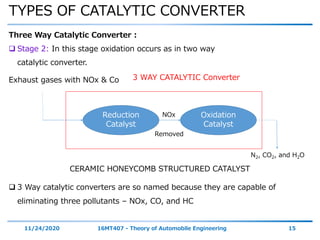
 Stage 2: In this stage oxidation occurs as in two way
catalytic converter.
Reduction
Catalyst
Oxidation
Catalyst
Exhaust gases with NOx & Co
NOx
Removed
N2, CO2, and H2O
CERAMIC HONEYCOMB STRUCTURED CATALYST
3 WAY CATALYTIC Converter
 3 Way catalytic converters are so named because they are capable of
eliminating three pollutants – NOx, CO, and HC
TYPES OF CATALYTIC CONVERTER
11/24/2020 16MT407 - Theory of Automobile Engineering 16
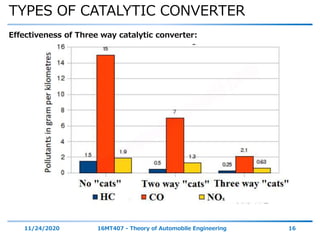
Effectiveness of Three way catalytic converter:
TYPES OF CATALYTIC CONVERTER
11/24/2020 16MT407 - Theory of Automobile Engineering 17
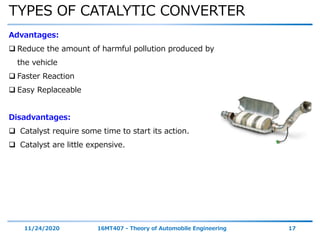
Advantages:
 Reduce the amount of harmful pollution produced by
the vehicle
 Faster Reaction
 Easy Replaceable
Disadvantages:
 Catalyst require some time to start its action.
 Catalyst are little expensive.
TYPES OF CATALYTIC CONVERTER
11/24/2020 16MT407 - Theory of Automobile Engineering 18
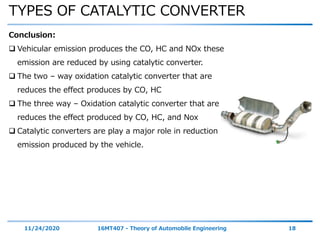
Conclusion:
 Vehicular emission produces the CO, HC and NOx these
emission are reduced by using catalytic converter.
 The two – way oxidation catalytic converter that are
reduces the effect produces by CO, HC
 The three way – Oxidation catalytic converter that are
reduces the effect produced by CO, HC, and Nox
 Catalytic converters are play a major role in reduction of
emission produced by the vehicle.
11/24/2020 16MT407 - Theory of Automobile Engineering 19
END

Three way catalytic converter

  • 1.
    SRI KRISHNA COLLEGEOF ENGINEERING AND TECHNOLOGY DEPARTMENT OF MECHATRONICS ENGINEERING Session: CATALYTIC CONVERTER 11/24/2020 16MT407 - Theory of Automobile Engineering 1 MODULE 1
  • 2.
    SESSION OBJECTIVES 11/24/2020 16MT407- Theory of Automobile Engineering 2  On the completion of this session, the students might be able to understand,  Function of catalytic Converter
  • 3.
    Topics  Introduction  History Construction of catalytic Converter  Working of catalytic Converter  Types of catalytic converter  Advantages  Conclusion 11/24/2020 16MT407 - Theory of Automobile Engineering 3
  • 4.
    INTRODUCTION 11/24/2020 16MT407 -Theory of Automobile Engineering 4 VEHICLE EMISSION:  Vehicular emission is a substance discharged into air, especially by an internal combustion engine  It includes a number of biologically active substance CO, HC, and NOx.
  • 5.
    INTRODUCTION 11/24/2020 16MT407 -Theory of Automobile Engineering 5 Adverse Environmental effects : Photochemical Smog & Rising Mercury in the air Acid Rain Death of Rain Forest Health Hazard & Reduce Atmospheric Visibility
  • 6.
    INTRODUCTION 11/24/2020 16MT407 -Theory of Automobile Engineering 6 Vehicle Emission Control : It is the study of reducing the motor vehicle emission Types of Vehicle Emission control: 1.Secondary Air Injection
  • 7.
    INTRODUCTION 11/24/2020 16MT407 -Theory of Automobile Engineering 7 Vehicle Emission Control : It is the study of reducing the motor vehicle emission Types of Vehicle Emission control: 2. Exhaust Gas Recirculation 3. Catalytic Converter
  • 8.
    INTRODUCTION 11/24/2020 16MT407 -Theory of Automobile Engineering 8 What is Catalytic Converter :  A catalytic Converter is a emission device that converts toxic gases and pollutants in exhaust gas to less toxic pollutants. Location of Catalytic Converter
  • 9.
    HISTORY 11/24/2020 16MT407 -Theory of Automobile Engineering 9 History of Catalytic Converter : Eugene Jules Houdry  Invented Catalytic Converter for smoke stacks called “Cats” In 1950 He started research to develop “CATS” for Gasoline Engine  In 1973 John.J.Mooney and CarlD.Keith Developed a catalytic Converter for Engelhard corporation  1975 – It was used in fuel Engine & 1980’s – 3 Way “CATS "introduced for NOx Reduction in SI Engine
  • 10.
    CONSTRUCTION OF CATS 11/24/202016MT407 - Theory of Automobile Engineering 10 Construction of “CATS” :  Honey comb – Ceramic Core  Washcoat added to the coat, Form some irregular surface, that surface area utilized for catalyst reaction  The Catalyst (Platinum) is most often a precious wash coat  Palladium (Oxidation Catalyst) and Rhodium (Reduction Catalyst) are two other precious metals used for CO & NOx
  • 11.
    WORKING OF CATS 11/24/202016MT407 - Theory of Automobile Engineering 11 Working of “CATS” :  In chemistry, a catalyst is substance that causes or accelerates a chemical reaction without itself being affected  In the catalytic converter, there are two different types of catalyst at work, a reduction catalyst and an oxidation catalyst.  Both types consists of a ceramic structure coated with metals  Catalyst, usually platinum, Rhodium and or Palladium
  • 12.
    TYPES OF CATALYTICCONVERTER 11/24/2020 16MT407 - Theory of Automobile Engineering 12 Types of Catalytic Converter :  Catalytic converter are classified into 2 types based on the capability of eliminating the number of pollutants.  Two way Catalytic Converter  Three way Catalytic Converter
  • 13.
    TYPES OF CATALYTICCONVERTER 11/24/2020 16MT407 - Theory of Automobile Engineering 13 Two Way Catalytic Converter :  The two way oxidation catalytic converter performs two simultaneous tasks of oxidation of carbon monoxide to carbon dioxide and oxidation of hydrocarbons to carbon dioxide and water  Oxidation of carbon monoxide to carbon dioxide: 2𝐶𝑂 + 𝑂2 = 2𝐶𝑂2  Oxidation of Hydrocarbon 𝐶 𝑋 𝐻2𝑋+2 + 3𝑋 + 1 2 𝑂2 = 𝑋𝐶𝑂2 + 𝑋 + 1 𝐻2 𝑂  Disadvantage: Inability to control oxides of nitrogen
  • 14.
    TYPES OF CATALYTICCONVERTER 11/24/2020 16MT407 - Theory of Automobile Engineering 14 Three Way Catalytic Converter :  It converts harmful gases (NOx, CO, HC) in the engine exhaust to relatively harmless gases (N2, Co2, H20).  A three way catalytic converter make use of two catalyst to convert harmful gases to harmless gases.  Reduction Catalyst (Platinum and Rhodium)  Oxidation Catalyst (Platinum and Palladium)  Stage 1: 2NO = N2 + O2
  • 15.
    TYPES OF CATALYTICCONVERTER 11/24/2020 16MT407 - Theory of Automobile Engineering 15 Three Way Catalytic Converter :  Stage 2: In this stage oxidation occurs as in two way catalytic converter. Reduction Catalyst Oxidation Catalyst Exhaust gases with NOx & Co NOx Removed N2, CO2, and H2O CERAMIC HONEYCOMB STRUCTURED CATALYST 3 WAY CATALYTIC Converter  3 Way catalytic converters are so named because they are capable of eliminating three pollutants – NOx, CO, and HC
  • 16.
    TYPES OF CATALYTICCONVERTER 11/24/2020 16MT407 - Theory of Automobile Engineering 16 Effectiveness of Three way catalytic converter:
  • 17.
    TYPES OF CATALYTICCONVERTER 11/24/2020 16MT407 - Theory of Automobile Engineering 17 Advantages:  Reduce the amount of harmful pollution produced by the vehicle  Faster Reaction  Easy Replaceable Disadvantages:  Catalyst require some time to start its action.  Catalyst are little expensive.
  • 18.
    TYPES OF CATALYTICCONVERTER 11/24/2020 16MT407 - Theory of Automobile Engineering 18 Conclusion:  Vehicular emission produces the CO, HC and NOx these emission are reduced by using catalytic converter.  The two – way oxidation catalytic converter that are reduces the effect produces by CO, HC  The three way – Oxidation catalytic converter that are reduces the effect produced by CO, HC, and Nox  Catalytic converters are play a major role in reduction of emission produced by the vehicle.
  • 19.
    11/24/2020 16MT407 -Theory of Automobile Engineering 19 END