SRI KRISHNA COLLEGE OF ENGINEERING AND TECHNOLOGY
DEPARTMENT OF MECHATRONICS ENGINEERING
Session: Vehicle Body Construction
11/24/2020 16MT407 - Theory of Automobile Engineering 1
MODULE 1
SESSION OBJECTIVES
11/24/2020 16MT407 - Theory of Automobile Engineering 2
 On the completion of this session, the students might
be able to understand,
 How the various parts form the vehicle body to
give aesthetic view to the consumer?
Topics
 Introduction
 Importance of vehicle body design
 Different Types of vehicle Body
 Body Construction & its components
 Requirements of automobile body
 Materials for body construction work
 Aerodynamic in vehicle body construction
11/24/2020 16MT407 - Theory of Automobile Engineering 3
INTRODUCTION
11/24/2020 16MT407 - Theory of Automobile Engineering 4
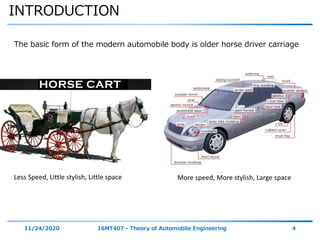
The basic form of the modern automobile body is older horse driver carriage
Less Speed, Little stylish, Little space More speed, More stylish, Large space
INTRODUCTION
11/24/2020 16MT407 - Theory of Automobile Engineering 5
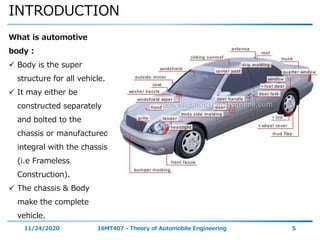
What is automotive
body :
 Body is the super
structure for all vehicle.
 It may either be
constructed separately
and bolted to the
chassis or manufactured
integral with the chassis
(i.e Frameless
Construction).
 The chassis & Body
make the complete
vehicle.
IMPORTANCE OF VEHICLE BODY DESIGN
11/24/2020 16MT407 - Theory of Automobile Engineering 6
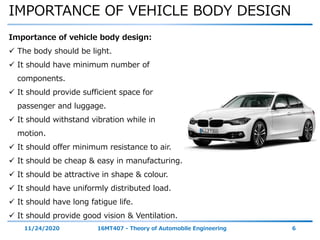
Importance of vehicle body design:
 The body should be light.
 It should have minimum number of
components.
 It should provide sufficient space for
passenger and luggage.
 It should withstand vibration while in
motion.
 It should offer minimum resistance to air.
 It should be cheap & easy in manufacturing.
 It should be attractive in shape & colour.
 It should have uniformly distributed load.
 It should have long fatigue life.
 It should provide good vision & Ventilation.
TYPES OF VEHICLE BODY
11/24/2020 16MT407 - Theory of Automobile Engineering 7
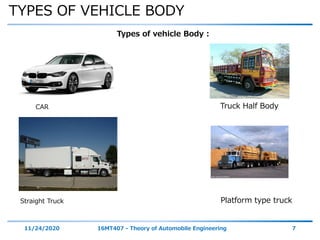
Types of vehicle Body :
CAR
Straight Truck
Truck Half Body
Platform type truck
INTRODUCTION
11/24/2020 16MT407 - Theory of Automobile Engineering 8
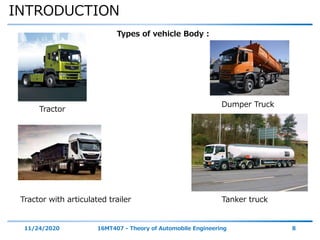
Types of vehicle Body :
Tractor
Tractor with articulated trailer
Dumper Truck
Tanker truck
INTRODUCTION
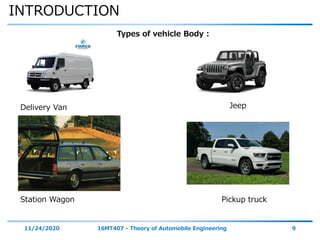
11/24/2020 16MT407 - Theory of Automobile Engineering 9
Types of vehicle Body :
Delivery Van
Station Wagon
Jeep
Pickup truck
INTRODUCTION
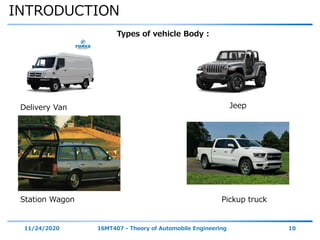
11/24/2020 16MT407 - Theory of Automobile Engineering 10
Types of vehicle Body :
Delivery Van
Station Wagon
Jeep
Pickup truck
BODY CONSTRUCTION AND ITS COMPONENTS
11/24/2020 16MT407 - Theory of Automobile Engineering 11
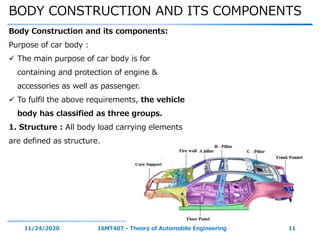
Body Construction and its components:
Purpose of car body :
 The main purpose of car body is for
containing and protection of engine &
accessories as well as passenger.
 To fulfil the above requirements, the vehicle
body has classified as three groups.
1. Structure : All body load carrying elements
are defined as structure.
BODY CONSTRUCTION AND ITS COMPONENTS
11/24/2020 16MT407 - Theory of Automobile Engineering 12
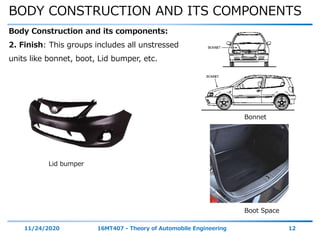
Body Construction and its components:
2. Finish: This groups includes all unstressed
units like bonnet, boot, Lid bumper, etc.
Lid bumper
Boot Space
Bonnet
BODY CONSTRUCTION AND ITS COMPONENTS
11/24/2020 16MT407 - Theory of Automobile Engineering 13
Body Construction and its components:
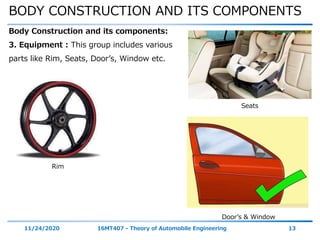
3. Equipment : This group includes various
parts like Rim, Seats, Door’s, Window etc.
Rim
Seats
Door’s & Window
COMPONENTS OF CAR BODY
11/24/2020 16MT407 - Theory of Automobile Engineering 14
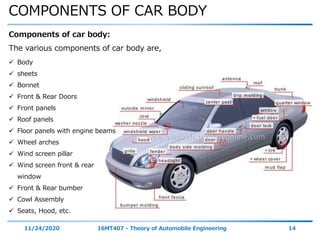
Components of car body:
The various components of car body are,
 Body
 sheets
 Bonnet
 Front & Rear Doors
 Front panels
 Roof panels
 Floor panels with engine beams
 Wheel arches
 Wind screen pillar
 Wind screen front & rear
window
 Front & Rear bumber
 Cowl Assembly
 Seats, Hood, etc.
COMPONENTS OF CAR BODY
11/24/2020 16MT407 - Theory of Automobile Engineering 15
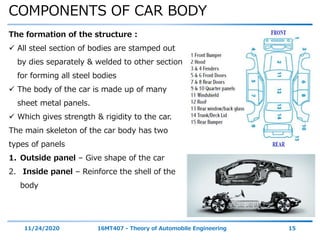
The formation of the structure :
 All steel section of bodies are stamped out
by dies separately & welded to other section
for forming all steel bodies
 The body of the car is made up of many
sheet metal panels.
 Which gives strength & rigidity to the car.
The main skeleton of the car body has two
types of panels
1. Outside panel – Give shape of the car
2. Inside panel – Reinforce the shell of the
body
COMPONENTS OF CAR BODY
11/24/2020 16MT407 - Theory of Automobile Engineering 16
The formation of the
structure :
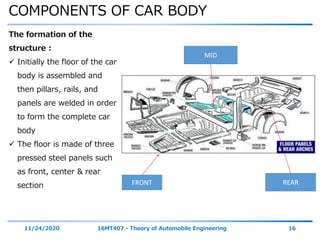
 Initially the floor of the car
body is assembled and
then pillars, rails, and
panels are welded in order
to form the complete car
body
 The floor is made of three
pressed steel panels such
as front, center & rear
section FRONT
MID
REAR
COMPONENTS OF CAR BODY
11/24/2020 16MT407 - Theory of Automobile Engineering 17
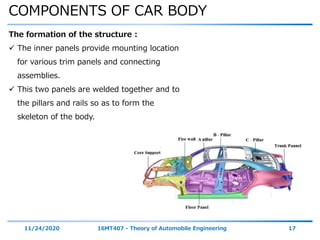
The formation of the structure :
 The inner panels provide mounting location
for various trim panels and connecting
assemblies.
 This two panels are welded together and to
the pillars and rails so as to form the
skeleton of the body.
COMPONENTS OF CAR BODY
11/24/2020 16MT407 - Theory of Automobile Engineering 18
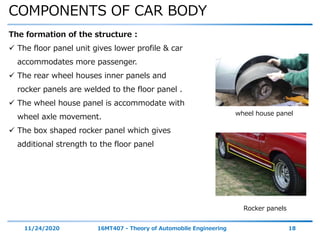
The formation of the structure :
 The floor panel unit gives lower profile & car
accommodates more passenger.
 The rear wheel houses inner panels and
rocker panels are welded to the floor panel .
 The wheel house panel is accommodate with
wheel axle movement.
 The box shaped rocker panel which gives
additional strength to the floor panel
wheel house panel
Rocker panels
COMPONENTS OF CAR BODY
11/24/2020 16MT407 - Theory of Automobile Engineering 19
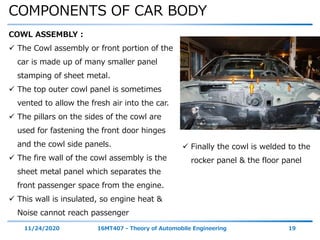
COWL ASSEMBLY :
 The Cowl assembly or front portion of the
car is made up of many smaller panel
stamping of sheet metal.
 The top outer cowl panel is sometimes
vented to allow the fresh air into the car.
 The pillars on the sides of the cowl are
used for fastening the front door hinges
and the cowl side panels.
 The fire wall of the cowl assembly is the
sheet metal panel which separates the
front passenger space from the engine.
 This wall is insulated, so engine heat &
Noise cannot reach passenger
 Finally the cowl is welded to the
rocker panel & the floor panel
COMPONENTS OF CAR BODY
11/24/2020 16MT407 - Theory of Automobile Engineering 20
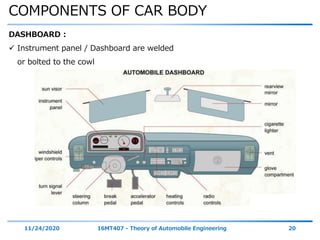
DASHBOARD :
 Instrument panel / Dashboard are welded
or bolted to the cowl
COMPONENTS OF CAR BODY
11/24/2020 16MT407 - Theory of Automobile Engineering 21
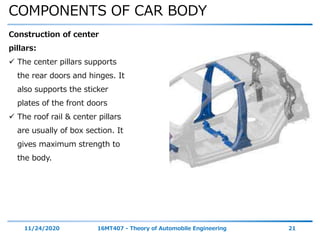
Construction of center
pillars:
 The center pillars supports
the rear doors and hinges. It
also supports the sticker
plates of the front doors
 The roof rail & center pillars
are usually of box section. It
gives maximum strength to
the body.
COMPONENTS OF CAR BODY
11/24/2020 16MT407 - Theory of Automobile Engineering 22
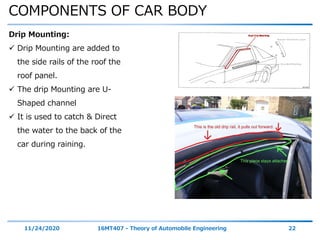
Drip Mounting:
 Drip Mounting are added to
the side rails of the roof the
roof panel.
 The drip Mounting are U-
Shaped channel
 It is used to catch & Direct
the water to the back of the
car during raining.
COMPONENTS OF CAR BODY
11/24/2020 16MT407 - Theory of Automobile Engineering 23
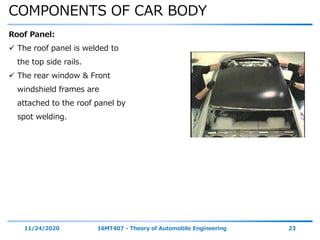
Roof Panel:
 The roof panel is welded to
the top side rails.
 The rear window & Front
windshield frames are
attached to the roof panel by
spot welding.
COMPONENTS OF CAR BODY
11/24/2020 16MT407 - Theory of Automobile Engineering 24
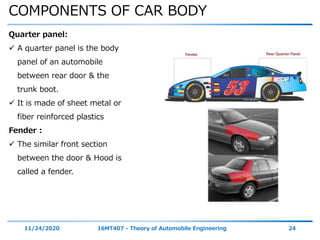
Quarter panel:
 A quarter panel is the body
panel of an automobile
between rear door & the
trunk boot.
 It is made of sheet metal or
fiber reinforced plastics
Fender :
 The similar front section
between the door & Hood is
called a fender.
COMPONENTS OF CAR BODY
11/24/2020 16MT407 - Theory of Automobile Engineering 25
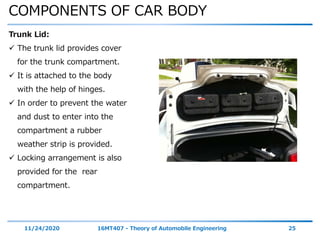
Trunk Lid:
 The trunk lid provides cover
for the trunk compartment.
 It is attached to the body
with the help of hinges.
 In order to prevent the water
and dust to enter into the
compartment a rubber
weather strip is provided.
 Locking arrangement is also
provided for the rear
compartment.
COMPONENTS OF CAR BODY
11/24/2020 16MT407 - Theory of Automobile Engineering 26
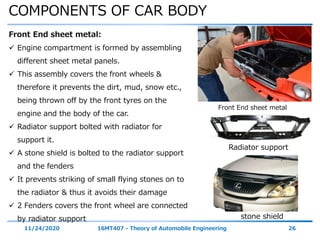
Front End sheet metal:
 Engine compartment is formed by assembling
different sheet metal panels.
 This assembly covers the front wheels &
therefore it prevents the dirt, mud, snow etc.,
being thrown off by the front tyres on the
engine and the body of the car.
 Radiator support bolted with radiator for
support it.
 A stone shield is bolted to the radiator support
and the fenders
 It prevents striking of small flying stones on to
the radiator & thus it avoids their damage
 2 Fenders covers the front wheel are connected
by radiator support
Front End sheet metal
Radiator support
stone shield
COMPONENTS OF CAR BODY
11/24/2020 16MT407 - Theory of Automobile Engineering 27
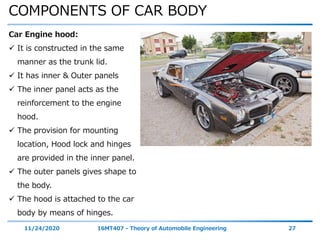
Car Engine hood:
 It is constructed in the same
manner as the trunk lid.
 It has inner & Outer panels
 The inner panel acts as the
reinforcement to the engine
hood.
 The provision for mounting
location, Hood lock and hinges
are provided in the inner panel.
 The outer panels gives shape to
the body.
 The hood is attached to the car
body by means of hinges.
COMPONENTS OF CAR BODY
11/24/2020 16MT407 - Theory of Automobile Engineering 28
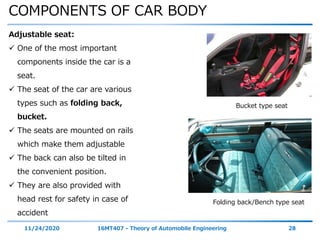
Adjustable seat:
 One of the most important
components inside the car is a
seat.
 The seat of the car are various
types such as folding back,
bucket.
 The seats are mounted on rails
which make them adjustable
 The back can also be tilted in
the convenient position.
 They are also provided with
head rest for safety in case of
accident
Folding back/Bench type seat
Bucket type seat
COMPONENTS OF CAR BODY
11/24/2020 16MT407 - Theory of Automobile Engineering 29
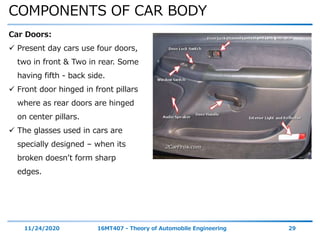
Car Doors:
 Present day cars use four doors,
two in front & Two in rear. Some
having fifth - back side.
 Front door hinged in front pillars
where as rear doors are hinged
on center pillars.
 The glasses used in cars are
specially designed – when its
broken doesn’t form sharp
edges.
COMPONENTS OF CAR BODY
11/24/2020 16MT407 - Theory of Automobile Engineering 30
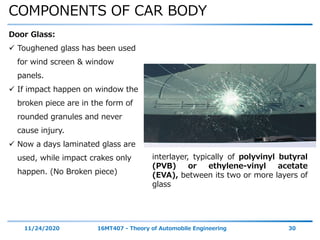
Door Glass:
 Toughened glass has been used
for wind screen & window
panels.
 If impact happen on window the
broken piece are in the form of
rounded granules and never
cause injury.
 Now a days laminated glass are
used, while impact crakes only
happen. (No Broken piece)
interlayer, typically of polyvinyl butyral
(PVB) or ethylene-vinyl acetate
(EVA), between its two or more layers of
glass
COMPONENTS OF CAR BODY
11/24/2020 16MT407 - Theory of Automobile Engineering 31
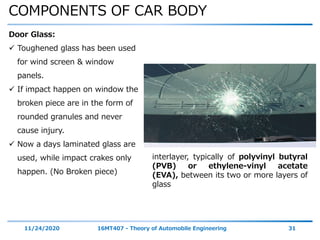
Door Glass:
 Toughened glass has been used
for wind screen & window
panels.
 If impact happen on window the
broken piece are in the form of
rounded granules and never
cause injury.
 Now a days laminated glass are
used, while impact crakes only
happen. (No Broken piece)
interlayer, typically of polyvinyl butyral
(PVB) or ethylene-vinyl acetate
(EVA), between its two or more layers of
glass
MATERIALS FOR CAR BODY
11/24/2020 16MT407 - Theory of Automobile Engineering 32
Materials for car body:
 Steel (Majority cases, Cheapest, stamped out to form various shape)
 Aluminum is used by some manufacturer – better formability, lightness & anti
rusting quality.
 Plastic also a passion of making car body
 Thermo plastics are often used components like boot covers, grills etc
 Thermosetting plastics – glass reinforced plastics like fiber are being used
for body shells.
 The latest type plastics is carbon fiber (stronger than steel)
 But cost is only disadvantage
AERODYNAMIC IN VEHICLE BODY CONSTRUCTION
11/24/2020 16MT407 - Theory of Automobile Engineering 33
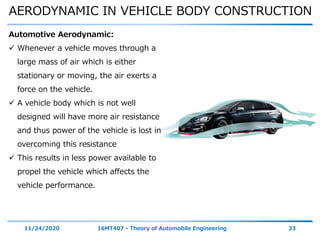
Automotive Aerodynamic:
 Whenever a vehicle moves through a
large mass of air which is either
stationary or moving, the air exerts a
force on the vehicle.
 A vehicle body which is not well
designed will have more air resistance
and thus power of the vehicle is lost in
overcoming this resistance
 This results in less power available to
propel the vehicle which affects the
vehicle performance.
AERODYNAMIC IN VEHICLE BODY CONSTRUCTION
11/24/2020 16MT407 - Theory of Automobile Engineering 34
Force exerted by air on a moving
vehicle has three components:
 Aerodynamic Drag Force
 Aerodynamic Lift Force
AERODYNAMIC IN VEHICLE BODY CONSTRUCTION
11/24/2020 16MT407 - Theory of Automobile Engineering 35
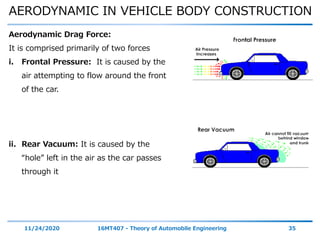
Aerodynamic Drag Force:
It is comprised primarily of two forces
i. Frontal Pressure: It is caused by the
air attempting to flow around the front
of the car.
ii. Rear Vacuum: It is caused by the
“hole” left in the air as the car passes
through it
AERODYNAMIC IN VEHICLE BODY CONSTRUCTION
11/24/2020 16MT407 - Theory of Automobile Engineering 36
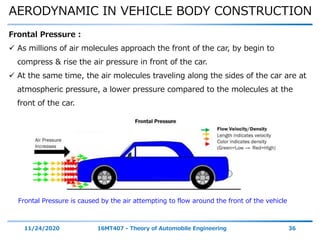
Frontal Pressure :
 As millions of air molecules approach the front of the car, by begin to
compress & rise the air pressure in front of the car.
 At the same time, the air molecules traveling along the sides of the car are at
atmospheric pressure, a lower pressure compared to the molecules at the
front of the car.
Frontal Pressure is caused by the air attempting to flow around the front of the vehicle
AERODYNAMIC IN VEHICLE BODY CONSTRUCTION
11/24/2020 16MT407 - Theory of Automobile Engineering 37
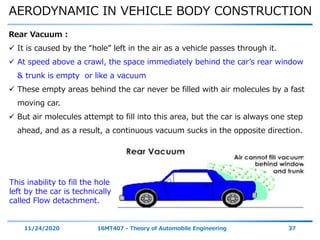
Rear Vacuum :
 It is caused by the “hole” left in the air as a vehicle passes through it.
 At speed above a crawl, the space immediately behind the car’s rear window
& trunk is empty or like a vacuum
 These empty areas behind the car never be filled with air molecules by a fast
moving car.
 But air molecules attempt to fill into this area, but the car is always one step
ahead, and as a result, a continuous vacuum sucks in the opposite direction.
This inability to fill the hole
left by the car is technically
called Flow detachment.
AERODYNAMIC IN VEHICLE BODY CONSTRUCTION
11/24/2020 16MT407 - Theory of Automobile Engineering 38
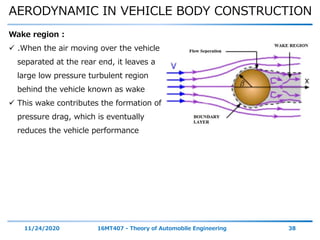
Wake region :
 .When the air moving over the vehicle is
separated at the rear end, it leaves a
large low pressure turbulent region
behind the vehicle known as wake
 This wake contributes the formation of
pressure drag, which is eventually
reduces the vehicle performance
AERODYNAMIC IN VEHICLE BODY CONSTRUCTION
11/24/2020 16MT407 - Theory of Automobile Engineering 39
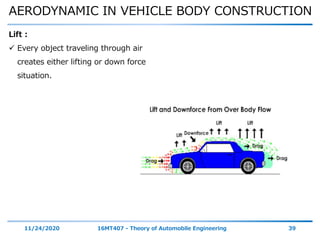
Lift :
 Every object traveling through air
creates either lifting or down force
situation.
AERODYNAMIC IN VEHICLE BODY CONSTRUCTION
11/24/2020 16MT407 - Theory of Automobile Engineering 40
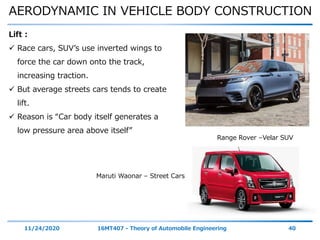
Lift :
 Race cars, SUV’s use inverted wings to
force the car down onto the track,
increasing traction.
 But average streets cars tends to create
lift.
 Reason is “Car body itself generates a
low pressure area above itself”
Range Rover –Velar SUV
Maruti Waonar – Street Cars
AERODYNAMIC IN VEHICLE BODY CONSTRUCTION
11/24/2020 16MT407 - Theory of Automobile Engineering 41
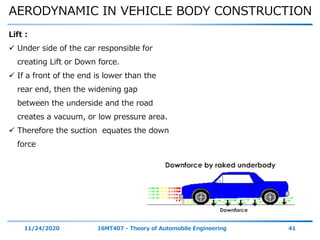
Lift :
 Under side of the car responsible for
creating Lift or Down force.
 If a front of the end is lower than the
rear end, then the widening gap
between the underside and the road
creates a vacuum, or low pressure area.
 Therefore the suction equates the down
force
AERODYNAMIC IN VEHICLE BODY CONSTRUCTION
11/24/2020 16MT407 - Theory of Automobile Engineering 42
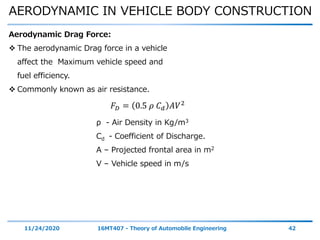
Aerodynamic Drag Force:
 The aerodynamic Drag force in a vehicle
affect the Maximum vehicle speed and
fuel efficiency.
 Commonly known as air resistance.
𝐹 𝐷 = 0.5 𝜌 𝐶 𝑑 𝐴𝑉2
ρ - Air Density in Kg/m3
Cd - Coefficient of Discharge.
A – Projected frontal area in m2
V – Vehicle speed in m/s
AERODYNAMIC IN VEHICLE BODY CONSTRUCTION
11/24/2020 16MT407 - Theory of Automobile Engineering 43
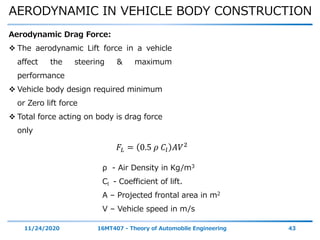
Aerodynamic Drag Force:
 The aerodynamic Lift force in a vehicle
affect the steering & maximum
performance
 Vehicle body design required minimum
or Zero lift force
 Total force acting on body is drag force
only
𝐹𝐿 = 0.5 𝜌 𝐶𝑙 𝐴𝑉2
ρ - Air Density in Kg/m3
Cl - Coefficient of lift.
A – Projected frontal area in m2
V – Vehicle speed in m/s
AERODYNAMIC IN VEHICLE BODY CONSTRUCTION
11/24/2020 16MT407 - Theory of Automobile Engineering 44
Way to reduce the drag force on SUV:
 Lowering the front bumper and Bonnet, including the front windshield.
 Rounding off the corners and sharp edges
 Extending the front bumper
 Make small chamfers at the rear end of the roof and the side body there will be
a significant change in the drag.
AERODYNAMIC IN VEHICLE BODY CONSTRUCTION
11/24/2020 16MT407 - Theory of Automobile Engineering 45
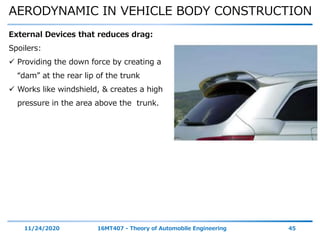
External Devices that reduces drag:
Spoilers:
 Providing the down force by creating a
“dam” at the rear lip of the trunk
 Works like windshield, & creates a high
pressure in the area above the trunk.
AERODYNAMIC IN VEHICLE BODY CONSTRUCTION
11/24/2020 16MT407 - Theory of Automobile Engineering 46
External Devices that reduces drag:
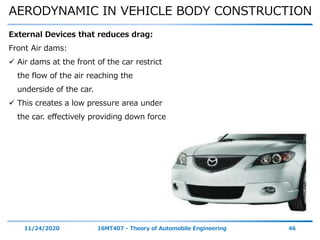
Front Air dams:
 Air dams at the front of the car restrict
the flow of the air reaching the
underside of the car.
 This creates a low pressure area under
the car. effectively providing down force
11/24/2020 16MT407 - Theory of Automobile Engineering 47
END

Vehicle body

  • 1.
    SRI KRISHNA COLLEGEOF ENGINEERING AND TECHNOLOGY DEPARTMENT OF MECHATRONICS ENGINEERING Session: Vehicle Body Construction 11/24/2020 16MT407 - Theory of Automobile Engineering 1 MODULE 1
  • 2.
    SESSION OBJECTIVES 11/24/2020 16MT407- Theory of Automobile Engineering 2  On the completion of this session, the students might be able to understand,  How the various parts form the vehicle body to give aesthetic view to the consumer?
  • 3.
    Topics  Introduction  Importanceof vehicle body design  Different Types of vehicle Body  Body Construction & its components  Requirements of automobile body  Materials for body construction work  Aerodynamic in vehicle body construction 11/24/2020 16MT407 - Theory of Automobile Engineering 3
  • 4.
    INTRODUCTION 11/24/2020 16MT407 -Theory of Automobile Engineering 4 The basic form of the modern automobile body is older horse driver carriage Less Speed, Little stylish, Little space More speed, More stylish, Large space
  • 5.
    INTRODUCTION 11/24/2020 16MT407 -Theory of Automobile Engineering 5 What is automotive body :  Body is the super structure for all vehicle.  It may either be constructed separately and bolted to the chassis or manufactured integral with the chassis (i.e Frameless Construction).  The chassis & Body make the complete vehicle.
  • 6.
    IMPORTANCE OF VEHICLEBODY DESIGN 11/24/2020 16MT407 - Theory of Automobile Engineering 6 Importance of vehicle body design:  The body should be light.  It should have minimum number of components.  It should provide sufficient space for passenger and luggage.  It should withstand vibration while in motion.  It should offer minimum resistance to air.  It should be cheap & easy in manufacturing.  It should be attractive in shape & colour.  It should have uniformly distributed load.  It should have long fatigue life.  It should provide good vision & Ventilation.
  • 7.
    TYPES OF VEHICLEBODY 11/24/2020 16MT407 - Theory of Automobile Engineering 7 Types of vehicle Body : CAR Straight Truck Truck Half Body Platform type truck
  • 8.
    INTRODUCTION 11/24/2020 16MT407 -Theory of Automobile Engineering 8 Types of vehicle Body : Tractor Tractor with articulated trailer Dumper Truck Tanker truck
  • 9.
    INTRODUCTION 11/24/2020 16MT407 -Theory of Automobile Engineering 9 Types of vehicle Body : Delivery Van Station Wagon Jeep Pickup truck
  • 10.
    INTRODUCTION 11/24/2020 16MT407 -Theory of Automobile Engineering 10 Types of vehicle Body : Delivery Van Station Wagon Jeep Pickup truck
  • 11.
    BODY CONSTRUCTION ANDITS COMPONENTS 11/24/2020 16MT407 - Theory of Automobile Engineering 11 Body Construction and its components: Purpose of car body :  The main purpose of car body is for containing and protection of engine & accessories as well as passenger.  To fulfil the above requirements, the vehicle body has classified as three groups. 1. Structure : All body load carrying elements are defined as structure.
  • 12.
    BODY CONSTRUCTION ANDITS COMPONENTS 11/24/2020 16MT407 - Theory of Automobile Engineering 12 Body Construction and its components: 2. Finish: This groups includes all unstressed units like bonnet, boot, Lid bumper, etc. Lid bumper Boot Space Bonnet
  • 13.
    BODY CONSTRUCTION ANDITS COMPONENTS 11/24/2020 16MT407 - Theory of Automobile Engineering 13 Body Construction and its components: 3. Equipment : This group includes various parts like Rim, Seats, Door’s, Window etc. Rim Seats Door’s & Window
  • 14.
    COMPONENTS OF CARBODY 11/24/2020 16MT407 - Theory of Automobile Engineering 14 Components of car body: The various components of car body are,  Body  sheets  Bonnet  Front & Rear Doors  Front panels  Roof panels  Floor panels with engine beams  Wheel arches  Wind screen pillar  Wind screen front & rear window  Front & Rear bumber  Cowl Assembly  Seats, Hood, etc.
  • 15.
    COMPONENTS OF CARBODY 11/24/2020 16MT407 - Theory of Automobile Engineering 15 The formation of the structure :  All steel section of bodies are stamped out by dies separately & welded to other section for forming all steel bodies  The body of the car is made up of many sheet metal panels.  Which gives strength & rigidity to the car. The main skeleton of the car body has two types of panels 1. Outside panel – Give shape of the car 2. Inside panel – Reinforce the shell of the body
  • 16.
    COMPONENTS OF CARBODY 11/24/2020 16MT407 - Theory of Automobile Engineering 16 The formation of the structure :  Initially the floor of the car body is assembled and then pillars, rails, and panels are welded in order to form the complete car body  The floor is made of three pressed steel panels such as front, center & rear section FRONT MID REAR
  • 17.
    COMPONENTS OF CARBODY 11/24/2020 16MT407 - Theory of Automobile Engineering 17 The formation of the structure :  The inner panels provide mounting location for various trim panels and connecting assemblies.  This two panels are welded together and to the pillars and rails so as to form the skeleton of the body.
  • 18.
    COMPONENTS OF CARBODY 11/24/2020 16MT407 - Theory of Automobile Engineering 18 The formation of the structure :  The floor panel unit gives lower profile & car accommodates more passenger.  The rear wheel houses inner panels and rocker panels are welded to the floor panel .  The wheel house panel is accommodate with wheel axle movement.  The box shaped rocker panel which gives additional strength to the floor panel wheel house panel Rocker panels
  • 19.
    COMPONENTS OF CARBODY 11/24/2020 16MT407 - Theory of Automobile Engineering 19 COWL ASSEMBLY :  The Cowl assembly or front portion of the car is made up of many smaller panel stamping of sheet metal.  The top outer cowl panel is sometimes vented to allow the fresh air into the car.  The pillars on the sides of the cowl are used for fastening the front door hinges and the cowl side panels.  The fire wall of the cowl assembly is the sheet metal panel which separates the front passenger space from the engine.  This wall is insulated, so engine heat & Noise cannot reach passenger  Finally the cowl is welded to the rocker panel & the floor panel
  • 20.
    COMPONENTS OF CARBODY 11/24/2020 16MT407 - Theory of Automobile Engineering 20 DASHBOARD :  Instrument panel / Dashboard are welded or bolted to the cowl
  • 21.
    COMPONENTS OF CARBODY 11/24/2020 16MT407 - Theory of Automobile Engineering 21 Construction of center pillars:  The center pillars supports the rear doors and hinges. It also supports the sticker plates of the front doors  The roof rail & center pillars are usually of box section. It gives maximum strength to the body.
  • 22.
    COMPONENTS OF CARBODY 11/24/2020 16MT407 - Theory of Automobile Engineering 22 Drip Mounting:  Drip Mounting are added to the side rails of the roof the roof panel.  The drip Mounting are U- Shaped channel  It is used to catch & Direct the water to the back of the car during raining.
  • 23.
    COMPONENTS OF CARBODY 11/24/2020 16MT407 - Theory of Automobile Engineering 23 Roof Panel:  The roof panel is welded to the top side rails.  The rear window & Front windshield frames are attached to the roof panel by spot welding.
  • 24.
    COMPONENTS OF CARBODY 11/24/2020 16MT407 - Theory of Automobile Engineering 24 Quarter panel:  A quarter panel is the body panel of an automobile between rear door & the trunk boot.  It is made of sheet metal or fiber reinforced plastics Fender :  The similar front section between the door & Hood is called a fender.
  • 25.
    COMPONENTS OF CARBODY 11/24/2020 16MT407 - Theory of Automobile Engineering 25 Trunk Lid:  The trunk lid provides cover for the trunk compartment.  It is attached to the body with the help of hinges.  In order to prevent the water and dust to enter into the compartment a rubber weather strip is provided.  Locking arrangement is also provided for the rear compartment.
  • 26.
    COMPONENTS OF CARBODY 11/24/2020 16MT407 - Theory of Automobile Engineering 26 Front End sheet metal:  Engine compartment is formed by assembling different sheet metal panels.  This assembly covers the front wheels & therefore it prevents the dirt, mud, snow etc., being thrown off by the front tyres on the engine and the body of the car.  Radiator support bolted with radiator for support it.  A stone shield is bolted to the radiator support and the fenders  It prevents striking of small flying stones on to the radiator & thus it avoids their damage  2 Fenders covers the front wheel are connected by radiator support Front End sheet metal Radiator support stone shield
  • 27.
    COMPONENTS OF CARBODY 11/24/2020 16MT407 - Theory of Automobile Engineering 27 Car Engine hood:  It is constructed in the same manner as the trunk lid.  It has inner & Outer panels  The inner panel acts as the reinforcement to the engine hood.  The provision for mounting location, Hood lock and hinges are provided in the inner panel.  The outer panels gives shape to the body.  The hood is attached to the car body by means of hinges.
  • 28.
    COMPONENTS OF CARBODY 11/24/2020 16MT407 - Theory of Automobile Engineering 28 Adjustable seat:  One of the most important components inside the car is a seat.  The seat of the car are various types such as folding back, bucket.  The seats are mounted on rails which make them adjustable  The back can also be tilted in the convenient position.  They are also provided with head rest for safety in case of accident Folding back/Bench type seat Bucket type seat
  • 29.
    COMPONENTS OF CARBODY 11/24/2020 16MT407 - Theory of Automobile Engineering 29 Car Doors:  Present day cars use four doors, two in front & Two in rear. Some having fifth - back side.  Front door hinged in front pillars where as rear doors are hinged on center pillars.  The glasses used in cars are specially designed – when its broken doesn’t form sharp edges.
  • 30.
    COMPONENTS OF CARBODY 11/24/2020 16MT407 - Theory of Automobile Engineering 30 Door Glass:  Toughened glass has been used for wind screen & window panels.  If impact happen on window the broken piece are in the form of rounded granules and never cause injury.  Now a days laminated glass are used, while impact crakes only happen. (No Broken piece) interlayer, typically of polyvinyl butyral (PVB) or ethylene-vinyl acetate (EVA), between its two or more layers of glass
  • 31.
    COMPONENTS OF CARBODY 11/24/2020 16MT407 - Theory of Automobile Engineering 31 Door Glass:  Toughened glass has been used for wind screen & window panels.  If impact happen on window the broken piece are in the form of rounded granules and never cause injury.  Now a days laminated glass are used, while impact crakes only happen. (No Broken piece) interlayer, typically of polyvinyl butyral (PVB) or ethylene-vinyl acetate (EVA), between its two or more layers of glass
  • 32.
    MATERIALS FOR CARBODY 11/24/2020 16MT407 - Theory of Automobile Engineering 32 Materials for car body:  Steel (Majority cases, Cheapest, stamped out to form various shape)  Aluminum is used by some manufacturer – better formability, lightness & anti rusting quality.  Plastic also a passion of making car body  Thermo plastics are often used components like boot covers, grills etc  Thermosetting plastics – glass reinforced plastics like fiber are being used for body shells.  The latest type plastics is carbon fiber (stronger than steel)  But cost is only disadvantage
  • 33.
    AERODYNAMIC IN VEHICLEBODY CONSTRUCTION 11/24/2020 16MT407 - Theory of Automobile Engineering 33 Automotive Aerodynamic:  Whenever a vehicle moves through a large mass of air which is either stationary or moving, the air exerts a force on the vehicle.  A vehicle body which is not well designed will have more air resistance and thus power of the vehicle is lost in overcoming this resistance  This results in less power available to propel the vehicle which affects the vehicle performance.
  • 34.
    AERODYNAMIC IN VEHICLEBODY CONSTRUCTION 11/24/2020 16MT407 - Theory of Automobile Engineering 34 Force exerted by air on a moving vehicle has three components:  Aerodynamic Drag Force  Aerodynamic Lift Force
  • 35.
    AERODYNAMIC IN VEHICLEBODY CONSTRUCTION 11/24/2020 16MT407 - Theory of Automobile Engineering 35 Aerodynamic Drag Force: It is comprised primarily of two forces i. Frontal Pressure: It is caused by the air attempting to flow around the front of the car. ii. Rear Vacuum: It is caused by the “hole” left in the air as the car passes through it
  • 36.
    AERODYNAMIC IN VEHICLEBODY CONSTRUCTION 11/24/2020 16MT407 - Theory of Automobile Engineering 36 Frontal Pressure :  As millions of air molecules approach the front of the car, by begin to compress & rise the air pressure in front of the car.  At the same time, the air molecules traveling along the sides of the car are at atmospheric pressure, a lower pressure compared to the molecules at the front of the car. Frontal Pressure is caused by the air attempting to flow around the front of the vehicle
  • 37.
    AERODYNAMIC IN VEHICLEBODY CONSTRUCTION 11/24/2020 16MT407 - Theory of Automobile Engineering 37 Rear Vacuum :  It is caused by the “hole” left in the air as a vehicle passes through it.  At speed above a crawl, the space immediately behind the car’s rear window & trunk is empty or like a vacuum  These empty areas behind the car never be filled with air molecules by a fast moving car.  But air molecules attempt to fill into this area, but the car is always one step ahead, and as a result, a continuous vacuum sucks in the opposite direction. This inability to fill the hole left by the car is technically called Flow detachment.
  • 38.
    AERODYNAMIC IN VEHICLEBODY CONSTRUCTION 11/24/2020 16MT407 - Theory of Automobile Engineering 38 Wake region :  .When the air moving over the vehicle is separated at the rear end, it leaves a large low pressure turbulent region behind the vehicle known as wake  This wake contributes the formation of pressure drag, which is eventually reduces the vehicle performance
  • 39.
    AERODYNAMIC IN VEHICLEBODY CONSTRUCTION 11/24/2020 16MT407 - Theory of Automobile Engineering 39 Lift :  Every object traveling through air creates either lifting or down force situation.
  • 40.
    AERODYNAMIC IN VEHICLEBODY CONSTRUCTION 11/24/2020 16MT407 - Theory of Automobile Engineering 40 Lift :  Race cars, SUV’s use inverted wings to force the car down onto the track, increasing traction.  But average streets cars tends to create lift.  Reason is “Car body itself generates a low pressure area above itself” Range Rover –Velar SUV Maruti Waonar – Street Cars
  • 41.
    AERODYNAMIC IN VEHICLEBODY CONSTRUCTION 11/24/2020 16MT407 - Theory of Automobile Engineering 41 Lift :  Under side of the car responsible for creating Lift or Down force.  If a front of the end is lower than the rear end, then the widening gap between the underside and the road creates a vacuum, or low pressure area.  Therefore the suction equates the down force
  • 42.
    AERODYNAMIC IN VEHICLEBODY CONSTRUCTION 11/24/2020 16MT407 - Theory of Automobile Engineering 42 Aerodynamic Drag Force:  The aerodynamic Drag force in a vehicle affect the Maximum vehicle speed and fuel efficiency.  Commonly known as air resistance. 𝐹 𝐷 = 0.5 𝜌 𝐶 𝑑 𝐴𝑉2 ρ - Air Density in Kg/m3 Cd - Coefficient of Discharge. A – Projected frontal area in m2 V – Vehicle speed in m/s
  • 43.
    AERODYNAMIC IN VEHICLEBODY CONSTRUCTION 11/24/2020 16MT407 - Theory of Automobile Engineering 43 Aerodynamic Drag Force:  The aerodynamic Lift force in a vehicle affect the steering & maximum performance  Vehicle body design required minimum or Zero lift force  Total force acting on body is drag force only 𝐹𝐿 = 0.5 𝜌 𝐶𝑙 𝐴𝑉2 ρ - Air Density in Kg/m3 Cl - Coefficient of lift. A – Projected frontal area in m2 V – Vehicle speed in m/s
  • 44.
    AERODYNAMIC IN VEHICLEBODY CONSTRUCTION 11/24/2020 16MT407 - Theory of Automobile Engineering 44 Way to reduce the drag force on SUV:  Lowering the front bumper and Bonnet, including the front windshield.  Rounding off the corners and sharp edges  Extending the front bumper  Make small chamfers at the rear end of the roof and the side body there will be a significant change in the drag.
  • 45.
    AERODYNAMIC IN VEHICLEBODY CONSTRUCTION 11/24/2020 16MT407 - Theory of Automobile Engineering 45 External Devices that reduces drag: Spoilers:  Providing the down force by creating a “dam” at the rear lip of the trunk  Works like windshield, & creates a high pressure in the area above the trunk.
  • 46.
    AERODYNAMIC IN VEHICLEBODY CONSTRUCTION 11/24/2020 16MT407 - Theory of Automobile Engineering 46 External Devices that reduces drag: Front Air dams:  Air dams at the front of the car restrict the flow of the air reaching the underside of the car.  This creates a low pressure area under the car. effectively providing down force
  • 47.
    11/24/2020 16MT407 -Theory of Automobile Engineering 47 END