UNIT IIIUNIT - III
Engine Emissions & Their Control
Introduction
 Gl b l i Global warming
 Acid rain
 Smog
 odour
 Respiratory and other health hazards
Ozone - lung tissues & functionsOzone - lung tissues & functions
PM - respiratory problems, Visibility, Irritations
CO O delivery to bloodCO - O2 delivery to blood
Lead - children Visibility
NO l & i t f tiNOx - lungs & respiratory functions
SOx - Acid rain
The Internal Combustion Engine and Atmospheric Pollution
Type of Pollution Principal Sources Relevance of the I.C. Engineype o o u o c p Sou ces e ev ce o e .C. g e
Lead Anti-knock compounds A (for the SI Engine)
A id R i S lf di id B (f th CI E i )Acid Rain Sulfur dioxide B (for the CI Engine)
Oxides of nitrogen A
Unburned hydrocarbons A (for the SI Engine)
Carbon monoxide A (for the SI Engine)
Global warming CFCs B (for car with A/c)
(or else not involved)
Carbon dioxide B (may be even A)
Methane B (may be A if CNG used)
Photochemical smog Carbon monoxide A (for the SI Engine)
Unburned hydrocarbons A (for the SI Engine)
Sulfur dioxide B (for the CI Engine)
Oxides of nitrogen A
Ozone depletion CFCs B (for car with A/c)
(or else not involved)
Unburned hydrocarbons A (for the SI Engine)
Oxides of nitrogen Ag
A: Major contributor
B: Secondary influence
Engine Emissions
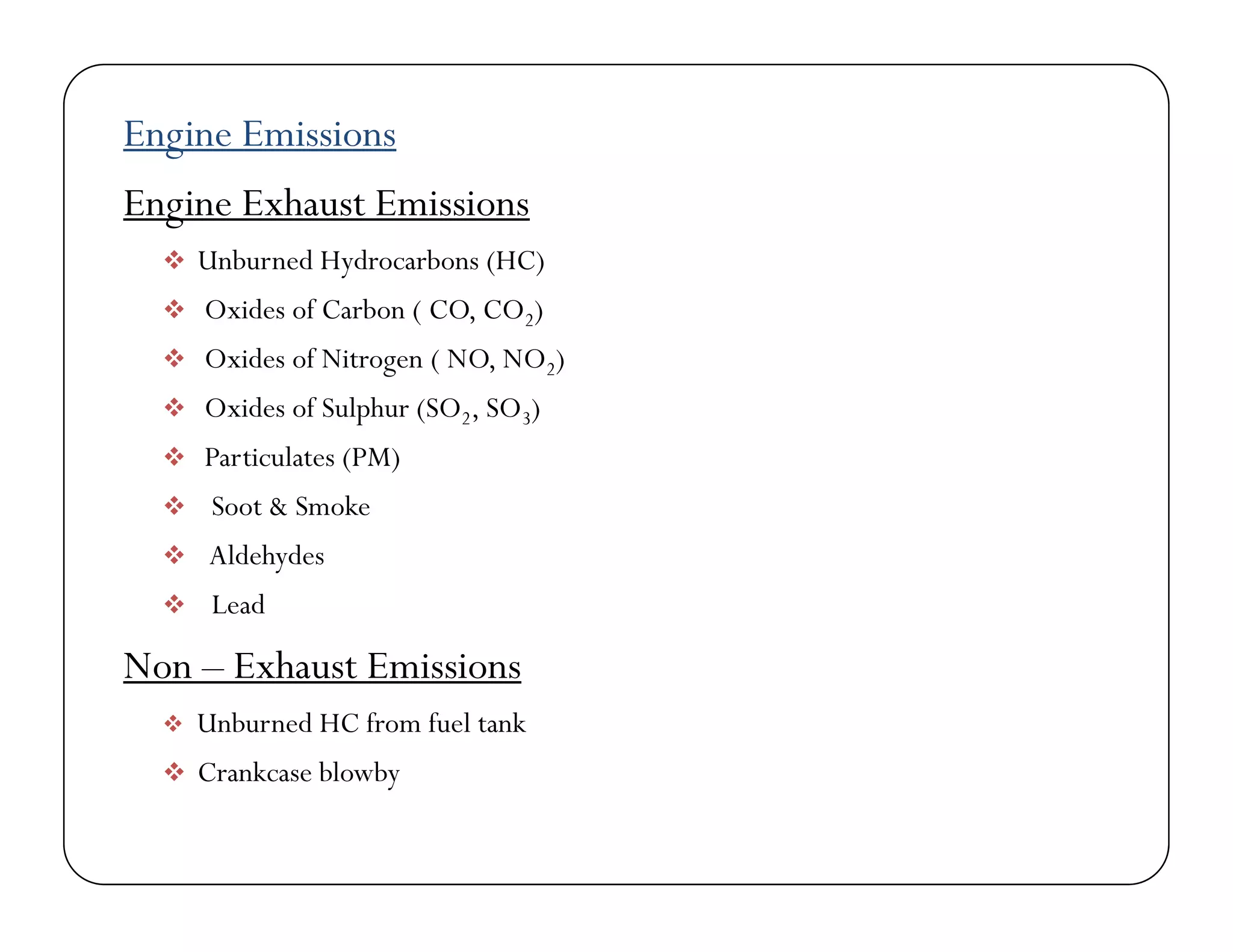
Engine Exhaust Emissions
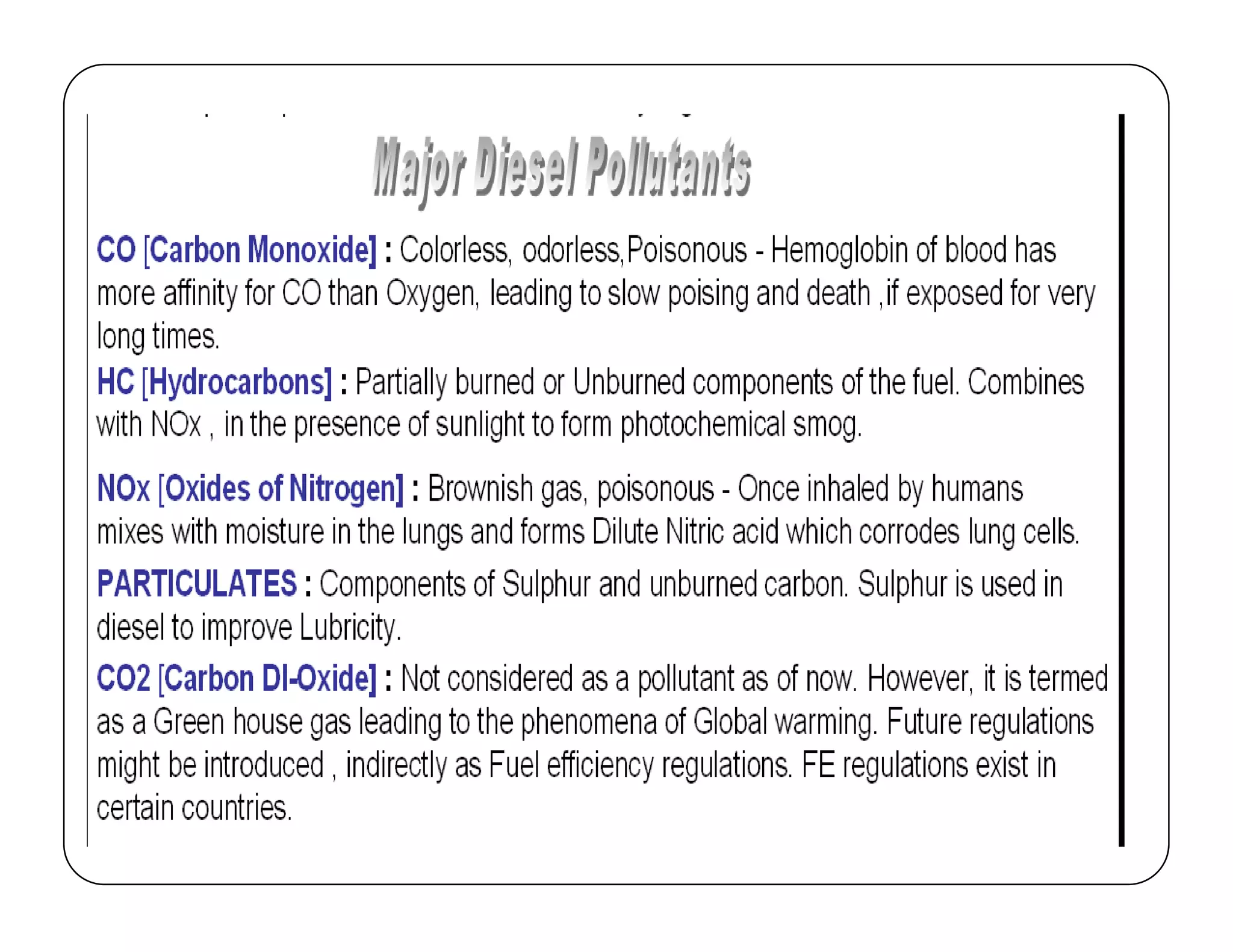
 Unburned Hydrocarbons (HC)
 Oxides of Carbon ( CO, CO2)
 Oxides of Nitrogen ( NO, NO2)
 Oxides of Sulphur (SO2, SO3) Oxides of Sulphur (SO2, SO3)
 Particulates (PM)
 Soot & Smoke
 Aldehydes
 Lead
N E h E i iNon – Exhaust Emissions
 Unburned HC from fuel tank
 Crankcase blowby Crankcase blowby
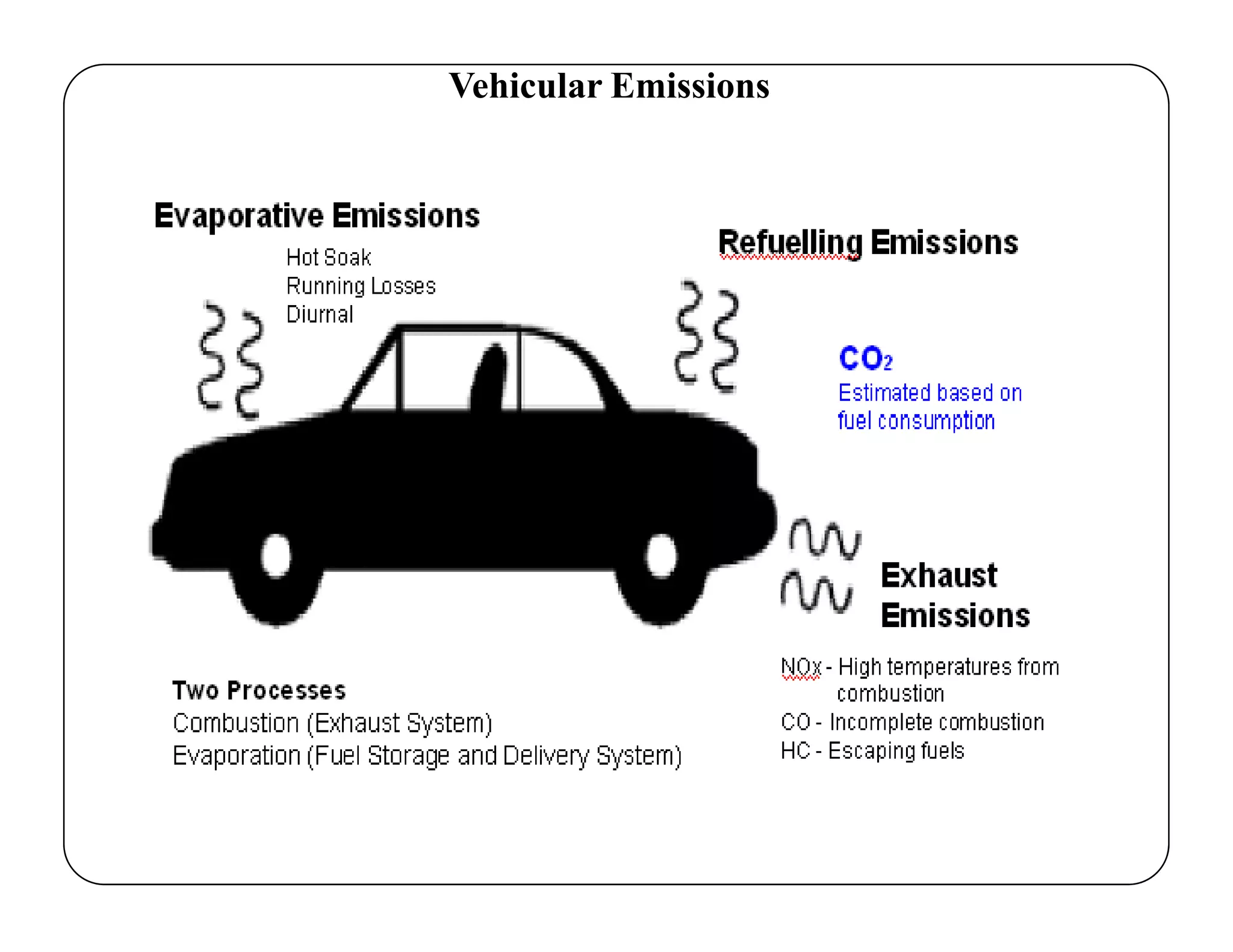
Vehicular Emissions
Unburned HC Formation
 Irritate the mucous membranes Irritate the mucous membranes
 Operating conditions 1000- 2000 rpm
 It rise rapidly as the mixture becomes richer than stiochiometric
mixturemixture
 Incomplete combustion
 Air – fuel ratio
I i i Improper mixing
 Flame quenching
 Factors which lead to incomplete flame propagation
 Poor carburetion and mixture preparation
 Poor ignition system
 Scavenging problem due to improper valve overlapg g p p p p
 Poor swirl and turbulence
 Excess exhaust residual gas within the cylinder
 Exhaust gas recirculation not properly controlled Exhaust gas recirculation not properly controlled
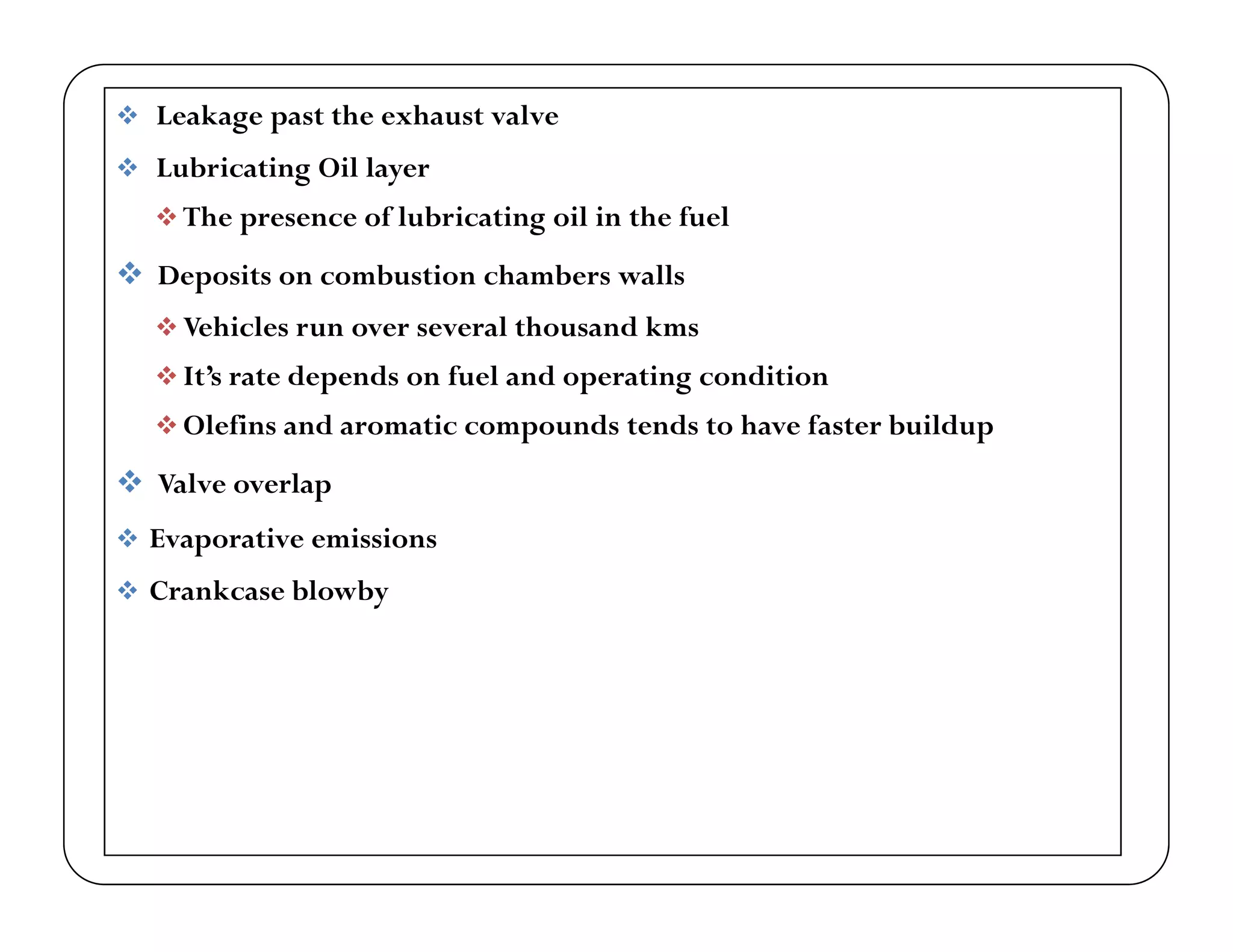
 Leakage past the exhaust valve
 Lubricating Oil layer Lubricating Oil layer
 The presence of lubricating oil in the fuel
 Deposits on combustion chambers walls
 Vehicles run over several thousand kms
 It’s rate depends on fuel and operating condition
 Ol fi d i d d h f b ild Olefins and aromatic compounds tends to have faster buildup
 Valve overlap
 Evaporative emissions Evaporative emissions
 Crankcase blowby
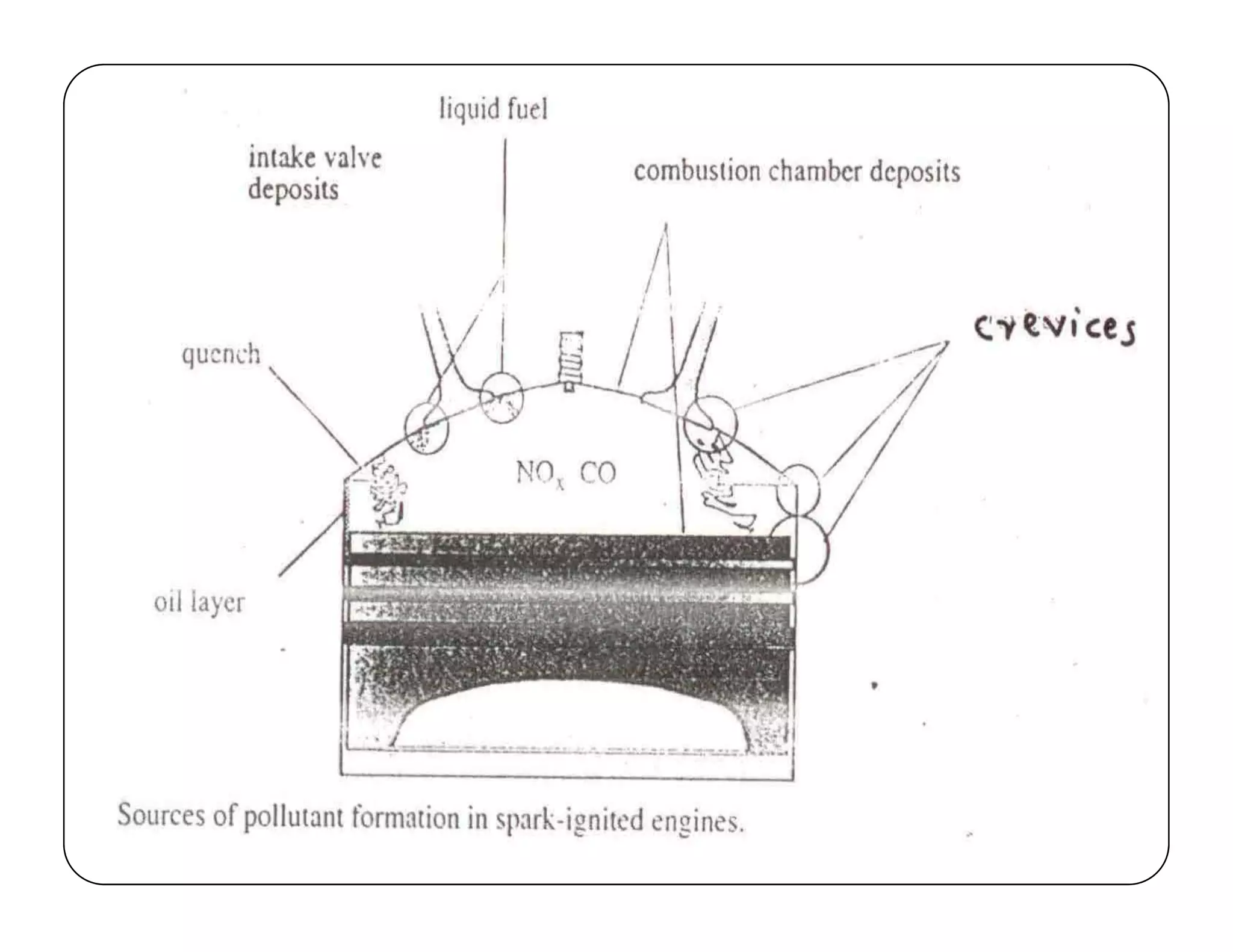
 CreviceVolumes
 l d h f f h b i Narrow volumes present around the surface of the combustion
chamber
 High surface to volume into which flame will not propagateg p p g
 They are present between the piston crown, piston rings and cylinder
liner
 Along the gasket joints between cylinder head and block Along the gasket joints between cylinder head and block
 Along the seats of the intake and exhaust valves,
 space around the plug center electrode and between spark plug
threads.
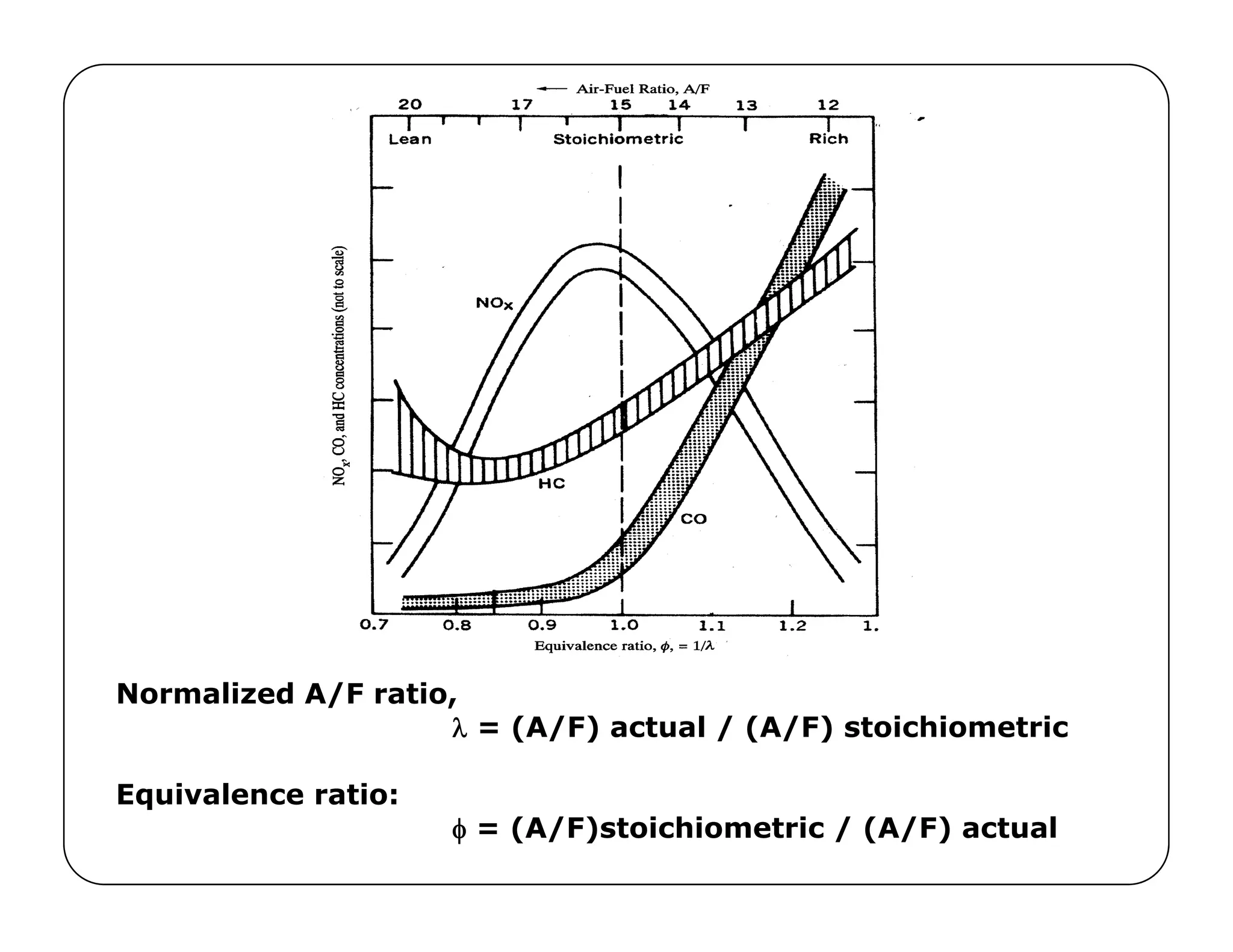
Normalized A/F ratio,
 = (A/F) actual / (A/F) stoichiometric
Equivalence ratio:
 = (A/F)stoichiometric / (A/F) actual
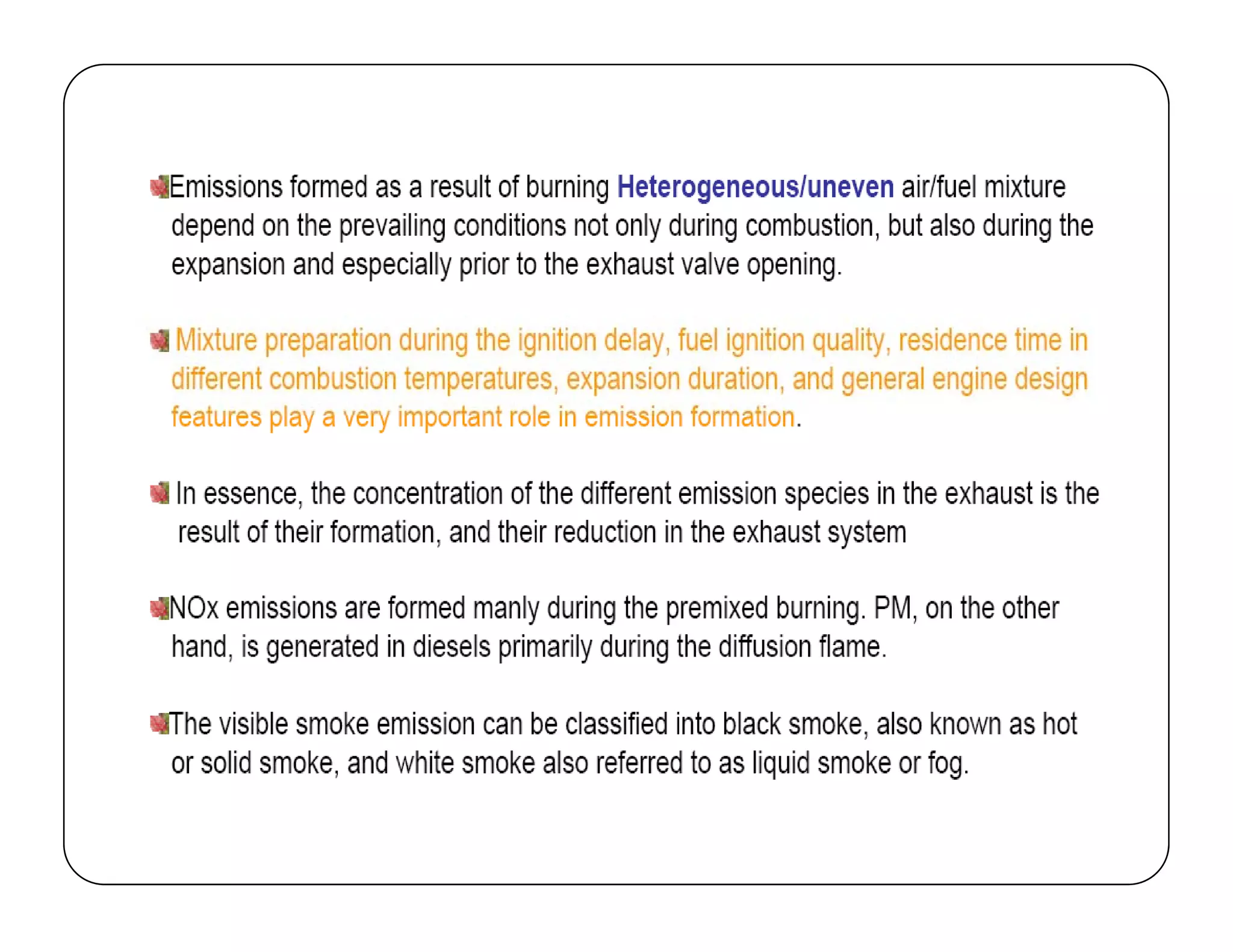
Fig. Emissions for diesel engine
CO formation
 Colourless gas of about the same density as air
 Poisonous gas, which when inhaled replaces the oxygen in the blood stream
 Slowdown physical and mental activity
 Headache Headache
 Large concentration can lead to death
 Due to dissociation process
 Loss in chemical energy
 Incomplete combustion
 It increases during idling and lowest during acceleration It increases during idling and lowest during acceleration
 Rich mixture
 Poor mixing
 CO value does not drop to zero value when the mixture is chemically
correct and leaner
 Combination of cycle to cycle and cylinder to cylinder air-fuel mixture
maldistribution
NOx Formation
 Photochemical smog Photochemical smog
 Principal source is oxidation of atmospheric nitrogen
 Dissociation of the molecular oxygen and nitrogen at the peak
combustion temperaturescombustion temperatures
 Temperature range of 1100 ºc
 High temperature will promote the formation of NO by speeding up the
formation reactionsformation reactions
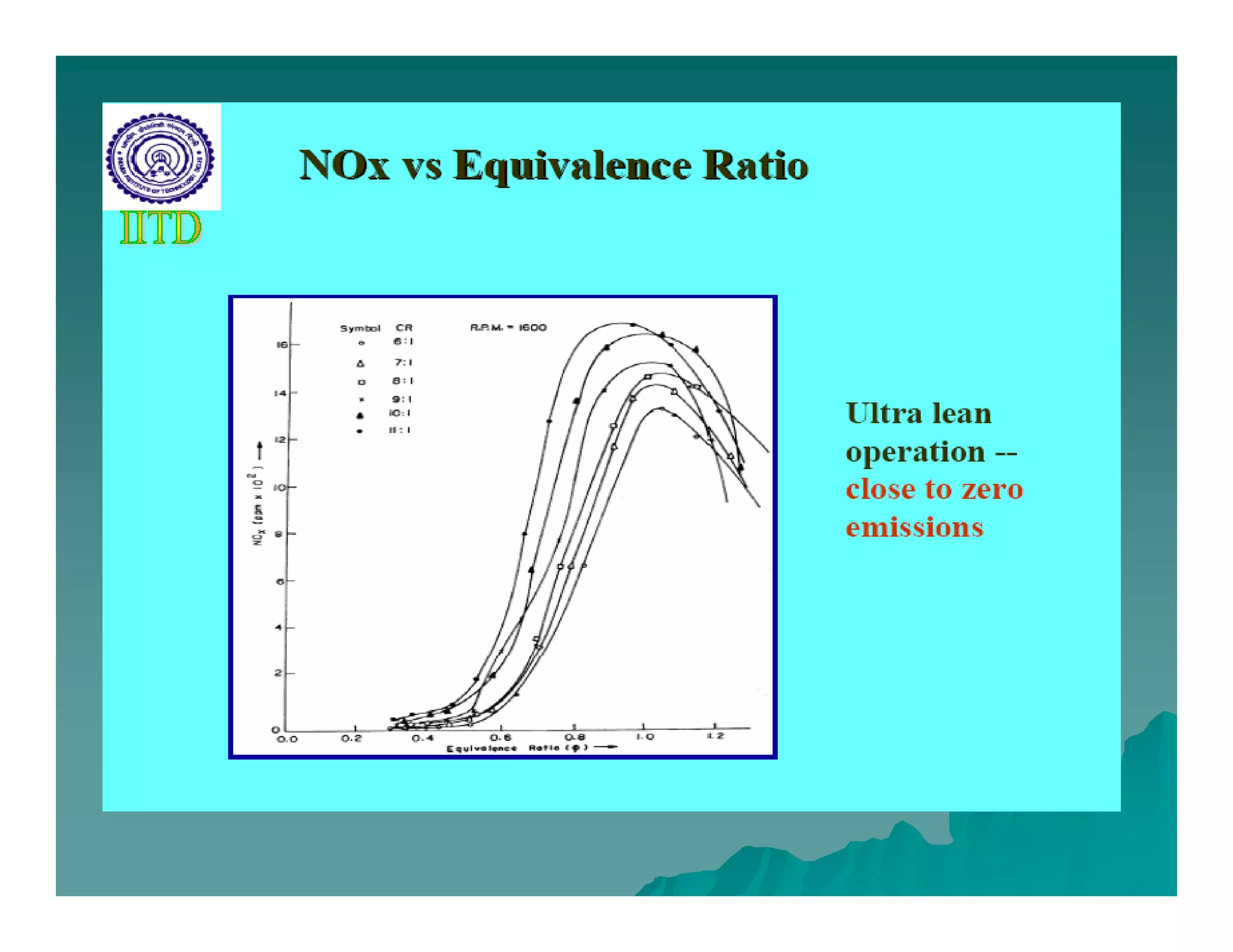
 Maximum level – 10 % above the stoichiometric
 Too much lean mixture – reduce peak temperature
 Nitrogen present in the fuel
 O + N2 = NO + N Equivalence ratio
 N+ O2 = NO + O Advanced spark timing
 N + OH = NO+ H
 NO+ H2O = NO2+ H2
 NO + O2 = NO2 +O (Zeldovich Mechanism) NO O2 NO2 O (Zeldovich Mechanism)
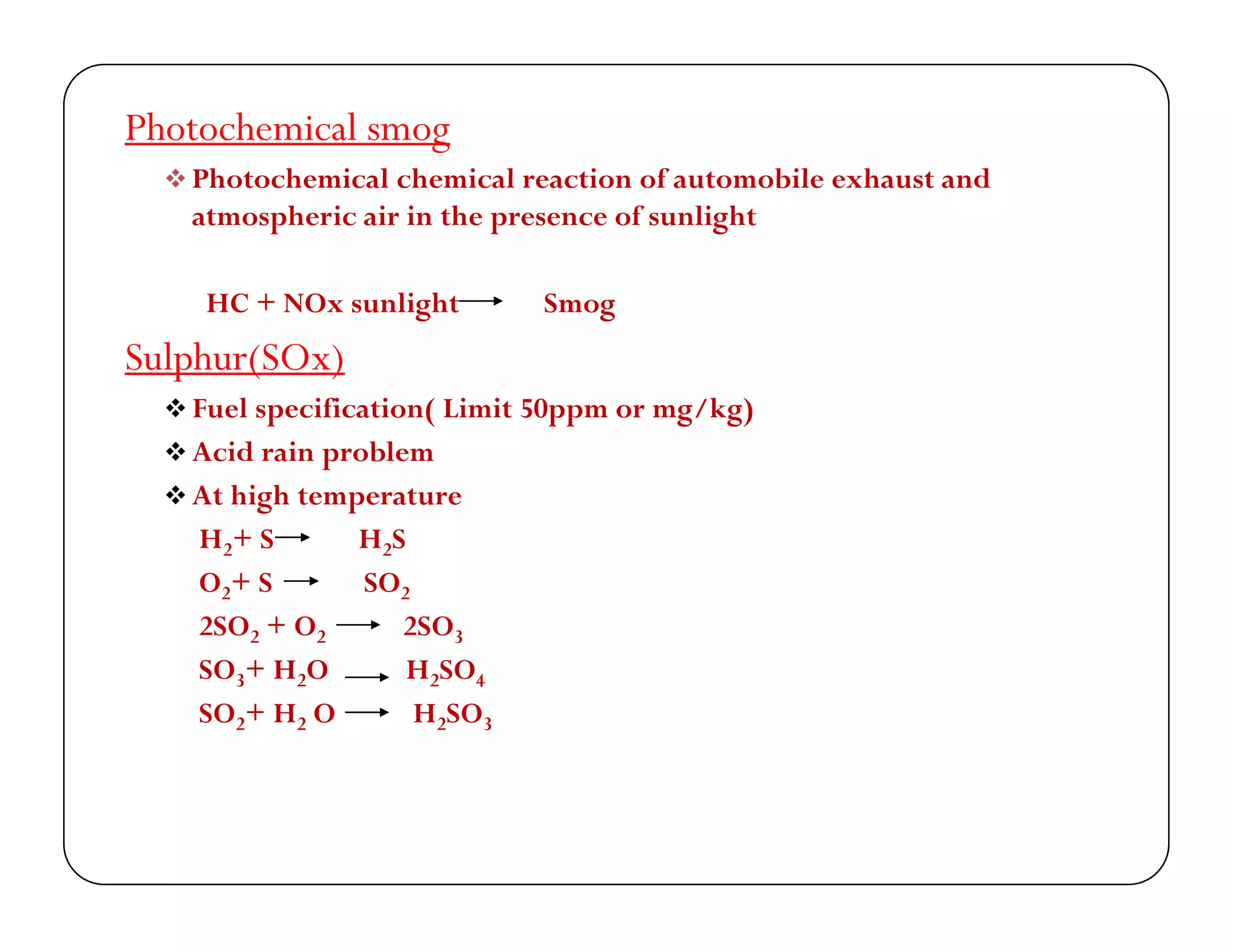
Photochemical smog
 Photochemical chemical reaction of automobile e haust and Photochemical chemical reaction of automobile exhaust and
atmospheric air in the presence of sunlight
HC + NO li ht SHC + NOx sunlight Smog
Sulphur(SOx)
 Fuel specification( Limit 50ppm or mg/kg) Fuel specification( Limit 50ppm or mg/kg)
 Acid rain problem
 At high temperature
H + S H SH2+ S H2S
O2+ S SO2
2SO2 + O2 2SO3
SO3+ H2O H2SO4
SO2+ H2 O H2SO3
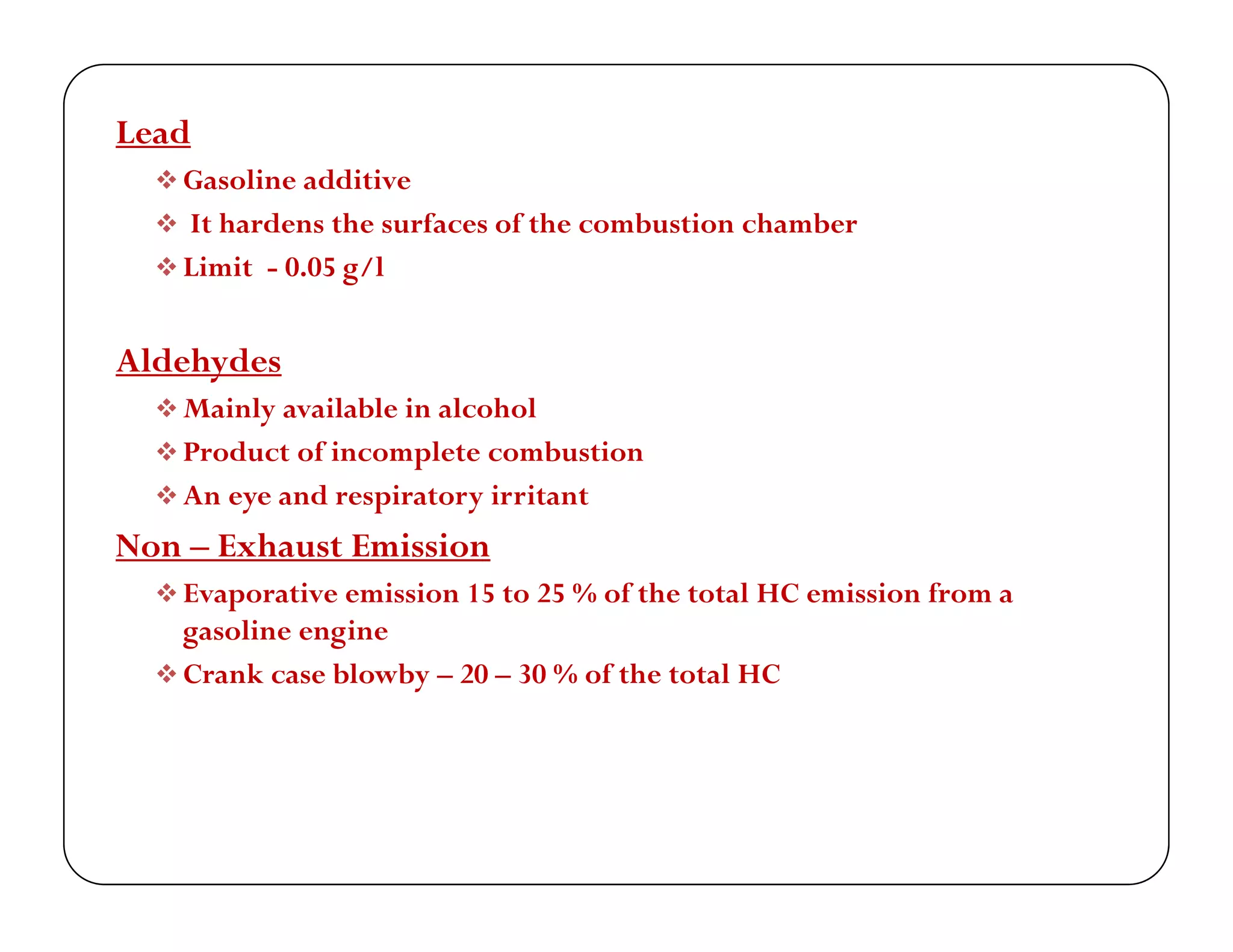
Lead
 G li dditi Gasoline additive
 It hardens the surfaces of the combustion chamber
 Limit - 0.05 g/l
Aldehydes
 Mainly available in alcohol Mainly available in alcohol
 Product of incomplete combustion
 An eye and respiratory irritant
N E h E i iNon – Exhaust Emission
 Evaporative emission 15 to 25 % of the total HC emission from a
gasoline engine
 Crank case blowby – 20 – 30 % of the total HC
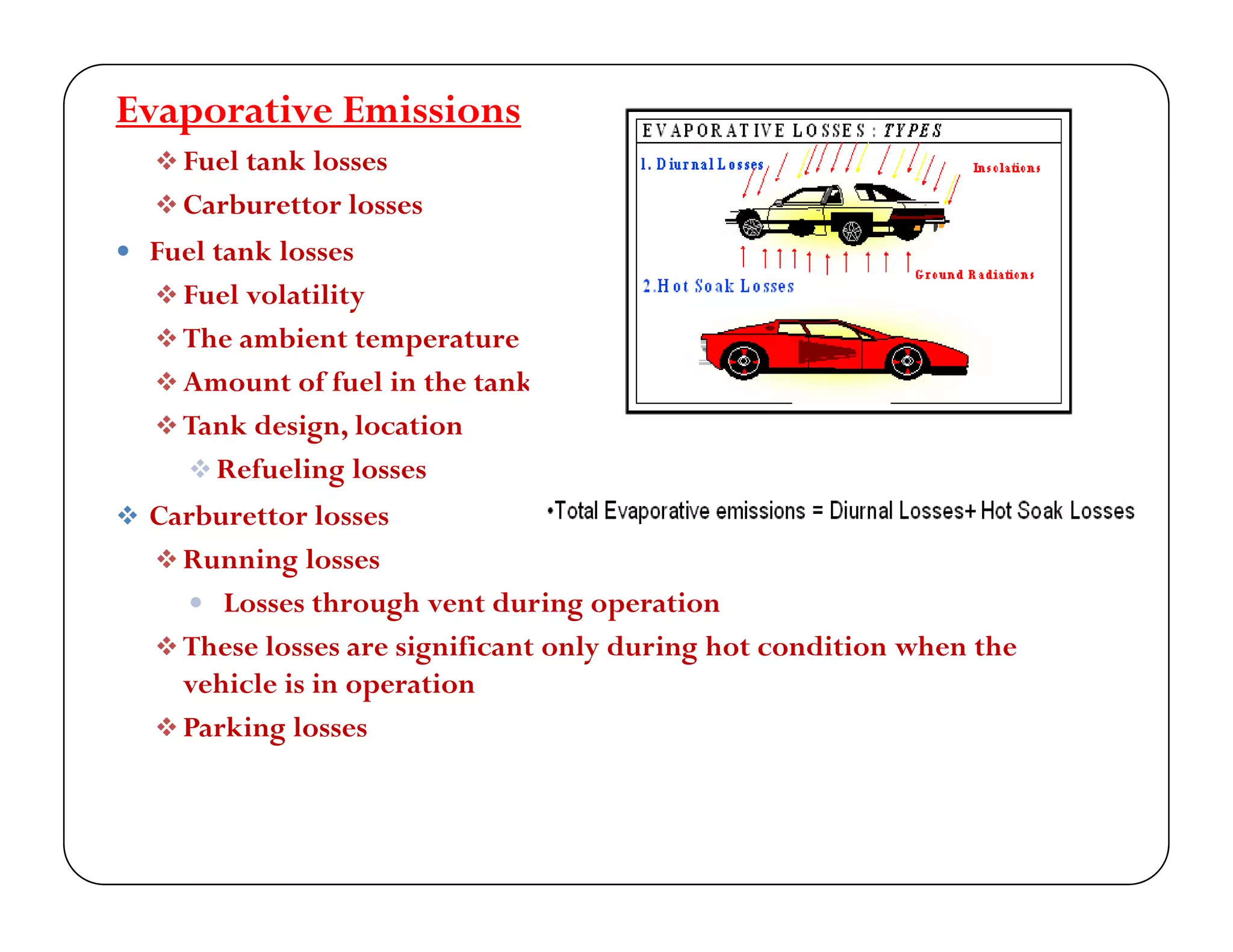
Evaporative Emissions
 Fuel tank losses
 Carburettor losses
 Fuel tank losses
 Fuel volatility Fuel volatility
 The ambient temperature
 Amount of fuel in the tank
 k d i l i Tank design, location
 Refueling losses
 Carburettor losses
 Running losses
 Losses through vent during operation
 These losses are significant only during hot condition when theese osses a e s g ca t o y u g ot co t o w e t e
vehicle is in operation
 Parking losses
Evaporative emissions
increase significantly
if the fuel volatilityif the fuel volatility
increases”
Dirunal Emissions
 Take place from fuel tanks and carburetor float bowls
 (in engines fitted with carburetors) of parked vehicles.
 It draws in air at night as it cools downg
 Expels air and gasoline vapour as it heats up during the day.
 These could be up to 50g per day on hot days.
Hot Soak Emissions
 This occurs after an engine is shut down.
 The residual thermal energy of the engine heats upThe residual thermal energy of the engine heats up
 The fuel system leading to release of fuel vapours.
Running Losses
 Gasoline vapours are expelled from the tank (or float bowl)
 when the car is driven and the fuel tank becomes hot.
 This can be high if the ambient temperature is high.This can be high if the ambient temperature is high.
Crankcase blow by
 Leakage past the piston piston rings from the cylinder to the crankcaseLeakage past the piston, piston rings from the cylinder to the crankcase
• Blow by gases are produced in the crankcase during the normal
combustion process
Pi t bl b i ith i d d i ti l th• Piston blowby increases with engine speed and in particular as the
piston rings and cylinder bore wears
SI Engine Emissions Control
 Main approaches
 Engine design modification & Operating parameters Engine design modification & Operating parameters
 Treatment of exhaust gas
 Fuel modification
 Engine modifications Engine modifications
 Combustion chamber configuration
 Reduce surface to volume area
 Reduce space around the piston ringsg
 Reduce top land distance
 Avoid flame quenching zones
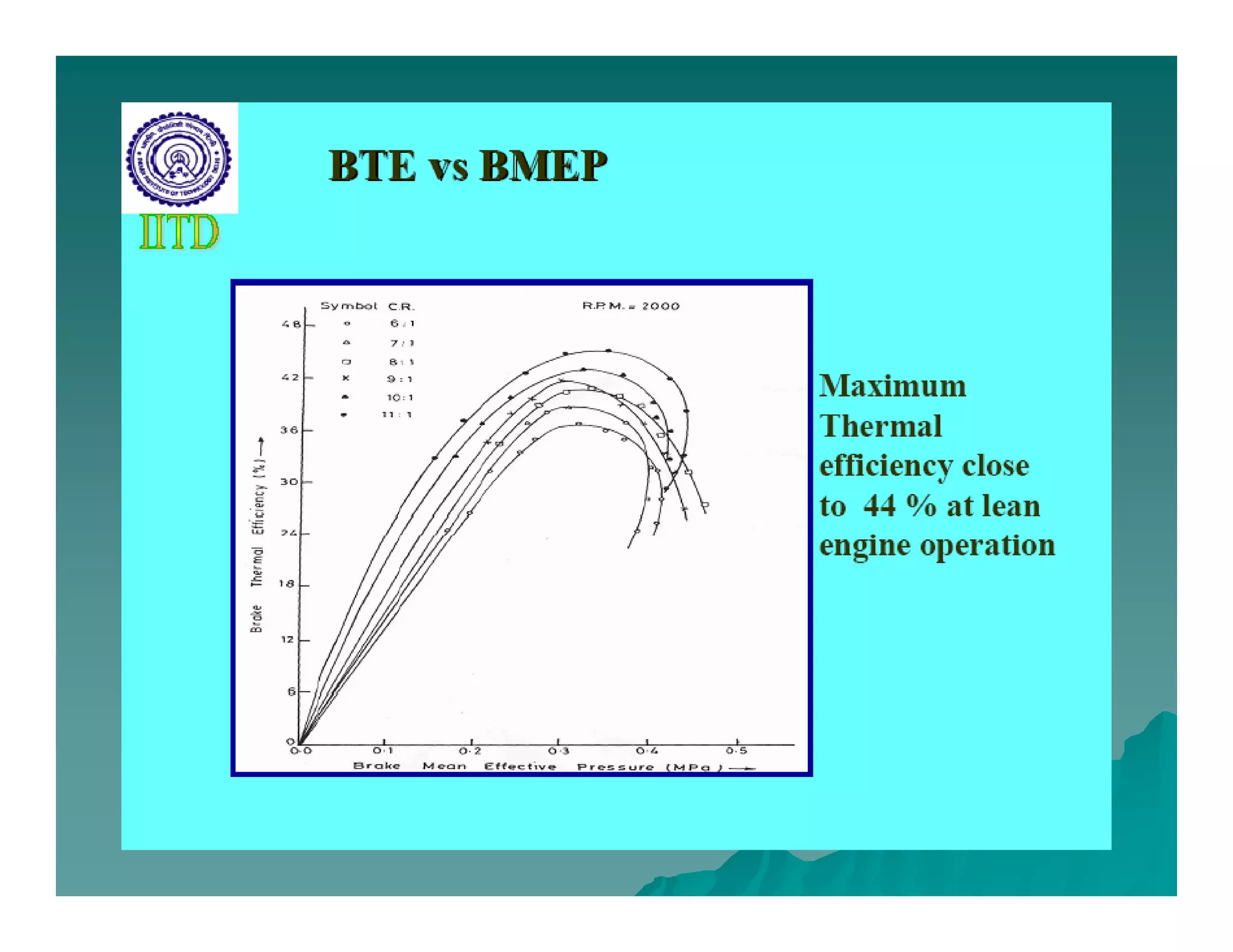
 Lower compression ratio
R h hi Resuces the quenching area
 Also reduces NOx emissions
 Affect the thermal efficiency
 Modified induction system Modified induction system
 Supply of air-fuel ratio for all cylinders under all operating conditions of load
and speed
 Multi choke carburettors or MPFI system
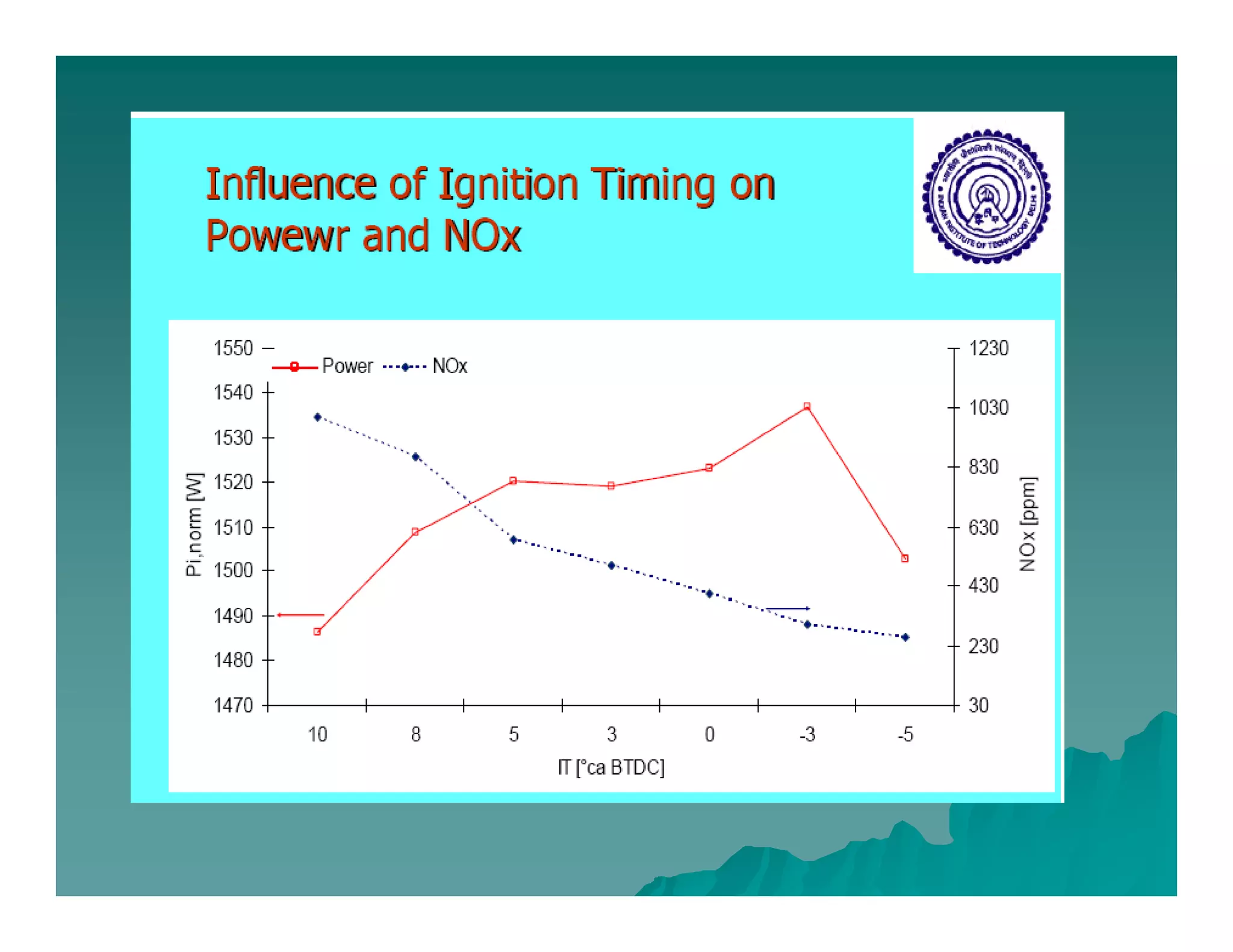
 Ignition timing
 Proper ignition timing
 Affect HC and NOx formation
 Required spark advance during cruising and retard the same for idling running
 Also affect the power output
 Valve overlap
 Sh ld b d d Should be reduced
 VariableValveTiming – control of scheduling of valve timing events
 Use of leaner air-fuel ratios Use of leaner air fuel ratios
 Proper modification required to provide lean and stable air-fuel mixtures during
idling and cruise operation
 Electronic Fuel injection system
 Coolant temperature
 HC hi h HC – high
 NOX – low
Fuel modification
 Unleaded Petrol
 0.05% sulphur in petrol
 0.05% sulphur diesel
 Using reformulated fuels Using reformulated fuels
 Oxygenated gasoline in winter season
 Low volatility in summer –To reduce HC emission
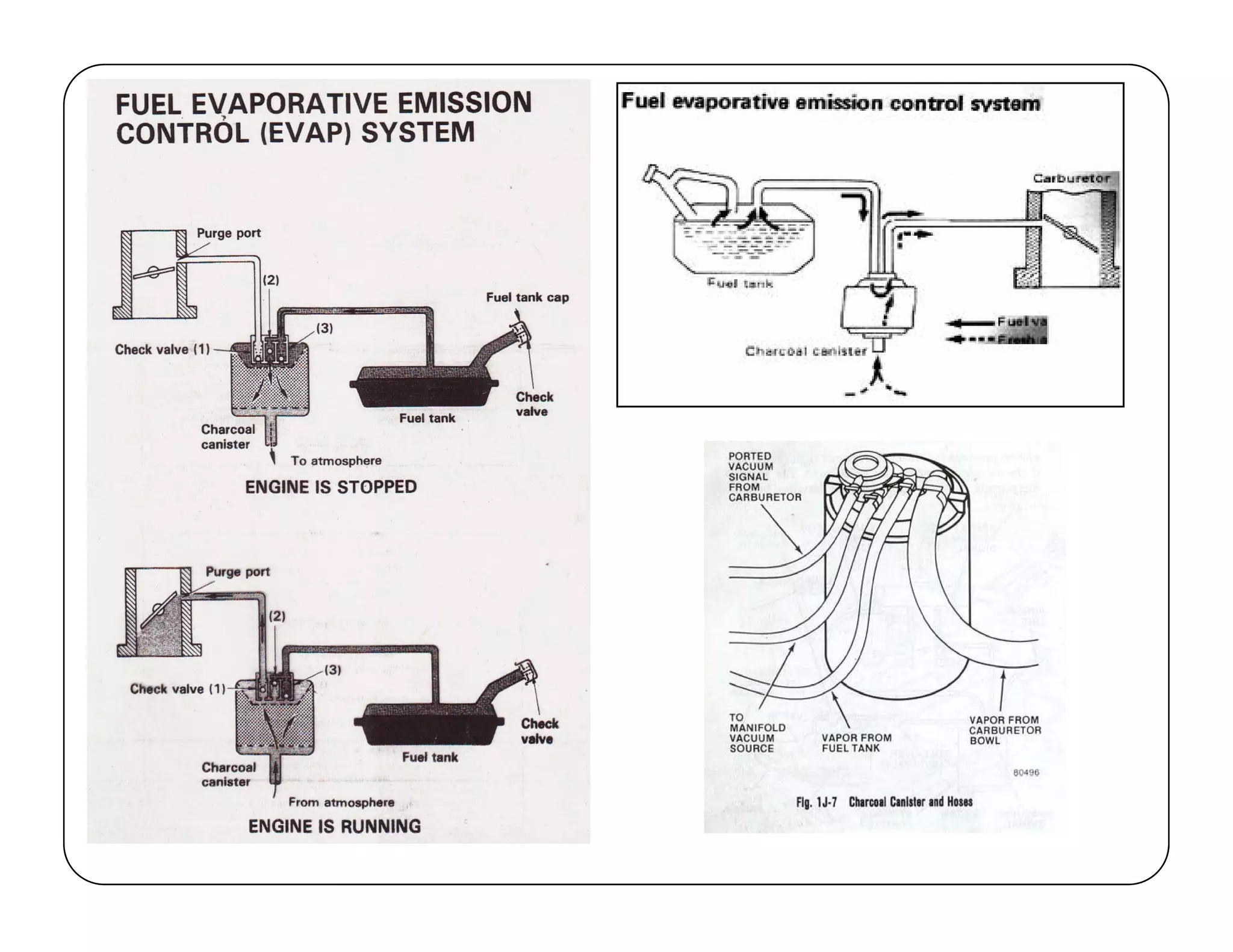
Evaporation Loss control device
 Control all evaporative emissions by capturing the vapours andp y p g p
recirculation them at the appropriate times
 Adsorbent chamber
 Charcoal bed or formed polyurethaneC a coa be o o e po yu et a e
 Adsorbs the vapour
 Canister
 The purge control valve
 Purging - process by which the gasoline vapours are removed
Activated
Carbon
Atmosphere
vent
Inlet
manifold
Fuel tankFuel tank
vent
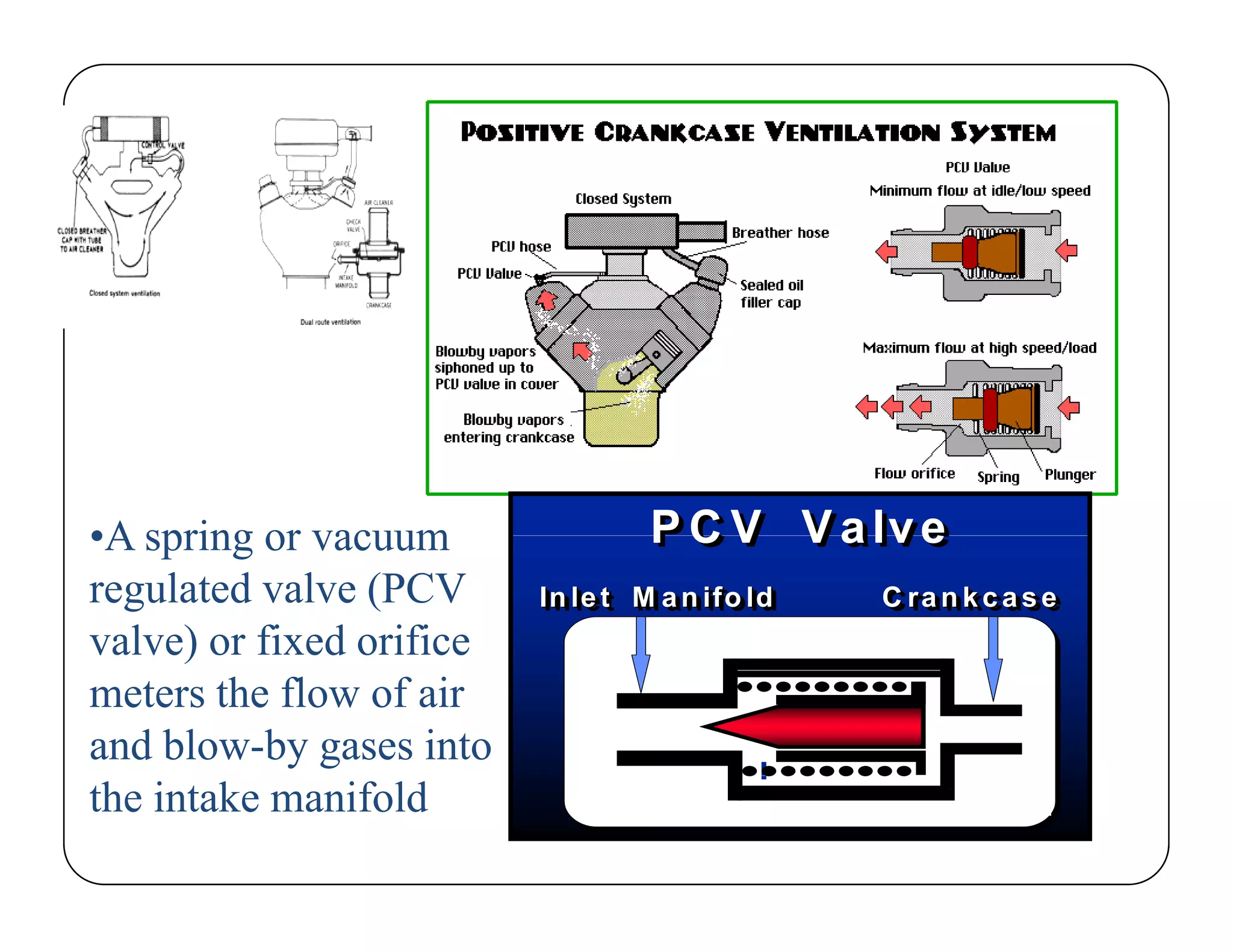
Crankcase ventilations
 Phenomenon of leakage past the piston and piston rings Phenomenon of leakage past the piston and piston rings
from the cylinder to the crank case
 20% of the total HC emission from the engine 20% of the total HC emission from the engine
 Rings are worn out
 Recirculation of the vapours back into the intake air cleaner Recirculation of the vapours back into the intake air cleaner
 Closed or open crankcase ventilation
 S t l d d li ht System placed under slight vacuum
 Positive crankcase ventilation
 When the acuum is high blo b is less When the vacuum is high - blowby is less
 At wide opening throttle , the air flow gets unrestricted but flow rate
is metered by the valve opening
P C V V alveP C V V alve•A spring or vacuum
In let M an ifo ldIn let M an ifo ldIn let M an ifo ld C ran kcaseC ran kcaseC ran kcase
P C V V alveP C V V alve•A spring or vacuum
regulated valve (PCV
valve) or fixed orifice)
meters the flow of air
and blow-by gases into
the intake manifold
ExhaustTreatment Methods
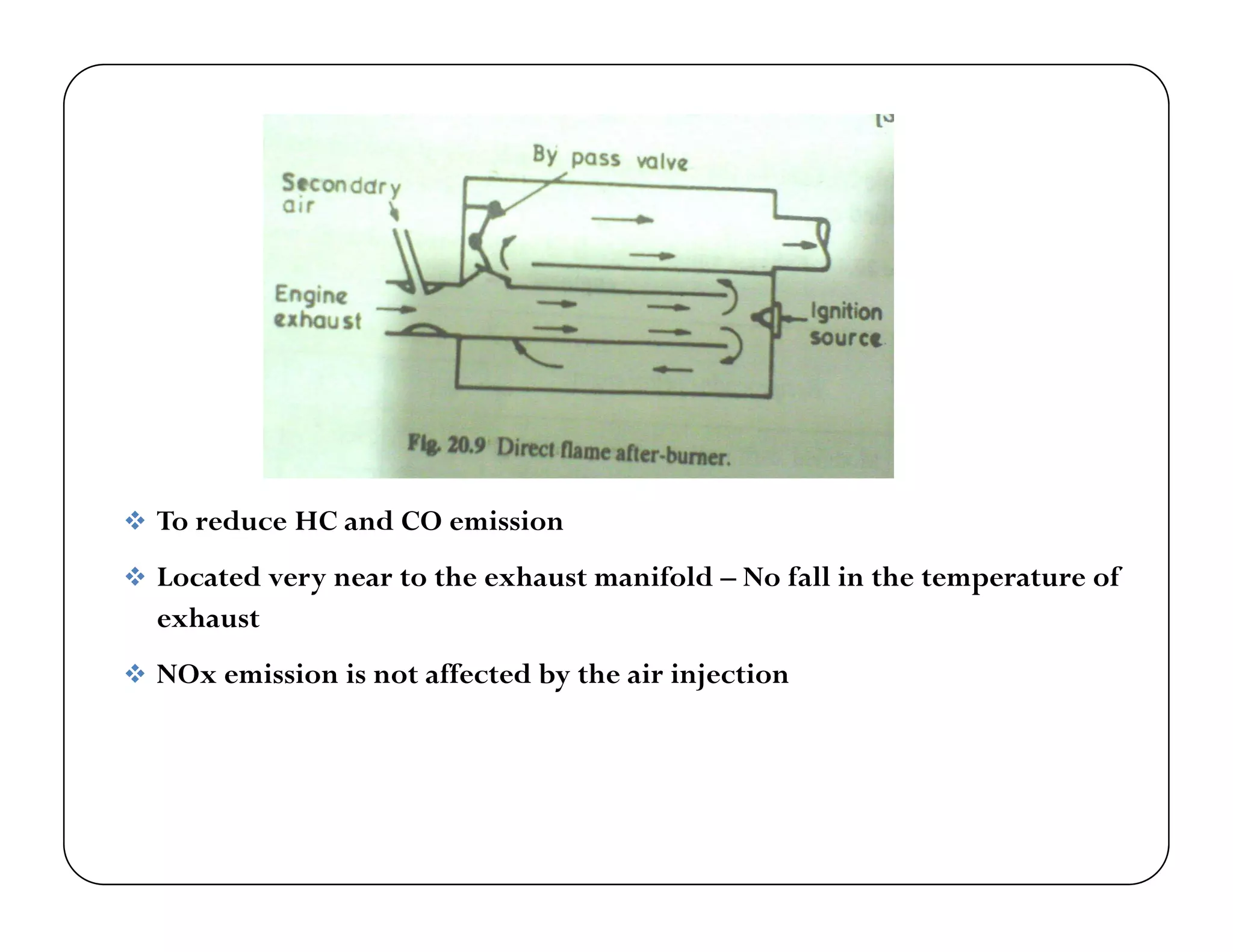
 After burners
 Sustain the high temperature within the system during rich
operating conditions
 High heat losses over a large area High heat losses over a large area
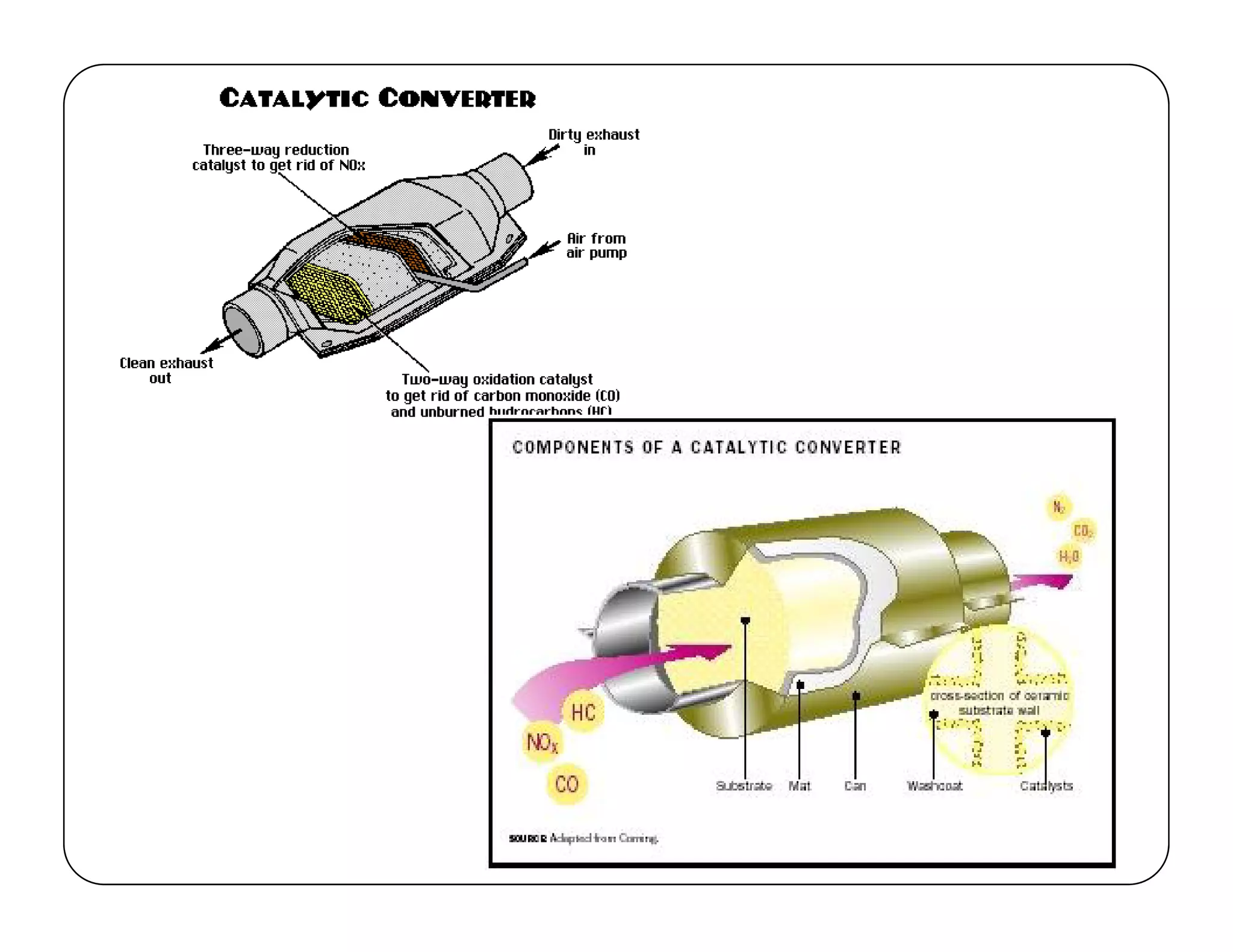
 Catalytic Converters
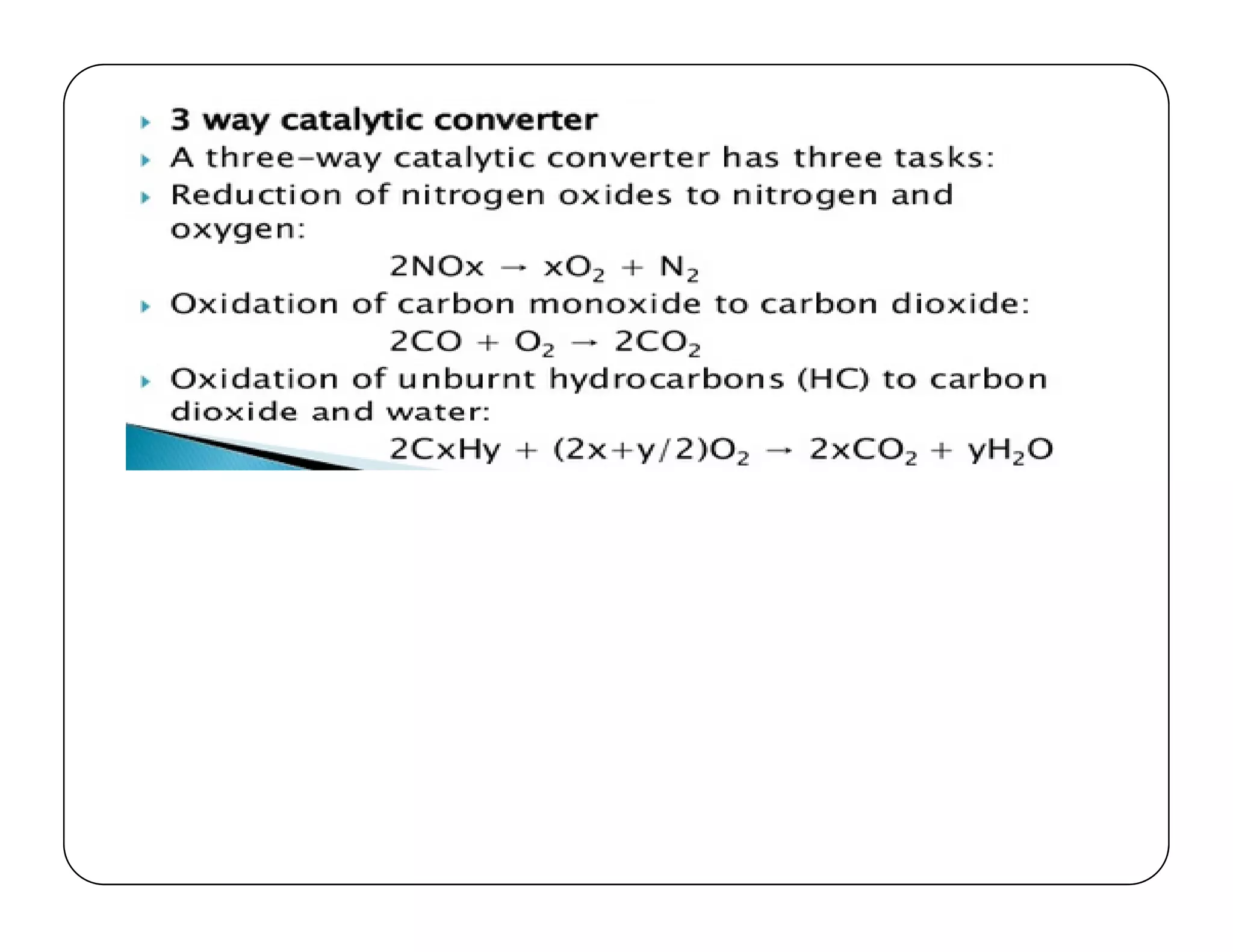
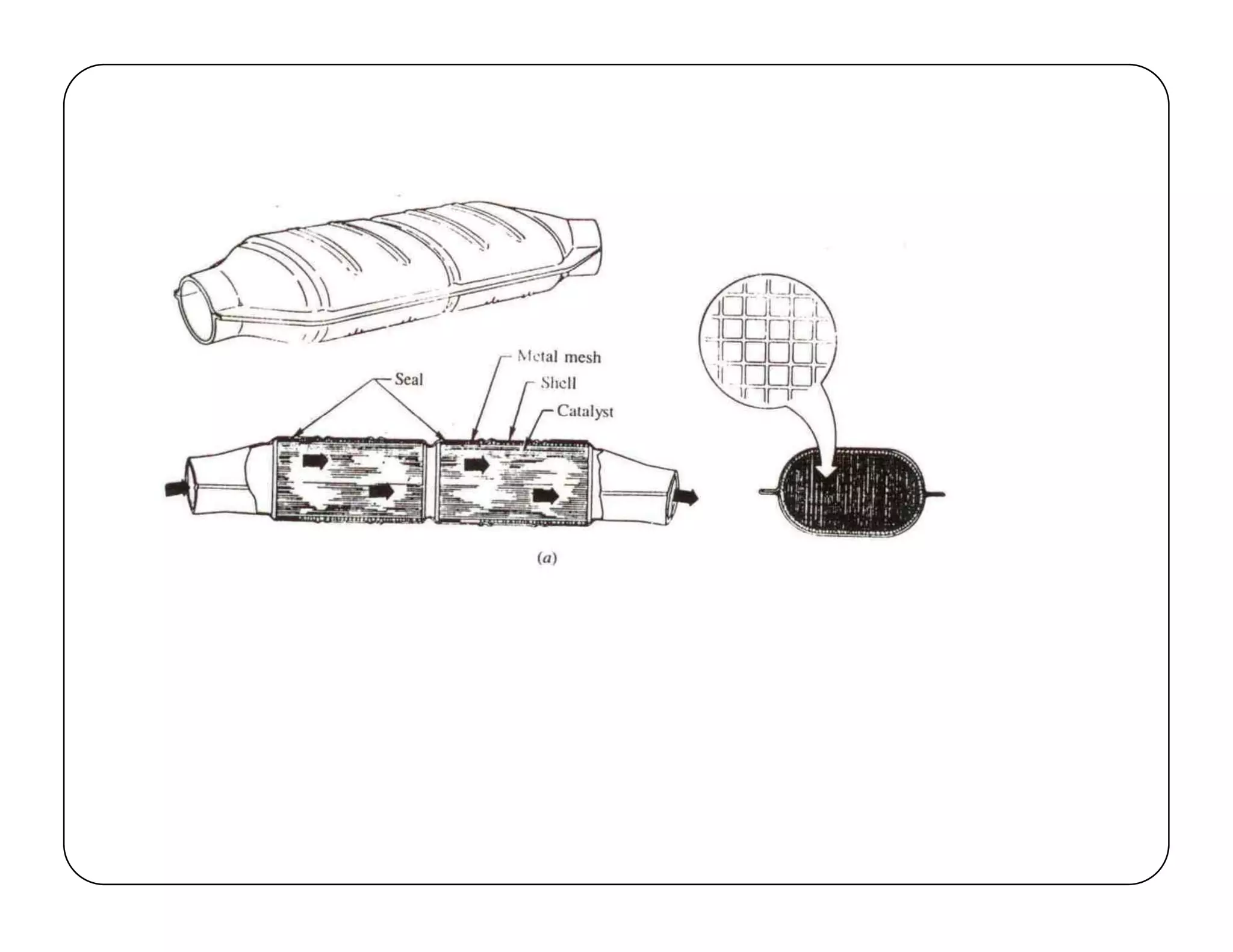
 Three way catalytic converter
 CO, HC and NOx reduction
 CO and HC can be oxidized to CO2 and H2O in the exhaust systems
 Its quality degraded by heat life contaminants Its quality degraded by heat, life , contaminants
 Stainless steel container
 Inside the container – Porous ceramic structure
 Ceramic honeycomb or matrix structure- also called monolith
 A bed of spherical ceramic pellets
 Volume of the ceramic structure is about half of the displacement Volume of the ceramic structure is about half of the displacement
volume
 To reduce HC and CO emission
 Located very near to the exhaust manifold – No fall in the temperature of
exhaust
 NOx emission is not affected by the air injection
Catalytic materials
 Al i O id B i i l Aluminum Oxide – Base ceramic material
 Withstand high temperature
 Low thermal expansion Low thermal expansion
 Platinum & Palladium – CO& HC emissions
 Rhodium – NOx Rhodium NOx
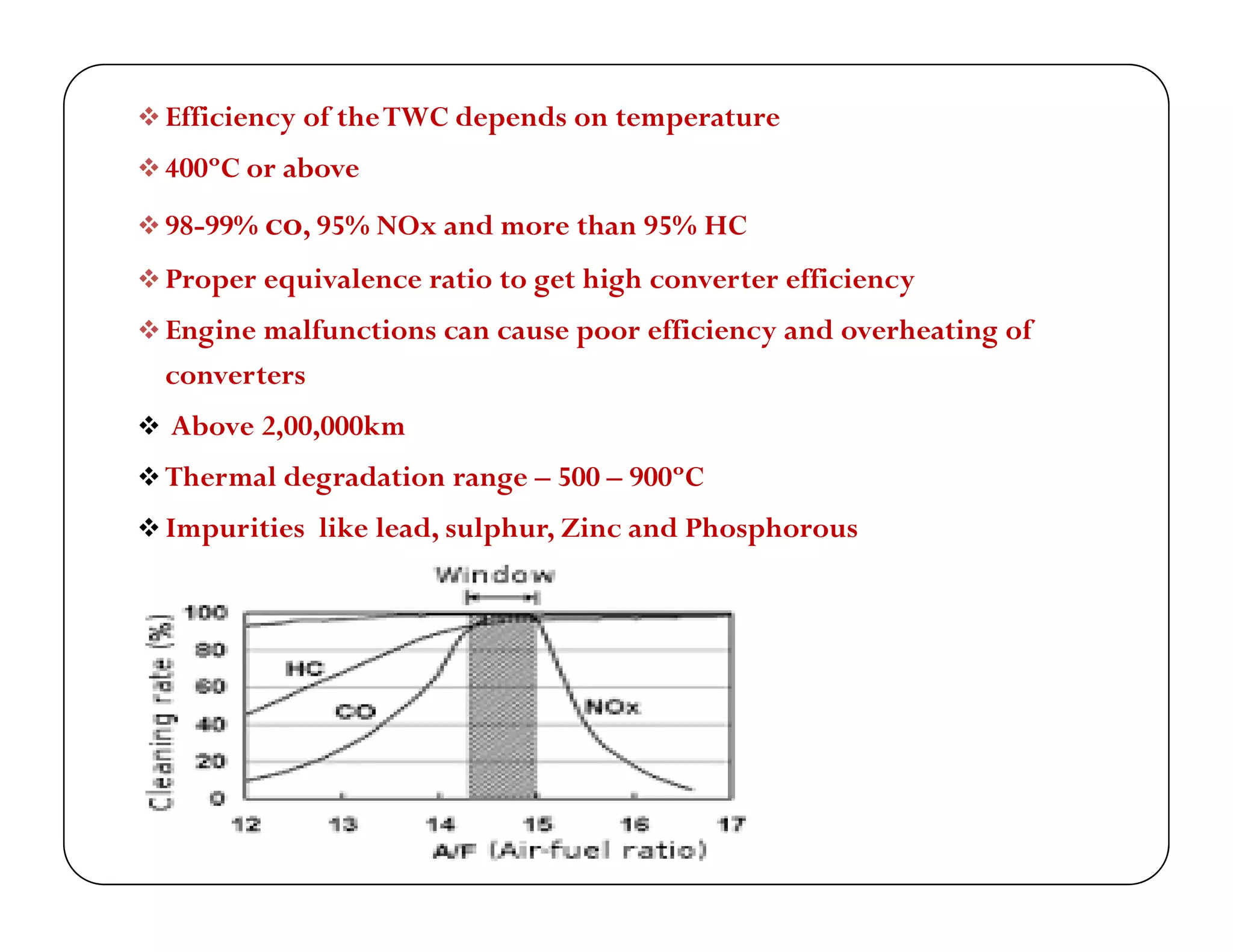
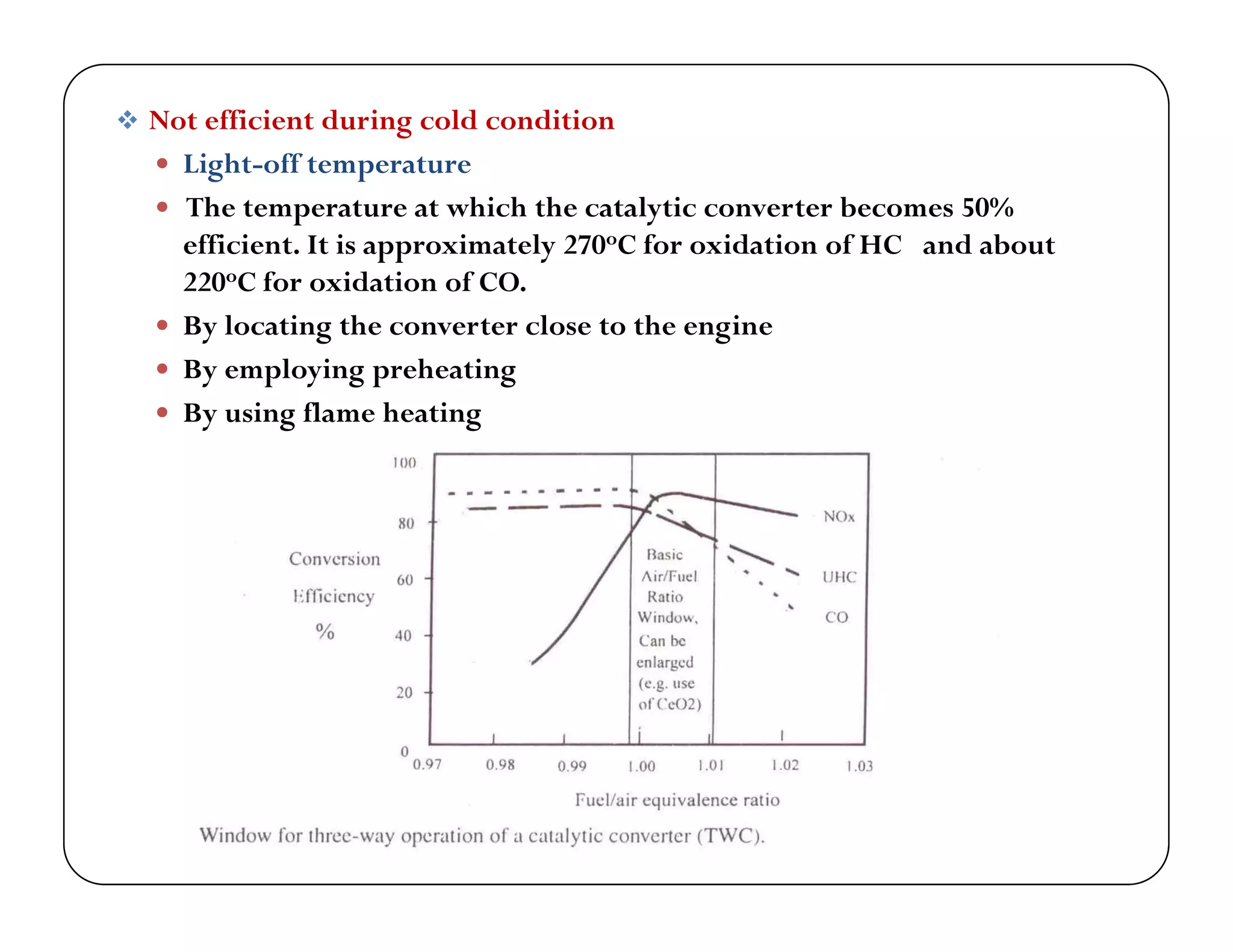
 Efficiency of theTWC depends on temperature
 400ºC or above 400 C or above
 98-99% co, 95% NOx and more than 95% HC
 Proper equivalence ratio to get high converter efficiencyp q g g y
 Engine malfunctions can cause poor efficiency and overheating of
converters
 b k Above 2,00,000km
 Thermal degradation range – 500 – 900ºC
 Impurities like lead, sulphur, Zinc and Phosphorous Impurities like lead, sulphur, Zinc and Phosphorous
 Not efficient during cold condition
 Light-off temperatureg p
 The temperature at which the catalytic converter becomes 50%
efficient. It is approximately 270oC for oxidation of HC and about
220oC for oxidation of CO.
 By locating the converter close to the engine
 By employing preheating
 By using flame heating By using flame heating
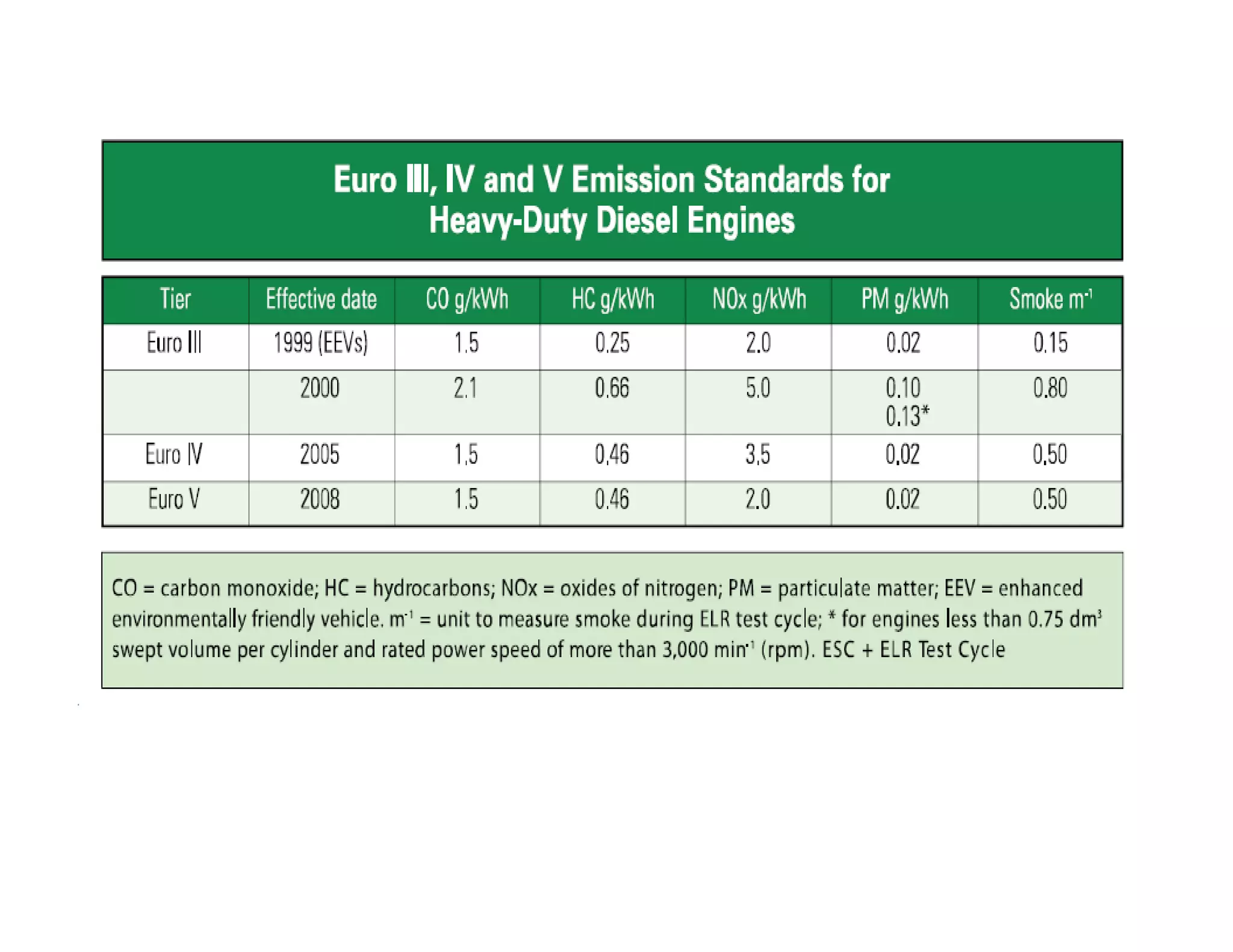
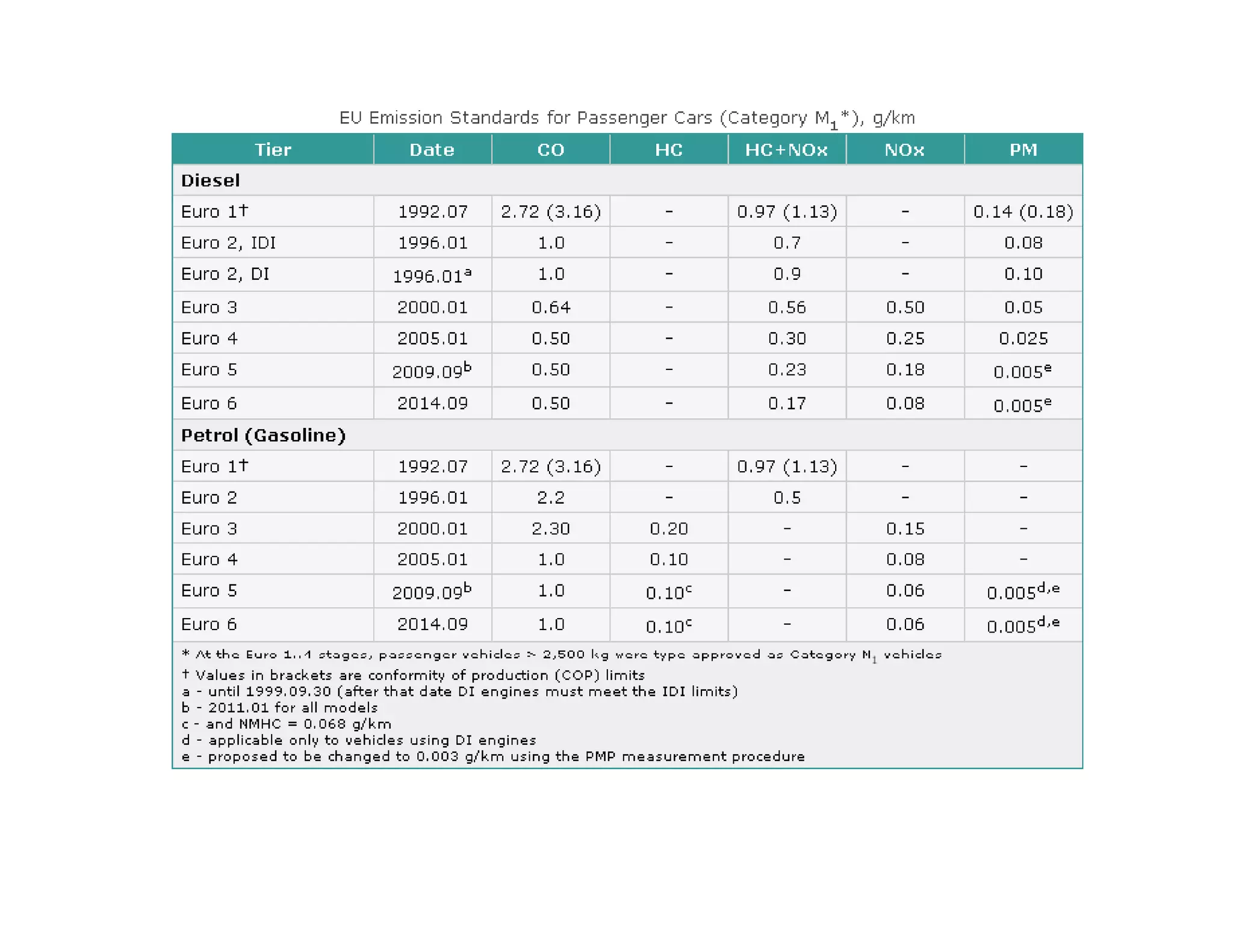
Emission Norms and Driving Cycles
OVERVIEW OF THE EMISSION NORMS IN INDIA
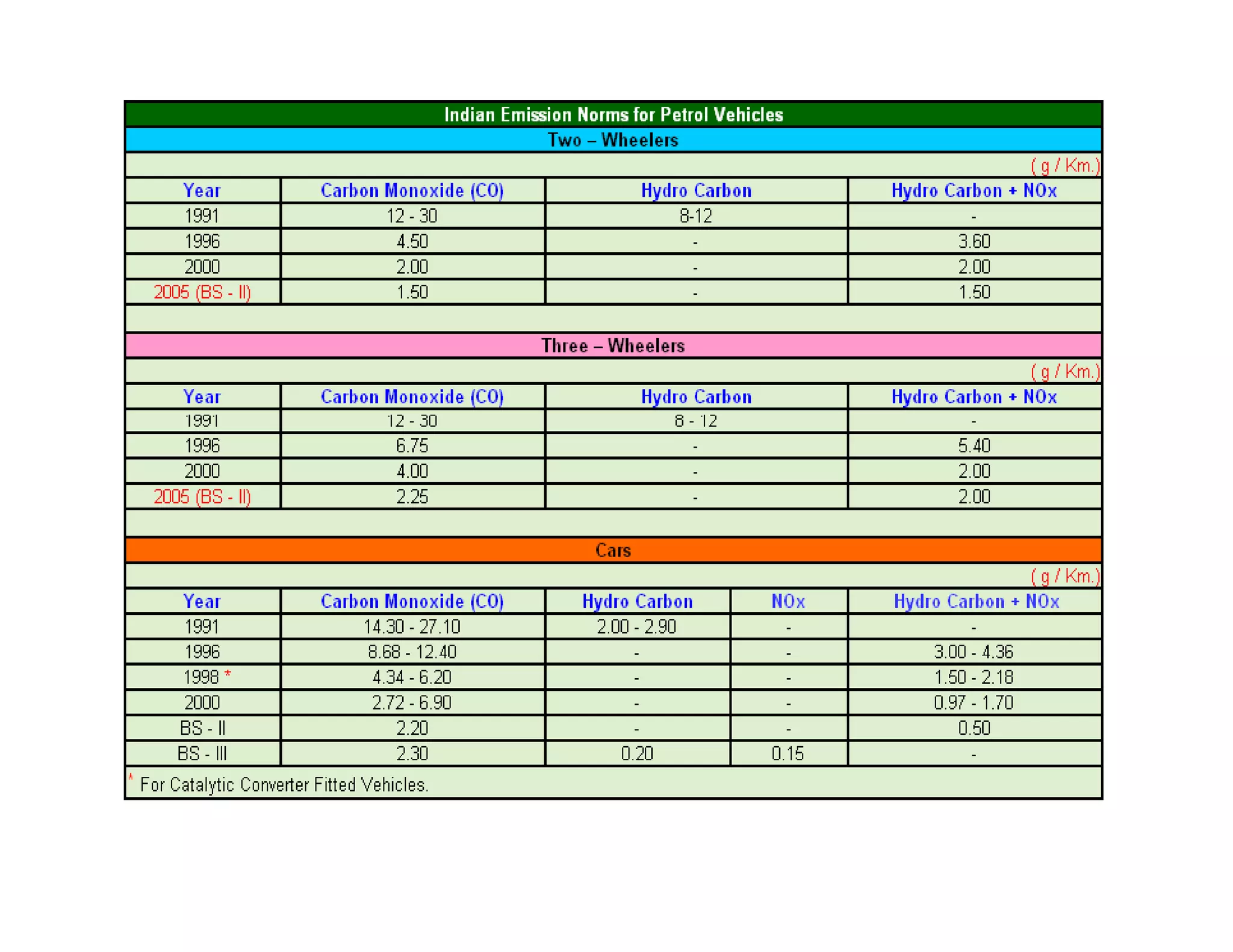
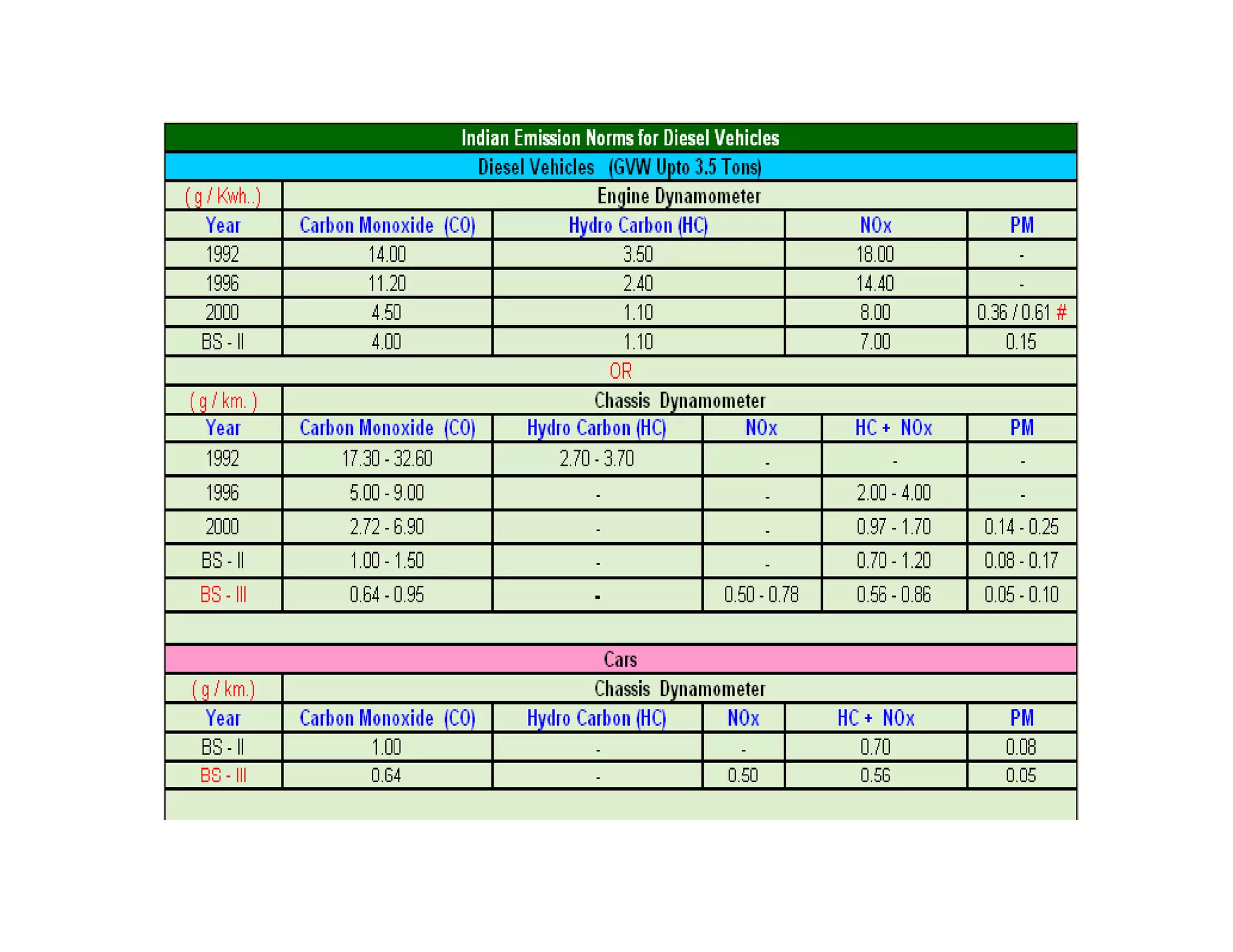
• 1991 - Idle CO Limits for Gasoline Vehicles and Free Acceleration Smoke for Diesel1991 Idle CO Limits for Gasoline Vehicles and Free Acceleration Smoke for Diesel
Vehicles, Mass Emission Norms for Gasoline Vehicles.
1992 - Mass Emission Norms for Diesel Vehicles.
1996 - Revision of Mass Emission Norms for Gasoline and Diesel Vehicles, mandatory
fitment of Catalytic Converter for Cars in Metros on Unleaded Gasoline.
1998 - Cold Start Norms Introduced.
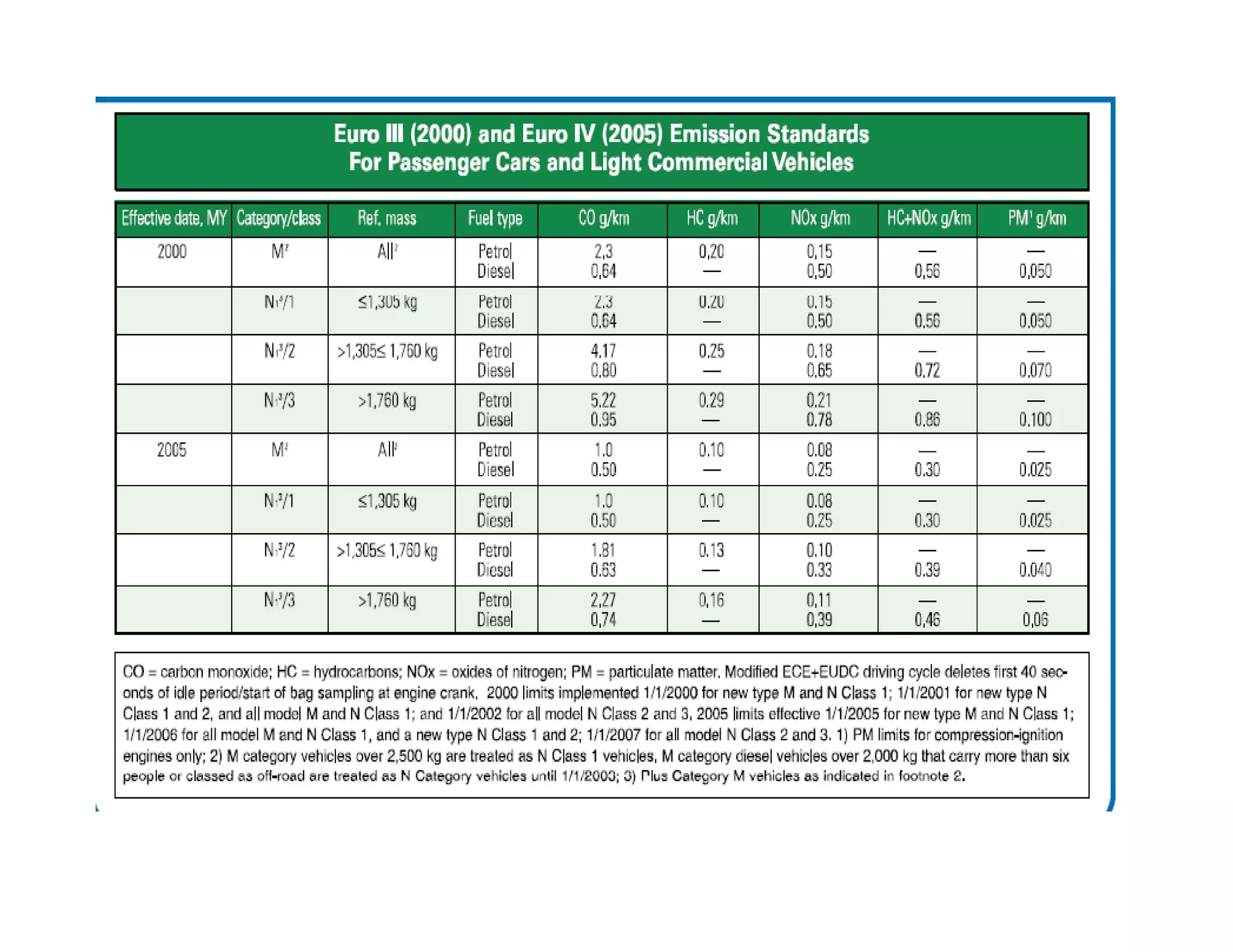
2000 - India 2000 (Eq. to Euro I) Norms, Modified IDC (Indian Driving Cycle), Bharat Stage
II Norms for Delhi.
2001 - Bharat Stage II (Eq. to Euro II) Norms for All Metros, Emission Norms for CNG & LPG
Vehicles.
2003 - Bharat Stage II (Eq. to Euro II) Norms for 11 major cities.
2005 - From 1st April Bharat Stage III (Eq. to Euro III) Norms for 11 major cities.
2010 - Bharat Stage III Emission Norms for 4-wheelers for entire country whereas Bharat
Stage - IV (Eq. to Euro IV) for 11 major cities.
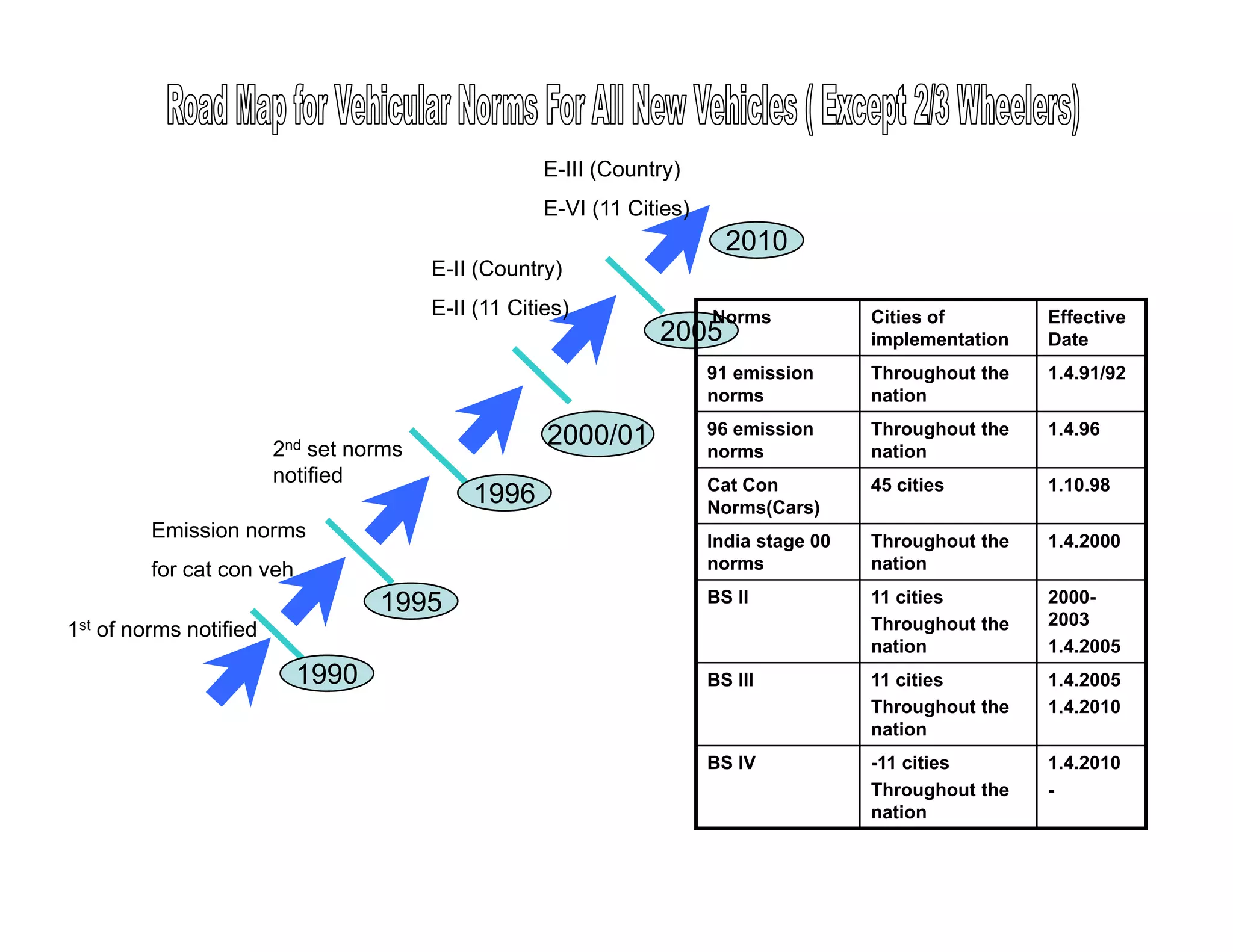
E-III (Country)
E-II (Country)
E III (Country)
E-VI (11 Cities)
2010
E-II (11 Cities)
2005
Norms Cities of
implementation
Effective
Date
91 emission
norms
Throughout the
nation
1.4.91/92
Emission norms
2nd set norms
notified
2000/01
1996
96 emission
norms
Throughout the
nation
1.4.96
Cat Con
Norms(Cars)
45 cities 1.10.98
I di t 00 Th h t th 1 4 2000
1st of norms notified
Emission norms
for cat con veh
1995
India stage 00
norms
Throughout the
nation
1.4.2000
BS II 11 cities
Throughout the
nation
2000-
2003
1.4.2005
1990 BS III 11 cities
Throughout the
nation
1.4.2005
1.4.2010
BS IV -11 cities 1.4.2010
Throughout the
nation
-
Indian Emission Standards (4-Wheel Vehicles)
Standard Reference Date Region
India 2000 Euro 1 2000 NationwideIndia 2000 Euro 1 2000 Nationwide
Bharat Stage II Euro 2
2001 NCR*, Mumbai, Kolkata, Chennai
2003.04 NCR*, 10 Cities†Bharat Stage II Euro 2 2003.04 NCR , 10 Cities†
2005.04 Nationwide
Bh t St III E 3
2005.04 NCR*, 10 Cities†
Bharat Stage III Euro 3
2010.04 Nationwide
Bharat Stage IV Euro 4 2010.04 NCR*, 10 Cities†
*National Capital Region (Delhi)
† Mumbai, Kolkata, Chennai, Bangalore, Hyderabad, Ahmedabad, Pune,
Surat Kanpur and AgraSurat, Kanpur and Agra
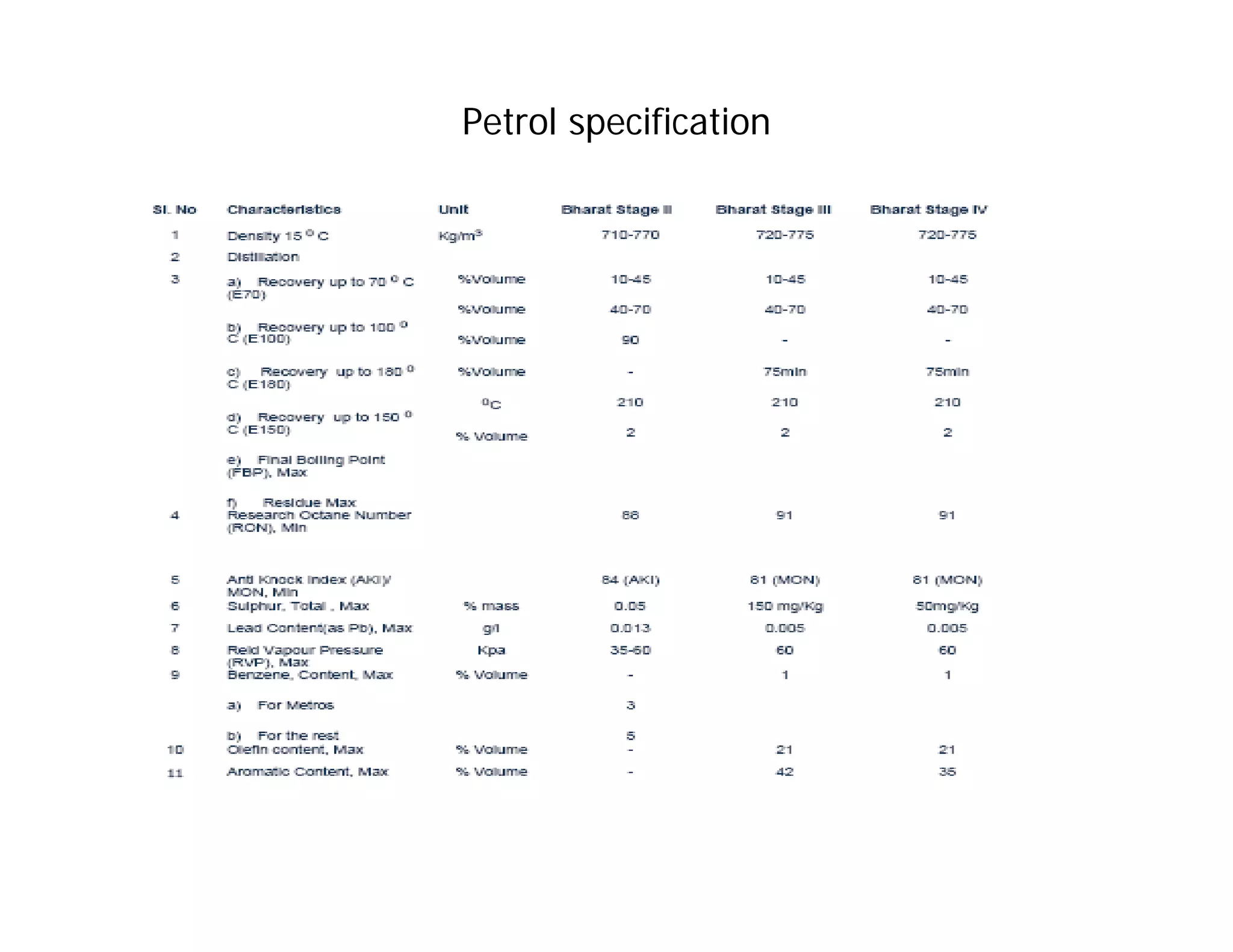
Petrol specification
Vehicular Technological Upgradations Required
2/3 Wheelers
?Secondary air
injection Fuel injection
Category of Engine Bharat Stage II Bharat Stage III Bharat Stage IV
2- Stroke SI
Engines
j
Catalytic
converter
CNG / LPG
Catalytic
converter
2/3 Wheelers
4- Stroke SI
Fuel injection
+ catalytic
converter
4-Stroke design
Secondary air
injection
(specific power
Carburetor +
secondary air
injection + catalytic
converter
4 Stroke SI
Engines
Lean burn
( p p
based)
Direct
i li d
Fuel injection
Fuel injection +
t l ti t
4 Wheelers
4- Stroke SI
Engines
in-cylinder
injection
catalytic
converter
Lean burn
Fuel injection
Catalytic converter
Fixed EGR
CNG / LPG
catalytic converter
Variable EGR
Variable valve timing
Multi valve
CNG / LPGEngines
Vehicular Technological Upgradations Required
NOx Trap
Particulate trap
Turbocharging
Inter cooling (based
TC & inter cooling
Multi valve
Category of Engine Bharat Stage II Bharat Stage III? Bharat Stage IV?
Diesel Engines
p
Common rail
injection
Injection
pressure > 1600
bar
g (
on specific power)
Moderate swirl
Injection pressure >
800 bar
Rotary pump
Low swirl
Injection pressure >
1200 bar
Unit injector /
common rail injectionDiesel Engines bar
On-board
diagnostic system
VGT
Cooled EGR
Rotary pump
EGR (need based)
Conversion to CNG
/ LPG
common rail injection
Rotary pump and
pilot injection rate
shaping
Variable geometry
turbocharger (VGT)
Oxycat
EGR (hot/cooled)
Electronic injection
control
Sulphur content in
diesel < 50 ppm
<15 ppm for NOxcontrolSulphur content in
diesel < 500 ppm
Sulphur content in
diesel <300 ppm
15 ppm for NOx
trap
pp
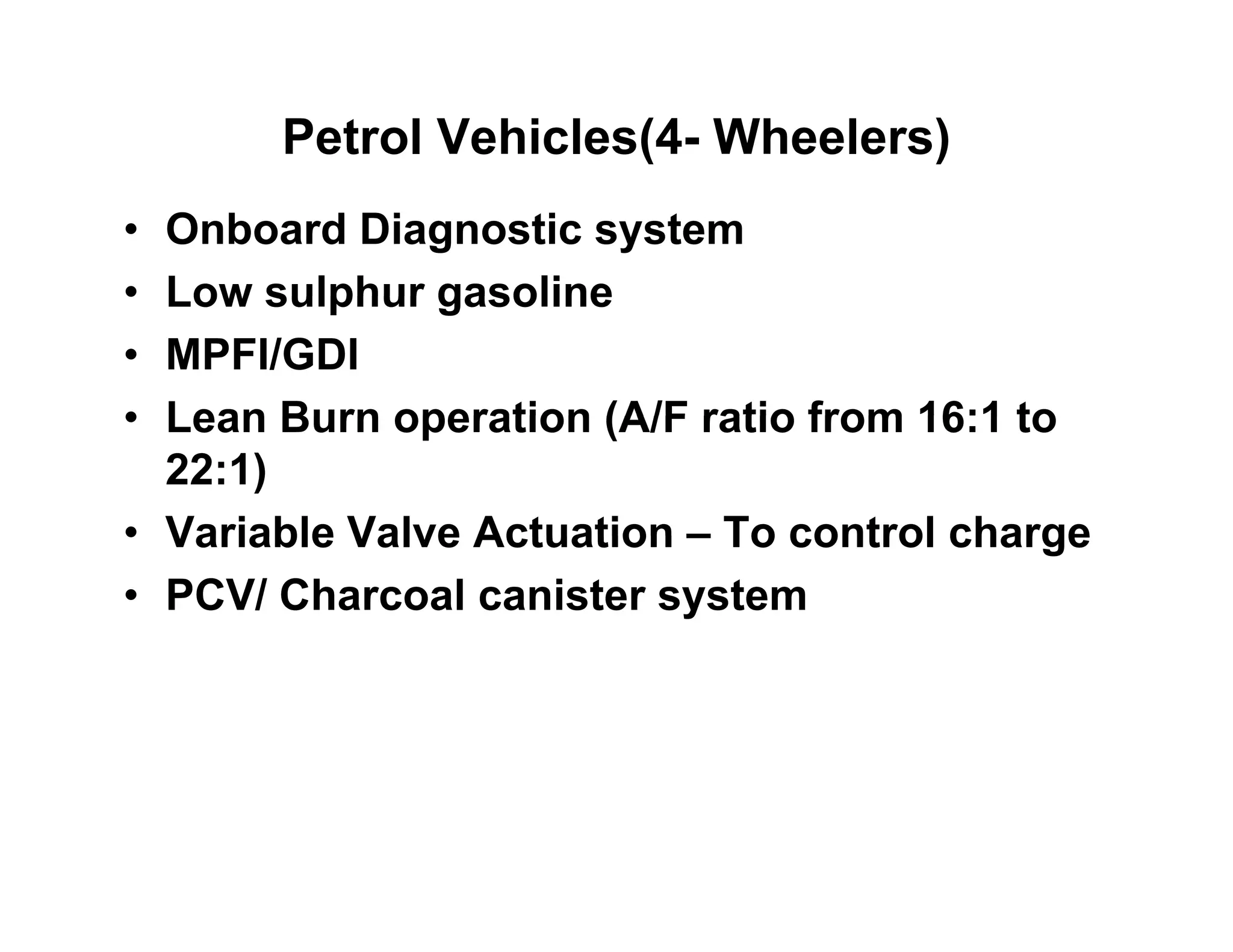
Petrol Vehicles(4- Wheelers)
• Onboard Diagnostic system
• Low sulphur gasoline• Low sulphur gasoline
• MPFI/GDI
• Lean Burn operation (A/F ratio from 16:1 to• Lean Burn operation (A/F ratio from 16:1 to
22:1)
• Variable Valve Actuation – To control charge• Variable Valve Actuation – To control charge
• PCV/ Charcoal canister system
Diesel Vehicles
Onboard Diagnostics System• Onboard Diagnostics System
• Unit Injector – 2500 bar
CRDI 1600 b• CRDI – 1600 bar
• Homogeneous Charge Compression Ignition
• Fuel cell
• CNG/ HANG
• Particulate Trap/ Diesel Oxidation Catalyst
2 Wheelers
• Fuel injection(GDI or Port oe throttle body)
• Electric motor cyclesy
• Catalytic converter
• Evaporative emission control device
• Electronic ignition
• EFI
C b ti h b ti i ti• Combustion chamber optimization
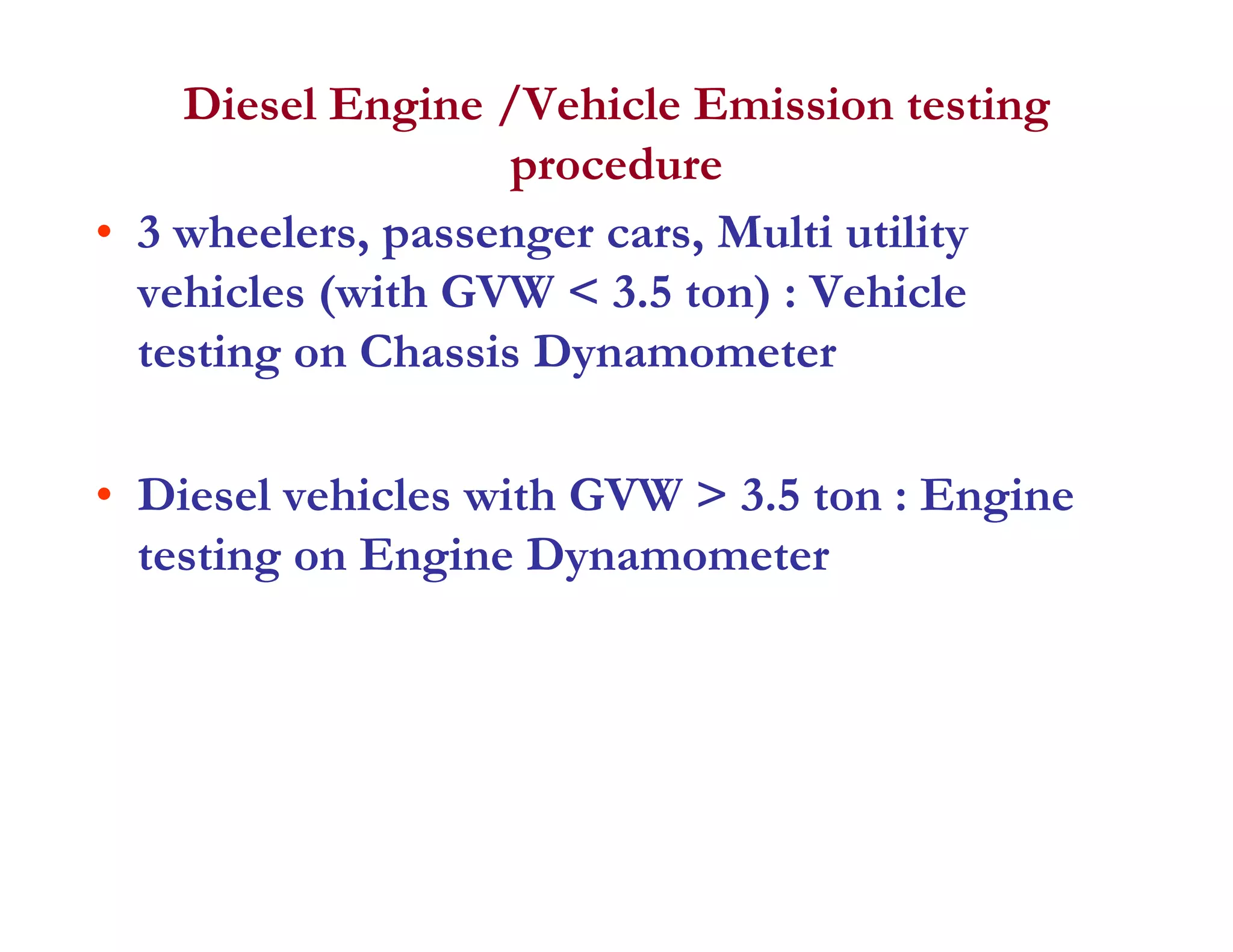
Diesel Engine /Vehicle Emission testing
procedureprocedure
• 3 wheelers, passenger cars, Multi utility
vehicles (with GVW < 3 5 ton) : Vehiclevehicles (with GVW < 3.5 ton) : Vehicle
testing on Chassis Dynamometer
• Diesel vehicles with GVW > 3.5 ton : Engine
testing on Engine Dynamometer
Equipments used for Diesel Engine Testing
on Engine Dynamometeron Engine Dynamometer
• Engine Dynamometer
• a) Eddy current typea) Eddy current type
• b) Transient Dynamometer (AC/DC)
• Throttle actuator• Throttle actuator
• Fuel consumption meter
• Ai ti t• Air consumption meter
• Fuel conditioning unit
E i i k i di i i i• Engine intake air conditioning unit
• Engine cooling water temperature controlling unit
• Intercooler for turbocharged + after cooled engines
Equipments used for Diesel Engine Testing
on Engine Dynamometeron Engine Dynamometer
• Exhaust gas analyzers
• a) Diluted measurement :
• CO CO THC NOx CH• CO,CO2,THC,NOx,CH4
• b) Raw measurement :
• CO,CO2,THC,NOx,O2
P• Pressure sensors :
• Intake air pressure
• Exhaust back pressure
I k d i• Intake depression
• Boost pressure (Turbocharged engines)
• Oil pressure
T• Temperature sensors :
• Intake air temperature
• Fuel temperature
• Oil temperature
• Boost temperature
• Exhaust temperature
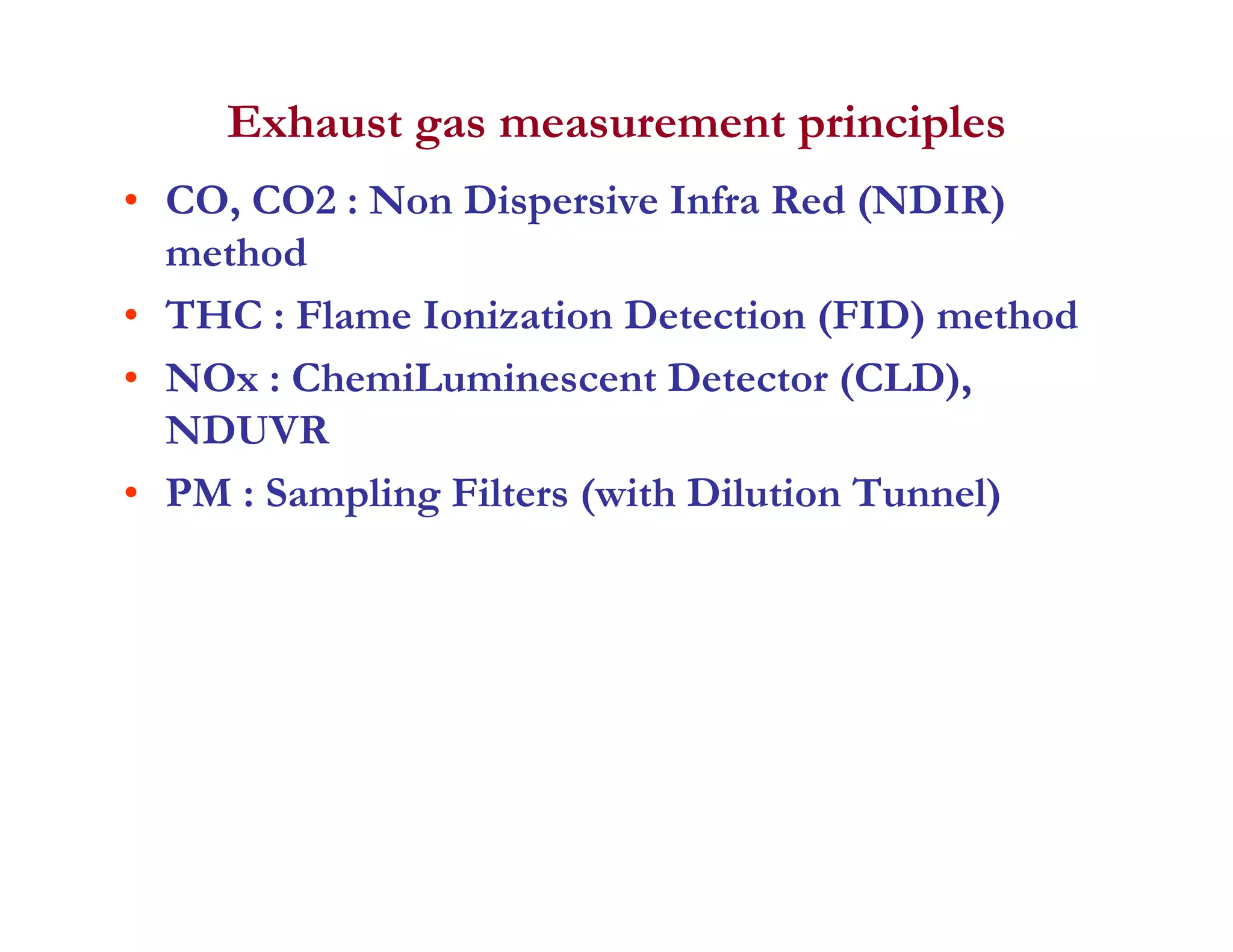
Exhaust gas measurement principles
• CO, CO2 : Non Dispersive Infra Red (NDIR)
method
• THC : Flame Ionization Detection (FID) method
• NOx : ChemiLuminescent Detector (CLD),
D VRNDUVR
• PM : Sampling Filters (with Dilution Tunnel)
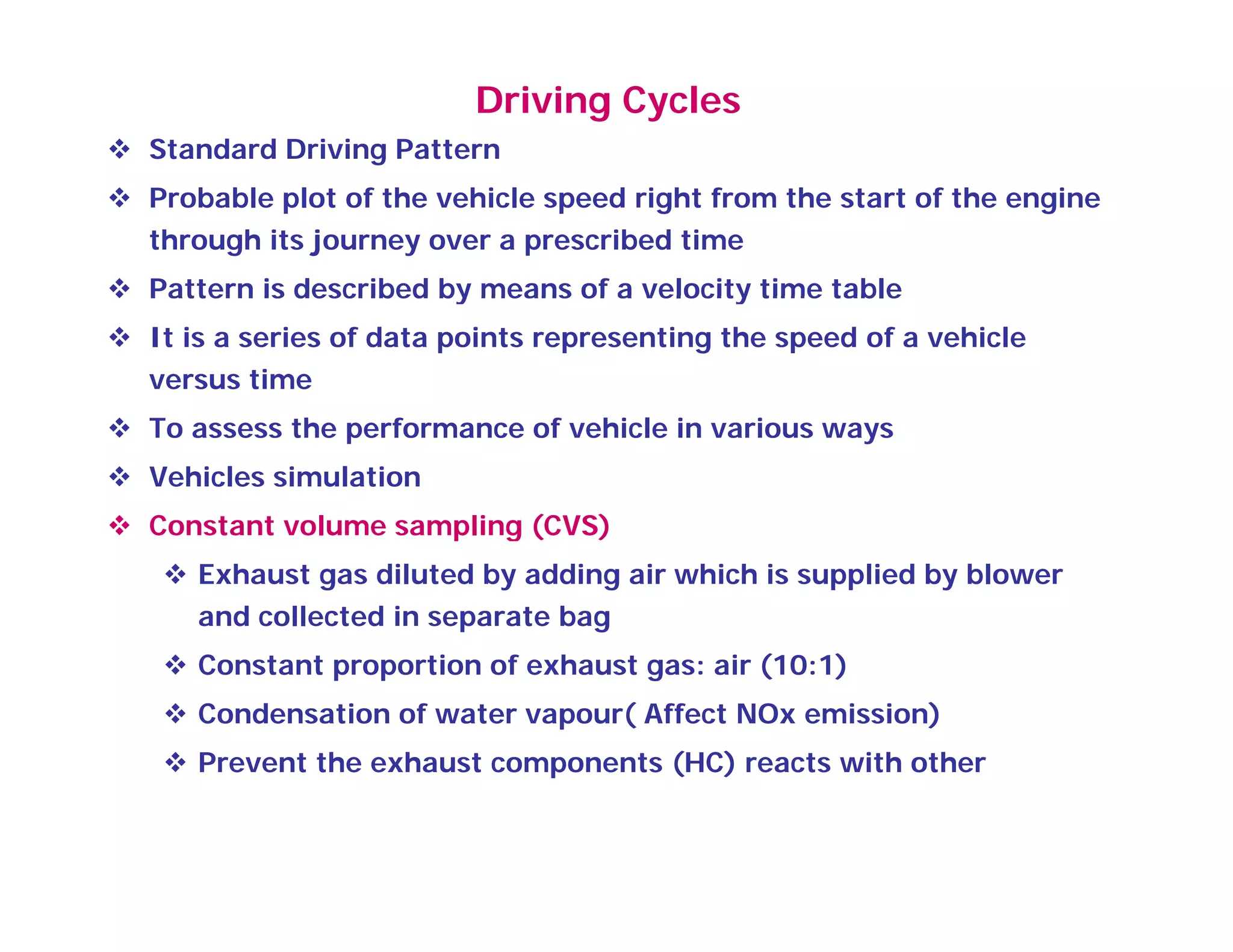
Driving Cycles
 Standard Driving Pattern
 Probable plot of the vehicle speed right from the start of the engine
through its journey over a prescribed time
 Pattern is described by means of a velocity time table Pattern is described by means of a velocity time table
 It is a series of data points representing the speed of a vehicle
versus time
 To assess the performance of vehicle in various ways
 Vehicles simulation
 Constant volume sampling (CVS)p g ( )
 Exhaust gas diluted by adding air which is supplied by blower
and collected in separate bag
 C t t ti f h t i (10 1) Constant proportion of exhaust gas: air (10:1)
 Condensation of water vapour( Affect NOx emission)
 Prevent the exhaust components (HC) reacts with otherp ( )
 Driving cycle derived from driving behavior and real traffic
conditions
 Gear shifts
 Braking
 Idle Phases
 Standstill periods
Types of Driving Cycles
 Transient Driving cycles – constant speed changes on road
conditions (FTP and some of European cycles)conditions (FTP and some of European cycles)
 Model Cycles - Protracted periods at constant speeds
Transient Driving Cycle
 Average emission performance per km drive
 Integrate the total effects of the road infrastructure
 Traffic pattern and driving culture
 Group of driving cycle
 European driving cyclep g y
 US driving cycle
 Japanese driving cycle
 Indian Driving Cycle (IDC) - 1985 – followed for 2/3 wheelers
 Modified Indian Driving cycle – Light & heavy duty vehicles
European Driving Cycle
 ECE 15 – speed 50kmph, low loadp p ,
 EUDC – Urban driving cycle
 EUDCL – For suburban route (speed 90kmph)
 ECE83 – New European driving cycle
US Driving Cycle
 FTP 72 - Urban route FTP 72 - Urban route
 FTP75 – Three phase (cold start+ transient+ hot starting)
 LA 92
 US 06 – High average speed
 SC03 - A/C vehicles
i i lJapanese Driving Cycle
 10 mode cycles
 15 mode cycles 15 mode cycles
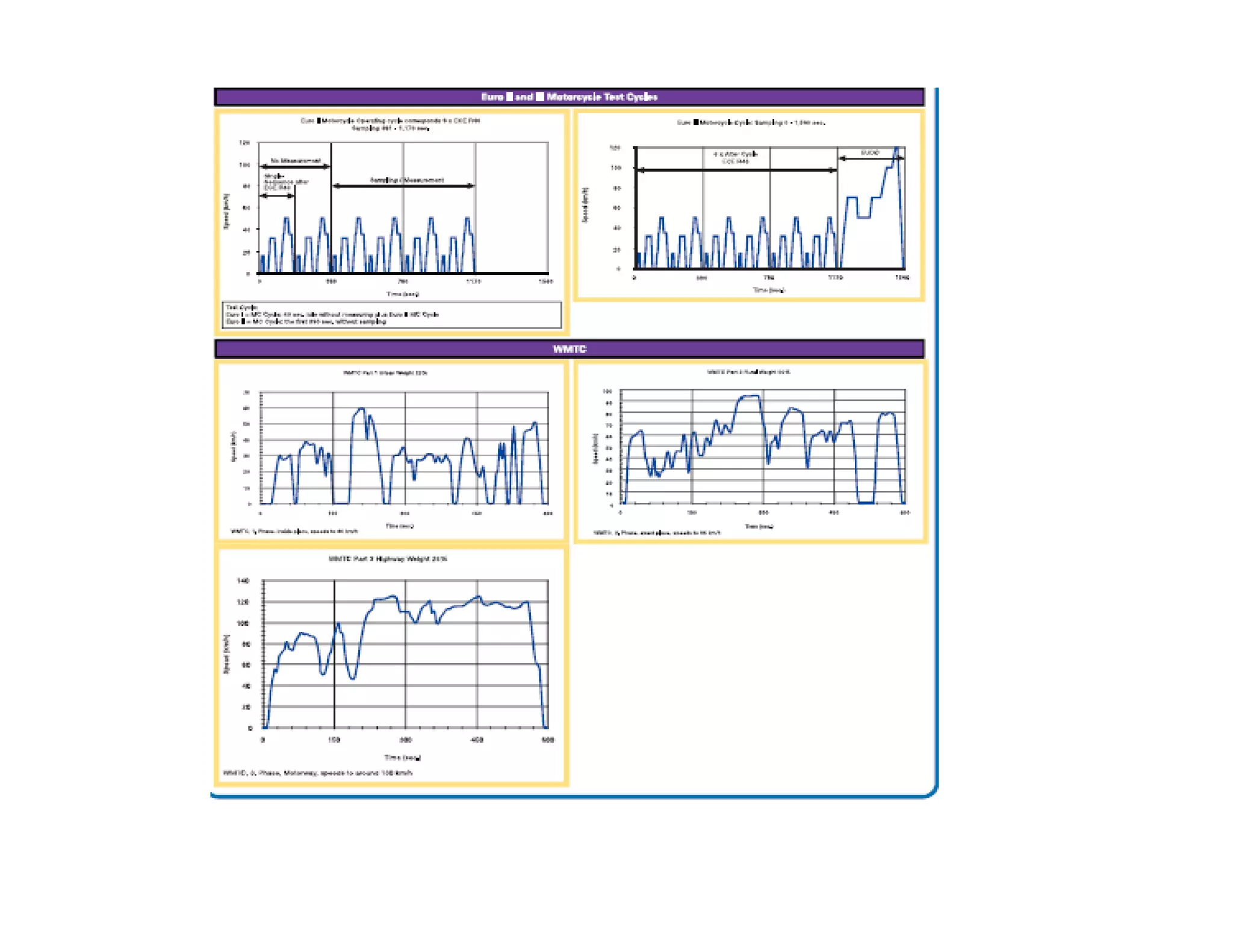
Typical Driving Cycle
EMISSION CYCLE
130
100
110
120
130
60
70
80
90
EED[KMPH]
30
40
50
60
SPEE
0
10
20
0 100 200 300 400 500 600 700 800 900 1000 1100 1200
SECONDSSECONDS
EURO II BS II
European Driving Cycle
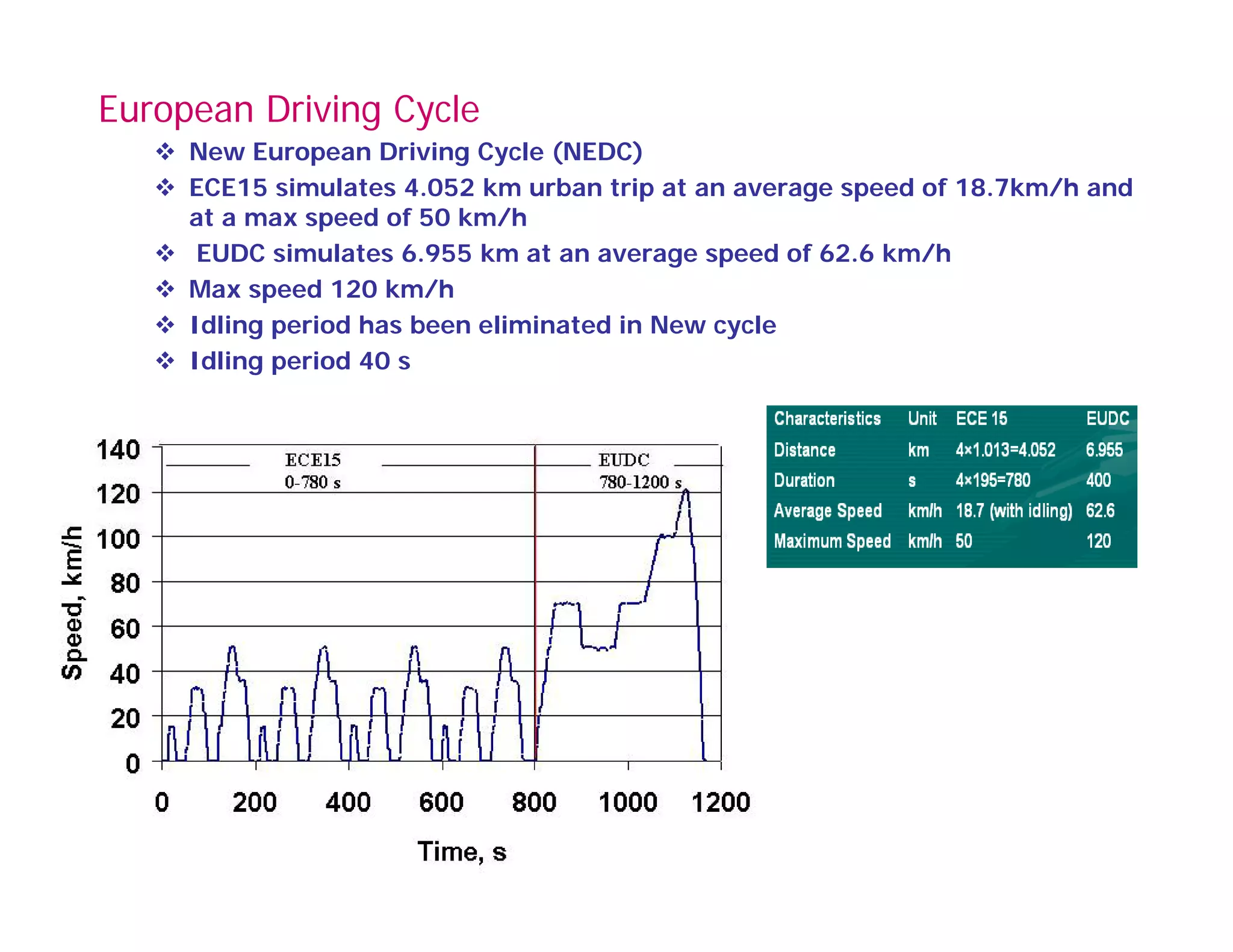
 New European Driving Cycle (NEDC)
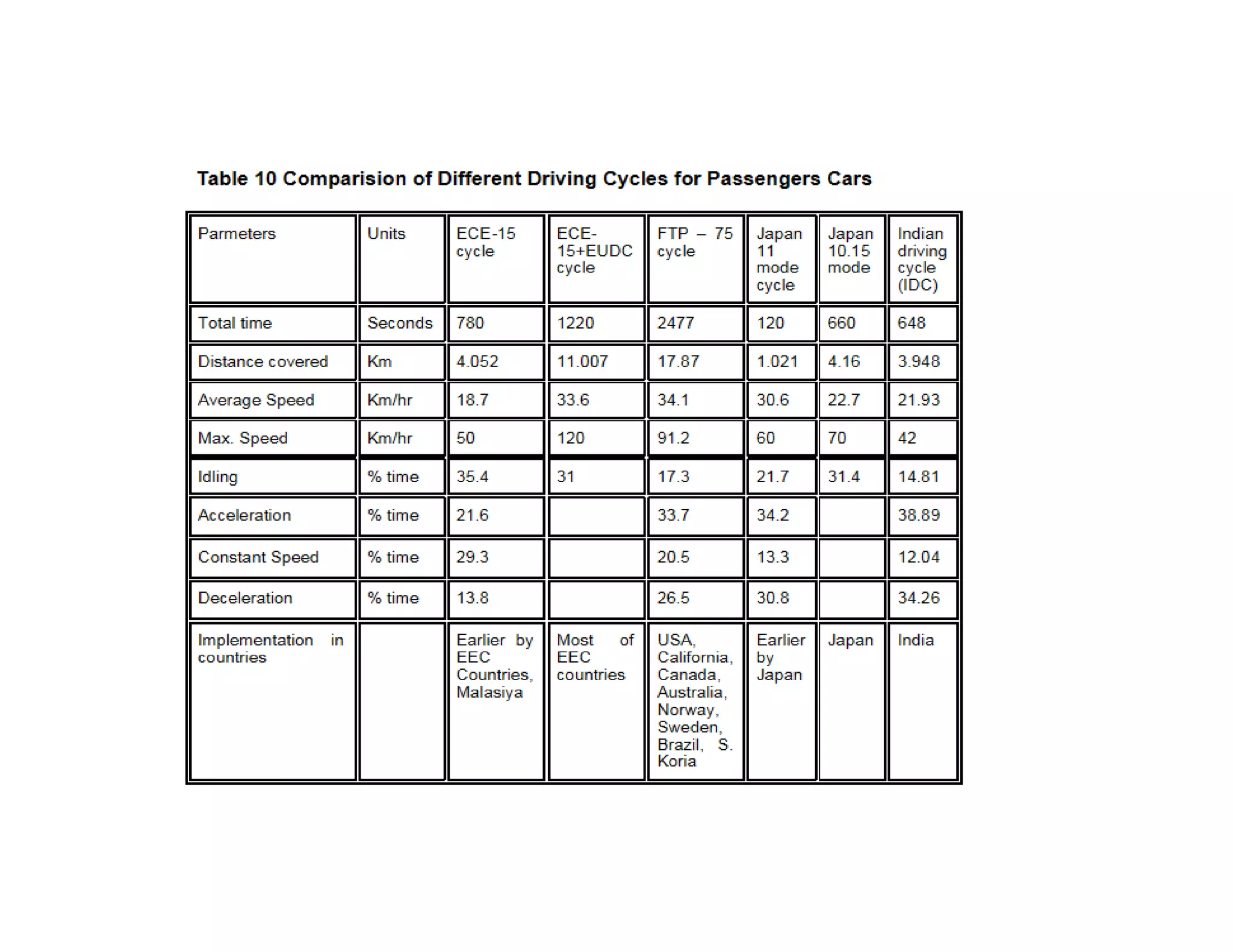
 ECE15 simulates 4.052 km urban trip at an average speed of 18.7km/h and
at a max speed of 50 km/h
 EUDC simulates 6.955 km at an average speed of 62.6 km/h
 Max speed 120 km/h Max speed 120 km/h
 Idling period has been eliminated in New cycle
 Idling period 40 s
Fig. ECE15 driving cycle
Fig. EUDC driving cycle
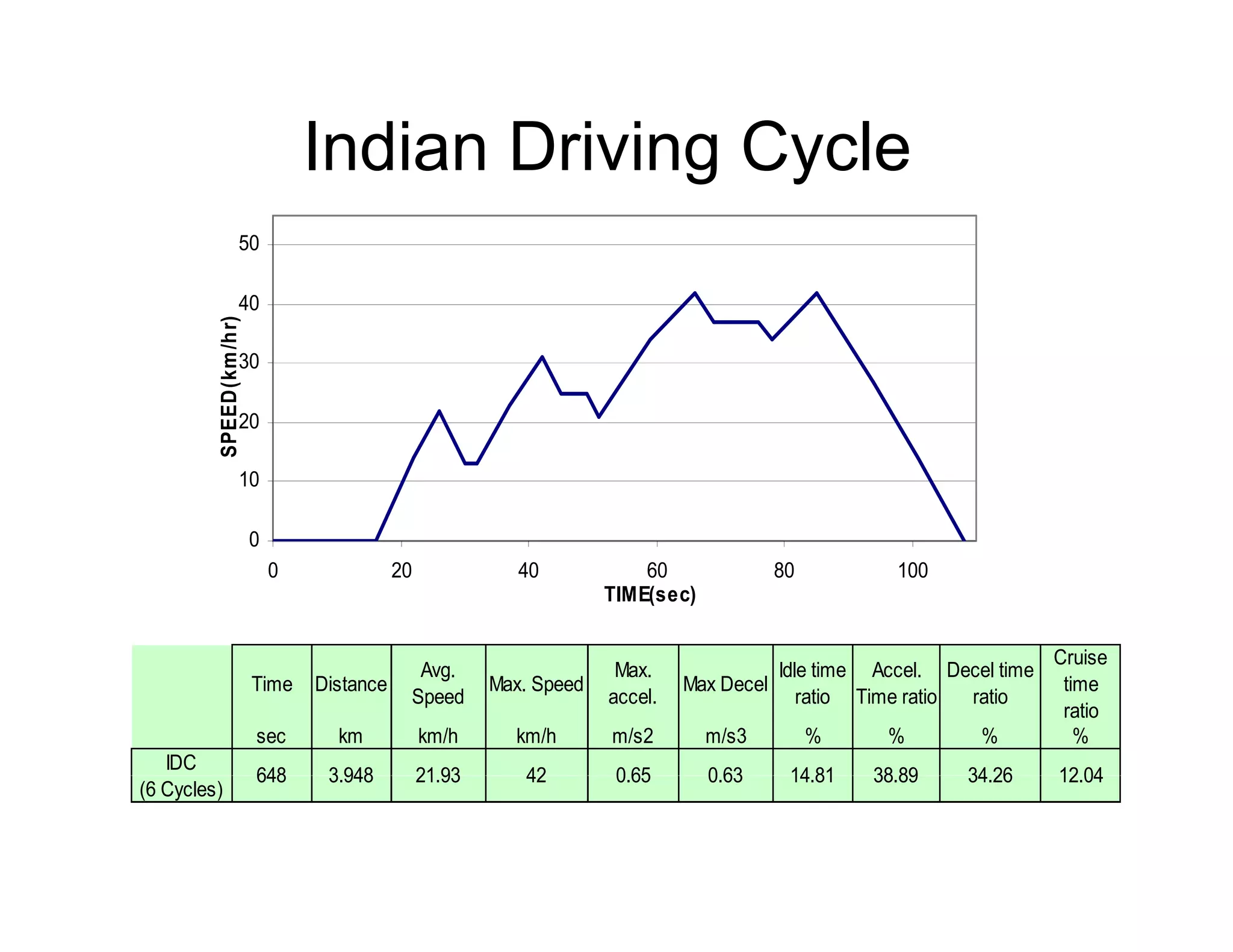
Indian Driving Cycles
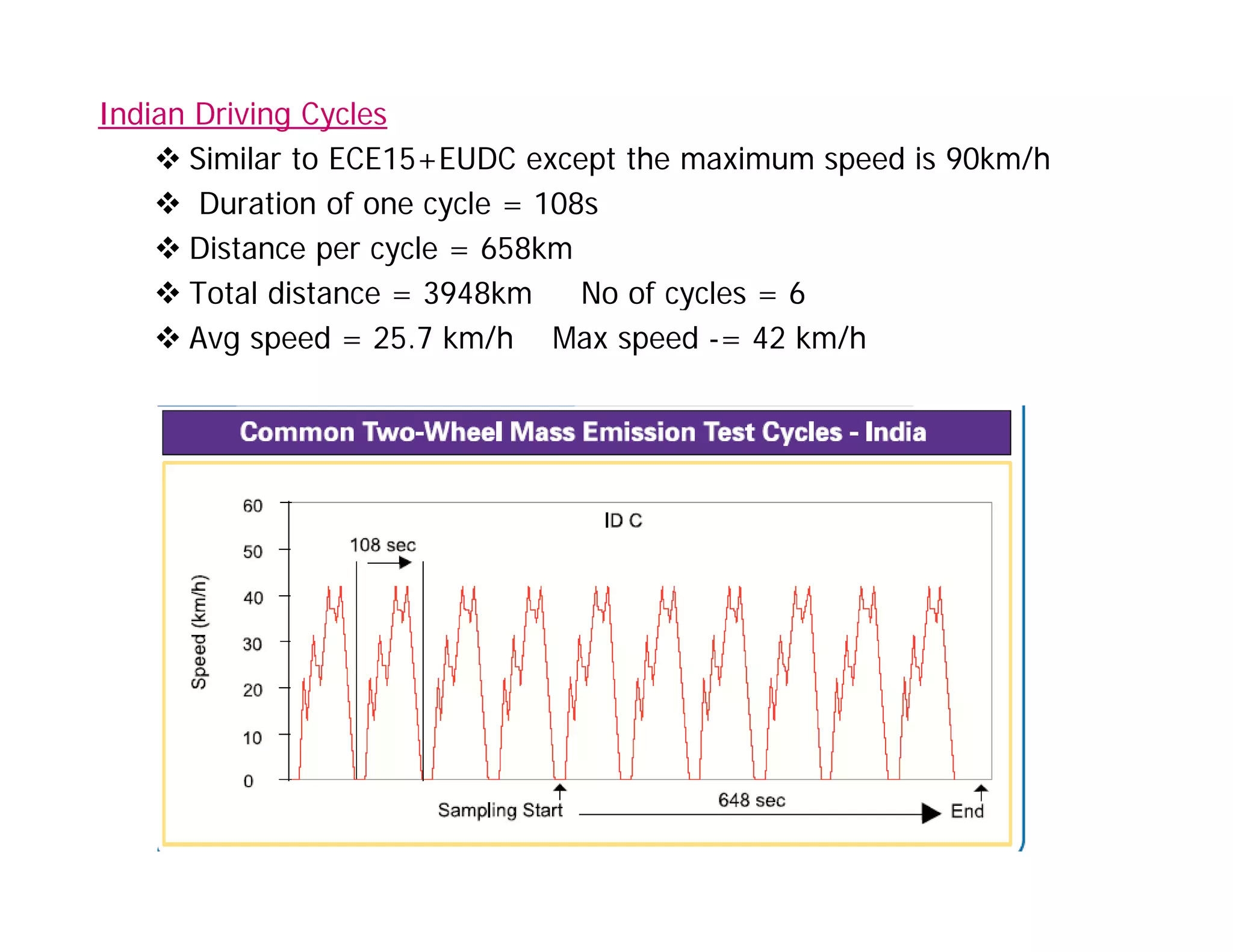
 Similar to ECE15+EUDC except the maximum speed is 90km/h
 Duration of one cycle = 108s
 Distance per cycle = 658km
 Total distance = 3948km No of cycles = 6 Total distance = 3948km No of cycles = 6
 Avg speed = 25.7 km/h Max speed -= 42 km/h
Indian Driving Cycleg y
40
50
20
30
40
ED(km/hr)
0
10
20
SPE
0
0 20 40 60 80 100
TIME(sec)
Cruise
Time Distance
Avg.
Speed
Max. Speed
Max.
accel.
Max Decel
Idle time
ratio
Accel.
Time ratio
Decel time
ratio
Cruise
time
ratio
sec km km/h km/h m/s2 m/s3 % % % %
IDC
648 3 948 21 93 42 0 65 0 63 14 81 38 89 34 26 12 04
(6 Cycles)
648 3.948 21.93 42 0.65 0.63 14.81 38.89 34.26 12.04
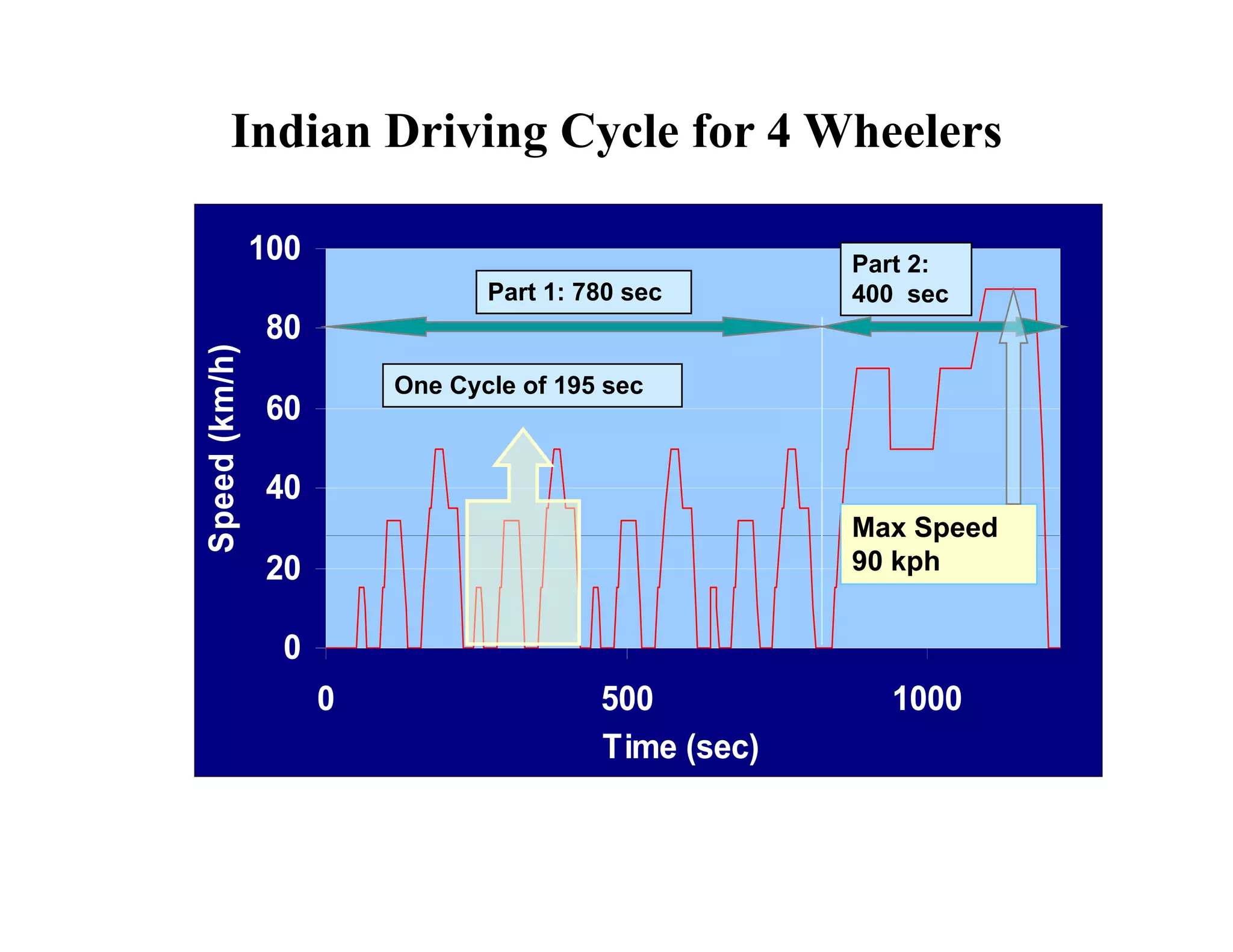
Indian Driving Cycle for 4 Wheelers
100
Part 1: 780 sec
Part 2:
400 sec
60
80
km/h)
One Cycle of 195 sec
Part 1: 780 sec 400 sec
40
60
Speed(k
Max Speed
0
20
S
Max Speed
90 kph
0
0 500 1000
Time (sec)
US Driving Cycles
 Vehicle is fitted in a room temperature of 20 to 30 ºC
 It simulates 17.7 km at an average speed of 34.1 km/h
 Duration 1874 s
 Transient test cycle with highly dynamic nature Transient test cycle with highly dynamic nature
FTP US06
 High speed and high
acceleration driving behaviour
FTP SC03
 Engine load and emissionsg
 Rapid speed fluctuations
 Average speed 77.9km/h
associated with air conditioned
vehicles
Japan Driving Cycles
 10 Mode cycles – Urban conditions 10 Mode cycles Urban conditions
 One segment covers a distance of 0.664 km at an average speed of
17.7km/h
 Max speed 40km Max speed 40km
 Cycle begins with a 15 minutes warm up
Diesel Engine Emissions & Their Control
Diesel Engine Emissions
 Carbon Monoxide (CO) Carbon Monoxide (CO)
 Unburned Hydrocarbons (HC)
 Oxides of Nitrogen (NOx)
P ti l t M tt (PM) Particulate Matter (PM)
 Smoke
HC Emissions
 1/5 of HC emissions of SI engines
 Over all fuel – air lean equivalence ratio
 Non-homogeneity of fuel- air mixture Non homogeneity of fuel air mixture
 Some local spots in the combustion chamber
 Some fuel particles in fuel rich zones never react due to lack of
oxygenoxygen
 Dribble in fuel injector
 Crevice volume
ll d b Wall deposit absorption
 Oil film adsorption
Particulate Matter (PM)
 Any matter in the exhaust gases that can be trapped on sampling
filter medium at particular temperature at 52ºC
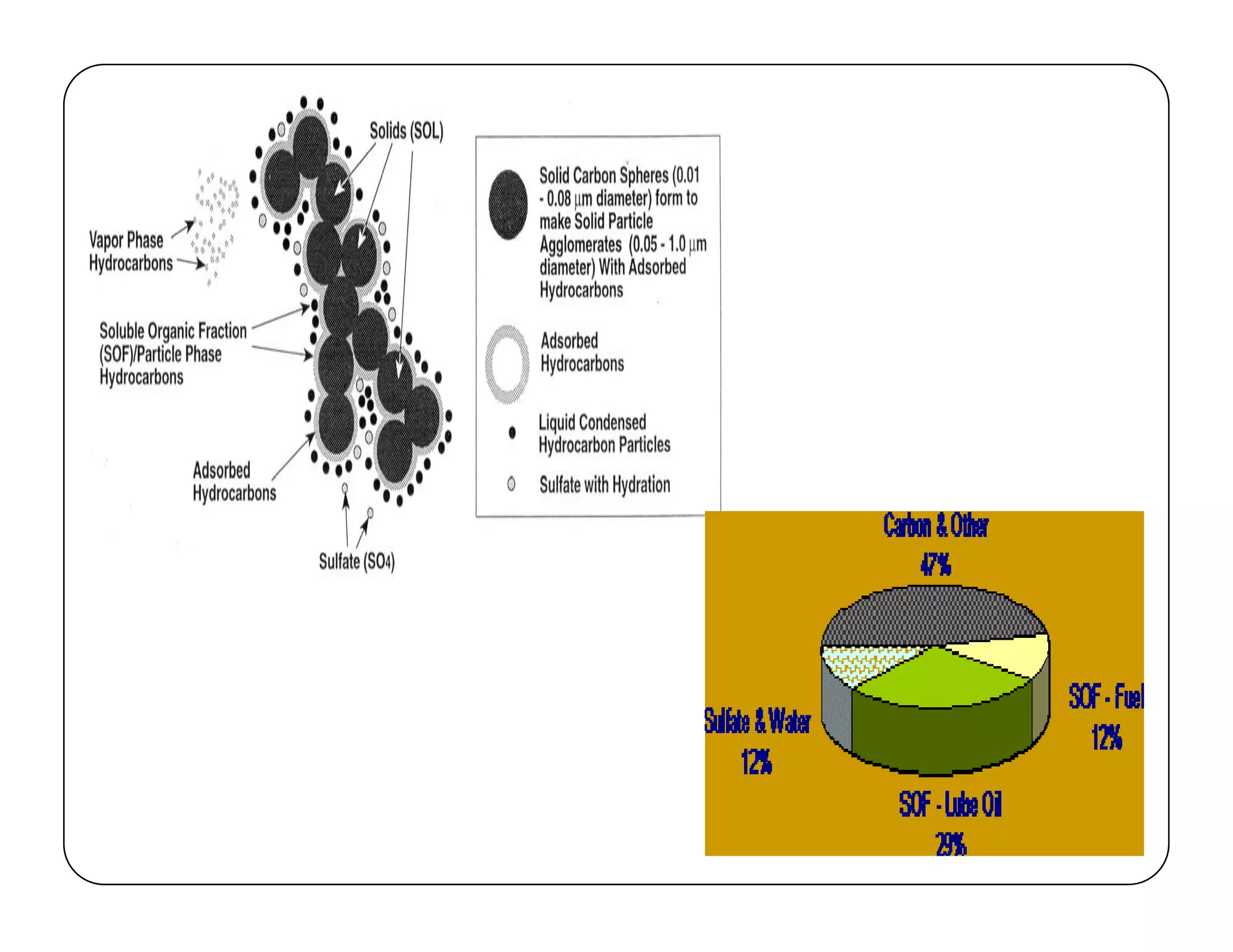
 Solid carbon soot particles that are generated in the fuel rich zones
within the cylinder during controlled combustion phase
S i l l f lid b h Soot particles are clusters of solid carbon spheres
 Diameters from 9nm to 90 nm
 The spheres are solid carbon with HC and traces of other
components adsorbed on the surface
 Large expansion occurs during power stroke
 The remaining high boiling components found in the fuel and
lubricating oil condenses on the surface of the solid carbon
t ti lsoot particles
 Adsorbed hydrocarbons: Soluble organic fraction (SOF)
Si ifi f i f SOF f l b i i Significant fraction of SOF may come from lubricating
oil(25%)
S lf i th f l f lf i id hi h i l t l d Sulfur in the fuel forms sulfuric acid which is later sampled
as PM
Soot PhotomicrographsSoot Photomicrographs
Diesel smoke
Bl k k f t Black smoke : from soot
 White, blue or gray smoke: condensed hydrocarbon droplets in the
exhaust
 Blue or gray generally due to vaporized lubricant
 White due to cold start
Emissions Control Technology - CI
 Ad n d t hn l in f l inj ti n t m Advanced technology in fuel injection system
 Combustion chamber geometry
 Two way catalyst – CO & HC
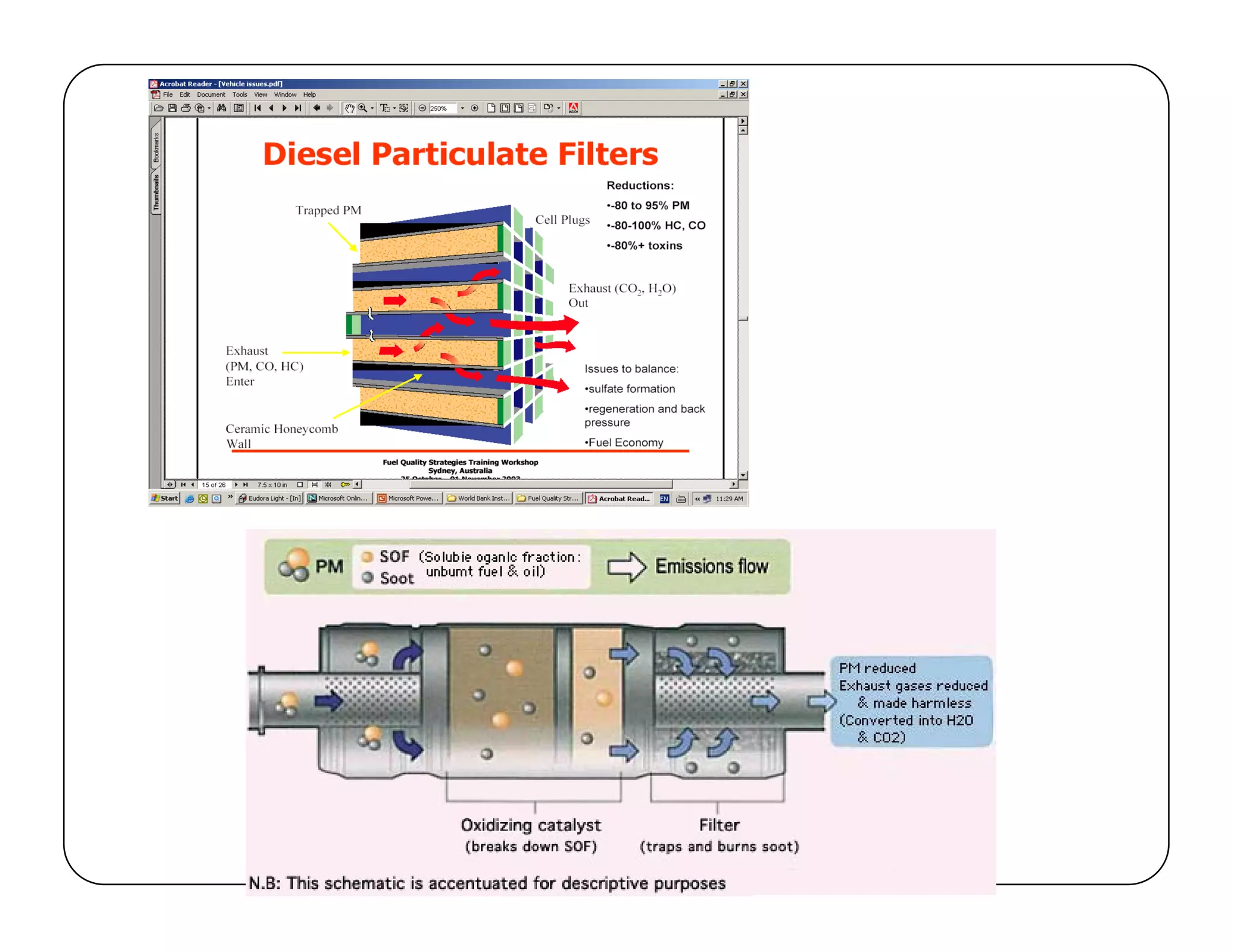
 Diesel Oxidation Catalyst (DOC)
Particulates
 Particulate Traps
 Diesel Particulates Filter (DPF)
NOx Emissions
 Additives into diesel fuel
 Water injection
 Emulsion Technology
 Injection timing retardation Injection timing retardation
 Simulatneous technology
 Exhaust gas Recirculation (EGR)
 S l ti C t l ti R d ti (SCR) Selective Catalytic Reduction (SCR)
 Low temperature combsution
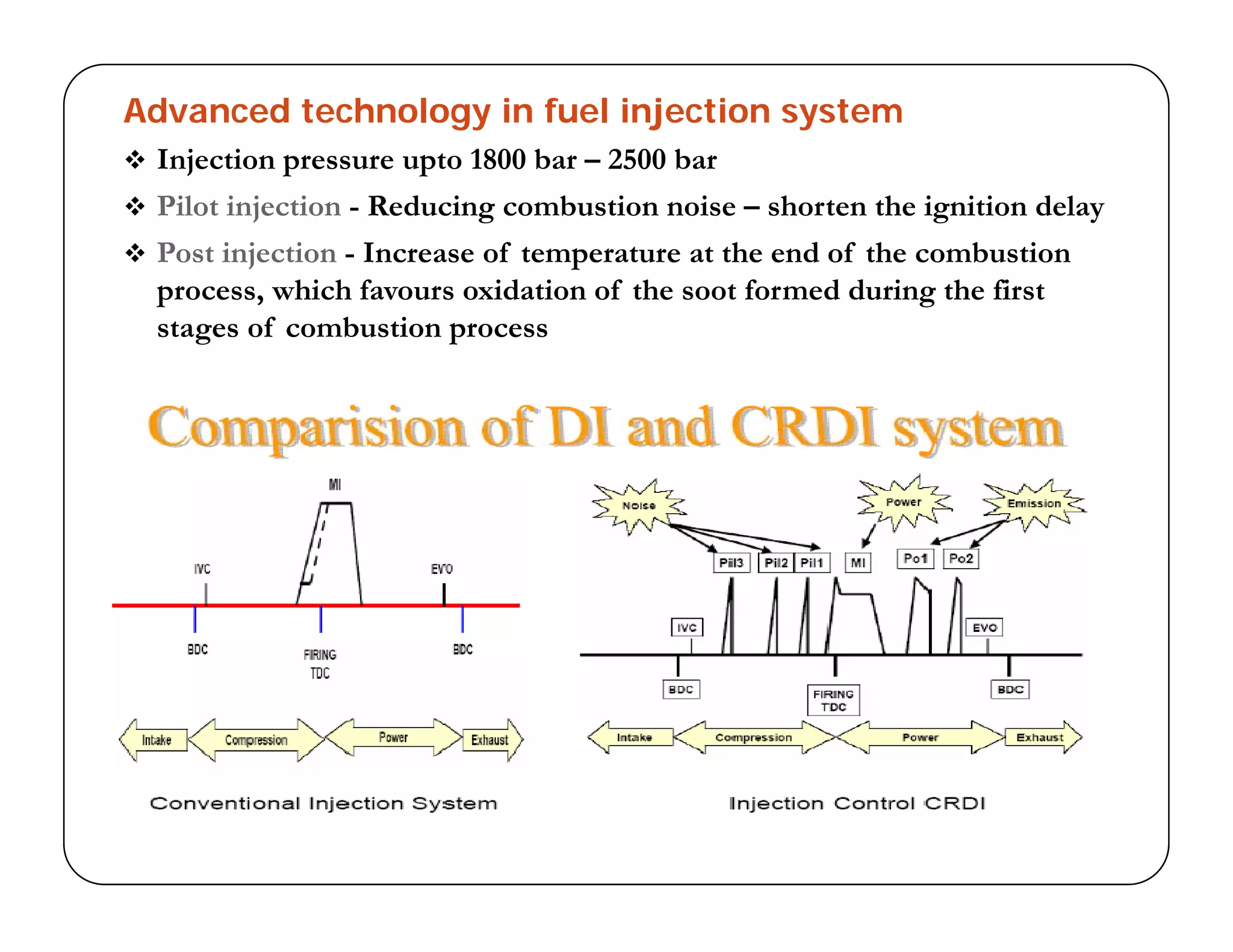
Advanced technology in fuel injection system
 Injection pressure upto 1800 bar – 2500 barj p p
 Pilot injection - Reducing combustion noise – shorten the ignition delay
 Post injection - Increase of temperature at the end of the combustion
process, which favours oxidation of the soot formed during the firstprocess, which favours oxidation of the soot formed during the first
stages of combustion process
Use of different additives
 Oxygenated additives: Ethanol/ dimethyl ether/methanol)
 Cetane number improvers : EHN
 Antioxidants (for biodiesel): NPAA, DPPD( ) ,
Drawbacks:
 Very expensive
P d hi h CO HC d PM i i Produce higher CO, HC and PM emissions
Use of Emulsion Technology
 To introduce the water in the combustion chamberd
 Emulsifying agent or surfactant: To reduce the surface tension between
oil and water
Drawbacks:Drawbacks:
 Higher viscosity and density of water significantly affect the performance
 Inherently unstable and prone to phase seperation
 Cold start issues
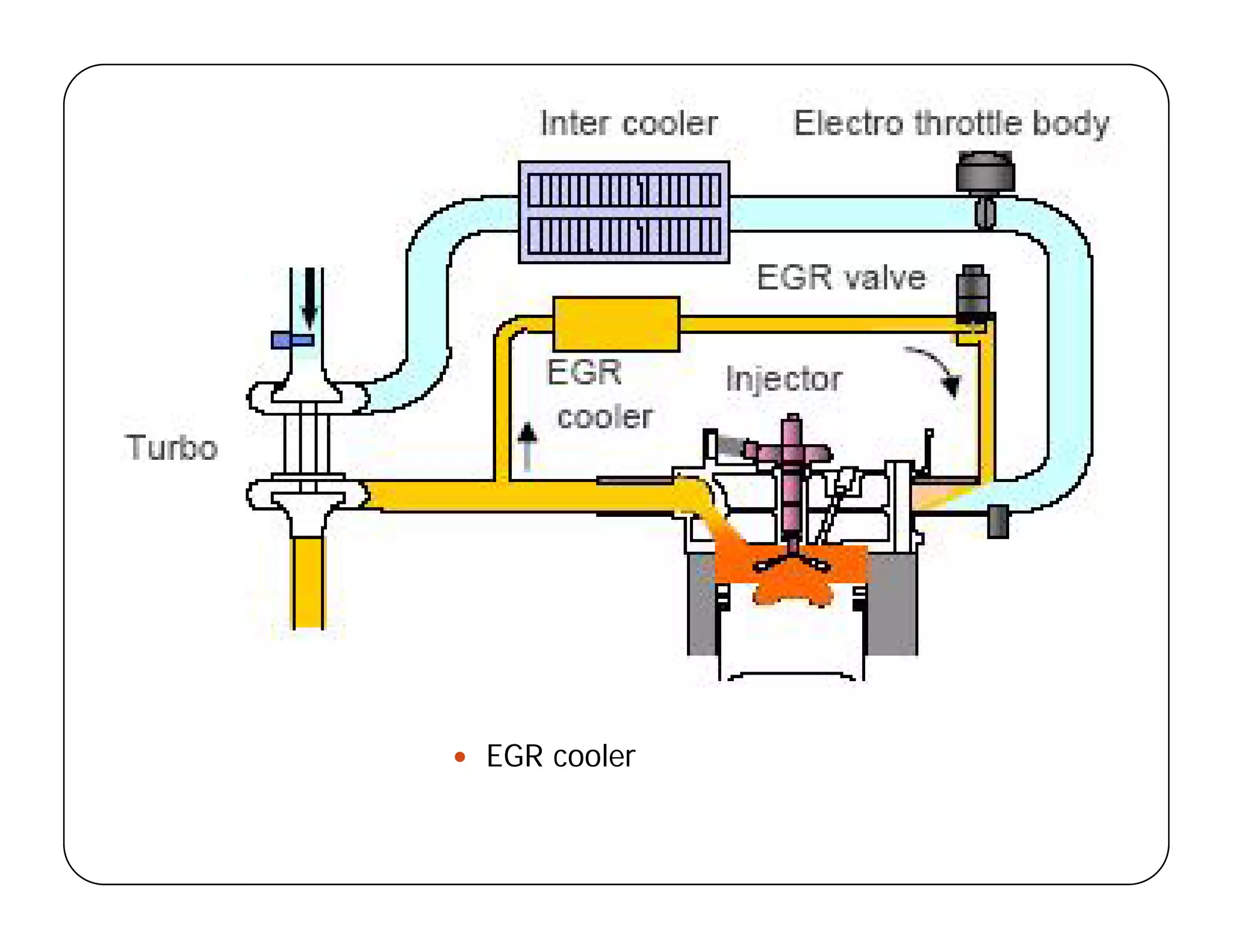
Exhaust Gas Recirculation (EGR)
 Most effective technique for both SI and CI engines Most effective technique for both SI and CI engines
 To dilute air- fuel mixture with non reacting gas
 Adding air changes air-fuel ratio and combustion characteristics
 Lower the flame temperature
 Gases with larger specific heats
EGR IN SI ENGINESEGR IN SI ENGINES
 5 to 15 percent of the exhaust gas is routed back to the intake as
EGR
 Maximum quantity is limited by the requirement of the mixture to
sustain a contiguous flame front during the combustion event
 Reduced heat transfer to combustion chamber surface Reduced heat transfer to combustion chamber surface
 Reduced chemical dissociation
 Not employed at WOT and idling condition
EGR IN DIESEL ENGINES
 Maximum possible flow 30 % of total intake Maximum possible flow – 30 % of total intake
 Flow rate can be controlled by Engine Management System
 Thermal efficiency decrease
 Increase the PM emission
 In modern diesel engines EGR gas is cooled through a heat
exchanger to allow the introduction of a greater mass ofexchanger to allow the introduction of a greater mass of
re circulated gas
 External EGR - Piping a route from the exhaust manifold to the inlet
manifold
 Internal EGR - Trapping exhaust gas within the cylinder by not fully
expelling it during the exhaust strokeexpelling it during the exhaust stroke
VGT arrangement
 EGR cooler
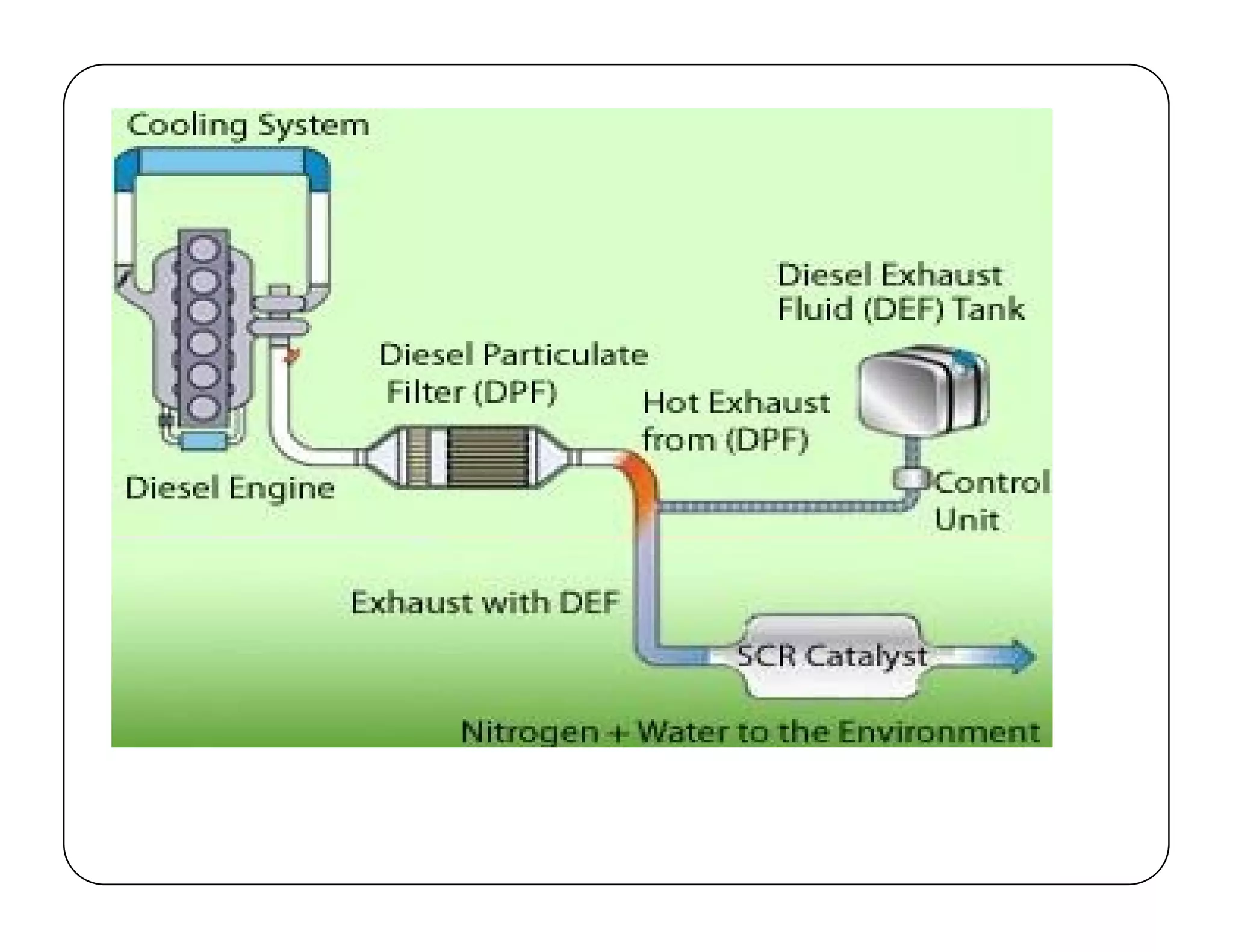
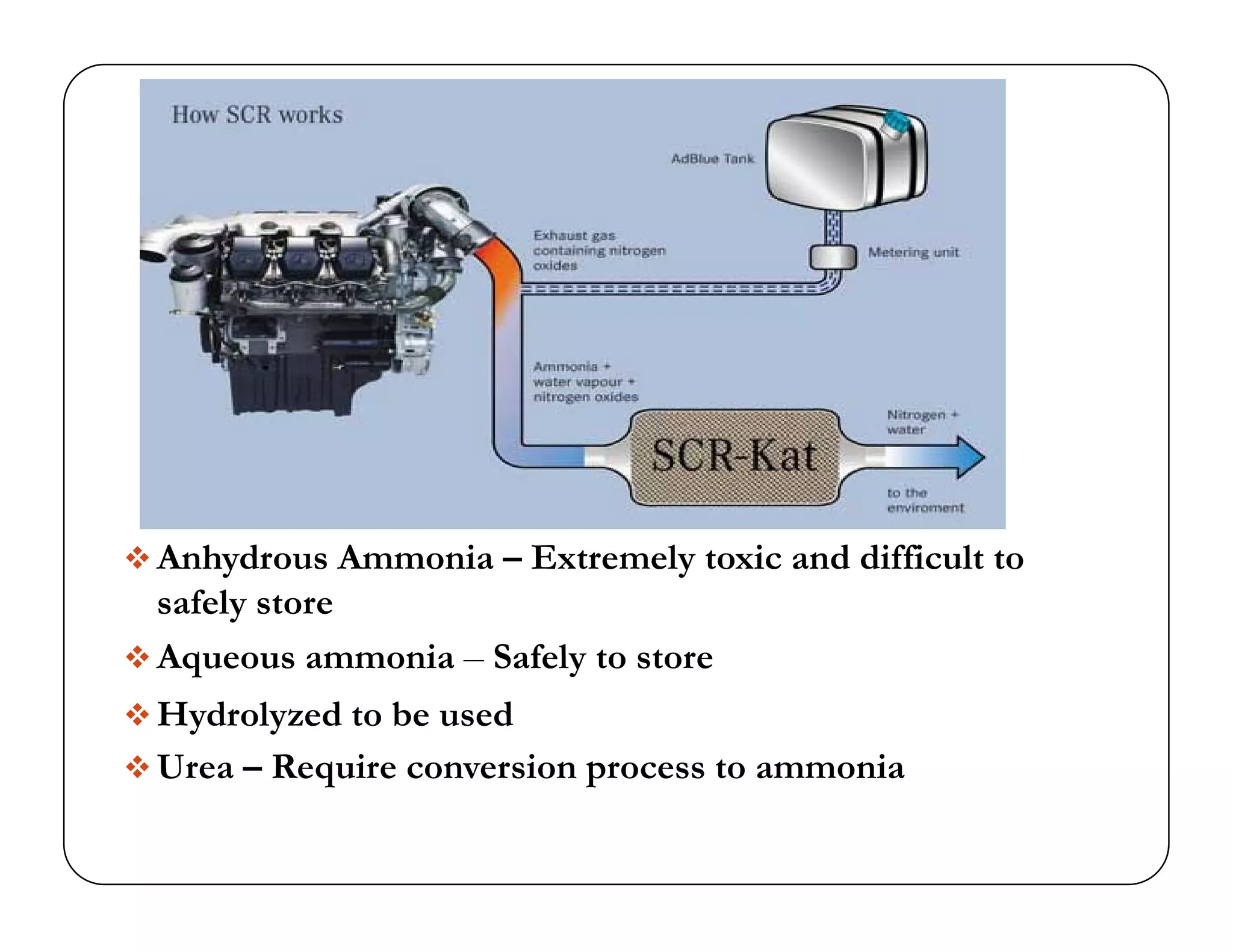
Selective Catalyst Reduction(SCR)
 NOx reduction technique NOx reduction technique
 Conversion of NOx with the aid of catalyst into N2 and H2O
 Reduction agent : Urea, Anhydrous ammonia or aqueous ammonia
 Catalysts: Oxides of base metal such as Vanadium, Tungsten Titanium
oxide
 Vanadium, Tungsten- Less expensive and lack in durability, g p y
 Damage the Particulate Filter
 Zeolite – High thermal durability
 O i 500 720 K Operating range - 500 to 720 K
4NH3 + 4NO + O2 -> 4N2 + 6H2O
2NH + NO + NO > 2N + 3H O
For Urea
2NH3 + NO + NO2 -> 2N2 + 3H2O
8NH3 + 6NO2 -> 7N2 + 12H2O
For Urea
 Anhydrous Ammonia – Extremely toxic and difficult to
safely store
 Aqueous ammonia Safely to store Aqueous ammonia – Safely to store
 Hydrolyzed to be used
 Urea – Require conversion process to ammonia Urea Require conversion process to ammonia
Technical problems with automotive SCR units
R i f f t i tRemains free from contaminants
Correct materials of construction must be used for both
storage and dispensingg p g
Ammonia slip – Release of unreacted ammonia
When catalyst temperatures are not in the optimal range
f h ifor the reaction
When too much ammonia is injected into the process
Low exhaust gas temperature during cold start conditionLow exhaust gas temperature during cold start condition
Selective Catalyst Reduction (SCR)
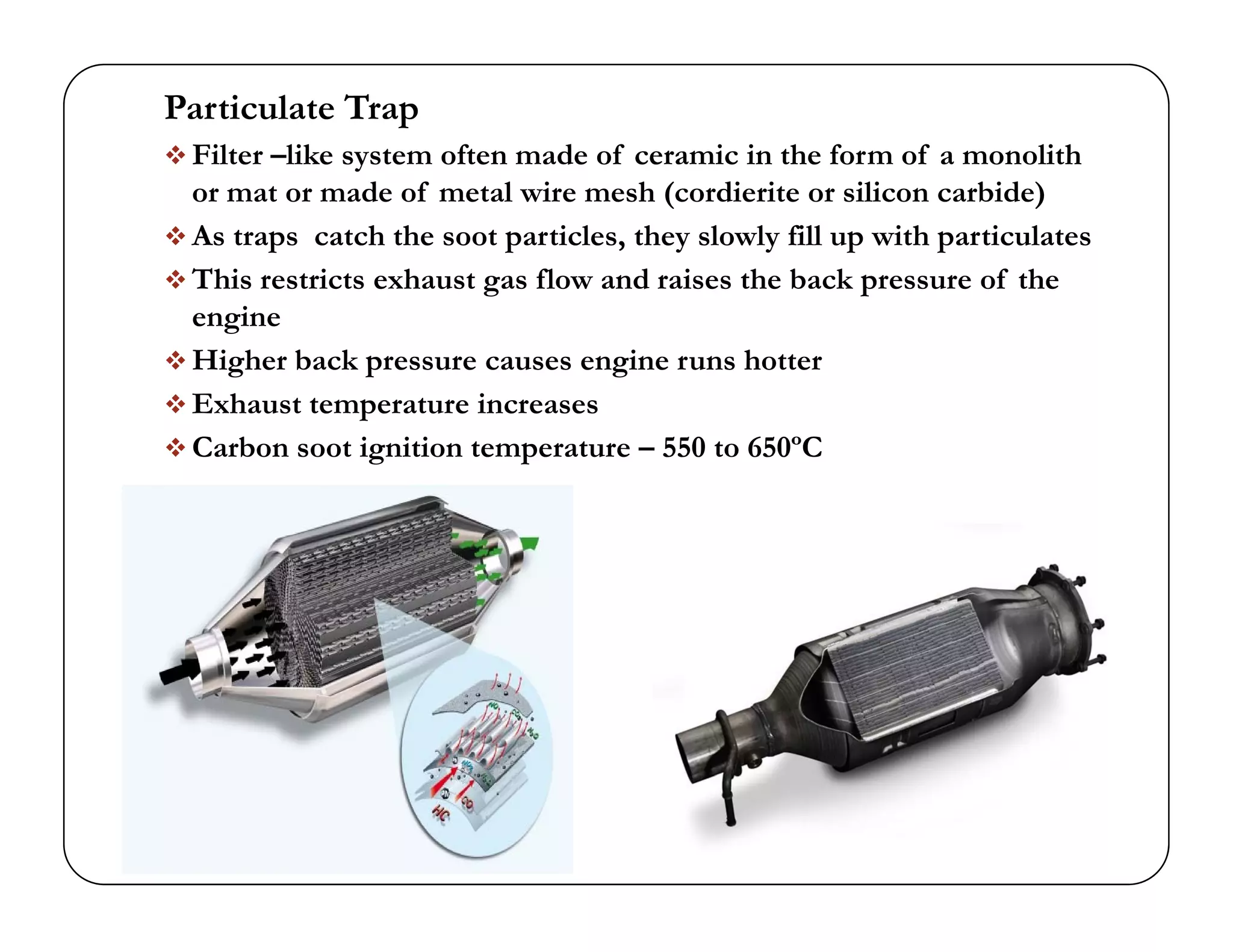
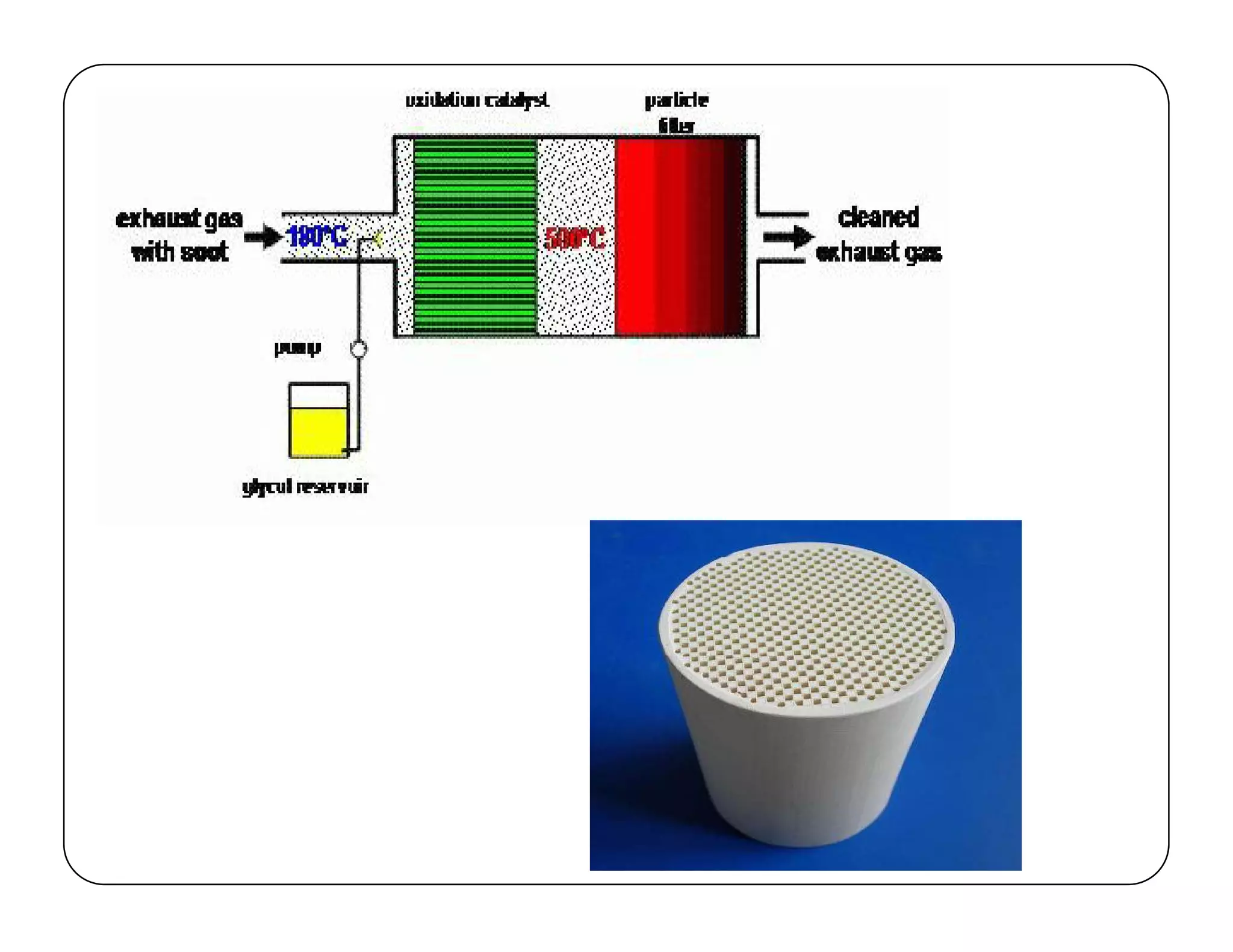
Particulate Trap
 Filter –like system often made of ceramic in the form of a monolith
or mat or made of metal wire mesh (cordierite or silicon carbide)
 As traps catch the soot particles, they slowly fill up with particulates
 This restricts exhaust gas flow and raises the back pressure of theg p
engine
 Higher back pressure causes engine runs hotter
 Exhaust temperature increasesp
 Carbon soot ignition temperature – 550 to 650ºC
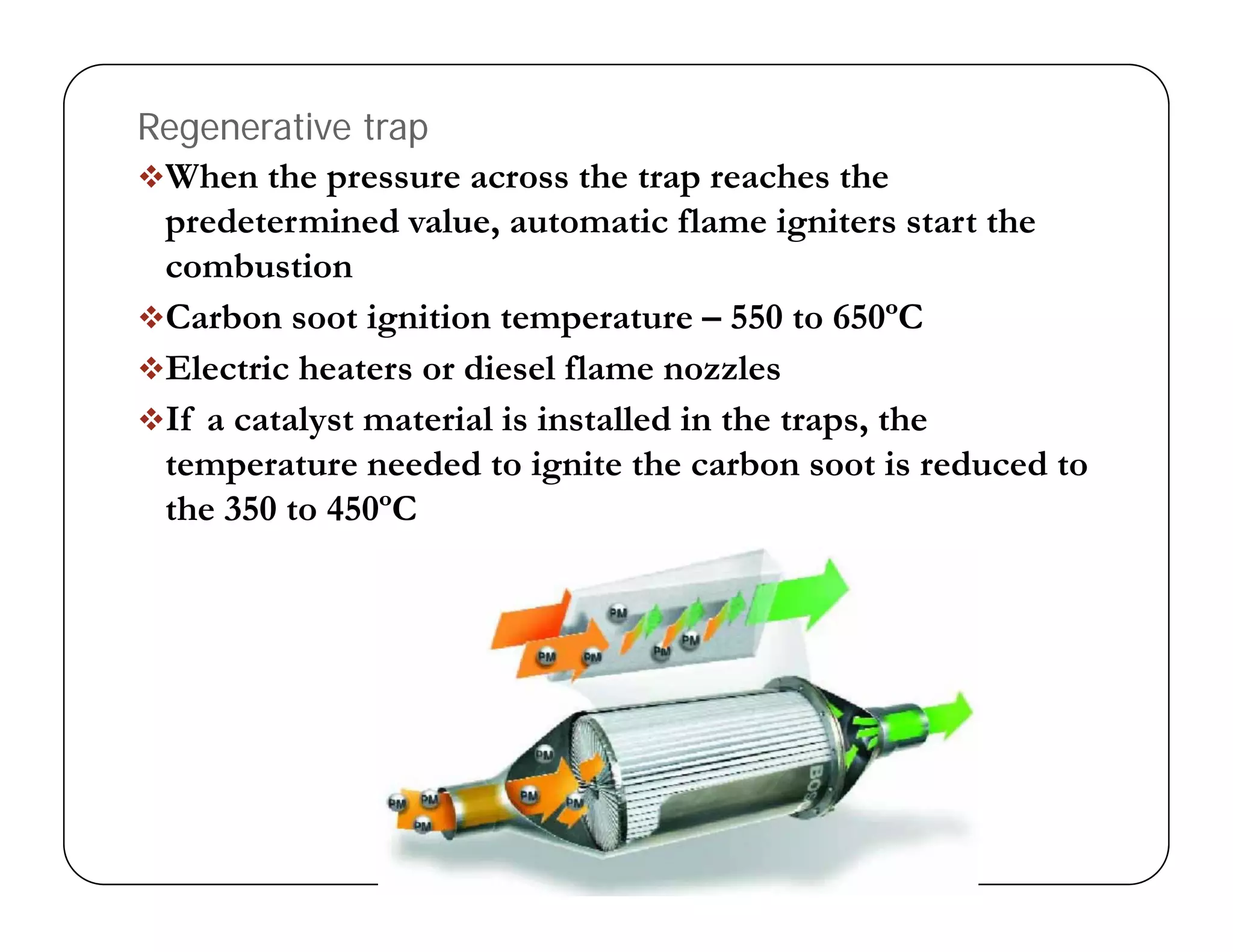
Regenerative trap
When the pressure across the trap reaches theWhen the pressure across the trap reaches the
predetermined value, automatic flame igniters start the
combustion
Carbon soot ignition temperature – 550 to 650ºC
Electric heaters or diesel flame nozzles
If a catalyst material is installed in the traps theIf a catalyst material is installed in the traps, the
temperature needed to ignite the carbon soot is reduced to
the 350 to 450ºC
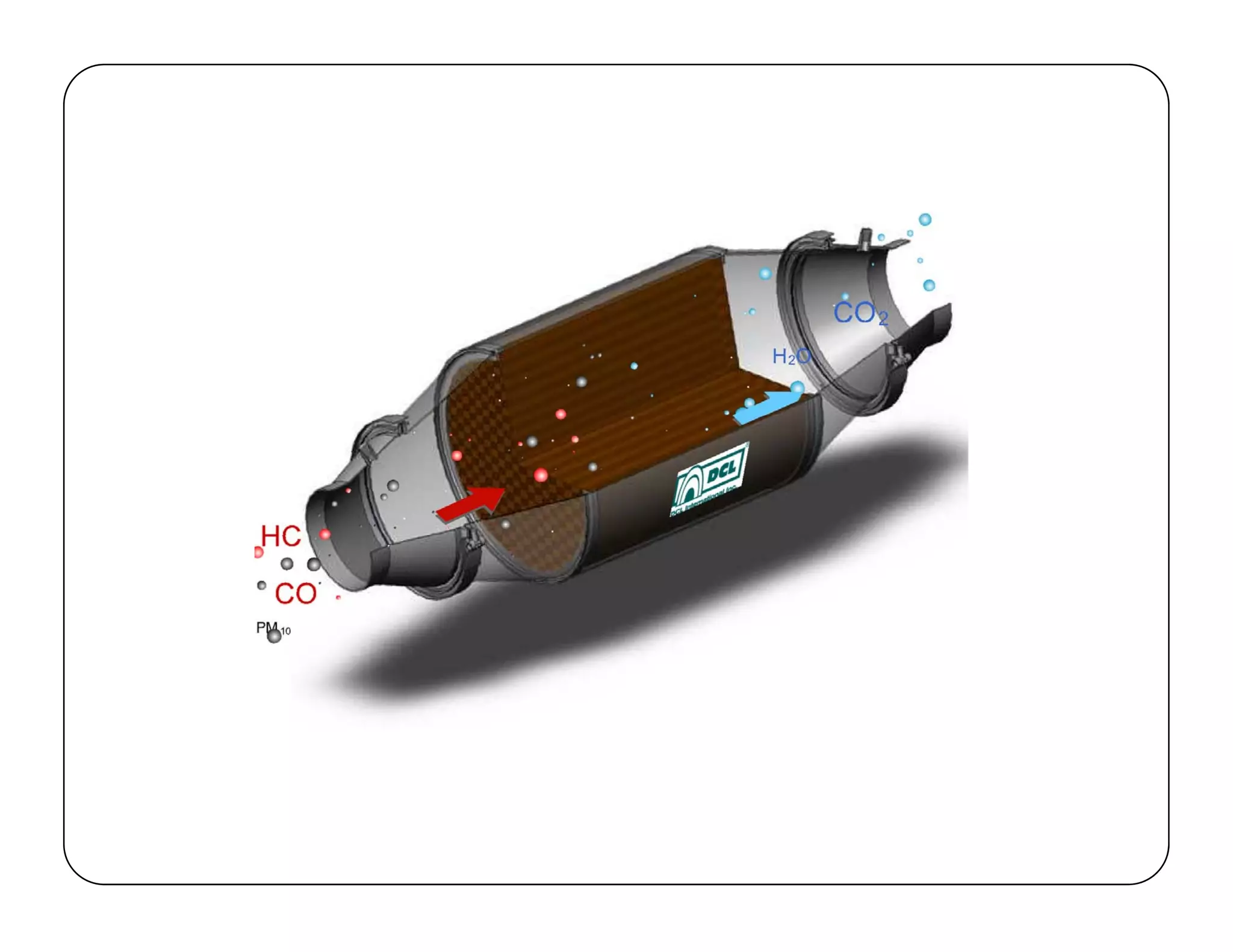
DIESEL OXIDATION CATALYST(DOC)
T W C t l t (TWC) Two Way Catalyst (TWC)
 It is a device that uses a chemical process to breakdown pollutants in
the exhaust stream into less harmful componentsp
 Porous ceramic honeycomb – like structure that is coated with a
material that catalyzes a chemical reaction to reduce a pollution
 Soluble Organic Fractions (SOF) removal – 80 to 90%
 PM reduction – 20 to 50 %
 Unburned Hydrocarbon (HC) reduction – 50%
 Carbon Monoxide reduction– 40%
Eff ti f th DOC i d ith Ult l lf di l(15 ) Effectiveness of the DOC increased with Ultra low sulfur diesel(15ppm)
 At high exhaust temperature, catalyst can oxidize SO2 to form sulfate
particulatesparticulates
Diesel Oxidation Catalyst (DOC)
 St i l t l C i t Stainless steel Canister
 Catalyst support or
substratesubstrate
 Ceramic or metallic
honeycomb or wire mesh
structure
 Catalytic coating
Pl i Platinum
 Palladium
 No technology maintenance
 Abilit t b d hi l / i t f l d ith ti l Ability to be used on vehicles/ equipment fueled with conventional
diesel fuel
 No operational issues, impact on vehicles/ equipment performance or No operational issues, impact on vehicles/ equipment performance or
impacts on fuel consumption
 2,00,000 km and can last 7 to 15 years
 DOC may suffer when exposed to temperatures above 650ºC for
prolonged period of time
S l h i l l t h h h l d d h Several chemical elements such as phosphourus , lead and heavy
metals also damage some catalysts
 The size of DOC need to be matched to engine displacement and The size of DOC need to be matched to engine displacement and
exhaust system
UNIT - IVUNIT - IV
NATURAL GAS
Introduction
 Mixture of paraffinic hydrocarbons Mixture of paraffinic hydrocarbons
 It occurs in gas fields and also in association with crude petroleum
in oil fields
 Found compressed in porous rock and shale formations sealed in
rock strata underground
 Raw gas contains mainly methane plus lesser amounts of ethane,
propane, butane and pentane, negligible sulfur
 Some carbon dioxide and nitrogen are present Some carbon dioxide and nitrogen are present.
 The only gas occurring in nature
Typical Compositionyp p
 Methane – 60 to 90 %
 Ethane - 3 to 30 %
 Propane 1 to 3% Propane - 1 to 3%
Properties
 C l l d d l Colourless and odourless gas
 Commercial odorant is added
 Lighter than air with specific Lighter than air with specific
gravity 0.6 to 0.8
 Clean burning fuel
Fuels Characteristics
Natural Gas Diesel Oil
Carbon content [mass %] 73,3 85,9
Hydrogen content [mass %] 23,9 14,0
Oxygen content [mass %] 0,4 0,05
Carbon-to-hydrogen ratio 0 25 - 0 33 0 16Carbon to hydrogen ratio 0,25 0.33 0,16
Relative molar mass 17 - 20 ~170
Density at 0 oC and 1,013 bar [kg/m3] ~0,83 840
B ili t t [°C / 1 b ] 162 f 170 t 380Boiling temperature [°C / 1 bar] -162 from 170 to 380
Autoignition temperature [°C] 540 - 560 320 – 330
Octane number 120 -130 -
Cetane number - 52 - 56
Methane number 69 - 99 -
Natural Gas Diesel Oil
• Stoichiometric air/fuel ratio [mass] 17.2 14,5
• Vapour flammability limits [Volume %] 5 - 15 -
• Flammability limits [lambda] 0,7 – 2,1 0,19 - 0,98
• Lower heating/calorific value [MJ/kg] 38 - 50 42,6
• Methane concentration [Volume %] 80 - 99 -
• Ethane concentration [Volume %] 2,7 – 4.6 -
• Nitrogen concentration [Volume %] 0,1 - 15 -
• Carbon dioxide concentration [Volume %] 1 – 5 -
• Sulphur concentration [ppm, mass] < 5 < 50
• Specific CO2 formation [g/MJ] 38 - 50 72
Onboard Storage of Natural Gas
 Compressed Natural Gas (CNG)
 Storage pressure – 250 bar
 Cylinder Vessel – Steel, Aluminium, Fiber reinforced aluminium
 Liquefied Natural Gas (LNG)
 Cryogenic state (-161ºC, 1t0 60 bar)
 Maximum volumetric energy density
 Liquefaction process removes certain impurities like water, dust and
h lihelium
 It is not explosive
 Cylinder – Double wall
 I ll Ni k l t l E t i ll C b t l Inner wall – Nickel steel Exterior wall - Carbon steel
 Space between two walls filled with a pertile( powder insulating material)
 Adsorbent storage (ANG)
 B d th bilit f th t i l t i il t th Based on the ability of the materials to assimilate methane gas
 Carbon sorbency – low pressure (12.4 bar)
 Enhanced capability – By chilling the gas
 At hi h Si l i l At high pressure – Simple compression vessel
Advantages of Natural Gas Disadvantages
 Fairly abundant worldwide
 Excellent knock resistance
 Low energy density
 Low engine volumetric efficiency
 Its calorific value is identical
to diesel
 Higher ignition energy requirement
 Need of large pressurized fuel tank
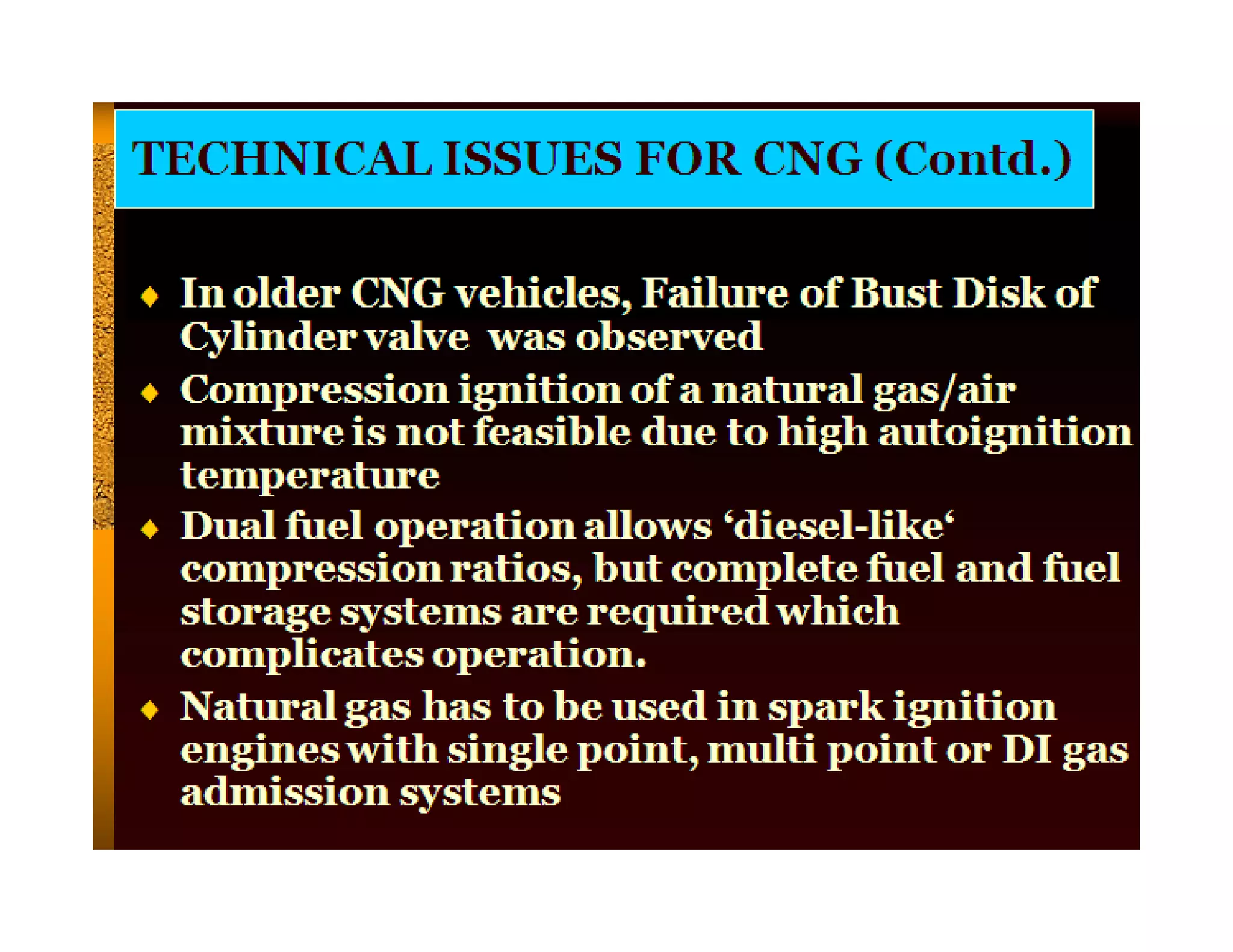
 Inconsistent fuel properties
 Higher self ignition
temperature than diesel
 Good charge distribution
 Inconsistent fuel properties
 Refuelling is a slow process
 Good charge distribution
 Clean burning characteristics
 Non – corrosive
 Non – toxic
 No sulfuric emissions
 No cold starting and warmup
problems
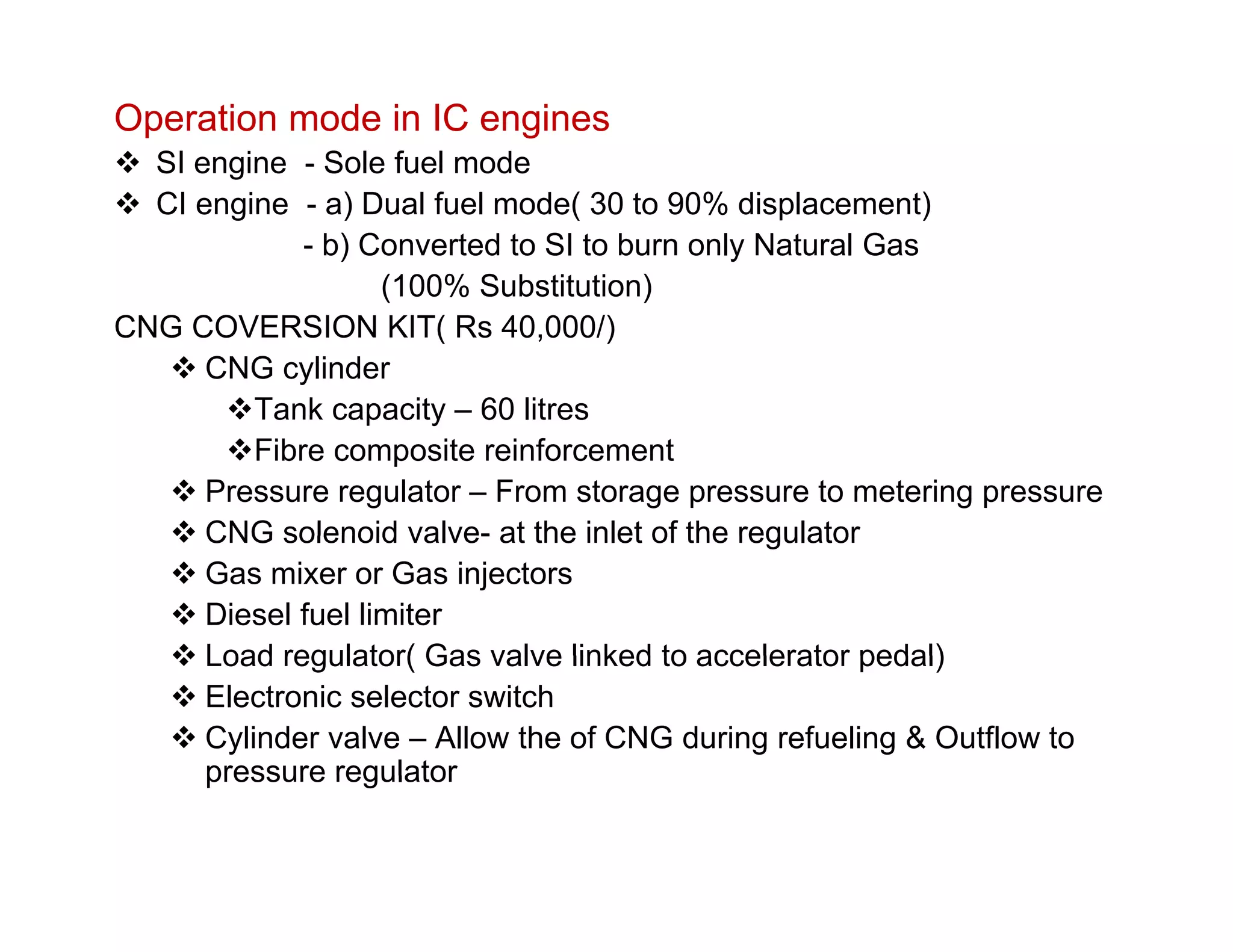
Operation mode in IC engines
 SI engine - Sole fuel modeg
 CI engine - a) Dual fuel mode( 30 to 90% displacement)
- b) Converted to SI to burn only Natural Gas
(100% Substitution)(100% Substitution)
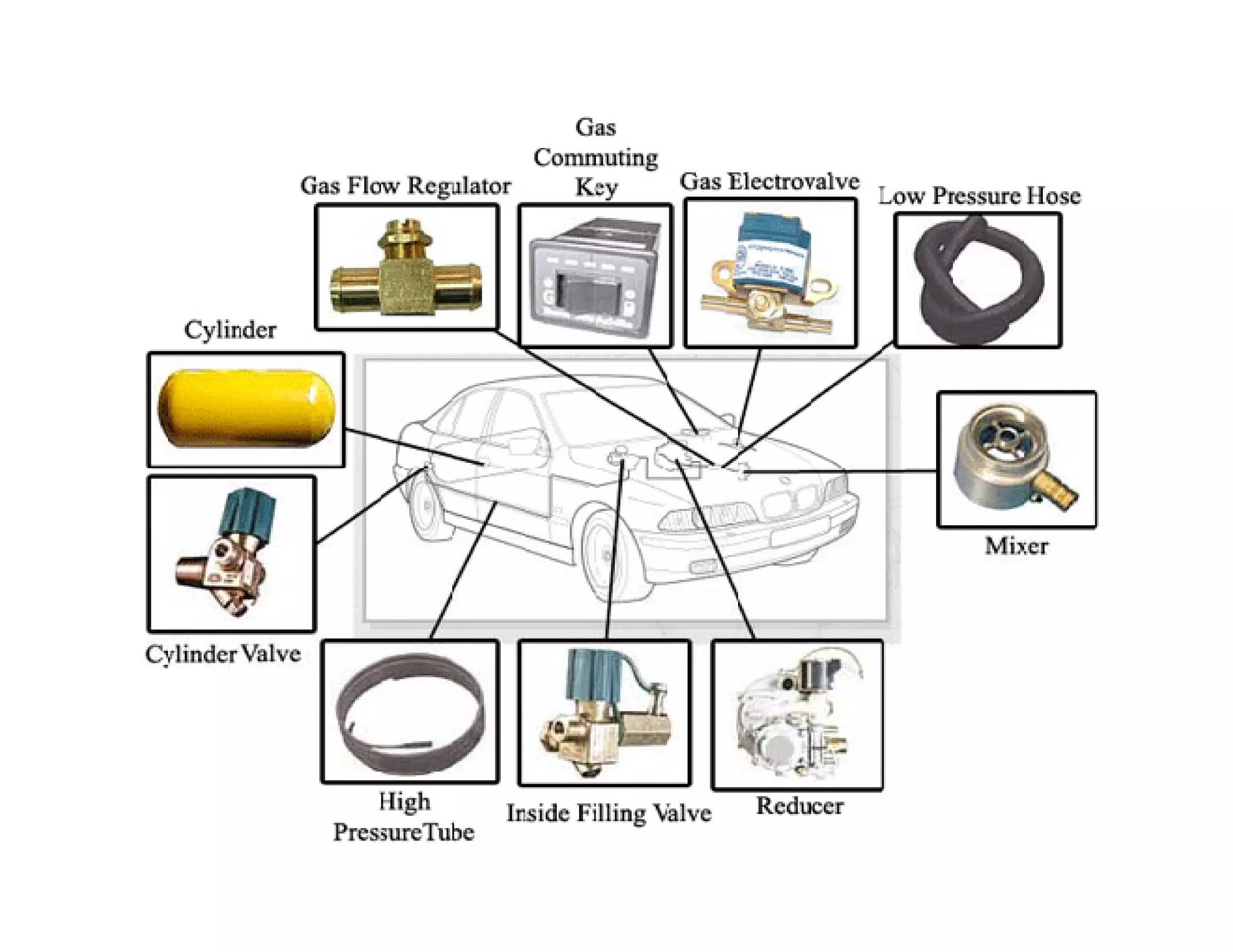
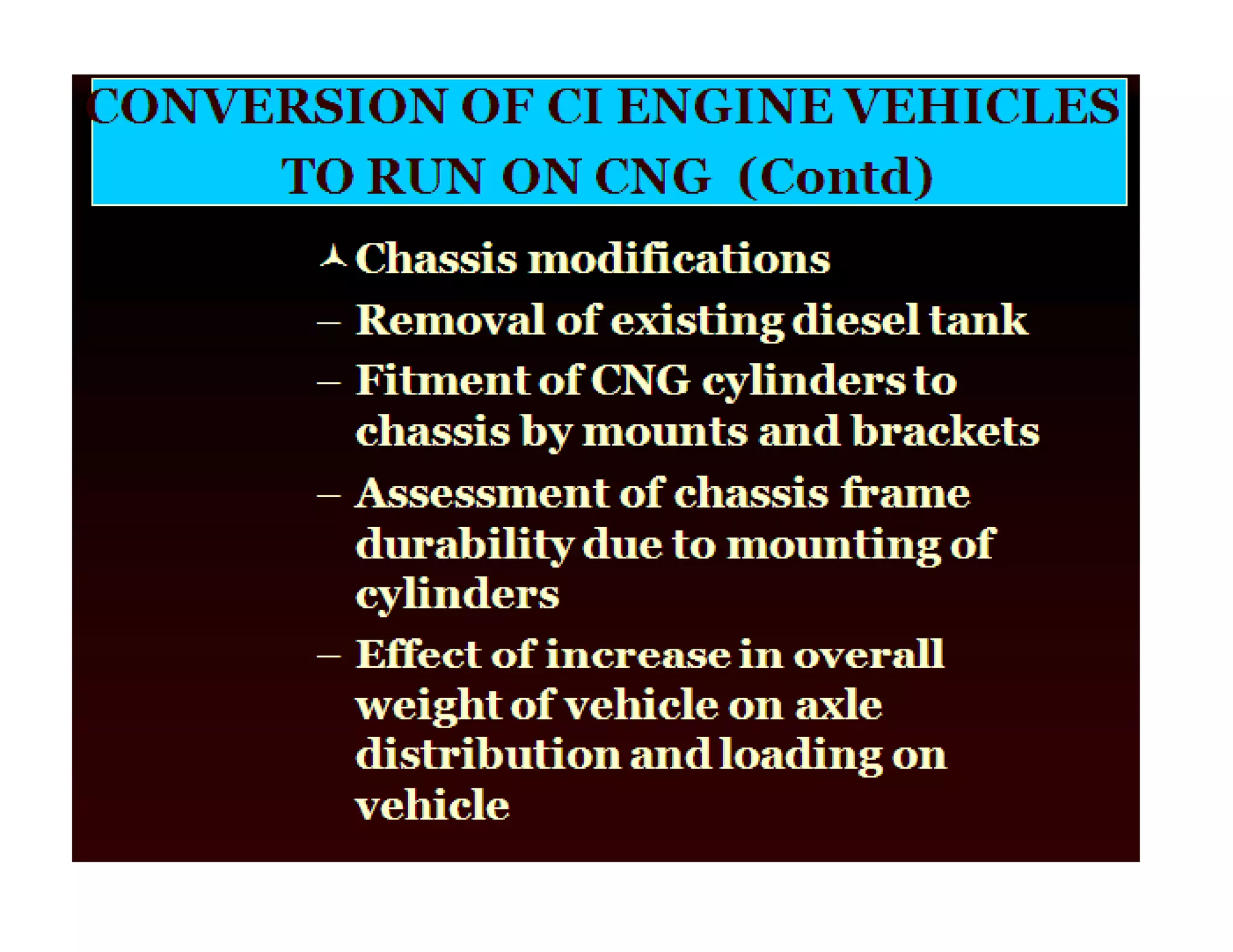
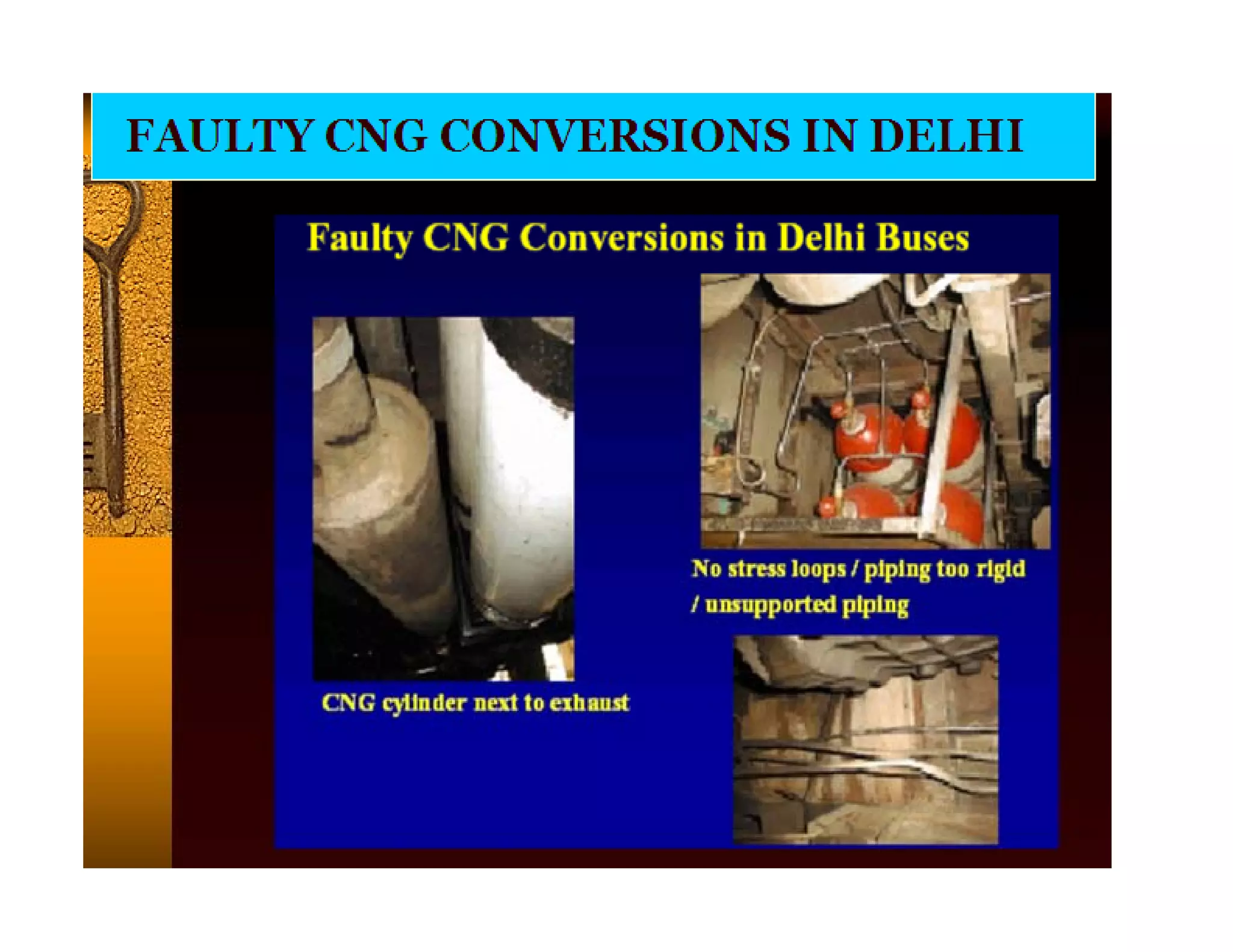
CNG COVERSION KIT( Rs 40,000/)
 CNG cylinder
Tank capacity – 60 litresTank capacity 60 litres
Fibre composite reinforcement
 Pressure regulator – From storage pressure to metering pressure
 CNG solenoid valve- at the inlet of the regulator CNG solenoid valve- at the inlet of the regulator
 Gas mixer or Gas injectors
 Diesel fuel limiter
 Load regulator( Gas valve linked to accelerator pedal) Load regulator( Gas valve linked to accelerator pedal)
 Electronic selector switch
 Cylinder valve – Allow the of CNG during refueling & Outflow to
pressure regulatorpressure regulator
CNG in SI engines
 Higher compression ratio Higher compression ratio
 CNG inducted along with air and ignited using spark plug
 No starting problem
 Ignition timing has to be advanced(5 to 10º crank angle)
 High thermal efficiency
 Low brake power(10%) – Displacement of intake air by the fuelp ( ) p y
vapour
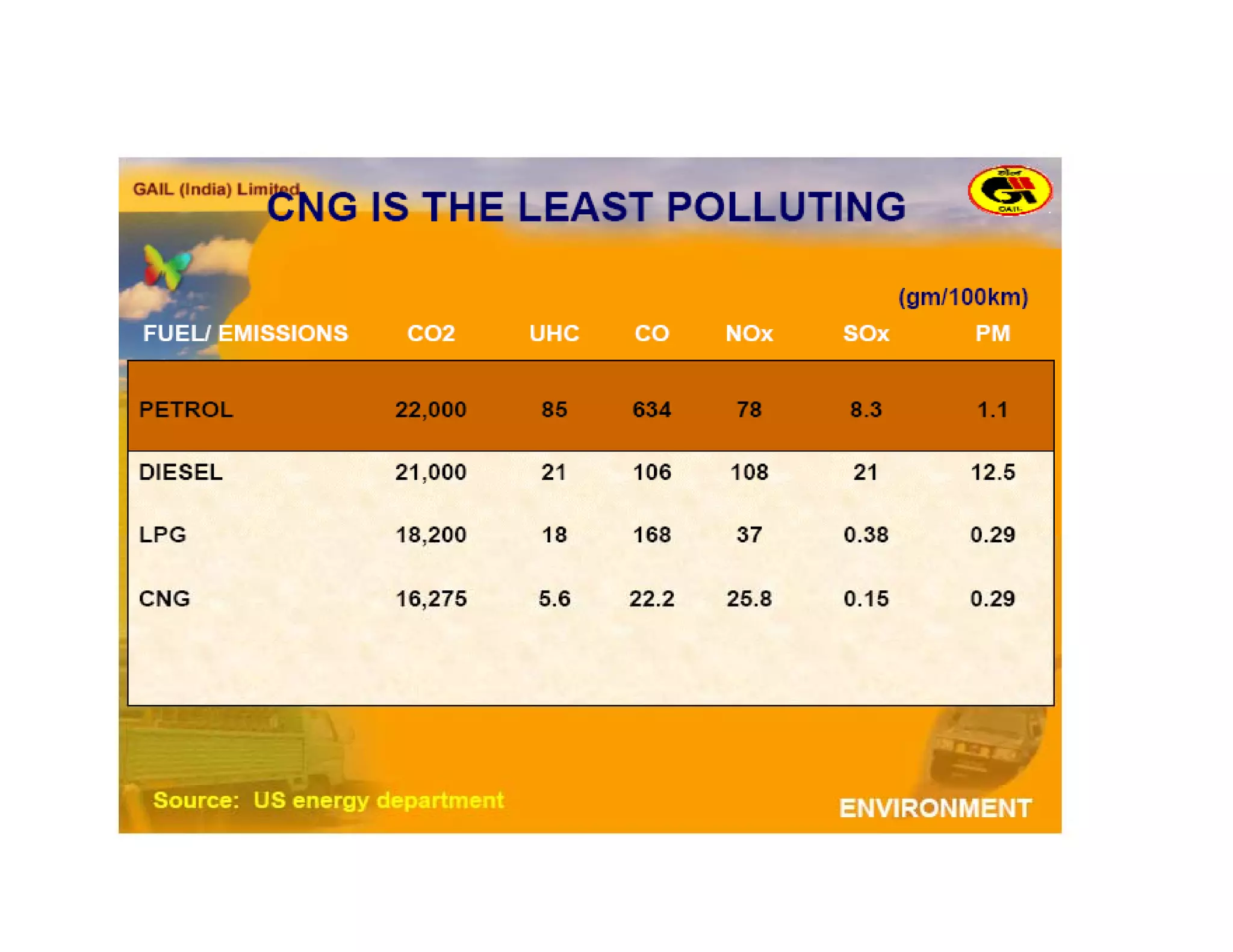
 Low CO and HC emissions
 Flexible fuel operation Flexible fuel operation
CNG in CI engines
 NG – air mixture induction
 Gas is injected directly into the cylinder
 Superior starting capability under cold weather conditions
Dual Fuel Engine Performanceg
CATERPILLAR
C-10 DFNG
ENGINE [9]
MATERIAL COMPATIBILITY OF
NATURAL GAS
All prices as applicable at Mumbai
UnitUnit -- IVIV
Alternative FuelsAlternative Fuels
Introduction
l f l f l Depletion of petroleum fuels
 Engine Emissions
 Production and characteristics of alternative fuels
 Comparison of properties
 Suitability in existing engines
 Results and Discussions Results and Discussions
 Alcohol
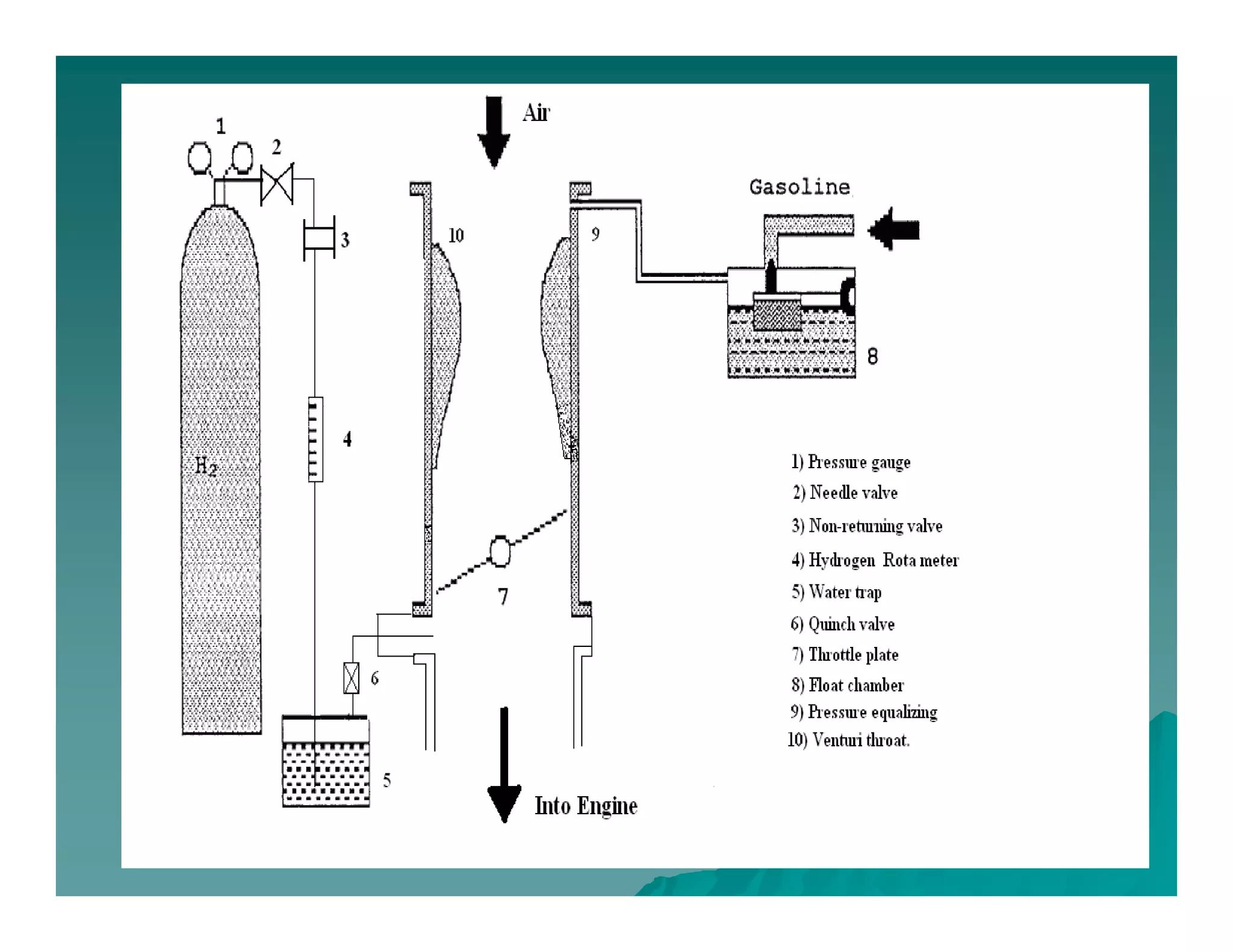
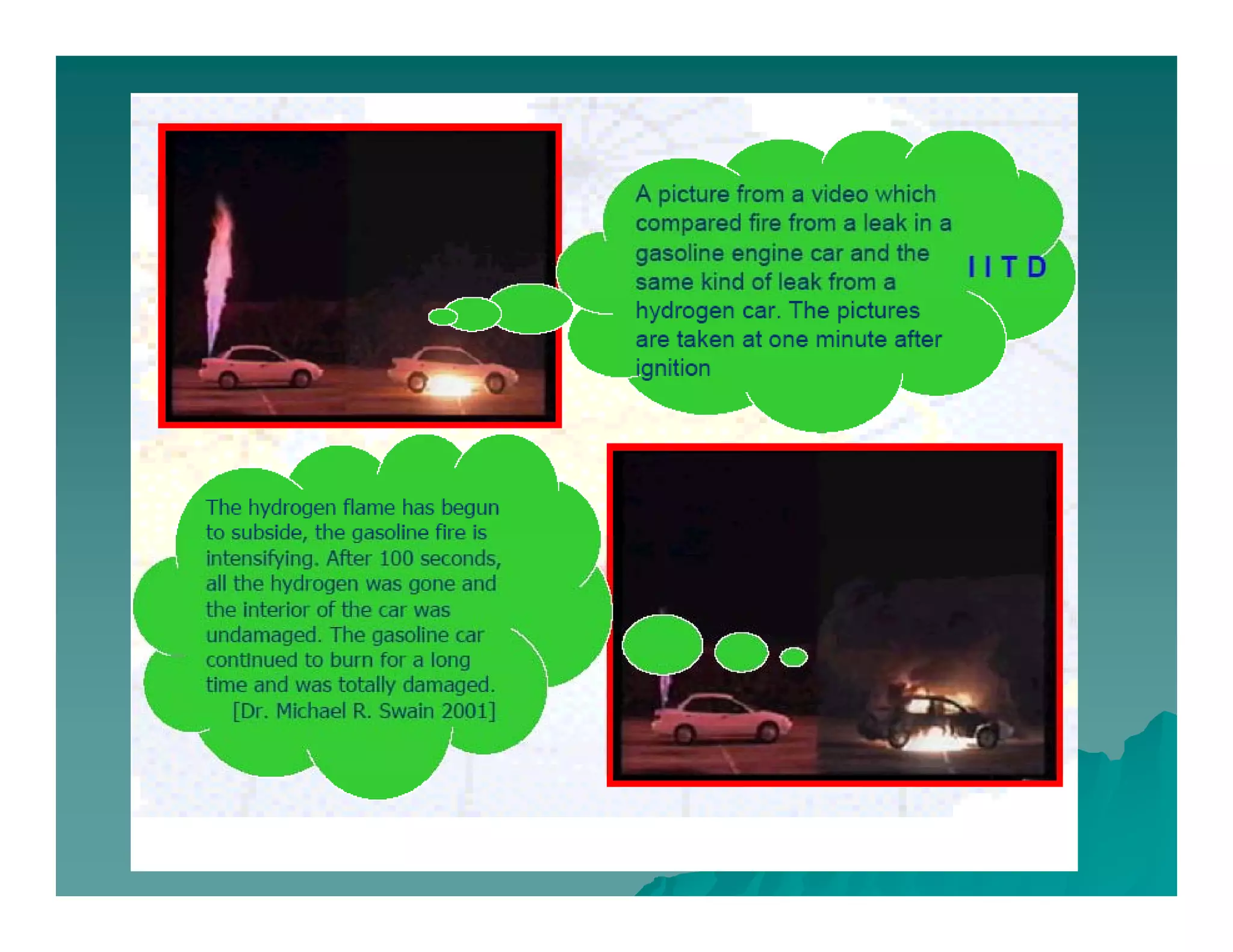
 Hydrogen
 LPG LPG
 CNG
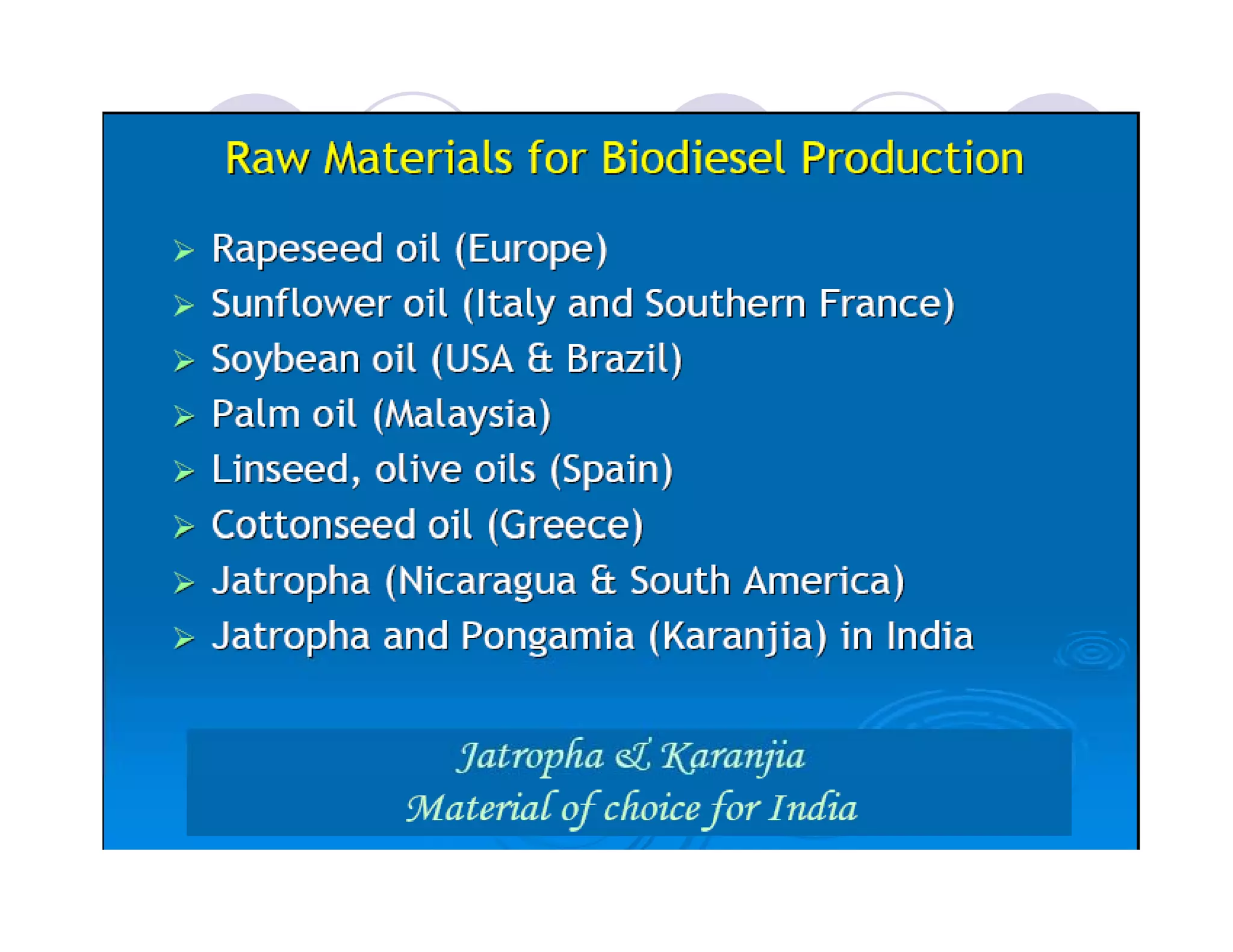
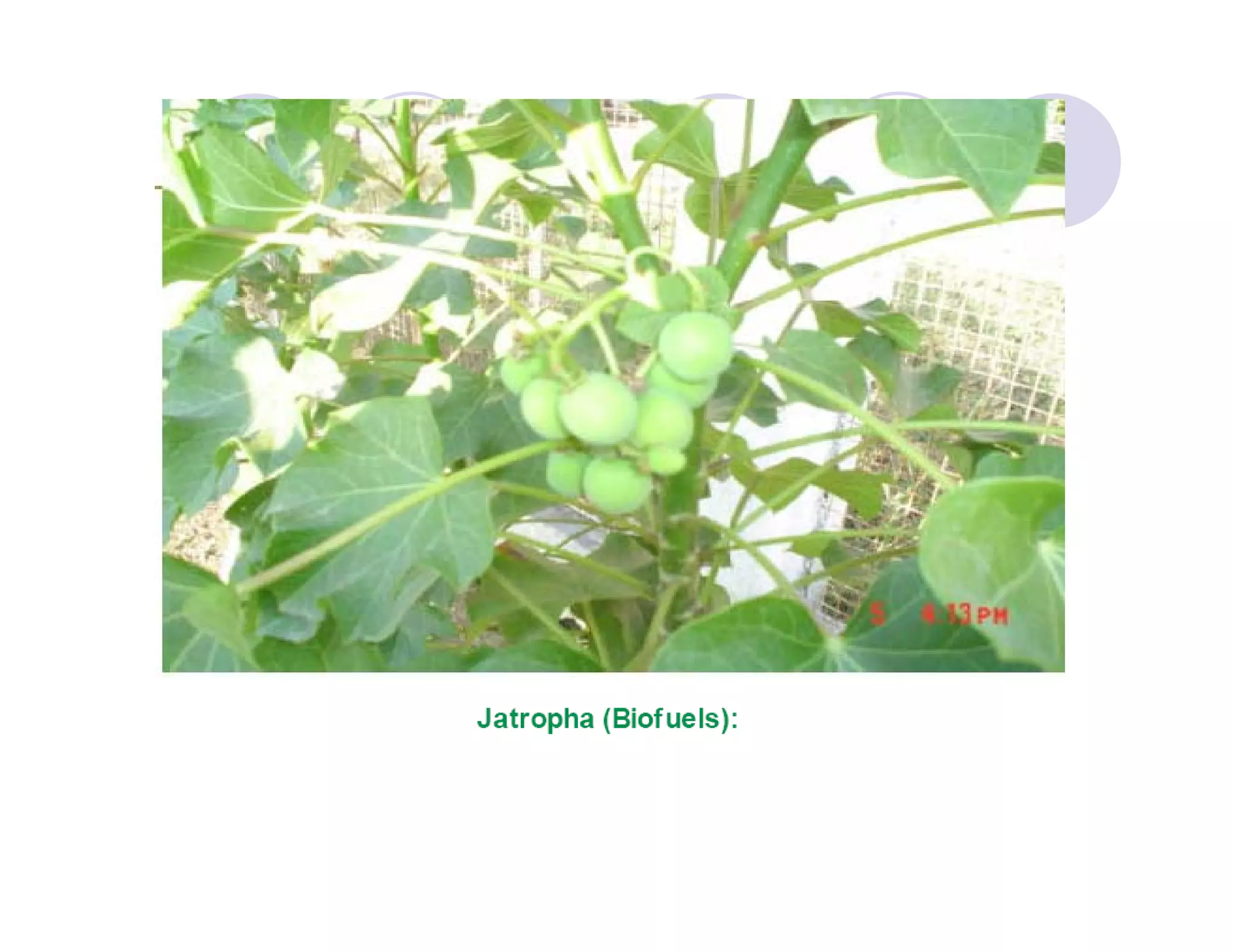
 Biodiesel
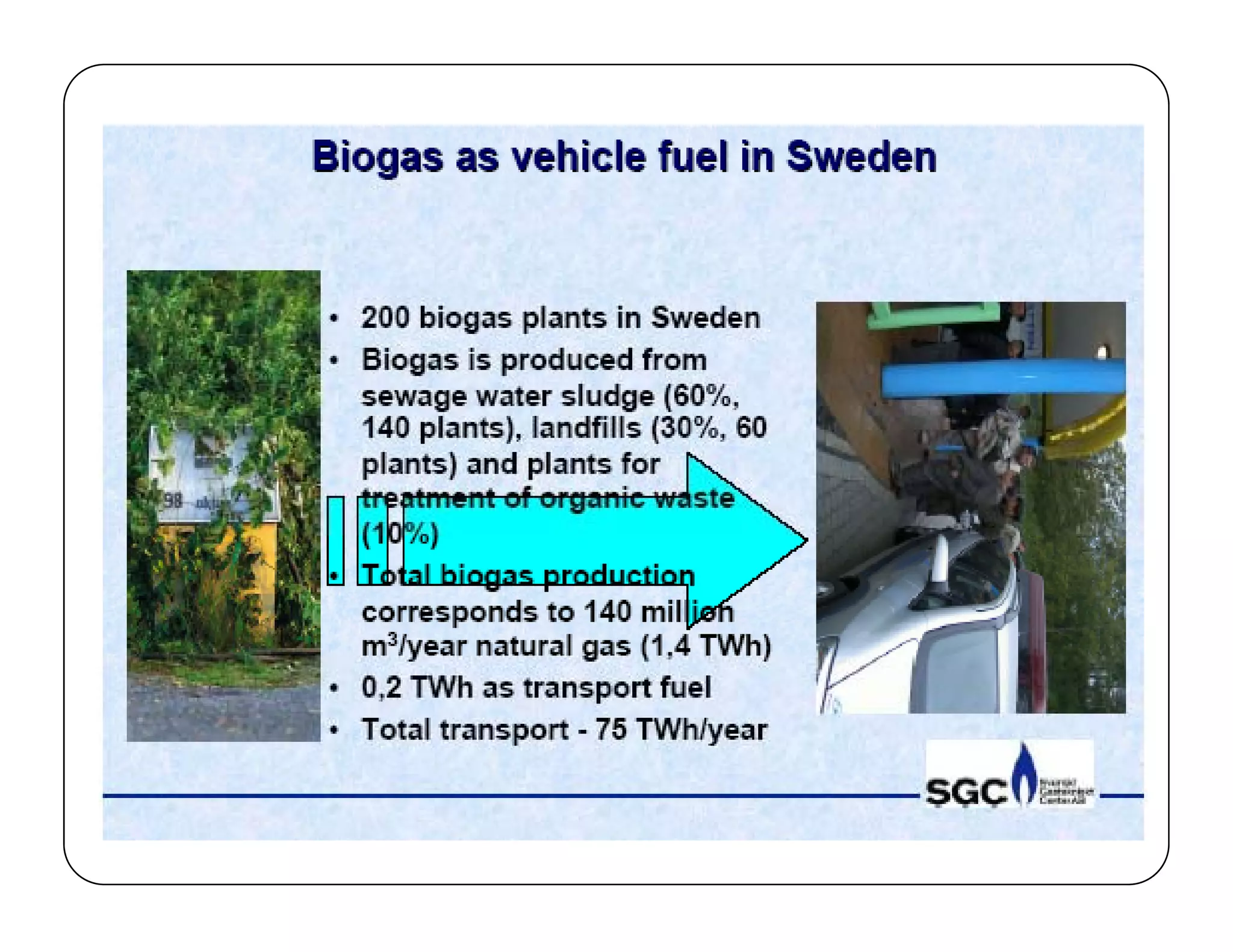
 Biogas
Alcohol
 Renewable fuels
h l l h l d h l l h l Methyl alcohol and Ethyl alcohol
 Iso-Butanol, n-butanol, pentanol
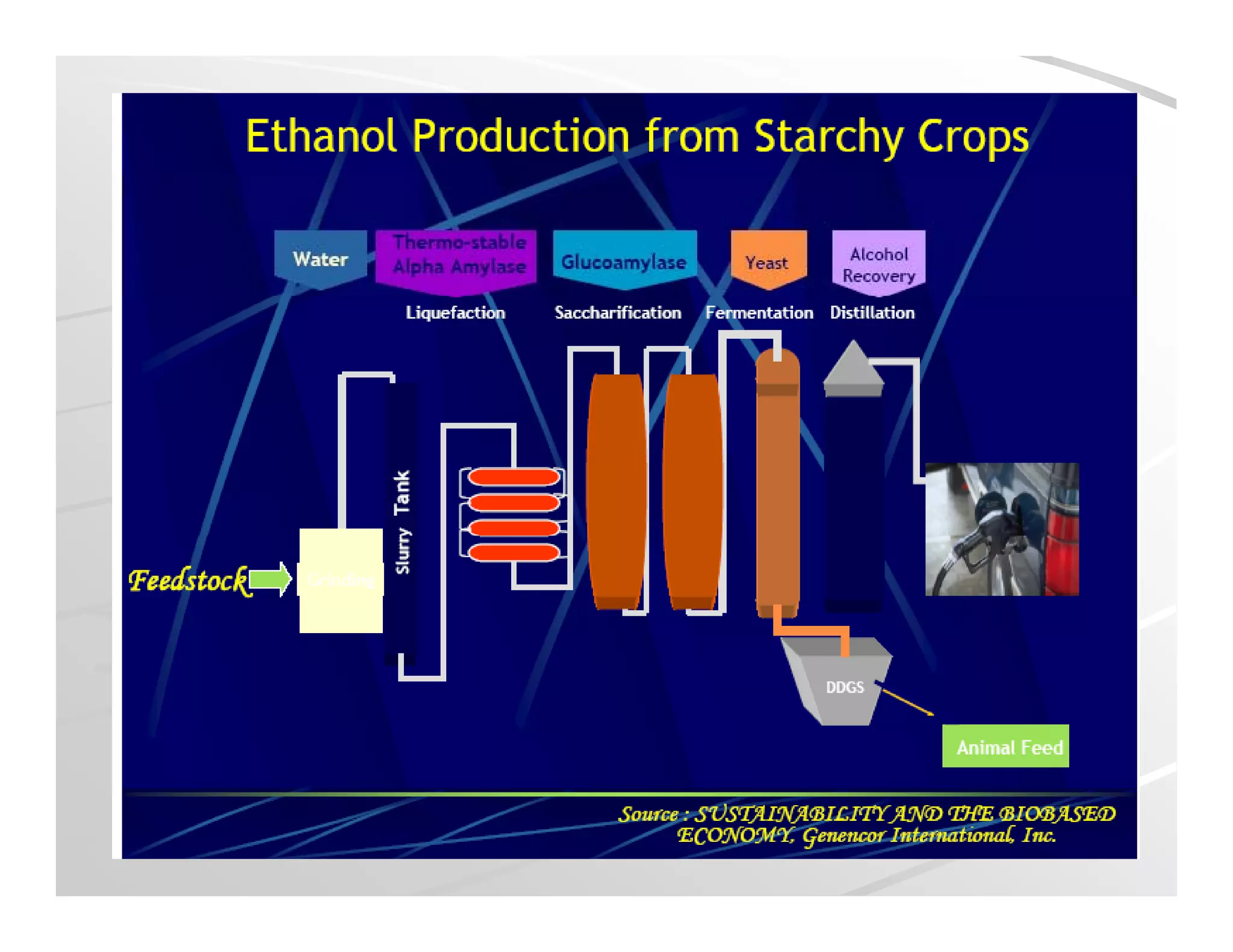
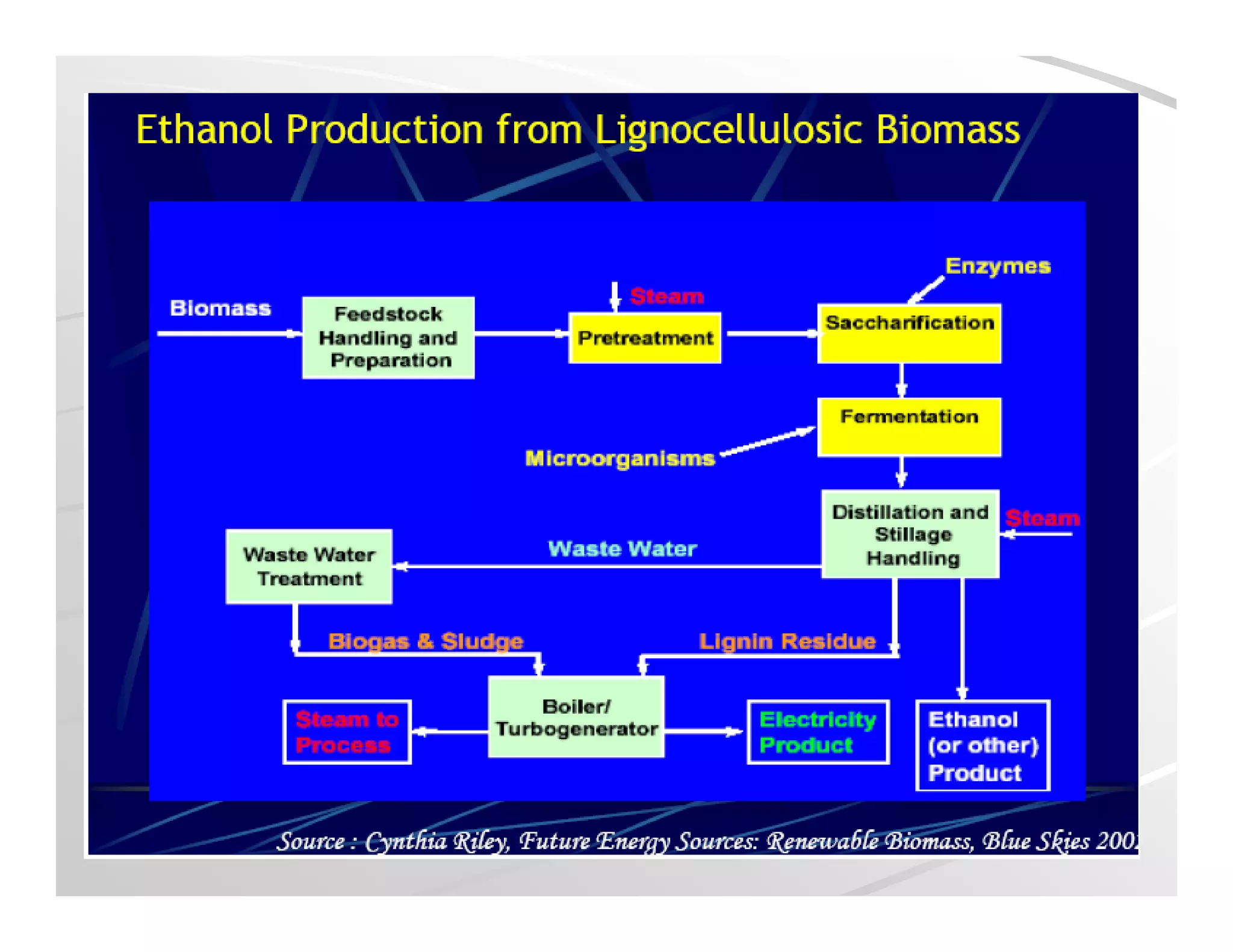
 Fermentation of carbohydrates
 From sugarcane and starchy materials like corn and potatoes
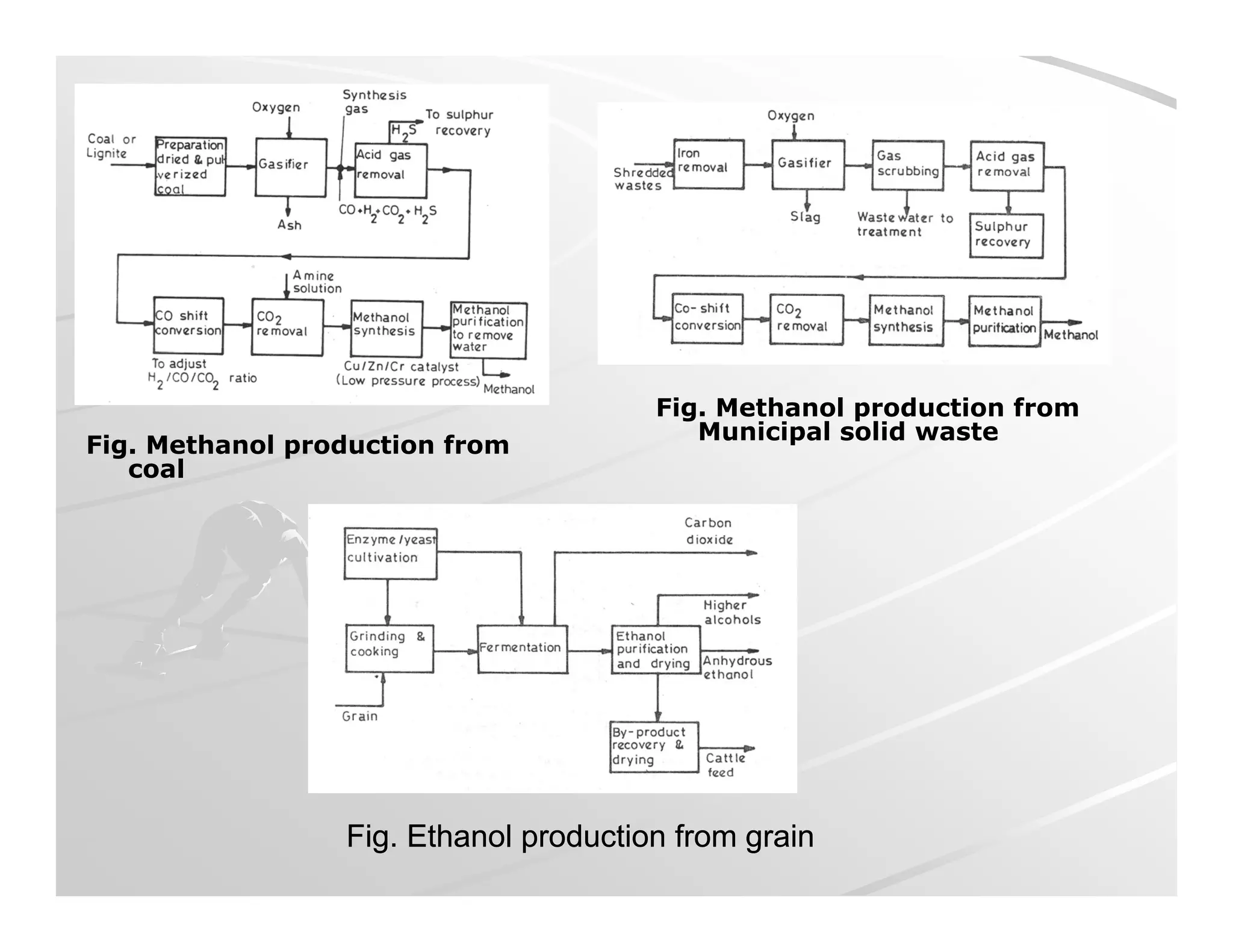
 Methanol can be produced
 Lignite or coal Municipal solid wastes Lignite or coal, Municipal solid wastes
 Natural gas
 Ethanol can be produced fromp
 Feed stock containing carbohydrates such as corn, wheat, sugar-
beets and potatoes
Fig. Methanol production from
coal
Fig. Methanol production from
Municipal solid waste
Fig. Ethanol production from grainFig. Ethanol production from grain
Fuel properties
Auto ignition temp(ºC) 300-450 220-300 478 468
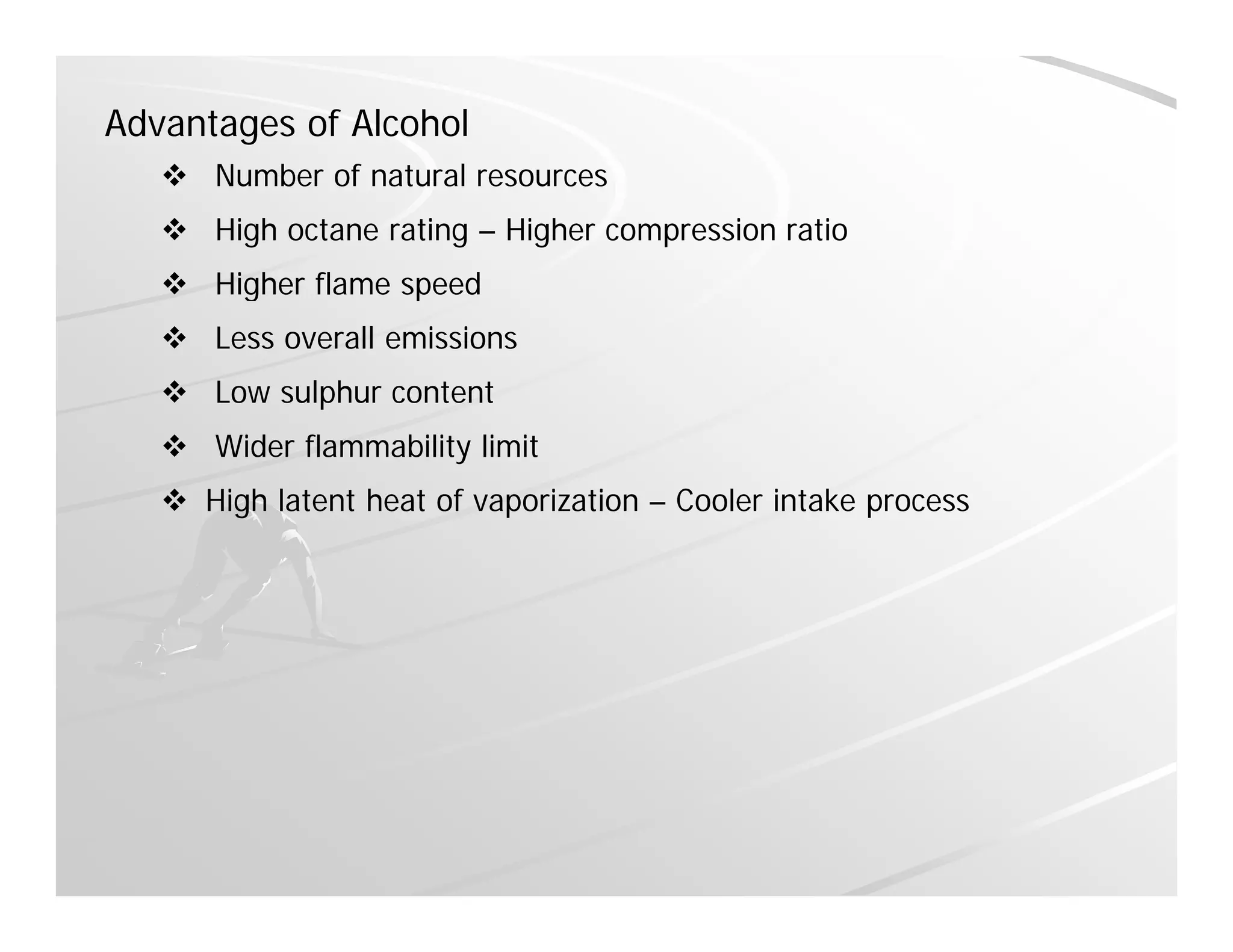
Advantages of Alcohol
 Number of natural resources Number of natural resources
 High octane rating – Higher compression ratio
 Higher flame speedg p
 Less overall emissions
 Low sulphur content
 Wider flammability limit
 High latent heat of vaporization – Cooler intake process
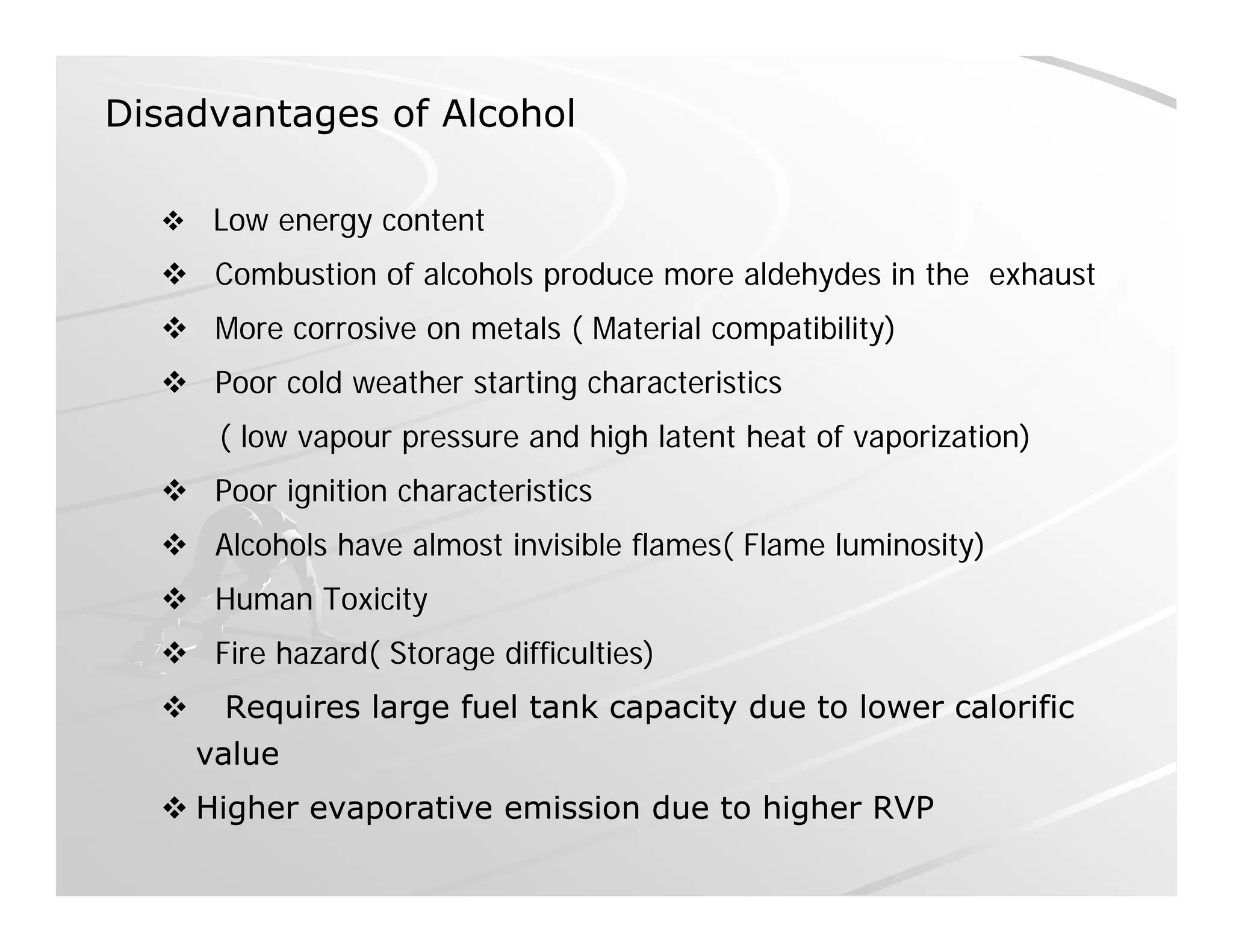
Disadvantages of Alcohol
 Low energy content
 Combustion of alcohols produce more aldehydes in the exhaust
 More corrosive on metals ( Material compatibility)
 Poor cold weather starting characteristics
( low vapour pressure and high latent heat of vaporization)
 Poor ignition characteristics
 Al h l h l t i i ibl fl ( Fl l i it ) Alcohols have almost invisible flames( Flame luminosity)
 Human Toxicity
 Fire hazard( Storage difficulties) Fire hazard( Storage difficulties)
 Requires large fuel tank capacity due to lower calorificRequires large fuel tank capacity due to lower calorific
valuevalue
 Higher evaporative emission due to higher RVPHigher evaporative emission due to higher RVP
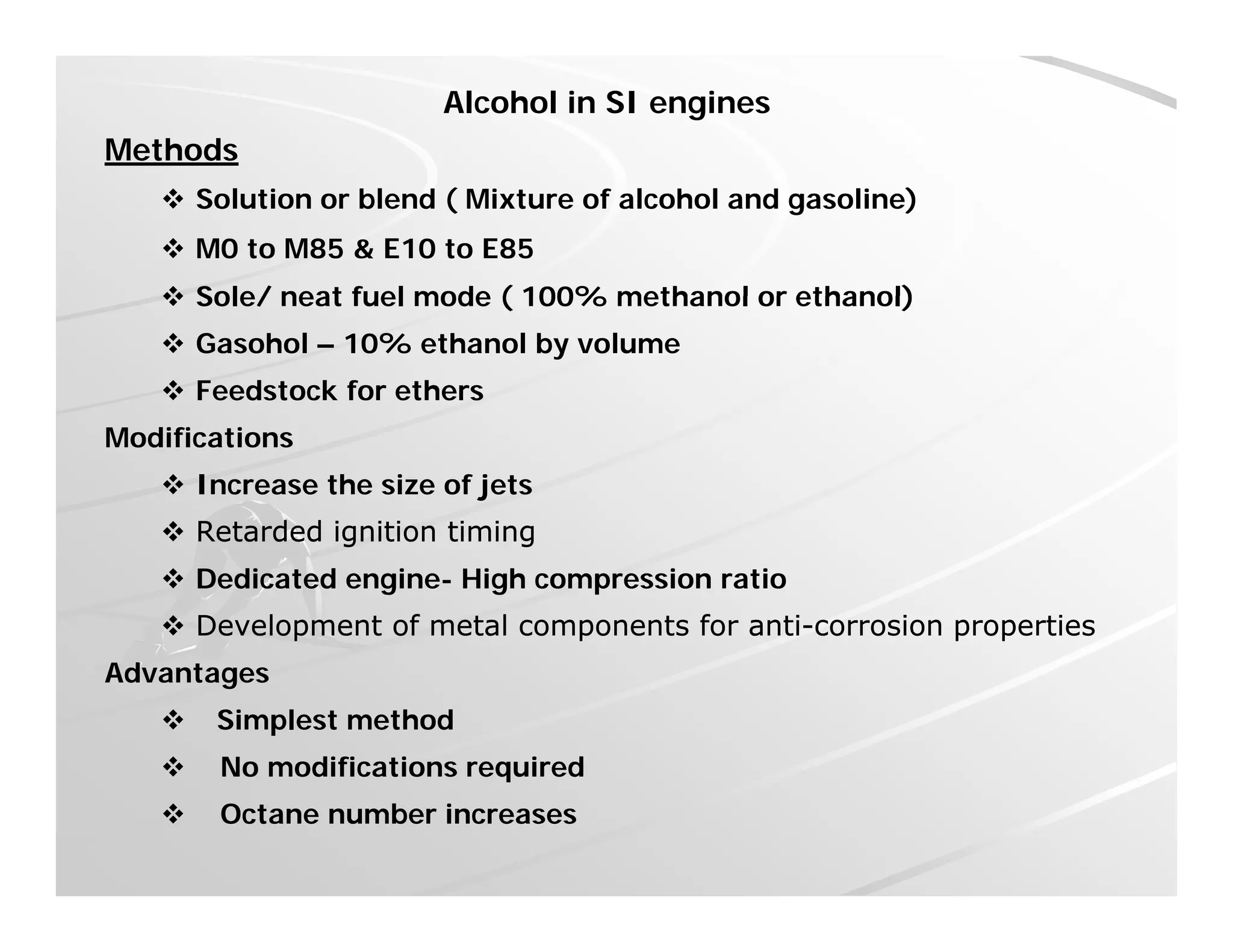
Alcohol in SI engines
Methods
 Solution or blend ( Mixture of alcohol and gasoline)
 M0 to M85 & E10 to E85
 Sole/ neat fuel mode ( 100% methanol or ethanol) Sole/ neat fuel mode ( 100% methanol or ethanol)
 Gasohol – 10% ethanol by volume
 Feedstock for ethers
Modifications
 Increase the size of jets
 Retarded ignition timingRetarded ignition timing Retarded ignition timingRetarded ignition timing
 Dedicated engine- High compression ratio
 Development of metal components for antiDevelopment of metal components for anti--corrosion propertiescorrosion properties
Advantages
 Simplest method
 No modifications required No modifications required
 Octane number increases
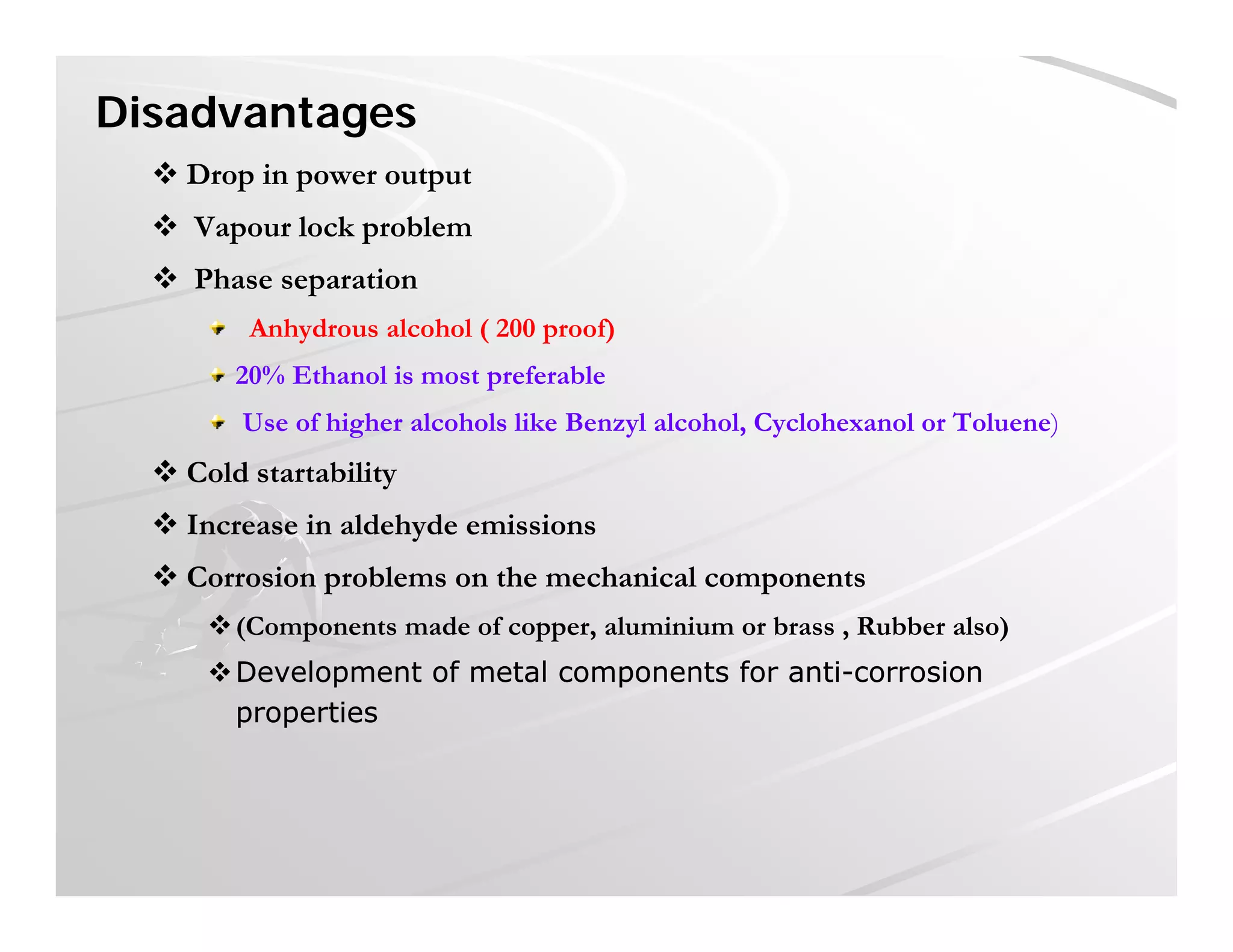
Disadvantages
 Drop in power output Drop in power output
 Vapour lock problem
 Phase separationp
Anhydrous alcohol ( 200 proof)
20% Ethanol is most preferable
U f hi h l h l lik B l l h l C l h l T l )Use of higher alcohols like Benzyl alcohol, Cyclohexanol or Toluene)
 Cold startability
 Increase in aldehyde emissionsy
 Corrosion problems on the mechanical components
(Components made of copper, aluminium or brass , Rubber also)
Development of metal components for antiDevelopment of metal components for anti--corrosioncorrosion
propertiesproperties
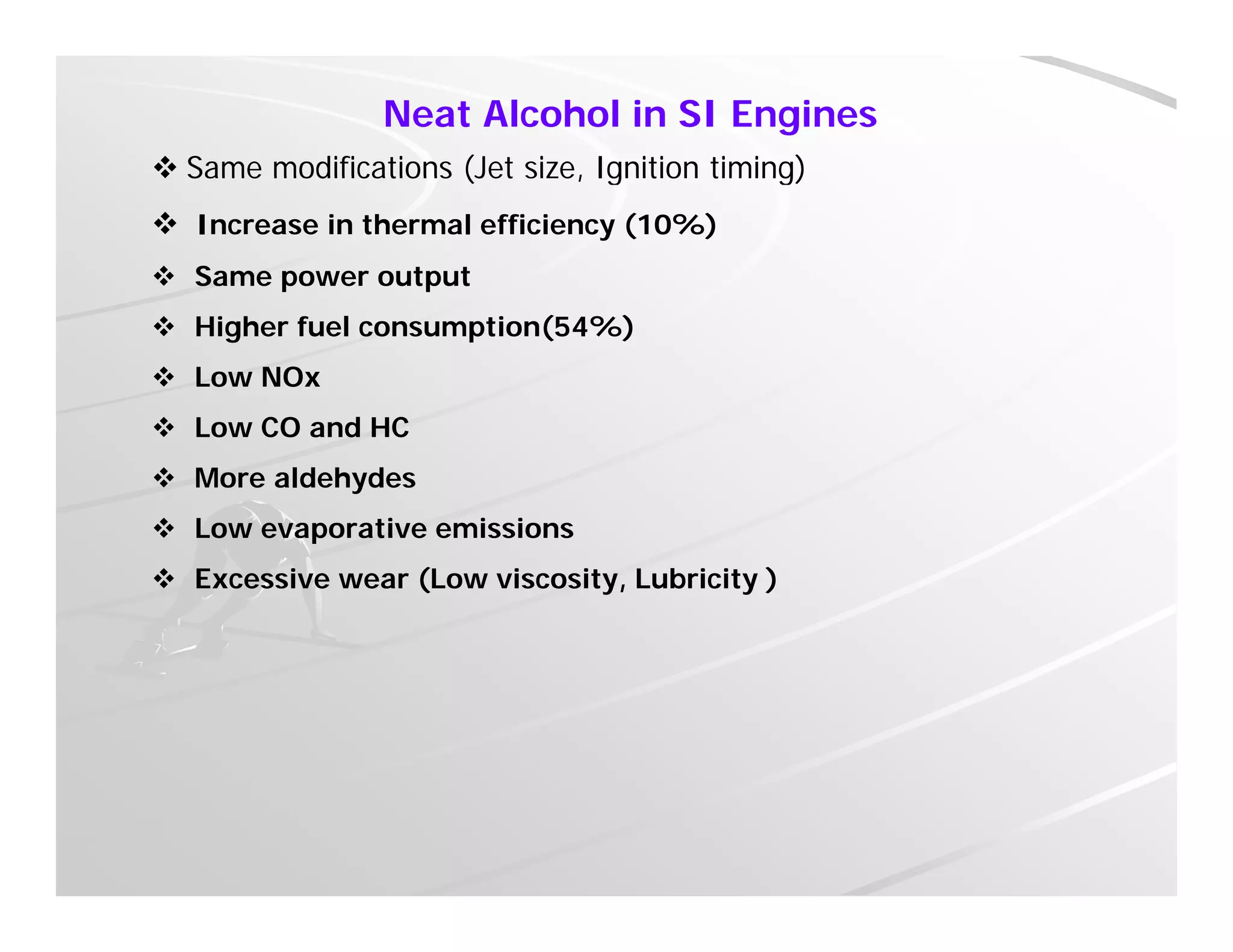
Neat Alcohol in SI Engines
 Same modifications (Jet size, Ignition timing) Same modifications (Jet size, Ignition timing)
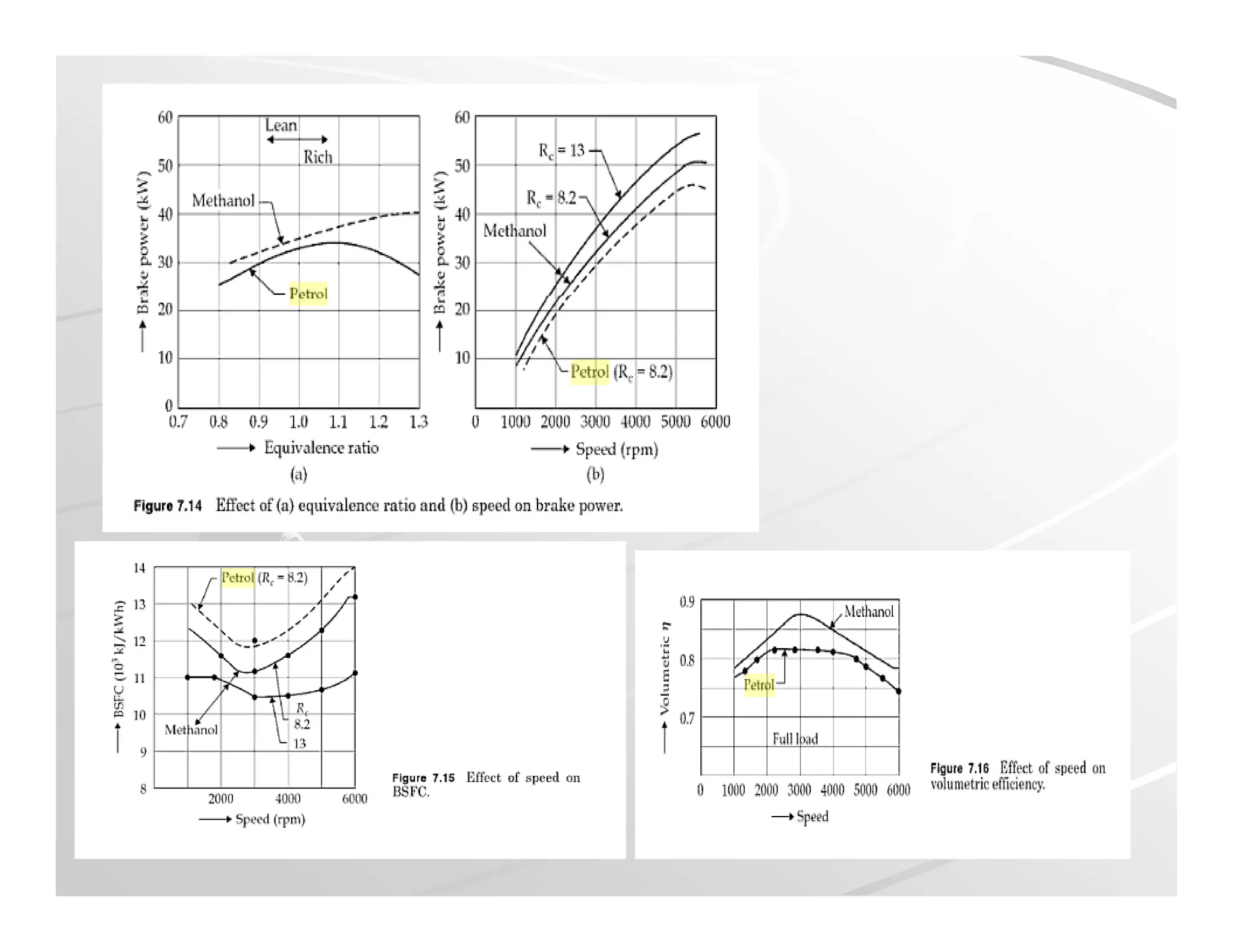
 Increase in thermal efficiency (10%)
 Same power output
 Higher fuel consumption(54%)
 Low NOx
 Low CO and HC
 More aldehydes
 Low evaporative emissions Low evaporative emissions
 Excessive wear (Low viscosity, Lubricity )
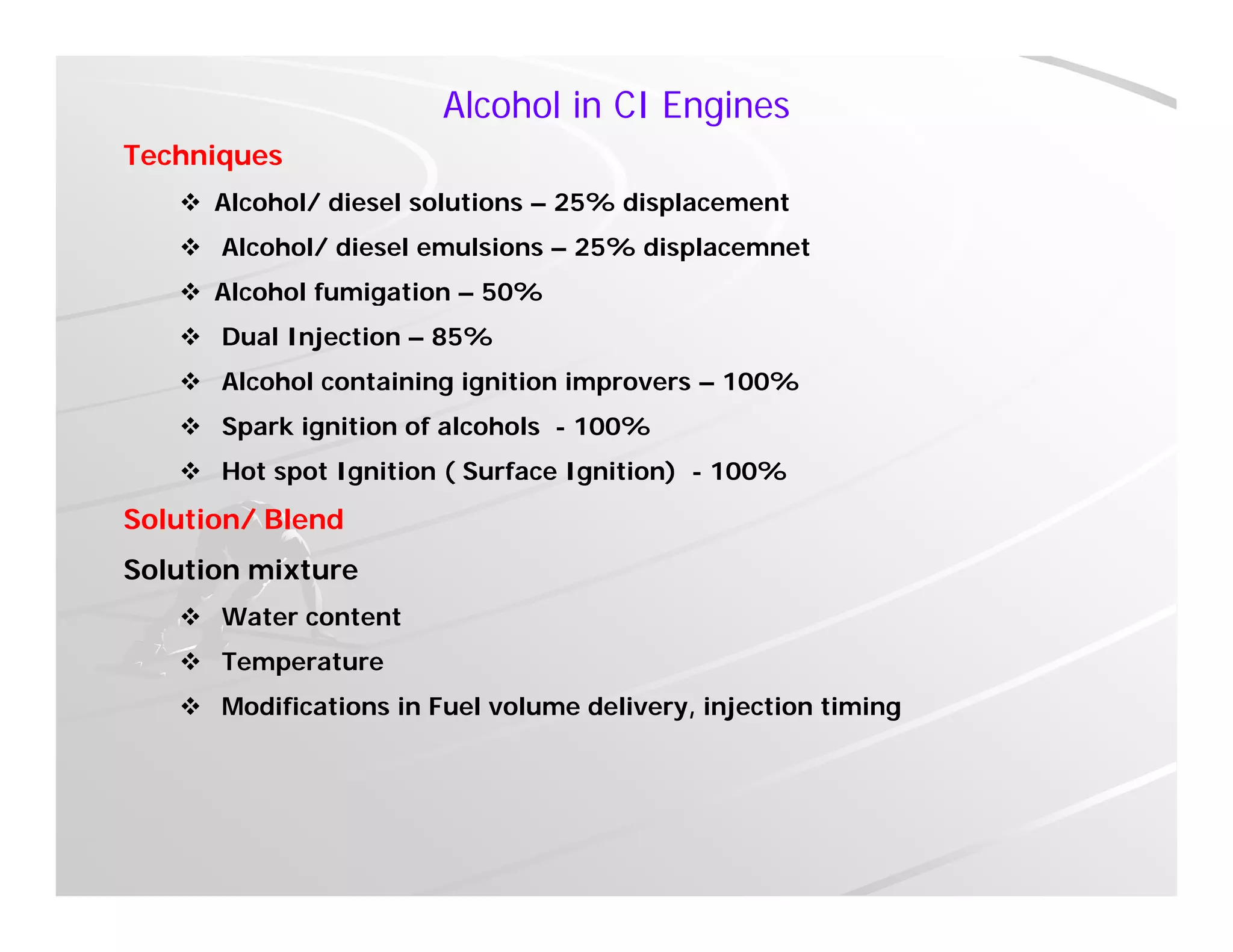
Alcohol in CI Engines
Techniques
 Alcohol/ diesel solutions – 25% displacement
 Alcohol/ diesel emulsions – 25% displacemnet
 Alcohol fumigation – 50% Alcohol fumigation 50%
 Dual Injection – 85%
 Alcohol containing ignition improvers – 100%
 Spark ignition of alcohols - 100%
 Hot spot Ignition ( Surface Ignition) - 100%
Solution/ Blend
Solution mixture
 Water content
 T t Temperature
 Modifications in Fuel volume delivery, injection timing
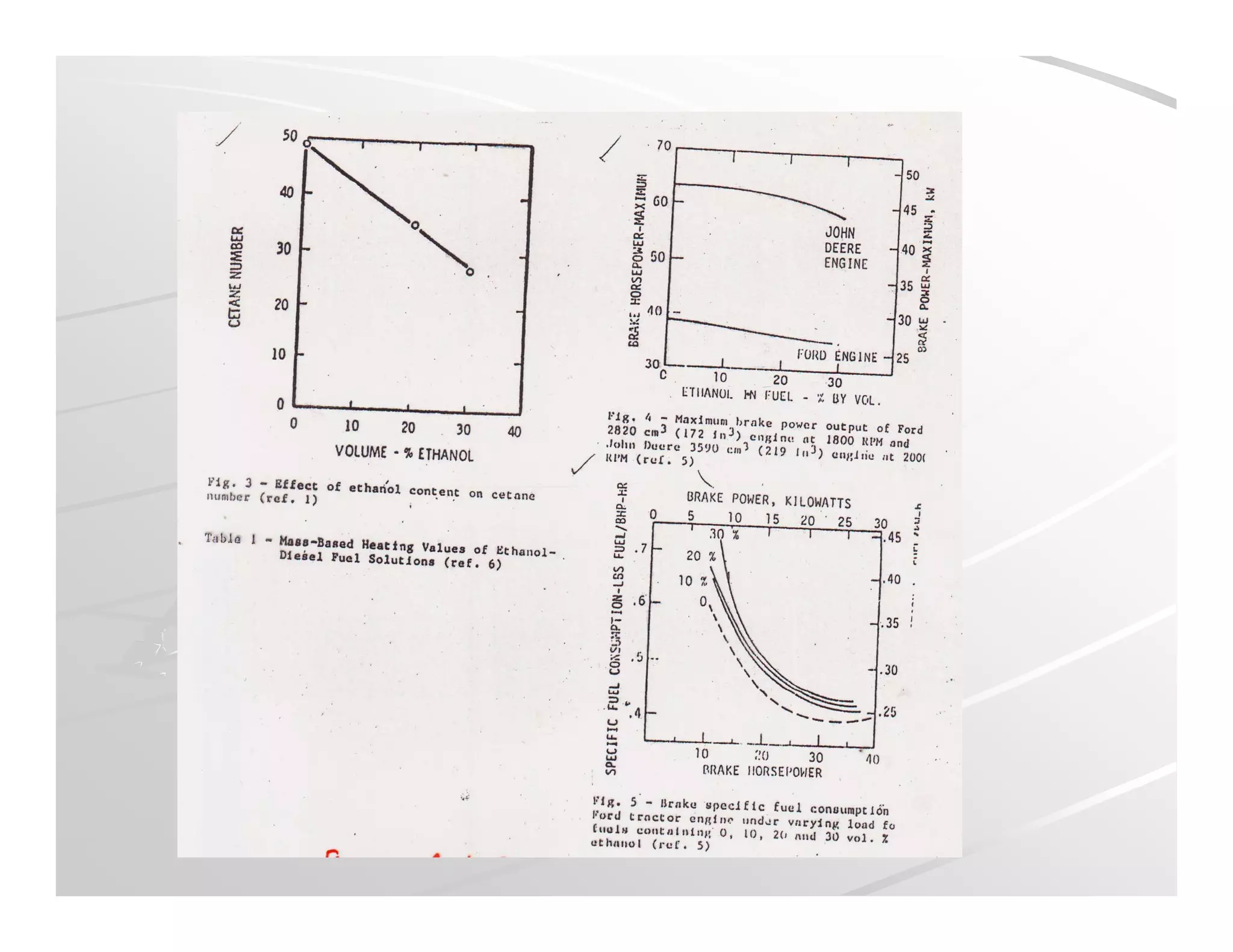
 Low cetane number
 Viscosity decreases
 Calorific value reduces
 Decrease in thermal efficiency
 Low NOx
 Power output is less with maximum % of alcohol
 No change in CO
 High UBHC with increase in ethanol solution %
 Smoke and PM emission decrease with increase in ethanol content
Emulsions
 25- 30 % displacement of alcohol
 Equal amount of Emulsifier and alcoholq
 Extent the water tolerance of alcohol / diesel blends
 Modification in injection timing and fuel volume delivery
 Low calorific value and low cetane number
 Reduced power output and thermal efficiency
 CO is same CO is same
 Viscosity increases( Results in poor mixing)
 UBHC increases
 NOx increases( Increases in ignition delay)
 Cost of emulsifier
Surfactant
 Sodium lauryl sulphate (0.1%)
 Ethyl acetate
 1 Butanol 1- Butanol
 Alkali metal soap
 Sodium Hydroxide ( 2 to 3%) Sodium Hydroxide ( 2 to 3%)
Fumigation
 50 80 % Di l t f l h l 50 – 80 % Displacement of alcohol
 Alcohol introduced into the engine by carburettor or
vapourzer
 Use of separate fuel supply system for alcohol and diesel
 At low load – Low fuel delivery (Flame quenching)
 Increase in power output
 More efficiency
 CO & UBHC are higher (Flame quenching effect) CO & UBHC are higher (Flame quenching effect)
 Low NOx
 High latent heat of alcohol cool the intake charge
 70% reduction in PM
 Flexible to switch over from dual fuel mode to single fuel
modemode
Dual Injection
 90% displacement 90% displacement
 Complex and expensive method
 Alcohol is directly injected into the cylinder and ignited by a pilot
h f di l f lcharge of diesel fuel
 To initiate the combustion
 Pilot charge must precede the injection of alcohol
 More power output(13%)
 High thermal efficiency
 Low emissions Low emissions
 Best suitable in IDI engines
 Lubrication problem
Spark Ignition
 100% displacement
 Spark ignition must be associated with fuel injection
 Improved thermal efficiency
 More power output
 Low NOx & PM
 More CO
 Proper lubrication
Ignition Improvers
 10 to 20 % by volume
 Increase its cetane number
 Nitrogen based compounds
 Isoamyl nitrate
 Tri elthylene glycol dinitrate
 Kerobrisol
 Castor oil – Lubricant
 High NOx
 Better power output and thermal efficiency
Surface Ignition
 Glow plugp g
 100% displacement
 To glow continuously throughout the cycle
 Temperature 900 to 1000ºCp
Alcohol – Feedstock for Ethers
 Dimethyl ethers ( CH3 O CH3) – Colourless gas
 Cetane number -55
 Sulfur free
 Diethyl ethers ( CH3-CH2)2O
 Cetane number – 85-95
 High auto ignition temperatureg g p
 Methyl Tertiary Butyl Ether(MTBE)
 Ethyl Tertiary Butyl Ether(ETBE)
 Oxygenate Oxygenate
 10 – 15% by volume
 To increase the octane number of gasoline
UnitUnit IVIVUnitUnit -- IVIV
H dH dHydrogenHydrogen
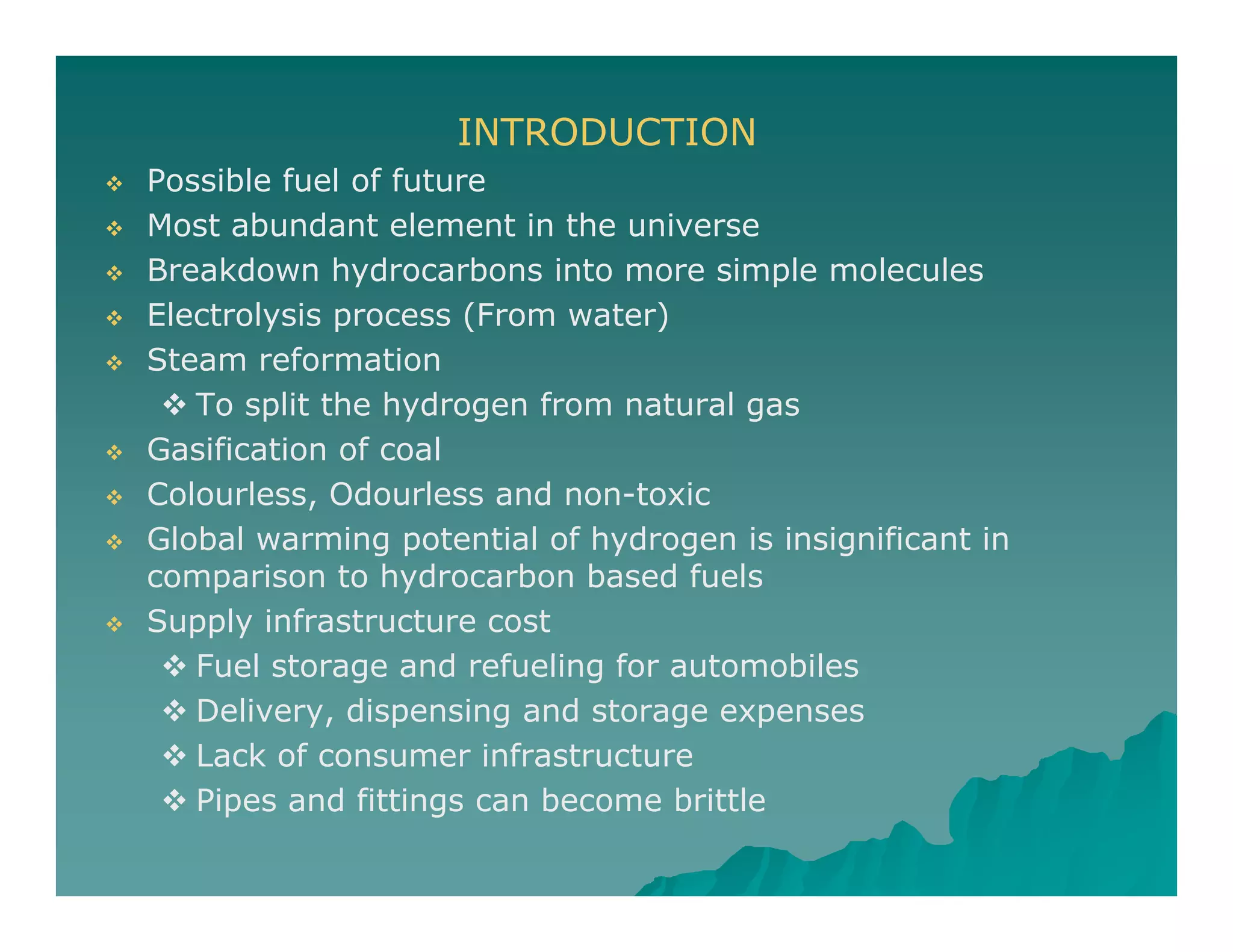
INTRODUCTION
 Possible fuel of future Possible fuel of future
 Most abundant element in the universe
 Breakdown hydrocarbons into more simple molecules
 Electrolysis process (From water)
 Steam reformation
 To split the hydrogen from natural gaso sp e yd oge o a u a gas
 Gasification of coal
 Colourless, Odourless and non-toxic
 Global warming potential of hydrogen is insignificant in Global warming potential of hydrogen is insignificant in
comparison to hydrocarbon based fuels
 Supply infrastructure cost
 F l t d f li f t bil Fuel storage and refueling for automobiles
 Delivery, dispensing and storage expenses
 Lack of consumer infrastructure
 Pipes and fittings can become brittle
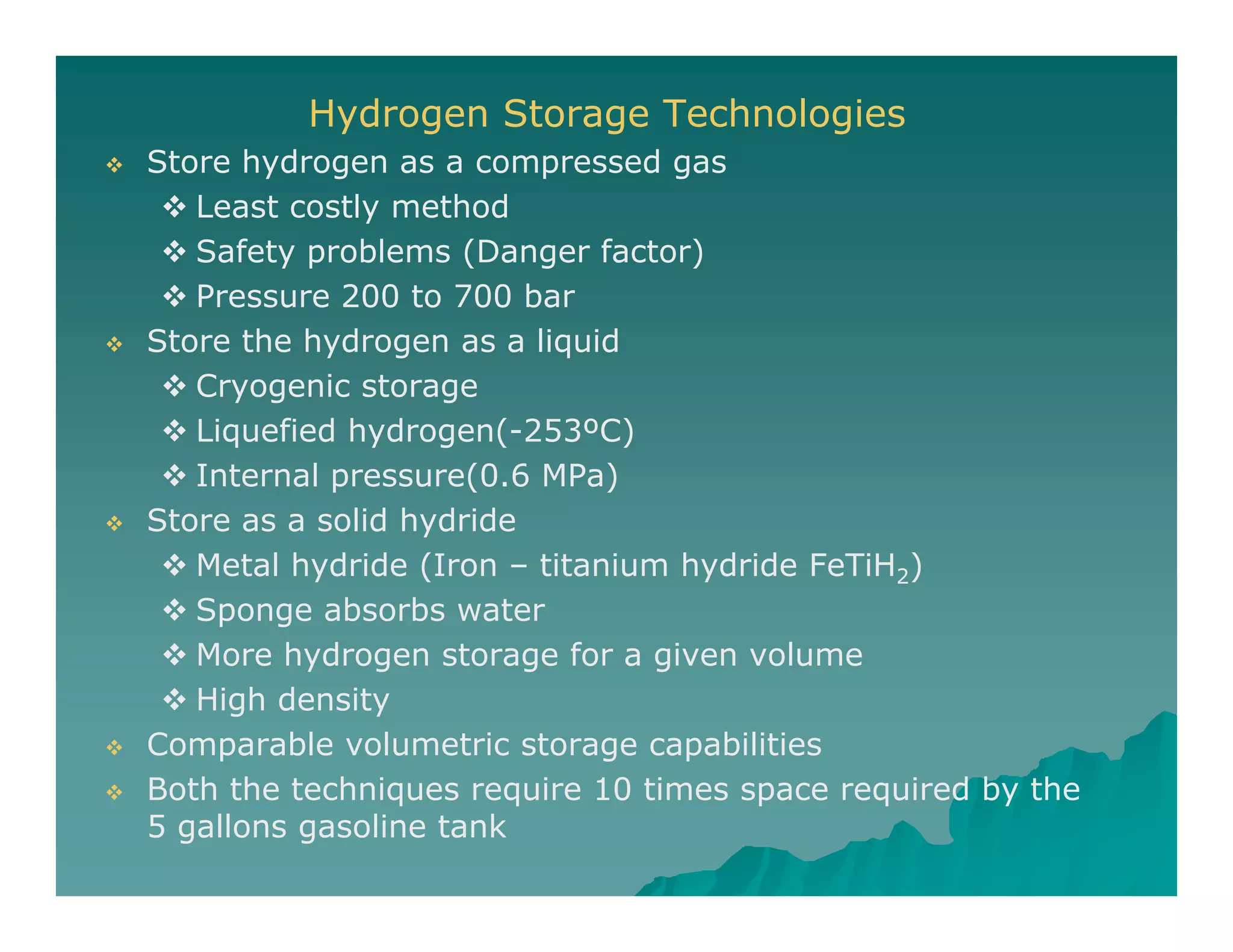
Hydrogen Storage Technologies
 Store hydrogen as a compressed gasy g p g
 Least costly method
 Safety problems (Danger factor)
 Pressure 200 to 700 bar Pressure 200 to 700 bar
 Store the hydrogen as a liquid
 Cryogenic storage
 Liquefied hydrogen(-253ºC)
 Internal pressure(0.6 MPa)
 Store as a solid hydridey
 Metal hydride (Iron – titanium hydride FeTiH2)
 Sponge absorbs water
 More hydrogen storage for a given volume More hydrogen storage for a given volume
 High density
 Comparable volumetric storage capabilities
 Both the techniques require 10 times space required by the
5 gallons gasoline tank
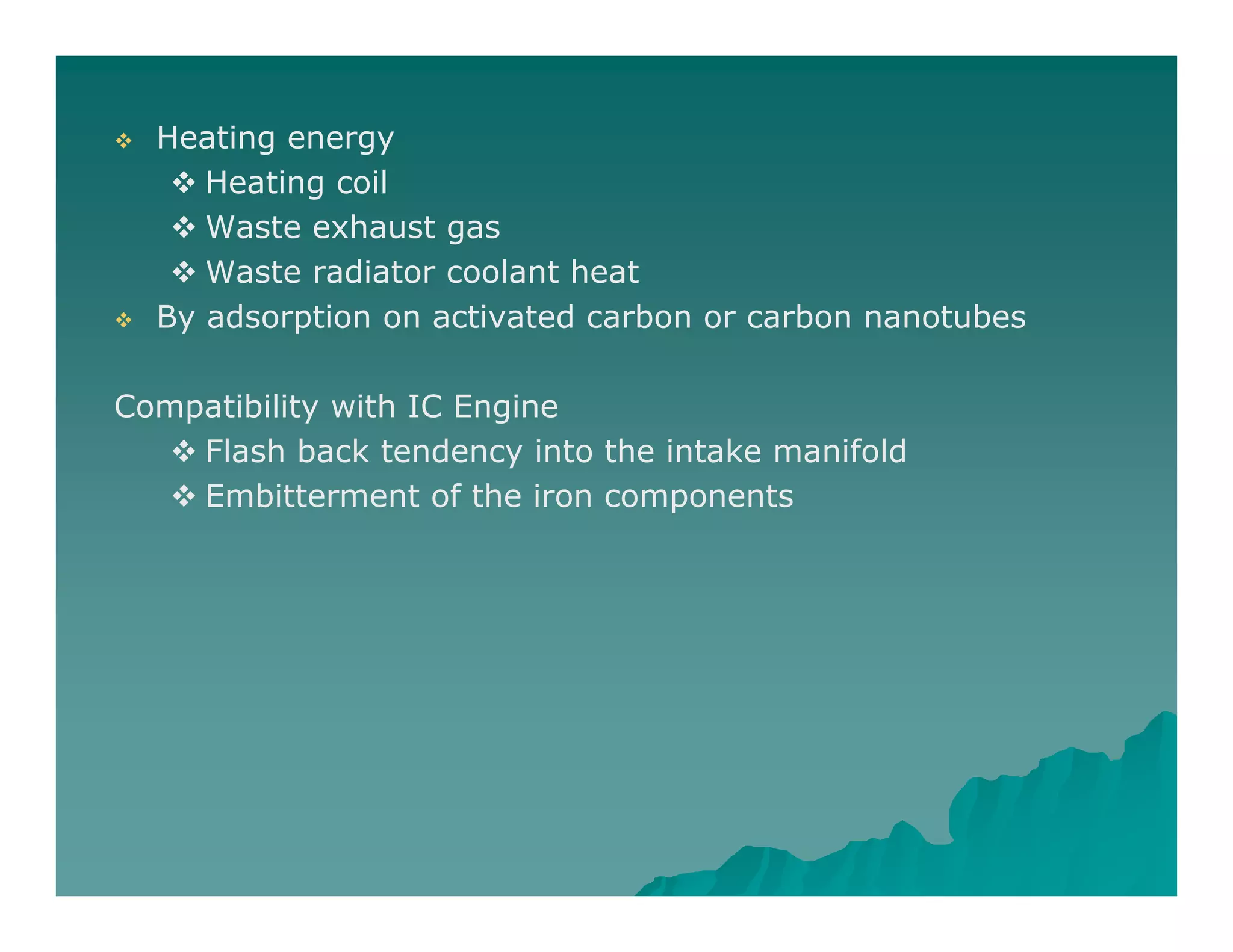
 Heating energy
 Heating oil Heating coil
 Waste exhaust gas
 Waste radiator coolant heat
 By adsorption on activated carbon or carbon nanotubes
Compatibility with IC EngineCompatibility with IC Engine
 Flash back tendency into the intake manifold
 Embitterment of the iron components
Hydrogen (Metal Hydride Tank)
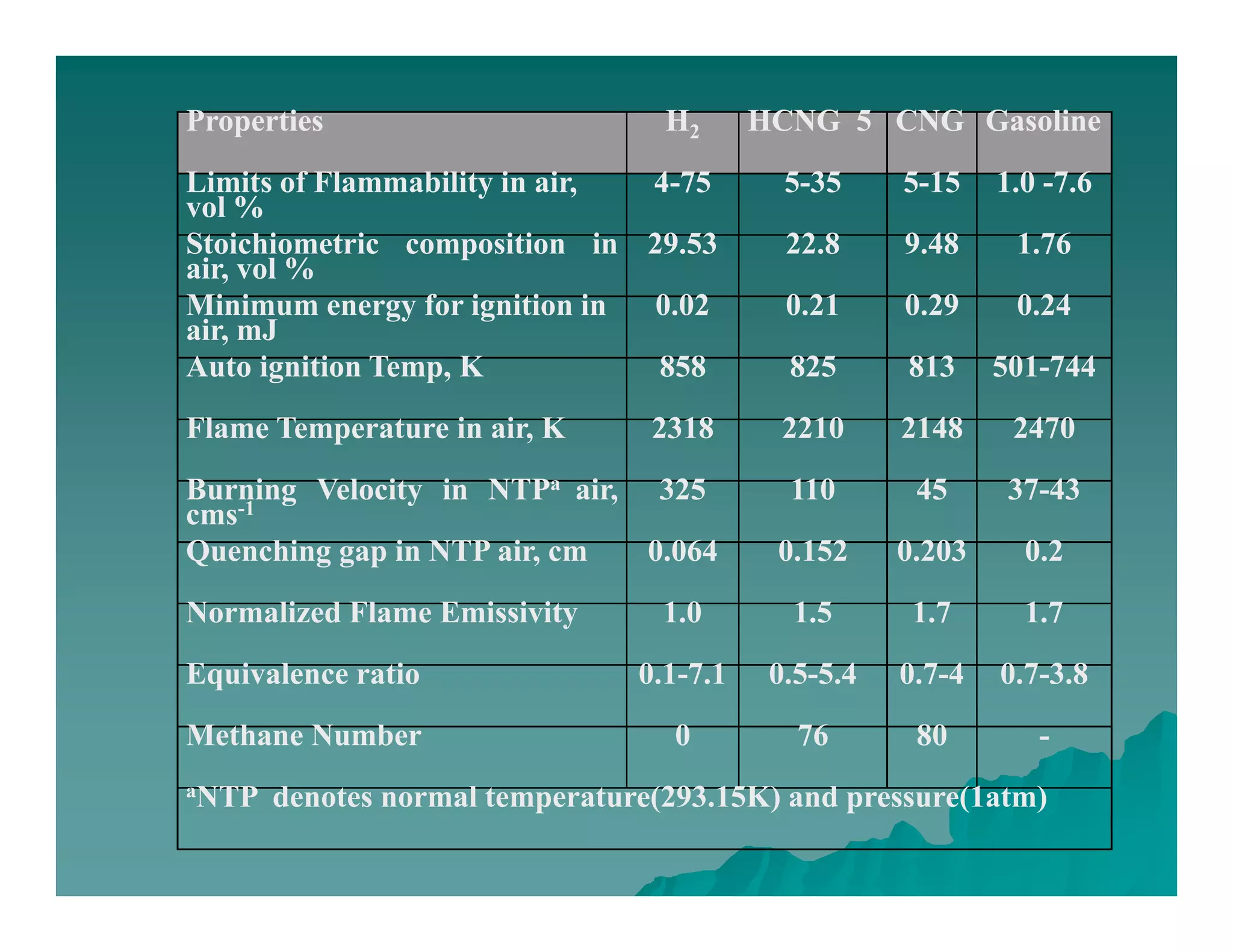
Properties H2 HCNG 5 CNG Gasoline
Li it f Fl bilit i i 4 75 5 35 5 15 1 0 7 6Limits of Flammability in air,
vol %
4-75 5-35 5-15 1.0 -7.6
Stoichiometric composition in
air, vol %
29.53 22.8 9.48 1.76
Mi i f i iti i 0 02 0 21 0 29 0 24Minimum energy for ignition in
air, mJ
0.02 0.21 0.29 0.24
Auto ignition Temp, K 858 825 813 501-744
Flame Temperature in air, K 2318 2210 2148 2470
Burning Velocity in NTPa air,
cms-1
325 110 45 37-43
Quenching gap in NTP air, cm 0.064 0.152 0.203 0.2
Normalized Flame Emissivity 1.0 1.5 1.7 1.7
Equivalence ratio 0.1-7.1 0.5-5.4 0.7-4 0.7-3.8
Methane Number 0 76 80 -
aNTP denotes normal temperature(293.15K) and pressure(1atm)
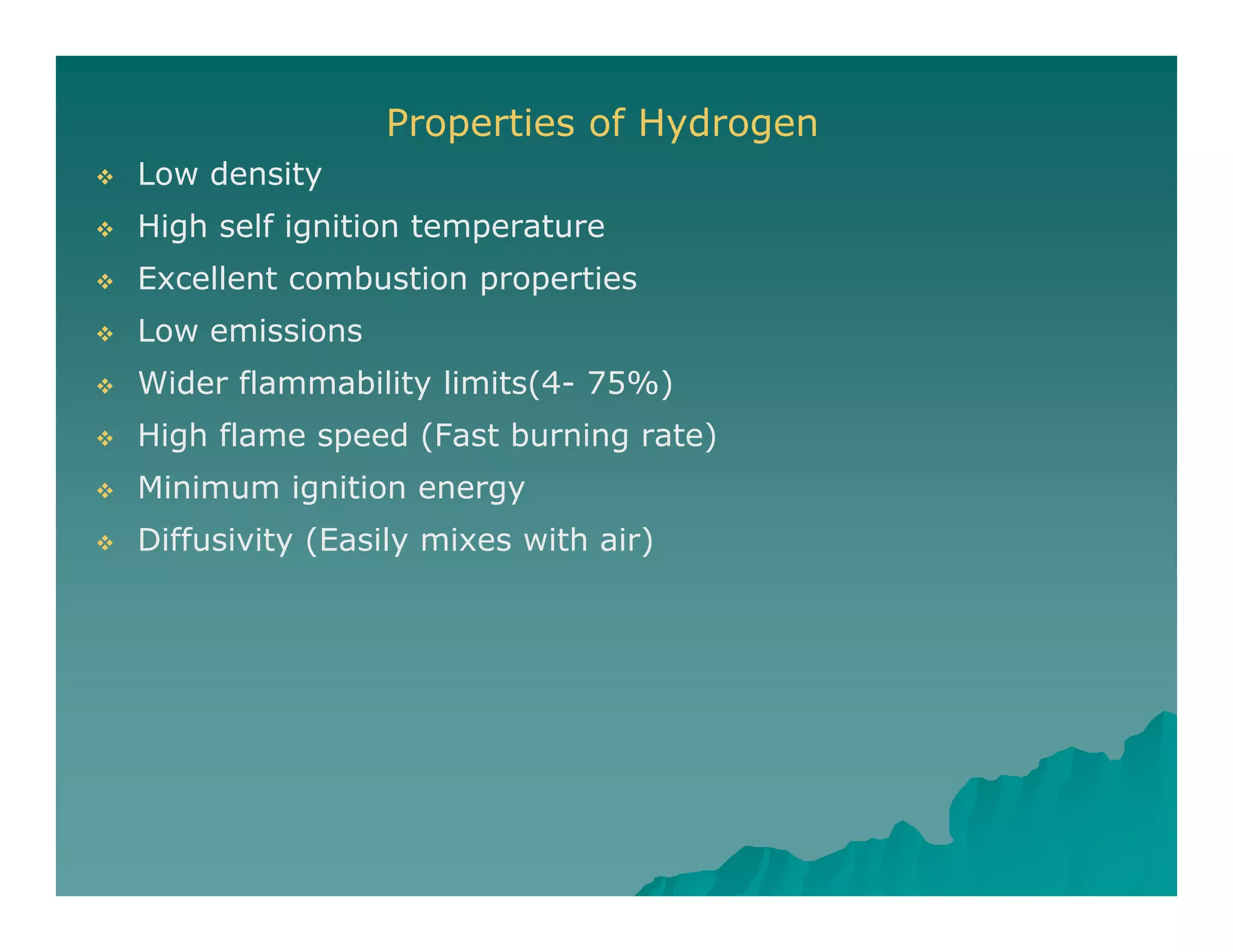
Properties of Hydrogen
 Low density Low density
 High self ignition temperature
 Excellent combustion properties
 Low emissions
 Wider flammability limits(4- 75%)
 High flame speed (Fast burning rate)
 Minimum ignition energy
 Diffusivity (Easily mixes with air) Diffusivity (Easily mixes with air)
Performance in hydrogen engines
 Reduced power in comparison to gasoline engine
 High thermal efficiency and low NOx at part load
 No CO,HC,SOX and Particulates
 NOx is the only pollutant of concern
 NOx increases as the fuel ratio increases
 Tendency to flashback into the intake manifold
BIODIESEL
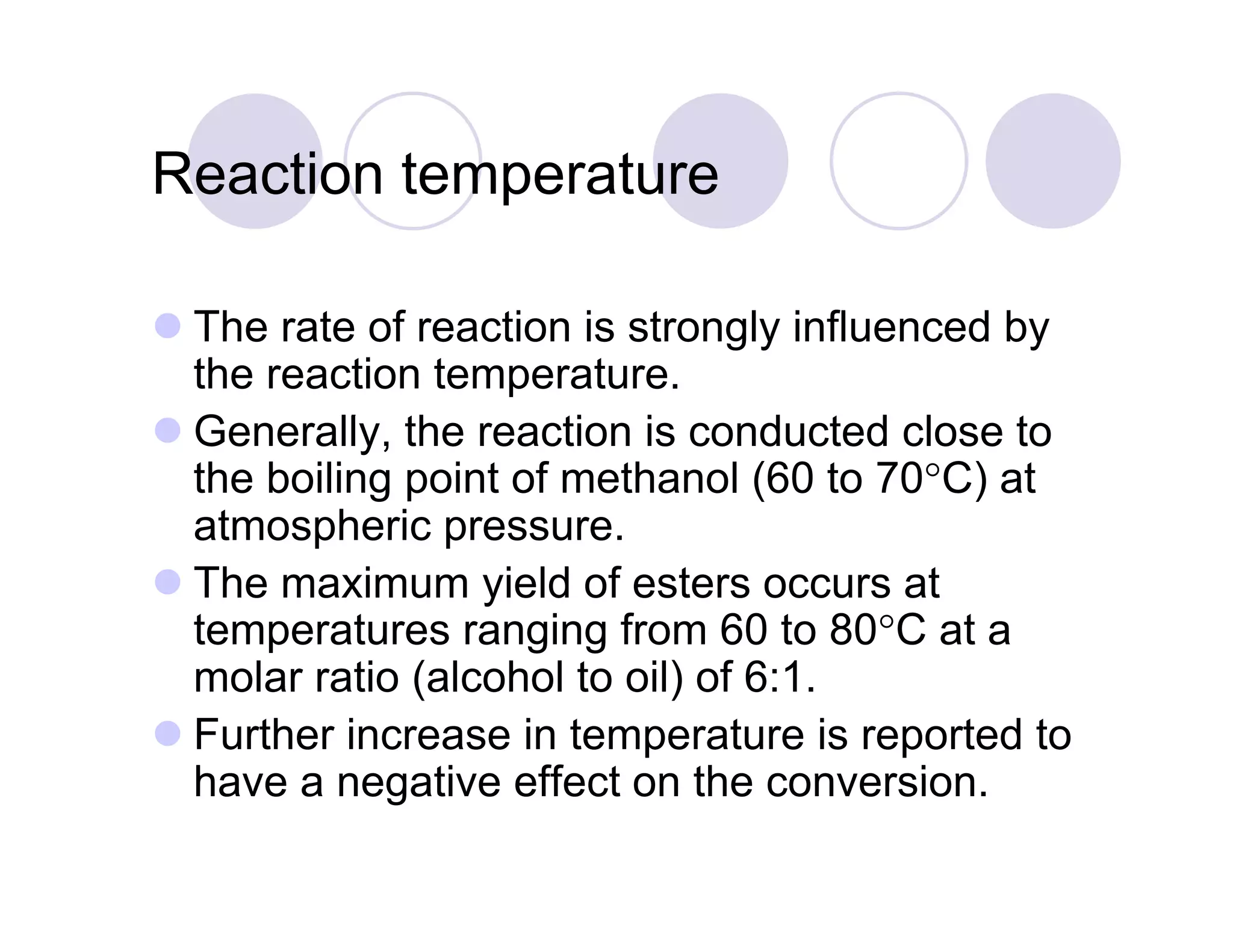
Reaction temperatureReaction temperature
 The rate of reaction is strongly influenced by
the reaction temperature.
G ll th ti i d t d l t Generally, the reaction is conducted close to
the boiling point of methanol (60 to 70°C) at
atmospheric pressure.atmospheric pressure.
 The maximum yield of esters occurs at
temperatures ranging from 60 to 80°C at a
molar ratio (alcohol to oil) of 6:1.
 Further increase in temperature is reported to
have a negative effect on the conversionhave a negative effect on the conversion.
Ratio of alcohol to oil:
 A molar ratio of 6:1 is normally used in A molar ratio of 6:1 is normally used in
industrial processes to obtain methyl ester
yields higher than 98% by weight.
 Higher molar ratio of alcohol to vegetable oil
interferes in the separation of glycerol.
 l l ti i ti ti lower molar ratios require more reaction time.
 With higher molar ratios, conversion
increases but recovery decreases due to poorincreases but recovery decreases due to poor
separation of glycerol.
 optimum molar ratios depend upon type &p p p yp
quality of oil.
Comparative Properties of Biodiesel
T E S T
LO W
S U LFU R
C O N T E N T
D IE S E L
R A P E S E E D
M E T H Y L
E S T E R
N E A T
R A P E S E E D
O IL
R A P E S E E D
E T H Y L
E S T E R
H Y D R O -
G E N A T E D
S O Y
E T H Y L
E S T E R
C E T A N EC E T A N E
N U M B E R
46 61.2 42.6 59.7 61
FLA S H
P O IN T , °C
67 180 270 185 144
C LO U D
P O IN T °C
-12 -2 -11 -2 7
P O IN T , C
P O U R
P O IN T , °C
-16 -10 N A -20 7
B O ILIN G
P O IN T , °C
191 347 311 273 142
V IS C O S IT Y ,
(cs)
@ 40° C
2.98 5.65 47.6 6.1 5.78
S U LFU R
(% ,w t)
0.036 0.012 0.022 0.012 0.023
N IT R O G E N ,
ppm
0 6 N A 7 12
H E A T O F
C O M B U S T IO N
-B T U s/lb.
19,500
46 420
17.500
40 600
17,370
40 400
17,500
40 510
17,113
39 800
U s/ b
(gross)
-kj/kg (gross)
46,420 40,600 40,400 40,510 39,800
S P E C IFIC
G R A V IT Y
0.8495 0.8802 0.906 0.876 0.872
BIOGAS
INTRODUCTIONTO BIOGAS
 Biomass is organic matter produced by plants and animals
 Bi t pi ll r f r t pr d d b th bi l i l Biogas typically refers to a gas produced by the biological
breakdown of organic matter in the absence of oxygen`
 Organic waste such as dead plant and animal material,
animal feces and kitchen waste can be converted into aanimal feces, and kitchen waste can be converted into a
gaseous fuel called biogas
 Biogas is the product of fermentation of Biomass
i i ll i h l i h CO d Biogas essentially contains methane along with CO2 and
traces of water vapour, nitrogen and hydrogen sulfide
 Biogas has energy content equivalent to 2/3 of Natural gas
 Biogas can be used for cooking, heating or as an automotive
fuel
ADVANTAGES OF BIOGAS
 Environmentally less polluting
 Leak detection is easy Leak detection is easy
 Renewable in Nature
 Obtained from Diverse Sources
 Economically Cheaper
 Higher Energy Content
 Higher Octane Rating
 Promotes rural economy
 Wide range of applications
PROPERTIES OF BIOGAS
 Calorific value = 35 MJ/m3
 O t R ti 130 Octane Rating = 130
 IgnitionTemperature = 650°C
 Air to Fuel ratio (Stoichiometric) = 10:1 Air to Fuel ratio (Stoichiometric) 10:1
 Explosive limit = 5 to 15
 Contains 50 to 60 % CH4, 30 to 45% CO2, 5-10%
H2S,Trace N2 and H2O
BIOGAS : ISSUES
 Biogas contains sulfur and water vapourg p
impurities which need to be cleaned
 Reduced volumetric efficiency & less partial
pressures in the intake manifold causes powerpressures in the intake manifold causes power
loss
 Variable fuel composition affects performancep p
and emissions
 Inadequate transportation and distribution
i f t tinfrastructure
BIOGAS GENERATION REACTIONS
FACTORS AFFECTING BIOGAS GENERATION
 pH value of Biomass
 Temperature of digestion Temperature of digestion
 Solid content of feed
 Rate of feed in digesterg
 Carbon to Nitrogen ratio in Biomass
 Diameter to depth ratio of digester
 Retention time for digestion
 Stirring of contents of digester
 Pressure in the digester
 Acid accumulation in digester
Engine emission and their control

Engine emission and their control

  • 1.
    UNIT IIIUNIT -III Engine Emissions & Their Control
  • 2.
    Introduction  Gl bl i Global warming  Acid rain  Smog  odour  Respiratory and other health hazards Ozone - lung tissues & functionsOzone - lung tissues & functions PM - respiratory problems, Visibility, Irritations CO O delivery to bloodCO - O2 delivery to blood Lead - children Visibility NO l & i t f tiNOx - lungs & respiratory functions SOx - Acid rain
  • 3.
    The Internal CombustionEngine and Atmospheric Pollution Type of Pollution Principal Sources Relevance of the I.C. Engineype o o u o c p Sou ces e ev ce o e .C. g e Lead Anti-knock compounds A (for the SI Engine) A id R i S lf di id B (f th CI E i )Acid Rain Sulfur dioxide B (for the CI Engine) Oxides of nitrogen A Unburned hydrocarbons A (for the SI Engine) Carbon monoxide A (for the SI Engine) Global warming CFCs B (for car with A/c) (or else not involved) Carbon dioxide B (may be even A) Methane B (may be A if CNG used) Photochemical smog Carbon monoxide A (for the SI Engine) Unburned hydrocarbons A (for the SI Engine) Sulfur dioxide B (for the CI Engine) Oxides of nitrogen A Ozone depletion CFCs B (for car with A/c) (or else not involved) Unburned hydrocarbons A (for the SI Engine) Oxides of nitrogen Ag A: Major contributor B: Secondary influence
  • 4.
    Engine Emissions Engine ExhaustEmissions  Unburned Hydrocarbons (HC)  Oxides of Carbon ( CO, CO2)  Oxides of Nitrogen ( NO, NO2)  Oxides of Sulphur (SO2, SO3) Oxides of Sulphur (SO2, SO3)  Particulates (PM)  Soot & Smoke  Aldehydes  Lead N E h E i iNon – Exhaust Emissions  Unburned HC from fuel tank  Crankcase blowby Crankcase blowby
  • 5.
  • 6.
    Unburned HC Formation Irritate the mucous membranes Irritate the mucous membranes  Operating conditions 1000- 2000 rpm  It rise rapidly as the mixture becomes richer than stiochiometric mixturemixture  Incomplete combustion  Air – fuel ratio I i i Improper mixing  Flame quenching  Factors which lead to incomplete flame propagation  Poor carburetion and mixture preparation  Poor ignition system  Scavenging problem due to improper valve overlapg g p p p p  Poor swirl and turbulence  Excess exhaust residual gas within the cylinder  Exhaust gas recirculation not properly controlled Exhaust gas recirculation not properly controlled
  • 7.
     Leakage pastthe exhaust valve  Lubricating Oil layer Lubricating Oil layer  The presence of lubricating oil in the fuel  Deposits on combustion chambers walls  Vehicles run over several thousand kms  It’s rate depends on fuel and operating condition  Ol fi d i d d h f b ild Olefins and aromatic compounds tends to have faster buildup  Valve overlap  Evaporative emissions Evaporative emissions  Crankcase blowby
  • 8.
     CreviceVolumes  ld h f f h b i Narrow volumes present around the surface of the combustion chamber  High surface to volume into which flame will not propagateg p p g  They are present between the piston crown, piston rings and cylinder liner  Along the gasket joints between cylinder head and block Along the gasket joints between cylinder head and block  Along the seats of the intake and exhaust valves,  space around the plug center electrode and between spark plug threads.
  • 10.
    Normalized A/F ratio, = (A/F) actual / (A/F) stoichiometric Equivalence ratio:  = (A/F)stoichiometric / (A/F) actual
  • 11.
    Fig. Emissions fordiesel engine
  • 13.
    CO formation  Colourlessgas of about the same density as air  Poisonous gas, which when inhaled replaces the oxygen in the blood stream  Slowdown physical and mental activity  Headache Headache  Large concentration can lead to death  Due to dissociation process  Loss in chemical energy  Incomplete combustion  It increases during idling and lowest during acceleration It increases during idling and lowest during acceleration  Rich mixture  Poor mixing  CO value does not drop to zero value when the mixture is chemically correct and leaner  Combination of cycle to cycle and cylinder to cylinder air-fuel mixture maldistribution
  • 14.
    NOx Formation  Photochemicalsmog Photochemical smog  Principal source is oxidation of atmospheric nitrogen  Dissociation of the molecular oxygen and nitrogen at the peak combustion temperaturescombustion temperatures  Temperature range of 1100 ºc  High temperature will promote the formation of NO by speeding up the formation reactionsformation reactions  Maximum level – 10 % above the stoichiometric  Too much lean mixture – reduce peak temperature  Nitrogen present in the fuel  O + N2 = NO + N Equivalence ratio  N+ O2 = NO + O Advanced spark timing  N + OH = NO+ H  NO+ H2O = NO2+ H2  NO + O2 = NO2 +O (Zeldovich Mechanism) NO O2 NO2 O (Zeldovich Mechanism)
  • 15.
    Photochemical smog  Photochemicalchemical reaction of automobile e haust and Photochemical chemical reaction of automobile exhaust and atmospheric air in the presence of sunlight HC + NO li ht SHC + NOx sunlight Smog Sulphur(SOx)  Fuel specification( Limit 50ppm or mg/kg) Fuel specification( Limit 50ppm or mg/kg)  Acid rain problem  At high temperature H + S H SH2+ S H2S O2+ S SO2 2SO2 + O2 2SO3 SO3+ H2O H2SO4 SO2+ H2 O H2SO3
  • 16.
    Lead  G lidditi Gasoline additive  It hardens the surfaces of the combustion chamber  Limit - 0.05 g/l Aldehydes  Mainly available in alcohol Mainly available in alcohol  Product of incomplete combustion  An eye and respiratory irritant N E h E i iNon – Exhaust Emission  Evaporative emission 15 to 25 % of the total HC emission from a gasoline engine  Crank case blowby – 20 – 30 % of the total HC
  • 17.
    Evaporative Emissions  Fueltank losses  Carburettor losses  Fuel tank losses  Fuel volatility Fuel volatility  The ambient temperature  Amount of fuel in the tank  k d i l i Tank design, location  Refueling losses  Carburettor losses  Running losses  Losses through vent during operation  These losses are significant only during hot condition when theese osses a e s g ca t o y u g ot co t o w e t e vehicle is in operation  Parking losses
  • 18.
    Evaporative emissions increase significantly ifthe fuel volatilityif the fuel volatility increases”
  • 19.
    Dirunal Emissions  Takeplace from fuel tanks and carburetor float bowls  (in engines fitted with carburetors) of parked vehicles.  It draws in air at night as it cools downg  Expels air and gasoline vapour as it heats up during the day.  These could be up to 50g per day on hot days. Hot Soak Emissions  This occurs after an engine is shut down.  The residual thermal energy of the engine heats upThe residual thermal energy of the engine heats up  The fuel system leading to release of fuel vapours. Running Losses  Gasoline vapours are expelled from the tank (or float bowl)  when the car is driven and the fuel tank becomes hot.  This can be high if the ambient temperature is high.This can be high if the ambient temperature is high.
  • 20.
    Crankcase blow by Leakage past the piston piston rings from the cylinder to the crankcaseLeakage past the piston, piston rings from the cylinder to the crankcase • Blow by gases are produced in the crankcase during the normal combustion process Pi t bl b i ith i d d i ti l th• Piston blowby increases with engine speed and in particular as the piston rings and cylinder bore wears
  • 22.
    SI Engine EmissionsControl  Main approaches  Engine design modification & Operating parameters Engine design modification & Operating parameters  Treatment of exhaust gas  Fuel modification  Engine modifications Engine modifications  Combustion chamber configuration  Reduce surface to volume area  Reduce space around the piston ringsg  Reduce top land distance  Avoid flame quenching zones  Lower compression ratio R h hi Resuces the quenching area  Also reduces NOx emissions  Affect the thermal efficiency  Modified induction system Modified induction system  Supply of air-fuel ratio for all cylinders under all operating conditions of load and speed  Multi choke carburettors or MPFI system
  • 23.
     Ignition timing Proper ignition timing  Affect HC and NOx formation  Required spark advance during cruising and retard the same for idling running  Also affect the power output  Valve overlap  Sh ld b d d Should be reduced  VariableValveTiming – control of scheduling of valve timing events  Use of leaner air-fuel ratios Use of leaner air fuel ratios  Proper modification required to provide lean and stable air-fuel mixtures during idling and cruise operation  Electronic Fuel injection system  Coolant temperature  HC hi h HC – high  NOX – low
  • 24.
    Fuel modification  UnleadedPetrol  0.05% sulphur in petrol  0.05% sulphur diesel  Using reformulated fuels Using reformulated fuels  Oxygenated gasoline in winter season  Low volatility in summer –To reduce HC emission
  • 25.
    Evaporation Loss controldevice  Control all evaporative emissions by capturing the vapours andp y p g p recirculation them at the appropriate times  Adsorbent chamber  Charcoal bed or formed polyurethaneC a coa be o o e po yu et a e  Adsorbs the vapour  Canister  The purge control valve  Purging - process by which the gasoline vapours are removed
  • 27.
  • 29.
    Crankcase ventilations  Phenomenonof leakage past the piston and piston rings Phenomenon of leakage past the piston and piston rings from the cylinder to the crank case  20% of the total HC emission from the engine 20% of the total HC emission from the engine  Rings are worn out  Recirculation of the vapours back into the intake air cleaner Recirculation of the vapours back into the intake air cleaner  Closed or open crankcase ventilation  S t l d d li ht System placed under slight vacuum  Positive crankcase ventilation  When the acuum is high blo b is less When the vacuum is high - blowby is less  At wide opening throttle , the air flow gets unrestricted but flow rate is metered by the valve opening
  • 30.
    P C VV alveP C V V alve•A spring or vacuum In let M an ifo ldIn let M an ifo ldIn let M an ifo ld C ran kcaseC ran kcaseC ran kcase P C V V alveP C V V alve•A spring or vacuum regulated valve (PCV valve) or fixed orifice) meters the flow of air and blow-by gases into the intake manifold
  • 31.
    ExhaustTreatment Methods  Afterburners  Sustain the high temperature within the system during rich operating conditions  High heat losses over a large area High heat losses over a large area  Catalytic Converters  Three way catalytic converter  CO, HC and NOx reduction  CO and HC can be oxidized to CO2 and H2O in the exhaust systems  Its quality degraded by heat life contaminants Its quality degraded by heat, life , contaminants  Stainless steel container  Inside the container – Porous ceramic structure  Ceramic honeycomb or matrix structure- also called monolith  A bed of spherical ceramic pellets  Volume of the ceramic structure is about half of the displacement Volume of the ceramic structure is about half of the displacement volume
  • 32.
     To reduceHC and CO emission  Located very near to the exhaust manifold – No fall in the temperature of exhaust  NOx emission is not affected by the air injection
  • 33.
    Catalytic materials  Ali O id B i i l Aluminum Oxide – Base ceramic material  Withstand high temperature  Low thermal expansion Low thermal expansion  Platinum & Palladium – CO& HC emissions  Rhodium – NOx Rhodium NOx
  • 37.
     Efficiency oftheTWC depends on temperature  400ºC or above 400 C or above  98-99% co, 95% NOx and more than 95% HC  Proper equivalence ratio to get high converter efficiencyp q g g y  Engine malfunctions can cause poor efficiency and overheating of converters  b k Above 2,00,000km  Thermal degradation range – 500 – 900ºC  Impurities like lead, sulphur, Zinc and Phosphorous Impurities like lead, sulphur, Zinc and Phosphorous
  • 39.
     Not efficientduring cold condition  Light-off temperatureg p  The temperature at which the catalytic converter becomes 50% efficient. It is approximately 270oC for oxidation of HC and about 220oC for oxidation of CO.  By locating the converter close to the engine  By employing preheating  By using flame heating By using flame heating
  • 44.
    Emission Norms andDriving Cycles
  • 46.
    OVERVIEW OF THEEMISSION NORMS IN INDIA • 1991 - Idle CO Limits for Gasoline Vehicles and Free Acceleration Smoke for Diesel1991 Idle CO Limits for Gasoline Vehicles and Free Acceleration Smoke for Diesel Vehicles, Mass Emission Norms for Gasoline Vehicles. 1992 - Mass Emission Norms for Diesel Vehicles. 1996 - Revision of Mass Emission Norms for Gasoline and Diesel Vehicles, mandatory fitment of Catalytic Converter for Cars in Metros on Unleaded Gasoline. 1998 - Cold Start Norms Introduced. 2000 - India 2000 (Eq. to Euro I) Norms, Modified IDC (Indian Driving Cycle), Bharat Stage II Norms for Delhi. 2001 - Bharat Stage II (Eq. to Euro II) Norms for All Metros, Emission Norms for CNG & LPG Vehicles. 2003 - Bharat Stage II (Eq. to Euro II) Norms for 11 major cities. 2005 - From 1st April Bharat Stage III (Eq. to Euro III) Norms for 11 major cities. 2010 - Bharat Stage III Emission Norms for 4-wheelers for entire country whereas Bharat Stage - IV (Eq. to Euro IV) for 11 major cities.
  • 47.
    E-III (Country) E-II (Country) EIII (Country) E-VI (11 Cities) 2010 E-II (11 Cities) 2005 Norms Cities of implementation Effective Date 91 emission norms Throughout the nation 1.4.91/92 Emission norms 2nd set norms notified 2000/01 1996 96 emission norms Throughout the nation 1.4.96 Cat Con Norms(Cars) 45 cities 1.10.98 I di t 00 Th h t th 1 4 2000 1st of norms notified Emission norms for cat con veh 1995 India stage 00 norms Throughout the nation 1.4.2000 BS II 11 cities Throughout the nation 2000- 2003 1.4.2005 1990 BS III 11 cities Throughout the nation 1.4.2005 1.4.2010 BS IV -11 cities 1.4.2010 Throughout the nation -
  • 48.
    Indian Emission Standards(4-Wheel Vehicles) Standard Reference Date Region India 2000 Euro 1 2000 NationwideIndia 2000 Euro 1 2000 Nationwide Bharat Stage II Euro 2 2001 NCR*, Mumbai, Kolkata, Chennai 2003.04 NCR*, 10 Cities†Bharat Stage II Euro 2 2003.04 NCR , 10 Cities† 2005.04 Nationwide Bh t St III E 3 2005.04 NCR*, 10 Cities† Bharat Stage III Euro 3 2010.04 Nationwide Bharat Stage IV Euro 4 2010.04 NCR*, 10 Cities† *National Capital Region (Delhi) † Mumbai, Kolkata, Chennai, Bangalore, Hyderabad, Ahmedabad, Pune, Surat Kanpur and AgraSurat, Kanpur and Agra
  • 53.
  • 60.
    Vehicular Technological UpgradationsRequired 2/3 Wheelers ?Secondary air injection Fuel injection Category of Engine Bharat Stage II Bharat Stage III Bharat Stage IV 2- Stroke SI Engines j Catalytic converter CNG / LPG Catalytic converter 2/3 Wheelers 4- Stroke SI Fuel injection + catalytic converter 4-Stroke design Secondary air injection (specific power Carburetor + secondary air injection + catalytic converter 4 Stroke SI Engines Lean burn ( p p based) Direct i li d Fuel injection Fuel injection + t l ti t 4 Wheelers 4- Stroke SI Engines in-cylinder injection catalytic converter Lean burn Fuel injection Catalytic converter Fixed EGR CNG / LPG catalytic converter Variable EGR Variable valve timing Multi valve CNG / LPGEngines
  • 61.
    Vehicular Technological UpgradationsRequired NOx Trap Particulate trap Turbocharging Inter cooling (based TC & inter cooling Multi valve Category of Engine Bharat Stage II Bharat Stage III? Bharat Stage IV? Diesel Engines p Common rail injection Injection pressure > 1600 bar g ( on specific power) Moderate swirl Injection pressure > 800 bar Rotary pump Low swirl Injection pressure > 1200 bar Unit injector / common rail injectionDiesel Engines bar On-board diagnostic system VGT Cooled EGR Rotary pump EGR (need based) Conversion to CNG / LPG common rail injection Rotary pump and pilot injection rate shaping Variable geometry turbocharger (VGT) Oxycat EGR (hot/cooled) Electronic injection control Sulphur content in diesel < 50 ppm <15 ppm for NOxcontrolSulphur content in diesel < 500 ppm Sulphur content in diesel <300 ppm 15 ppm for NOx trap pp
  • 62.
    Petrol Vehicles(4- Wheelers) •Onboard Diagnostic system • Low sulphur gasoline• Low sulphur gasoline • MPFI/GDI • Lean Burn operation (A/F ratio from 16:1 to• Lean Burn operation (A/F ratio from 16:1 to 22:1) • Variable Valve Actuation – To control charge• Variable Valve Actuation – To control charge • PCV/ Charcoal canister system
  • 63.
    Diesel Vehicles Onboard DiagnosticsSystem• Onboard Diagnostics System • Unit Injector – 2500 bar CRDI 1600 b• CRDI – 1600 bar • Homogeneous Charge Compression Ignition • Fuel cell • CNG/ HANG • Particulate Trap/ Diesel Oxidation Catalyst
  • 64.
    2 Wheelers • Fuelinjection(GDI or Port oe throttle body) • Electric motor cyclesy • Catalytic converter • Evaporative emission control device • Electronic ignition • EFI C b ti h b ti i ti• Combustion chamber optimization
  • 65.
    Diesel Engine /VehicleEmission testing procedureprocedure • 3 wheelers, passenger cars, Multi utility vehicles (with GVW < 3 5 ton) : Vehiclevehicles (with GVW < 3.5 ton) : Vehicle testing on Chassis Dynamometer • Diesel vehicles with GVW > 3.5 ton : Engine testing on Engine Dynamometer
  • 66.
    Equipments used forDiesel Engine Testing on Engine Dynamometeron Engine Dynamometer • Engine Dynamometer • a) Eddy current typea) Eddy current type • b) Transient Dynamometer (AC/DC) • Throttle actuator• Throttle actuator • Fuel consumption meter • Ai ti t• Air consumption meter • Fuel conditioning unit E i i k i di i i i• Engine intake air conditioning unit • Engine cooling water temperature controlling unit • Intercooler for turbocharged + after cooled engines
  • 67.
    Equipments used forDiesel Engine Testing on Engine Dynamometeron Engine Dynamometer • Exhaust gas analyzers • a) Diluted measurement : • CO CO THC NOx CH• CO,CO2,THC,NOx,CH4 • b) Raw measurement : • CO,CO2,THC,NOx,O2 P• Pressure sensors : • Intake air pressure • Exhaust back pressure I k d i• Intake depression • Boost pressure (Turbocharged engines) • Oil pressure T• Temperature sensors : • Intake air temperature • Fuel temperature • Oil temperature • Boost temperature • Exhaust temperature
  • 68.
    Exhaust gas measurementprinciples • CO, CO2 : Non Dispersive Infra Red (NDIR) method • THC : Flame Ionization Detection (FID) method • NOx : ChemiLuminescent Detector (CLD), D VRNDUVR • PM : Sampling Filters (with Dilution Tunnel)
  • 70.
    Driving Cycles  StandardDriving Pattern  Probable plot of the vehicle speed right from the start of the engine through its journey over a prescribed time  Pattern is described by means of a velocity time table Pattern is described by means of a velocity time table  It is a series of data points representing the speed of a vehicle versus time  To assess the performance of vehicle in various ways  Vehicles simulation  Constant volume sampling (CVS)p g ( )  Exhaust gas diluted by adding air which is supplied by blower and collected in separate bag  C t t ti f h t i (10 1) Constant proportion of exhaust gas: air (10:1)  Condensation of water vapour( Affect NOx emission)  Prevent the exhaust components (HC) reacts with otherp ( )
  • 71.
     Driving cyclederived from driving behavior and real traffic conditions  Gear shifts  Braking  Idle Phases  Standstill periods Types of Driving Cycles  Transient Driving cycles – constant speed changes on road conditions (FTP and some of European cycles)conditions (FTP and some of European cycles)  Model Cycles - Protracted periods at constant speeds Transient Driving Cycle  Average emission performance per km drive  Integrate the total effects of the road infrastructure  Traffic pattern and driving culture
  • 72.
     Group ofdriving cycle  European driving cyclep g y  US driving cycle  Japanese driving cycle  Indian Driving Cycle (IDC) - 1985 – followed for 2/3 wheelers  Modified Indian Driving cycle – Light & heavy duty vehicles
  • 73.
    European Driving Cycle ECE 15 – speed 50kmph, low loadp p ,  EUDC – Urban driving cycle  EUDCL – For suburban route (speed 90kmph)  ECE83 – New European driving cycle US Driving Cycle  FTP 72 - Urban route FTP 72 - Urban route  FTP75 – Three phase (cold start+ transient+ hot starting)  LA 92  US 06 – High average speed  SC03 - A/C vehicles i i lJapanese Driving Cycle  10 mode cycles  15 mode cycles 15 mode cycles
  • 74.
    Typical Driving Cycle EMISSIONCYCLE 130 100 110 120 130 60 70 80 90 EED[KMPH] 30 40 50 60 SPEE 0 10 20 0 100 200 300 400 500 600 700 800 900 1000 1100 1200 SECONDSSECONDS EURO II BS II
  • 75.
    European Driving Cycle New European Driving Cycle (NEDC)  ECE15 simulates 4.052 km urban trip at an average speed of 18.7km/h and at a max speed of 50 km/h  EUDC simulates 6.955 km at an average speed of 62.6 km/h  Max speed 120 km/h Max speed 120 km/h  Idling period has been eliminated in New cycle  Idling period 40 s
  • 76.
    Fig. ECE15 drivingcycle Fig. EUDC driving cycle
  • 78.
    Indian Driving Cycles Similar to ECE15+EUDC except the maximum speed is 90km/h  Duration of one cycle = 108s  Distance per cycle = 658km  Total distance = 3948km No of cycles = 6 Total distance = 3948km No of cycles = 6  Avg speed = 25.7 km/h Max speed -= 42 km/h
  • 79.
    Indian Driving Cyclegy 40 50 20 30 40 ED(km/hr) 0 10 20 SPE 0 0 20 40 60 80 100 TIME(sec) Cruise Time Distance Avg. Speed Max. Speed Max. accel. Max Decel Idle time ratio Accel. Time ratio Decel time ratio Cruise time ratio sec km km/h km/h m/s2 m/s3 % % % % IDC 648 3 948 21 93 42 0 65 0 63 14 81 38 89 34 26 12 04 (6 Cycles) 648 3.948 21.93 42 0.65 0.63 14.81 38.89 34.26 12.04
  • 80.
    Indian Driving Cyclefor 4 Wheelers 100 Part 1: 780 sec Part 2: 400 sec 60 80 km/h) One Cycle of 195 sec Part 1: 780 sec 400 sec 40 60 Speed(k Max Speed 0 20 S Max Speed 90 kph 0 0 500 1000 Time (sec)
  • 84.
    US Driving Cycles Vehicle is fitted in a room temperature of 20 to 30 ºC  It simulates 17.7 km at an average speed of 34.1 km/h  Duration 1874 s  Transient test cycle with highly dynamic nature Transient test cycle with highly dynamic nature
  • 85.
    FTP US06  Highspeed and high acceleration driving behaviour FTP SC03  Engine load and emissionsg  Rapid speed fluctuations  Average speed 77.9km/h associated with air conditioned vehicles
  • 86.
    Japan Driving Cycles 10 Mode cycles – Urban conditions 10 Mode cycles Urban conditions  One segment covers a distance of 0.664 km at an average speed of 17.7km/h  Max speed 40km Max speed 40km  Cycle begins with a 15 minutes warm up
  • 88.
    Diesel Engine Emissions& Their Control
  • 91.
    Diesel Engine Emissions Carbon Monoxide (CO) Carbon Monoxide (CO)  Unburned Hydrocarbons (HC)  Oxides of Nitrogen (NOx) P ti l t M tt (PM) Particulate Matter (PM)  Smoke HC Emissions  1/5 of HC emissions of SI engines  Over all fuel – air lean equivalence ratio  Non-homogeneity of fuel- air mixture Non homogeneity of fuel air mixture  Some local spots in the combustion chamber  Some fuel particles in fuel rich zones never react due to lack of oxygenoxygen  Dribble in fuel injector  Crevice volume ll d b Wall deposit absorption  Oil film adsorption
  • 98.
    Particulate Matter (PM) Any matter in the exhaust gases that can be trapped on sampling filter medium at particular temperature at 52ºC  Solid carbon soot particles that are generated in the fuel rich zones within the cylinder during controlled combustion phase S i l l f lid b h Soot particles are clusters of solid carbon spheres  Diameters from 9nm to 90 nm  The spheres are solid carbon with HC and traces of other components adsorbed on the surface
  • 99.
     Large expansionoccurs during power stroke  The remaining high boiling components found in the fuel and lubricating oil condenses on the surface of the solid carbon t ti lsoot particles  Adsorbed hydrocarbons: Soluble organic fraction (SOF) Si ifi f i f SOF f l b i i Significant fraction of SOF may come from lubricating oil(25%) S lf i th f l f lf i id hi h i l t l d Sulfur in the fuel forms sulfuric acid which is later sampled as PM
  • 100.
  • 102.
    Diesel smoke Bl kk f t Black smoke : from soot  White, blue or gray smoke: condensed hydrocarbon droplets in the exhaust  Blue or gray generally due to vaporized lubricant  White due to cold start
  • 103.
    Emissions Control Technology- CI  Ad n d t hn l in f l inj ti n t m Advanced technology in fuel injection system  Combustion chamber geometry  Two way catalyst – CO & HC  Diesel Oxidation Catalyst (DOC) Particulates  Particulate Traps  Diesel Particulates Filter (DPF) NOx Emissions  Additives into diesel fuel  Water injection  Emulsion Technology  Injection timing retardation Injection timing retardation  Simulatneous technology  Exhaust gas Recirculation (EGR)  S l ti C t l ti R d ti (SCR) Selective Catalytic Reduction (SCR)  Low temperature combsution
  • 104.
    Advanced technology infuel injection system  Injection pressure upto 1800 bar – 2500 barj p p  Pilot injection - Reducing combustion noise – shorten the ignition delay  Post injection - Increase of temperature at the end of the combustion process, which favours oxidation of the soot formed during the firstprocess, which favours oxidation of the soot formed during the first stages of combustion process
  • 106.
    Use of differentadditives  Oxygenated additives: Ethanol/ dimethyl ether/methanol)  Cetane number improvers : EHN  Antioxidants (for biodiesel): NPAA, DPPD( ) , Drawbacks:  Very expensive P d hi h CO HC d PM i i Produce higher CO, HC and PM emissions Use of Emulsion Technology  To introduce the water in the combustion chamberd  Emulsifying agent or surfactant: To reduce the surface tension between oil and water Drawbacks:Drawbacks:  Higher viscosity and density of water significantly affect the performance  Inherently unstable and prone to phase seperation  Cold start issues
  • 107.
    Exhaust Gas Recirculation(EGR)  Most effective technique for both SI and CI engines Most effective technique for both SI and CI engines  To dilute air- fuel mixture with non reacting gas  Adding air changes air-fuel ratio and combustion characteristics  Lower the flame temperature  Gases with larger specific heats EGR IN SI ENGINESEGR IN SI ENGINES  5 to 15 percent of the exhaust gas is routed back to the intake as EGR  Maximum quantity is limited by the requirement of the mixture to sustain a contiguous flame front during the combustion event  Reduced heat transfer to combustion chamber surface Reduced heat transfer to combustion chamber surface  Reduced chemical dissociation  Not employed at WOT and idling condition
  • 108.
    EGR IN DIESELENGINES  Maximum possible flow 30 % of total intake Maximum possible flow – 30 % of total intake  Flow rate can be controlled by Engine Management System  Thermal efficiency decrease  Increase the PM emission  In modern diesel engines EGR gas is cooled through a heat exchanger to allow the introduction of a greater mass ofexchanger to allow the introduction of a greater mass of re circulated gas  External EGR - Piping a route from the exhaust manifold to the inlet manifold  Internal EGR - Trapping exhaust gas within the cylinder by not fully expelling it during the exhaust strokeexpelling it during the exhaust stroke VGT arrangement
  • 110.
  • 112.
    Selective Catalyst Reduction(SCR) NOx reduction technique NOx reduction technique  Conversion of NOx with the aid of catalyst into N2 and H2O  Reduction agent : Urea, Anhydrous ammonia or aqueous ammonia  Catalysts: Oxides of base metal such as Vanadium, Tungsten Titanium oxide  Vanadium, Tungsten- Less expensive and lack in durability, g p y  Damage the Particulate Filter  Zeolite – High thermal durability  O i 500 720 K Operating range - 500 to 720 K 4NH3 + 4NO + O2 -> 4N2 + 6H2O 2NH + NO + NO > 2N + 3H O For Urea 2NH3 + NO + NO2 -> 2N2 + 3H2O 8NH3 + 6NO2 -> 7N2 + 12H2O For Urea
  • 113.
     Anhydrous Ammonia– Extremely toxic and difficult to safely store  Aqueous ammonia Safely to store Aqueous ammonia – Safely to store  Hydrolyzed to be used  Urea – Require conversion process to ammonia Urea Require conversion process to ammonia
  • 114.
    Technical problems withautomotive SCR units R i f f t i tRemains free from contaminants Correct materials of construction must be used for both storage and dispensingg p g Ammonia slip – Release of unreacted ammonia When catalyst temperatures are not in the optimal range f h ifor the reaction When too much ammonia is injected into the process Low exhaust gas temperature during cold start conditionLow exhaust gas temperature during cold start condition
  • 115.
  • 116.
    Particulate Trap  Filter–like system often made of ceramic in the form of a monolith or mat or made of metal wire mesh (cordierite or silicon carbide)  As traps catch the soot particles, they slowly fill up with particulates  This restricts exhaust gas flow and raises the back pressure of theg p engine  Higher back pressure causes engine runs hotter  Exhaust temperature increasesp  Carbon soot ignition temperature – 550 to 650ºC
  • 117.
    Regenerative trap When thepressure across the trap reaches theWhen the pressure across the trap reaches the predetermined value, automatic flame igniters start the combustion Carbon soot ignition temperature – 550 to 650ºC Electric heaters or diesel flame nozzles If a catalyst material is installed in the traps theIf a catalyst material is installed in the traps, the temperature needed to ignite the carbon soot is reduced to the 350 to 450ºC
  • 120.
    DIESEL OXIDATION CATALYST(DOC) TW C t l t (TWC) Two Way Catalyst (TWC)  It is a device that uses a chemical process to breakdown pollutants in the exhaust stream into less harmful componentsp  Porous ceramic honeycomb – like structure that is coated with a material that catalyzes a chemical reaction to reduce a pollution  Soluble Organic Fractions (SOF) removal – 80 to 90%  PM reduction – 20 to 50 %  Unburned Hydrocarbon (HC) reduction – 50%  Carbon Monoxide reduction– 40% Eff ti f th DOC i d ith Ult l lf di l(15 ) Effectiveness of the DOC increased with Ultra low sulfur diesel(15ppm)  At high exhaust temperature, catalyst can oxidize SO2 to form sulfate particulatesparticulates
  • 122.
    Diesel Oxidation Catalyst(DOC)  St i l t l C i t Stainless steel Canister  Catalyst support or substratesubstrate  Ceramic or metallic honeycomb or wire mesh structure  Catalytic coating Pl i Platinum  Palladium
  • 123.
     No technologymaintenance  Abilit t b d hi l / i t f l d ith ti l Ability to be used on vehicles/ equipment fueled with conventional diesel fuel  No operational issues, impact on vehicles/ equipment performance or No operational issues, impact on vehicles/ equipment performance or impacts on fuel consumption  2,00,000 km and can last 7 to 15 years  DOC may suffer when exposed to temperatures above 650ºC for prolonged period of time S l h i l l t h h h l d d h Several chemical elements such as phosphourus , lead and heavy metals also damage some catalysts  The size of DOC need to be matched to engine displacement and The size of DOC need to be matched to engine displacement and exhaust system
  • 125.
    UNIT - IVUNIT- IV NATURAL GAS
  • 126.
    Introduction  Mixture ofparaffinic hydrocarbons Mixture of paraffinic hydrocarbons  It occurs in gas fields and also in association with crude petroleum in oil fields  Found compressed in porous rock and shale formations sealed in rock strata underground  Raw gas contains mainly methane plus lesser amounts of ethane, propane, butane and pentane, negligible sulfur  Some carbon dioxide and nitrogen are present Some carbon dioxide and nitrogen are present.  The only gas occurring in nature Typical Compositionyp p  Methane – 60 to 90 %  Ethane - 3 to 30 %  Propane 1 to 3% Propane - 1 to 3%
  • 130.
    Properties  C ll d d l Colourless and odourless gas  Commercial odorant is added  Lighter than air with specific Lighter than air with specific gravity 0.6 to 0.8  Clean burning fuel
  • 134.
    Fuels Characteristics Natural GasDiesel Oil Carbon content [mass %] 73,3 85,9 Hydrogen content [mass %] 23,9 14,0 Oxygen content [mass %] 0,4 0,05 Carbon-to-hydrogen ratio 0 25 - 0 33 0 16Carbon to hydrogen ratio 0,25 0.33 0,16 Relative molar mass 17 - 20 ~170 Density at 0 oC and 1,013 bar [kg/m3] ~0,83 840 B ili t t [°C / 1 b ] 162 f 170 t 380Boiling temperature [°C / 1 bar] -162 from 170 to 380 Autoignition temperature [°C] 540 - 560 320 – 330 Octane number 120 -130 - Cetane number - 52 - 56 Methane number 69 - 99 -
  • 135.
    Natural Gas DieselOil • Stoichiometric air/fuel ratio [mass] 17.2 14,5 • Vapour flammability limits [Volume %] 5 - 15 - • Flammability limits [lambda] 0,7 – 2,1 0,19 - 0,98 • Lower heating/calorific value [MJ/kg] 38 - 50 42,6 • Methane concentration [Volume %] 80 - 99 - • Ethane concentration [Volume %] 2,7 – 4.6 - • Nitrogen concentration [Volume %] 0,1 - 15 - • Carbon dioxide concentration [Volume %] 1 – 5 - • Sulphur concentration [ppm, mass] < 5 < 50 • Specific CO2 formation [g/MJ] 38 - 50 72
  • 136.
    Onboard Storage ofNatural Gas  Compressed Natural Gas (CNG)  Storage pressure – 250 bar  Cylinder Vessel – Steel, Aluminium, Fiber reinforced aluminium  Liquefied Natural Gas (LNG)  Cryogenic state (-161ºC, 1t0 60 bar)  Maximum volumetric energy density  Liquefaction process removes certain impurities like water, dust and h lihelium  It is not explosive  Cylinder – Double wall  I ll Ni k l t l E t i ll C b t l Inner wall – Nickel steel Exterior wall - Carbon steel  Space between two walls filled with a pertile( powder insulating material)  Adsorbent storage (ANG)  B d th bilit f th t i l t i il t th Based on the ability of the materials to assimilate methane gas  Carbon sorbency – low pressure (12.4 bar)  Enhanced capability – By chilling the gas  At hi h Si l i l At high pressure – Simple compression vessel
  • 137.
    Advantages of NaturalGas Disadvantages  Fairly abundant worldwide  Excellent knock resistance  Low energy density  Low engine volumetric efficiency  Its calorific value is identical to diesel  Higher ignition energy requirement  Need of large pressurized fuel tank  Inconsistent fuel properties  Higher self ignition temperature than diesel  Good charge distribution  Inconsistent fuel properties  Refuelling is a slow process  Good charge distribution  Clean burning characteristics  Non – corrosive  Non – toxic  No sulfuric emissions  No cold starting and warmup problems
  • 138.
    Operation mode inIC engines  SI engine - Sole fuel modeg  CI engine - a) Dual fuel mode( 30 to 90% displacement) - b) Converted to SI to burn only Natural Gas (100% Substitution)(100% Substitution) CNG COVERSION KIT( Rs 40,000/)  CNG cylinder Tank capacity – 60 litresTank capacity 60 litres Fibre composite reinforcement  Pressure regulator – From storage pressure to metering pressure  CNG solenoid valve- at the inlet of the regulator CNG solenoid valve- at the inlet of the regulator  Gas mixer or Gas injectors  Diesel fuel limiter  Load regulator( Gas valve linked to accelerator pedal) Load regulator( Gas valve linked to accelerator pedal)  Electronic selector switch  Cylinder valve – Allow the of CNG during refueling & Outflow to pressure regulatorpressure regulator
  • 141.
    CNG in SIengines  Higher compression ratio Higher compression ratio  CNG inducted along with air and ignited using spark plug  No starting problem  Ignition timing has to be advanced(5 to 10º crank angle)  High thermal efficiency  Low brake power(10%) – Displacement of intake air by the fuelp ( ) p y vapour  Low CO and HC emissions  Flexible fuel operation Flexible fuel operation CNG in CI engines  NG – air mixture induction  Gas is injected directly into the cylinder  Superior starting capability under cold weather conditions
  • 149.
    Dual Fuel EnginePerformanceg CATERPILLAR C-10 DFNG ENGINE [9]
  • 154.
  • 160.
    All prices asapplicable at Mumbai
  • 169.
    UnitUnit -- IVIV AlternativeFuelsAlternative Fuels
  • 170.
    Introduction l f lf l Depletion of petroleum fuels  Engine Emissions  Production and characteristics of alternative fuels  Comparison of properties  Suitability in existing engines  Results and Discussions Results and Discussions  Alcohol  Hydrogen  LPG LPG  CNG  Biodiesel  Biogas
  • 171.
    Alcohol  Renewable fuels hl l h l d h l l h l Methyl alcohol and Ethyl alcohol  Iso-Butanol, n-butanol, pentanol  Fermentation of carbohydrates  From sugarcane and starchy materials like corn and potatoes  Methanol can be produced  Lignite or coal Municipal solid wastes Lignite or coal, Municipal solid wastes  Natural gas  Ethanol can be produced fromp  Feed stock containing carbohydrates such as corn, wheat, sugar- beets and potatoes
  • 172.
    Fig. Methanol productionfrom Fig. Methanol production from coal Fig. Methanol production from Municipal solid waste Fig. Ethanol production from grainFig. Ethanol production from grain
  • 178.
    Fuel properties Auto ignitiontemp(ºC) 300-450 220-300 478 468
  • 179.
    Advantages of Alcohol Number of natural resources Number of natural resources  High octane rating – Higher compression ratio  Higher flame speedg p  Less overall emissions  Low sulphur content  Wider flammability limit  High latent heat of vaporization – Cooler intake process
  • 180.
    Disadvantages of Alcohol Low energy content  Combustion of alcohols produce more aldehydes in the exhaust  More corrosive on metals ( Material compatibility)  Poor cold weather starting characteristics ( low vapour pressure and high latent heat of vaporization)  Poor ignition characteristics  Al h l h l t i i ibl fl ( Fl l i it ) Alcohols have almost invisible flames( Flame luminosity)  Human Toxicity  Fire hazard( Storage difficulties) Fire hazard( Storage difficulties)  Requires large fuel tank capacity due to lower calorificRequires large fuel tank capacity due to lower calorific valuevalue  Higher evaporative emission due to higher RVPHigher evaporative emission due to higher RVP
  • 181.
    Alcohol in SIengines Methods  Solution or blend ( Mixture of alcohol and gasoline)  M0 to M85 & E10 to E85  Sole/ neat fuel mode ( 100% methanol or ethanol) Sole/ neat fuel mode ( 100% methanol or ethanol)  Gasohol – 10% ethanol by volume  Feedstock for ethers Modifications  Increase the size of jets  Retarded ignition timingRetarded ignition timing Retarded ignition timingRetarded ignition timing  Dedicated engine- High compression ratio  Development of metal components for antiDevelopment of metal components for anti--corrosion propertiescorrosion properties Advantages  Simplest method  No modifications required No modifications required  Octane number increases
  • 182.
    Disadvantages  Drop inpower output Drop in power output  Vapour lock problem  Phase separationp Anhydrous alcohol ( 200 proof) 20% Ethanol is most preferable U f hi h l h l lik B l l h l C l h l T l )Use of higher alcohols like Benzyl alcohol, Cyclohexanol or Toluene)  Cold startability  Increase in aldehyde emissionsy  Corrosion problems on the mechanical components (Components made of copper, aluminium or brass , Rubber also) Development of metal components for antiDevelopment of metal components for anti--corrosioncorrosion propertiesproperties
  • 187.
    Neat Alcohol inSI Engines  Same modifications (Jet size, Ignition timing) Same modifications (Jet size, Ignition timing)  Increase in thermal efficiency (10%)  Same power output  Higher fuel consumption(54%)  Low NOx  Low CO and HC  More aldehydes  Low evaporative emissions Low evaporative emissions  Excessive wear (Low viscosity, Lubricity )
  • 189.
    Alcohol in CIEngines Techniques  Alcohol/ diesel solutions – 25% displacement  Alcohol/ diesel emulsions – 25% displacemnet  Alcohol fumigation – 50% Alcohol fumigation 50%  Dual Injection – 85%  Alcohol containing ignition improvers – 100%  Spark ignition of alcohols - 100%  Hot spot Ignition ( Surface Ignition) - 100% Solution/ Blend Solution mixture  Water content  T t Temperature  Modifications in Fuel volume delivery, injection timing
  • 190.
     Low cetanenumber  Viscosity decreases  Calorific value reduces  Decrease in thermal efficiency  Low NOx  Power output is less with maximum % of alcohol  No change in CO  High UBHC with increase in ethanol solution %  Smoke and PM emission decrease with increase in ethanol content
  • 191.
    Emulsions  25- 30% displacement of alcohol  Equal amount of Emulsifier and alcoholq  Extent the water tolerance of alcohol / diesel blends  Modification in injection timing and fuel volume delivery  Low calorific value and low cetane number  Reduced power output and thermal efficiency  CO is same CO is same  Viscosity increases( Results in poor mixing)  UBHC increases  NOx increases( Increases in ignition delay)  Cost of emulsifier
  • 192.
    Surfactant  Sodium laurylsulphate (0.1%)  Ethyl acetate  1 Butanol 1- Butanol  Alkali metal soap  Sodium Hydroxide ( 2 to 3%) Sodium Hydroxide ( 2 to 3%)
  • 194.
    Fumigation  50 80% Di l t f l h l 50 – 80 % Displacement of alcohol  Alcohol introduced into the engine by carburettor or vapourzer  Use of separate fuel supply system for alcohol and diesel  At low load – Low fuel delivery (Flame quenching)  Increase in power output  More efficiency  CO & UBHC are higher (Flame quenching effect) CO & UBHC are higher (Flame quenching effect)  Low NOx  High latent heat of alcohol cool the intake charge  70% reduction in PM  Flexible to switch over from dual fuel mode to single fuel modemode
  • 195.
    Dual Injection  90%displacement 90% displacement  Complex and expensive method  Alcohol is directly injected into the cylinder and ignited by a pilot h f di l f lcharge of diesel fuel  To initiate the combustion  Pilot charge must precede the injection of alcohol  More power output(13%)  High thermal efficiency  Low emissions Low emissions  Best suitable in IDI engines  Lubrication problem
  • 197.
    Spark Ignition  100%displacement  Spark ignition must be associated with fuel injection  Improved thermal efficiency  More power output  Low NOx & PM  More CO  Proper lubrication Ignition Improvers  10 to 20 % by volume  Increase its cetane number  Nitrogen based compounds  Isoamyl nitrate  Tri elthylene glycol dinitrate  Kerobrisol  Castor oil – Lubricant  High NOx  Better power output and thermal efficiency
  • 198.
    Surface Ignition  Glowplugp g  100% displacement  To glow continuously throughout the cycle  Temperature 900 to 1000ºCp Alcohol – Feedstock for Ethers  Dimethyl ethers ( CH3 O CH3) – Colourless gas  Cetane number -55  Sulfur free  Diethyl ethers ( CH3-CH2)2O  Cetane number – 85-95  High auto ignition temperatureg g p  Methyl Tertiary Butyl Ether(MTBE)  Ethyl Tertiary Butyl Ether(ETBE)  Oxygenate Oxygenate  10 – 15% by volume  To increase the octane number of gasoline
  • 199.
    UnitUnit IVIVUnitUnit --IVIV H dH dHydrogenHydrogen
  • 201.
    INTRODUCTION  Possible fuelof future Possible fuel of future  Most abundant element in the universe  Breakdown hydrocarbons into more simple molecules  Electrolysis process (From water)  Steam reformation  To split the hydrogen from natural gaso sp e yd oge o a u a gas  Gasification of coal  Colourless, Odourless and non-toxic  Global warming potential of hydrogen is insignificant in Global warming potential of hydrogen is insignificant in comparison to hydrocarbon based fuels  Supply infrastructure cost  F l t d f li f t bil Fuel storage and refueling for automobiles  Delivery, dispensing and storage expenses  Lack of consumer infrastructure  Pipes and fittings can become brittle
  • 203.
    Hydrogen Storage Technologies Store hydrogen as a compressed gasy g p g  Least costly method  Safety problems (Danger factor)  Pressure 200 to 700 bar Pressure 200 to 700 bar  Store the hydrogen as a liquid  Cryogenic storage  Liquefied hydrogen(-253ºC)  Internal pressure(0.6 MPa)  Store as a solid hydridey  Metal hydride (Iron – titanium hydride FeTiH2)  Sponge absorbs water  More hydrogen storage for a given volume More hydrogen storage for a given volume  High density  Comparable volumetric storage capabilities  Both the techniques require 10 times space required by the 5 gallons gasoline tank
  • 204.
     Heating energy Heating oil Heating coil  Waste exhaust gas  Waste radiator coolant heat  By adsorption on activated carbon or carbon nanotubes Compatibility with IC EngineCompatibility with IC Engine  Flash back tendency into the intake manifold  Embitterment of the iron components
  • 205.
  • 210.
    Properties H2 HCNG5 CNG Gasoline Li it f Fl bilit i i 4 75 5 35 5 15 1 0 7 6Limits of Flammability in air, vol % 4-75 5-35 5-15 1.0 -7.6 Stoichiometric composition in air, vol % 29.53 22.8 9.48 1.76 Mi i f i iti i 0 02 0 21 0 29 0 24Minimum energy for ignition in air, mJ 0.02 0.21 0.29 0.24 Auto ignition Temp, K 858 825 813 501-744 Flame Temperature in air, K 2318 2210 2148 2470 Burning Velocity in NTPa air, cms-1 325 110 45 37-43 Quenching gap in NTP air, cm 0.064 0.152 0.203 0.2 Normalized Flame Emissivity 1.0 1.5 1.7 1.7 Equivalence ratio 0.1-7.1 0.5-5.4 0.7-4 0.7-3.8 Methane Number 0 76 80 - aNTP denotes normal temperature(293.15K) and pressure(1atm)
  • 211.
    Properties of Hydrogen Low density Low density  High self ignition temperature  Excellent combustion properties  Low emissions  Wider flammability limits(4- 75%)  High flame speed (Fast burning rate)  Minimum ignition energy  Diffusivity (Easily mixes with air) Diffusivity (Easily mixes with air)
  • 217.
    Performance in hydrogenengines  Reduced power in comparison to gasoline engine  High thermal efficiency and low NOx at part load  No CO,HC,SOX and Particulates  NOx is the only pollutant of concern  NOx increases as the fuel ratio increases  Tendency to flashback into the intake manifold
  • 233.
  • 241.
    Reaction temperatureReaction temperature The rate of reaction is strongly influenced by the reaction temperature. G ll th ti i d t d l t Generally, the reaction is conducted close to the boiling point of methanol (60 to 70°C) at atmospheric pressure.atmospheric pressure.  The maximum yield of esters occurs at temperatures ranging from 60 to 80°C at a molar ratio (alcohol to oil) of 6:1.  Further increase in temperature is reported to have a negative effect on the conversionhave a negative effect on the conversion.
  • 242.
    Ratio of alcoholto oil:  A molar ratio of 6:1 is normally used in A molar ratio of 6:1 is normally used in industrial processes to obtain methyl ester yields higher than 98% by weight.  Higher molar ratio of alcohol to vegetable oil interferes in the separation of glycerol.  l l ti i ti ti lower molar ratios require more reaction time.  With higher molar ratios, conversion increases but recovery decreases due to poorincreases but recovery decreases due to poor separation of glycerol.  optimum molar ratios depend upon type &p p p yp quality of oil.
  • 246.
    Comparative Properties ofBiodiesel T E S T LO W S U LFU R C O N T E N T D IE S E L R A P E S E E D M E T H Y L E S T E R N E A T R A P E S E E D O IL R A P E S E E D E T H Y L E S T E R H Y D R O - G E N A T E D S O Y E T H Y L E S T E R C E T A N EC E T A N E N U M B E R 46 61.2 42.6 59.7 61 FLA S H P O IN T , °C 67 180 270 185 144 C LO U D P O IN T °C -12 -2 -11 -2 7 P O IN T , C P O U R P O IN T , °C -16 -10 N A -20 7 B O ILIN G P O IN T , °C 191 347 311 273 142 V IS C O S IT Y , (cs) @ 40° C 2.98 5.65 47.6 6.1 5.78 S U LFU R (% ,w t) 0.036 0.012 0.022 0.012 0.023 N IT R O G E N , ppm 0 6 N A 7 12 H E A T O F C O M B U S T IO N -B T U s/lb. 19,500 46 420 17.500 40 600 17,370 40 400 17,500 40 510 17,113 39 800 U s/ b (gross) -kj/kg (gross) 46,420 40,600 40,400 40,510 39,800 S P E C IFIC G R A V IT Y 0.8495 0.8802 0.906 0.876 0.872
  • 259.
  • 260.
    INTRODUCTIONTO BIOGAS  Biomassis organic matter produced by plants and animals  Bi t pi ll r f r t pr d d b th bi l i l Biogas typically refers to a gas produced by the biological breakdown of organic matter in the absence of oxygen`  Organic waste such as dead plant and animal material, animal feces and kitchen waste can be converted into aanimal feces, and kitchen waste can be converted into a gaseous fuel called biogas  Biogas is the product of fermentation of Biomass i i ll i h l i h CO d Biogas essentially contains methane along with CO2 and traces of water vapour, nitrogen and hydrogen sulfide  Biogas has energy content equivalent to 2/3 of Natural gas  Biogas can be used for cooking, heating or as an automotive fuel
  • 261.
    ADVANTAGES OF BIOGAS Environmentally less polluting  Leak detection is easy Leak detection is easy  Renewable in Nature  Obtained from Diverse Sources  Economically Cheaper  Higher Energy Content  Higher Octane Rating  Promotes rural economy  Wide range of applications
  • 262.
    PROPERTIES OF BIOGAS Calorific value = 35 MJ/m3  O t R ti 130 Octane Rating = 130  IgnitionTemperature = 650°C  Air to Fuel ratio (Stoichiometric) = 10:1 Air to Fuel ratio (Stoichiometric) 10:1  Explosive limit = 5 to 15  Contains 50 to 60 % CH4, 30 to 45% CO2, 5-10% H2S,Trace N2 and H2O
  • 263.
    BIOGAS : ISSUES Biogas contains sulfur and water vapourg p impurities which need to be cleaned  Reduced volumetric efficiency & less partial pressures in the intake manifold causes powerpressures in the intake manifold causes power loss  Variable fuel composition affects performancep p and emissions  Inadequate transportation and distribution i f t tinfrastructure
  • 264.
  • 265.
    FACTORS AFFECTING BIOGASGENERATION  pH value of Biomass  Temperature of digestion Temperature of digestion  Solid content of feed  Rate of feed in digesterg  Carbon to Nitrogen ratio in Biomass  Diameter to depth ratio of digester  Retention time for digestion  Stirring of contents of digester  Pressure in the digester  Acid accumulation in digester