of  NOx from Exhaust Stack
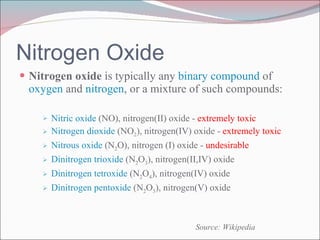
Nitrogen Oxide Nitrogen oxide  is typically any  binary compound  of  oxygen  and  nitrogen , or a mixture of such compounds: Nitric oxide  (NO), nitrogen(II) oxide -  extremely toxic  Nitrogen dioxide  (NO 2 ), nitrogen(IV) oxide -  extremely toxic  Nitrous oxide  (N 2 O), nitrogen (I) oxide -  undesirable Dinitrogen trioxide  (N 2 O 3 ), nitrogen(II,IV) oxide Dinitrogen tetroxide  (N 2 O 4 ), nitrogen(IV) oxide Dinitrogen pentoxide  (N 2 O 5 ), nitrogen(V) oxide Source: Wikipedia
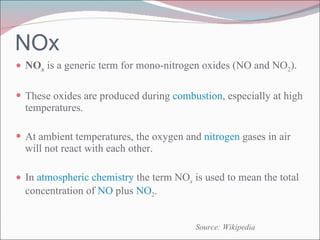
NOx NO x  is a generic term for mono-nitrogen oxides (NO and NO 2 ). These oxides are produced during  combustion , especially at high temperatures. At ambient temperatures, the oxygen and  nitrogen  gases in air will not react with each other. In  atmospheric chemistry  the term NO x  is used to mean the total concentration of  NO  plus  NO 2 .  Source: Wikipedia
Industrial Sources The three primary sources of NO x  in  combustion  processes: Thermal No x  - produced when nitrogen and oxygen in the combustion air supply combine at high flame temperatures.  Thermal NOx is generally produced during the combustion of both gases and fuel oils. Fuel No x   - produced when nitrogen in the fuel combines with the excess oxygen in the combustion air and is only a problem with fuel oils containing fuel bound nitrogen. Prompt NO x   - Attributed to the reaction of atmospheric nitrogen, N 2 , with radicals such as C, CH, and CH 2  fragments derived from fuel. Formed during the early, low temperature states of combustion and is insignificant. Source: Wikipedia & http://www.bacharach-training.com/combustionzone/nox1.htm
Health Effects NO x  react with  ammonia , moisture, and other compounds to form  nitric acid  vapor and related particles. Small particles can penetrate deeply into sensitive lung tissue and damage it, causing premature death in extreme cases. Inhalation of such particles may cause or worsen respiratory diseases such as  emphysema ,  bronchitis  it may also aggravate existing heart disease.   Source: Wikipedia
NO x  react with  volatile organic compounds  in the presence of heat and sunlight to form  Ozone .  Ozone can cause adverse effects such as damage to lung tissue and reduction in lung function mostly in susceptible populations (children, elderly, asthmatics).  Ozone can be transported by wind currents and cause health impacts far from the original sources. Health Effects Source: Wikipedia
NO x  (especially N 2 O) destroys  ozone layer . This layer absorbs  ultraviolet light , which is potentially damaging to life on earth. NO x  also readily react with common organic chemicals, and even ozone, to form a wide variety of toxic products:  nitroarenes ,  nitrosamines  and also the  nitrate radical  some of which may cause biological  mutations . Health Effects Source: Wikipedia
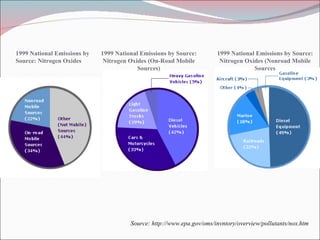
1999 National Emissions by Source: Nitrogen Oxides  1999 National Emissions by Source: Nitrogen Oxides (On-Road Mobile Sources) 1999 National Emissions by Source: Nitrogen Oxides (Nonroad Mobile Sources Source: http://www.epa.gov/oms/invntory/overview/pollutants/nox.htm
Selective Catalytic Reduction Means of converting  nitrogen oxides , also referred to as  NO x  with the aid of a  catalyst  into  diatomic nitrogen , N 2 , and  water , H2O. known to reduce the NOx emissions by nearly 70-95%. SCR provides emissions after-treatment well into the exhaust stack. Commercial selective catalytic reduction systems are typically found on large  utility boilers ,  industrial boilers , and  municipal solid waste boilers  and have been shown to reduce NOx by 70-95%. [1]  More recent applications include  diesel engines , such as those found on large ships,  diesel locomotives ,  gas turbines , and even  automobiles . Source: Wikipedia.com About.com & Ezinearticles.com
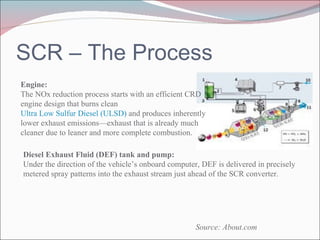
SCR – The Process Engine:   The NOx reduction process starts with an efficient CRD engine design that burns clean  Ultra Low Sulfur Diesel (ULSD)  and produces inherently lower exhaust emissions—exhaust that is already much cleaner due to leaner and more complete combustion. Diesel Exhaust Fluid (DEF) tank and pump:   Under the direction of the vehicle’s onboard computer, DEF is delivered in precisely metered spray patterns into the exhaust stream just ahead of the SCR converter. Source: About.com
SCR – The Process SCR Catalytic Converter:   This is where the conversion happens. Exhaust gases and an atomized mist of DEF enter the converter simultaneously. Together with the catalyst inside the converter, the mixture undergoes a chemical reaction that produces nitrogen gas and water vapor.  Control device:  Exhaust gases are monitored via a sensor as they leave the SCR catalyst. Feedback is supplied to the main computer to alter the DEF flow if NOx levels fluctuate beyond acceptable parameters.  Source: About.com
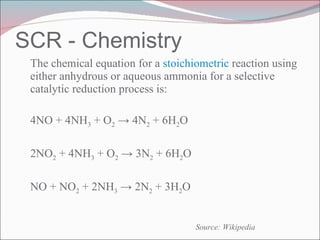
SCR - Chemistry The chemical equation for a  stoichiometric  reaction using either anhydrous or aqueous ammonia for a selective catalytic reduction process is: 4NO + 4NH 3  + O 2  -> 4N 2  + 6H 2 O  2NO 2  + 4NH 3  + O 2  -> 3N 2  + 6H 2 O  NO + NO 2  + 2NH 3  -> 2N 2  + 3H 2 O  Source: Wikipedia
SCR - Chemistry With several secondary reactions: 2SO 2  + O 2  -> 2SO 3   2NH 3  + SO 3  + H 2 O -> (NH 4 ) 2 SO 4   NH 3  + SO 3  + H 2 O -> NH 4 HSO 4 Source: Wikipedia
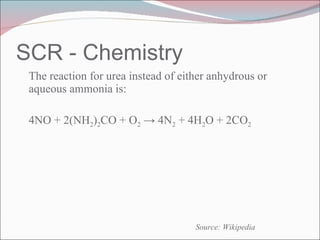
The reaction for urea instead of either anhydrous or aqueous ammonia is: 4NO + 2(NH 2 ) 2 CO + O 2  -> 4N 2  + 4H 2 O + 2CO 2   SCR - Chemistry Source: Wikipedia
SCR - Catalyst Manufactured from various  ceramic  materials used as a carrier, such as  titanium oxide , and active catalytic components are usually either oxides of base metals (such as  vanadium  and  tungsten ),  zeolites , and various  precious metals .  Source: Wikipedia
SCR – Catalyst : Base Metal Catalyst Examples: vanadium and tungsten Lack high thermal durability Less expensive and operate very well at the temperature ranges most commonly seen in industrial and utility boiler applications high catalyzing potential to oxidize  SO 2  into  SO 3 , which can be extremely damaging due to its acidic properties Source: Wikipedia
SCR – Catalyst - Zeolite have the potential to operate at substantially higher temperature than base metal catalysts can withstand prolonged operation at temperatures of 900 K and  transient  conditions of up to 1120 K have a lower potential for potentially damaging SO 2  oxidation. Source: Wikipedia
SCR – Catalyst : Fe- & Cu-exchanged zeolite urea Approximately equal performance to that of vanadium-urea SCRs if the fraction of the NO 2  is 20% to 50% of the total NO x Two most common designs of SCR catalyst geometry used today are  honeycomb  and plate Plate-type catalysts have lower  pressure drops  and are less susceptible to plugging and fouling than the honeycomb types, but plate configurations are much larger and more expensive. Honeycomb configurations are smaller than plate types, but have higher pressure drops and plug much more easily. Source: Wikipedia
SCR - Reductants Remember:  A reducing agent (also called a reductant or reducer) is the element or compound in a  redox  (reduction-oxidation) reaction (see  electrochemistry ) that reduces another  species . In doing so, it becomes oxidized, and is therefore the  electron donor  in the redox.  Several reductants are currently used in SCR applications including: Anhydrous ammonia   Extremely toxic and difficult to safely store, but needs no further conversion to operate within an SCR. Typically favored by large industrial SCR operators Aqueous ammonia must be  hydrolyzed  in order to be used, but it is substantially safer to store and transport than anhydrous ammonia. Urea the safest to store, but requires conversion to ammonia through thermal decomposition in order to be used as an effective reductant. Source: Wikipedia
SCR – The Process
SCR - Limitation If unsuitable materials are used in the manufacture of the units, ions can pass from the dispensing materials into the porous head on the SCR unit that spoils the SCR's efficacy and can reduce its lifespan by more than 60%. Ammonia slip or release of unreacted ammonia Slip can occur when catalyst temperatures are not in the optimal range for the reaction or when too much ammonia is injected into the process. Source: Wikipedia
NOx Monitoring The purpose of the monitoring is to verify the company's compliance with the air quality standards of the DENR Administrative Order  DAO No. 2000-81 (Implementing Rules and Regulations of the Philippine Clean Air Act of 1999) - for Stack  Method of Sampling & Analysis : Grab Sampling – Phenolsulfonic Method (US EPA Method 7) DENR ADMINISTRATIVE ORDER No. 46 Series of 1998 – for motor vehicles Method of Sampling & Analysis :  Direct Reading
Thank You!

Selective Catalytic Reduction of NOx

  • 1.
    of NOxfrom Exhaust Stack
  • 2.
    Nitrogen Oxide Nitrogenoxide is typically any binary compound of oxygen and nitrogen , or a mixture of such compounds: Nitric oxide (NO), nitrogen(II) oxide - extremely toxic Nitrogen dioxide (NO 2 ), nitrogen(IV) oxide - extremely toxic Nitrous oxide (N 2 O), nitrogen (I) oxide - undesirable Dinitrogen trioxide (N 2 O 3 ), nitrogen(II,IV) oxide Dinitrogen tetroxide (N 2 O 4 ), nitrogen(IV) oxide Dinitrogen pentoxide (N 2 O 5 ), nitrogen(V) oxide Source: Wikipedia
  • 3.
    NOx NO x is a generic term for mono-nitrogen oxides (NO and NO 2 ). These oxides are produced during combustion , especially at high temperatures. At ambient temperatures, the oxygen and nitrogen gases in air will not react with each other. In atmospheric chemistry the term NO x is used to mean the total concentration of NO plus NO 2 . Source: Wikipedia
  • 4.
    Industrial Sources Thethree primary sources of NO x in combustion processes: Thermal No x - produced when nitrogen and oxygen in the combustion air supply combine at high flame temperatures.  Thermal NOx is generally produced during the combustion of both gases and fuel oils. Fuel No x - produced when nitrogen in the fuel combines with the excess oxygen in the combustion air and is only a problem with fuel oils containing fuel bound nitrogen. Prompt NO x - Attributed to the reaction of atmospheric nitrogen, N 2 , with radicals such as C, CH, and CH 2 fragments derived from fuel. Formed during the early, low temperature states of combustion and is insignificant. Source: Wikipedia & http://www.bacharach-training.com/combustionzone/nox1.htm
  • 5.
    Health Effects NOx react with ammonia , moisture, and other compounds to form nitric acid vapor and related particles. Small particles can penetrate deeply into sensitive lung tissue and damage it, causing premature death in extreme cases. Inhalation of such particles may cause or worsen respiratory diseases such as emphysema , bronchitis it may also aggravate existing heart disease. Source: Wikipedia
  • 6.
    NO x react with volatile organic compounds in the presence of heat and sunlight to form Ozone . Ozone can cause adverse effects such as damage to lung tissue and reduction in lung function mostly in susceptible populations (children, elderly, asthmatics). Ozone can be transported by wind currents and cause health impacts far from the original sources. Health Effects Source: Wikipedia
  • 7.
    NO x (especially N 2 O) destroys ozone layer . This layer absorbs ultraviolet light , which is potentially damaging to life on earth. NO x also readily react with common organic chemicals, and even ozone, to form a wide variety of toxic products: nitroarenes , nitrosamines and also the nitrate radical some of which may cause biological mutations . Health Effects Source: Wikipedia
  • 8.
    1999 National Emissionsby Source: Nitrogen Oxides 1999 National Emissions by Source: Nitrogen Oxides (On-Road Mobile Sources) 1999 National Emissions by Source: Nitrogen Oxides (Nonroad Mobile Sources Source: http://www.epa.gov/oms/invntory/overview/pollutants/nox.htm
  • 9.
    Selective Catalytic ReductionMeans of converting nitrogen oxides , also referred to as NO x with the aid of a catalyst into diatomic nitrogen , N 2 , and water , H2O. known to reduce the NOx emissions by nearly 70-95%. SCR provides emissions after-treatment well into the exhaust stack. Commercial selective catalytic reduction systems are typically found on large utility boilers , industrial boilers , and municipal solid waste boilers and have been shown to reduce NOx by 70-95%. [1] More recent applications include diesel engines , such as those found on large ships, diesel locomotives , gas turbines , and even automobiles . Source: Wikipedia.com About.com & Ezinearticles.com
  • 10.
    SCR – TheProcess Engine: The NOx reduction process starts with an efficient CRD engine design that burns clean Ultra Low Sulfur Diesel (ULSD) and produces inherently lower exhaust emissions—exhaust that is already much cleaner due to leaner and more complete combustion. Diesel Exhaust Fluid (DEF) tank and pump: Under the direction of the vehicle’s onboard computer, DEF is delivered in precisely metered spray patterns into the exhaust stream just ahead of the SCR converter. Source: About.com
  • 11.
    SCR – TheProcess SCR Catalytic Converter: This is where the conversion happens. Exhaust gases and an atomized mist of DEF enter the converter simultaneously. Together with the catalyst inside the converter, the mixture undergoes a chemical reaction that produces nitrogen gas and water vapor. Control device: Exhaust gases are monitored via a sensor as they leave the SCR catalyst. Feedback is supplied to the main computer to alter the DEF flow if NOx levels fluctuate beyond acceptable parameters. Source: About.com
  • 12.
    SCR - ChemistryThe chemical equation for a stoichiometric reaction using either anhydrous or aqueous ammonia for a selective catalytic reduction process is: 4NO + 4NH 3 + O 2 -> 4N 2 + 6H 2 O 2NO 2 + 4NH 3 + O 2 -> 3N 2 + 6H 2 O NO + NO 2 + 2NH 3 -> 2N 2 + 3H 2 O Source: Wikipedia
  • 13.
    SCR - ChemistryWith several secondary reactions: 2SO 2 + O 2 -> 2SO 3 2NH 3 + SO 3 + H 2 O -> (NH 4 ) 2 SO 4 NH 3 + SO 3 + H 2 O -> NH 4 HSO 4 Source: Wikipedia
  • 14.
    The reaction forurea instead of either anhydrous or aqueous ammonia is: 4NO + 2(NH 2 ) 2 CO + O 2 -> 4N 2 + 4H 2 O + 2CO 2 SCR - Chemistry Source: Wikipedia
  • 15.
    SCR - CatalystManufactured from various ceramic materials used as a carrier, such as titanium oxide , and active catalytic components are usually either oxides of base metals (such as vanadium and tungsten ), zeolites , and various precious metals . Source: Wikipedia
  • 16.
    SCR – Catalyst: Base Metal Catalyst Examples: vanadium and tungsten Lack high thermal durability Less expensive and operate very well at the temperature ranges most commonly seen in industrial and utility boiler applications high catalyzing potential to oxidize SO 2 into SO 3 , which can be extremely damaging due to its acidic properties Source: Wikipedia
  • 17.
    SCR – Catalyst- Zeolite have the potential to operate at substantially higher temperature than base metal catalysts can withstand prolonged operation at temperatures of 900 K and transient conditions of up to 1120 K have a lower potential for potentially damaging SO 2 oxidation. Source: Wikipedia
  • 18.
    SCR – Catalyst: Fe- & Cu-exchanged zeolite urea Approximately equal performance to that of vanadium-urea SCRs if the fraction of the NO 2 is 20% to 50% of the total NO x Two most common designs of SCR catalyst geometry used today are honeycomb and plate Plate-type catalysts have lower pressure drops and are less susceptible to plugging and fouling than the honeycomb types, but plate configurations are much larger and more expensive. Honeycomb configurations are smaller than plate types, but have higher pressure drops and plug much more easily. Source: Wikipedia
  • 19.
    SCR - ReductantsRemember: A reducing agent (also called a reductant or reducer) is the element or compound in a redox (reduction-oxidation) reaction (see electrochemistry ) that reduces another species . In doing so, it becomes oxidized, and is therefore the electron donor in the redox. Several reductants are currently used in SCR applications including: Anhydrous ammonia Extremely toxic and difficult to safely store, but needs no further conversion to operate within an SCR. Typically favored by large industrial SCR operators Aqueous ammonia must be hydrolyzed in order to be used, but it is substantially safer to store and transport than anhydrous ammonia. Urea the safest to store, but requires conversion to ammonia through thermal decomposition in order to be used as an effective reductant. Source: Wikipedia
  • 20.
    SCR – TheProcess
  • 21.
    SCR - LimitationIf unsuitable materials are used in the manufacture of the units, ions can pass from the dispensing materials into the porous head on the SCR unit that spoils the SCR's efficacy and can reduce its lifespan by more than 60%. Ammonia slip or release of unreacted ammonia Slip can occur when catalyst temperatures are not in the optimal range for the reaction or when too much ammonia is injected into the process. Source: Wikipedia
  • 22.
    NOx Monitoring Thepurpose of the monitoring is to verify the company's compliance with the air quality standards of the DENR Administrative Order DAO No. 2000-81 (Implementing Rules and Regulations of the Philippine Clean Air Act of 1999) - for Stack Method of Sampling & Analysis : Grab Sampling – Phenolsulfonic Method (US EPA Method 7) DENR ADMINISTRATIVE ORDER No. 46 Series of 1998 – for motor vehicles Method of Sampling & Analysis : Direct Reading
  • 23.