
Welcome
Presentation Topic:
Exhaust System of an Engine
Md Sujon Babu
ID: 15207019
Contents
• Introduction of exhaust system
• Describe the parts and operation of exhaust system
components
• Understand the operation of a muffler
• Understand the operation of a catalytic convertor
• Understand the operation of a Resonator
• Understand the operation of a heat shield
• Turbocharger and its operation
• Discuss about turbocharger
• Question-answer session
Introduction of exhaust system
An Exhaust system is usually piping used to
guide reaction exhaust gases away from a
controlled combustion inside an engine or
stove. The entire system conveys burnt gases
from the engine and includes one or more
exhaust pipes.
Introduction ( cont.)
Depending on the overall system design, the
exhaust gas may flow through one or more of
• Cylinder head and exhaust manifold
• A turbocharger to increase engine power
• A catalytic converter to reduce pollution
• A muffler or silencer to reduce noise.
Exhaust system fundamentals
• Exhaust system functions
– Carries burned exhaust gases away from the
passenger compartment
– Quiets the engine
– Most new cars have one or more catalytic converters
• Excessive backpressure
– Reduces performance and fuel economy
• Exhaust system flow
– Not severely affected by bends in the pipe
Exhaust system fundamentals
• Mounted to cylinder head's exhaust ports
– Typically made of cast iron or steel
• Exhaust temperature
– Related to the amount of load on the engine
• Headers
– Aftermarket manifolds made of tube steel
– Sometimes require modification to install
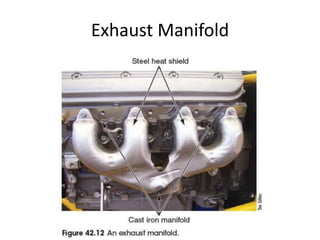
Exhaust Manifold
• Fastens over the exhaust ports to carry burned
gases into the exhaust system
• Connects the cylinder head exhaust ports to a
header pipe
• Can be made of heavy cast iron or lightweight
aluminum or stainless steel tubing
Exhaust Manifold
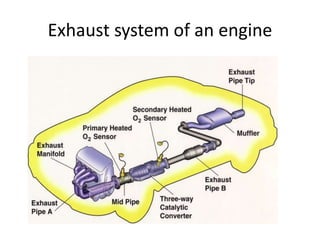
Exhaust system of an engine
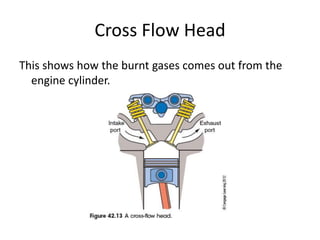
Cross Flow Head
This shows how the burnt gases comes out from the
engine cylinder.
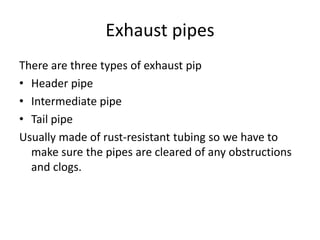
Exhaust pipes
There are three types of exhaust pip
• Header pipe
• Intermediate pipe
• Tail pipe
Usually made of rust-resistant tubing so we have to
make sure the pipes are cleared of any obstructions
and clogs.
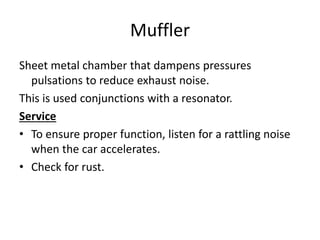
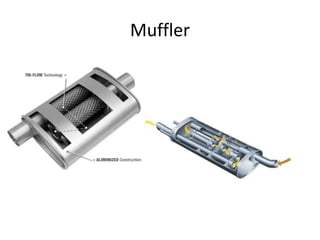
Muffler
Sheet metal chamber that dampens pressures
pulsations to reduce exhaust noise.
This is used conjunctions with a resonator.
Service
• To ensure proper function, listen for a rattling noise
when the car accelerates.
• Check for rust.
Muffler
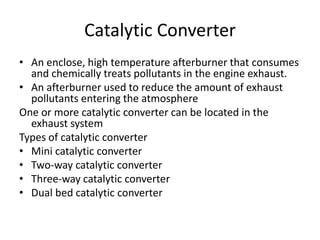
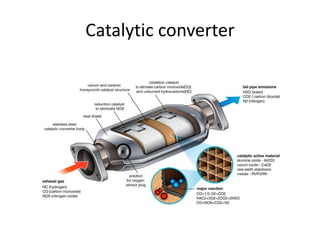
Catalytic Converter
• An enclose, high temperature afterburner that consumes
and chemically treats pollutants in the engine exhaust.
• An afterburner used to reduce the amount of exhaust
pollutants entering the atmosphere
One or more catalytic converter can be located in the
exhaust system
Types of catalytic converter
• Mini catalytic converter
• Two-way catalytic converter
• Three-way catalytic converter
• Dual bed catalytic converter
Catalytic converter
Resonator
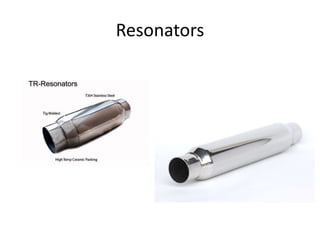
• A resonator is a hollow chamber in the exhaust tract
that creates a frequency of pulses that reverse the
pulses coming down the exhaust pipe
• It works in conjunction with the muffler to quiet the
exhaustion being emitted from the car
Service
Check for rattling to indicate loose pieces or debris
build-up
Resonators
Heat Shield
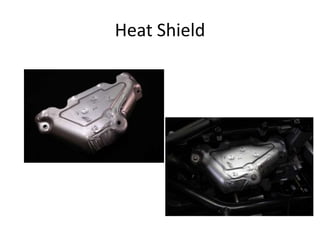
• Metal plates that prevent exhaust heat from
transferring to the fuel lines, floor, transmission and
engine
• Located in areas where the exhaust system
components are close to the vehicle’s body or near
the ground
• The shields reduce the amount of heat transferred
into the body and protect items under the vehicle
• Heat shields should be flat and not bent
Heat Shield
Exhaust system service
• Exhaust systems rust because of acids and moisture
– Exhaust gaskets suffer a good deal of abuse
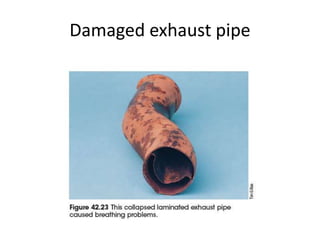
– Header pipes collapse resulting in a restriction
• Tools used for exhaust work
– Chain-type pipe and roller-type exhaust cutters
– Pipe expander
– Deep sockets
– Chisel cutter
– Oxyacetylene torch
Damaged exhaust pipe
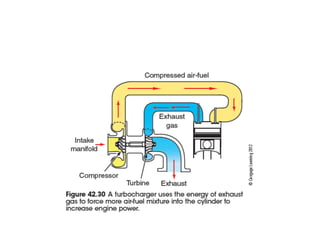
Turbocharger
• Small radial fan pump driven by the energy of the
exhaust flow
– Helps a smaller engine provide more power
• Components and characteristics
– Centrifugal pump
– Diffuser and volute
– Size must match compressor
– Boost pressure: amount of air density provided
– Turbo lag: time required to bring the turbo up to a
functioning speed
Turbocharger(Cont)
• Supercharged systems
– Use different ways to prevent excess pressure from
accumulating
• Waste gate
– Prevents overpowering
– Internal and external
– Amount of boost can be changed
• Spring or boost controllers
• Valves
– Blow-off and compressor by-pass
Turbocharger(Cont)
• Variable geometry turbochargers
– Vary turbocharger geometry
• After cooler/intercooler
– Cooled by either air or water
• Turbocharger thrust/boost differential
– Occurs when pressure is higher in either the turbine
or the compressor
• Turbocharger parts
– Bearings, turbine shaft, compressor, turbine wheels,
and housings
Function of Turbocharger
A turbocharger is a turbine driven forced induction
device that increases an internal combustion
engine’s efficiency and power output by forcing extra
air into the combustion chamber. This improvement
over a naturally aspirated engine’s power output is
due to the fact that the compressor can force more
air and proportionately more fuel into the
combustion chamber than atmospheric pressure
alone.
Functions of turbocharger parts
• Boost Threshold
The boost threshold of a turbocharger system is the lower
bound of the region within which the compressor operates.
Below a certain rate of flow, a compressor operates. Below a
certain rate of flow, a compressor produces insignificant
boost. This limits boost at a particular RPM, regardless of
exhaust gas pressure. Newer turbocharger and engine
developments have steadily reduced boost thresholds.
Turbochargers start producing boost only when a certain
amount of kinetic energy is present in the exhaust gases.
Without adequate exhaust gas flow to spin the turbine blades,
the turbocharger cannot produce the necessary force needed
to compress the air going into the engine.
Functions of turbocharger parts(cont.)
• Turbine
The turbocharger turbine, which consists of a turbine
wheel and a turbine housing, converts the engine
exhaust gas into mechanical energy to drive the
compressor. The gas, which is restricted by the
turbine’s flow cross-sectional area, results in a
pressure and temperature drop between the inlet
and outlet. This pressure drop is converted by the
turbine into kinetic energy to drive the turbine
wheel.
Functions of turbocharger parts(cont.)
• Compressor
Turbocharger compressors are generally centrifugal
compressors consisting of three essential component:
compressor wheel, diffuser, and housing. With the
rotational speed of the wheel, air is drawn in axially,
accelerated to high velocity and then expelled in a radial
direction. The diffuser slows down the high-velocity air,
largely without losses, so that both pressure and
temperature rise. The diffuser is formed by the
compressor backplate and a part of the volute housing,
which in its turbine collects the air and slows it down
further before it reaches the compressor exit.
Functions of turbocharger parts(cont.)
• Center Housing/ Hub
The center hub rotating assembly (CHRA) houses the shaft that
connects the compressor impeller and turbine. It also must
contain a bearing system to suspend the shaft, allowing it to
rotate at very high speed with minimal friction. For instance,
in automotive applications the CHRA typically uses a thrust
bearing of ball bearing lubricated by a constant supply of
pressurized engine oil. The CHRA may also be considered
water-cooled by having and entry and exit point for engine
coolant. Water-cooled models use engine coolant to keep
lubricating oil cooler, avoiding possible oil coking from the
extreme heat in the turbine. The development of air-foil
bearing removed the risk.
Turbocharger (Troubleshooting)
• Turbocharger balance
– Turbo spin in excess of 100,000 rpm and are
balanced to run in excess of 150,000 rpm
• Turbocharger replacement
– Not usually attempted in repair shops
• Turbocharger troubleshooting
– Common failures: blockages, leaks, and foreign
object damage
Turbocharger(Troubleshooting)
• Diagnosing damage to a turbo
– Turbine damage
• Broken piston rings, valves, or pistons
– Compressor damage
• Results from objects entering the intake
• Thrust bearing failure
– Not common
Exhaust system of an engine

Exhaust system of an engine

  • 1.
    Welcome Presentation Topic: Exhaust Systemof an Engine Md Sujon Babu ID: 15207019
  • 2.
    Contents • Introduction ofexhaust system • Describe the parts and operation of exhaust system components • Understand the operation of a muffler • Understand the operation of a catalytic convertor • Understand the operation of a Resonator • Understand the operation of a heat shield • Turbocharger and its operation • Discuss about turbocharger • Question-answer session
  • 3.
    Introduction of exhaustsystem An Exhaust system is usually piping used to guide reaction exhaust gases away from a controlled combustion inside an engine or stove. The entire system conveys burnt gases from the engine and includes one or more exhaust pipes.
  • 4.
    Introduction ( cont.) Dependingon the overall system design, the exhaust gas may flow through one or more of • Cylinder head and exhaust manifold • A turbocharger to increase engine power • A catalytic converter to reduce pollution • A muffler or silencer to reduce noise.
  • 5.
    Exhaust system fundamentals •Exhaust system functions – Carries burned exhaust gases away from the passenger compartment – Quiets the engine – Most new cars have one or more catalytic converters • Excessive backpressure – Reduces performance and fuel economy • Exhaust system flow – Not severely affected by bends in the pipe
  • 6.
    Exhaust system fundamentals •Mounted to cylinder head's exhaust ports – Typically made of cast iron or steel • Exhaust temperature – Related to the amount of load on the engine • Headers – Aftermarket manifolds made of tube steel – Sometimes require modification to install
  • 7.
    Exhaust Manifold • Fastensover the exhaust ports to carry burned gases into the exhaust system • Connects the cylinder head exhaust ports to a header pipe • Can be made of heavy cast iron or lightweight aluminum or stainless steel tubing
  • 8.
  • 9.
  • 10.
    Cross Flow Head Thisshows how the burnt gases comes out from the engine cylinder.
  • 11.
    Exhaust pipes There arethree types of exhaust pip • Header pipe • Intermediate pipe • Tail pipe Usually made of rust-resistant tubing so we have to make sure the pipes are cleared of any obstructions and clogs.
  • 12.
    Muffler Sheet metal chamberthat dampens pressures pulsations to reduce exhaust noise. This is used conjunctions with a resonator. Service • To ensure proper function, listen for a rattling noise when the car accelerates. • Check for rust.
  • 13.
  • 14.
    Catalytic Converter • Anenclose, high temperature afterburner that consumes and chemically treats pollutants in the engine exhaust. • An afterburner used to reduce the amount of exhaust pollutants entering the atmosphere One or more catalytic converter can be located in the exhaust system Types of catalytic converter • Mini catalytic converter • Two-way catalytic converter • Three-way catalytic converter • Dual bed catalytic converter
  • 15.
  • 16.
    Resonator • A resonatoris a hollow chamber in the exhaust tract that creates a frequency of pulses that reverse the pulses coming down the exhaust pipe • It works in conjunction with the muffler to quiet the exhaustion being emitted from the car Service Check for rattling to indicate loose pieces or debris build-up
  • 17.
  • 18.
    Heat Shield • Metalplates that prevent exhaust heat from transferring to the fuel lines, floor, transmission and engine • Located in areas where the exhaust system components are close to the vehicle’s body or near the ground • The shields reduce the amount of heat transferred into the body and protect items under the vehicle • Heat shields should be flat and not bent
  • 19.
  • 20.
    Exhaust system service •Exhaust systems rust because of acids and moisture – Exhaust gaskets suffer a good deal of abuse – Header pipes collapse resulting in a restriction • Tools used for exhaust work – Chain-type pipe and roller-type exhaust cutters – Pipe expander – Deep sockets – Chisel cutter – Oxyacetylene torch
  • 21.
  • 22.
    Turbocharger • Small radialfan pump driven by the energy of the exhaust flow – Helps a smaller engine provide more power • Components and characteristics – Centrifugal pump – Diffuser and volute – Size must match compressor – Boost pressure: amount of air density provided – Turbo lag: time required to bring the turbo up to a functioning speed
  • 23.
    Turbocharger(Cont) • Supercharged systems –Use different ways to prevent excess pressure from accumulating • Waste gate – Prevents overpowering – Internal and external – Amount of boost can be changed • Spring or boost controllers • Valves – Blow-off and compressor by-pass
  • 24.
    Turbocharger(Cont) • Variable geometryturbochargers – Vary turbocharger geometry • After cooler/intercooler – Cooled by either air or water • Turbocharger thrust/boost differential – Occurs when pressure is higher in either the turbine or the compressor • Turbocharger parts – Bearings, turbine shaft, compressor, turbine wheels, and housings
  • 26.
    Function of Turbocharger Aturbocharger is a turbine driven forced induction device that increases an internal combustion engine’s efficiency and power output by forcing extra air into the combustion chamber. This improvement over a naturally aspirated engine’s power output is due to the fact that the compressor can force more air and proportionately more fuel into the combustion chamber than atmospheric pressure alone.
  • 27.
    Functions of turbochargerparts • Boost Threshold The boost threshold of a turbocharger system is the lower bound of the region within which the compressor operates. Below a certain rate of flow, a compressor operates. Below a certain rate of flow, a compressor produces insignificant boost. This limits boost at a particular RPM, regardless of exhaust gas pressure. Newer turbocharger and engine developments have steadily reduced boost thresholds. Turbochargers start producing boost only when a certain amount of kinetic energy is present in the exhaust gases. Without adequate exhaust gas flow to spin the turbine blades, the turbocharger cannot produce the necessary force needed to compress the air going into the engine.
  • 28.
    Functions of turbochargerparts(cont.) • Turbine The turbocharger turbine, which consists of a turbine wheel and a turbine housing, converts the engine exhaust gas into mechanical energy to drive the compressor. The gas, which is restricted by the turbine’s flow cross-sectional area, results in a pressure and temperature drop between the inlet and outlet. This pressure drop is converted by the turbine into kinetic energy to drive the turbine wheel.
  • 29.
    Functions of turbochargerparts(cont.) • Compressor Turbocharger compressors are generally centrifugal compressors consisting of three essential component: compressor wheel, diffuser, and housing. With the rotational speed of the wheel, air is drawn in axially, accelerated to high velocity and then expelled in a radial direction. The diffuser slows down the high-velocity air, largely without losses, so that both pressure and temperature rise. The diffuser is formed by the compressor backplate and a part of the volute housing, which in its turbine collects the air and slows it down further before it reaches the compressor exit.
  • 30.
    Functions of turbochargerparts(cont.) • Center Housing/ Hub The center hub rotating assembly (CHRA) houses the shaft that connects the compressor impeller and turbine. It also must contain a bearing system to suspend the shaft, allowing it to rotate at very high speed with minimal friction. For instance, in automotive applications the CHRA typically uses a thrust bearing of ball bearing lubricated by a constant supply of pressurized engine oil. The CHRA may also be considered water-cooled by having and entry and exit point for engine coolant. Water-cooled models use engine coolant to keep lubricating oil cooler, avoiding possible oil coking from the extreme heat in the turbine. The development of air-foil bearing removed the risk.
  • 31.
    Turbocharger (Troubleshooting) • Turbochargerbalance – Turbo spin in excess of 100,000 rpm and are balanced to run in excess of 150,000 rpm • Turbocharger replacement – Not usually attempted in repair shops • Turbocharger troubleshooting – Common failures: blockages, leaks, and foreign object damage
  • 32.
    Turbocharger(Troubleshooting) • Diagnosing damageto a turbo – Turbine damage • Broken piston rings, valves, or pistons – Compressor damage • Results from objects entering the intake • Thrust bearing failure – Not common