SRI KRISHNA COLLEGE OF ENGINEERING AND TECHNOLOGY
DEPARTMENT OF MECHATRONICS ENGINEERING
Session: Engine Components & its
Materials
11/24/2020 16MT407 - Theory of Automobile Engineering 1
MODULE 1
SESSION OBJECTIVES
11/24/2020 16MT407 - Theory of Automobile Engineering 2
 On the completion of this session, the students might
be able to understand,
 Revolution in Engine modification
 Engine Classification
 Components of Engine & Its materials.
Topics
 History of engine development
 Combustion
 Types of Engine
 Components of Engine & its material
11/24/2020 16MT407 - Theory of Automobile Engineering 3
History of Engine Development
11/24/2020 16MT407 - Theory of Automobile Engineering 4
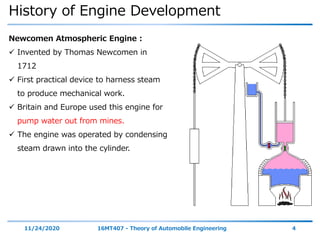
Newcomen Atmospheric Engine :
 Invented by Thomas Newcomen in
1712
 First practical device to harness steam
to produce mechanical work.
 Britain and Europe used this engine for
pump water out from mines.
 The engine was operated by condensing
steam drawn into the cylinder.
History of Engine Development
11/24/2020 16MT407 - Theory of Automobile Engineering 5
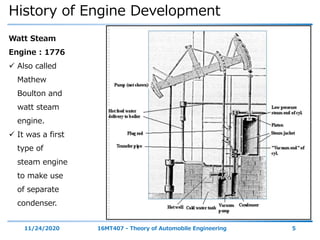
Watt Steam
Engine : 1776
 Also called
Mathew
Boulton and
watt steam
engine.
 It was a first
type of
steam engine
to make use
of separate
condenser.
History of Engine Development
11/24/2020 16MT407 - Theory of Automobile Engineering 6
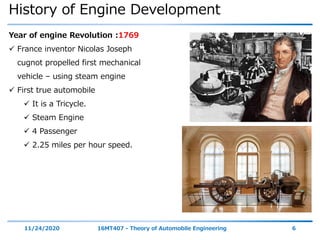
Year of engine Revolution :1769
 France inventor Nicolas Joseph
cugnot propelled first mechanical
vehicle – using steam engine
 First true automobile
 It is a Tricycle.
 Steam Engine
 4 Passenger
 2.25 miles per hour speed.
History of Engine Development
11/24/2020i 16MT407 - Theory of Automobile Engineering 7
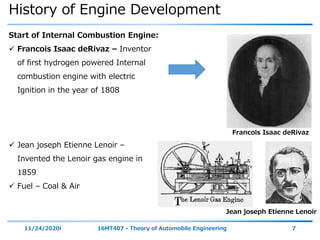
Start of Internal Combustion Engine:
 Francois Isaac deRivaz – Inventor
of first hydrogen powered Internal
combustion engine with electric
Ignition in the year of 1808
 Jean joseph Etienne Lenoir –
Invented the Lenoir gas engine in
1859
 Fuel – Coal & Air
Francois Isaac deRivaz
Jean joseph Etienne Lenoir
History of Engine Development
11/24/2020i 16MT407 - Theory of Automobile Engineering 8
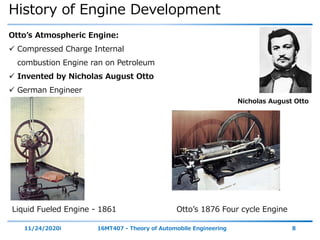
Otto’s Atmospheric Engine:
 Compressed Charge Internal
combustion Engine ran on Petroleum
 Invented by Nicholas August Otto
 German Engineer
Liquid Fueled Engine - 1861 Otto’s 1876 Four cycle Engine
Nicholas August Otto
COMBUSTION
11/24/2020i 16MT407 - Theory of Automobile Engineering 9
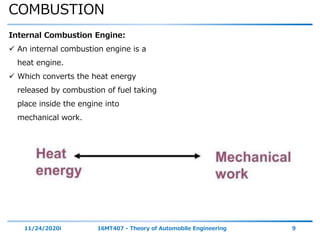
Internal Combustion Engine:
 An internal combustion engine is a
heat engine.
 Which converts the heat energy
released by combustion of fuel taking
place inside the engine into
mechanical work.
COMBUSTION
11/24/2020i 16MT407 - Theory of Automobile Engineering 10
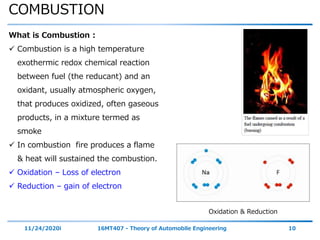
What is Combustion :
 Combustion is a high temperature
exothermic redox chemical reaction
between fuel (the reducant) and an
oxidant, usually atmospheric oxygen,
that produces oxidized, often gaseous
products, in a mixture termed as
smoke
 In combustion fire produces a flame
& heat will sustained the combustion.
 Oxidation – Loss of electron
 Reduction – gain of electron
Oxidation & Reduction
Engine classification
11/24/2020i 16MT407 - Theory of Automobile Engineering 11
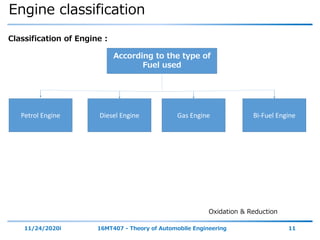
Classification of Engine :
Oxidation & Reduction
According to the type of
Fuel used
Petrol Engine Diesel Engine Gas Engine Bi-Fuel Engine
Engine classification
11/24/2020i 16MT407 - Theory of Automobile Engineering 12
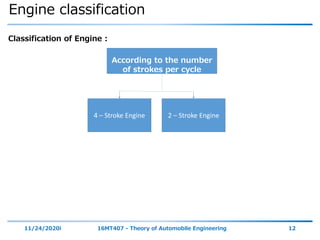
Classification of Engine :
According to the number
of strokes per cycle
4 – Stroke Engine 2 – Stroke Engine
Engine classification
11/24/2020i 16MT407 - Theory of Automobile Engineering 13
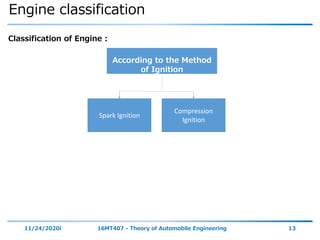
Classification of Engine :
According to the Method
of Ignition
Spark Ignition
Compression
Ignition
Engine classification
11/24/2020i 16MT407 - Theory of Automobile Engineering 14
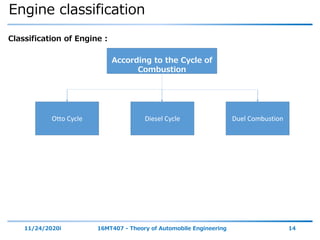
Classification of Engine :
According to the Cycle of
Combustion
Otto Cycle Diesel Cycle Duel Combustion
Engine classification
11/24/2020i 16MT407 - Theory of Automobile Engineering 15
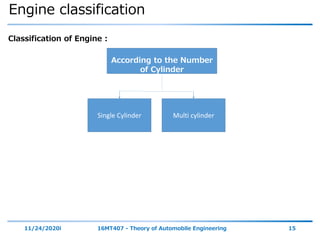
Classification of Engine :
According to the Number
of Cylinder
Single Cylinder Multi cylinder
Engine classification
11/24/2020i 16MT407 - Theory of Automobile Engineering 16
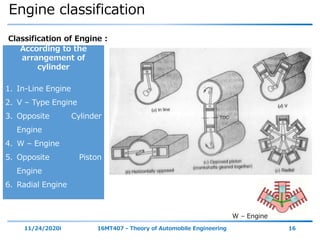
Classification of Engine :
According to the
arrangement of
cylinder
1. In-Line Engine
2. V – Type Engine
3. Opposite Cylinder
Engine
4. W – Engine
5. Opposite Piston
Engine
6. Radial Engine
W – Engine
Engine classification
11/24/2020i 16MT407 - Theory of Automobile Engineering 17
Classification of Engine :
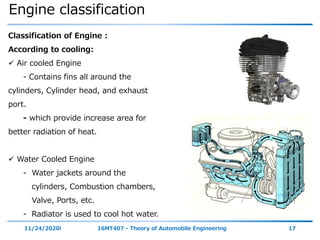
According to cooling:
 Air cooled Engine
- Contains fins all around the
cylinders, Cylinder head, and exhaust
port.
- which provide increase area for
better radiation of heat.
 Water Cooled Engine
- Water jackets around the
cylinders, Combustion chambers,
Valve, Ports, etc.
- Radiator is used to cool hot water.
COMPONENTS OF IC ENGINE
11/24/2020i 16MT407 - Theory of Automobile Engineering 18
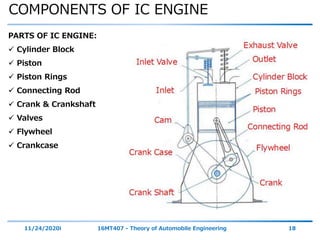
PARTS OF IC ENGINE:
 Cylinder Block
 Piston
 Piston Rings
 Connecting Rod
 Crank & Crankshaft
 Valves
 Flywheel
 Crankcase
COMPONENTS OF IC ENGINE
11/24/2020i 16MT407 - Theory of Automobile Engineering 19
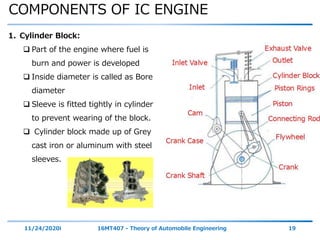
1. Cylinder Block:
 Part of the engine where fuel is
burn and power is developed
 Inside diameter is called as Bore
diameter
 Sleeve is fitted tightly in cylinder
to prevent wearing of the block.
 Cylinder block made up of Grey
cast iron or aluminum with steel
sleeves.
COMPONENTS OF IC ENGINE
11/24/2020i 16MT407 - Theory of Automobile Engineering 20
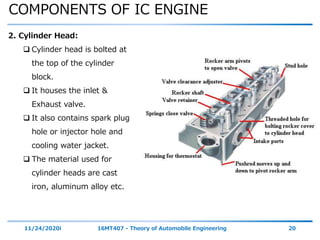
2. Cylinder Head:
 Cylinder head is bolted at
the top of the cylinder
block.
 It houses the inlet &
Exhaust valve.
 It also contains spark plug
hole or injector hole and
cooling water jacket.
 The material used for
cylinder heads are cast
iron, aluminum alloy etc.
COMPONENTS OF IC ENGINE
11/24/2020i 16MT407 - Theory of Automobile Engineering 21
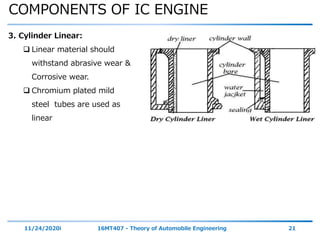
3. Cylinder Linear:
 Linear material should
withstand abrasive wear &
Corrosive wear.
 Chromium plated mild
steel tubes are used as
linear
COMPONENTS OF IC ENGINE
11/24/2020i 16MT407 - Theory of Automobile Engineering 22
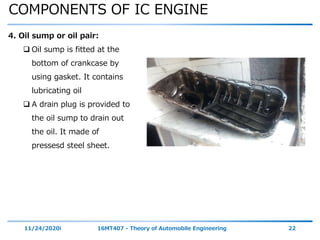
4. Oil sump or oil pair:
 Oil sump is fitted at the
bottom of crankcase by
using gasket. It contains
lubricating oil
 A drain plug is provided to
the oil sump to drain out
the oil. It made of
pressesd steel sheet.
COMPONENTS OF IC ENGINE
11/24/2020i 16MT407 - Theory of Automobile Engineering 23
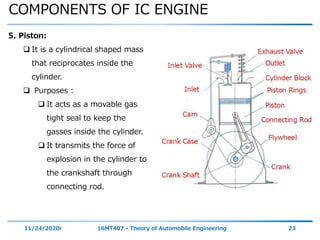
5. Piston:
 It is a cylindrical shaped mass
that reciprocates inside the
cylinder.
 Purposes :
 It acts as a movable gas
tight seal to keep the
gasses inside the cylinder.
 It transmits the force of
explosion in the cylinder to
the crankshaft through
connecting rod.
COMPONENTS OF IC ENGINE
11/24/2020i 16MT407 - Theory of Automobile Engineering 24
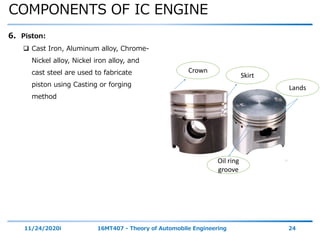
6. Piston:
 Cast Iron, Aluminum alloy, Chrome-
Nickel alloy, Nickel iron alloy, and
cast steel are used to fabricate
piston using Casting or forging
method
Crown
Skirt
Lands
Oil ring
groove
COMPONENTS OF IC ENGINE
11/24/2020i 16MT407 - Theory of Automobile Engineering 25
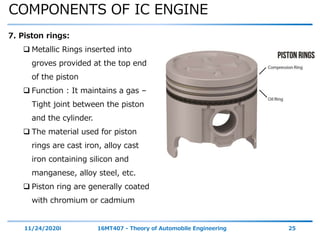
7. Piston rings:
 Metallic Rings inserted into
groves provided at the top end
of the piston
 Function : It maintains a gas –
Tight joint between the piston
and the cylinder.
 The material used for piston
rings are cast iron, alloy cast
iron containing silicon and
manganese, alloy steel, etc.
 Piston ring are generally coated
with chromium or cadmium
COMPONENTS OF IC ENGINE
11/24/2020i 16MT407 - Theory of Automobile Engineering 26
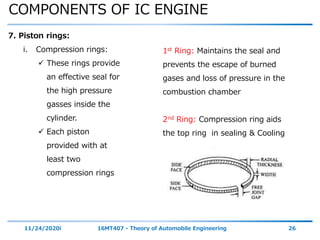
7. Piston rings:
i. Compression rings:
 These rings provide
an effective seal for
the high pressure
gasses inside the
cylinder.
 Each piston
provided with at
least two
compression rings
1st Ring: Maintains the seal and
prevents the escape of burned
gases and loss of pressure in the
combustion chamber
2nd Ring: Compression ring aids
the top ring in sealing & Cooling
COMPONENTS OF IC ENGINE
11/24/2020i 16MT407 - Theory of Automobile Engineering 27
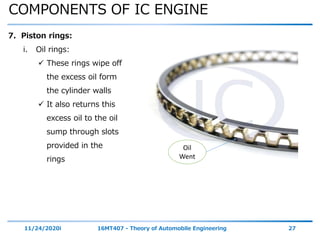
7. Piston rings:
i. Oil rings:
 These rings wipe off
the excess oil form
the cylinder walls
 It also returns this
excess oil to the oil
sump through slots
provided in the
rings
Oil
Went
COMPONENTS OF IC ENGINE
11/24/2020i 16MT407 - Theory of Automobile Engineering 28
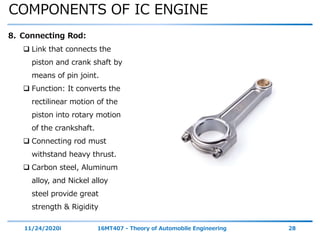
8. Connecting Rod:
 Link that connects the
piston and crank shaft by
means of pin joint.
 Function: It converts the
rectilinear motion of the
piston into rotary motion
of the crankshaft.
 Connecting rod must
withstand heavy thrust.
 Carbon steel, Aluminum
alloy, and Nickel alloy
steel provide great
strength & Rigidity
COMPONENTS OF IC ENGINE
11/24/2020 16MT407 - Theory of Automobile Engineering 29
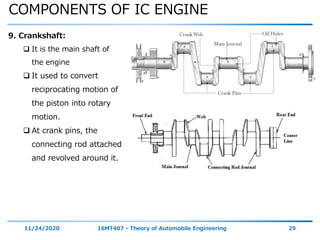
9. Crankshaft:
 It is the main shaft of
the engine
 It used to convert
reciprocating motion of
the piston into rotary
motion.
 At crank pins, the
connecting rod attached
and revolved around it.
COMPONENTS OF IC ENGINE
11/24/2020 16MT407 - Theory of Automobile Engineering 30
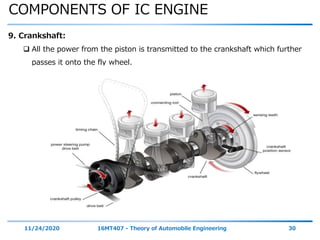
9. Crankshaft:
 All the power from the piston is transmitted to the crankshaft which further
passes it onto the fly wheel.
COMPONENTS OF IC ENGINE
11/24/2020 16MT407 - Theory of Automobile Engineering 31
9. Crankshaft:
 The material of the crank shaft should be strong enough to resist the heavy
impact force of the piston
 They are made of hot billet steel, Carbon steel, Nickel – chromium and
other heat treated alloy steels.
COMPONENTS OF IC ENGINE
11/24/2020 16MT407 - Theory of Automobile Engineering 32
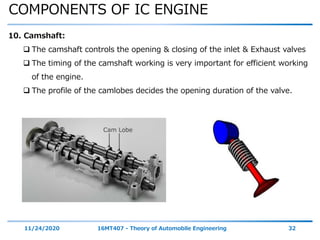
10. Camshaft:
 The camshaft controls the opening & closing of the inlet & Exhaust valves
 The timing of the camshaft working is very important for efficient working
of the engine.
 The profile of the camlobes decides the opening duration of the valve.
COMPONENTS OF IC ENGINE
11/24/2020 16MT407 - Theory of Automobile Engineering 33
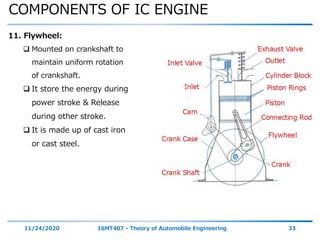
11. Flywheel:
 Mounted on crankshaft to
maintain uniform rotation
of crankshaft.
 It store the energy during
power stroke & Release
during other stroke.
 It is made up of cast iron
or cast steel.
COMPONENTS OF IC ENGINE
11/24/2020 16MT407 - Theory of Automobile Engineering 34
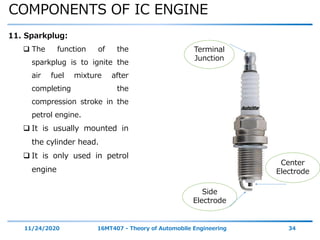
11. Sparkplug:
 The function of the
sparkplug is to ignite the
air fuel mixture after
completing the
compression stroke in the
petrol engine.
 It is usually mounted in
the cylinder head.
 It is only used in petrol
engine
Side
Electrode
Terminal
Junction
Center
Electrode
COMPONENTS OF IC ENGINE
11/24/2020 16MT407 - Theory of Automobile Engineering 35
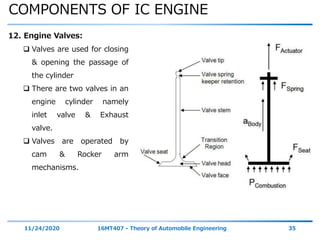
12. Engine Valves:
 Valves are used for closing
& opening the passage of
the cylinder
 There are two valves in an
engine cylinder namely
inlet valve & Exhaust
valve.
 Valves are operated by
cam & Rocker arm
mechanisms.
COMPONENTS OF IC ENGINE
11/24/2020 16MT407 - Theory of Automobile Engineering 36
12. Engine Valves:
Valve mechanisms :
1. Side valve
Mechanism
2. Overhead valve
Mechanism
3. Overhead inlet &
Side exhaust valve
mechanism.
COMPONENTS OF IC ENGINE
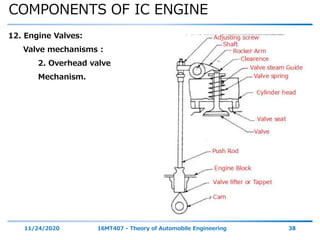
11/24/2020 16MT407 - Theory of Automobile Engineering 37
12. Engine Valves:
Valve mechanisms :
1. Side valve
Mechanism
COMPONENTS OF IC ENGINE
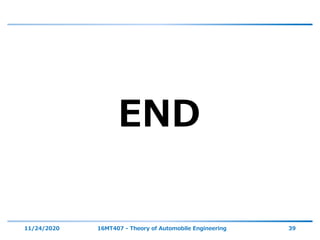
11/24/2020 16MT407 - Theory of Automobile Engineering 38
12. Engine Valves:
Valve mechanisms :
2. Overhead valve
Mechanism.
11/24/2020 16MT407 - Theory of Automobile Engineering 39
END

Components of engine & its materials

  • 1.
    SRI KRISHNA COLLEGEOF ENGINEERING AND TECHNOLOGY DEPARTMENT OF MECHATRONICS ENGINEERING Session: Engine Components & its Materials 11/24/2020 16MT407 - Theory of Automobile Engineering 1 MODULE 1
  • 2.
    SESSION OBJECTIVES 11/24/2020 16MT407- Theory of Automobile Engineering 2  On the completion of this session, the students might be able to understand,  Revolution in Engine modification  Engine Classification  Components of Engine & Its materials.
  • 3.
    Topics  History ofengine development  Combustion  Types of Engine  Components of Engine & its material 11/24/2020 16MT407 - Theory of Automobile Engineering 3
  • 4.
    History of EngineDevelopment 11/24/2020 16MT407 - Theory of Automobile Engineering 4 Newcomen Atmospheric Engine :  Invented by Thomas Newcomen in 1712  First practical device to harness steam to produce mechanical work.  Britain and Europe used this engine for pump water out from mines.  The engine was operated by condensing steam drawn into the cylinder.
  • 5.
    History of EngineDevelopment 11/24/2020 16MT407 - Theory of Automobile Engineering 5 Watt Steam Engine : 1776  Also called Mathew Boulton and watt steam engine.  It was a first type of steam engine to make use of separate condenser.
  • 6.
    History of EngineDevelopment 11/24/2020 16MT407 - Theory of Automobile Engineering 6 Year of engine Revolution :1769  France inventor Nicolas Joseph cugnot propelled first mechanical vehicle – using steam engine  First true automobile  It is a Tricycle.  Steam Engine  4 Passenger  2.25 miles per hour speed.
  • 7.
    History of EngineDevelopment 11/24/2020i 16MT407 - Theory of Automobile Engineering 7 Start of Internal Combustion Engine:  Francois Isaac deRivaz – Inventor of first hydrogen powered Internal combustion engine with electric Ignition in the year of 1808  Jean joseph Etienne Lenoir – Invented the Lenoir gas engine in 1859  Fuel – Coal & Air Francois Isaac deRivaz Jean joseph Etienne Lenoir
  • 8.
    History of EngineDevelopment 11/24/2020i 16MT407 - Theory of Automobile Engineering 8 Otto’s Atmospheric Engine:  Compressed Charge Internal combustion Engine ran on Petroleum  Invented by Nicholas August Otto  German Engineer Liquid Fueled Engine - 1861 Otto’s 1876 Four cycle Engine Nicholas August Otto
  • 9.
    COMBUSTION 11/24/2020i 16MT407 -Theory of Automobile Engineering 9 Internal Combustion Engine:  An internal combustion engine is a heat engine.  Which converts the heat energy released by combustion of fuel taking place inside the engine into mechanical work.
  • 10.
    COMBUSTION 11/24/2020i 16MT407 -Theory of Automobile Engineering 10 What is Combustion :  Combustion is a high temperature exothermic redox chemical reaction between fuel (the reducant) and an oxidant, usually atmospheric oxygen, that produces oxidized, often gaseous products, in a mixture termed as smoke  In combustion fire produces a flame & heat will sustained the combustion.  Oxidation – Loss of electron  Reduction – gain of electron Oxidation & Reduction
  • 11.
    Engine classification 11/24/2020i 16MT407- Theory of Automobile Engineering 11 Classification of Engine : Oxidation & Reduction According to the type of Fuel used Petrol Engine Diesel Engine Gas Engine Bi-Fuel Engine
  • 12.
    Engine classification 11/24/2020i 16MT407- Theory of Automobile Engineering 12 Classification of Engine : According to the number of strokes per cycle 4 – Stroke Engine 2 – Stroke Engine
  • 13.
    Engine classification 11/24/2020i 16MT407- Theory of Automobile Engineering 13 Classification of Engine : According to the Method of Ignition Spark Ignition Compression Ignition
  • 14.
    Engine classification 11/24/2020i 16MT407- Theory of Automobile Engineering 14 Classification of Engine : According to the Cycle of Combustion Otto Cycle Diesel Cycle Duel Combustion
  • 15.
    Engine classification 11/24/2020i 16MT407- Theory of Automobile Engineering 15 Classification of Engine : According to the Number of Cylinder Single Cylinder Multi cylinder
  • 16.
    Engine classification 11/24/2020i 16MT407- Theory of Automobile Engineering 16 Classification of Engine : According to the arrangement of cylinder 1. In-Line Engine 2. V – Type Engine 3. Opposite Cylinder Engine 4. W – Engine 5. Opposite Piston Engine 6. Radial Engine W – Engine
  • 17.
    Engine classification 11/24/2020i 16MT407- Theory of Automobile Engineering 17 Classification of Engine : According to cooling:  Air cooled Engine - Contains fins all around the cylinders, Cylinder head, and exhaust port. - which provide increase area for better radiation of heat.  Water Cooled Engine - Water jackets around the cylinders, Combustion chambers, Valve, Ports, etc. - Radiator is used to cool hot water.
  • 18.
    COMPONENTS OF ICENGINE 11/24/2020i 16MT407 - Theory of Automobile Engineering 18 PARTS OF IC ENGINE:  Cylinder Block  Piston  Piston Rings  Connecting Rod  Crank & Crankshaft  Valves  Flywheel  Crankcase
  • 19.
    COMPONENTS OF ICENGINE 11/24/2020i 16MT407 - Theory of Automobile Engineering 19 1. Cylinder Block:  Part of the engine where fuel is burn and power is developed  Inside diameter is called as Bore diameter  Sleeve is fitted tightly in cylinder to prevent wearing of the block.  Cylinder block made up of Grey cast iron or aluminum with steel sleeves.
  • 20.
    COMPONENTS OF ICENGINE 11/24/2020i 16MT407 - Theory of Automobile Engineering 20 2. Cylinder Head:  Cylinder head is bolted at the top of the cylinder block.  It houses the inlet & Exhaust valve.  It also contains spark plug hole or injector hole and cooling water jacket.  The material used for cylinder heads are cast iron, aluminum alloy etc.
  • 21.
    COMPONENTS OF ICENGINE 11/24/2020i 16MT407 - Theory of Automobile Engineering 21 3. Cylinder Linear:  Linear material should withstand abrasive wear & Corrosive wear.  Chromium plated mild steel tubes are used as linear
  • 22.
    COMPONENTS OF ICENGINE 11/24/2020i 16MT407 - Theory of Automobile Engineering 22 4. Oil sump or oil pair:  Oil sump is fitted at the bottom of crankcase by using gasket. It contains lubricating oil  A drain plug is provided to the oil sump to drain out the oil. It made of pressesd steel sheet.
  • 23.
    COMPONENTS OF ICENGINE 11/24/2020i 16MT407 - Theory of Automobile Engineering 23 5. Piston:  It is a cylindrical shaped mass that reciprocates inside the cylinder.  Purposes :  It acts as a movable gas tight seal to keep the gasses inside the cylinder.  It transmits the force of explosion in the cylinder to the crankshaft through connecting rod.
  • 24.
    COMPONENTS OF ICENGINE 11/24/2020i 16MT407 - Theory of Automobile Engineering 24 6. Piston:  Cast Iron, Aluminum alloy, Chrome- Nickel alloy, Nickel iron alloy, and cast steel are used to fabricate piston using Casting or forging method Crown Skirt Lands Oil ring groove
  • 25.
    COMPONENTS OF ICENGINE 11/24/2020i 16MT407 - Theory of Automobile Engineering 25 7. Piston rings:  Metallic Rings inserted into groves provided at the top end of the piston  Function : It maintains a gas – Tight joint between the piston and the cylinder.  The material used for piston rings are cast iron, alloy cast iron containing silicon and manganese, alloy steel, etc.  Piston ring are generally coated with chromium or cadmium
  • 26.
    COMPONENTS OF ICENGINE 11/24/2020i 16MT407 - Theory of Automobile Engineering 26 7. Piston rings: i. Compression rings:  These rings provide an effective seal for the high pressure gasses inside the cylinder.  Each piston provided with at least two compression rings 1st Ring: Maintains the seal and prevents the escape of burned gases and loss of pressure in the combustion chamber 2nd Ring: Compression ring aids the top ring in sealing & Cooling
  • 27.
    COMPONENTS OF ICENGINE 11/24/2020i 16MT407 - Theory of Automobile Engineering 27 7. Piston rings: i. Oil rings:  These rings wipe off the excess oil form the cylinder walls  It also returns this excess oil to the oil sump through slots provided in the rings Oil Went
  • 28.
    COMPONENTS OF ICENGINE 11/24/2020i 16MT407 - Theory of Automobile Engineering 28 8. Connecting Rod:  Link that connects the piston and crank shaft by means of pin joint.  Function: It converts the rectilinear motion of the piston into rotary motion of the crankshaft.  Connecting rod must withstand heavy thrust.  Carbon steel, Aluminum alloy, and Nickel alloy steel provide great strength & Rigidity
  • 29.
    COMPONENTS OF ICENGINE 11/24/2020 16MT407 - Theory of Automobile Engineering 29 9. Crankshaft:  It is the main shaft of the engine  It used to convert reciprocating motion of the piston into rotary motion.  At crank pins, the connecting rod attached and revolved around it.
  • 30.
    COMPONENTS OF ICENGINE 11/24/2020 16MT407 - Theory of Automobile Engineering 30 9. Crankshaft:  All the power from the piston is transmitted to the crankshaft which further passes it onto the fly wheel.
  • 31.
    COMPONENTS OF ICENGINE 11/24/2020 16MT407 - Theory of Automobile Engineering 31 9. Crankshaft:  The material of the crank shaft should be strong enough to resist the heavy impact force of the piston  They are made of hot billet steel, Carbon steel, Nickel – chromium and other heat treated alloy steels.
  • 32.
    COMPONENTS OF ICENGINE 11/24/2020 16MT407 - Theory of Automobile Engineering 32 10. Camshaft:  The camshaft controls the opening & closing of the inlet & Exhaust valves  The timing of the camshaft working is very important for efficient working of the engine.  The profile of the camlobes decides the opening duration of the valve.
  • 33.
    COMPONENTS OF ICENGINE 11/24/2020 16MT407 - Theory of Automobile Engineering 33 11. Flywheel:  Mounted on crankshaft to maintain uniform rotation of crankshaft.  It store the energy during power stroke & Release during other stroke.  It is made up of cast iron or cast steel.
  • 34.
    COMPONENTS OF ICENGINE 11/24/2020 16MT407 - Theory of Automobile Engineering 34 11. Sparkplug:  The function of the sparkplug is to ignite the air fuel mixture after completing the compression stroke in the petrol engine.  It is usually mounted in the cylinder head.  It is only used in petrol engine Side Electrode Terminal Junction Center Electrode
  • 35.
    COMPONENTS OF ICENGINE 11/24/2020 16MT407 - Theory of Automobile Engineering 35 12. Engine Valves:  Valves are used for closing & opening the passage of the cylinder  There are two valves in an engine cylinder namely inlet valve & Exhaust valve.  Valves are operated by cam & Rocker arm mechanisms.
  • 36.
    COMPONENTS OF ICENGINE 11/24/2020 16MT407 - Theory of Automobile Engineering 36 12. Engine Valves: Valve mechanisms : 1. Side valve Mechanism 2. Overhead valve Mechanism 3. Overhead inlet & Side exhaust valve mechanism.
  • 37.
    COMPONENTS OF ICENGINE 11/24/2020 16MT407 - Theory of Automobile Engineering 37 12. Engine Valves: Valve mechanisms : 1. Side valve Mechanism
  • 38.
    COMPONENTS OF ICENGINE 11/24/2020 16MT407 - Theory of Automobile Engineering 38 12. Engine Valves: Valve mechanisms : 2. Overhead valve Mechanism.
  • 39.
    11/24/2020 16MT407 -Theory of Automobile Engineering 39 END