SRI KRISHNA COLLEGE OF ENGINEERING AND TECHNOLOGY
DEPARTMENT OF MECHATRONICS ENGINEERING
Session: Unmanned Aerial Vehicles(UAVs)
7/22/2018 15MT409 Autonomous Vehicle Guidance
System
1
MODULE 2
SESSION OBJECTIVES
7/22/2018
15MT409 Autonomous Vehicle Guidance
System
2
 On the completion of this session, the students might
be able to understand,
 Introduction
 Types of UAVs
 Elements of UAVs
 Missions of UAV’s
 UAV’s Navigation System
Topics
 Introduction
 Brief History
 Elements of UAV’s
 Types of UAV’s
 Navigation system of UAV’s
7/22/2018
15MT409 Autonomous Vehicle Guidance
System
3
Introduction
7/22/2018
15MT409 Autonomous Vehicle Guidance
System
4
 UAV – commonly known as ”Drone”
– aircraft without human pilot aboard
 UAVs are a component of Unmanned
Aircraft Systems(UAS)
 Basic components of UAS – UAV,
ground based controller and a
communication system between the
two
 The UAVs may operate either under
remote control or autonomously with
on-board computers
General Atomics MQ-9 Reaper
AliGator – Civil Drone
Brief History
7/22/2018
15MT409 Autonomous Vehicle Guidance
System
5
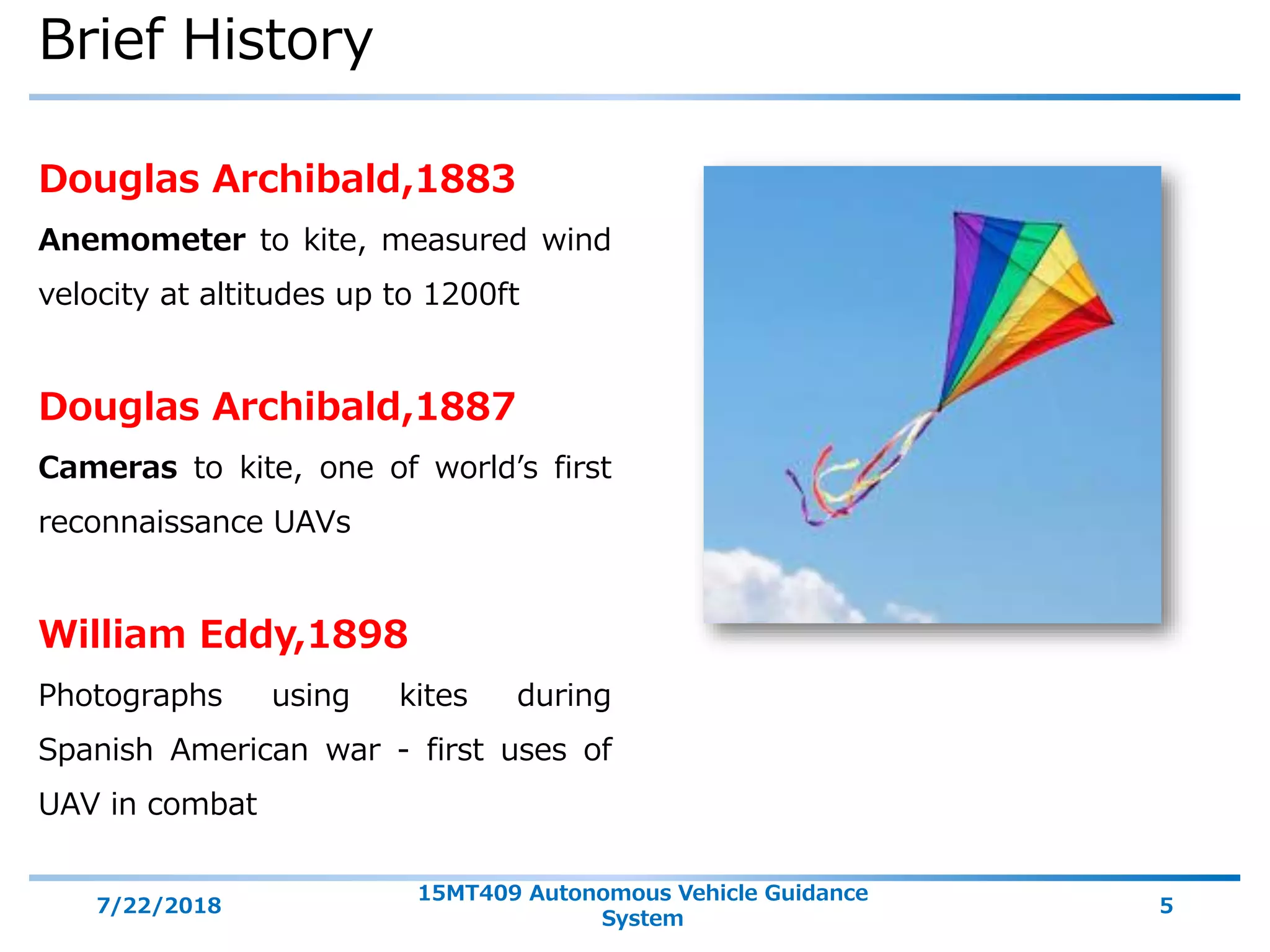
Douglas Archibald,1883
Anemometer to kite, measured wind
velocity at altitudes up to 1200ft
Douglas Archibald,1887
Cameras to kite, one of world’s first
reconnaissance UAVs
William Eddy,1898
Photographs using kites during
Spanish American war - first uses of
UAV in combat
Brief History
7/22/2018
15MT409 Autonomous Vehicle Guidance
System
6
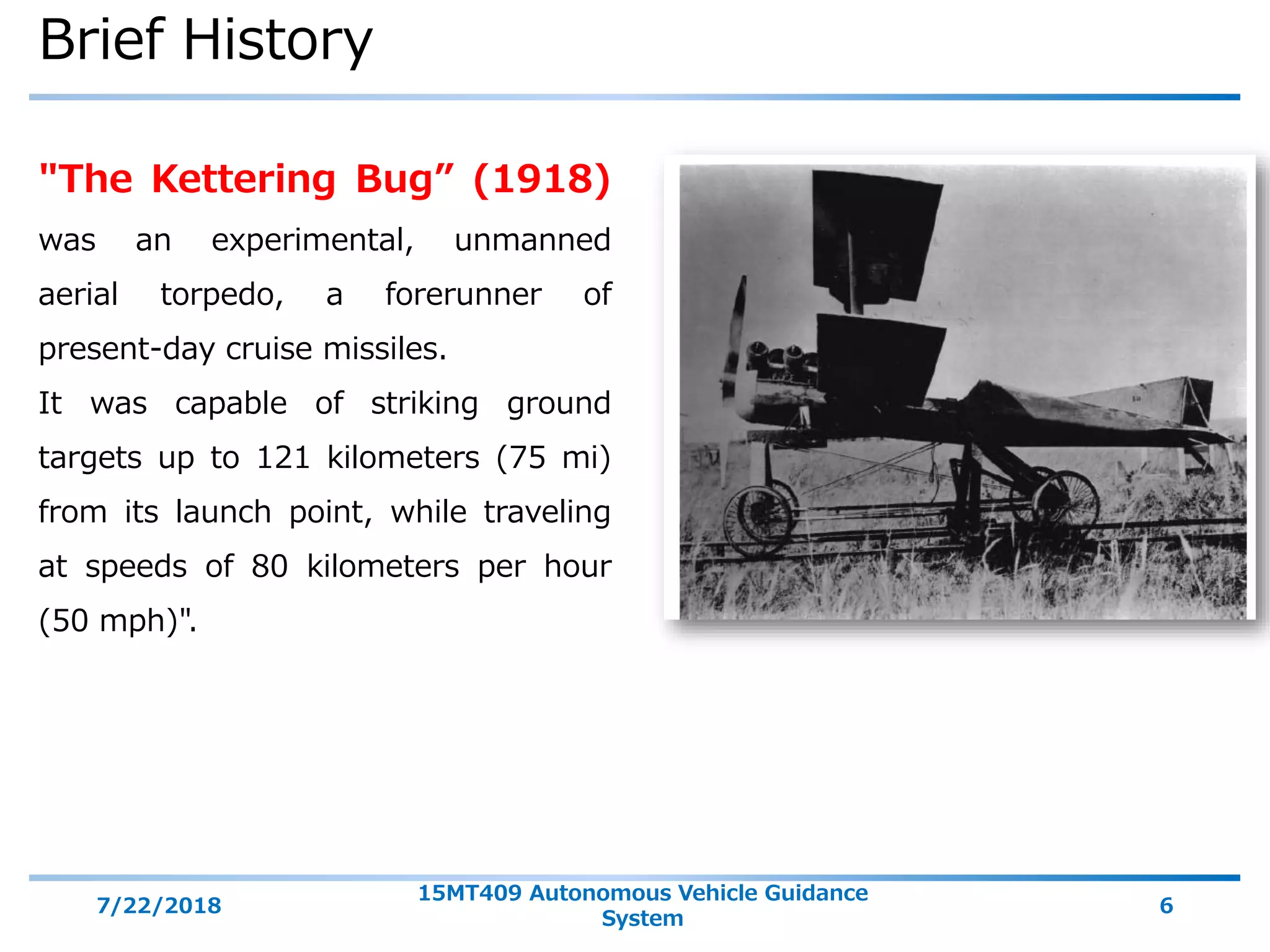
"The Kettering Bug” (1918)
was an experimental, unmanned
aerial torpedo, a forerunner of
present-day cruise missiles.
It was capable of striking ground
targets up to 121 kilometers (75 mi)
from its launch point, while traveling
at speeds of 80 kilometers per hour
(50 mph)".
Elements of UAV
7/22/2018
15MT409 Autonomous Vehicle Guidance
System
7
Air
Vehicle
Ground Control
Station
Data link &
Antenna
 A typical UAV system comprises of
 Air vehicles
 One or more ground control
stations(GCS)
 Mission planning and control
stations(MPCS)
 Payload
 Datalink
 Launch and recovery
subsystems
 Air vehicle carriers
 Ground handling and
maintenance equipment
Air vehicle
7/22/2018
15MT409 Autonomous Vehicle Guidance
System
8
 Airborne part of the system
 Includes airframe, propulsion,
flight controls and electric power
system
 Air data terminal mounted in the
vehicle
 Payload is also onboard the air
vehicle – subsystem that often is
easily interchanged with
different air vehicles
Fixed Wing
Rotary Wing
Ducted fan
Mission planning and control station
7/22/2018
15MT409 Autonomous Vehicle Guidance
System
9
 Also called as Ground control
station(GCS)
 Operational control center of the
UAV system where video,
command, and telemetry data
from the air vehicle are
processed and displayed
 Positions for both air vehicle and
mission payload operators
Communication
antennaPilot & Payload
operator console
Shelter
Communications rack
Workstation
Mission planning and control station
7/22/2018
15MT409 Autonomous Vehicle Guidance
System
10
 Small UAVs, GCS is hand
held hosted on a
ruggedized laptop
 Some GCS are located in
permanent structures
1000 of miles away
 Communication through
satellites
Launch and recovery equipment
7/22/2018
15MT409 Autonomous Vehicle Guidance
System
11
 From conventional takeoff and
landing on prepared sites to
vertical descent using rotary wing
or fan systems.
 Pyrotechnic (rocket) propulsion, or
a combination of
pneumatic/hydraulic arrangements
are also popular methods for
launching air vehicles.
 Some small UAVs are launched by
hand, essentially thrown into the
air like a toy glider
Launch and recovery equipment
7/22/2018
15MT409 Autonomous Vehicle Guidance
System
12
 Nets and arresting gear are used to
capture fixed-wing air vehicles in
small spaces.
 Parachutes and parafoils are used
for landing in small areas for point
recoveries
Payloads
7/22/2018
15MT409 Autonomous Vehicle Guidance
System
13
 Often include video cameras,
either daylight or night (image-
intensifiers or thermal infrared),
for reconnaissance and
surveillance missions.
 Armed UAVs carry weapons to
be fired, dropped, or launched
 “Lethal” UAVs carry explosive
or other types of warheads and
may be deliberately crashed
into targets
Flight
Computer
Gyro stabilized
observation
platform
Digital cameras and sensors
Mission and
payload control
Communication
subsystem
Payloads
7/22/2018
15MT409 Autonomous Vehicle Guidance
System
14
 A laser may be added with additional
cost
 Radar sensors, using Moving Target
Indicator(MTI) or Synthetic Aperture
Radar(SAR) are also important payloads
 Electronic Warfare(EW) systems
 Signal Intelligence(SIGINT) and jammer
 Meteorological and chemical sensing
devices
Datalinks
7/22/2018
15MT409 Autonomous Vehicle Guidance
System
15
 Two-way communication, either upon
demand or on a continuous basis.
 An uplink with a data rate of a few kHz
provides control of the air-vehicle flight
path and commands to its payload.
 The downlink:
 low data-rate channel to acknowledge
commands and transmit status
information about the air vehicle
 a high data-rate channel (1–10 MHz)
for sensor data such as video and
radar.
Datalinks
7/22/2018
15MT409 Autonomous Vehicle Guidance
System
16
 The data link may also be called upon
to measure the position of the air
vehicle
 This information is used to assist in
navigation and accurately determining
air-vehicle location
 Ground data terminal microwave
electronic system transmitting
guidance and payload commands
Ground
control
station
UAV
Ground
terminals
Datalinks
7/22/2018
15MT409 Autonomous Vehicle Guidance
System
17
 Multiple vehicle control with single
operator
 Air data terminal – includes
transmitter and antenna for
transmitting video air vehicle data
and receiver for receiving
commands form the ground
Ground support equipment
7/22/2018
15MT409 Autonomous Vehicle Guidance
System
18
 GSE may include:
 test and maintenance
equipment,
 a supply of spare parts and
other expendables,
 a fuel supply and any
refueling equipment required
by a particular air vehicle,
 handling equipment to move
air vehicles
 generators to power all of the
other support equipment.
Size Classes of UAV
7/22/2018
15MT409 Autonomous Vehicle Guidance
System
19
UAV
Very small Small LargeMedium
 Micro sized –
30-50cm
 Flapping wings
type
 Conventional
aircraft type
 Size>50cm
 Fixed wing
type
 too large to be
carried around by
one person but
smaller than an
aircraft
 Larger than a
typical one
manned aircraft
 Long distances
capability
Very small UAVs
7/22/2018
15MT409 Autonomous Vehicle Guidance
System
20
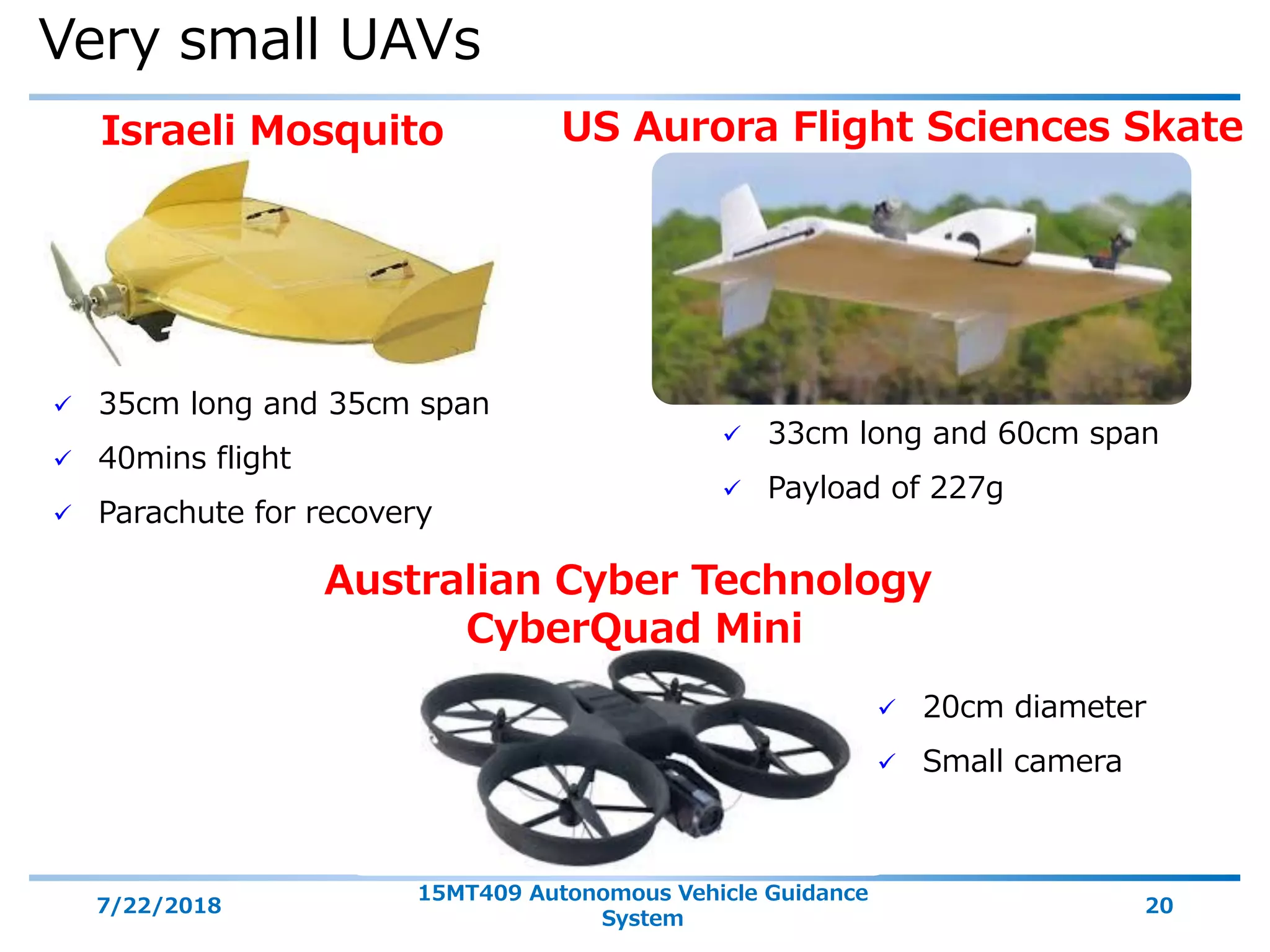
Israeli Mosquito
 35cm long and 35cm span
 40mins flight
 Parachute for recovery
US Aurora Flight Sciences Skate
 33cm long and 60cm span
 Payload of 227g
Australian Cyber Technology
CyberQuad Mini
 20cm diameter
 Small camera
Small UAVs
7/22/2018
15MT409 Autonomous Vehicle Guidance
System
21
US AeroVironment Raven
 1.4m span and 1m long
 Less than 2kg
 Electrical propulsion
 Carry visible, infrared and
thermal imaging systems
 Control station carried by
operator
Bayraktar Mini UAV
 2m span and 1.2m long
 5kg weight
 Electrical propulsion
 20km range
 Night and day camera can
be attached
Medium UAVs
7/22/2018
15MT409 Autonomous Vehicle Guidance
System
22
Pioneer RQ2
 Wingspan 5.2m
 220kg payload
 205kg weight
 200kph speed
 5.5h endurance
 Max. altitude 15,000ft
 Pneumatic or rocket launched
Skyeye R4E UAV
 Wingspan 7.3m
 80kg payload
 570kg weight
 8-10h endurance
 Max. altitude 14,803ft
 Parafoil or a parachute-no
landing gear
Medium UAVs
7/22/2018
15MT409 Autonomous Vehicle Guidance
System
23
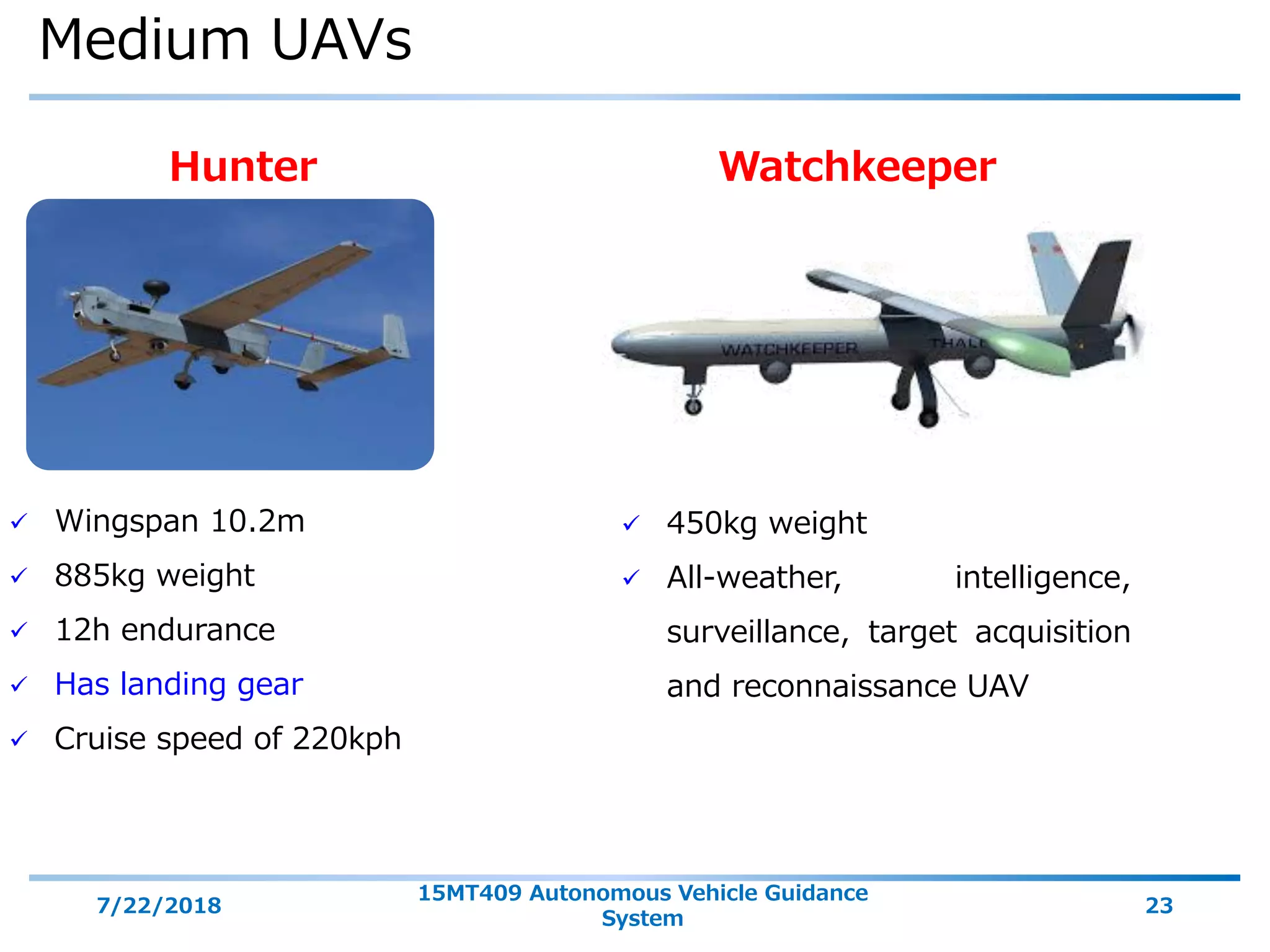
Hunter
 Wingspan 10.2m
 885kg weight
 12h endurance
 Has landing gear
 Cruise speed of 220kph
Watchkeeper
 450kg weight
 All-weather, intelligence,
surveillance, target acquisition
and reconnaissance UAV
Medium UAVs
7/22/2018
15MT409 Autonomous Vehicle Guidance
System
24
Fire Scout
 Wingspan 9.2m
 630kg payload
 VTOL – Vertical Takeoff &
Landing
Eagle Eye
 Tilt wing technology
 5.2m span
 1300kg weight
 345kph speed
 19,308 ft altitude
Large UAVs
7/22/2018
15MT409 Autonomous Vehicle Guidance
System
25
Predator A
 Wingspan 17m
 336kg payload
 220kph speed
 40h endurance
 Max. altitude 24,521 ft
 real-time surveillance using high-
resolution video, infrared imaging, and
synthetic aperture radar.
Global Hawk
 Wingspan 40m
 1460kg takeoff weight
 32h endurance
 575kph max speed
 radar, electro-optical, and
infrared sensors
Range and Endurance Classes of UAV
7/22/2018
15MT409 Autonomous Vehicle Guidance
System
26
UAV
Very Low Cost
Close Range Close Range
 Range of 5km
 $10,000 cost
 Eg: Dragon Eye and Raven
 Used by Marine Corps
 50km range
 1-6h endurance
 Air force – for damage assessment
 Army and Marine corps- look over
the next hill
 Navy – want to operate from ships
 reconnaissance and surveillance,
day and night
Range and Endurance Classes of UAV
7/22/2018
15MT409 Autonomous Vehicle Guidance
System
27
UAV
Short Range Mid Range
 All of the services
 150km range
 Endurance time 8-
12h
 Reconnaissance and
surveillance, day
and night
 All services except
army
 650km range
 Day/night
reconnaissance and
surveillance and
gathering of
meteorological data
Endurance
 All services
 300km range
 36h endurance
 Day/night
reconnaissance and
surveillance and
gathering of
meteorological data
The Tier System
7/22/2018
15MT409 Autonomous Vehicle Guidance
System
28
Tier I: Low altitude, long endurance
Tier II: Medium altitude, long endurance (MALE).
An example is the MQ-1 Predator.
Tier II+: High altitude, long endurance (HALE) conventional UAV.
Altitude:60,000–65,000 ft (19,800 m),
Less than 300 knots (560 km/h) airspeed,
3,000- nautical-mile (6,000 km) radius,
24 h time-on-station capability
Tier III: HALE low-observable (LO) UAV.
Same as the Tier II+ aircraft with the addition of LO.
An example is the RQ-3 DarkStar
Missions
7/22/2018
15MT409 Autonomous Vehicle Guidance
System
29
UAV
Reconnaissance Surveillance
 Obtain by visual or other
detection methods information
about what is present or
happening at some point or in
some area
 Systematic observation of
aerospace, surface or subsurface
areas, places persons or things by
visual, aural, electronic,
photographic or other means
Missions
7/22/2018
15MT409 Autonomous Vehicle Guidance
System
30
 Surveillance implies long endurance and, for the military, somewhat stealthy
operations that will allow the UAV to remain overhead for long periods of
time
 Military :
 Detection and identification of stationary and moving targets both day
and night
 Target or artillery spotting
 Electronic Warfare(EW)
 Listening to an enemy transmission
 Weapon delivery
Guidance, Navigation & Control(GNC)
7/22/2018
15MT409 Autonomous Vehicle Guidance
System
31
 Guidance :
 Determination of the desired path of travel (the "trajectory") from the
vehicle's current location to a designated target, as well as desired
changes in velocity, rotation and acceleration for following that path.
 Navigation :
 Determination, at a given time, of the vehicle's location and velocity (the
"state vector") as well as its attitude
 Control :
 Manipulation of the forces, by way of steering controls, thrusters, etc.,
needed to execute guidance commands whilst maintaining vehicle
stability
Navigation Systems
7/22/2018
15MT409 Autonomous Vehicle Guidance
System
32
Navigation Systems
Global
Positioning
System(GPS)
TACtical Air
Navigation
(TACAN)
LOng RAnge
Navigation
(LORAN)
Inertial
Navigation
Radio
Tracking
Way-point
navigation
Global Positioning Systems(GPS)
7/22/2018
15MT409 Autonomous Vehicle Guidance
System
33
 Developed by US DOD and
named as NAVSTAR GPS
 Uses primarily 4 satellites
orbiting at 20,000 km to
locate
 Satellite – atomic clock and
transmits radio signals (1.1-
1.6GHz) that travel at a
known speed
 Receiver – uses the received
signal time to calculate its
range from each satellite and
so its position on earth
S1
S2
S3
S4
Global Positioning Systems(GPS)
7/22/2018
15MT409 Autonomous Vehicle Guidance
System
34
 GPS enables the operation of
MALE and HALE UAV systems
effectively
 Dead Reckoning(DR system) –
discrete positions based on
previous location based on
speed, time and direction
 GPS may have some local
errors, local radio frequency
interference
 Can be improved using filters
Global Positioning Systems(GPS)
7/22/2018
15MT409 Autonomous Vehicle Guidance
System
35
GPS
Standard
Positioning
System(SPS)
Precise
Positioning
Service(PPS)
 Civilian users
 L1 frequency -
1575.42 MHz
 Positional
accuracy of 10m
 Military users
 L1 and L2 frequency
- 1575.42 MHz &
1227.60 MHz
 Positional accuracy of
3m
Differential
GPS(DGPS)
 Fixed, ground based
reference stations
 Accuracy of 0.2m per
100km
TACAN
7/22/2018
15MT409 Autonomous Vehicle Guidance
System
36
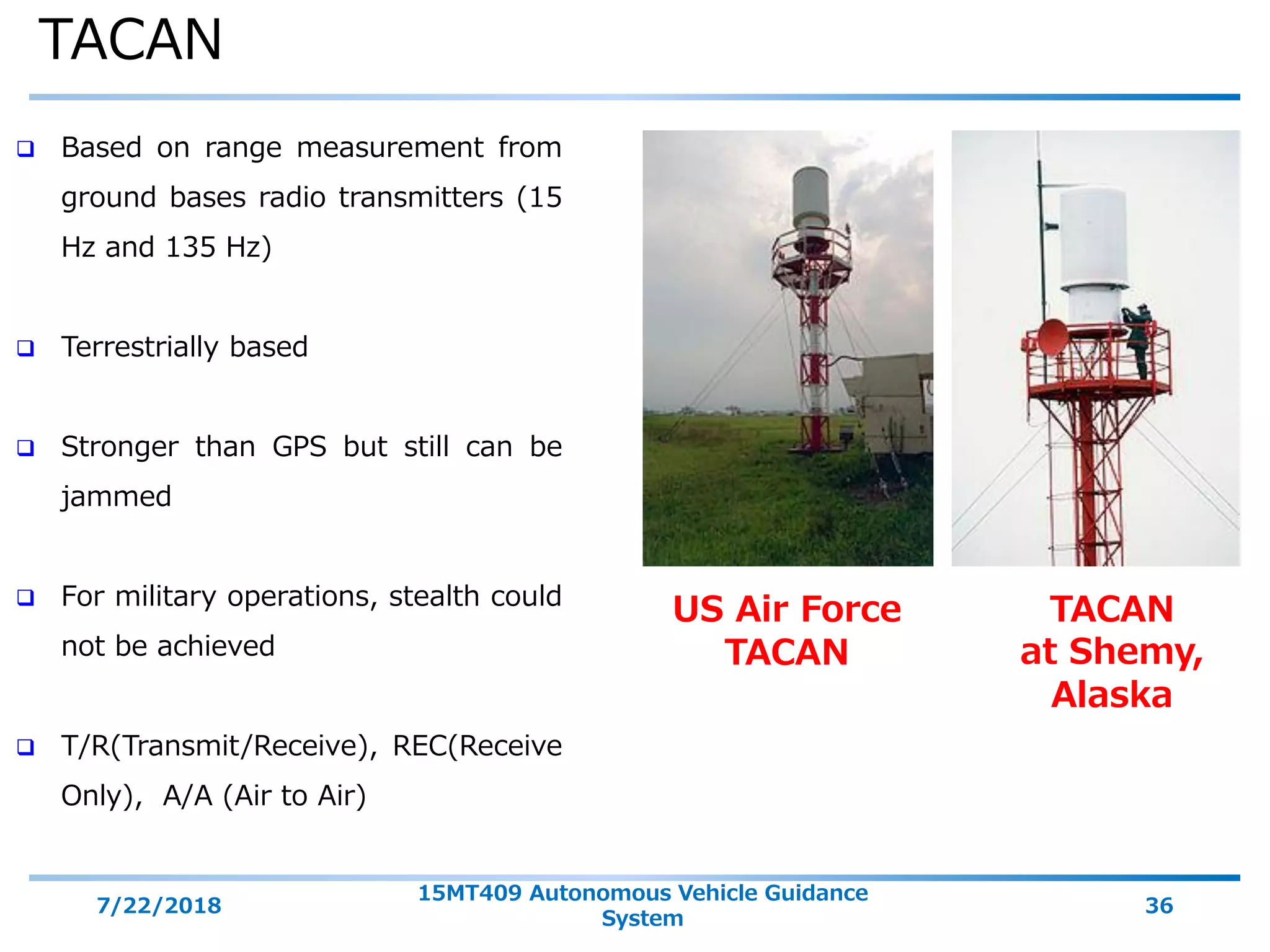
 Based on range measurement from
ground bases radio transmitters (15
Hz and 135 Hz)
 Terrestrially based
 Stronger than GPS but still can be
jammed
 For military operations, stealth could
not be achieved
 T/R(Transmit/Receive), REC(Receive
Only), A/A (Air to Air)
US Air Force
TACAN
TACAN
at Shemy,
Alaska
LORAN
7/22/2018
15MT409 Autonomous Vehicle Guidance
System
37
 Stronger signals than TACAN and is
less easy to jam
7/22/2018
15MT409 Autonomous Vehicle Guidance
System
38
END

unmanned aerial vehicles

  • 1.
    SRI KRISHNA COLLEGEOF ENGINEERING AND TECHNOLOGY DEPARTMENT OF MECHATRONICS ENGINEERING Session: Unmanned Aerial Vehicles(UAVs) 7/22/2018 15MT409 Autonomous Vehicle Guidance System 1 MODULE 2
  • 2.
    SESSION OBJECTIVES 7/22/2018 15MT409 AutonomousVehicle Guidance System 2  On the completion of this session, the students might be able to understand,  Introduction  Types of UAVs  Elements of UAVs  Missions of UAV’s  UAV’s Navigation System
  • 3.
    Topics  Introduction  BriefHistory  Elements of UAV’s  Types of UAV’s  Navigation system of UAV’s 7/22/2018 15MT409 Autonomous Vehicle Guidance System 3
  • 4.
    Introduction 7/22/2018 15MT409 Autonomous VehicleGuidance System 4  UAV – commonly known as ”Drone” – aircraft without human pilot aboard  UAVs are a component of Unmanned Aircraft Systems(UAS)  Basic components of UAS – UAV, ground based controller and a communication system between the two  The UAVs may operate either under remote control or autonomously with on-board computers General Atomics MQ-9 Reaper AliGator – Civil Drone
  • 5.
    Brief History 7/22/2018 15MT409 AutonomousVehicle Guidance System 5 Douglas Archibald,1883 Anemometer to kite, measured wind velocity at altitudes up to 1200ft Douglas Archibald,1887 Cameras to kite, one of world’s first reconnaissance UAVs William Eddy,1898 Photographs using kites during Spanish American war - first uses of UAV in combat
  • 6.
    Brief History 7/22/2018 15MT409 AutonomousVehicle Guidance System 6 "The Kettering Bug” (1918) was an experimental, unmanned aerial torpedo, a forerunner of present-day cruise missiles. It was capable of striking ground targets up to 121 kilometers (75 mi) from its launch point, while traveling at speeds of 80 kilometers per hour (50 mph)".
  • 7.
    Elements of UAV 7/22/2018 15MT409Autonomous Vehicle Guidance System 7 Air Vehicle Ground Control Station Data link & Antenna  A typical UAV system comprises of  Air vehicles  One or more ground control stations(GCS)  Mission planning and control stations(MPCS)  Payload  Datalink  Launch and recovery subsystems  Air vehicle carriers  Ground handling and maintenance equipment
  • 8.
    Air vehicle 7/22/2018 15MT409 AutonomousVehicle Guidance System 8  Airborne part of the system  Includes airframe, propulsion, flight controls and electric power system  Air data terminal mounted in the vehicle  Payload is also onboard the air vehicle – subsystem that often is easily interchanged with different air vehicles Fixed Wing Rotary Wing Ducted fan
  • 9.
    Mission planning andcontrol station 7/22/2018 15MT409 Autonomous Vehicle Guidance System 9  Also called as Ground control station(GCS)  Operational control center of the UAV system where video, command, and telemetry data from the air vehicle are processed and displayed  Positions for both air vehicle and mission payload operators Communication antennaPilot & Payload operator console Shelter Communications rack Workstation
  • 10.
    Mission planning andcontrol station 7/22/2018 15MT409 Autonomous Vehicle Guidance System 10  Small UAVs, GCS is hand held hosted on a ruggedized laptop  Some GCS are located in permanent structures 1000 of miles away  Communication through satellites
  • 11.
    Launch and recoveryequipment 7/22/2018 15MT409 Autonomous Vehicle Guidance System 11  From conventional takeoff and landing on prepared sites to vertical descent using rotary wing or fan systems.  Pyrotechnic (rocket) propulsion, or a combination of pneumatic/hydraulic arrangements are also popular methods for launching air vehicles.  Some small UAVs are launched by hand, essentially thrown into the air like a toy glider
  • 12.
    Launch and recoveryequipment 7/22/2018 15MT409 Autonomous Vehicle Guidance System 12  Nets and arresting gear are used to capture fixed-wing air vehicles in small spaces.  Parachutes and parafoils are used for landing in small areas for point recoveries
  • 13.
    Payloads 7/22/2018 15MT409 Autonomous VehicleGuidance System 13  Often include video cameras, either daylight or night (image- intensifiers or thermal infrared), for reconnaissance and surveillance missions.  Armed UAVs carry weapons to be fired, dropped, or launched  “Lethal” UAVs carry explosive or other types of warheads and may be deliberately crashed into targets Flight Computer Gyro stabilized observation platform Digital cameras and sensors Mission and payload control Communication subsystem
  • 14.
    Payloads 7/22/2018 15MT409 Autonomous VehicleGuidance System 14  A laser may be added with additional cost  Radar sensors, using Moving Target Indicator(MTI) or Synthetic Aperture Radar(SAR) are also important payloads  Electronic Warfare(EW) systems  Signal Intelligence(SIGINT) and jammer  Meteorological and chemical sensing devices
  • 15.
    Datalinks 7/22/2018 15MT409 Autonomous VehicleGuidance System 15  Two-way communication, either upon demand or on a continuous basis.  An uplink with a data rate of a few kHz provides control of the air-vehicle flight path and commands to its payload.  The downlink:  low data-rate channel to acknowledge commands and transmit status information about the air vehicle  a high data-rate channel (1–10 MHz) for sensor data such as video and radar.
  • 16.
    Datalinks 7/22/2018 15MT409 Autonomous VehicleGuidance System 16  The data link may also be called upon to measure the position of the air vehicle  This information is used to assist in navigation and accurately determining air-vehicle location  Ground data terminal microwave electronic system transmitting guidance and payload commands Ground control station UAV Ground terminals
  • 17.
    Datalinks 7/22/2018 15MT409 Autonomous VehicleGuidance System 17  Multiple vehicle control with single operator  Air data terminal – includes transmitter and antenna for transmitting video air vehicle data and receiver for receiving commands form the ground
  • 18.
    Ground support equipment 7/22/2018 15MT409Autonomous Vehicle Guidance System 18  GSE may include:  test and maintenance equipment,  a supply of spare parts and other expendables,  a fuel supply and any refueling equipment required by a particular air vehicle,  handling equipment to move air vehicles  generators to power all of the other support equipment.
  • 19.
    Size Classes ofUAV 7/22/2018 15MT409 Autonomous Vehicle Guidance System 19 UAV Very small Small LargeMedium  Micro sized – 30-50cm  Flapping wings type  Conventional aircraft type  Size>50cm  Fixed wing type  too large to be carried around by one person but smaller than an aircraft  Larger than a typical one manned aircraft  Long distances capability
  • 20.
    Very small UAVs 7/22/2018 15MT409Autonomous Vehicle Guidance System 20 Israeli Mosquito  35cm long and 35cm span  40mins flight  Parachute for recovery US Aurora Flight Sciences Skate  33cm long and 60cm span  Payload of 227g Australian Cyber Technology CyberQuad Mini  20cm diameter  Small camera
  • 21.
    Small UAVs 7/22/2018 15MT409 AutonomousVehicle Guidance System 21 US AeroVironment Raven  1.4m span and 1m long  Less than 2kg  Electrical propulsion  Carry visible, infrared and thermal imaging systems  Control station carried by operator Bayraktar Mini UAV  2m span and 1.2m long  5kg weight  Electrical propulsion  20km range  Night and day camera can be attached
  • 22.
    Medium UAVs 7/22/2018 15MT409 AutonomousVehicle Guidance System 22 Pioneer RQ2  Wingspan 5.2m  220kg payload  205kg weight  200kph speed  5.5h endurance  Max. altitude 15,000ft  Pneumatic or rocket launched Skyeye R4E UAV  Wingspan 7.3m  80kg payload  570kg weight  8-10h endurance  Max. altitude 14,803ft  Parafoil or a parachute-no landing gear
  • 23.
    Medium UAVs 7/22/2018 15MT409 AutonomousVehicle Guidance System 23 Hunter  Wingspan 10.2m  885kg weight  12h endurance  Has landing gear  Cruise speed of 220kph Watchkeeper  450kg weight  All-weather, intelligence, surveillance, target acquisition and reconnaissance UAV
  • 24.
    Medium UAVs 7/22/2018 15MT409 AutonomousVehicle Guidance System 24 Fire Scout  Wingspan 9.2m  630kg payload  VTOL – Vertical Takeoff & Landing Eagle Eye  Tilt wing technology  5.2m span  1300kg weight  345kph speed  19,308 ft altitude
  • 25.
    Large UAVs 7/22/2018 15MT409 AutonomousVehicle Guidance System 25 Predator A  Wingspan 17m  336kg payload  220kph speed  40h endurance  Max. altitude 24,521 ft  real-time surveillance using high- resolution video, infrared imaging, and synthetic aperture radar. Global Hawk  Wingspan 40m  1460kg takeoff weight  32h endurance  575kph max speed  radar, electro-optical, and infrared sensors
  • 26.
    Range and EnduranceClasses of UAV 7/22/2018 15MT409 Autonomous Vehicle Guidance System 26 UAV Very Low Cost Close Range Close Range  Range of 5km  $10,000 cost  Eg: Dragon Eye and Raven  Used by Marine Corps  50km range  1-6h endurance  Air force – for damage assessment  Army and Marine corps- look over the next hill  Navy – want to operate from ships  reconnaissance and surveillance, day and night
  • 27.
    Range and EnduranceClasses of UAV 7/22/2018 15MT409 Autonomous Vehicle Guidance System 27 UAV Short Range Mid Range  All of the services  150km range  Endurance time 8- 12h  Reconnaissance and surveillance, day and night  All services except army  650km range  Day/night reconnaissance and surveillance and gathering of meteorological data Endurance  All services  300km range  36h endurance  Day/night reconnaissance and surveillance and gathering of meteorological data
  • 28.
    The Tier System 7/22/2018 15MT409Autonomous Vehicle Guidance System 28 Tier I: Low altitude, long endurance Tier II: Medium altitude, long endurance (MALE). An example is the MQ-1 Predator. Tier II+: High altitude, long endurance (HALE) conventional UAV. Altitude:60,000–65,000 ft (19,800 m), Less than 300 knots (560 km/h) airspeed, 3,000- nautical-mile (6,000 km) radius, 24 h time-on-station capability Tier III: HALE low-observable (LO) UAV. Same as the Tier II+ aircraft with the addition of LO. An example is the RQ-3 DarkStar
  • 29.
    Missions 7/22/2018 15MT409 Autonomous VehicleGuidance System 29 UAV Reconnaissance Surveillance  Obtain by visual or other detection methods information about what is present or happening at some point or in some area  Systematic observation of aerospace, surface or subsurface areas, places persons or things by visual, aural, electronic, photographic or other means
  • 30.
    Missions 7/22/2018 15MT409 Autonomous VehicleGuidance System 30  Surveillance implies long endurance and, for the military, somewhat stealthy operations that will allow the UAV to remain overhead for long periods of time  Military :  Detection and identification of stationary and moving targets both day and night  Target or artillery spotting  Electronic Warfare(EW)  Listening to an enemy transmission  Weapon delivery
  • 31.
    Guidance, Navigation &Control(GNC) 7/22/2018 15MT409 Autonomous Vehicle Guidance System 31  Guidance :  Determination of the desired path of travel (the "trajectory") from the vehicle's current location to a designated target, as well as desired changes in velocity, rotation and acceleration for following that path.  Navigation :  Determination, at a given time, of the vehicle's location and velocity (the "state vector") as well as its attitude  Control :  Manipulation of the forces, by way of steering controls, thrusters, etc., needed to execute guidance commands whilst maintaining vehicle stability
  • 32.
    Navigation Systems 7/22/2018 15MT409 AutonomousVehicle Guidance System 32 Navigation Systems Global Positioning System(GPS) TACtical Air Navigation (TACAN) LOng RAnge Navigation (LORAN) Inertial Navigation Radio Tracking Way-point navigation
  • 33.
    Global Positioning Systems(GPS) 7/22/2018 15MT409Autonomous Vehicle Guidance System 33  Developed by US DOD and named as NAVSTAR GPS  Uses primarily 4 satellites orbiting at 20,000 km to locate  Satellite – atomic clock and transmits radio signals (1.1- 1.6GHz) that travel at a known speed  Receiver – uses the received signal time to calculate its range from each satellite and so its position on earth S1 S2 S3 S4
  • 34.
    Global Positioning Systems(GPS) 7/22/2018 15MT409Autonomous Vehicle Guidance System 34  GPS enables the operation of MALE and HALE UAV systems effectively  Dead Reckoning(DR system) – discrete positions based on previous location based on speed, time and direction  GPS may have some local errors, local radio frequency interference  Can be improved using filters
  • 35.
    Global Positioning Systems(GPS) 7/22/2018 15MT409Autonomous Vehicle Guidance System 35 GPS Standard Positioning System(SPS) Precise Positioning Service(PPS)  Civilian users  L1 frequency - 1575.42 MHz  Positional accuracy of 10m  Military users  L1 and L2 frequency - 1575.42 MHz & 1227.60 MHz  Positional accuracy of 3m Differential GPS(DGPS)  Fixed, ground based reference stations  Accuracy of 0.2m per 100km
  • 36.
    TACAN 7/22/2018 15MT409 Autonomous VehicleGuidance System 36  Based on range measurement from ground bases radio transmitters (15 Hz and 135 Hz)  Terrestrially based  Stronger than GPS but still can be jammed  For military operations, stealth could not be achieved  T/R(Transmit/Receive), REC(Receive Only), A/A (Air to Air) US Air Force TACAN TACAN at Shemy, Alaska
  • 37.
    LORAN 7/22/2018 15MT409 Autonomous VehicleGuidance System 37  Stronger signals than TACAN and is less easy to jam
  • 38.