SRI KRISHNA COLLEGE OF ENGINEERING AND TECHNOLOGY
DEPARTMENT OF MECHATRONICS ENGINEERING
Session: Introduction to Transmission
System
11/24/2020 16MT407 - Theory of Automobile Engineering 1
MODULE 2
SESSION OBJECTIVES
11/24/2020 16MT407 - Theory of Automobile Engineering 2
 On the completion of this session, the students might
be able to understand,
 Basic Necessity of a transmission system in Vehicle
 How the transmission system provide tractive force
to the vehicle.
Topics
 Function of Transmission system
 Basic Necessity of transmission
 Types of gears and Gear train
 Types of transmission
11/24/2020 16MT407 - Theory of Automobile Engineering 3
FUNCTION OF TRANSMISSION SYSTEM
11/24/2020 16MT407 - Theory of Automobile Engineering 4
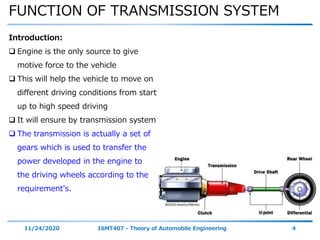
Introduction:
 Engine is the only source to give
motive force to the vehicle
 This will help the vehicle to move on
different driving conditions from start
up to high speed driving
 It will ensure by transmission system
 The transmission is actually a set of
gears which is used to transfer the
power developed in the engine to
the driving wheels according to the
requirement's.
FUNCTION OF TRANSMISSION SYSTEM
11/24/2020 16MT407 - Theory of Automobile Engineering 5
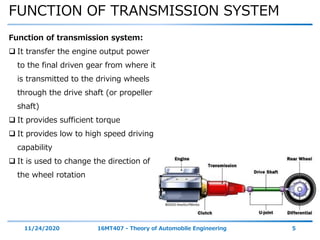
Function of transmission system:
 It transfer the engine output power
to the final driven gear from where it
is transmitted to the driving wheels
through the drive shaft (or propeller
shaft)
 It provides sufficient torque
 It provides low to high speed driving
capability
 It is used to change the direction of
the wheel rotation
BASIC NECESSITY OF GEAR BOX
11/24/2020 16MT407 - Theory of Automobile Engineering 6
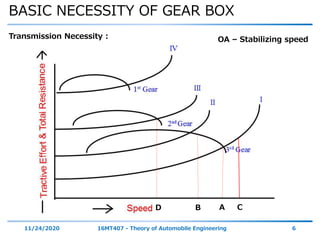
Transmission Necessity :
CAD B
OA – Stabilizing speed
TYPES OF GEARS
11/24/2020 16MT407 - Theory of Automobile Engineering 7
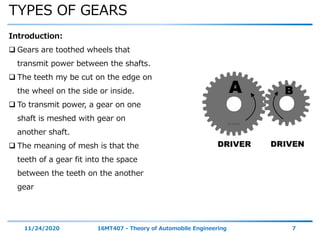
Introduction:
 Gears are toothed wheels that
transmit power between the shafts.
 The teeth my be cut on the edge on
the wheel on the side or inside.
 To transmit power, a gear on one
shaft is meshed with gear on
another shaft.
 The meaning of mesh is that the
teeth of a gear fit into the space
between the teeth on the another
gear
TYPES OF GEARS
11/24/2020 16MT407 - Theory of Automobile Engineering 8
Introduction:
 When one gear turns, then it’s teeth
forces the other gear to turn.
 The gear that does the turning is the
driving gear.[A - Gear]
 The gear that is forced to turn is the
driven gear.[B – Gear]
TYPES OF GEARS
11/24/2020 16MT407 - Theory of Automobile Engineering 9
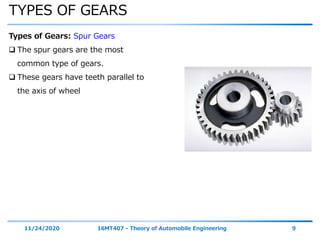
Types of Gears: Spur Gears
 The spur gears are the most
common type of gears.
 These gears have teeth parallel to
the axis of wheel
TYPES OF GEARS
11/24/2020 16MT407 - Theory of Automobile Engineering 10
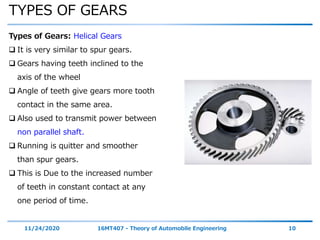
Types of Gears: Helical Gears
 It is very similar to spur gears.
 Gears having teeth inclined to the
axis of the wheel
 Angle of teeth give gears more tooth
contact in the same area.
 Also used to transmit power between
non parallel shaft.
 Running is quitter and smoother
than spur gears.
 This is Due to the increased number
of teeth in constant contact at any
one period of time.
TYPES OF GEARS
11/24/2020 16MT407 - Theory of Automobile Engineering 11
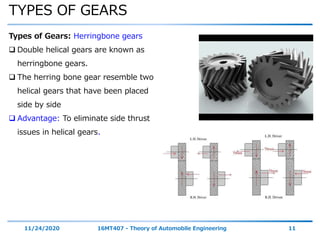
Types of Gears: Herringbone gears
 Double helical gears are known as
herringbone gears.
 The herring bone gear resemble two
helical gears that have been placed
side by side
 Advantage: To eliminate side thrust
issues in helical gears.
TYPES OF GEARS
11/24/2020 16MT407 - Theory of Automobile Engineering 12
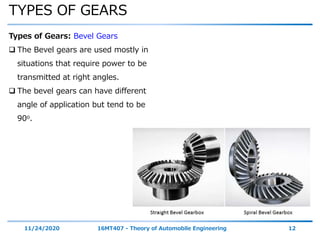
Types of Gears: Bevel Gears
 The Bevel gears are used mostly in
situations that require power to be
transmitted at right angles.
 The bevel gears can have different
angle of application but tend to be
90o.
TYPES OF GEARS
11/24/2020 16MT407 - Theory of Automobile Engineering 13
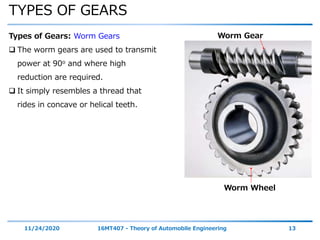
Types of Gears: Worm Gears
 The worm gears are used to transmit
power at 90o and where high
reduction are required.
 It simply resembles a thread that
rides in concave or helical teeth.
Worm Gear
Worm Wheel
TYPES OF GEARS
11/24/2020 16MT407 - Theory of Automobile Engineering 14
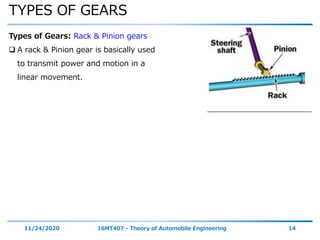
Types of Gears: Rack & Pinion gears
 A rack & Pinion gear is basically used
to transmit power and motion in a
linear movement.
TYPES OF GEARS
11/24/2020 16MT407 - Theory of Automobile Engineering 15
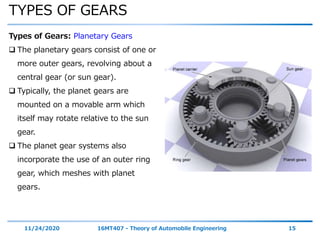
Types of Gears: Planetary Gears
 The planetary gears consist of one or
more outer gears, revolving about a
central gear (or sun gear).
 Typically, the planet gears are
mounted on a movable arm which
itself may rotate relative to the sun
gear.
 The planet gear systems also
incorporate the use of an outer ring
gear, which meshes with planet
gears.
TYPES OF GEARS
11/24/2020 16MT407 - Theory of Automobile Engineering 16
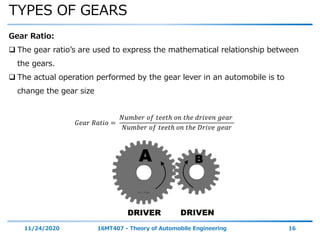
Gear Ratio:
 The gear ratio’s are used to express the mathematical relationship between
the gears.
 The actual operation performed by the gear lever in an automobile is to
change the gear size
𝐺𝑒𝑎𝑟 𝑅𝑎𝑡𝑖𝑜 =
𝑁𝑢𝑚𝑏𝑒𝑟 𝑜𝑓 𝑡𝑒𝑒𝑡ℎ 𝑜𝑛 𝑡ℎ𝑒 𝑑𝑟𝑖𝑣𝑒𝑛 𝑔𝑒𝑎𝑟
𝑁𝑢𝑚𝑏𝑒𝑟 𝑜𝑓 𝑡𝑒𝑒𝑡ℎ 𝑜𝑛 𝑡ℎ𝑒 𝐷𝑟𝑖𝑣𝑒 𝑔𝑒𝑎𝑟
TYPES OF GEARS
11/24/2020 16MT407 - Theory of Automobile Engineering 17
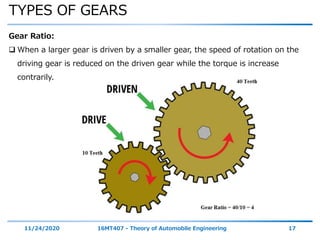
Gear Ratio:
 When a larger gear is driven by a smaller gear, the speed of rotation on the
driving gear is reduced on the driven gear while the torque is increase
contrarily.
TYPES OF GEARS
11/24/2020 16MT407 - Theory of Automobile Engineering 18
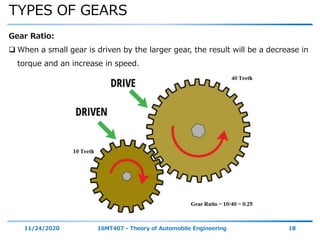
Gear Ratio:
 When a small gear is driven by the larger gear, the result will be a decrease in
torque and an increase in speed.
TYPES OF GEAR TRAIN
11/24/2020 16MT407 - Theory of Automobile Engineering 19
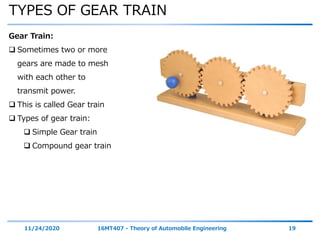
Gear Train:
 Sometimes two or more
gears are made to mesh
with each other to
transmit power.
 This is called Gear train
 Types of gear train:
 Simple Gear train
 Compound gear train
TYPES OF GEAR TRAIN
11/24/2020 16MT407 - Theory of Automobile Engineering 20
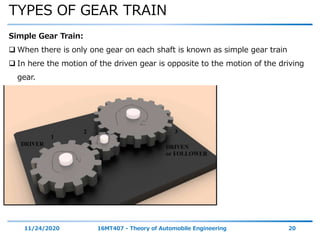
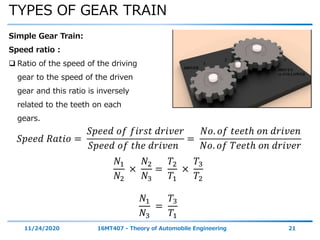
Simple Gear Train:
 When there is only one gear on each shaft is known as simple gear train
 In here the motion of the driven gear is opposite to the motion of the driving
gear.
TYPES OF GEAR TRAIN
11/24/2020 16MT407 - Theory of Automobile Engineering 21
Simple Gear Train:
Speed ratio :
 Ratio of the speed of the driving
gear to the speed of the driven
gear and this ratio is inversely
related to the teeth on each
gears.
𝑆𝑝𝑒𝑒𝑑 𝑅𝑎𝑡𝑖𝑜 =
𝑆𝑝𝑒𝑒𝑑 𝑜𝑓 𝑓𝑖𝑟𝑠𝑡 𝑑𝑟𝑖𝑣𝑒𝑟
𝑆𝑝𝑒𝑒𝑑 𝑜𝑓 𝑡ℎ𝑒 𝑑𝑟𝑖𝑣𝑒𝑛
=
𝑁𝑜. 𝑜𝑓 𝑡𝑒𝑒𝑡ℎ 𝑜𝑛 𝑑𝑟𝑖𝑣𝑒𝑛
𝑁𝑜. 𝑜𝑓 𝑇𝑒𝑒𝑡ℎ 𝑜𝑛 𝑑𝑟𝑖𝑣𝑒𝑟
𝑁1
𝑁2
×
𝑁2
𝑁3
=
𝑇2
𝑇1
×
𝑇3
𝑇2
𝑁1
𝑁3
=
𝑇3
𝑇1
TYPES OF GEAR TRAIN
11/24/2020 16MT407 - Theory of Automobile Engineering 22
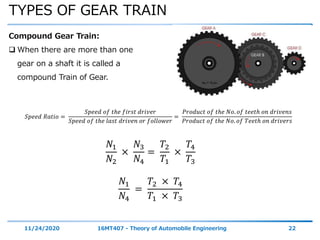
Compound Gear Train:
 When there are more than one
gear on a shaft it is called a
compound Train of Gear.
𝑆𝑝𝑒𝑒𝑑 𝑅𝑎𝑡𝑖𝑜 =
𝑆𝑝𝑒𝑒𝑑 𝑜𝑓 𝑡ℎ𝑒 𝑓𝑖𝑟𝑠𝑡 𝑑𝑟𝑖𝑣𝑒𝑟
𝑆𝑝𝑒𝑒𝑑 𝑜𝑓 𝑡ℎ𝑒 𝑙𝑎𝑠𝑡 𝑑𝑟𝑖𝑣𝑒𝑛 𝑜𝑟 𝑓𝑜𝑙𝑙𝑜𝑤𝑒𝑟
=
𝑃𝑟𝑜𝑑𝑢𝑐𝑡 𝑜𝑓 𝑡ℎ𝑒 𝑁𝑜. 𝑜𝑓 𝑡𝑒𝑒𝑡ℎ 𝑜𝑛 𝑑𝑟𝑖𝑣𝑒𝑛𝑠
𝑃𝑟𝑜𝑑𝑢𝑐𝑡 𝑜𝑓 𝑡ℎ𝑒 𝑁𝑜. 𝑜𝑓 𝑇𝑒𝑒𝑡ℎ 𝑜𝑛 𝑑𝑟𝑖𝑣𝑒𝑟𝑠
𝑁1
𝑁2
×
𝑁3
𝑁4
=
𝑇2
𝑇1
×
𝑇4
𝑇3
𝑁1
𝑁4
=
𝑇2 × 𝑇4
𝑇1 × 𝑇3
TYPES OF GEAR TRAIN
11/24/2020 16MT407 - Theory of Automobile Engineering 23
Compound Gear Train: Advantage
 Compare to simple gear train much
larger speed reduction is achieved
 But simple gear require large size
gear at last for large speed reduction.
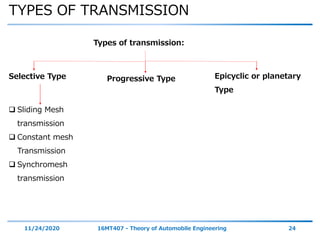
TYPES OF TRANSMISSION
11/24/2020 16MT407 - Theory of Automobile Engineering 24
Epicyclic or planetary
Type
Selective Type Progressive Type
Types of transmission:
 Sliding Mesh
transmission
 Constant mesh
Transmission
 Synchromesh
transmission
TYPES OF TRANSMISSION
11/24/2020 16MT407 - Theory of Automobile Engineering 25
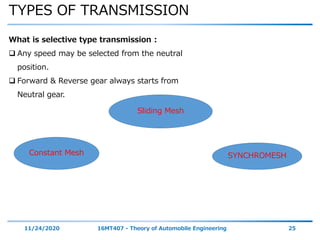
What is selective type transmission :
 Any speed may be selected from the neutral
position.
 Forward & Reverse gear always starts from
Neutral gear.
Constant Mesh
Sliding Mesh
SYNCHROMESH
TYPES OF TRANSMISSION
11/24/2020 16MT407 - Theory of Automobile Engineering 26
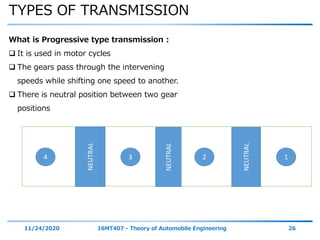
What is Progressive type transmission :
 It is used in motor cycles
 The gears pass through the intervening
speeds while shifting one speed to another.
 There is neutral position between two gear
positions
NEUTRAL
NEUTRAL
NEUTRAL
1234
TYPES OF TRANSMISSION
11/24/2020 16MT407 - Theory of Automobile Engineering 27
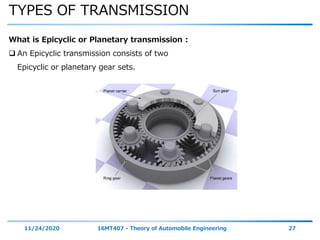
What is Epicyclic or Planetary transmission :
 An Epicyclic transmission consists of two
Epicyclic or planetary gear sets.
TYPES OF TRANSMISSION
11/24/2020 16MT407 - Theory of Automobile Engineering 28
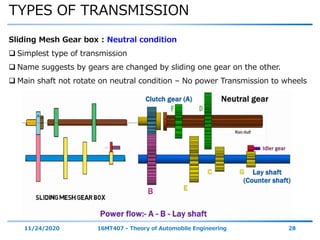
Sliding Mesh Gear box : Neutral condition
 Simplest type of transmission
 Name suggests by gears are changed by sliding one gear on the other.
 Main shaft not rotate on neutral condition – No power Transmission to wheels
TYPES OF TRANSMISSION
11/24/2020 16MT407 - Theory of Automobile Engineering 29
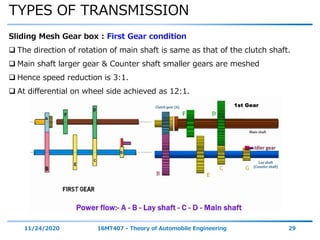
Sliding Mesh Gear box : First Gear condition
 The direction of rotation of main shaft is same as that of the clutch shaft.
 Main shaft larger gear & Counter shaft smaller gears are meshed
 Hence speed reduction is 3:1.
 At differential on wheel side achieved as 12:1.
TYPES OF TRANSMISSION
11/24/2020 16MT407 - Theory of Automobile Engineering 30
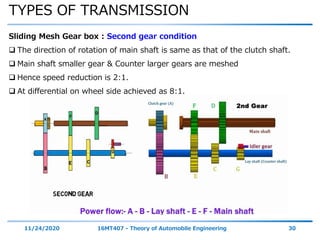
Sliding Mesh Gear box : Second gear condition
 The direction of rotation of main shaft is same as that of the clutch shaft.
 Main shaft smaller gear & Counter larger gears are meshed
 Hence speed reduction is 2:1.
 At differential on wheel side achieved as 8:1.
TYPES OF TRANSMISSION
11/24/2020 16MT407 - Theory of Automobile Engineering 31
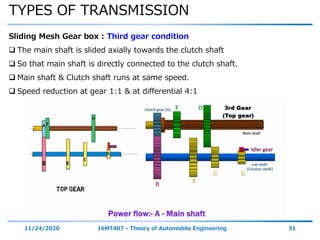
Sliding Mesh Gear box : Third gear condition
 The main shaft is slided axially towards the clutch shaft
 So that main shaft is directly connected to the clutch shaft.
 Main shaft & Clutch shaft runs at same speed.
 Speed reduction at gear 1:1 & at differential 4:1
TYPES OF TRANSMISSION
11/24/2020 16MT407 - Theory of Automobile Engineering 32
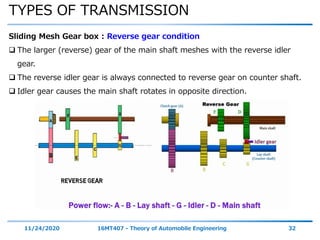
Sliding Mesh Gear box : Reverse gear condition
 The larger (reverse) gear of the main shaft meshes with the reverse idler
gear.
 The reverse idler gear is always connected to reverse gear on counter shaft.
 Idler gear causes the main shaft rotates in opposite direction.
TYPES OF TRANSMISSION
11/24/2020 16MT407 - Theory of Automobile Engineering 33
Sliding Mesh Gear box :
Advantages :
 It is simple in construction
 It has low cost
 The mechanical efficiency of sliding mesh gear box is very high
Disadvantage:
 The gear noise is very high due to the type of gears (i.e spur gears)
 It is difficult to obtain a smooth, quiet and quick change of gears.
TYPES OF TRANSMISSION
11/24/2020 16MT407 - Theory of Automobile Engineering 34
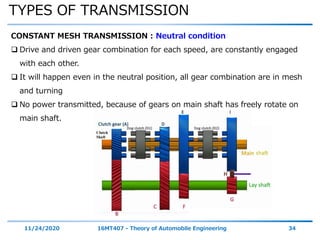
CONSTANT MESH TRANSMISSION : Neutral condition
 Drive and driven gear combination for each speed, are constantly engaged
with each other.
 It will happen even in the neutral position, all gear combination are in mesh
and turning
 No power transmitted, because of gears on main shaft has freely rotate on
main shaft.
TYPES OF TRANSMISSION
11/24/2020 16MT407 - Theory of Automobile Engineering 35
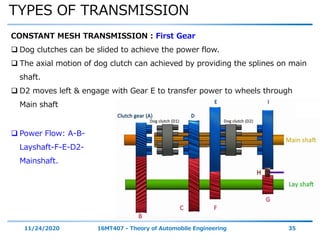
CONSTANT MESH TRANSMISSION : First Gear
 Dog clutches can be slided to achieve the power flow.
 The axial motion of dog clutch can achieved by providing the splines on main
shaft.
 D2 moves left & engage with Gear E to transfer power to wheels through
Main shaft
 Power Flow: A-B-
Layshaft-F-E-D2-
Mainshaft.
TYPES OF TRANSMISSION
11/24/2020 16MT407 - Theory of Automobile Engineering 36
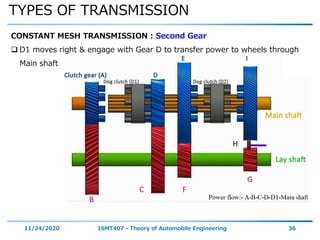
CONSTANT MESH TRANSMISSION : Second Gear
 D1 moves right & engage with Gear D to transfer power to wheels through
Main shaft
TYPES OF TRANSMISSION
11/24/2020 16MT407 - Theory of Automobile Engineering 37
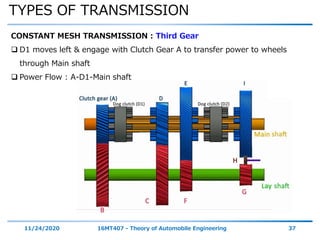
CONSTANT MESH TRANSMISSION : Third Gear
 D1 moves left & engage with Clutch Gear A to transfer power to wheels
through Main shaft
 Power Flow : A-D1-Main shaft
TYPES OF TRANSMISSION
11/24/2020 16MT407 - Theory of Automobile Engineering 38
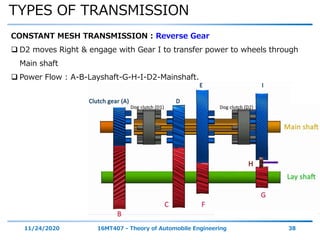
CONSTANT MESH TRANSMISSION : Reverse Gear
 D2 moves Right & engage with Gear I to transfer power to wheels through
Main shaft
 Power Flow : A-B-Layshaft-G-H-I-D2-Mainshaft.
TYPES OF TRANSMISSION
11/24/2020 16MT407 - Theory of Automobile Engineering 39
CONSTANT MESH TRANSMISSION :advantage
 These have high Mechanical efficiency.
 It has helical gears, very quiet power transmission is achieved.
 Constant mesh ensure the safeness of gear from damage
Disadvantage:
 Dog clutch produce noise & jerk.
TYPES OF TRANSMISSION
11/24/2020 16MT407 - Theory of Automobile Engineering 40
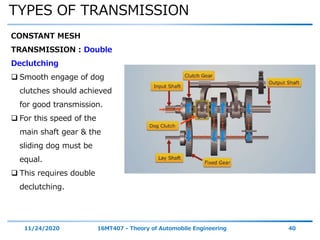
CONSTANT MESH
TRANSMISSION : Double
Declutching
 Smooth engage of dog
clutches should achieved
for good transmission.
 For this speed of the
main shaft gear & the
sliding dog must be
equal.
 This requires double
declutching.
TYPES OF TRANSMISSION
11/24/2020 16MT407 - Theory of Automobile Engineering 41
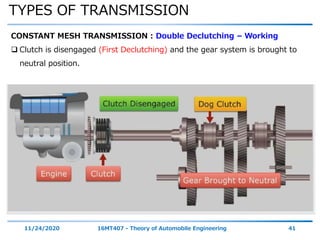
CONSTANT MESH TRANSMISSION : Double Declutching – Working
 Clutch is disengaged (First Declutching) and the gear system is brought to
neutral position.
TYPES OF TRANSMISSION
11/24/2020 16MT407 - Theory of Automobile Engineering 42
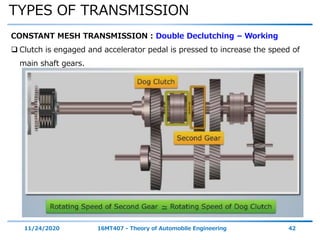
CONSTANT MESH TRANSMISSION : Double Declutching – Working
 Clutch is engaged and accelerator pedal is pressed to increase the speed of
main shaft gears.
TYPES OF TRANSMISSION
11/24/2020 16MT407 - Theory of Automobile Engineering 43
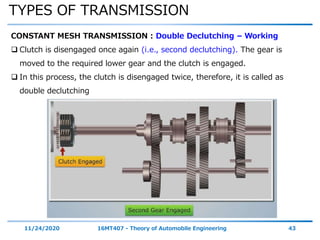
CONSTANT MESH TRANSMISSION : Double Declutching – Working
 Clutch is disengaged once again (i.e., second declutching). The gear is
moved to the required lower gear and the clutch is engaged.
 In this process, the clutch is disengaged twice, therefore, it is called as
double declutching
TYPES OF TRANSMISSION
11/24/2020 16MT407 - Theory of Automobile Engineering 44
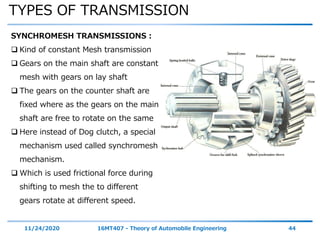
SYNCHROMESH TRANSMISSIONS :
 Kind of constant Mesh transmission
 Gears on the main shaft are constant
mesh with gears on lay shaft
 The gears on the counter shaft are
fixed where as the gears on the main
shaft are free to rotate on the same
 Here instead of Dog clutch, a special
mechanism used called synchromesh
mechanism.
 Which is used frictional force during
shifting to mesh the to different
gears rotate at different speed.
TYPES OF TRANSMISSION
11/24/2020 16MT407 - Theory of Automobile Engineering 45
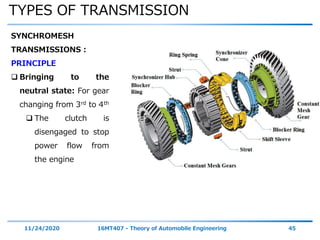
SYNCHROMESH
TRANSMISSIONS :
PRINCIPLE
 Bringing to the
neutral state: For gear
changing from 3rd to 4th
 The clutch is
disengaged to stop
power flow from
the engine
TYPES OF TRANSMISSION
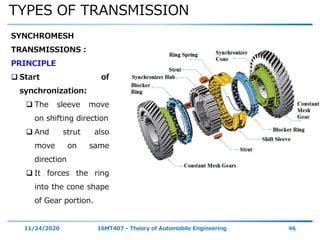
11/24/2020 16MT407 - Theory of Automobile Engineering 46
SYNCHROMESH
TRANSMISSIONS :
PRINCIPLE
 Start of
synchronization:
 The sleeve move
on shifting direction
 And strut also
move on same
direction
 It forces the ring
into the cone shape
of Gear portion.
TYPES OF TRANSMISSION
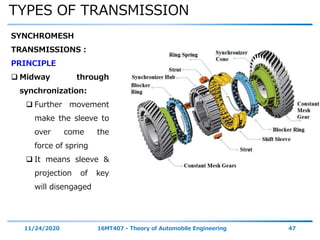
11/24/2020 16MT407 - Theory of Automobile Engineering 47
SYNCHROMESH
TRANSMISSIONS :
PRINCIPLE
 Midway through
synchronization:
 Further movement
make the sleeve to
over come the
force of spring
 It means sleeve &
projection of key
will disengaged
TYPES OF TRANSMISSION
11/24/2020 16MT407 - Theory of Automobile Engineering 48
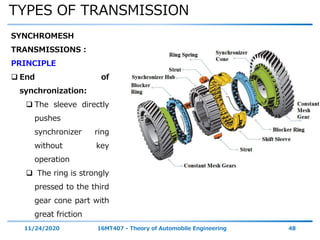
SYNCHROMESH
TRANSMISSIONS :
PRINCIPLE
 End of
synchronization:
 The sleeve directly
pushes
synchronizer ring
without key
operation
 The ring is strongly
pressed to the third
gear cone part with
great friction
TYPES OF TRANSMISSION
11/24/2020 16MT407 - Theory of Automobile Engineering 49
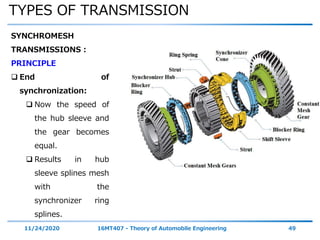
SYNCHROMESH
TRANSMISSIONS :
PRINCIPLE
 End of
synchronization:
 Now the speed of
the hub sleeve and
the gear becomes
equal.
 Results in hub
sleeve splines mesh
with the
synchronizer ring
splines.
TYPES OF TRANSMISSION
11/24/2020 16MT407 - Theory of Automobile Engineering 50
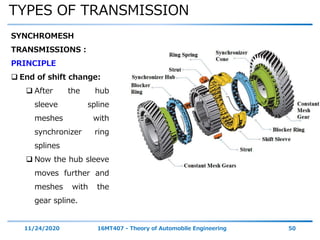
SYNCHROMESH
TRANSMISSIONS :
PRINCIPLE
 End of shift change:
 After the hub
sleeve spline
meshes with
synchronizer ring
splines
 Now the hub sleeve
moves further and
meshes with the
gear spline.
TYPES OF TRANSMISSION
11/24/2020 16MT407 - Theory of Automobile Engineering 51
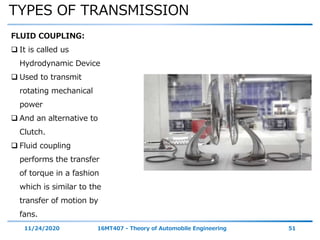
FLUID COUPLING:
 It is called us
Hydrodynamic Device
 Used to transmit
rotating mechanical
power
 And an alternative to
Clutch.
 Fluid coupling
performs the transfer
of torque in a fashion
which is similar to the
transfer of motion by
fans.
TYPES OF TRANSMISSION
11/24/2020 16MT407 - Theory of Automobile Engineering 52
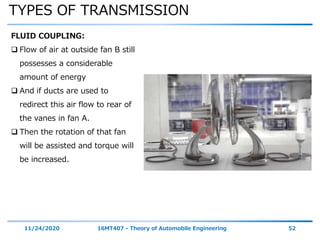
FLUID COUPLING:
 Flow of air at outside fan B still
possesses a considerable
amount of energy
 And if ducts are used to
redirect this air flow to rear of
the vanes in fan A.
 Then the rotation of that fan
will be assisted and torque will
be increased.
TYPES OF TRANSMISSION
11/24/2020 16MT407 - Theory of Automobile Engineering 53
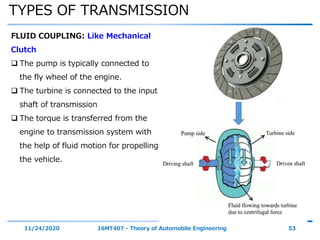
FLUID COUPLING: Like Mechanical
Clutch
 The pump is typically connected to
the fly wheel of the engine.
 The turbine is connected to the input
shaft of transmission
 The torque is transferred from the
engine to transmission system with
the help of fluid motion for propelling
the vehicle.
TYPES OF TRANSMISSION
11/24/2020 16MT407 - Theory of Automobile Engineering 54
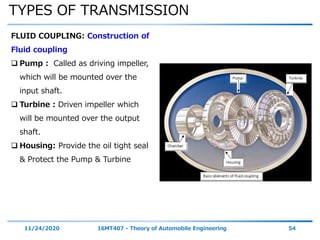
FLUID COUPLING: Construction of
Fluid coupling
 Pump : Called as driving impeller,
which will be mounted over the
input shaft.
 Turbine : Driven impeller which
will be mounted over the output
shaft.
 Housing: Provide the oil tight seal
& Protect the Pump & Turbine
TYPES OF TRANSMISSION
11/24/2020 16MT407 - Theory of Automobile Engineering 55
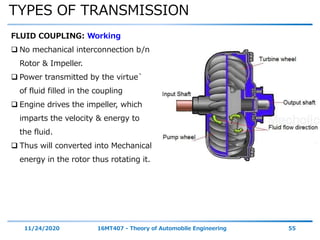
FLUID COUPLING: Working
 No mechanical interconnection b/n
Rotor & Impeller.
 Power transmitted by the virtue`
of fluid filled in the coupling
 Engine drives the impeller, which
imparts the velocity & energy to
the fluid.
 Thus will converted into Mechanical
energy in the rotor thus rotating it.
TYPES OF TRANSMISSION
11/24/2020 16MT407 - Theory of Automobile Engineering 56
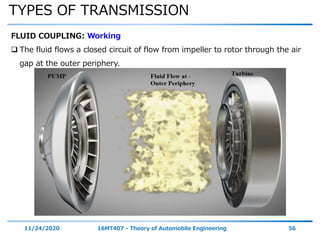
FLUID COUPLING: Working
 The fluid flows a closed circuit of flow from impeller to rotor through the air
gap at the outer periphery.
TYPES OF TRANSMISSION
11/24/2020 16MT407 - Theory of Automobile Engineering 57
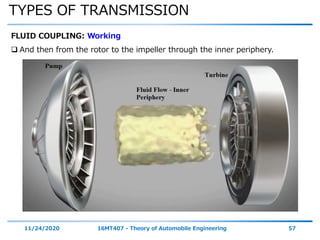
FLUID COUPLING: Working
 And then from the rotor to the impeller through the inner periphery.
TYPES OF TRANSMISSION
11/24/2020 16MT407 - Theory of Automobile Engineering 58
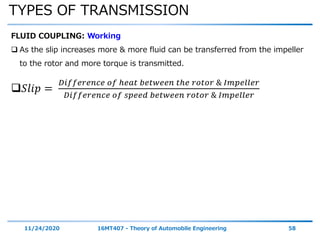
FLUID COUPLING: Working
 As the slip increases more & more fluid can be transferred from the impeller
to the rotor and more torque is transmitted.
𝑆𝑙𝑖𝑝 =
𝐷𝑖𝑓𝑓𝑒𝑟𝑒𝑛𝑐𝑒 𝑜𝑓 ℎ𝑒𝑎𝑡 𝑏𝑒𝑡𝑤𝑒𝑒𝑛 𝑡ℎ𝑒 𝑟𝑜𝑡𝑜𝑟 & 𝐼𝑚𝑝𝑒𝑙𝑙𝑒𝑟
𝐷𝑖𝑓𝑓𝑒𝑟𝑒𝑛𝑐𝑒 𝑜𝑓 𝑠𝑝𝑒𝑒𝑑 𝑏𝑒𝑡𝑤𝑒𝑒𝑛 𝑟𝑜𝑡𝑜𝑟 & 𝐼𝑚𝑝𝑒𝑙𝑙𝑒𝑟
TYPES OF TRANSMISSION
11/24/2020 16MT407 - Theory of Automobile Engineering 59
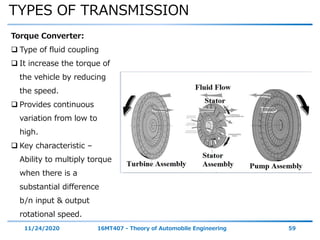
Torque Converter:
 Type of fluid coupling
 It increase the torque of
the vehicle by reducing
the speed.
 Provides continuous
variation from low to
high.
 Key characteristic –
Ability to multiply torque
when there is a
substantial difference
b/n input & output
rotational speed.
TYPES OF TRANSMISSION
11/24/2020 16MT407 - Theory of Automobile Engineering 60
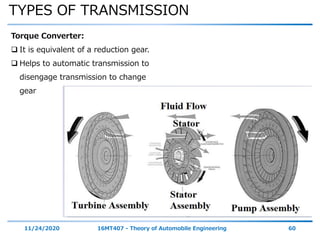
Torque Converter:
 It is equivalent of a reduction gear.
 Helps to automatic transmission to
disengage transmission to change
gear
TYPES OF TRANSMISSION
11/24/2020 16MT407 - Theory of Automobile Engineering 61
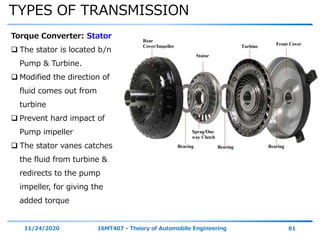
Torque Converter: Stator
 The stator is located b/n
Pump & Turbine.
 Modified the direction of
fluid comes out from
turbine
 Prevent hard impact of
Pump impeller
 The stator vanes catches
the fluid from turbine &
redirects to the pump
impeller, for giving the
added torque
TYPES OF TRANSMISSION
11/24/2020 16MT407 - Theory of Automobile Engineering 62
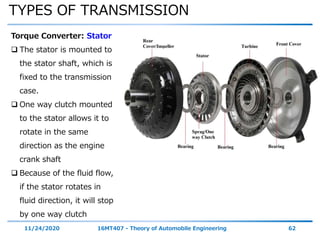
Torque Converter: Stator
 The stator is mounted to
the stator shaft, which is
fixed to the transmission
case.
 One way clutch mounted
to the stator allows it to
rotate in the same
direction as the engine
crank shaft
 Because of the fluid flow,
if the stator rotates in
fluid direction, it will stop
by one way clutch
TYPES OF TRANSMISSION
11/24/2020 16MT407 - Theory of Automobile Engineering 63
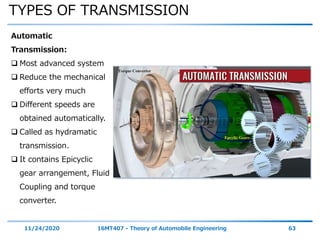
Automatic
Transmission:
 Most advanced system
 Reduce the mechanical
efforts very much
 Different speeds are
obtained automatically.
 Called as hydramatic
transmission.
 It contains Epicyclic
gear arrangement, Fluid
Coupling and torque
converter.
TYPES OF TRANSMISSION
11/24/2020 16MT407 - Theory of Automobile Engineering 64
Automatic Transmission:
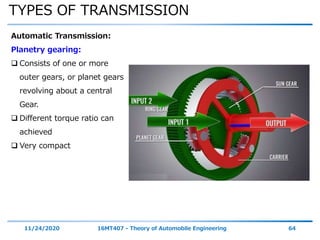
Planetry gearing:
 Consists of one or more
outer gears, or planet gears
revolving about a central
Gear.
 Different torque ratio can
achieved
 Very compact
TYPES OF TRANSMISSION
11/24/2020 16MT407 - Theory of Automobile Engineering 65
Automatic Transmission: Working
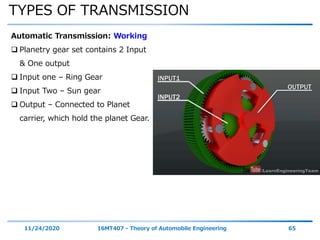
 Planetry gear set contains 2 Input
& One output
 Input one – Ring Gear
 Input Two – Sun gear
 Output – Connected to Planet
carrier, which hold the planet Gear.
TYPES OF TRANSMISSION
11/24/2020 16MT407 - Theory of Automobile Engineering 66
Automatic Transmission:
Working
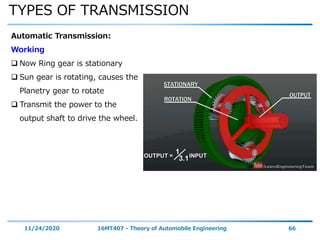
 Now Ring gear is stationary
 Sun gear is rotating, causes the
Planetry gear to rotate
 Transmit the power to the
output shaft to drive the wheel.
TYPES OF TRANSMISSION
11/24/2020 16MT407 - Theory of Automobile Engineering 67
Automatic Transmission:
Working
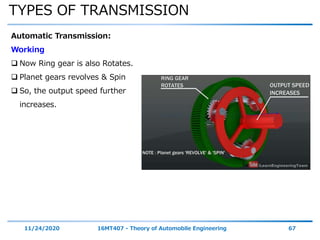
 Now Ring gear is also Rotates.
 Planet gears revolves & Spin
 So, the output speed further
increases.
TYPES OF TRANSMISSION
11/24/2020 16MT407 - Theory of Automobile Engineering 68
Automatic Transmission:
Working
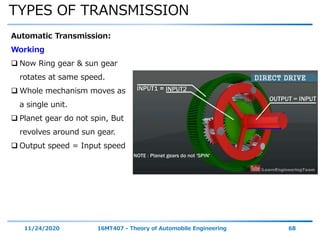
 Now Ring gear & sun gear
rotates at same speed.
 Whole mechanism moves as
a single unit.
 Planet gear do not spin, But
revolves around sun gear.
 Output speed = Input speed
TYPES OF TRANSMISSION
11/24/2020 16MT407 - Theory of Automobile Engineering 69
Automatic Transmission:
Working
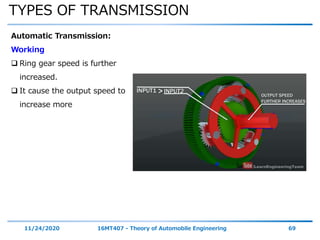
 Ring gear speed is further
increased.
 It cause the output speed to
increase more
TYPES OF TRANSMISSION
11/24/2020 16MT407 - Theory of Automobile Engineering 70
Automatic Transmission:
Working
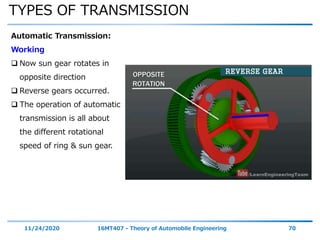
 Now sun gear rotates in
opposite direction
 Reverse gears occurred.
 The operation of automatic
transmission is all about
the different rotational
speed of ring & sun gear.
TYPES OF TRANSMISSION
11/24/2020 16MT407 - Theory of Automobile Engineering 71
Automatic Transmission:
Working
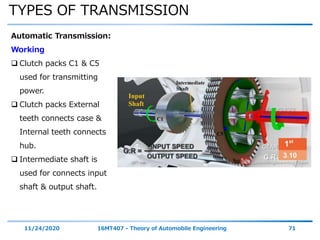
 Clutch packs C1 & C5
used for transmitting
power.
 Clutch packs External
teeth connects case &
Internal teeth connects
hub.
 Intermediate shaft is
used for connects input
shaft & output shaft.
TYPES OF TRANSMISSION
11/24/2020 16MT407 - Theory of Automobile Engineering 72
Automatic Transmission:
Working
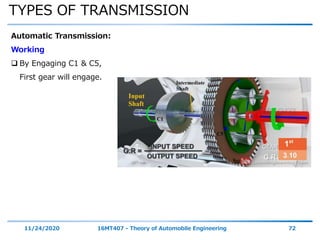
 By Engaging C1 & C5,
First gear will engage.
TYPES OF TRANSMISSION
11/24/2020 16MT407 - Theory of Automobile Engineering 73
Automatic Transmission:
Working
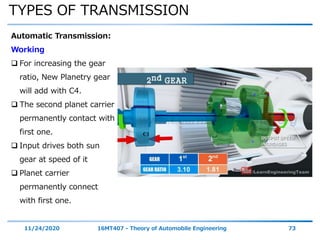
 For increasing the gear
ratio, New Planetry gear
will add with C4.
 The second planet carrier
permanently contact with
first one.
 Input drives both sun
gear at speed of it
 Planet carrier
permanently connect
with first one.
TYPES OF TRANSMISSION
11/24/2020 16MT407 - Theory of Automobile Engineering 74
Automatic Transmission:
Working
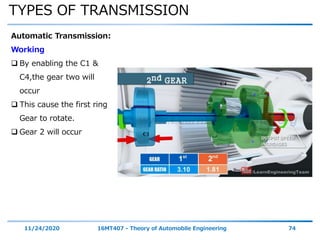
 By enabling the C1 &
C4,the gear two will
occur
 This cause the first ring
Gear to rotate.
 Gear 2 will occur
TYPES OF TRANSMISSION
11/24/2020 16MT407 - Theory of Automobile Engineering 75
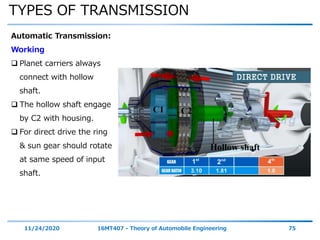
Automatic Transmission:
Working
 Planet carriers always
connect with hollow
shaft.
 The hollow shaft engage
by C2 with housing.
 For direct drive the ring
& sun gear should rotate
at same speed of input
shaft.
TYPES OF TRANSMISSION
11/24/2020 16MT407 - Theory of Automobile Engineering 76
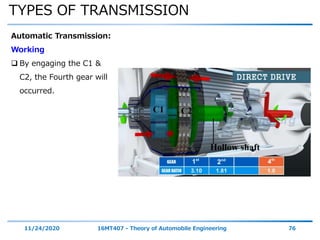
Automatic Transmission:
Working
 By engaging the C1 &
C2, the Fourth gear will
occurred.
TYPES OF TRANSMISSION
11/24/2020 16MT407 - Theory of Automobile Engineering 77
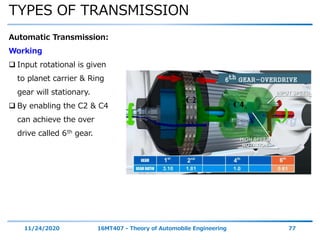
Automatic Transmission:
Working
 Input rotational is given
to planet carrier & Ring
gear will stationary.
 By enabling the C2 & C4
can achieve the over
drive called 6th gear.
TYPES OF TRANSMISSION
11/24/2020 16MT407 - Theory of Automobile Engineering 78
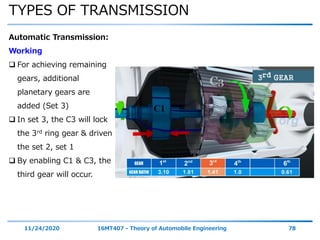
Automatic Transmission:
Working
 For achieving remaining
gears, additional
planetary gears are
added (Set 3)
 In set 3, the C3 will lock
the 3rd ring gear & driven
the set 2, set 1
 By enabling C1 & C3, the
third gear will occur.
TYPES OF TRANSMISSION
11/24/2020 16MT407 - Theory of Automobile Engineering 79
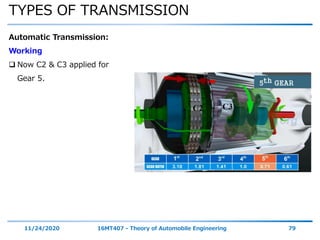
Automatic Transmission:
Working
 Now C2 & C3 applied for
Gear 5.
TYPES OF TRANSMISSION
11/24/2020 16MT407 - Theory of Automobile Engineering 80
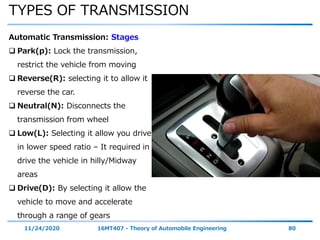
Automatic Transmission: Stages
 Park(p): Lock the transmission,
restrict the vehicle from moving
 Reverse(R): selecting it to allow it
reverse the car.
 Neutral(N): Disconnects the
transmission from wheel
 Low(L): Selecting it allow you drive
in lower speed ratio – It required in
drive the vehicle in hilly/Midway
areas
 Drive(D): By selecting it allow the
vehicle to move and accelerate
through a range of gears
TYPES OF TRANSMISSION
11/24/2020 16MT407 - Theory of Automobile Engineering 81
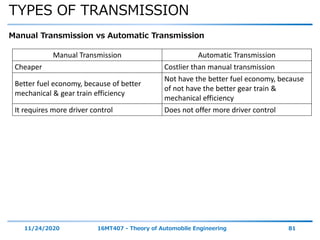
Manual Transmission vs Automatic Transmission
Manual Transmission Automatic Transmission
Cheaper Costlier than manual transmission
Better fuel economy, because of better
mechanical & gear train efficiency
Not have the better fuel economy, because
of not have the better gear train &
mechanical efficiency
It requires more driver control Does not offer more driver control
11/24/2020 16MT407 - Theory of Automobile Engineering 82
END

Automotive Transmission system

  • 1.
    SRI KRISHNA COLLEGEOF ENGINEERING AND TECHNOLOGY DEPARTMENT OF MECHATRONICS ENGINEERING Session: Introduction to Transmission System 11/24/2020 16MT407 - Theory of Automobile Engineering 1 MODULE 2
  • 2.
    SESSION OBJECTIVES 11/24/2020 16MT407- Theory of Automobile Engineering 2  On the completion of this session, the students might be able to understand,  Basic Necessity of a transmission system in Vehicle  How the transmission system provide tractive force to the vehicle.
  • 3.
    Topics  Function ofTransmission system  Basic Necessity of transmission  Types of gears and Gear train  Types of transmission 11/24/2020 16MT407 - Theory of Automobile Engineering 3
  • 4.
    FUNCTION OF TRANSMISSIONSYSTEM 11/24/2020 16MT407 - Theory of Automobile Engineering 4 Introduction:  Engine is the only source to give motive force to the vehicle  This will help the vehicle to move on different driving conditions from start up to high speed driving  It will ensure by transmission system  The transmission is actually a set of gears which is used to transfer the power developed in the engine to the driving wheels according to the requirement's.
  • 5.
    FUNCTION OF TRANSMISSIONSYSTEM 11/24/2020 16MT407 - Theory of Automobile Engineering 5 Function of transmission system:  It transfer the engine output power to the final driven gear from where it is transmitted to the driving wheels through the drive shaft (or propeller shaft)  It provides sufficient torque  It provides low to high speed driving capability  It is used to change the direction of the wheel rotation
  • 6.
    BASIC NECESSITY OFGEAR BOX 11/24/2020 16MT407 - Theory of Automobile Engineering 6 Transmission Necessity : CAD B OA – Stabilizing speed
  • 7.
    TYPES OF GEARS 11/24/202016MT407 - Theory of Automobile Engineering 7 Introduction:  Gears are toothed wheels that transmit power between the shafts.  The teeth my be cut on the edge on the wheel on the side or inside.  To transmit power, a gear on one shaft is meshed with gear on another shaft.  The meaning of mesh is that the teeth of a gear fit into the space between the teeth on the another gear
  • 8.
    TYPES OF GEARS 11/24/202016MT407 - Theory of Automobile Engineering 8 Introduction:  When one gear turns, then it’s teeth forces the other gear to turn.  The gear that does the turning is the driving gear.[A - Gear]  The gear that is forced to turn is the driven gear.[B – Gear]
  • 9.
    TYPES OF GEARS 11/24/202016MT407 - Theory of Automobile Engineering 9 Types of Gears: Spur Gears  The spur gears are the most common type of gears.  These gears have teeth parallel to the axis of wheel
  • 10.
    TYPES OF GEARS 11/24/202016MT407 - Theory of Automobile Engineering 10 Types of Gears: Helical Gears  It is very similar to spur gears.  Gears having teeth inclined to the axis of the wheel  Angle of teeth give gears more tooth contact in the same area.  Also used to transmit power between non parallel shaft.  Running is quitter and smoother than spur gears.  This is Due to the increased number of teeth in constant contact at any one period of time.
  • 11.
    TYPES OF GEARS 11/24/202016MT407 - Theory of Automobile Engineering 11 Types of Gears: Herringbone gears  Double helical gears are known as herringbone gears.  The herring bone gear resemble two helical gears that have been placed side by side  Advantage: To eliminate side thrust issues in helical gears.
  • 12.
    TYPES OF GEARS 11/24/202016MT407 - Theory of Automobile Engineering 12 Types of Gears: Bevel Gears  The Bevel gears are used mostly in situations that require power to be transmitted at right angles.  The bevel gears can have different angle of application but tend to be 90o.
  • 13.
    TYPES OF GEARS 11/24/202016MT407 - Theory of Automobile Engineering 13 Types of Gears: Worm Gears  The worm gears are used to transmit power at 90o and where high reduction are required.  It simply resembles a thread that rides in concave or helical teeth. Worm Gear Worm Wheel
  • 14.
    TYPES OF GEARS 11/24/202016MT407 - Theory of Automobile Engineering 14 Types of Gears: Rack & Pinion gears  A rack & Pinion gear is basically used to transmit power and motion in a linear movement.
  • 15.
    TYPES OF GEARS 11/24/202016MT407 - Theory of Automobile Engineering 15 Types of Gears: Planetary Gears  The planetary gears consist of one or more outer gears, revolving about a central gear (or sun gear).  Typically, the planet gears are mounted on a movable arm which itself may rotate relative to the sun gear.  The planet gear systems also incorporate the use of an outer ring gear, which meshes with planet gears.
  • 16.
    TYPES OF GEARS 11/24/202016MT407 - Theory of Automobile Engineering 16 Gear Ratio:  The gear ratio’s are used to express the mathematical relationship between the gears.  The actual operation performed by the gear lever in an automobile is to change the gear size 𝐺𝑒𝑎𝑟 𝑅𝑎𝑡𝑖𝑜 = 𝑁𝑢𝑚𝑏𝑒𝑟 𝑜𝑓 𝑡𝑒𝑒𝑡ℎ 𝑜𝑛 𝑡ℎ𝑒 𝑑𝑟𝑖𝑣𝑒𝑛 𝑔𝑒𝑎𝑟 𝑁𝑢𝑚𝑏𝑒𝑟 𝑜𝑓 𝑡𝑒𝑒𝑡ℎ 𝑜𝑛 𝑡ℎ𝑒 𝐷𝑟𝑖𝑣𝑒 𝑔𝑒𝑎𝑟
  • 17.
    TYPES OF GEARS 11/24/202016MT407 - Theory of Automobile Engineering 17 Gear Ratio:  When a larger gear is driven by a smaller gear, the speed of rotation on the driving gear is reduced on the driven gear while the torque is increase contrarily.
  • 18.
    TYPES OF GEARS 11/24/202016MT407 - Theory of Automobile Engineering 18 Gear Ratio:  When a small gear is driven by the larger gear, the result will be a decrease in torque and an increase in speed.
  • 19.
    TYPES OF GEARTRAIN 11/24/2020 16MT407 - Theory of Automobile Engineering 19 Gear Train:  Sometimes two or more gears are made to mesh with each other to transmit power.  This is called Gear train  Types of gear train:  Simple Gear train  Compound gear train
  • 20.
    TYPES OF GEARTRAIN 11/24/2020 16MT407 - Theory of Automobile Engineering 20 Simple Gear Train:  When there is only one gear on each shaft is known as simple gear train  In here the motion of the driven gear is opposite to the motion of the driving gear.
  • 21.
    TYPES OF GEARTRAIN 11/24/2020 16MT407 - Theory of Automobile Engineering 21 Simple Gear Train: Speed ratio :  Ratio of the speed of the driving gear to the speed of the driven gear and this ratio is inversely related to the teeth on each gears. 𝑆𝑝𝑒𝑒𝑑 𝑅𝑎𝑡𝑖𝑜 = 𝑆𝑝𝑒𝑒𝑑 𝑜𝑓 𝑓𝑖𝑟𝑠𝑡 𝑑𝑟𝑖𝑣𝑒𝑟 𝑆𝑝𝑒𝑒𝑑 𝑜𝑓 𝑡ℎ𝑒 𝑑𝑟𝑖𝑣𝑒𝑛 = 𝑁𝑜. 𝑜𝑓 𝑡𝑒𝑒𝑡ℎ 𝑜𝑛 𝑑𝑟𝑖𝑣𝑒𝑛 𝑁𝑜. 𝑜𝑓 𝑇𝑒𝑒𝑡ℎ 𝑜𝑛 𝑑𝑟𝑖𝑣𝑒𝑟 𝑁1 𝑁2 × 𝑁2 𝑁3 = 𝑇2 𝑇1 × 𝑇3 𝑇2 𝑁1 𝑁3 = 𝑇3 𝑇1
  • 22.
    TYPES OF GEARTRAIN 11/24/2020 16MT407 - Theory of Automobile Engineering 22 Compound Gear Train:  When there are more than one gear on a shaft it is called a compound Train of Gear. 𝑆𝑝𝑒𝑒𝑑 𝑅𝑎𝑡𝑖𝑜 = 𝑆𝑝𝑒𝑒𝑑 𝑜𝑓 𝑡ℎ𝑒 𝑓𝑖𝑟𝑠𝑡 𝑑𝑟𝑖𝑣𝑒𝑟 𝑆𝑝𝑒𝑒𝑑 𝑜𝑓 𝑡ℎ𝑒 𝑙𝑎𝑠𝑡 𝑑𝑟𝑖𝑣𝑒𝑛 𝑜𝑟 𝑓𝑜𝑙𝑙𝑜𝑤𝑒𝑟 = 𝑃𝑟𝑜𝑑𝑢𝑐𝑡 𝑜𝑓 𝑡ℎ𝑒 𝑁𝑜. 𝑜𝑓 𝑡𝑒𝑒𝑡ℎ 𝑜𝑛 𝑑𝑟𝑖𝑣𝑒𝑛𝑠 𝑃𝑟𝑜𝑑𝑢𝑐𝑡 𝑜𝑓 𝑡ℎ𝑒 𝑁𝑜. 𝑜𝑓 𝑇𝑒𝑒𝑡ℎ 𝑜𝑛 𝑑𝑟𝑖𝑣𝑒𝑟𝑠 𝑁1 𝑁2 × 𝑁3 𝑁4 = 𝑇2 𝑇1 × 𝑇4 𝑇3 𝑁1 𝑁4 = 𝑇2 × 𝑇4 𝑇1 × 𝑇3
  • 23.
    TYPES OF GEARTRAIN 11/24/2020 16MT407 - Theory of Automobile Engineering 23 Compound Gear Train: Advantage  Compare to simple gear train much larger speed reduction is achieved  But simple gear require large size gear at last for large speed reduction.
  • 24.
    TYPES OF TRANSMISSION 11/24/202016MT407 - Theory of Automobile Engineering 24 Epicyclic or planetary Type Selective Type Progressive Type Types of transmission:  Sliding Mesh transmission  Constant mesh Transmission  Synchromesh transmission
  • 25.
    TYPES OF TRANSMISSION 11/24/202016MT407 - Theory of Automobile Engineering 25 What is selective type transmission :  Any speed may be selected from the neutral position.  Forward & Reverse gear always starts from Neutral gear. Constant Mesh Sliding Mesh SYNCHROMESH
  • 26.
    TYPES OF TRANSMISSION 11/24/202016MT407 - Theory of Automobile Engineering 26 What is Progressive type transmission :  It is used in motor cycles  The gears pass through the intervening speeds while shifting one speed to another.  There is neutral position between two gear positions NEUTRAL NEUTRAL NEUTRAL 1234
  • 27.
    TYPES OF TRANSMISSION 11/24/202016MT407 - Theory of Automobile Engineering 27 What is Epicyclic or Planetary transmission :  An Epicyclic transmission consists of two Epicyclic or planetary gear sets.
  • 28.
    TYPES OF TRANSMISSION 11/24/202016MT407 - Theory of Automobile Engineering 28 Sliding Mesh Gear box : Neutral condition  Simplest type of transmission  Name suggests by gears are changed by sliding one gear on the other.  Main shaft not rotate on neutral condition – No power Transmission to wheels
  • 29.
    TYPES OF TRANSMISSION 11/24/202016MT407 - Theory of Automobile Engineering 29 Sliding Mesh Gear box : First Gear condition  The direction of rotation of main shaft is same as that of the clutch shaft.  Main shaft larger gear & Counter shaft smaller gears are meshed  Hence speed reduction is 3:1.  At differential on wheel side achieved as 12:1.
  • 30.
    TYPES OF TRANSMISSION 11/24/202016MT407 - Theory of Automobile Engineering 30 Sliding Mesh Gear box : Second gear condition  The direction of rotation of main shaft is same as that of the clutch shaft.  Main shaft smaller gear & Counter larger gears are meshed  Hence speed reduction is 2:1.  At differential on wheel side achieved as 8:1.
  • 31.
    TYPES OF TRANSMISSION 11/24/202016MT407 - Theory of Automobile Engineering 31 Sliding Mesh Gear box : Third gear condition  The main shaft is slided axially towards the clutch shaft  So that main shaft is directly connected to the clutch shaft.  Main shaft & Clutch shaft runs at same speed.  Speed reduction at gear 1:1 & at differential 4:1
  • 32.
    TYPES OF TRANSMISSION 11/24/202016MT407 - Theory of Automobile Engineering 32 Sliding Mesh Gear box : Reverse gear condition  The larger (reverse) gear of the main shaft meshes with the reverse idler gear.  The reverse idler gear is always connected to reverse gear on counter shaft.  Idler gear causes the main shaft rotates in opposite direction.
  • 33.
    TYPES OF TRANSMISSION 11/24/202016MT407 - Theory of Automobile Engineering 33 Sliding Mesh Gear box : Advantages :  It is simple in construction  It has low cost  The mechanical efficiency of sliding mesh gear box is very high Disadvantage:  The gear noise is very high due to the type of gears (i.e spur gears)  It is difficult to obtain a smooth, quiet and quick change of gears.
  • 34.
    TYPES OF TRANSMISSION 11/24/202016MT407 - Theory of Automobile Engineering 34 CONSTANT MESH TRANSMISSION : Neutral condition  Drive and driven gear combination for each speed, are constantly engaged with each other.  It will happen even in the neutral position, all gear combination are in mesh and turning  No power transmitted, because of gears on main shaft has freely rotate on main shaft.
  • 35.
    TYPES OF TRANSMISSION 11/24/202016MT407 - Theory of Automobile Engineering 35 CONSTANT MESH TRANSMISSION : First Gear  Dog clutches can be slided to achieve the power flow.  The axial motion of dog clutch can achieved by providing the splines on main shaft.  D2 moves left & engage with Gear E to transfer power to wheels through Main shaft  Power Flow: A-B- Layshaft-F-E-D2- Mainshaft.
  • 36.
    TYPES OF TRANSMISSION 11/24/202016MT407 - Theory of Automobile Engineering 36 CONSTANT MESH TRANSMISSION : Second Gear  D1 moves right & engage with Gear D to transfer power to wheels through Main shaft
  • 37.
    TYPES OF TRANSMISSION 11/24/202016MT407 - Theory of Automobile Engineering 37 CONSTANT MESH TRANSMISSION : Third Gear  D1 moves left & engage with Clutch Gear A to transfer power to wheels through Main shaft  Power Flow : A-D1-Main shaft
  • 38.
    TYPES OF TRANSMISSION 11/24/202016MT407 - Theory of Automobile Engineering 38 CONSTANT MESH TRANSMISSION : Reverse Gear  D2 moves Right & engage with Gear I to transfer power to wheels through Main shaft  Power Flow : A-B-Layshaft-G-H-I-D2-Mainshaft.
  • 39.
    TYPES OF TRANSMISSION 11/24/202016MT407 - Theory of Automobile Engineering 39 CONSTANT MESH TRANSMISSION :advantage  These have high Mechanical efficiency.  It has helical gears, very quiet power transmission is achieved.  Constant mesh ensure the safeness of gear from damage Disadvantage:  Dog clutch produce noise & jerk.
  • 40.
    TYPES OF TRANSMISSION 11/24/202016MT407 - Theory of Automobile Engineering 40 CONSTANT MESH TRANSMISSION : Double Declutching  Smooth engage of dog clutches should achieved for good transmission.  For this speed of the main shaft gear & the sliding dog must be equal.  This requires double declutching.
  • 41.
    TYPES OF TRANSMISSION 11/24/202016MT407 - Theory of Automobile Engineering 41 CONSTANT MESH TRANSMISSION : Double Declutching – Working  Clutch is disengaged (First Declutching) and the gear system is brought to neutral position.
  • 42.
    TYPES OF TRANSMISSION 11/24/202016MT407 - Theory of Automobile Engineering 42 CONSTANT MESH TRANSMISSION : Double Declutching – Working  Clutch is engaged and accelerator pedal is pressed to increase the speed of main shaft gears.
  • 43.
    TYPES OF TRANSMISSION 11/24/202016MT407 - Theory of Automobile Engineering 43 CONSTANT MESH TRANSMISSION : Double Declutching – Working  Clutch is disengaged once again (i.e., second declutching). The gear is moved to the required lower gear and the clutch is engaged.  In this process, the clutch is disengaged twice, therefore, it is called as double declutching
  • 44.
    TYPES OF TRANSMISSION 11/24/202016MT407 - Theory of Automobile Engineering 44 SYNCHROMESH TRANSMISSIONS :  Kind of constant Mesh transmission  Gears on the main shaft are constant mesh with gears on lay shaft  The gears on the counter shaft are fixed where as the gears on the main shaft are free to rotate on the same  Here instead of Dog clutch, a special mechanism used called synchromesh mechanism.  Which is used frictional force during shifting to mesh the to different gears rotate at different speed.
  • 45.
    TYPES OF TRANSMISSION 11/24/202016MT407 - Theory of Automobile Engineering 45 SYNCHROMESH TRANSMISSIONS : PRINCIPLE  Bringing to the neutral state: For gear changing from 3rd to 4th  The clutch is disengaged to stop power flow from the engine
  • 46.
    TYPES OF TRANSMISSION 11/24/202016MT407 - Theory of Automobile Engineering 46 SYNCHROMESH TRANSMISSIONS : PRINCIPLE  Start of synchronization:  The sleeve move on shifting direction  And strut also move on same direction  It forces the ring into the cone shape of Gear portion.
  • 47.
    TYPES OF TRANSMISSION 11/24/202016MT407 - Theory of Automobile Engineering 47 SYNCHROMESH TRANSMISSIONS : PRINCIPLE  Midway through synchronization:  Further movement make the sleeve to over come the force of spring  It means sleeve & projection of key will disengaged
  • 48.
    TYPES OF TRANSMISSION 11/24/202016MT407 - Theory of Automobile Engineering 48 SYNCHROMESH TRANSMISSIONS : PRINCIPLE  End of synchronization:  The sleeve directly pushes synchronizer ring without key operation  The ring is strongly pressed to the third gear cone part with great friction
  • 49.
    TYPES OF TRANSMISSION 11/24/202016MT407 - Theory of Automobile Engineering 49 SYNCHROMESH TRANSMISSIONS : PRINCIPLE  End of synchronization:  Now the speed of the hub sleeve and the gear becomes equal.  Results in hub sleeve splines mesh with the synchronizer ring splines.
  • 50.
    TYPES OF TRANSMISSION 11/24/202016MT407 - Theory of Automobile Engineering 50 SYNCHROMESH TRANSMISSIONS : PRINCIPLE  End of shift change:  After the hub sleeve spline meshes with synchronizer ring splines  Now the hub sleeve moves further and meshes with the gear spline.
  • 51.
    TYPES OF TRANSMISSION 11/24/202016MT407 - Theory of Automobile Engineering 51 FLUID COUPLING:  It is called us Hydrodynamic Device  Used to transmit rotating mechanical power  And an alternative to Clutch.  Fluid coupling performs the transfer of torque in a fashion which is similar to the transfer of motion by fans.
  • 52.
    TYPES OF TRANSMISSION 11/24/202016MT407 - Theory of Automobile Engineering 52 FLUID COUPLING:  Flow of air at outside fan B still possesses a considerable amount of energy  And if ducts are used to redirect this air flow to rear of the vanes in fan A.  Then the rotation of that fan will be assisted and torque will be increased.
  • 53.
    TYPES OF TRANSMISSION 11/24/202016MT407 - Theory of Automobile Engineering 53 FLUID COUPLING: Like Mechanical Clutch  The pump is typically connected to the fly wheel of the engine.  The turbine is connected to the input shaft of transmission  The torque is transferred from the engine to transmission system with the help of fluid motion for propelling the vehicle.
  • 54.
    TYPES OF TRANSMISSION 11/24/202016MT407 - Theory of Automobile Engineering 54 FLUID COUPLING: Construction of Fluid coupling  Pump : Called as driving impeller, which will be mounted over the input shaft.  Turbine : Driven impeller which will be mounted over the output shaft.  Housing: Provide the oil tight seal & Protect the Pump & Turbine
  • 55.
    TYPES OF TRANSMISSION 11/24/202016MT407 - Theory of Automobile Engineering 55 FLUID COUPLING: Working  No mechanical interconnection b/n Rotor & Impeller.  Power transmitted by the virtue` of fluid filled in the coupling  Engine drives the impeller, which imparts the velocity & energy to the fluid.  Thus will converted into Mechanical energy in the rotor thus rotating it.
  • 56.
    TYPES OF TRANSMISSION 11/24/202016MT407 - Theory of Automobile Engineering 56 FLUID COUPLING: Working  The fluid flows a closed circuit of flow from impeller to rotor through the air gap at the outer periphery.
  • 57.
    TYPES OF TRANSMISSION 11/24/202016MT407 - Theory of Automobile Engineering 57 FLUID COUPLING: Working  And then from the rotor to the impeller through the inner periphery.
  • 58.
    TYPES OF TRANSMISSION 11/24/202016MT407 - Theory of Automobile Engineering 58 FLUID COUPLING: Working  As the slip increases more & more fluid can be transferred from the impeller to the rotor and more torque is transmitted. 𝑆𝑙𝑖𝑝 = 𝐷𝑖𝑓𝑓𝑒𝑟𝑒𝑛𝑐𝑒 𝑜𝑓 ℎ𝑒𝑎𝑡 𝑏𝑒𝑡𝑤𝑒𝑒𝑛 𝑡ℎ𝑒 𝑟𝑜𝑡𝑜𝑟 & 𝐼𝑚𝑝𝑒𝑙𝑙𝑒𝑟 𝐷𝑖𝑓𝑓𝑒𝑟𝑒𝑛𝑐𝑒 𝑜𝑓 𝑠𝑝𝑒𝑒𝑑 𝑏𝑒𝑡𝑤𝑒𝑒𝑛 𝑟𝑜𝑡𝑜𝑟 & 𝐼𝑚𝑝𝑒𝑙𝑙𝑒𝑟
  • 59.
    TYPES OF TRANSMISSION 11/24/202016MT407 - Theory of Automobile Engineering 59 Torque Converter:  Type of fluid coupling  It increase the torque of the vehicle by reducing the speed.  Provides continuous variation from low to high.  Key characteristic – Ability to multiply torque when there is a substantial difference b/n input & output rotational speed.
  • 60.
    TYPES OF TRANSMISSION 11/24/202016MT407 - Theory of Automobile Engineering 60 Torque Converter:  It is equivalent of a reduction gear.  Helps to automatic transmission to disengage transmission to change gear
  • 61.
    TYPES OF TRANSMISSION 11/24/202016MT407 - Theory of Automobile Engineering 61 Torque Converter: Stator  The stator is located b/n Pump & Turbine.  Modified the direction of fluid comes out from turbine  Prevent hard impact of Pump impeller  The stator vanes catches the fluid from turbine & redirects to the pump impeller, for giving the added torque
  • 62.
    TYPES OF TRANSMISSION 11/24/202016MT407 - Theory of Automobile Engineering 62 Torque Converter: Stator  The stator is mounted to the stator shaft, which is fixed to the transmission case.  One way clutch mounted to the stator allows it to rotate in the same direction as the engine crank shaft  Because of the fluid flow, if the stator rotates in fluid direction, it will stop by one way clutch
  • 63.
    TYPES OF TRANSMISSION 11/24/202016MT407 - Theory of Automobile Engineering 63 Automatic Transmission:  Most advanced system  Reduce the mechanical efforts very much  Different speeds are obtained automatically.  Called as hydramatic transmission.  It contains Epicyclic gear arrangement, Fluid Coupling and torque converter.
  • 64.
    TYPES OF TRANSMISSION 11/24/202016MT407 - Theory of Automobile Engineering 64 Automatic Transmission: Planetry gearing:  Consists of one or more outer gears, or planet gears revolving about a central Gear.  Different torque ratio can achieved  Very compact
  • 65.
    TYPES OF TRANSMISSION 11/24/202016MT407 - Theory of Automobile Engineering 65 Automatic Transmission: Working  Planetry gear set contains 2 Input & One output  Input one – Ring Gear  Input Two – Sun gear  Output – Connected to Planet carrier, which hold the planet Gear.
  • 66.
    TYPES OF TRANSMISSION 11/24/202016MT407 - Theory of Automobile Engineering 66 Automatic Transmission: Working  Now Ring gear is stationary  Sun gear is rotating, causes the Planetry gear to rotate  Transmit the power to the output shaft to drive the wheel.
  • 67.
    TYPES OF TRANSMISSION 11/24/202016MT407 - Theory of Automobile Engineering 67 Automatic Transmission: Working  Now Ring gear is also Rotates.  Planet gears revolves & Spin  So, the output speed further increases.
  • 68.
    TYPES OF TRANSMISSION 11/24/202016MT407 - Theory of Automobile Engineering 68 Automatic Transmission: Working  Now Ring gear & sun gear rotates at same speed.  Whole mechanism moves as a single unit.  Planet gear do not spin, But revolves around sun gear.  Output speed = Input speed
  • 69.
    TYPES OF TRANSMISSION 11/24/202016MT407 - Theory of Automobile Engineering 69 Automatic Transmission: Working  Ring gear speed is further increased.  It cause the output speed to increase more
  • 70.
    TYPES OF TRANSMISSION 11/24/202016MT407 - Theory of Automobile Engineering 70 Automatic Transmission: Working  Now sun gear rotates in opposite direction  Reverse gears occurred.  The operation of automatic transmission is all about the different rotational speed of ring & sun gear.
  • 71.
    TYPES OF TRANSMISSION 11/24/202016MT407 - Theory of Automobile Engineering 71 Automatic Transmission: Working  Clutch packs C1 & C5 used for transmitting power.  Clutch packs External teeth connects case & Internal teeth connects hub.  Intermediate shaft is used for connects input shaft & output shaft.
  • 72.
    TYPES OF TRANSMISSION 11/24/202016MT407 - Theory of Automobile Engineering 72 Automatic Transmission: Working  By Engaging C1 & C5, First gear will engage.
  • 73.
    TYPES OF TRANSMISSION 11/24/202016MT407 - Theory of Automobile Engineering 73 Automatic Transmission: Working  For increasing the gear ratio, New Planetry gear will add with C4.  The second planet carrier permanently contact with first one.  Input drives both sun gear at speed of it  Planet carrier permanently connect with first one.
  • 74.
    TYPES OF TRANSMISSION 11/24/202016MT407 - Theory of Automobile Engineering 74 Automatic Transmission: Working  By enabling the C1 & C4,the gear two will occur  This cause the first ring Gear to rotate.  Gear 2 will occur
  • 75.
    TYPES OF TRANSMISSION 11/24/202016MT407 - Theory of Automobile Engineering 75 Automatic Transmission: Working  Planet carriers always connect with hollow shaft.  The hollow shaft engage by C2 with housing.  For direct drive the ring & sun gear should rotate at same speed of input shaft.
  • 76.
    TYPES OF TRANSMISSION 11/24/202016MT407 - Theory of Automobile Engineering 76 Automatic Transmission: Working  By engaging the C1 & C2, the Fourth gear will occurred.
  • 77.
    TYPES OF TRANSMISSION 11/24/202016MT407 - Theory of Automobile Engineering 77 Automatic Transmission: Working  Input rotational is given to planet carrier & Ring gear will stationary.  By enabling the C2 & C4 can achieve the over drive called 6th gear.
  • 78.
    TYPES OF TRANSMISSION 11/24/202016MT407 - Theory of Automobile Engineering 78 Automatic Transmission: Working  For achieving remaining gears, additional planetary gears are added (Set 3)  In set 3, the C3 will lock the 3rd ring gear & driven the set 2, set 1  By enabling C1 & C3, the third gear will occur.
  • 79.
    TYPES OF TRANSMISSION 11/24/202016MT407 - Theory of Automobile Engineering 79 Automatic Transmission: Working  Now C2 & C3 applied for Gear 5.
  • 80.
    TYPES OF TRANSMISSION 11/24/202016MT407 - Theory of Automobile Engineering 80 Automatic Transmission: Stages  Park(p): Lock the transmission, restrict the vehicle from moving  Reverse(R): selecting it to allow it reverse the car.  Neutral(N): Disconnects the transmission from wheel  Low(L): Selecting it allow you drive in lower speed ratio – It required in drive the vehicle in hilly/Midway areas  Drive(D): By selecting it allow the vehicle to move and accelerate through a range of gears
  • 81.
    TYPES OF TRANSMISSION 11/24/202016MT407 - Theory of Automobile Engineering 81 Manual Transmission vs Automatic Transmission Manual Transmission Automatic Transmission Cheaper Costlier than manual transmission Better fuel economy, because of better mechanical & gear train efficiency Not have the better fuel economy, because of not have the better gear train & mechanical efficiency It requires more driver control Does not offer more driver control
  • 82.
    11/24/2020 16MT407 -Theory of Automobile Engineering 82 END