SRI KRISHNA COLLEGE OF ENGINEERING AND TECHNOLOGY
DEPARTMENT OF MECHATRONICS ENGINEERING
Session: AXLE SYSTEMS
11/24/2020 16MT407 - Theory of Automobile Engineering 1
MODULE 2
SESSION OBJECTIVES
11/24/2020 16MT407 - Theory of Automobile Engineering 2
 On the completion of this session, the students might
be able to understand,
 Construction & Function of Axle systems in Vehicle
Topics
 Axle
 Type of Axle in vehicle
 Rear Axle
 Front Axle
 Stub Axle
11/24/2020 16MT407 - Theory of Automobile Engineering 3
AXLE
11/24/2020 16MT407 - Theory of Automobile Engineering 4
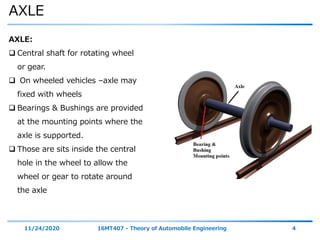
AXLE:
 Central shaft for rotating wheel
or gear.
 On wheeled vehicles –axle may
fixed with wheels
 Bearings & Bushings are provided
at the mounting points where the
axle is supported.
 Those are sits inside the central
hole in the wheel to allow the
wheel or gear to rotate around
the axle
AXLE
11/24/2020 16MT407 - Theory of Automobile Engineering 5
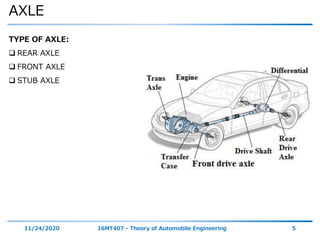
TYPE OF AXLE:
 REAR AXLE
 FRONT AXLE
 STUB AXLE
REAR AXLE
11/24/2020 16MT407 - Theory of Automobile Engineering 6
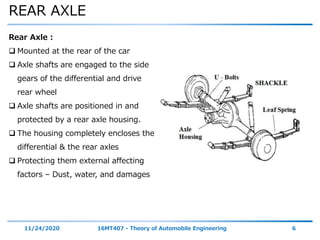
Rear Axle :
 Mounted at the rear of the car
 Axle shafts are engaged to the side
gears of the differential and drive
rear wheel
 Axle shafts are positioned in and
protected by a rear axle housing.
 The housing completely encloses the
differential & the rear axles
 Protecting them external affecting
factors – Dust, water, and damages
REAR AXLE
11/24/2020 16MT407 - Theory of Automobile Engineering 7
Rear Axle : Function
 Act as a beam to support the weight
of the vehicle
 Act as an axis of the vehicle
 Transmits the power to the wheel
 Act as a housing & Support for the
final drive, differential and axle shaft
REAR AXLE
11/24/2020 16MT407 - Theory of Automobile Engineering 8
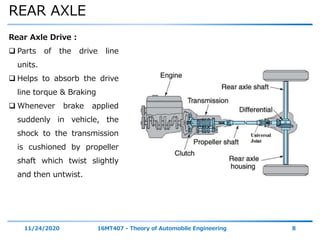
Rear Axle Drive :
 Parts of the drive line
units.
 Helps to absorb the drive
line torque & Braking
 Whenever brake applied
suddenly in vehicle, the
shock to the transmission
is cushioned by propeller
shaft which twist slightly
and then untwist.
REAR AXLE
11/24/2020 16MT407 - Theory of Automobile Engineering 9
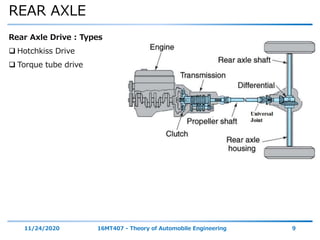
Rear Axle Drive : Types
 Hotchkiss Drive
 Torque tube drive
REAR AXLE
11/24/2020 16MT407 - Theory of Automobile Engineering 10
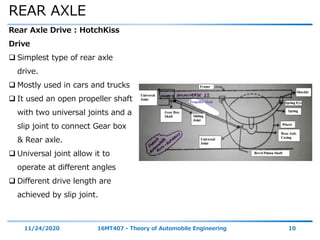
Rear Axle Drive : HotchKiss
Drive
 Simplest type of rear axle
drive.
 Mostly used in cars and trucks
 It used an open propeller shaft
with two universal joints and a
slip joint to connect Gear box
& Rear axle.
 Universal joint allow it to
operate at different angles
 Different drive length are
achieved by slip joint.
REAR AXLE
11/24/2020 16MT407 - Theory of Automobile Engineering 11
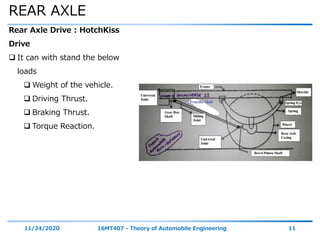
Rear Axle Drive : HotchKiss
Drive
 It can with stand the below
loads
 Weight of the vehicle.
 Driving Thrust.
 Braking Thrust.
 Torque Reaction.
REAR AXLE
11/24/2020 16MT407 - Theory of Automobile Engineering 12
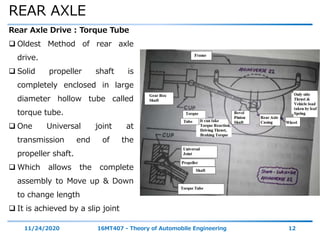
Rear Axle Drive : Torque Tube
 Oldest Method of rear axle
drive.
 Solid propeller shaft is
completely enclosed in large
diameter hollow tube called
torque tube.
 One Universal joint at
transmission end of the
propeller shaft.
 Which allows the complete
assembly to Move up & Down
to change length
 It is achieved by a slip joint
REAR AXLE
11/24/2020 16MT407 - Theory of Automobile Engineering 13
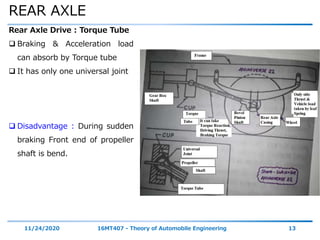
Rear Axle Drive : Torque Tube
 Braking & Acceleration load
can absorb by Torque tube
 It has only one universal joint
 Disadvantage : During sudden
braking Front end of propeller
shaft is bend.
TYPE OF REAR AXLE
11/24/2020 16MT407 - Theory of Automobile Engineering 14
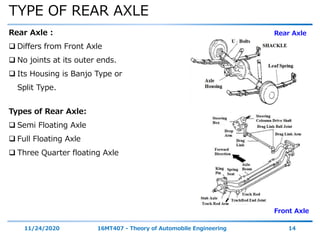
Rear Axle :
 Differs from Front Axle
 No joints at its outer ends.
 Its Housing is Banjo Type or
Split Type.
Front Axle
Rear Axle
Types of Rear Axle:
 Semi Floating Axle
 Full Floating Axle
 Three Quarter floating Axle
TYPE OF REAR AXLE
11/24/2020 16MT407 - Theory of Automobile Engineering 15
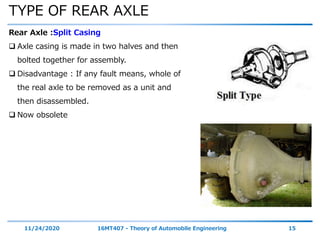
Rear Axle :Split Casing
 Axle casing is made in two halves and then
bolted together for assembly.
 Disadvantage : If any fault means, whole of
the real axle to be removed as a unit and
then disassembled.
 Now obsolete
TYPE OF REAR AXLE
11/24/2020 16MT407 - Theory of Automobile Engineering 16
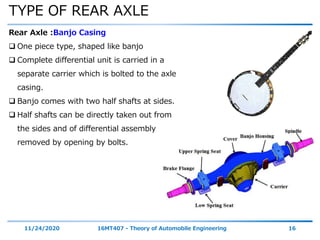
Rear Axle :Banjo Casing
 One piece type, shaped like banjo
 Complete differential unit is carried in a
separate carrier which is bolted to the axle
casing.
 Banjo comes with two half shafts at sides.
 Half shafts can be directly taken out from
the sides and of differential assembly
removed by opening by bolts.
TYPE OF REAR AXLE
11/24/2020 16MT407 - Theory of Automobile Engineering 17
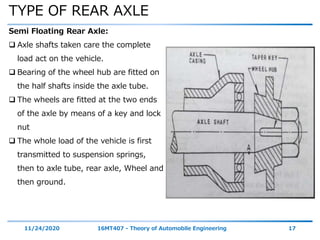
Semi Floating Rear Axle:
 Axle shafts taken care the complete
load act on the vehicle.
 Bearing of the wheel hub are fitted on
the half shafts inside the axle tube.
 The wheels are fitted at the two ends
of the axle by means of a key and lock
nut
 The whole load of the vehicle is first
transmitted to suspension springs,
then to axle tube, rear axle, Wheel and
then ground.
TYPE OF REAR AXLE
11/24/2020 16MT407 - Theory of Automobile Engineering 18
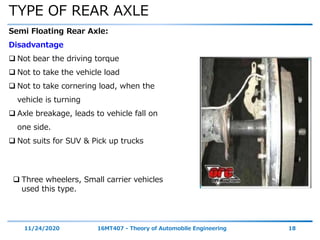
Semi Floating Rear Axle:
Disadvantage
 Not bear the driving torque
 Not to take the vehicle load
 Not to take cornering load, when the
vehicle is turning
 Axle breakage, leads to vehicle fall on
one side.
 Not suits for SUV & Pick up trucks
 Three wheelers, Small carrier vehicles
used this type.
TYPE OF REAR AXLE
11/24/2020 16MT407 - Theory of Automobile Engineering 19
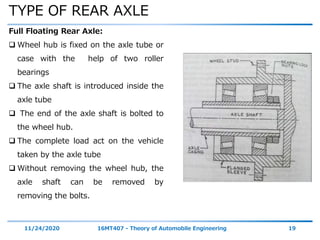
Full Floating Rear Axle:
 Wheel hub is fixed on the axle tube or
case with the help of two roller
bearings
 The axle shaft is introduced inside the
axle tube
 The end of the axle shaft is bolted to
the wheel hub.
 The complete load act on the vehicle
taken by the axle tube
 Without removing the wheel hub, the
axle shaft can be removed by
removing the bolts.
TYPE OF REAR AXLE
11/24/2020 16MT407 - Theory of Automobile Engineering 20
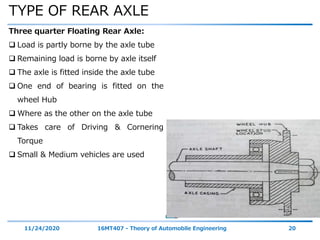
Three quarter Floating Rear Axle:
 Load is partly borne by the axle tube
 Remaining load is borne by axle itself
 The axle is fitted inside the axle tube
 One end of bearing is fitted on the
wheel Hub
 Where as the other on the axle tube
 Takes care of Driving & Cornering
Torque
 Small & Medium vehicles are used
FRONT AXLE
11/24/2020 16MT407 - Theory of Automobile Engineering 21
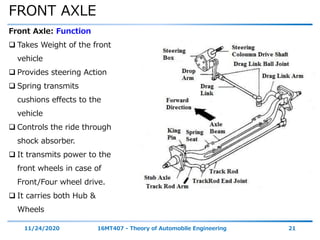
Front Axle: Function
 Takes Weight of the front
vehicle
 Provides steering Action
 Spring transmits
cushions effects to the
vehicle
 Controls the ride through
shock absorber.
 It transmits power to the
front wheels in case of
Front/Four wheel drive.
 It carries both Hub &
Wheels
FRONT AXLE
11/24/2020 16MT407 - Theory of Automobile Engineering 22
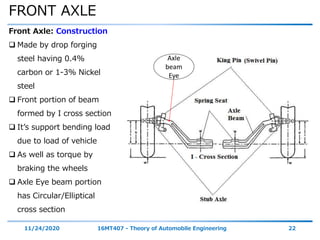
Front Axle: Construction
 Made by drop forging
steel having 0.4%
carbon or 1-3% Nickel
steel
 Front portion of beam
formed by I cross section
 It’s support bending load
due to load of vehicle
 As well as torque by
braking the wheels
 Axle Eye beam portion
has Circular/Elliptical
cross section
Axle
beam
Eye
FRONT AXLE
11/24/2020 16MT407 - Theory of Automobile Engineering 23
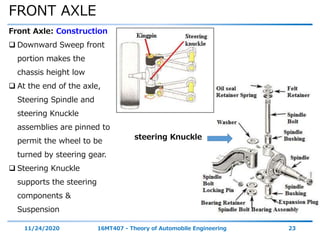
Front Axle: Construction
 Downward Sweep front
portion makes the
chassis height low
 At the end of the axle,
Steering Spindle and
steering Knuckle
assemblies are pinned to
permit the wheel to be
turned by steering gear.
 Steering Knuckle
supports the steering
components &
Suspension
steering Knuckle
FRONT AXLE
11/24/2020 16MT407 - Theory of Automobile Engineering 24
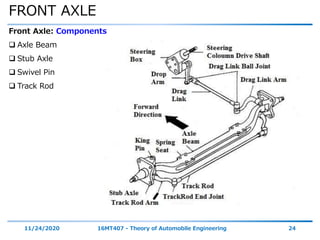
Front Axle: Components
 Axle Beam
 Stub Axle
 Swivel Pin
 Track Rod
FRONT AXLE
11/24/2020 16MT407 - Theory of Automobile Engineering 25
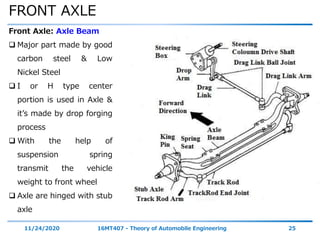
Front Axle: Axle Beam
 Major part made by good
carbon steel & Low
Nickel Steel
 I or H type center
portion is used in Axle &
it’s made by drop forging
process
 With the help of
suspension spring
transmit the vehicle
weight to front wheel
 Axle are hinged with stub
axle
FRONT AXLE
11/24/2020 16MT407 - Theory of Automobile Engineering 26
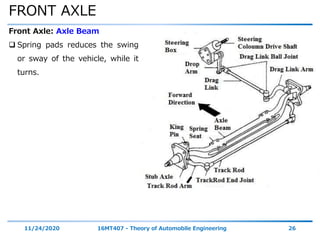
Front Axle: Axle Beam
 Spring pads reduces the swing
or sway of the vehicle, while it
turns.
FRONT AXLE
11/24/2020 16MT407 - Theory of Automobile Engineering 27
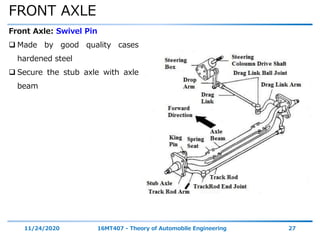
Front Axle: Swivel Pin
 Made by good quality cases
hardened steel
 Secure the stub axle with axle
beam
FRONT AXLE
11/24/2020 16MT407 - Theory of Automobile Engineering 28
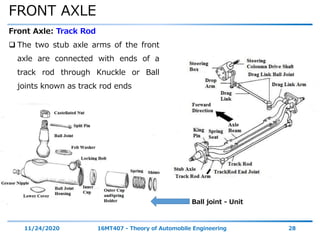
Front Axle: Track Rod
 The two stub axle arms of the front
axle are connected with ends of a
track rod through Knuckle or Ball
joints known as track rod ends
Ball joint - Unit
FRONT AXLE
11/24/2020 16MT407 - Theory of Automobile Engineering 29
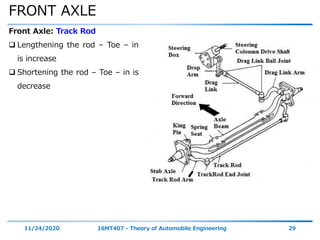
Front Axle: Track Rod
 Lengthening the rod – Toe – in
is increase
 Shortening the rod – Toe – in is
decrease
FRONT AXLE
11/24/2020 16MT407 - Theory of Automobile Engineering 30
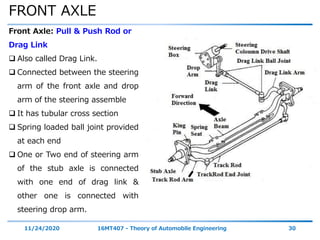
Front Axle: Pull & Push Rod or
Drag Link
 Also called Drag Link.
 Connected between the steering
arm of the front axle and drop
arm of the steering assemble
 It has tubular cross section
 Spring loaded ball joint provided
at each end
 One or Two end of steering arm
of the stub axle is connected
with one end of drag link &
other one is connected with
steering drop arm.
FRONT AXLE
11/24/2020 16MT407 - Theory of Automobile Engineering 31
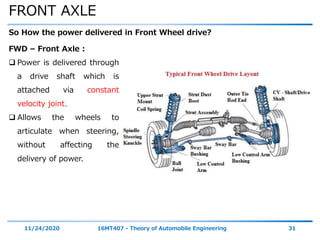
So How the power delivered in Front Wheel drive?
FWD – Front Axle :
 Power is delivered through
a drive shaft which is
attached via constant
velocity joint.
 Allows the wheels to
articulate when steering,
without affecting the
delivery of power.
FRONT AXLE
11/24/2020 16MT407 - Theory of Automobile Engineering 32
So How the power delivered in Front Wheel drive?
FWD – Front Axle :
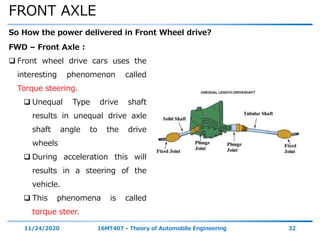
 Front wheel drive cars uses the
interesting phenomenon called
Torque steering.
 Unequal Type drive shaft
results in unequal drive axle
shaft angle to the drive
wheels
 During acceleration this will
results in a steering of the
vehicle.
 This phenomena is called
torque steer.
FRONT AXLE
11/24/2020 16MT407 - Theory of Automobile Engineering 33
So How the power delivered in Front Wheel drive?
FWD – Front Axle :
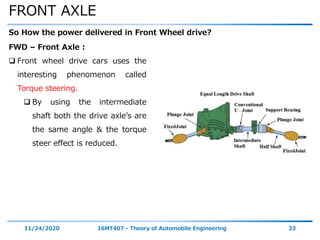
 Front wheel drive cars uses the
interesting phenomenon called
Torque steering.
 By using the intermediate
shaft both the drive axle’s are
the same angle & the torque
steer effect is reduced.
FRONT AXLE
11/24/2020 16MT407 - Theory of Automobile Engineering 34
So How the power delivered in Front Wheel drive?
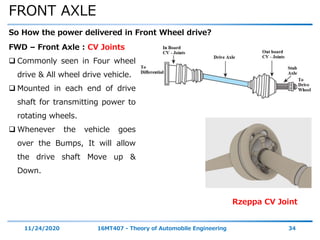
FWD – Front Axle : CV Joints
 Commonly seen in Four wheel
drive & All wheel drive vehicle.
 Mounted in each end of drive
shaft for transmitting power to
rotating wheels.
 Whenever the vehicle goes
over the Bumps, It will allow
the drive shaft Move up &
Down.
Rzeppa CV Joint
FRONT AXLE
11/24/2020 16MT407 - Theory of Automobile Engineering 35
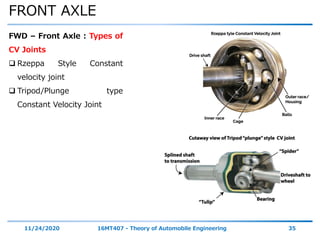
FWD – Front Axle : Types of
CV Joints
 Rzeppa Style Constant
velocity joint
 Tripod/Plunge type
Constant Velocity Joint
FRONT AXLE
11/24/2020 16MT407 - Theory of Automobile Engineering 36
FWD – Front Axle : Types of CV
Joints
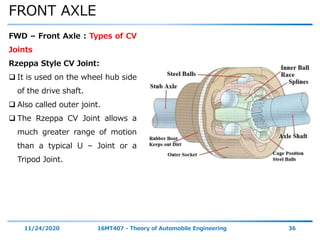
Rzeppa Style CV Joint:
 It is used on the wheel hub side
of the drive shaft.
 Also called outer joint.
 The Rzeppa CV Joint allows a
much greater range of motion
than a typical U – Joint or a
Tripod Joint.
FRONT AXLE
11/24/2020 16MT407 - Theory of Automobile Engineering 37
FWD – Front Axle : Types of CV
Joints
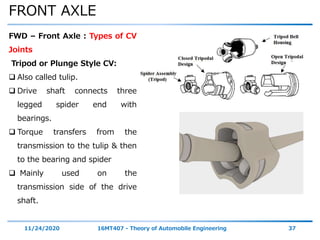
Tripod or Plunge Style CV:
 Also called tulip.
 Drive shaft connects three
legged spider end with
bearings.
 Torque transfers from the
transmission to the tulip & then
to the bearing and spider
 Mainly used on the
transmission side of the drive
shaft.
FRONT AXLE
11/24/2020 16MT407 - Theory of Automobile Engineering 38
FWD – Front Axle : Types of CV
Joints
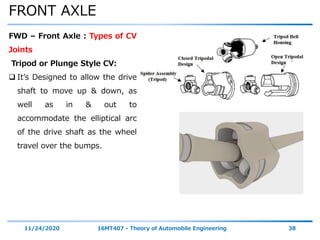
Tripod or Plunge Style CV:
 It’s Designed to allow the drive
shaft to move up & down, as
well as in & out to
accommodate the elliptical arc
of the drive shaft as the wheel
travel over the bumps.
LIVE AXLE
11/24/2020 16MT407 - Theory of Automobile Engineering 39
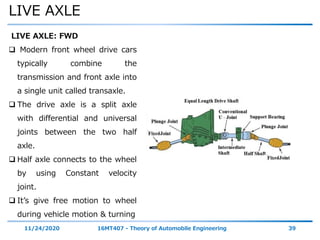
LIVE AXLE: FWD
 Modern front wheel drive cars
typically combine the
transmission and front axle into
a single unit called transaxle.
 The drive axle is a split axle
with differential and universal
joints between the two half
axle.
 Half axle connects to the wheel
by using Constant velocity
joint.
 It’s give free motion to wheel
during vehicle motion & turning
LIVE AXLE
11/24/2020 16MT407 - Theory of Automobile Engineering 40
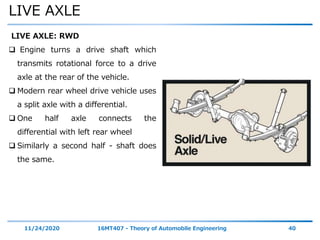
LIVE AXLE: RWD
 Engine turns a drive shaft which
transmits rotational force to a drive
axle at the rear of the vehicle.
 Modern rear wheel drive vehicle uses
a split axle with a differential.
 One half axle connects the
differential with left rear wheel
 Similarly a second half - shaft does
the same.
DEAD AXLE
11/24/2020 16MT407 - Theory of Automobile Engineering 41
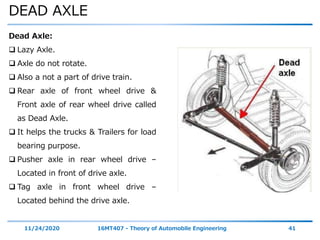
Dead Axle:
 Lazy Axle.
 Axle do not rotate.
 Also a not a part of drive train.
 Rear axle of front wheel drive &
Front axle of rear wheel drive called
as Dead Axle.
 It helps the trucks & Trailers for load
bearing purpose.
 Pusher axle in rear wheel drive –
Located in front of drive axle.
 Tag axle in front wheel drive –
Located behind the drive axle.
STUB AXLE
11/24/2020 16MT407 - Theory of Automobile Engineering 42
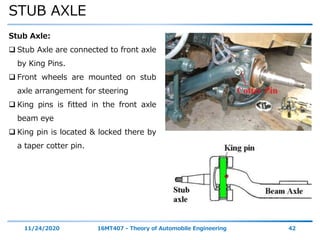
Stub Axle:
 Stub Axle are connected to front axle
by King Pins.
 Front wheels are mounted on stub
axle arrangement for steering
 King pins is fitted in the front axle
beam eye
 King pin is located & locked there by
a taper cotter pin.
STUB AXLE
11/24/2020 16MT407 - Theory of Automobile Engineering 43
Stub Axle: Types
 Elliot Type
 Reversed Elliot
 Lamoine
 Reversed Lamoine
STUB AXLE
11/24/2020 16MT407 - Theory of Automobile Engineering 44
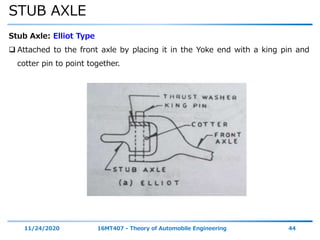
Stub Axle: Elliot Type
 Attached to the front axle by placing it in the Yoke end with a king pin and
cotter pin to point together.
STUB AXLE
11/24/2020 16MT407 - Theory of Automobile Engineering 45
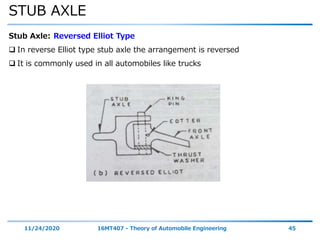
Stub Axle: Reversed Elliot Type
 In reverse Elliot type stub axle the arrangement is reversed
 It is commonly used in all automobiles like trucks
STUB AXLE
11/24/2020 16MT407 - Theory of Automobile Engineering 46
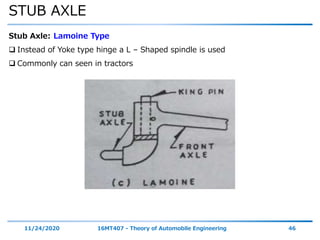
Stub Axle: Lamoine Type
 Instead of Yoke type hinge a L – Shaped spindle is used
 Commonly can seen in tractors
STUB AXLE
11/24/2020 16MT407 - Theory of Automobile Engineering 47
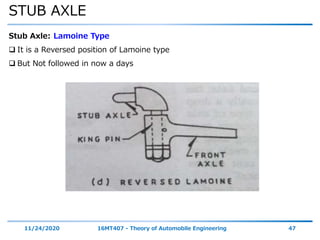
Stub Axle: Lamoine Type
 It is a Reversed position of Lamoine type
 But Not followed in now a days
11/24/2020 16MT407 - Theory of Automobile Engineering 48
END

Front & elliot axle

  • 1.
    SRI KRISHNA COLLEGEOF ENGINEERING AND TECHNOLOGY DEPARTMENT OF MECHATRONICS ENGINEERING Session: AXLE SYSTEMS 11/24/2020 16MT407 - Theory of Automobile Engineering 1 MODULE 2
  • 2.
    SESSION OBJECTIVES 11/24/2020 16MT407- Theory of Automobile Engineering 2  On the completion of this session, the students might be able to understand,  Construction & Function of Axle systems in Vehicle
  • 3.
    Topics  Axle  Typeof Axle in vehicle  Rear Axle  Front Axle  Stub Axle 11/24/2020 16MT407 - Theory of Automobile Engineering 3
  • 4.
    AXLE 11/24/2020 16MT407 -Theory of Automobile Engineering 4 AXLE:  Central shaft for rotating wheel or gear.  On wheeled vehicles –axle may fixed with wheels  Bearings & Bushings are provided at the mounting points where the axle is supported.  Those are sits inside the central hole in the wheel to allow the wheel or gear to rotate around the axle
  • 5.
    AXLE 11/24/2020 16MT407 -Theory of Automobile Engineering 5 TYPE OF AXLE:  REAR AXLE  FRONT AXLE  STUB AXLE
  • 6.
    REAR AXLE 11/24/2020 16MT407- Theory of Automobile Engineering 6 Rear Axle :  Mounted at the rear of the car  Axle shafts are engaged to the side gears of the differential and drive rear wheel  Axle shafts are positioned in and protected by a rear axle housing.  The housing completely encloses the differential & the rear axles  Protecting them external affecting factors – Dust, water, and damages
  • 7.
    REAR AXLE 11/24/2020 16MT407- Theory of Automobile Engineering 7 Rear Axle : Function  Act as a beam to support the weight of the vehicle  Act as an axis of the vehicle  Transmits the power to the wheel  Act as a housing & Support for the final drive, differential and axle shaft
  • 8.
    REAR AXLE 11/24/2020 16MT407- Theory of Automobile Engineering 8 Rear Axle Drive :  Parts of the drive line units.  Helps to absorb the drive line torque & Braking  Whenever brake applied suddenly in vehicle, the shock to the transmission is cushioned by propeller shaft which twist slightly and then untwist.
  • 9.
    REAR AXLE 11/24/2020 16MT407- Theory of Automobile Engineering 9 Rear Axle Drive : Types  Hotchkiss Drive  Torque tube drive
  • 10.
    REAR AXLE 11/24/2020 16MT407- Theory of Automobile Engineering 10 Rear Axle Drive : HotchKiss Drive  Simplest type of rear axle drive.  Mostly used in cars and trucks  It used an open propeller shaft with two universal joints and a slip joint to connect Gear box & Rear axle.  Universal joint allow it to operate at different angles  Different drive length are achieved by slip joint.
  • 11.
    REAR AXLE 11/24/2020 16MT407- Theory of Automobile Engineering 11 Rear Axle Drive : HotchKiss Drive  It can with stand the below loads  Weight of the vehicle.  Driving Thrust.  Braking Thrust.  Torque Reaction.
  • 12.
    REAR AXLE 11/24/2020 16MT407- Theory of Automobile Engineering 12 Rear Axle Drive : Torque Tube  Oldest Method of rear axle drive.  Solid propeller shaft is completely enclosed in large diameter hollow tube called torque tube.  One Universal joint at transmission end of the propeller shaft.  Which allows the complete assembly to Move up & Down to change length  It is achieved by a slip joint
  • 13.
    REAR AXLE 11/24/2020 16MT407- Theory of Automobile Engineering 13 Rear Axle Drive : Torque Tube  Braking & Acceleration load can absorb by Torque tube  It has only one universal joint  Disadvantage : During sudden braking Front end of propeller shaft is bend.
  • 14.
    TYPE OF REARAXLE 11/24/2020 16MT407 - Theory of Automobile Engineering 14 Rear Axle :  Differs from Front Axle  No joints at its outer ends.  Its Housing is Banjo Type or Split Type. Front Axle Rear Axle Types of Rear Axle:  Semi Floating Axle  Full Floating Axle  Three Quarter floating Axle
  • 15.
    TYPE OF REARAXLE 11/24/2020 16MT407 - Theory of Automobile Engineering 15 Rear Axle :Split Casing  Axle casing is made in two halves and then bolted together for assembly.  Disadvantage : If any fault means, whole of the real axle to be removed as a unit and then disassembled.  Now obsolete
  • 16.
    TYPE OF REARAXLE 11/24/2020 16MT407 - Theory of Automobile Engineering 16 Rear Axle :Banjo Casing  One piece type, shaped like banjo  Complete differential unit is carried in a separate carrier which is bolted to the axle casing.  Banjo comes with two half shafts at sides.  Half shafts can be directly taken out from the sides and of differential assembly removed by opening by bolts.
  • 17.
    TYPE OF REARAXLE 11/24/2020 16MT407 - Theory of Automobile Engineering 17 Semi Floating Rear Axle:  Axle shafts taken care the complete load act on the vehicle.  Bearing of the wheel hub are fitted on the half shafts inside the axle tube.  The wheels are fitted at the two ends of the axle by means of a key and lock nut  The whole load of the vehicle is first transmitted to suspension springs, then to axle tube, rear axle, Wheel and then ground.
  • 18.
    TYPE OF REARAXLE 11/24/2020 16MT407 - Theory of Automobile Engineering 18 Semi Floating Rear Axle: Disadvantage  Not bear the driving torque  Not to take the vehicle load  Not to take cornering load, when the vehicle is turning  Axle breakage, leads to vehicle fall on one side.  Not suits for SUV & Pick up trucks  Three wheelers, Small carrier vehicles used this type.
  • 19.
    TYPE OF REARAXLE 11/24/2020 16MT407 - Theory of Automobile Engineering 19 Full Floating Rear Axle:  Wheel hub is fixed on the axle tube or case with the help of two roller bearings  The axle shaft is introduced inside the axle tube  The end of the axle shaft is bolted to the wheel hub.  The complete load act on the vehicle taken by the axle tube  Without removing the wheel hub, the axle shaft can be removed by removing the bolts.
  • 20.
    TYPE OF REARAXLE 11/24/2020 16MT407 - Theory of Automobile Engineering 20 Three quarter Floating Rear Axle:  Load is partly borne by the axle tube  Remaining load is borne by axle itself  The axle is fitted inside the axle tube  One end of bearing is fitted on the wheel Hub  Where as the other on the axle tube  Takes care of Driving & Cornering Torque  Small & Medium vehicles are used
  • 21.
    FRONT AXLE 11/24/2020 16MT407- Theory of Automobile Engineering 21 Front Axle: Function  Takes Weight of the front vehicle  Provides steering Action  Spring transmits cushions effects to the vehicle  Controls the ride through shock absorber.  It transmits power to the front wheels in case of Front/Four wheel drive.  It carries both Hub & Wheels
  • 22.
    FRONT AXLE 11/24/2020 16MT407- Theory of Automobile Engineering 22 Front Axle: Construction  Made by drop forging steel having 0.4% carbon or 1-3% Nickel steel  Front portion of beam formed by I cross section  It’s support bending load due to load of vehicle  As well as torque by braking the wheels  Axle Eye beam portion has Circular/Elliptical cross section Axle beam Eye
  • 23.
    FRONT AXLE 11/24/2020 16MT407- Theory of Automobile Engineering 23 Front Axle: Construction  Downward Sweep front portion makes the chassis height low  At the end of the axle, Steering Spindle and steering Knuckle assemblies are pinned to permit the wheel to be turned by steering gear.  Steering Knuckle supports the steering components & Suspension steering Knuckle
  • 24.
    FRONT AXLE 11/24/2020 16MT407- Theory of Automobile Engineering 24 Front Axle: Components  Axle Beam  Stub Axle  Swivel Pin  Track Rod
  • 25.
    FRONT AXLE 11/24/2020 16MT407- Theory of Automobile Engineering 25 Front Axle: Axle Beam  Major part made by good carbon steel & Low Nickel Steel  I or H type center portion is used in Axle & it’s made by drop forging process  With the help of suspension spring transmit the vehicle weight to front wheel  Axle are hinged with stub axle
  • 26.
    FRONT AXLE 11/24/2020 16MT407- Theory of Automobile Engineering 26 Front Axle: Axle Beam  Spring pads reduces the swing or sway of the vehicle, while it turns.
  • 27.
    FRONT AXLE 11/24/2020 16MT407- Theory of Automobile Engineering 27 Front Axle: Swivel Pin  Made by good quality cases hardened steel  Secure the stub axle with axle beam
  • 28.
    FRONT AXLE 11/24/2020 16MT407- Theory of Automobile Engineering 28 Front Axle: Track Rod  The two stub axle arms of the front axle are connected with ends of a track rod through Knuckle or Ball joints known as track rod ends Ball joint - Unit
  • 29.
    FRONT AXLE 11/24/2020 16MT407- Theory of Automobile Engineering 29 Front Axle: Track Rod  Lengthening the rod – Toe – in is increase  Shortening the rod – Toe – in is decrease
  • 30.
    FRONT AXLE 11/24/2020 16MT407- Theory of Automobile Engineering 30 Front Axle: Pull & Push Rod or Drag Link  Also called Drag Link.  Connected between the steering arm of the front axle and drop arm of the steering assemble  It has tubular cross section  Spring loaded ball joint provided at each end  One or Two end of steering arm of the stub axle is connected with one end of drag link & other one is connected with steering drop arm.
  • 31.
    FRONT AXLE 11/24/2020 16MT407- Theory of Automobile Engineering 31 So How the power delivered in Front Wheel drive? FWD – Front Axle :  Power is delivered through a drive shaft which is attached via constant velocity joint.  Allows the wheels to articulate when steering, without affecting the delivery of power.
  • 32.
    FRONT AXLE 11/24/2020 16MT407- Theory of Automobile Engineering 32 So How the power delivered in Front Wheel drive? FWD – Front Axle :  Front wheel drive cars uses the interesting phenomenon called Torque steering.  Unequal Type drive shaft results in unequal drive axle shaft angle to the drive wheels  During acceleration this will results in a steering of the vehicle.  This phenomena is called torque steer.
  • 33.
    FRONT AXLE 11/24/2020 16MT407- Theory of Automobile Engineering 33 So How the power delivered in Front Wheel drive? FWD – Front Axle :  Front wheel drive cars uses the interesting phenomenon called Torque steering.  By using the intermediate shaft both the drive axle’s are the same angle & the torque steer effect is reduced.
  • 34.
    FRONT AXLE 11/24/2020 16MT407- Theory of Automobile Engineering 34 So How the power delivered in Front Wheel drive? FWD – Front Axle : CV Joints  Commonly seen in Four wheel drive & All wheel drive vehicle.  Mounted in each end of drive shaft for transmitting power to rotating wheels.  Whenever the vehicle goes over the Bumps, It will allow the drive shaft Move up & Down. Rzeppa CV Joint
  • 35.
    FRONT AXLE 11/24/2020 16MT407- Theory of Automobile Engineering 35 FWD – Front Axle : Types of CV Joints  Rzeppa Style Constant velocity joint  Tripod/Plunge type Constant Velocity Joint
  • 36.
    FRONT AXLE 11/24/2020 16MT407- Theory of Automobile Engineering 36 FWD – Front Axle : Types of CV Joints Rzeppa Style CV Joint:  It is used on the wheel hub side of the drive shaft.  Also called outer joint.  The Rzeppa CV Joint allows a much greater range of motion than a typical U – Joint or a Tripod Joint.
  • 37.
    FRONT AXLE 11/24/2020 16MT407- Theory of Automobile Engineering 37 FWD – Front Axle : Types of CV Joints Tripod or Plunge Style CV:  Also called tulip.  Drive shaft connects three legged spider end with bearings.  Torque transfers from the transmission to the tulip & then to the bearing and spider  Mainly used on the transmission side of the drive shaft.
  • 38.
    FRONT AXLE 11/24/2020 16MT407- Theory of Automobile Engineering 38 FWD – Front Axle : Types of CV Joints Tripod or Plunge Style CV:  It’s Designed to allow the drive shaft to move up & down, as well as in & out to accommodate the elliptical arc of the drive shaft as the wheel travel over the bumps.
  • 39.
    LIVE AXLE 11/24/2020 16MT407- Theory of Automobile Engineering 39 LIVE AXLE: FWD  Modern front wheel drive cars typically combine the transmission and front axle into a single unit called transaxle.  The drive axle is a split axle with differential and universal joints between the two half axle.  Half axle connects to the wheel by using Constant velocity joint.  It’s give free motion to wheel during vehicle motion & turning
  • 40.
    LIVE AXLE 11/24/2020 16MT407- Theory of Automobile Engineering 40 LIVE AXLE: RWD  Engine turns a drive shaft which transmits rotational force to a drive axle at the rear of the vehicle.  Modern rear wheel drive vehicle uses a split axle with a differential.  One half axle connects the differential with left rear wheel  Similarly a second half - shaft does the same.
  • 41.
    DEAD AXLE 11/24/2020 16MT407- Theory of Automobile Engineering 41 Dead Axle:  Lazy Axle.  Axle do not rotate.  Also a not a part of drive train.  Rear axle of front wheel drive & Front axle of rear wheel drive called as Dead Axle.  It helps the trucks & Trailers for load bearing purpose.  Pusher axle in rear wheel drive – Located in front of drive axle.  Tag axle in front wheel drive – Located behind the drive axle.
  • 42.
    STUB AXLE 11/24/2020 16MT407- Theory of Automobile Engineering 42 Stub Axle:  Stub Axle are connected to front axle by King Pins.  Front wheels are mounted on stub axle arrangement for steering  King pins is fitted in the front axle beam eye  King pin is located & locked there by a taper cotter pin.
  • 43.
    STUB AXLE 11/24/2020 16MT407- Theory of Automobile Engineering 43 Stub Axle: Types  Elliot Type  Reversed Elliot  Lamoine  Reversed Lamoine
  • 44.
    STUB AXLE 11/24/2020 16MT407- Theory of Automobile Engineering 44 Stub Axle: Elliot Type  Attached to the front axle by placing it in the Yoke end with a king pin and cotter pin to point together.
  • 45.
    STUB AXLE 11/24/2020 16MT407- Theory of Automobile Engineering 45 Stub Axle: Reversed Elliot Type  In reverse Elliot type stub axle the arrangement is reversed  It is commonly used in all automobiles like trucks
  • 46.
    STUB AXLE 11/24/2020 16MT407- Theory of Automobile Engineering 46 Stub Axle: Lamoine Type  Instead of Yoke type hinge a L – Shaped spindle is used  Commonly can seen in tractors
  • 47.
    STUB AXLE 11/24/2020 16MT407- Theory of Automobile Engineering 47 Stub Axle: Lamoine Type  It is a Reversed position of Lamoine type  But Not followed in now a days
  • 48.
    11/24/2020 16MT407 -Theory of Automobile Engineering 48 END