TOOL DESIGN
UNIT 4
THEORY OF BENDING
BY
PURNESH ALONI
ROLL NO. 11
MTECH(PRODUCTION ENGG)
DEPARTMENT OF
MECHANICAL ENGINEERING
1
CONTENTS
• Introduction
• Types of bending
• Spring back in bending
• Compensation for spring back
• Variations in bending operations
• Design principles
2
INTRODUCTION
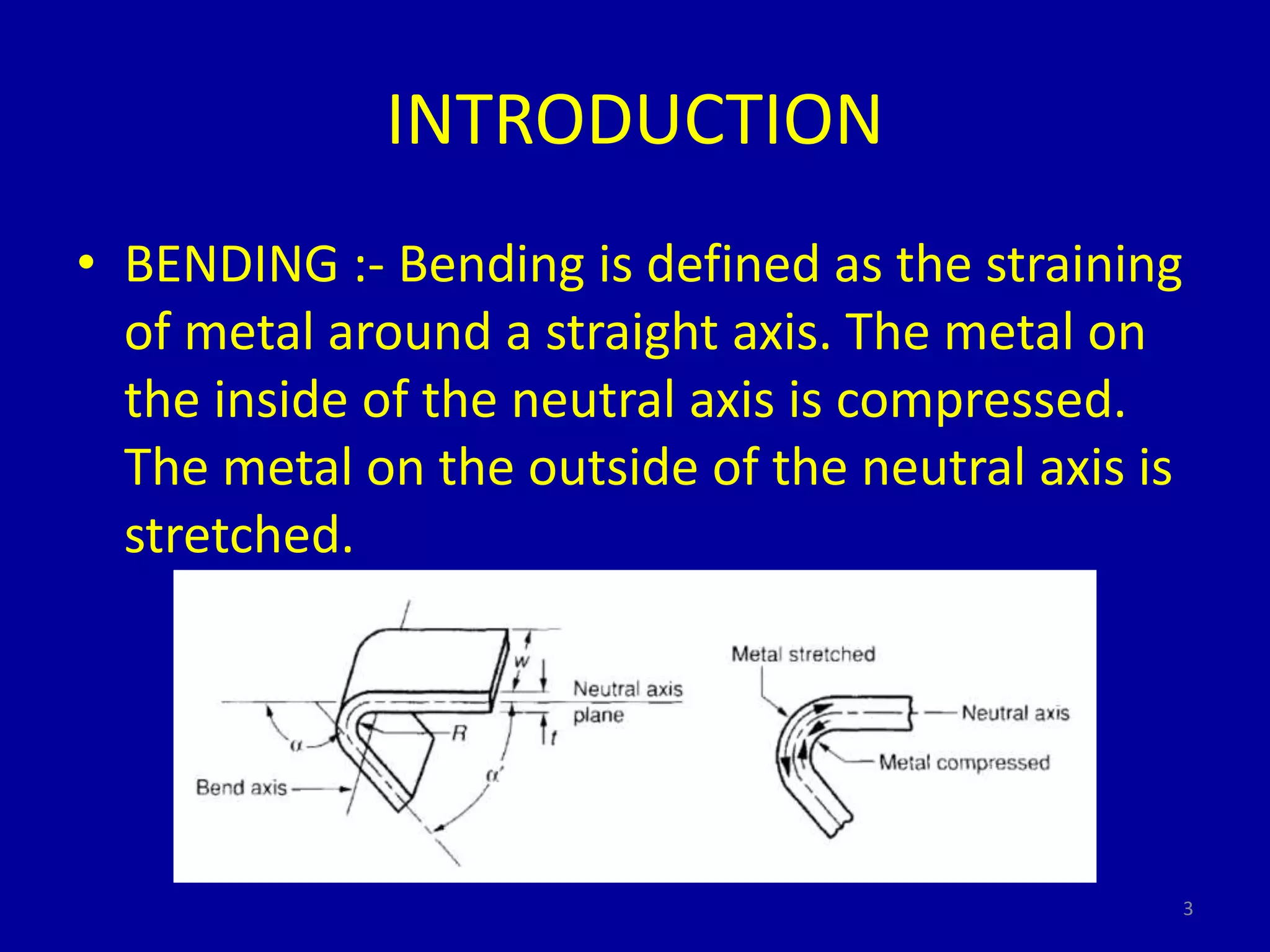
• BENDING :- Bending is defined as the straining
of metal around a straight axis. The metal on
the inside of the neutral axis is compressed.
The metal on the outside of the neutral axis is
stretched.
3
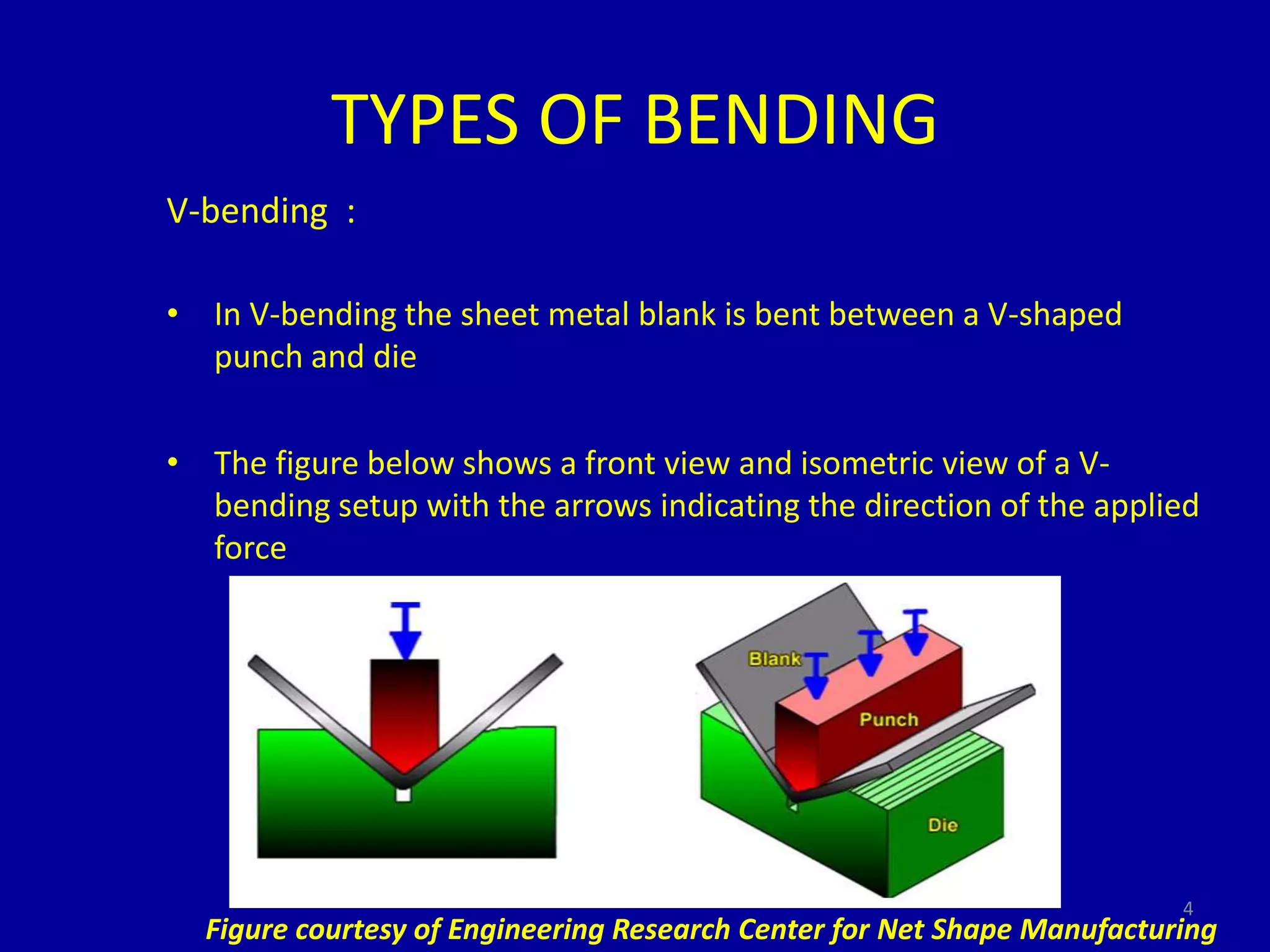
V-bending :
• In V-bending the sheet metal blank is bent between a V-shaped
punch and die
• The figure below shows a front view and isometric view of a V-
bending setup with the arrows indicating the direction of the applied
force
4
TYPES OF BENDING
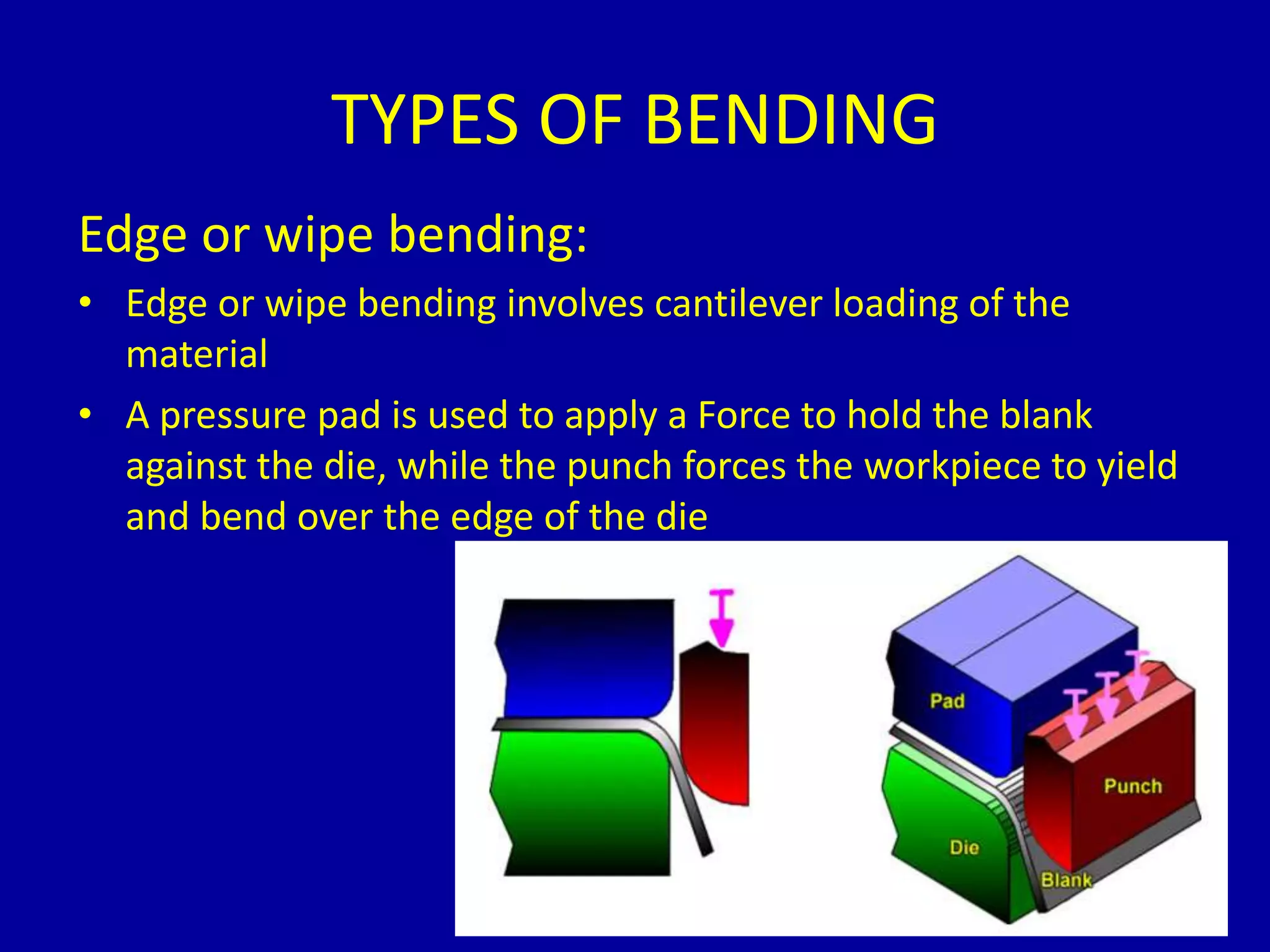
Figure courtesy of Engineering Research Center for Net Shape Manufacturing
Edge or wipe bending:
• Edge or wipe bending involves cantilever loading of the
material
• A pressure pad is used to apply a Force to hold the blank
against the die, while the punch forces the workpiece to yield
and bend over the edge of the die
TYPES OF BENDING
6
Spring back in bending
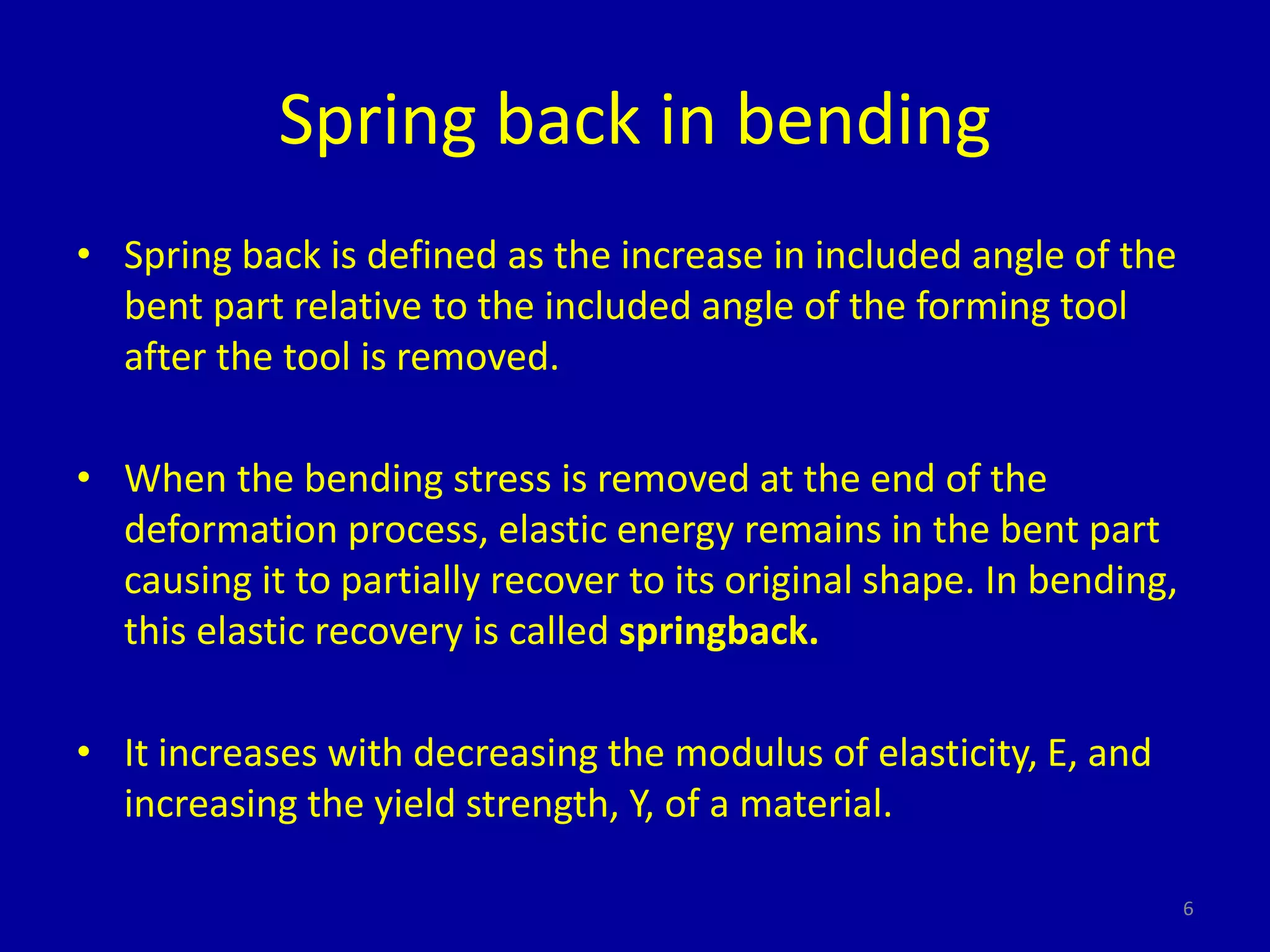
• Spring back is defined as the increase in included angle of the
bent part relative to the included angle of the forming tool
after the tool is removed.
• When the bending stress is removed at the end of the
deformation process, elastic energy remains in the bent part
causing it to partially recover to its original shape. In bending,
this elastic recovery is called springback.
• It increases with decreasing the modulus of elasticity, E, and
increasing the yield strength, Y, of a material.
Spring back in bending
7
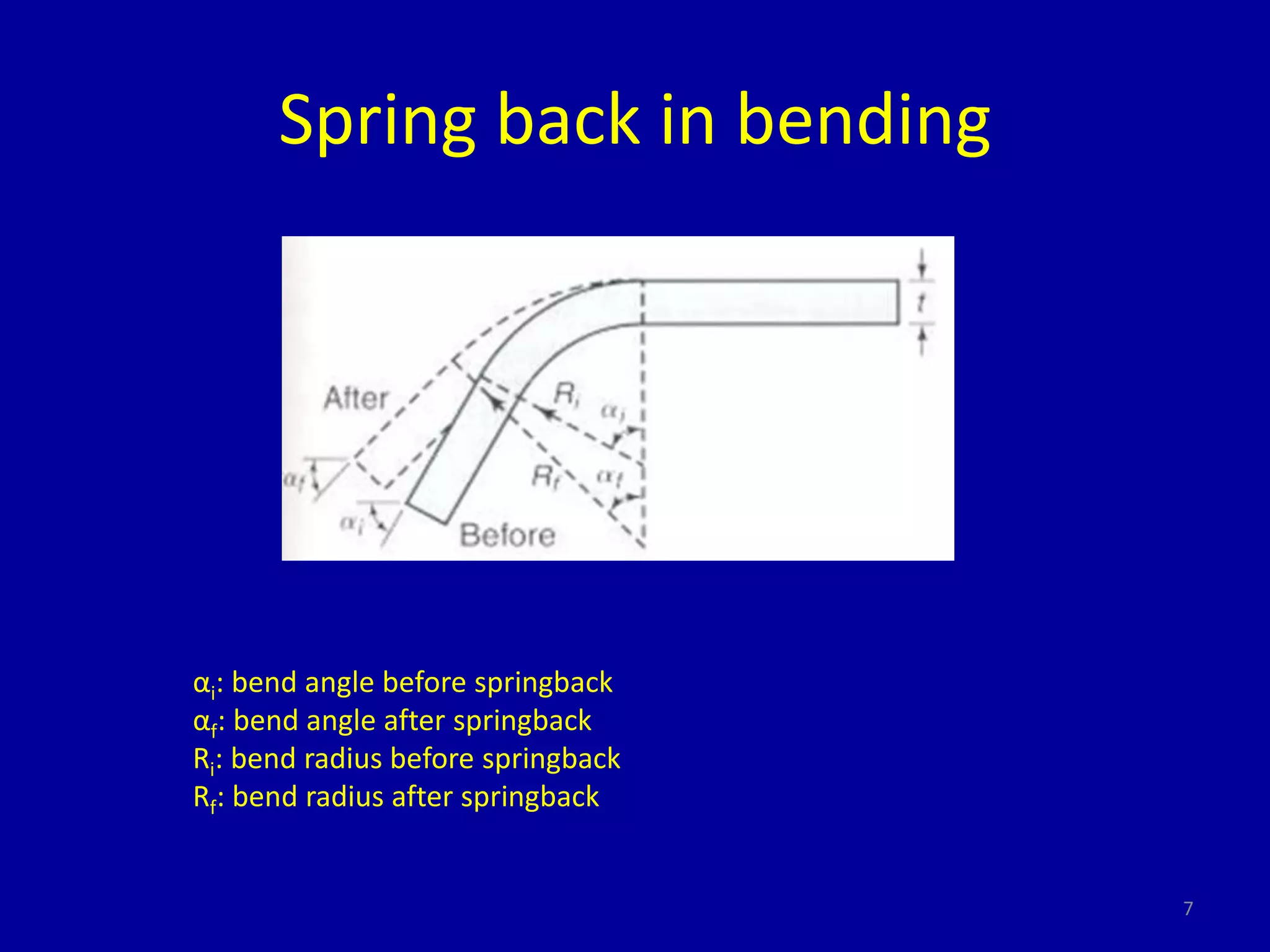
αi: bend angle before springback
αf: bend angle after springback
Ri: bend radius before springback
Rf: bend radius after springback
Spring back in bending
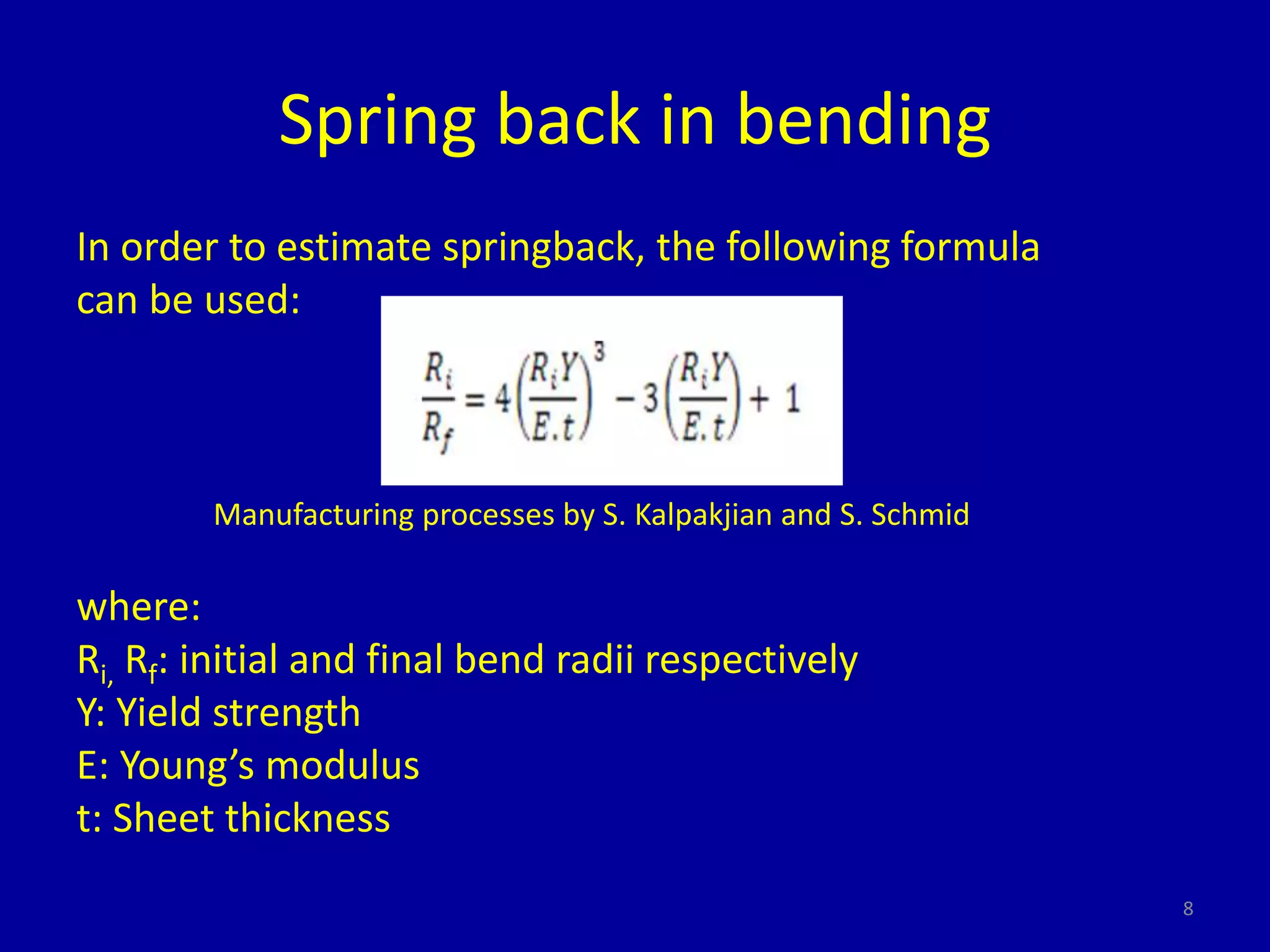
In order to estimate springback, the following formula
can be used:
Manufacturing processes by S. Kalpakjian and S. Schmid
where:
Ri, Rf: initial and final bend radii respectively
Y: Yield strength
E: Young’s modulus
t: Sheet thickness
8
9
Compensation for Springback
Overbending
• When overbending is used in V-bending (for example), the
punch angle and radius are fabricated slightly smaller than the
specified angle and raduis of the final part. This way the
material can “springback” to the desired value.
Bottoming (coining)
• Bottoming involves squeezing the part at the end of the stroke,
thus plastically deforming it in the bend region.
Variation in Bending Operations
• Flanging is a bending operation in which the edge of a sheet
metal is bent at a 90° angle to form a rim or flange. It is often
used to strengthen or stiffen sheet metal. The flange can be
straight, or it can involve stretching or shrinking as shown in
the figure below:
10
(a)Straight flanging
(b)Stretch flanging
(c)Shrink flanging
Variation in Flanging
In stretch flanging the curvature of
the bending line is concave and the
metal is circumferentially stretched,
i.e., A > B. The flange undergoes
thinning in stretch flanging.
In shrink flanging the curvature of
the bending line is convex and the
material is circumferentially
compressed, i.e., A < B. The material
undergoes thickening in shrink
flanging.
11
Variations in Bending Operation
•Hemming involves bending the edge of the sheet over
onto itself in more than one bending step. This process is
used to eliminate sharp edges, increase stiffness, and
improve appearance, such as the edges in car doors.
•Seaming is a bending operation in which two sheet metal
edges are joined together.
•Curling (or beading) forms the edges of the part into a roll.
Curling is also used for safety, strength, and aesthetics.
12
(a)Hemming
(b)Seaming
(c)Curling
Design Principles
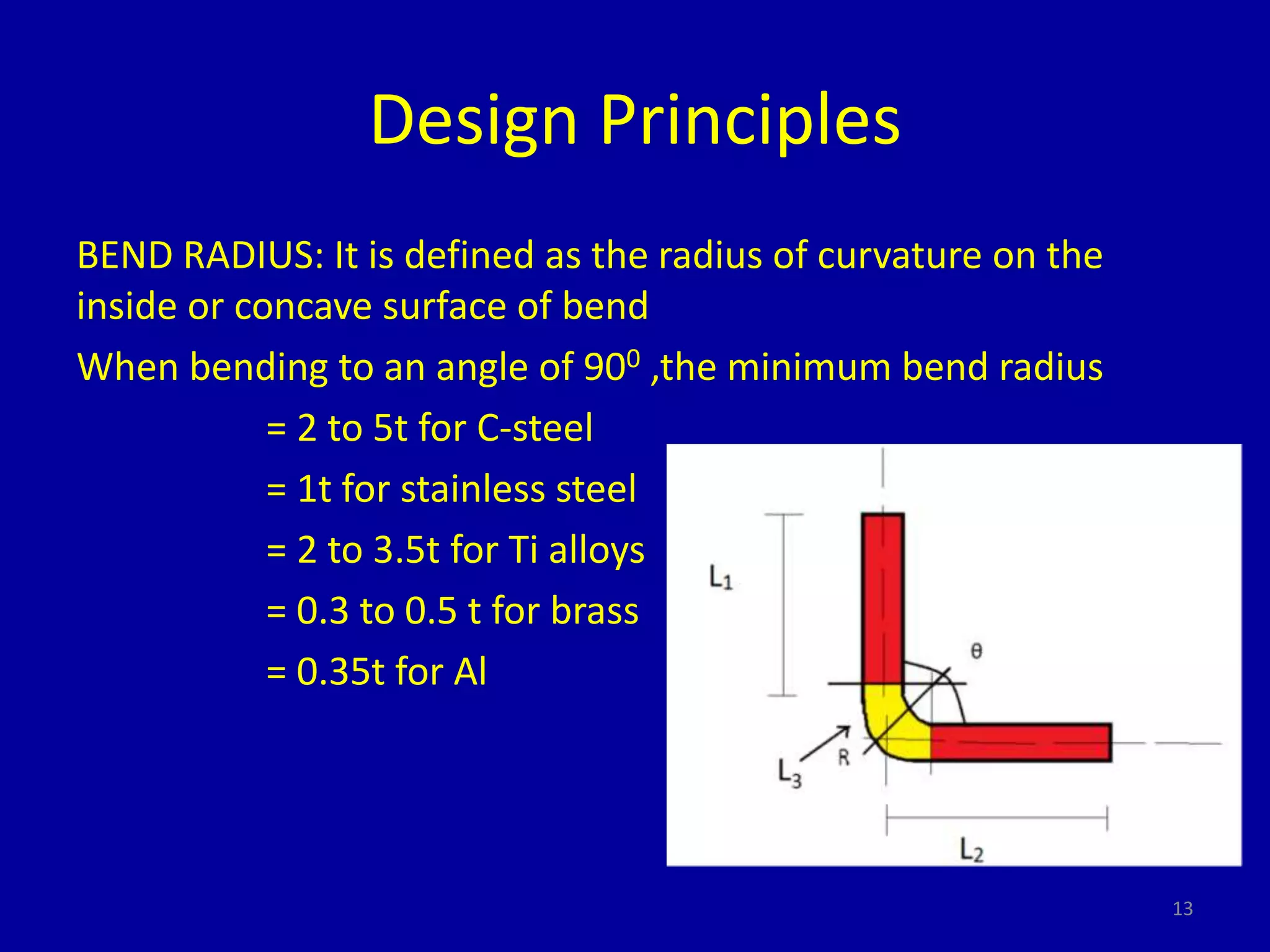
BEND RADIUS: It is defined as the radius of curvature on the
inside or concave surface of bend
When bending to an angle of 900 ,the minimum bend radius
= 2 to 5t for C-steel
= 1t for stainless steel
= 2 to 3.5t for Ti alloys
= 0.3 to 0.5 t for brass
= 0.35t for Al
13
Design Principles
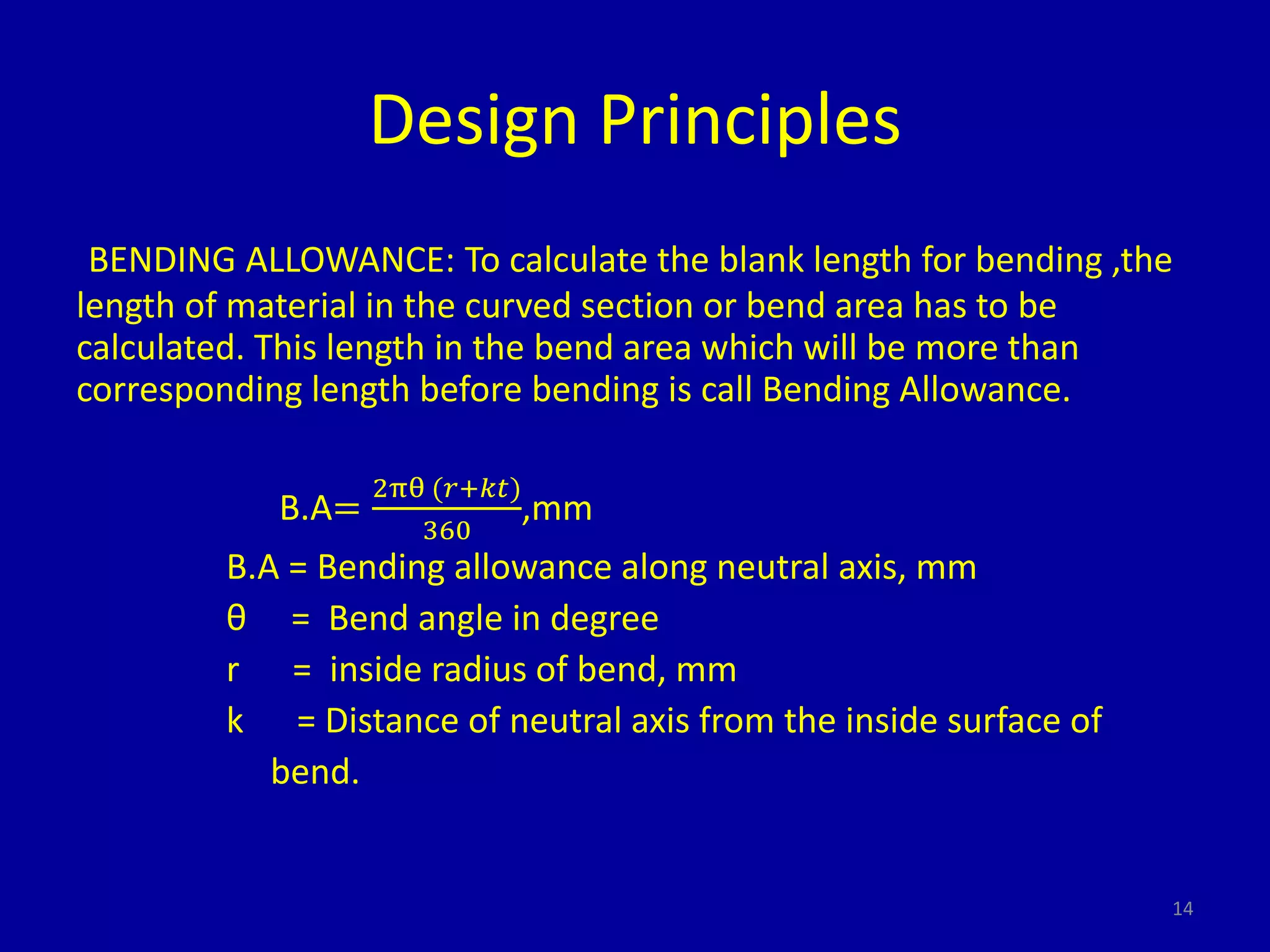
BENDING ALLOWANCE: To calculate the blank length for bending ,the
length of material in the curved section or bend area has to be
calculated. This length in the bend area which will be more than
corresponding length before bending is call Bending Allowance.
B.A=
2πθ (𝑟+𝑘𝑡)
360
,mm
B.A = Bending allowance along neutral axis, mm
θ = Bend angle in degree
r = inside radius of bend, mm
k = Distance of neutral axis from the inside surface of
bend.
14
Design Principles
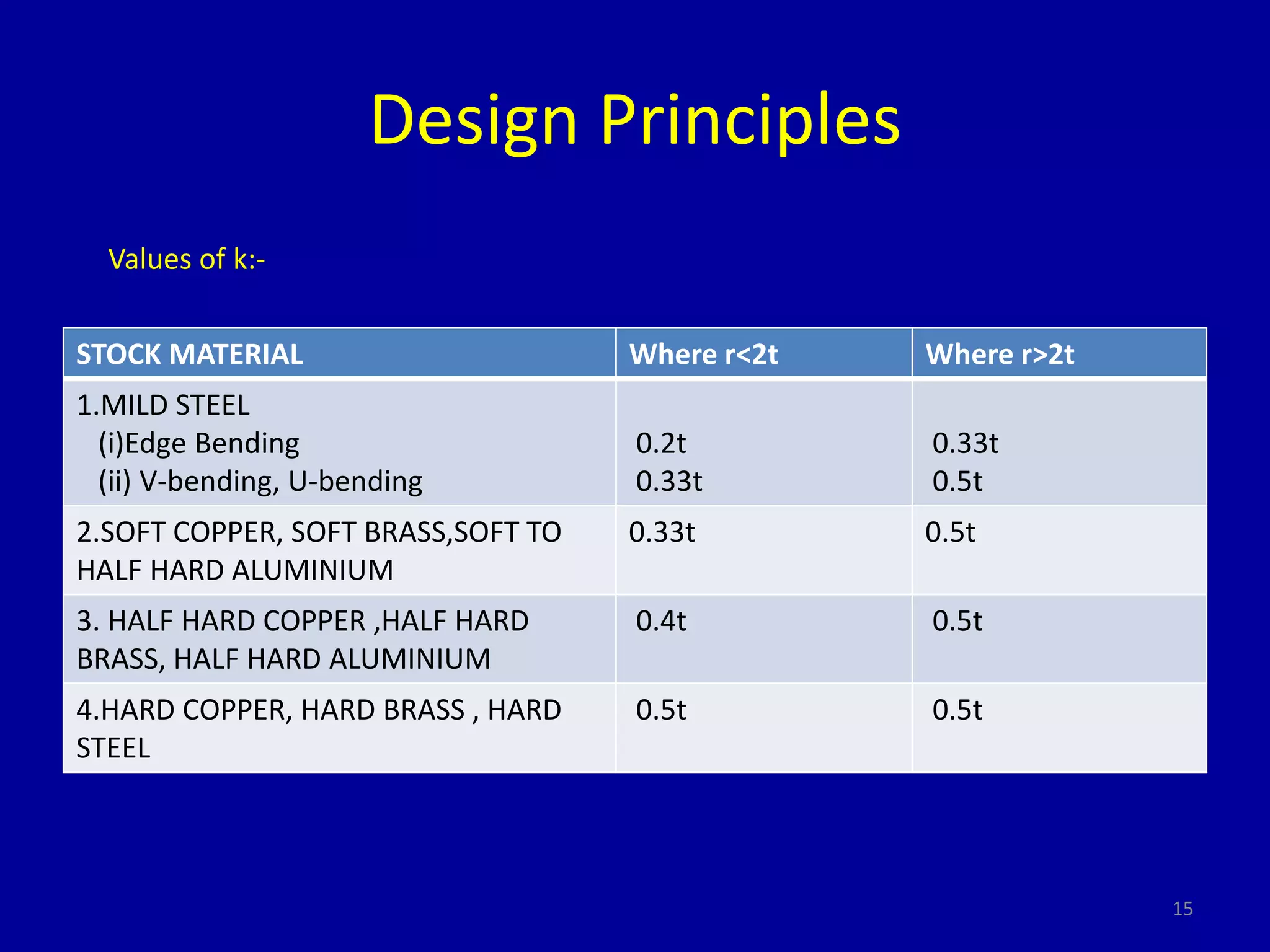
STOCK MATERIAL Where r<2t Where r>2t
1.MILD STEEL
(i)Edge Bending
(ii) V-bending, U-bending
0.2t
0.33t
0.33t
0.5t
2.SOFT COPPER, SOFT BRASS,SOFT TO
HALF HARD ALUMINIUM
0.33t 0.5t
3. HALF HARD COPPER ,HALF HARD
BRASS, HALF HARD ALUMINIUM
0.4t 0.5t
4.HARD COPPER, HARD BRASS , HARD
STEEL
0.5t 0.5t
15
Values of k:-
Design Principles
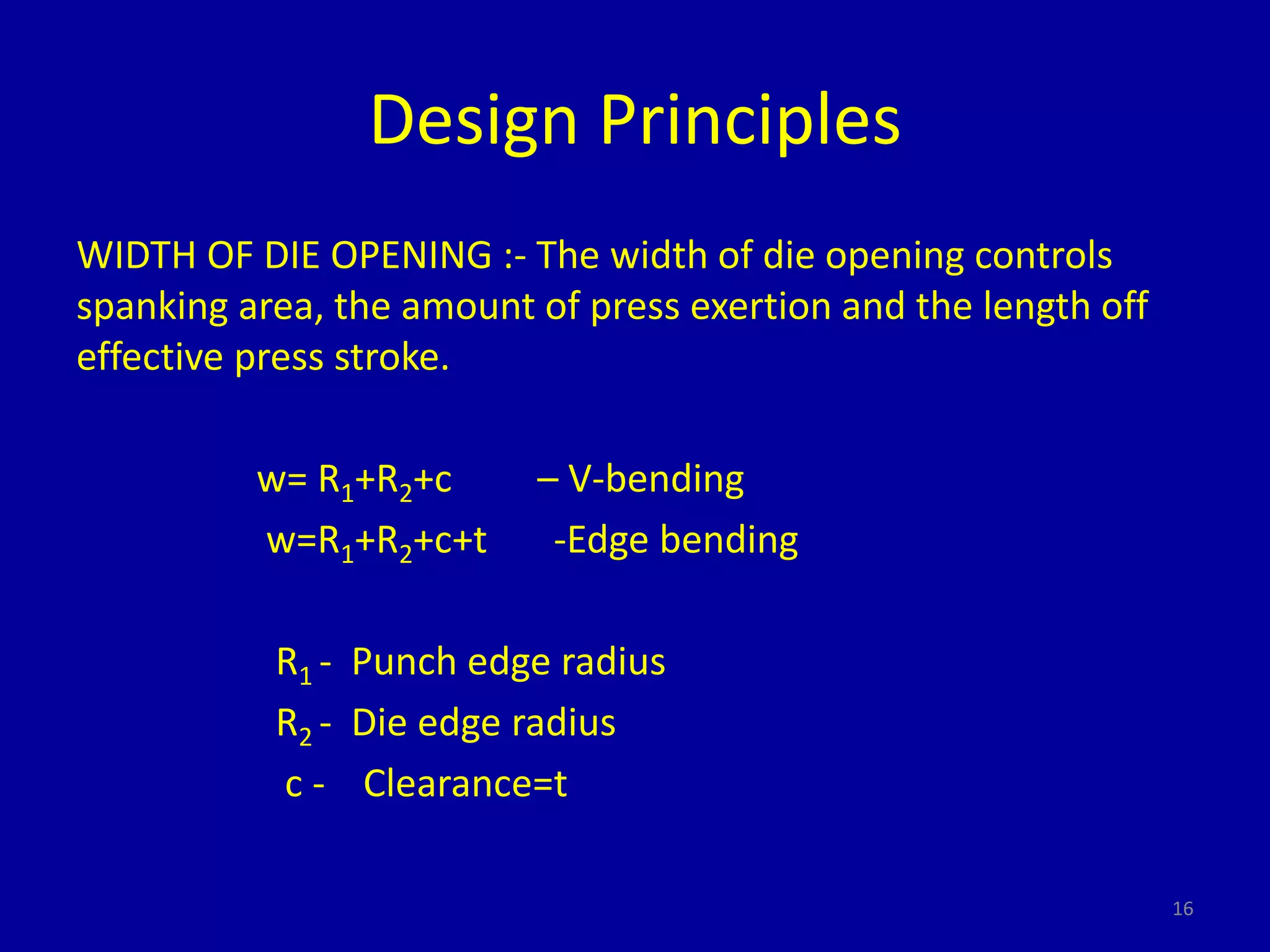
WIDTH OF DIE OPENING :- The width of die opening controls
spanking area, the amount of press exertion and the length off
effective press stroke.
w= R1+R2+c – V-bending
w=R1+R2+c+t -Edge bending
R1 - Punch edge radius
R2 - Die edge radius
c - Clearance=t
16
Design Principles
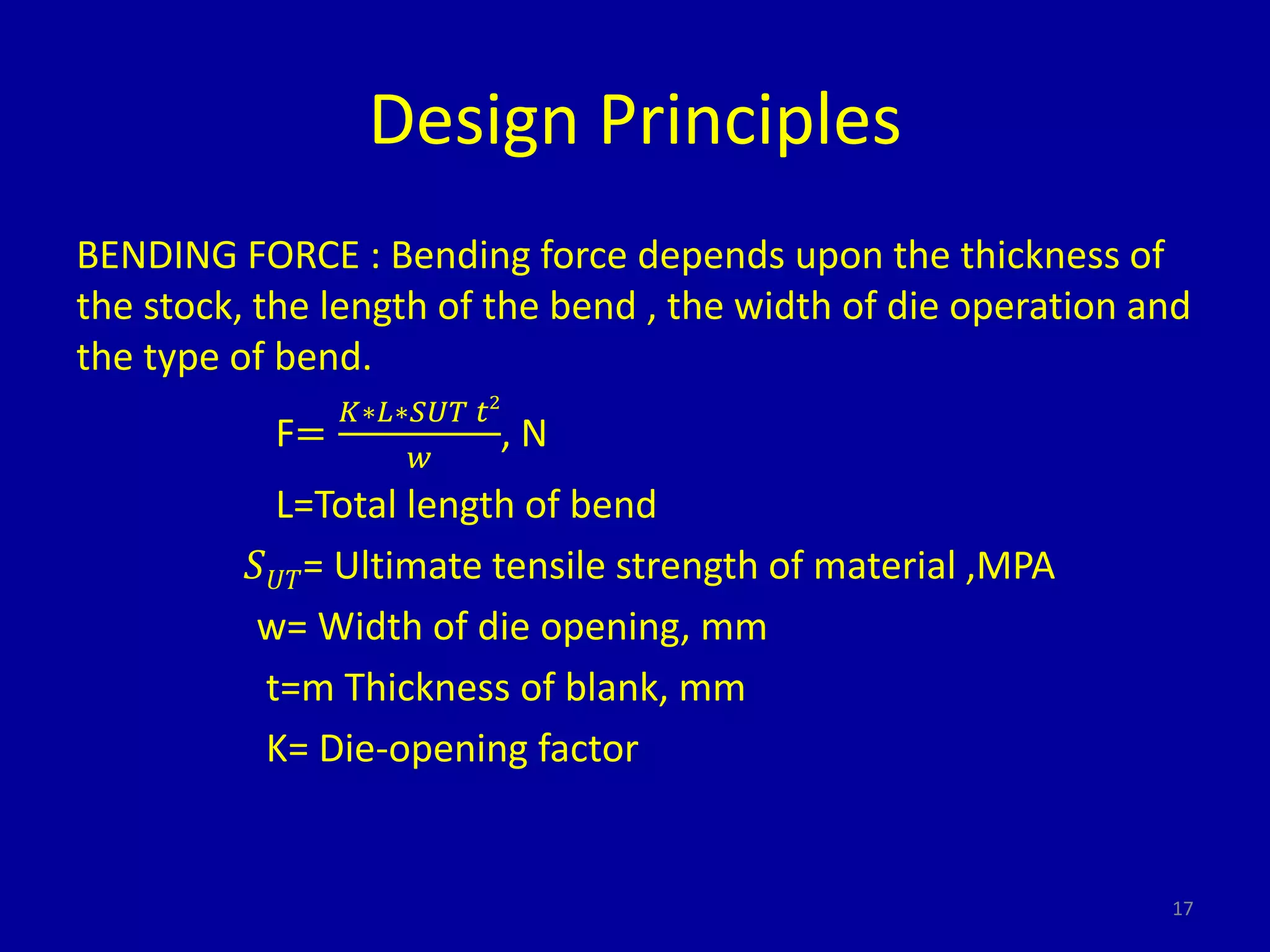
BENDING FORCE : Bending force depends upon the thickness of
the stock, the length of the bend , the width of die operation and
the type of bend.
F=
𝐾∗𝐿∗𝑆𝑈𝑇 𝑡2
𝑤
, N
L=Total length of bend
𝑆 𝑈𝑇= Ultimate tensile strength of material ,MPA
w= Width of die opening, mm
t=m Thickness of blank, mm
K= Die-opening factor
17
Design Principles
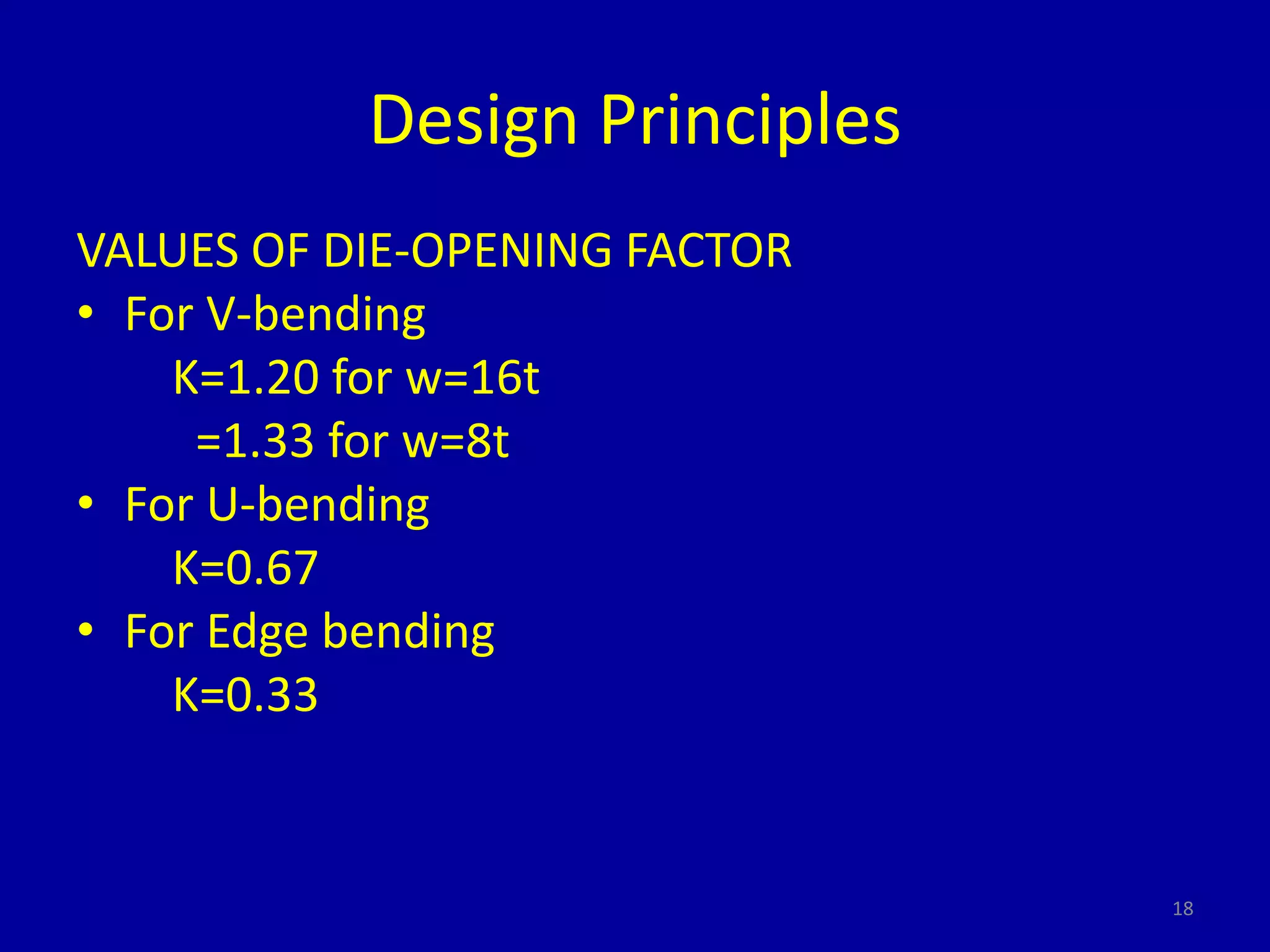
VALUES OF DIE-OPENING FACTOR
• For V-bending
K=1.20 for w=16t
=1.33 for w=8t
• For U-bending
K=0.67
• For Edge bending
K=0.33
18
19
THANK YOU

Theory of bending

  • 1.
    TOOL DESIGN UNIT 4 THEORYOF BENDING BY PURNESH ALONI ROLL NO. 11 MTECH(PRODUCTION ENGG) DEPARTMENT OF MECHANICAL ENGINEERING 1
  • 2.
    CONTENTS • Introduction • Typesof bending • Spring back in bending • Compensation for spring back • Variations in bending operations • Design principles 2
  • 3.
    INTRODUCTION • BENDING :-Bending is defined as the straining of metal around a straight axis. The metal on the inside of the neutral axis is compressed. The metal on the outside of the neutral axis is stretched. 3
  • 4.
    V-bending : • InV-bending the sheet metal blank is bent between a V-shaped punch and die • The figure below shows a front view and isometric view of a V- bending setup with the arrows indicating the direction of the applied force 4 TYPES OF BENDING Figure courtesy of Engineering Research Center for Net Shape Manufacturing
  • 5.
    Edge or wipebending: • Edge or wipe bending involves cantilever loading of the material • A pressure pad is used to apply a Force to hold the blank against the die, while the punch forces the workpiece to yield and bend over the edge of the die TYPES OF BENDING
  • 6.
    6 Spring back inbending • Spring back is defined as the increase in included angle of the bent part relative to the included angle of the forming tool after the tool is removed. • When the bending stress is removed at the end of the deformation process, elastic energy remains in the bent part causing it to partially recover to its original shape. In bending, this elastic recovery is called springback. • It increases with decreasing the modulus of elasticity, E, and increasing the yield strength, Y, of a material.
  • 7.
    Spring back inbending 7 αi: bend angle before springback αf: bend angle after springback Ri: bend radius before springback Rf: bend radius after springback
  • 8.
    Spring back inbending In order to estimate springback, the following formula can be used: Manufacturing processes by S. Kalpakjian and S. Schmid where: Ri, Rf: initial and final bend radii respectively Y: Yield strength E: Young’s modulus t: Sheet thickness 8
  • 9.
    9 Compensation for Springback Overbending •When overbending is used in V-bending (for example), the punch angle and radius are fabricated slightly smaller than the specified angle and raduis of the final part. This way the material can “springback” to the desired value. Bottoming (coining) • Bottoming involves squeezing the part at the end of the stroke, thus plastically deforming it in the bend region.
  • 10.
    Variation in BendingOperations • Flanging is a bending operation in which the edge of a sheet metal is bent at a 90° angle to form a rim or flange. It is often used to strengthen or stiffen sheet metal. The flange can be straight, or it can involve stretching or shrinking as shown in the figure below: 10 (a)Straight flanging (b)Stretch flanging (c)Shrink flanging
  • 11.
    Variation in Flanging Instretch flanging the curvature of the bending line is concave and the metal is circumferentially stretched, i.e., A > B. The flange undergoes thinning in stretch flanging. In shrink flanging the curvature of the bending line is convex and the material is circumferentially compressed, i.e., A < B. The material undergoes thickening in shrink flanging. 11
  • 12.
    Variations in BendingOperation •Hemming involves bending the edge of the sheet over onto itself in more than one bending step. This process is used to eliminate sharp edges, increase stiffness, and improve appearance, such as the edges in car doors. •Seaming is a bending operation in which two sheet metal edges are joined together. •Curling (or beading) forms the edges of the part into a roll. Curling is also used for safety, strength, and aesthetics. 12 (a)Hemming (b)Seaming (c)Curling
  • 13.
    Design Principles BEND RADIUS:It is defined as the radius of curvature on the inside or concave surface of bend When bending to an angle of 900 ,the minimum bend radius = 2 to 5t for C-steel = 1t for stainless steel = 2 to 3.5t for Ti alloys = 0.3 to 0.5 t for brass = 0.35t for Al 13
  • 14.
    Design Principles BENDING ALLOWANCE:To calculate the blank length for bending ,the length of material in the curved section or bend area has to be calculated. This length in the bend area which will be more than corresponding length before bending is call Bending Allowance. B.A= 2πθ (𝑟+𝑘𝑡) 360 ,mm B.A = Bending allowance along neutral axis, mm θ = Bend angle in degree r = inside radius of bend, mm k = Distance of neutral axis from the inside surface of bend. 14
  • 15.
    Design Principles STOCK MATERIALWhere r<2t Where r>2t 1.MILD STEEL (i)Edge Bending (ii) V-bending, U-bending 0.2t 0.33t 0.33t 0.5t 2.SOFT COPPER, SOFT BRASS,SOFT TO HALF HARD ALUMINIUM 0.33t 0.5t 3. HALF HARD COPPER ,HALF HARD BRASS, HALF HARD ALUMINIUM 0.4t 0.5t 4.HARD COPPER, HARD BRASS , HARD STEEL 0.5t 0.5t 15 Values of k:-
  • 16.
    Design Principles WIDTH OFDIE OPENING :- The width of die opening controls spanking area, the amount of press exertion and the length off effective press stroke. w= R1+R2+c – V-bending w=R1+R2+c+t -Edge bending R1 - Punch edge radius R2 - Die edge radius c - Clearance=t 16
  • 17.
    Design Principles BENDING FORCE: Bending force depends upon the thickness of the stock, the length of the bend , the width of die operation and the type of bend. F= 𝐾∗𝐿∗𝑆𝑈𝑇 𝑡2 𝑤 , N L=Total length of bend 𝑆 𝑈𝑇= Ultimate tensile strength of material ,MPA w= Width of die opening, mm t=m Thickness of blank, mm K= Die-opening factor 17
  • 18.
    Design Principles VALUES OFDIE-OPENING FACTOR • For V-bending K=1.20 for w=16t =1.33 for w=8t • For U-bending K=0.67 • For Edge bending K=0.33 18
  • 19.