Made by: Mohd. Sameer
Content
What are chips?
Shearing operation in chipping.
Factors on which chips depends.
Types of chips.
Comparison between chip types.
Conclusion.
What are chips?
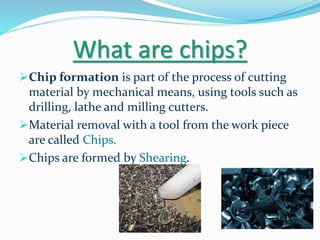
Chip formation is part of the process of cutting
material by mechanical means, using tools such as
drilling, lathe and milling cutters.
Material removal with a tool from the work piece
are called Chips.
Chips are formed by Shearing.
Shearing operation in chipping
Primary shear zone
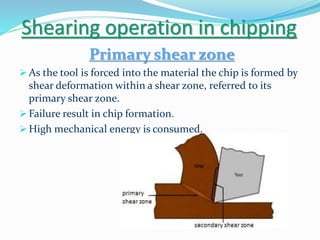
 As the tool is forced into the material the chip is formed by
shear deformation within a shear zone, referred to its
primary shear zone.
 Failure result in chip formation.
 High mechanical energy is consumed.
Secondary shear zone
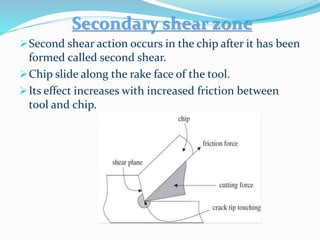
Second shear action occurs in the chip after it has been
formed called second shear.
Chip slide along the rake face of the tool.
Its effect increases with increased friction between
tool and chip.
Factors on which chips depends:
There are following points on which chip depend:
Nature of material
Rake angle of cutting tool
Dimension of tool
Feed rate
Cutting speed
Friction between tool and work piece
Cutting environment like temperature, friction etc.
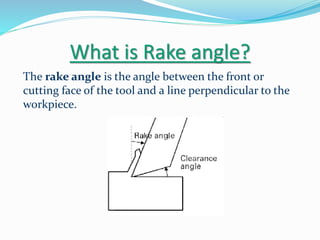
What is Rake angle?
The rake angle is the angle between the front or
cutting face of the tool and a line perpendicular to the
workpiece.
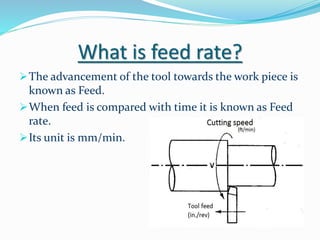
What is feed rate?
The advancement of the tool towards the work piece is
known as Feed.
When feed is compared with time it is known as Feed
rate.
Its unit is mm/min.
Why it is important ?
Chip forming influences many factors of production
process such as:
Surface finish of work piece.
Production speed.
Tool life.
Cutting speed of tool.
Power consumption in process
Types of chips:
There are mainly three types of chips in manufacturing
process:
A. Continuous chips.
B. Discontinuous chips.
C. Continuous chips with built up chips.
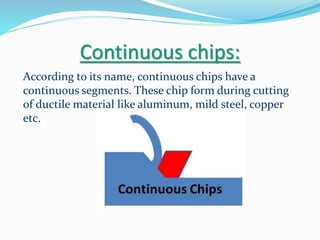
Continuous chips:
According to its name, continuous chips have a
continuous segments. These chip form during cutting
of ductile material like aluminum, mild steel, copper
etc.
Conditions for forming continuous
chips:
Ductile work piece
Large rack angle
Minimum friction between tool and work piece.
High cutting speed
Small deft cut
Use of coolant and lubricant
Tool with low coefficient of friction.
Advantage
High surface finish.
Minimize frictional loss.
Due to low friction, tool life is high.
Power consumption is low.
Less heat generation.
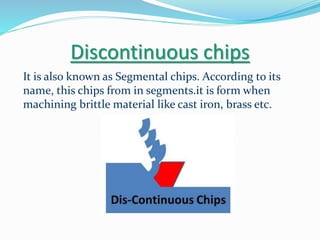
Discontinuous chips
It is also known as Segmental chips. According to its
name, this chips from in segments.it is form when
machining brittle material like cast iron, brass etc.
Conditions for forming this chips
Brittle work piece
Slow speed of cutting
Small rack angle
Depth of cut should be large.
Advantages
It provide good surface finish.
Increase tool life.
Reduces the consumption of power.
Disadvantages
Poor surface finish
Excessive wear and tear of tool
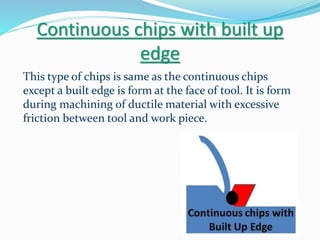
Continuous chips with built up
edge
This type of chips is same as the continuous chips
except a built edge is form at the face of tool. It is form
during machining of ductile material with excessive
friction between tool and work piece.
How build up edge is formed?
When the chip is flows in upward direction and high
friction is exist in between the interface of chip and
tool.
Due to friction heat is generated at nose of tool.
The compressed metal adjacent to the tool nose gets
welded to it.
This compressed metal welded to the nose is called
Build up edge.
Factors promoting built up edge
Cutting of ductile metal.
High friction force at the face of tool.
High temperature between tool and work piece
Lack of coolant and lubricant increase friction.
Small rack angle
Low cutting speed
Advantages
Making of built up edge has one advantage i.e. it
protects the tool from getting damaged from high
friction and temperature generated during machining
process.
Disadvantage
Rough surface
Change in rack angle
Tool life decreases
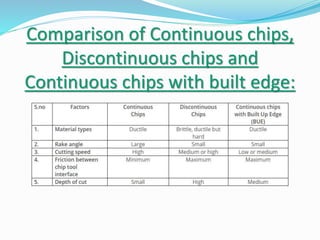
Comparison of Continuous chips,
Discontinuous chips and
Continuous chips with built edge:
Conclusion
Discontinuous chips in ductile material give poor
surface finish and slow machine & suitable for brittle
material.
Continuous chips are most preferable due to following
benefits:
 High surface finish.
 Low friction
 High tool life.
 Low power consumption.
Chips formed and its types in machining operations

Chips formed and its types in machining operations

  • 1.
  • 2.
    Content What are chips? Shearingoperation in chipping. Factors on which chips depends. Types of chips. Comparison between chip types. Conclusion.
  • 3.
    What are chips? Chipformation is part of the process of cutting material by mechanical means, using tools such as drilling, lathe and milling cutters. Material removal with a tool from the work piece are called Chips. Chips are formed by Shearing.
  • 4.
    Shearing operation inchipping Primary shear zone  As the tool is forced into the material the chip is formed by shear deformation within a shear zone, referred to its primary shear zone.  Failure result in chip formation.  High mechanical energy is consumed.
  • 5.
    Secondary shear zone Secondshear action occurs in the chip after it has been formed called second shear. Chip slide along the rake face of the tool. Its effect increases with increased friction between tool and chip.
  • 6.
    Factors on whichchips depends: There are following points on which chip depend: Nature of material Rake angle of cutting tool Dimension of tool Feed rate Cutting speed Friction between tool and work piece Cutting environment like temperature, friction etc.
  • 7.
    What is Rakeangle? The rake angle is the angle between the front or cutting face of the tool and a line perpendicular to the workpiece.
  • 8.
    What is feedrate? The advancement of the tool towards the work piece is known as Feed. When feed is compared with time it is known as Feed rate. Its unit is mm/min.
  • 9.
    Why it isimportant ? Chip forming influences many factors of production process such as: Surface finish of work piece. Production speed. Tool life. Cutting speed of tool. Power consumption in process
  • 10.
    Types of chips: Thereare mainly three types of chips in manufacturing process: A. Continuous chips. B. Discontinuous chips. C. Continuous chips with built up chips.
  • 11.
    Continuous chips: According toits name, continuous chips have a continuous segments. These chip form during cutting of ductile material like aluminum, mild steel, copper etc.
  • 12.
    Conditions for formingcontinuous chips: Ductile work piece Large rack angle Minimum friction between tool and work piece. High cutting speed Small deft cut Use of coolant and lubricant Tool with low coefficient of friction.
  • 13.
    Advantage High surface finish. Minimizefrictional loss. Due to low friction, tool life is high. Power consumption is low. Less heat generation.
  • 14.
    Discontinuous chips It isalso known as Segmental chips. According to its name, this chips from in segments.it is form when machining brittle material like cast iron, brass etc.
  • 15.
    Conditions for formingthis chips Brittle work piece Slow speed of cutting Small rack angle Depth of cut should be large.
  • 16.
    Advantages It provide goodsurface finish. Increase tool life. Reduces the consumption of power.
  • 17.
  • 18.
    Continuous chips withbuilt up edge This type of chips is same as the continuous chips except a built edge is form at the face of tool. It is form during machining of ductile material with excessive friction between tool and work piece.
  • 19.
    How build upedge is formed? When the chip is flows in upward direction and high friction is exist in between the interface of chip and tool. Due to friction heat is generated at nose of tool. The compressed metal adjacent to the tool nose gets welded to it. This compressed metal welded to the nose is called Build up edge.
  • 20.
    Factors promoting builtup edge Cutting of ductile metal. High friction force at the face of tool. High temperature between tool and work piece Lack of coolant and lubricant increase friction. Small rack angle Low cutting speed
  • 21.
    Advantages Making of builtup edge has one advantage i.e. it protects the tool from getting damaged from high friction and temperature generated during machining process.
  • 22.
    Disadvantage Rough surface Change inrack angle Tool life decreases
  • 23.
    Comparison of Continuouschips, Discontinuous chips and Continuous chips with built edge:
  • 24.
    Conclusion Discontinuous chips inductile material give poor surface finish and slow machine & suitable for brittle material. Continuous chips are most preferable due to following benefits:  High surface finish.  Low friction  High tool life.  Low power consumption.