
This document summarizes upset forging and die design. Upset forging is a hot forging process that increases the diameter of a workpiece by compressing its length, typically starting with a wire or rod. It consists of multiple cavities in a die to allow for mass production. Proper die design is important to achieve defect-free forging. The document outlines the principle, construction, die design rules, advantages such as higher strength and productivity, limitations such as maximum diameter, and applications like nuts, bolts, and engine valves.
Introduction to upset forging by Vivek Chandravanshi, including main content areas: principle, construction, die design, advantages, limitations, and applications.
Upset forging, also called hot heading, increases workpiece diameter; initial workpiece is wire or rod. Process enables mass production using a crank press.
Construction includes stationary die, moving die, and heading tool. Process involves bar stock positioning and automatic stock gauging.
Die design rules to ensure defect-free upset forging: 1) Length to diameter relationship, 2) cavity width requirements, and 3) conditions for free length to prevent unsatisfactory results.
Key advantages include improved product quality, higher productivity, material savings, and little need for dross, making the process automated.
Limitations include difficulty in forging heavy and asymmetric jobs, a maximum stock diameter limit of 25 cm, and potentially high tooling costs.
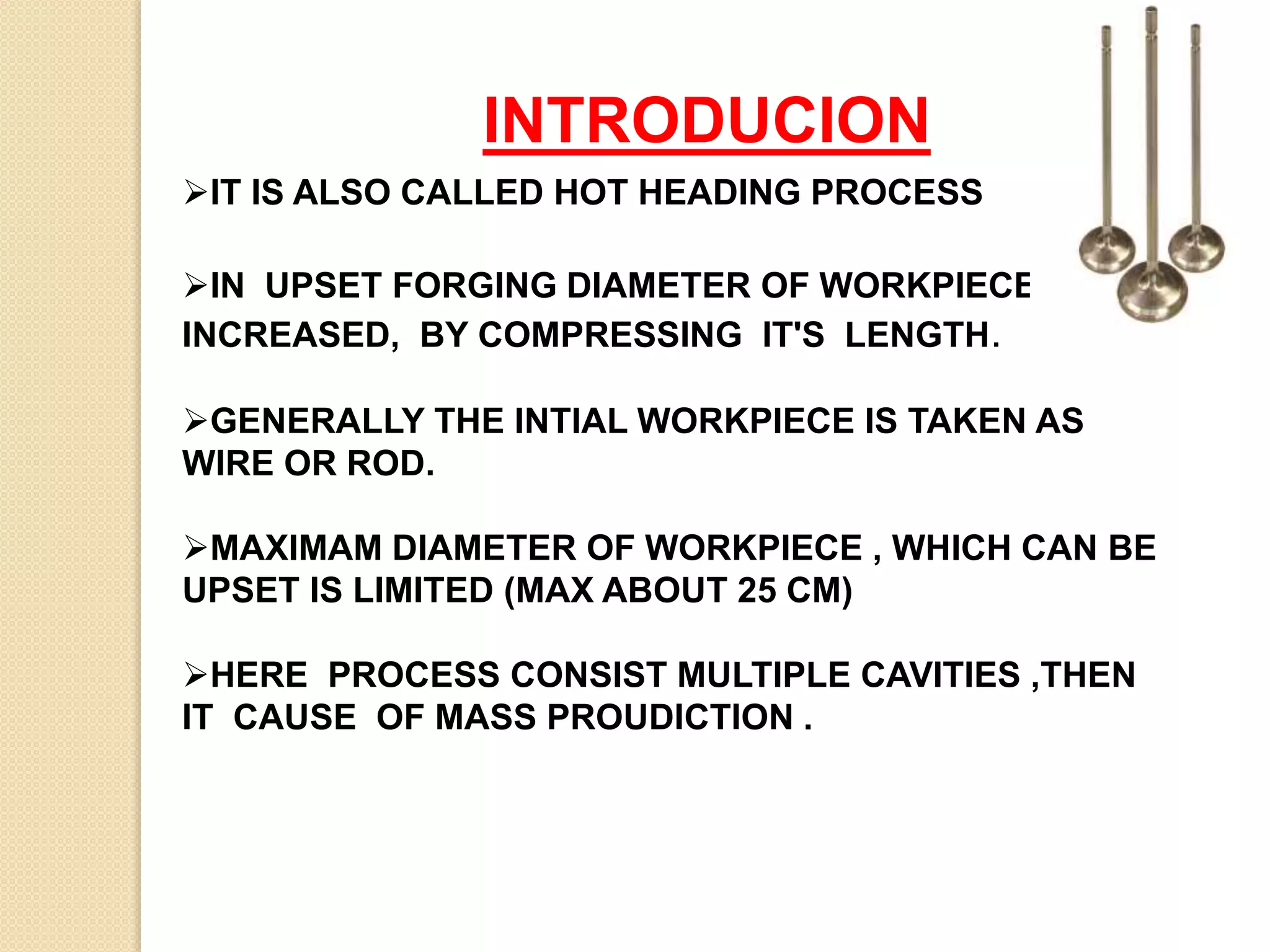
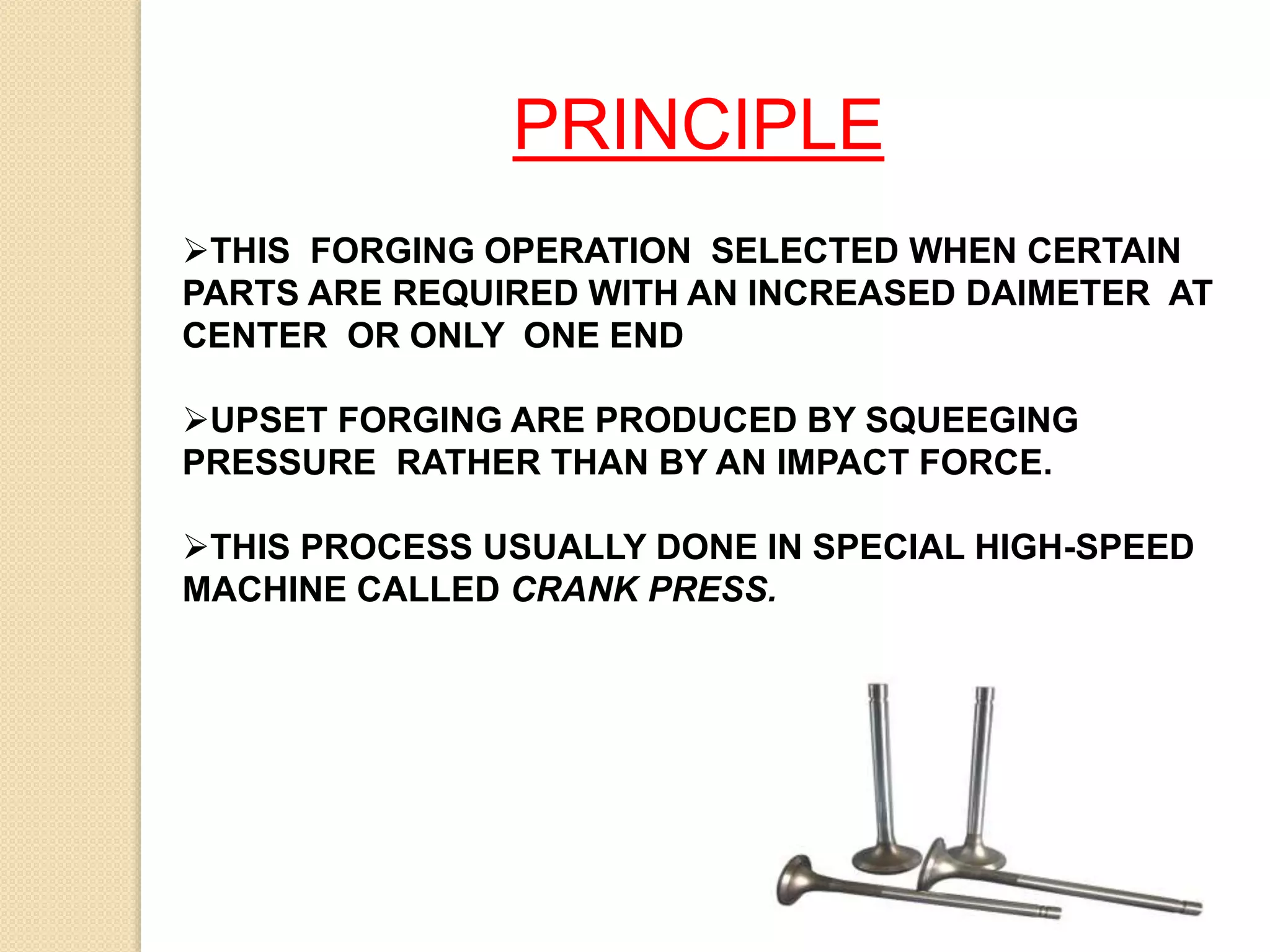
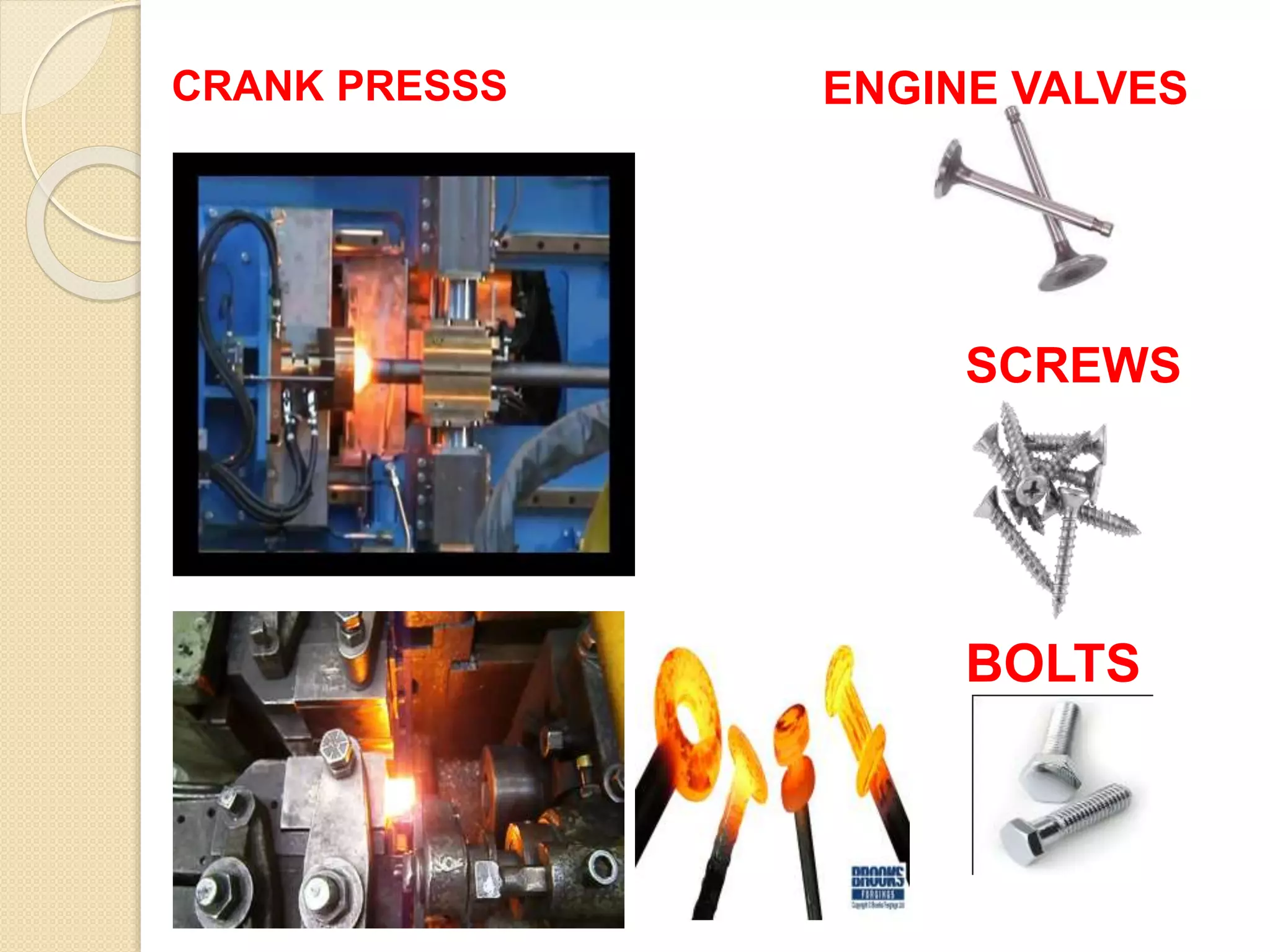
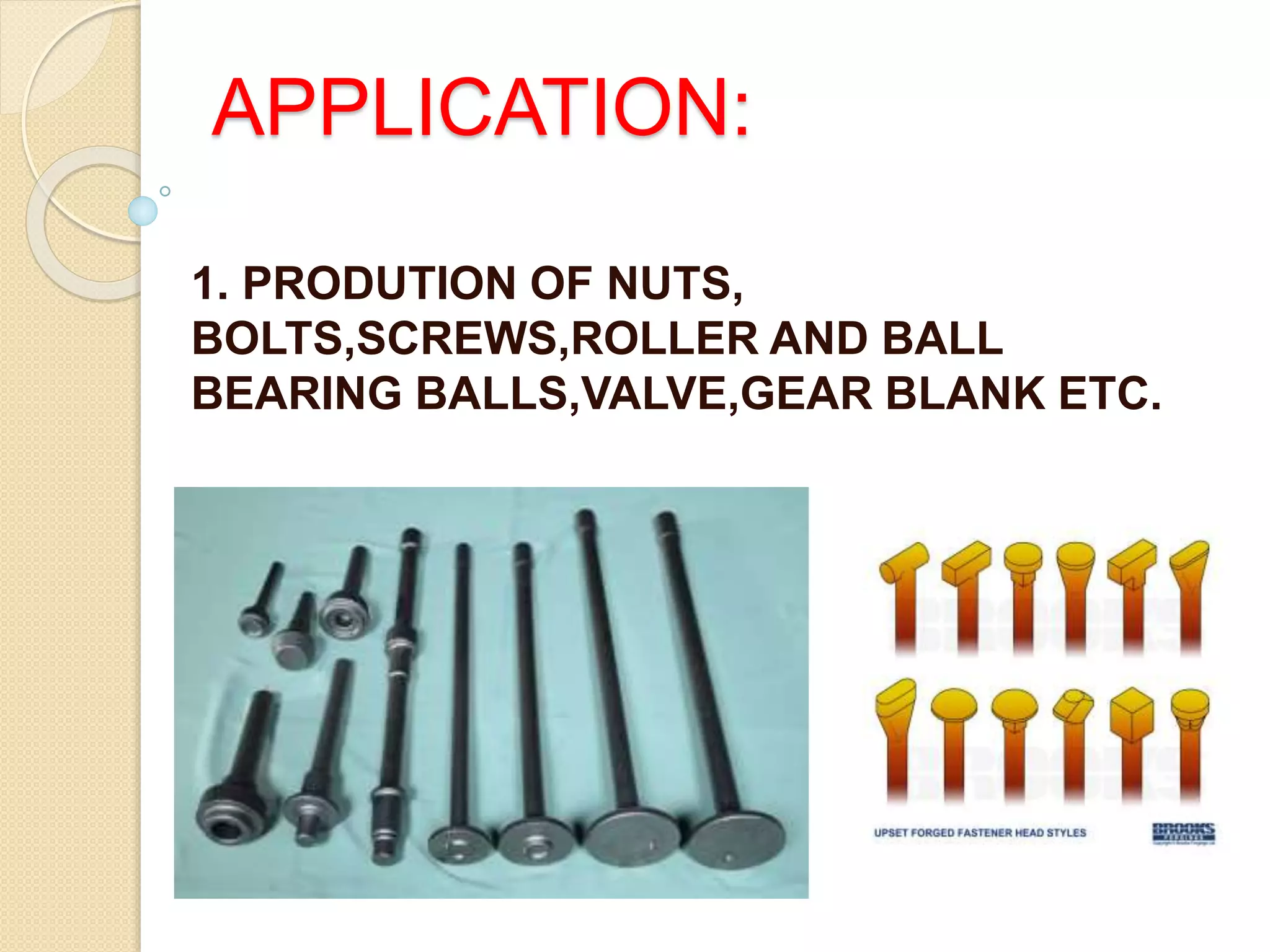
Applications include production of nuts, bolts, screws, bearings, valves, and gear blanks.
INTRODUCION
IT IS ALSOCALLED HOT HEADING PROCESS
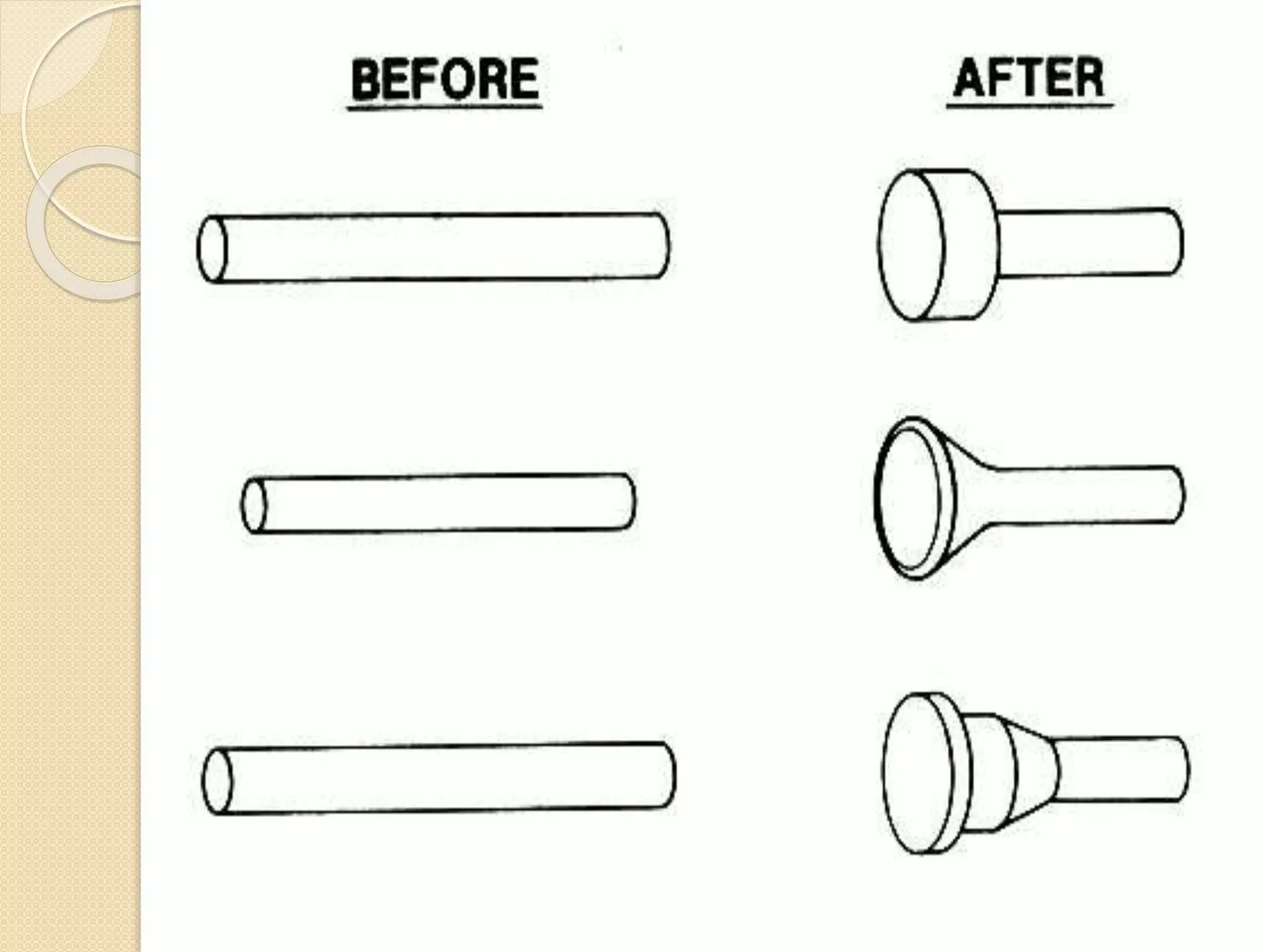
IN UPSET FORGING DIAMETER OF WORKPIECE IS
INCREASED, BY COMPRESSING IT'S LENGTH.
GENERALLY THE INTIAL WORKPIECE IS TAKEN AS
WIRE OR ROD.
MAXIMAM DIAMETER OF WORKPIECE , WHICH CAN BE
UPSET IS LIMITED (MAX ABOUT 25 CM)
HERE PROCESS CONSIST MULTIPLE CAVITIES ,THEN
IT CAUSE OF MASS PROUDICTION .
4.
PRINCIPLE
THIS FORGING OPERATIONSELECTED WHEN CERTAIN
PARTS ARE REQUIRED WITH AN INCREASED DAIMETER AT
CENTER OR ONLY ONE END
UPSET FORGING ARE PRODUCED BY SQUEEGING
PRESSURE RATHER THAN BY AN IMPACT FORCE.
THIS PROCESS USUALLY DONE IN SPECIAL HIGH-SPEED
MACHINE CALLED CRANK PRESS.
5.
CONSTRUCTION &
PROCESS:1. PROCESSCONSIST THREE MAIN COMPONENTS ,STATIONARY
DIE, MOVING DIE AND HEADING TOOL .
2. BAR STOCK PLACED IN POSITION.
3. AUTOMATIC STOCK GAUGE MOVES A SIDE , MOVING THE
STOCK IN CAVITIES OF THE DIES.
4. AFTER THE MOVING DIE AND HEADING TOOL BACK THEIR
ORIGINAL POSITIONS .
DIE DESIGN:
TO ARRIVETHE SAFE AMOUNT OF UPSETTING IN A
GIVEN PASS, THE FOLLOWING THREE RULES ARE
TO BE SATISFIED TO ACHIEVE DEFECT FREE UPSET
FORGING:-
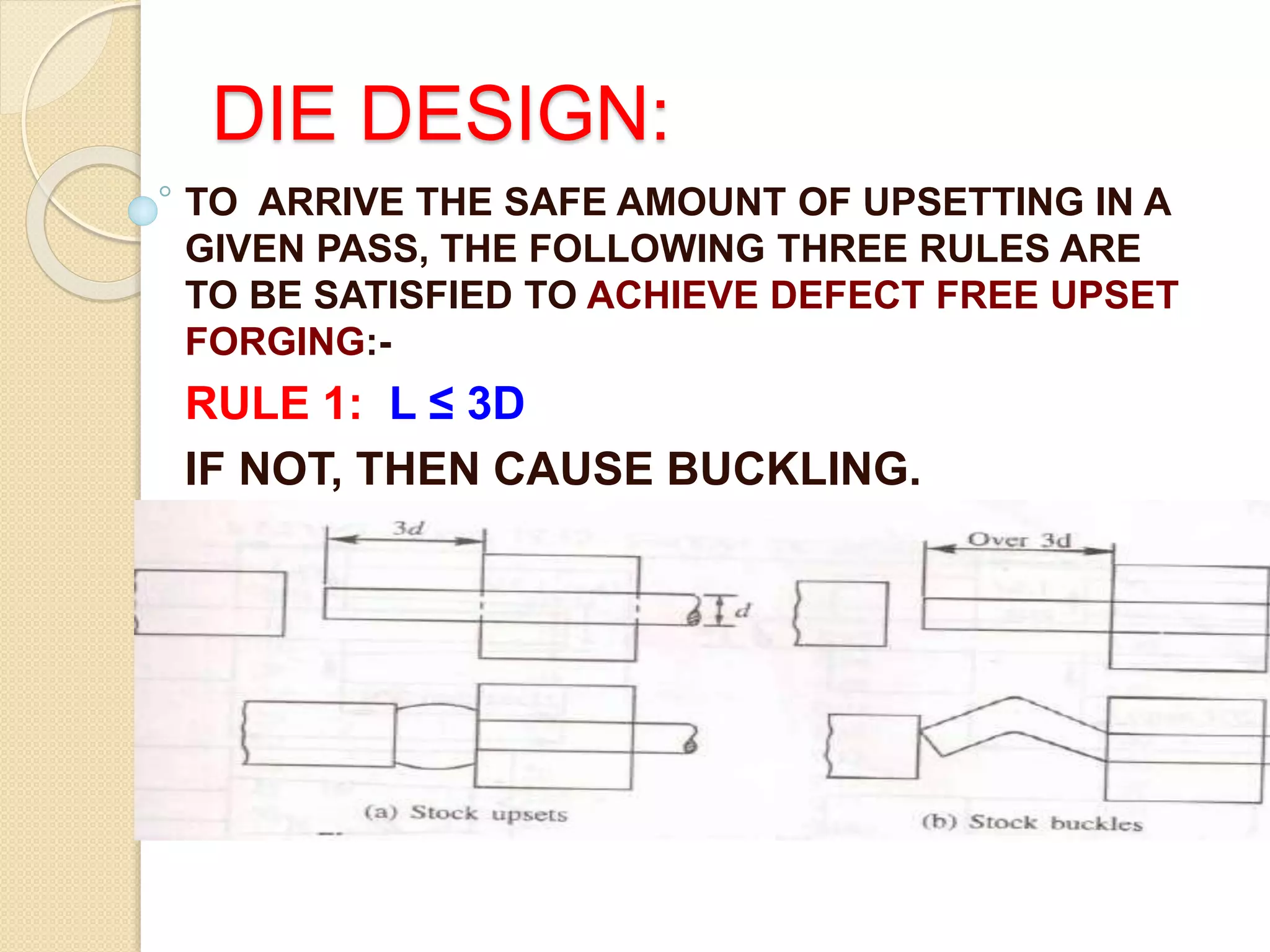
RULE 1: L ≤ 3D
IF NOT, THEN CAUSE BUCKLING.
10.
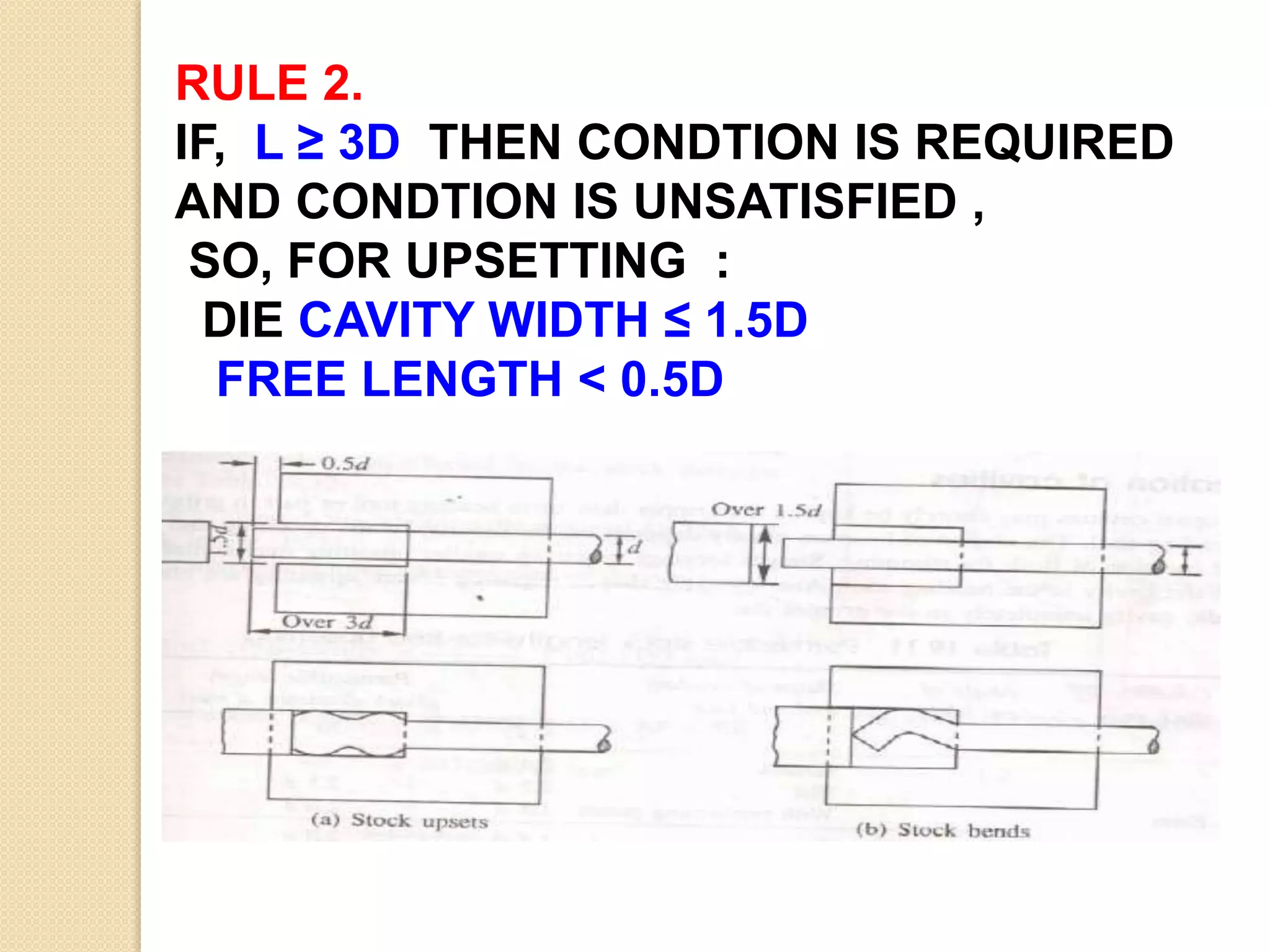
RULE 2.
IF, L≥ 3D THEN CONDTION IS REQUIRED
AND CONDTION IS UNSATISFIED ,
SO, FOR UPSETTING :
DIE CAVITY WIDTH ≤ 1.5D
FREE LENGTH < 0.5D
11.
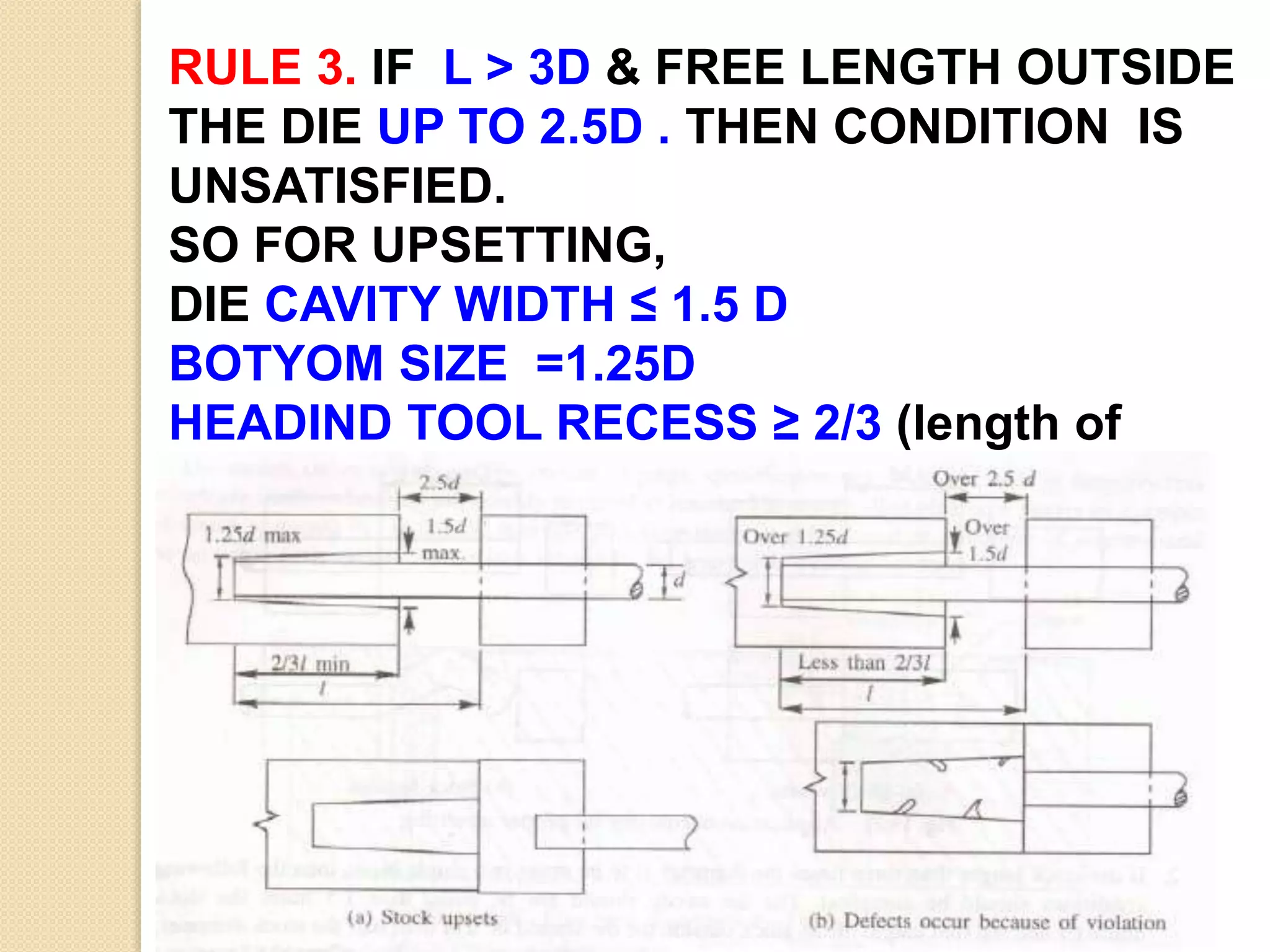
RULE 3. IFL > 3D & FREE LENGTH OUTSIDE
THE DIE UP TO 2.5D . THEN CONDITION IS
UNSATISFIED.
SO FOR UPSETTING,
DIE CAVITY WIDTH ≤ 1.5 D
BOTYOM SIZE =1.25D
HEADIND TOOL RECESS ≥ 2/3 (length of
working
Stock)
12.
ADVANTAGES:
1.THE QUALITY OBTAINEDOF PRODUCT ,GREATER
STREGTH.
2.HIGHER PRODUCTIVITY AND CHEAPER MAINTENACE.
3.UPSETTING PROCESS IS AUTOMATED.
4.SAVING IN MATERIAL AND NO OR LITTLE DRAFT IS
NEEDED .
5.FORGING IS ACCOMPAINED WITH LITTLE OR NO
FLASH.
13.
LIMITATIONS:
1. NOT CONVENIENTTO FORGE HEAVIER JOBS DUE THE
MATERIAL HANDELLING DIFFICULTIES.
2. MAX. DIAMETER OF STOCK IS LIMITED 25 CM.
3. UNSYMMETRIC AND HEAVY JOBS ARE DIFFICULT TO
BE FORGED.
4.TOOLING COST MAY BE HIGH.