S
Pipes and bends   (Mechanical Engineers society) Lahore Pakistan. Created by:  Irfan Yousaf From:  University of Lahore
TOPICS History of pipes Materials used in pipes Types of pipes Design considerations Bending of pipes Forces acting on bends Head loss in bends Wear resistance bends Applications
HISTORY The first use of pipe was by ancient agriculturalists who diverted water from streams and rivers into their fields. Archeological evidence suggests that the Chinese used reed pipe for transporting water to desired locations as early  as 2000 B.C. During the first century A.D. , the first lead pipes were constructed in Europe. In tropical countries, bamboo tubes were used to transport water.
Colonial Americans used wood for a similar purpose. In 1652, the first waterworks was made in Boston using hollow logs. Development of the modern day welded steel pipe can be traced back to the early 1800s. In 1815, William Murdock invented a coal burning lamp system
An early notable method for producing metal tubes quickly and inexpensively was patented by James Russell in 1824. In his method, tubes were created by joining together opposite edges of a flat iron strip. Russell's method was not used long because in the next year, Comelius Whitehouse developed a better method for making metal tubes. This process, called the butt-weld process is the basis for our current pipe-making procedures.
DEFINITION OF PIPE  A  pipe  is a tubular section or hollow cylinder, usually but not necessarily of circular cross-section, used mainly to convey substances which can flow — liquids and gases (fluids)..
MATERIALS USED FOR PIPES
Pipe are made in many materials including ceramic, fiberglass, many metals, concrete and plastic. In the past wood and lead were commonly used. Metallic pipes are commonly made from steel or iron   carbon steel   stainless steel  galvanized steel
Aluminum pipe or tubing may be utilized where iron is incompatible with the service fluid or where  weight is a concern. Copper tubing is popular for domestic  water (potable) plumbing systems. Copper  used where heat transfer is desirable (i.e. radiators or heat exchangers).
Plastic materials  polyvinyl chloride (PVC). chlorinated polyvinyl chloride (CPVC). fibre reinforced plastic (FRP). polypropylene (PP).
PIPE A hollow cylinder or tube used to conduct a liquid, gas, or finely divided solid.
TYPES  1- SEAMLESS PIPES 2- ERW ( ELECTRICAL RESISTANT WELDED) 3-CDW (COLD DRAWN ELECTRICALLY WELDED) TYPES OF PLASTIC PIPES 1- PVC ( POLY VINYL CHLORIDE)  2- PPRC ( POLY  PROPYLENE CHLORIDE )
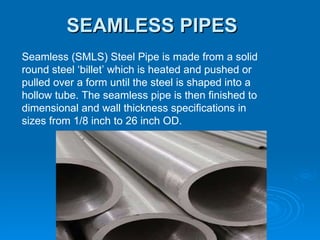
SEAMLESS PIPES Seamless (SMLS) Steel Pipe is made from a solid round steel ‘billet’ which is heated and pushed or pulled over a form until the steel is shaped into a hollow tube. The seamless pipe is then finished to dimensional and wall thickness specifications in sizes from 1/8 inch to 26 inch OD.
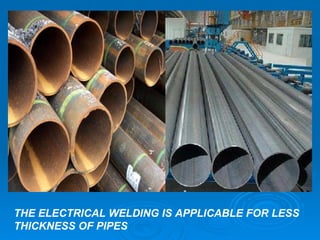
ERW PIPES ERW (Electrical Resistant Welded) pipe cold formed from a ribbon of steel pulled through a series of rollers and formed into a tube which is fused through a electric charge. Common sizes for ERW Steel Pipe range from 2 3/8 inch OD to 24 inch OD in a variety of lengths to over 100 feet. Surface finishes are available in bare and coated formats.
THE ELECTRICAL WELDING IS APPLICABLE FOR LESS THICKNESS OF PIPES
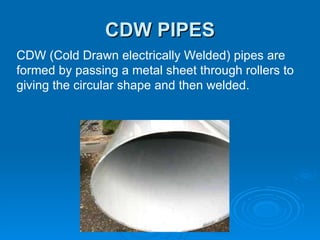
CDW PIPES CDW (Cold Drawn electrically Welded) pipes are formed by passing a metal sheet through rollers to giving the circular shape and then welded.
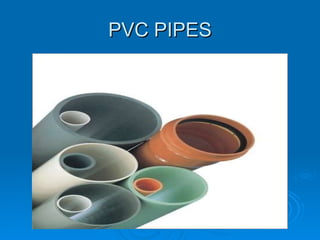
PVC PIPES
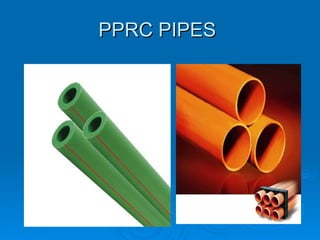
PPRC PIPES
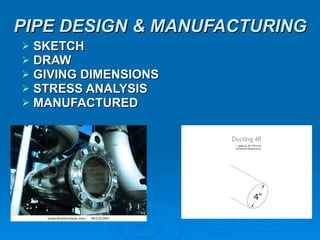
PIPE DESIGN & MANUFACTURING SKETCH DRAW GIVING DIMENSIONS  STRESS ANALYSIS MANUFACTURED
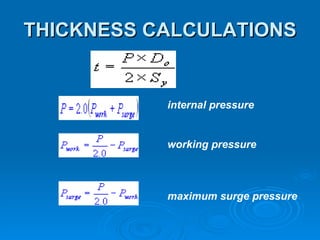
THICKNESS CALCULATIONS                          internal pressure                       working pressure                       maximum surge pressure
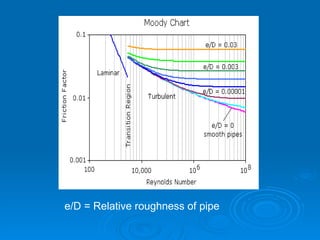
CALCULATION OF FRICTION LOSSES For laminar flow ( R  < 2000 in pipes),  f  can be deduced analytically f  = 64/R
For turbulent flow ( R  > 2000 in pipes),  f  is determined as The increase of Reynolds number will be the decrease in friction factor and after a interval the friction factor will remain constant.
e/D = Relative roughness of pipe
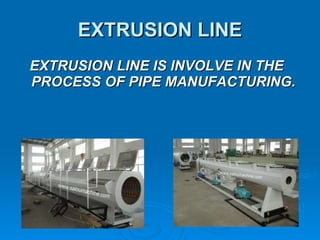
EXTRUSION LINE EXTRUSION LINE IS INVOLVE IN THE PROCESS OF PIPE MANUFACTURING.
Methods of bending pipes
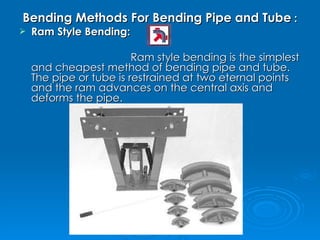
Bending Methods For Bending Pipe and Tube  : Ram Style Bending:   Ram style bending is the simplest and cheapest method of bending pipe and tube.  The pipe or tube is restrained at two eternal points and the ram advances on the central axis and deforms the pipe.
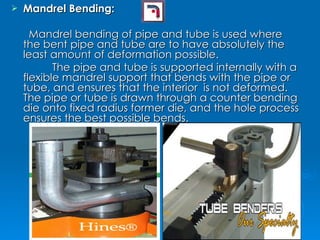
Mandrel Bending: Mandrel bending of pipe and tube is used where the bent pipe and tube are to have absolutely the least amount of deformation possible. The pipe and tube is supported internally with a flexible mandrel support that bends with the pipe or tube, and ensures that the interior  is not deformed. The pipe or tube is drawn through a counter bending die onto fixed radius former die, and the hole process ensures the best possible bends.
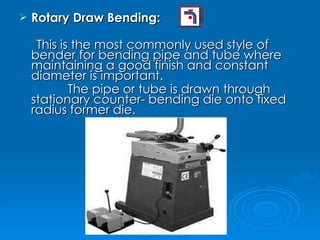
Rotary Draw Bending: This is the most commonly used style of bender for bending pipe and tube where maintaining a good finish and constant diameter is important. The pipe or tube is drawn through stationary counter- bending die onto fixed radius former die.
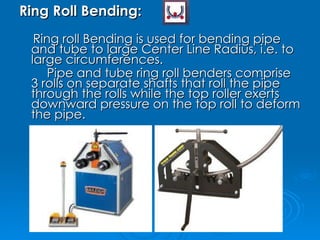
Ring Roll Bending: Ring roll Bending is used for bending pipe and tube to large Center Line Radius, i.e. to large circumferences.  Pipe and tube ring roll benders comprise 3 rolls on separate shafts that roll the pipe through the rolls while the top roller exerts downward pressure on the top roll to deform the pipe. 
Forces acting on pipe bends
 
 
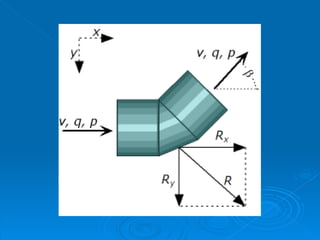
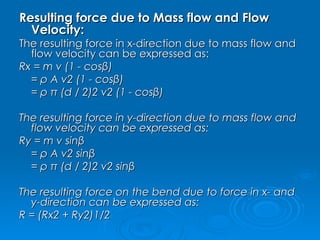
Resulting force due to Mass flow and Flow Velocity: The resulting force in x-direction due to mass flow and flow velocity can be expressed as: Rx = m v (1 - cosβ)               = ρ A v2 (1 - cosβ)              = ρ π (d / 2)2 v2 (1 - cosβ)        The resulting force in y-direction due to mass flow and flow velocity can be expressed as: Ry = m v sinβ              = ρ A v2 sinβ              = ρ π (d / 2)2 v2 sinβ             The resulting force on the bend due to force in x- and y-direction can be expressed as: R = (Rx2 + Ry2)1/2        
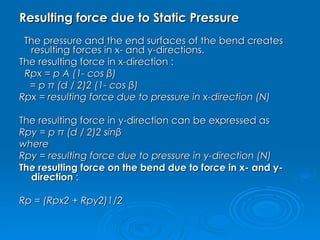
Resulting force due to Static Pressure The pressure and the end surfaces of the bend creates resulting forces in x- and y-directions. The resulting force in x-direction : Rpx = p A (1- cos β)                   = p π (d / 2)2 (1- cos β)         Rpx = resulting force due to pressure in x-direction (N) The resulting force in y-direction can be expressed as Rpy = p π (d / 2)2 sinβ        where  Rpy = resulting force due to pressure in y-direction (N) The resulting force on the bend due to force in x- and y-direction  : Rp = (Rpx2 + Rpy2)1/2        
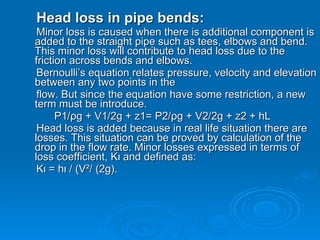
Head loss in pipe bends: Minor loss is caused when there is additional component is added to the straight pipe such as tees, elbows and bend. This minor loss will contribute to head loss due to the friction across bends and elbows.  Bernoulli’s equation relates pressure, velocity and elevation between any two points in the  flow. But since the equation have some restriction, a new term must be introduce.  P1/ρg + V1/2g + z1= P2/ρg + V2/2g + z2 + hL  Head loss is added because in real life situation there are losses. This situation can be proved by calculation of the drop in the flow rate. Minor losses expressed in terms of loss coefficient, Kι and defined as: Kι = hι / (V²/ (2g).
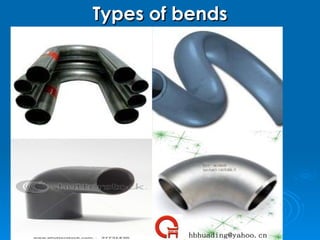
Types of bends
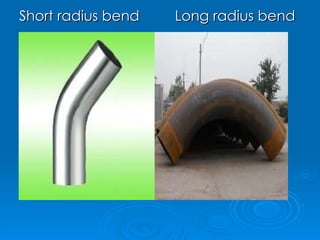
Short radius bend  Long radius bend
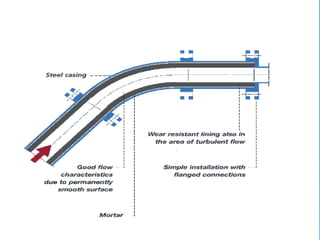
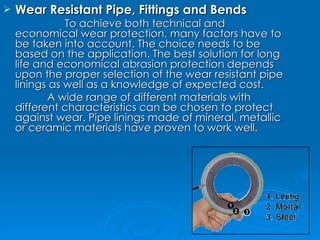
Wear Resistant Pipe, Fittings and Bends To achieve both technical and economical wear protection, many factors have to be taken into account. The choice needs to be based on the application. The best solution for long life and economical abrasion protection depends upon the proper selection of the wear resistant pipe linings as well as a knowledge of expected cost. A wide range of different materials with different characteristics can be chosen to protect against wear. Pipe linings made of mineral, metallic or ceramic materials have proven to work well.
 
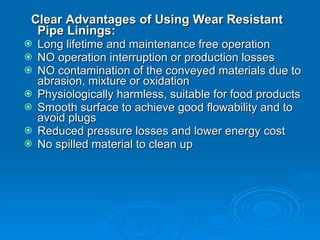
Clear Advantages of Using Wear Resistant Pipe Linings: Long lifetime and maintenance free operation  NO operation interruption or production losses  NO contamination of the conveyed materials due to abrasion, mixture or oxidation  Physiologically harmless, suitable for food products  Smooth surface to achieve good flowability and to avoid plugs  Reduced pressure losses and lower energy cost  No spilled material to clean up
Applications of pipes and bends Pipes and bends have got applications on a large scale. They are used almost everywhere in every industry. Pipes are used to transfer different sort of fluids in our industries.
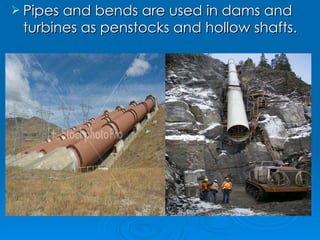
Pipes and bends are used in dams and turbines as penstocks and hollow shafts.
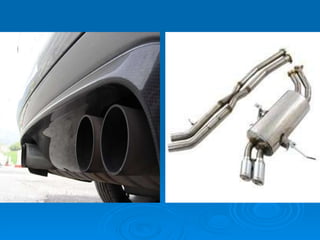
Have widely range of applications in automobile industry as well.
 
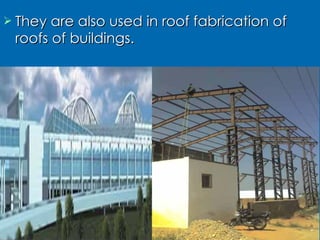
They are also used in roof fabrication of roofs of buildings.
They are also used in  many household applications.
 
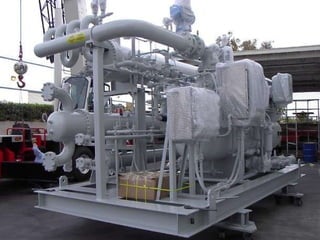
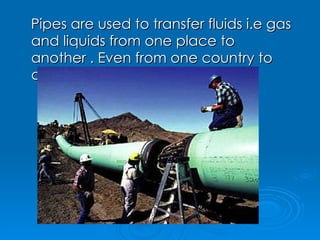
Pipes are used to transfer fluids i.e gas and liquids from one place to another . Even from one country to other as well.

Pipes and bends

  • 1.
  • 2.
    Pipes and bends (Mechanical Engineers society) Lahore Pakistan. Created by: Irfan Yousaf From: University of Lahore
  • 3.
    TOPICS History ofpipes Materials used in pipes Types of pipes Design considerations Bending of pipes Forces acting on bends Head loss in bends Wear resistance bends Applications
  • 4.
    HISTORY The firstuse of pipe was by ancient agriculturalists who diverted water from streams and rivers into their fields. Archeological evidence suggests that the Chinese used reed pipe for transporting water to desired locations as early as 2000 B.C. During the first century A.D. , the first lead pipes were constructed in Europe. In tropical countries, bamboo tubes were used to transport water.
  • 5.
    Colonial Americans usedwood for a similar purpose. In 1652, the first waterworks was made in Boston using hollow logs. Development of the modern day welded steel pipe can be traced back to the early 1800s. In 1815, William Murdock invented a coal burning lamp system
  • 6.
    An early notablemethod for producing metal tubes quickly and inexpensively was patented by James Russell in 1824. In his method, tubes were created by joining together opposite edges of a flat iron strip. Russell's method was not used long because in the next year, Comelius Whitehouse developed a better method for making metal tubes. This process, called the butt-weld process is the basis for our current pipe-making procedures.
  • 7.
    DEFINITION OF PIPE A pipe is a tubular section or hollow cylinder, usually but not necessarily of circular cross-section, used mainly to convey substances which can flow — liquids and gases (fluids)..
  • 8.
  • 9.
    Pipe are madein many materials including ceramic, fiberglass, many metals, concrete and plastic. In the past wood and lead were commonly used. Metallic pipes are commonly made from steel or iron carbon steel stainless steel galvanized steel
  • 10.
    Aluminum pipe ortubing may be utilized where iron is incompatible with the service fluid or where weight is a concern. Copper tubing is popular for domestic water (potable) plumbing systems. Copper used where heat transfer is desirable (i.e. radiators or heat exchangers).
  • 11.
    Plastic materials polyvinyl chloride (PVC). chlorinated polyvinyl chloride (CPVC). fibre reinforced plastic (FRP). polypropylene (PP).
  • 12.
    PIPE A hollowcylinder or tube used to conduct a liquid, gas, or finely divided solid.
  • 13.
    TYPES 1-SEAMLESS PIPES 2- ERW ( ELECTRICAL RESISTANT WELDED) 3-CDW (COLD DRAWN ELECTRICALLY WELDED) TYPES OF PLASTIC PIPES 1- PVC ( POLY VINYL CHLORIDE) 2- PPRC ( POLY PROPYLENE CHLORIDE )
  • 14.
    SEAMLESS PIPES Seamless(SMLS) Steel Pipe is made from a solid round steel ‘billet’ which is heated and pushed or pulled over a form until the steel is shaped into a hollow tube. The seamless pipe is then finished to dimensional and wall thickness specifications in sizes from 1/8 inch to 26 inch OD.
  • 15.
    ERW PIPES ERW(Electrical Resistant Welded) pipe cold formed from a ribbon of steel pulled through a series of rollers and formed into a tube which is fused through a electric charge. Common sizes for ERW Steel Pipe range from 2 3/8 inch OD to 24 inch OD in a variety of lengths to over 100 feet. Surface finishes are available in bare and coated formats.
  • 16.
    THE ELECTRICAL WELDINGIS APPLICABLE FOR LESS THICKNESS OF PIPES
  • 17.
    CDW PIPES CDW(Cold Drawn electrically Welded) pipes are formed by passing a metal sheet through rollers to giving the circular shape and then welded.
  • 18.
  • 19.
  • 20.
    PIPE DESIGN &MANUFACTURING SKETCH DRAW GIVING DIMENSIONS STRESS ANALYSIS MANUFACTURED
  • 21.
    THICKNESS CALCULATIONS                       internal pressure                    working pressure                    maximum surge pressure
  • 22.
    CALCULATION OF FRICTIONLOSSES For laminar flow ( R < 2000 in pipes), f can be deduced analytically f = 64/R
  • 23.
    For turbulent flow( R > 2000 in pipes), f is determined as The increase of Reynolds number will be the decrease in friction factor and after a interval the friction factor will remain constant.
  • 24.
    e/D = Relativeroughness of pipe
  • 25.
    EXTRUSION LINE EXTRUSIONLINE IS INVOLVE IN THE PROCESS OF PIPE MANUFACTURING.
  • 26.
  • 27.
    Bending Methods ForBending Pipe and Tube : Ram Style Bending: Ram style bending is the simplest and cheapest method of bending pipe and tube.  The pipe or tube is restrained at two eternal points and the ram advances on the central axis and deforms the pipe.
  • 28.
    Mandrel Bending: Mandrelbending of pipe and tube is used where the bent pipe and tube are to have absolutely the least amount of deformation possible. The pipe and tube is supported internally with a flexible mandrel support that bends with the pipe or tube, and ensures that the interior is not deformed. The pipe or tube is drawn through a counter bending die onto fixed radius former die, and the hole process ensures the best possible bends.
  • 29.
    Rotary Draw Bending:This is the most commonly used style of bender for bending pipe and tube where maintaining a good finish and constant diameter is important. The pipe or tube is drawn through stationary counter- bending die onto fixed radius former die.
  • 30.
    Ring Roll Bending:Ring roll Bending is used for bending pipe and tube to large Center Line Radius, i.e. to large circumferences. Pipe and tube ring roll benders comprise 3 rolls on separate shafts that roll the pipe through the rolls while the top roller exerts downward pressure on the top roll to deform the pipe. 
  • 31.
    Forces acting onpipe bends
  • 32.
  • 33.
  • 34.
    Resulting force dueto Mass flow and Flow Velocity: The resulting force in x-direction due to mass flow and flow velocity can be expressed as: Rx = m v (1 - cosβ)             = ρ A v2 (1 - cosβ)             = ρ π (d / 2)2 v2 (1 - cosβ)        The resulting force in y-direction due to mass flow and flow velocity can be expressed as: Ry = m v sinβ             = ρ A v2 sinβ             = ρ π (d / 2)2 v2 sinβ            The resulting force on the bend due to force in x- and y-direction can be expressed as: R = (Rx2 + Ry2)1/2        
  • 35.
    Resulting force dueto Static Pressure The pressure and the end surfaces of the bend creates resulting forces in x- and y-directions. The resulting force in x-direction : Rpx = p A (1- cos β)                 = p π (d / 2)2 (1- cos β)         Rpx = resulting force due to pressure in x-direction (N) The resulting force in y-direction can be expressed as Rpy = p π (d / 2)2 sinβ        where Rpy = resulting force due to pressure in y-direction (N) The resulting force on the bend due to force in x- and y-direction : Rp = (Rpx2 + Rpy2)1/2        
  • 36.
    Head loss inpipe bends: Minor loss is caused when there is additional component is added to the straight pipe such as tees, elbows and bend. This minor loss will contribute to head loss due to the friction across bends and elbows. Bernoulli’s equation relates pressure, velocity and elevation between any two points in the flow. But since the equation have some restriction, a new term must be introduce. P1/ρg + V1/2g + z1= P2/ρg + V2/2g + z2 + hL Head loss is added because in real life situation there are losses. This situation can be proved by calculation of the drop in the flow rate. Minor losses expressed in terms of loss coefficient, Kι and defined as: Kι = hι / (V²/ (2g).
  • 37.
  • 38.
    Short radius bend Long radius bend
  • 39.
    Wear Resistant Pipe,Fittings and Bends To achieve both technical and economical wear protection, many factors have to be taken into account. The choice needs to be based on the application. The best solution for long life and economical abrasion protection depends upon the proper selection of the wear resistant pipe linings as well as a knowledge of expected cost. A wide range of different materials with different characteristics can be chosen to protect against wear. Pipe linings made of mineral, metallic or ceramic materials have proven to work well.
  • 40.
  • 41.
    Clear Advantages ofUsing Wear Resistant Pipe Linings: Long lifetime and maintenance free operation NO operation interruption or production losses NO contamination of the conveyed materials due to abrasion, mixture or oxidation Physiologically harmless, suitable for food products Smooth surface to achieve good flowability and to avoid plugs Reduced pressure losses and lower energy cost No spilled material to clean up
  • 42.
    Applications of pipesand bends Pipes and bends have got applications on a large scale. They are used almost everywhere in every industry. Pipes are used to transfer different sort of fluids in our industries.
  • 43.
    Pipes and bendsare used in dams and turbines as penstocks and hollow shafts.
  • 44.
    Have widely rangeof applications in automobile industry as well.
  • 45.
  • 46.
    They are alsoused in roof fabrication of roofs of buildings.
  • 47.
    They are alsoused in many household applications.
  • 48.
  • 49.
    Pipes are usedto transfer fluids i.e gas and liquids from one place to another . Even from one country to other as well.