
The Stuart Kings
Role of Religion
• People were still very devoted to the church in the
1700s and attended regularly.
• Most of England was Protestant – any Christian not
belonging to the Roman Catholic or Orthodox
Eastern Church.
• The official church was the Church of England
(Anglican Church) with the king as its head.
• The Church decided how services were to be
conducted in the country, supported by taxes, and
had very elaborate ceremonies and buildings.
• Within the Protestants, there were many different
groups with diff ways of worshipping and diff
interpretations of the Bible.
Magna Carta
• Magna Carta (Latin for "Great Charter", literally
"Great Paper"), also known as Magna Carta
Libertatum, is an English 1215 charter which
limited the power of English Monarchs,
specifically King John, from absolute rule.
• Magna Carta required the king to renounce
certain rights and respect certain legal
procedures, and to accept that the will of the king
could be bound by law.
• Magna Carta is widely considered to be the first
step in a long historical process leading to the
rule of constitutional law.
The eaRly STuaRTS
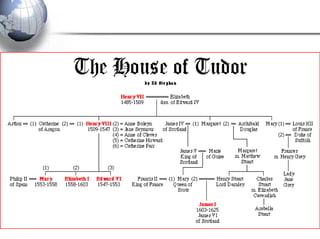
• James VI of Scotland became king when Elizabeth I
died in 1603, and became James I of England.
• James was a Stuart – they disliked the democratic
traditions of England and preferred to rule as
absolute monarchs which was unpopular.
• The idea of the Divine Right of Kings evolved in
Europe during the Middle Ages. The theory claimed
that kings were answerable only to God and it was
therefore sinful for their subjects to resist them.
John of England
signs
Magna Carta –
fanciful illustration
from Cassell's
History of England
(1902)
James I
•James I was born in 1566 to Mary Queen
of Scots and her second husband, Henry
Stewart, Lord Darnley.
•Mary Queen of Scots and Henry Stewart
were grandchildren of Margaret Tudor.
•James ascended the Scottish throne upon
the abdication of his mother in 1567, but
Scotland was ruled by regent until James
reached his majority.
•He married Anne of Denmark in 1589, who
bore him three sons and four daughters:
Henry, Elizabeth, Margaret, Charles,
Robert, Mary and Sophia.
•He was named successor to the English
throne by his cousin, Elizabeth I and
ascended that throne in 1603.
•James died of a stroke in 1625 after ruling
Scotland for 58 years and England for 22
Guy Fawkes
• One of 13 who planned the failed Gunpowder Plot
in 1605.
• Tried to assassinate James I and replace him
with a Catholic monarch.
• Guy Fawkes Night in England commemorates the
failed attempt by burning his effigy on November
5th.
James I
• Make a Mindmap from p.29-30 that deal with
James’ character and actions while King of
England.
•Paste the portrait in the middle of a page in
your notebook.
“Wee” Charles I
Charles I
• Charles was born in Dunfermline, the son of James I
and Anne of Denmark, was born in 1600.
• He was made the Duke of York at the age of five and
the Prince of Wales in 1616.
• When James I died in 1625, he became king.
• Charles married Henrietta Maria, the fifteen-year-old
daughter of Henri IV of France. As Henrietta Maria
was a Roman Catholic, this marriage was not very
popular with the English people. The Puritans were
particularly unhappy when they heard that the king
had promised that Henrietta Maria would be allowed
to practise her religion freely and would have the
responsibility for the upbringing of their children until
they reached the age of 13.
• France At this time King Louis XIII was involved in
a civil war against the Protestants (Huguenots) in
France.
• Parliament wanted to help the Huguenots but
Charles refused as he did not want to upset his
wife or brother-in-law. Eventually it was agreed to
send a fleet of eight ships to.
• However, at the last moment Charles sent orders
that the men should fight for, rather than against,
Louis XIII.
• The captains and crews refused to accept these
orders and fought against the French.
• Parliament was very angry with Charles for
supporting Louis XIII. When he asked for taxes of
£1,000,000 they only gave him £150,000. They
also asked Charles to sack his chief minister,
George Villiers, Duke of Buckingham, as they
thought he was guilty of giving the king bad
advice. Charles refused and instead dissolved
Parliament.
•

•
•
1.
2.
3.
4.
5.

The FighT WiTh
ParliamenT
Charles’ real difficulties came about because he
constantly needed money to support his
extravagant lifestyle, which he had to go to
parliament to get it.
Parliament would only agree to Charles’ request if
he agreed to respect its wishes. – he usually
refused.
He tried to raise money without parliament:
A fee called ship money –
Fees known as tunnage & poundage –
Billeted his soldiers –
Sold noble titles
Used the secret Court of Star Chamber –
• Charles recalled parliament in 1628 hoping to get
more money
• Parliament told the king it would grant no money until
he ceased his illegal activities and until he signed a
new charter called the “Petition of Rights”.
• Charles dissolved parliament again, and resolved to
rule without it.
• When the Duke of Buckingham was assassinated,
Charles asked Lord Strafford and Archbishop Laud
for help.
• Why were they unpopular also?
William Prynne
Led a series of attacks on the
church policies of the
government, and on the lax
morals prevalent at Court.
Being, like many Puritans, he
strongly opposed stage
plays, .He was tried in the
Star Chamber in 1633 and
sentenced to imprisonment
and the removal of part of his
ears.
CourT oF STar
Chamber
• The Court evolved from meetings of the king's royal
council, with its roots going back to the medieval
period. The court only became unusually powerful
during the reign of Henry VII of England, when in
1487 the court became a separate judicial body from
the king's council with a mandate to hear petitions of
redress.
• The court was set up to ensure the fair enforcement
of laws against prominent people, those so powerful
that ordinary courts could never convict them of their
crimes and other shenanigans.
Star Chamber Under
CharleS
• by the time of Charles I of England it had become
synonymous with misuse and abuse of power by the
king and his circle. James I of England and his son
Charles used the court to examine cases of sedition,
which meant that the court could be used to
suppress opposition to royal policies. It came to be
used to try nobles too powerful to be brought to trial
in the lower courts.
• Court sessions were held in secret, with no
indictments, no right of appeal, no juries, and no
witnesses. Evidence was presented in writing.
Charles I used the Court of Star Chamber as a sort
of Parliamentary substitute during the Eleven Years
Tyranny when he refused to call Parliament.
Civil War
•
•
•
•

What is a Civil War?
People within a country fight each other.
Which two sides were involved in 1642? (p.35)
King Charles I and his supporters called “Royalists”
or “Cavaliers”, who came from noble families and
were used to fighting and riding. Charles also had
experienced commanders, such as his dashing
nephew Prince Rupert, who inspired his troops.
• Parliament’s troops were local militia – farmers and
townspeople with almost no military experience.
Parliament controlled the navy, and the richest part
of the country (the south and London).
• Unless Charles won the war in the early stages, he
was doomed.
• Parliament made an alliance with the Scots and
began to build a more modern army.
• The leader of the “New Model Army” was Oliver
Cromwell, a Puritan who believed absolutely in
parliament’s cause.
• The New Model Army defeated the Royalists at 2
important battles, Marston Moor and Naseby.
• Charles was forced to flee to Scotland, where he was
made prisoner and handed over to parliament.
• What were the views of the Presbyterians and the
Puritans? (p. 36)
the triUmph of
parliament ?
• The execution of Charles I did not make England a
republic.
• Parliament sent an army under him to end the
Royalist threat in Ireland and Scotland.
• Eventually Oliver Cromwell as leader of the army
took control of England because parliament was
unable to govern effectively.
• He became the Lord Protector (military dictator) of
England.
• Cromwell became like the king he helped overthrow.
• Blue Laws outlawed Christmas, sports, and others.
the reStoration
• After Cromwell’s death in 1658, the Long Parliament
was recalled to prevent another civil war.
• General Monk ordered parliament to dissolve and
call an election for a new one.
• The new parliament decided to restore the monarchy
and invited Charles II to become king of England,
which was a very popular decision. Why? (p.44)
• Parliament insisted that the king rule as a
constitutional monarchy, with his powers set out by
parliament.
• How did Charles and the parliament clash? (p.46)
the GlorioUS
revolUtion

The stuart kings

  • 1.
  • 2.
    Role of Religion •People were still very devoted to the church in the 1700s and attended regularly. • Most of England was Protestant – any Christian not belonging to the Roman Catholic or Orthodox Eastern Church. • The official church was the Church of England (Anglican Church) with the king as its head. • The Church decided how services were to be conducted in the country, supported by taxes, and had very elaborate ceremonies and buildings. • Within the Protestants, there were many different groups with diff ways of worshipping and diff interpretations of the Bible.
  • 3.
    Magna Carta • MagnaCarta (Latin for "Great Charter", literally "Great Paper"), also known as Magna Carta Libertatum, is an English 1215 charter which limited the power of English Monarchs, specifically King John, from absolute rule. • Magna Carta required the king to renounce certain rights and respect certain legal procedures, and to accept that the will of the king could be bound by law. • Magna Carta is widely considered to be the first step in a long historical process leading to the rule of constitutional law.
  • 4.
    The eaRly STuaRTS •James VI of Scotland became king when Elizabeth I died in 1603, and became James I of England. • James was a Stuart – they disliked the democratic traditions of England and preferred to rule as absolute monarchs which was unpopular. • The idea of the Divine Right of Kings evolved in Europe during the Middle Ages. The theory claimed that kings were answerable only to God and it was therefore sinful for their subjects to resist them.
  • 5.
    John of England signs MagnaCarta – fanciful illustration from Cassell's History of England (1902)
  • 6.
    James I •James Iwas born in 1566 to Mary Queen of Scots and her second husband, Henry Stewart, Lord Darnley. •Mary Queen of Scots and Henry Stewart were grandchildren of Margaret Tudor. •James ascended the Scottish throne upon the abdication of his mother in 1567, but Scotland was ruled by regent until James reached his majority. •He married Anne of Denmark in 1589, who bore him three sons and four daughters: Henry, Elizabeth, Margaret, Charles, Robert, Mary and Sophia. •He was named successor to the English throne by his cousin, Elizabeth I and ascended that throne in 1603. •James died of a stroke in 1625 after ruling Scotland for 58 years and England for 22
  • 9.
    Guy Fawkes • Oneof 13 who planned the failed Gunpowder Plot in 1605. • Tried to assassinate James I and replace him with a Catholic monarch. • Guy Fawkes Night in England commemorates the failed attempt by burning his effigy on November 5th.
  • 10.
    James I • Makea Mindmap from p.29-30 that deal with James’ character and actions while King of England. •Paste the portrait in the middle of a page in your notebook.
  • 11.
  • 12.
    Charles I • Charleswas born in Dunfermline, the son of James I and Anne of Denmark, was born in 1600. • He was made the Duke of York at the age of five and the Prince of Wales in 1616. • When James I died in 1625, he became king. • Charles married Henrietta Maria, the fifteen-year-old daughter of Henri IV of France. As Henrietta Maria was a Roman Catholic, this marriage was not very popular with the English people. The Puritans were particularly unhappy when they heard that the king had promised that Henrietta Maria would be allowed to practise her religion freely and would have the responsibility for the upbringing of their children until they reached the age of 13.
  • 13.
    • France Atthis time King Louis XIII was involved in a civil war against the Protestants (Huguenots) in France. • Parliament wanted to help the Huguenots but Charles refused as he did not want to upset his wife or brother-in-law. Eventually it was agreed to send a fleet of eight ships to. • However, at the last moment Charles sent orders that the men should fight for, rather than against, Louis XIII. • The captains and crews refused to accept these orders and fought against the French.
  • 14.
    • Parliament wasvery angry with Charles for supporting Louis XIII. When he asked for taxes of £1,000,000 they only gave him £150,000. They also asked Charles to sack his chief minister, George Villiers, Duke of Buckingham, as they thought he was guilty of giving the king bad advice. Charles refused and instead dissolved Parliament.
  • 15.
    • • • 1. 2. 3. 4. 5. The FighT WiTh ParliamenT Charles’real difficulties came about because he constantly needed money to support his extravagant lifestyle, which he had to go to parliament to get it. Parliament would only agree to Charles’ request if he agreed to respect its wishes. – he usually refused. He tried to raise money without parliament: A fee called ship money – Fees known as tunnage & poundage – Billeted his soldiers – Sold noble titles Used the secret Court of Star Chamber –
  • 16.
    • Charles recalledparliament in 1628 hoping to get more money • Parliament told the king it would grant no money until he ceased his illegal activities and until he signed a new charter called the “Petition of Rights”. • Charles dissolved parliament again, and resolved to rule without it. • When the Duke of Buckingham was assassinated, Charles asked Lord Strafford and Archbishop Laud for help. • Why were they unpopular also?
  • 17.
    William Prynne Led aseries of attacks on the church policies of the government, and on the lax morals prevalent at Court. Being, like many Puritans, he strongly opposed stage plays, .He was tried in the Star Chamber in 1633 and sentenced to imprisonment and the removal of part of his ears.
  • 18.
    CourT oF STar Chamber •The Court evolved from meetings of the king's royal council, with its roots going back to the medieval period. The court only became unusually powerful during the reign of Henry VII of England, when in 1487 the court became a separate judicial body from the king's council with a mandate to hear petitions of redress. • The court was set up to ensure the fair enforcement of laws against prominent people, those so powerful that ordinary courts could never convict them of their crimes and other shenanigans.
  • 19.
    Star Chamber Under CharleS •by the time of Charles I of England it had become synonymous with misuse and abuse of power by the king and his circle. James I of England and his son Charles used the court to examine cases of sedition, which meant that the court could be used to suppress opposition to royal policies. It came to be used to try nobles too powerful to be brought to trial in the lower courts. • Court sessions were held in secret, with no indictments, no right of appeal, no juries, and no witnesses. Evidence was presented in writing. Charles I used the Court of Star Chamber as a sort of Parliamentary substitute during the Eleven Years Tyranny when he refused to call Parliament.
  • 20.
    Civil War • • • • What isa Civil War? People within a country fight each other. Which two sides were involved in 1642? (p.35) King Charles I and his supporters called “Royalists” or “Cavaliers”, who came from noble families and were used to fighting and riding. Charles also had experienced commanders, such as his dashing nephew Prince Rupert, who inspired his troops. • Parliament’s troops were local militia – farmers and townspeople with almost no military experience. Parliament controlled the navy, and the richest part of the country (the south and London).
  • 21.
    • Unless Charleswon the war in the early stages, he was doomed. • Parliament made an alliance with the Scots and began to build a more modern army. • The leader of the “New Model Army” was Oliver Cromwell, a Puritan who believed absolutely in parliament’s cause. • The New Model Army defeated the Royalists at 2 important battles, Marston Moor and Naseby. • Charles was forced to flee to Scotland, where he was made prisoner and handed over to parliament. • What were the views of the Presbyterians and the Puritans? (p. 36)
  • 22.
    the triUmph of parliament? • The execution of Charles I did not make England a republic. • Parliament sent an army under him to end the Royalist threat in Ireland and Scotland. • Eventually Oliver Cromwell as leader of the army took control of England because parliament was unable to govern effectively. • He became the Lord Protector (military dictator) of England. • Cromwell became like the king he helped overthrow. • Blue Laws outlawed Christmas, sports, and others.
  • 23.
    the reStoration • AfterCromwell’s death in 1658, the Long Parliament was recalled to prevent another civil war. • General Monk ordered parliament to dissolve and call an election for a new one. • The new parliament decided to restore the monarchy and invited Charles II to become king of England, which was a very popular decision. Why? (p.44) • Parliament insisted that the king rule as a constitutional monarchy, with his powers set out by parliament. • How did Charles and the parliament clash? (p.46)
  • 24.