World Population Growth
• Demography – the statistical study of
human populations
• helps us to understand the causes and
consequences of population change
• - important because population can affect
government decisions – need accurate figures
of population change so that they can plan
for such things as numbers of schools and
classrooms that are needed in a community
• -   businesses are interested in information
about family size, incomes, and consumer
habits as they plan their marketing
strategies.
•
Population Rates
• Components of population change are:
• •        How many people are born
• •        How many people die, and
• •        How many move in or out of an area
• Population Change Equation:
• Births – deaths + immigrants (people
moving INTO country)
• – emigrants (people moving OUT OF
country)
• = increase or decrease in population
• Important:
• comparing the relationship between the #
of births and the size of the population in
each country is more significant that simply
comparing # of births. Demographers do
this by using measurements called birth
rates and death rates. Demographers use
rates per thousand when figuring population
change.
• Canada’s annual crude birth rate is about
11 per thousand, and the crude death rate
is about 7 per thousand, so the natural
increase is six per thousand – usually
expressed as 0.6 per cent.
The Rule of Seventy
• - human populations have the potential to
grow at an ever-increasing rate.
• Example: a couple has 4 children – who
have 4 children each – by the 3rd
generation
= 16 descendants
•
• - This is called an exponential rate of
increase – a rapid rate of increase as each
generation doubles in size
•
•
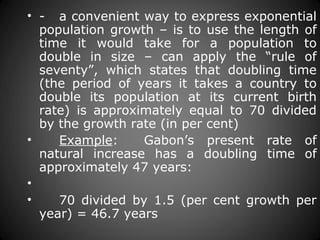
• - a convenient way to express exponential
population growth – is to use the length of
time it would take for a population to
double in size – can apply the “rule of
seventy”, which states that doubling time
(the period of years it takes a country to
double its population at its current birth
rate) is approximately equal to 70 divided
by the growth rate (in per cent)
• Example: Gabon’s present rate of
natural increase has a doubling time of
approximately 47 years:
•
• 70 divided by 1.5 (per cent growth per
year) = 46.7 years
World Population Growth

World Population Growth

  • 1.
  • 2.
    • Demography –the statistical study of human populations • helps us to understand the causes and consequences of population change • - important because population can affect government decisions – need accurate figures of population change so that they can plan for such things as numbers of schools and classrooms that are needed in a community • -   businesses are interested in information about family size, incomes, and consumer habits as they plan their marketing strategies. •
  • 3.
    Population Rates • Componentsof population change are: • •        How many people are born • •        How many people die, and • •        How many move in or out of an area • Population Change Equation: • Births – deaths + immigrants (people moving INTO country) • – emigrants (people moving OUT OF country) • = increase or decrease in population
  • 4.
    • Important: • comparingthe relationship between the # of births and the size of the population in each country is more significant that simply comparing # of births. Demographers do this by using measurements called birth rates and death rates. Demographers use rates per thousand when figuring population change. • Canada’s annual crude birth rate is about 11 per thousand, and the crude death rate is about 7 per thousand, so the natural increase is six per thousand – usually expressed as 0.6 per cent.
  • 5.
    The Rule ofSeventy • - human populations have the potential to grow at an ever-increasing rate. • Example: a couple has 4 children – who have 4 children each – by the 3rd generation = 16 descendants • • - This is called an exponential rate of increase – a rapid rate of increase as each generation doubles in size • •
  • 6.
    • - aconvenient way to express exponential population growth – is to use the length of time it would take for a population to double in size – can apply the “rule of seventy”, which states that doubling time (the period of years it takes a country to double its population at its current birth rate) is approximately equal to 70 divided by the growth rate (in per cent) • Example: Gabon’s present rate of natural increase has a doubling time of approximately 47 years: • • 70 divided by 1.5 (per cent growth per year) = 46.7 years