How did revolution lead the
colonies toward independence?
The Revolutionary War
• Started with the “shot heard round the world”
in 1775 – Lexington Green Massachusetts
• George Washington named Commander of
the Continental Army
• 1st major battle near Bunker Hill
https://www.youtube.com/watch?v=f4zpXaxg3i
s
• https://www.youtube.com/watch?v=3lXnfitSo
Yw
Attack on Quebec
• Colonies were vulnerable to the north
• Convince Quebec to join the revolution or attack
them first
• Winter of 1775 the Americans attacked Quebec
• The attack failed, but it helped reassure the
Canadians loyalty to Britain.
• https://www.youtube.com/watch?v=CdZxkoBZwoY
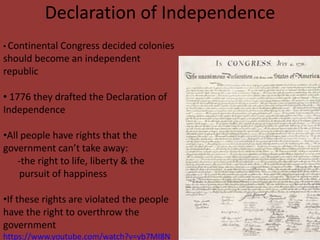
Declaration of Independence
• Continental Congress decided colonies
should become an independent
republic
• 1776 they drafted the Declaration of
Independence
•All people have rights that the
government can’t take away:
-the right to life, liberty & the
pursuit of happiness
•If these rights are violated the people
have the right to overthrow the
government
https://www.youtube.com/watch?v=yb7MI8N
After the Declaration was Signed
• The Declaration of Independence did not end
the revolutionary war
• Spain and France joined the Americans to help
defeat the British
• At the Battle of Yorktown 1781 the British lost
a whole army
• They soon surrendered Savannah and
Charleston before abandoning New York
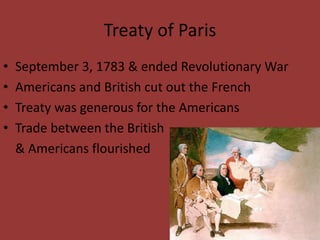
Treaty of Paris
• September 3, 1783 & ended Revolutionary War
• Americans and British cut out the French
• Treaty was generous for the Americans
• Trade between the British
& Americans flourished
Review: How did revolution lead the
colonies toward independence?
• They were united in their grievances against Britain
• Formation of the Continental Army
• Developed a sense of Nationalism/Patriotism
• Established distinct borders between the United
States and British North America
• Declaration of Independence
Comparing Viewpoints
• Page 177
• 15 minutes to read each passage and fill out the
table at the top. Do this with person next to you
• 5 minutes to discuss & share answers with
another pair. Add any additional information if
needed
• 10 minutes to answer the last question
individually
• Needs to be handed in before you leave class
How did the American Revolution
Change British North America?
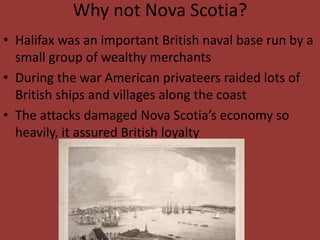
Why not Nova Scotia?
• Halifax was an important British naval base run by a
small group of wealthy merchants
• During the war American privateers raided lots of
British ships and villages along the coast
• The attacks damaged Nova Scotia’s economy so
heavily, it assured British loyalty
The Loyalists
• Not everyone in the
Thirteen Colonies
supported the revolution
• 1/5 supported British rule
• Loyalists were persecuted
during the war by
revolutionary patriots
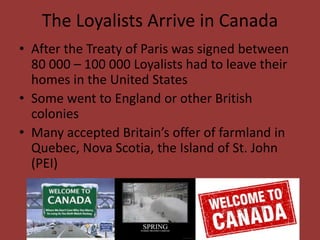
The Loyalists Arrive in Canada
• After the Treaty of Paris was signed between
80 000 – 100 000 Loyalists had to leave their
homes in the United States
• Some went to England or other British
colonies
• Many accepted Britain’s offer of farmland in
Quebec, Nova Scotia, the Island of St. John
(PEI)
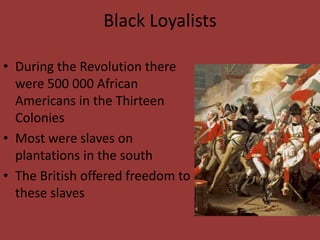
Black Loyalists
• During the Revolution there
were 500 000 African
Americans in the Thirteen
Colonies
• Most were slaves on
plantations in the south
• The British offered freedom to
these slaves
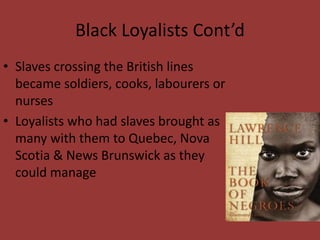
Black Loyalists Cont’d
• Slaves crossing the British lines
became soldiers, cooks, labourers or
nurses
• Loyalists who had slaves brought as
many with them to Quebec, Nova
Scotia & News Brunswick as they
could manage
First Nations
• The Americans wanted the First Nations land,
making conflict unavoidable
• The First Nations were divided about what to
do
• When revolution broke out they decided to
keep a neutral position
Joseph Brant
• Mohawk Leader, also known
as Thayendanegea
• In 1775 he visited England as
an ambassador
• The negotiations of the Treaty
of Paris (1783) ignored the
First Nations
• At Brant’s insistence the British
gave the Haudenosaunee land
along the Grand River
The Remaining British Colonies
• Britain wanted populations that were loyal to
the British Crown
• Loyalists, First Nations & African Americans
were the first to be accepted in British North
America
The Constitutional Act
• Loyalists settling in Quebec demanded they be
governed separately from the French speaking
Canadiens
• Constitutional Act (1791) divided Quebec into
Upper and Lower Canada
• Each colony received its own government
Review: How did the American
Revolution Change British North
America?
• Nova Scotia joined British North America
• Loyalists settled in British North America
• First Nations received land along the Grand River
• The Constitutional Act separated Quebec into
Upper and Lower Canada
Value Line Activity
• Did the American Revolution result in
freedom, liberty & happiness for the people in
the colonies?
• Stand on the left side of the room if you think
it did
• Stand on the right side of the room if you
think it didn’t
• If you’re not sure, stand in the middle
• Be prepared to explain your perspective

American Rev & BNA

  • 1.
    How did revolutionlead the colonies toward independence?
  • 2.
    The Revolutionary War •Started with the “shot heard round the world” in 1775 – Lexington Green Massachusetts • George Washington named Commander of the Continental Army • 1st major battle near Bunker Hill https://www.youtube.com/watch?v=f4zpXaxg3i s • https://www.youtube.com/watch?v=3lXnfitSo Yw
  • 3.
    Attack on Quebec •Colonies were vulnerable to the north • Convince Quebec to join the revolution or attack them first • Winter of 1775 the Americans attacked Quebec • The attack failed, but it helped reassure the Canadians loyalty to Britain. • https://www.youtube.com/watch?v=CdZxkoBZwoY
  • 4.
    Declaration of Independence •Continental Congress decided colonies should become an independent republic • 1776 they drafted the Declaration of Independence •All people have rights that the government can’t take away: -the right to life, liberty & the pursuit of happiness •If these rights are violated the people have the right to overthrow the government https://www.youtube.com/watch?v=yb7MI8N
  • 5.
    After the Declarationwas Signed • The Declaration of Independence did not end the revolutionary war • Spain and France joined the Americans to help defeat the British • At the Battle of Yorktown 1781 the British lost a whole army • They soon surrendered Savannah and Charleston before abandoning New York
  • 6.
    Treaty of Paris •September 3, 1783 & ended Revolutionary War • Americans and British cut out the French • Treaty was generous for the Americans • Trade between the British & Americans flourished
  • 7.
    Review: How didrevolution lead the colonies toward independence? • They were united in their grievances against Britain • Formation of the Continental Army • Developed a sense of Nationalism/Patriotism • Established distinct borders between the United States and British North America • Declaration of Independence
  • 8.
    Comparing Viewpoints • Page177 • 15 minutes to read each passage and fill out the table at the top. Do this with person next to you • 5 minutes to discuss & share answers with another pair. Add any additional information if needed • 10 minutes to answer the last question individually • Needs to be handed in before you leave class
  • 9.
    How did theAmerican Revolution Change British North America?
  • 10.
    Why not NovaScotia? • Halifax was an important British naval base run by a small group of wealthy merchants • During the war American privateers raided lots of British ships and villages along the coast • The attacks damaged Nova Scotia’s economy so heavily, it assured British loyalty
  • 11.
    The Loyalists • Noteveryone in the Thirteen Colonies supported the revolution • 1/5 supported British rule • Loyalists were persecuted during the war by revolutionary patriots
  • 12.
    The Loyalists Arrivein Canada • After the Treaty of Paris was signed between 80 000 – 100 000 Loyalists had to leave their homes in the United States • Some went to England or other British colonies • Many accepted Britain’s offer of farmland in Quebec, Nova Scotia, the Island of St. John (PEI)
  • 13.
    Black Loyalists • Duringthe Revolution there were 500 000 African Americans in the Thirteen Colonies • Most were slaves on plantations in the south • The British offered freedom to these slaves
  • 14.
    Black Loyalists Cont’d •Slaves crossing the British lines became soldiers, cooks, labourers or nurses • Loyalists who had slaves brought as many with them to Quebec, Nova Scotia & News Brunswick as they could manage
  • 15.
    First Nations • TheAmericans wanted the First Nations land, making conflict unavoidable • The First Nations were divided about what to do • When revolution broke out they decided to keep a neutral position
  • 16.
    Joseph Brant • MohawkLeader, also known as Thayendanegea • In 1775 he visited England as an ambassador • The negotiations of the Treaty of Paris (1783) ignored the First Nations • At Brant’s insistence the British gave the Haudenosaunee land along the Grand River
  • 17.
    The Remaining BritishColonies • Britain wanted populations that were loyal to the British Crown • Loyalists, First Nations & African Americans were the first to be accepted in British North America
  • 18.
    The Constitutional Act •Loyalists settling in Quebec demanded they be governed separately from the French speaking Canadiens • Constitutional Act (1791) divided Quebec into Upper and Lower Canada • Each colony received its own government
  • 19.
    Review: How didthe American Revolution Change British North America? • Nova Scotia joined British North America • Loyalists settled in British North America • First Nations received land along the Grand River • The Constitutional Act separated Quebec into Upper and Lower Canada
  • 20.
    Value Line Activity •Did the American Revolution result in freedom, liberty & happiness for the people in the colonies? • Stand on the left side of the room if you think it did • Stand on the right side of the room if you think it didn’t • If you’re not sure, stand in the middle • Be prepared to explain your perspective

Editor's Notes

  • #3  -most americans felt there was no turning back after the battle at lexington, many people in england felt the americans were justified in rebelling as they saw similarities in their own Glorious Revolution. -Continental Army made up local militia -Continental Army held their own at Bunker Hill against the British, who were one of the most experienced and trained armies in the world. A massive statement, and one the British would have to take seriously.
  • #4 -Continental Congress knew the colonies were vulnerable to the north along the Quebec borders, all the major cities and resources were along the coast -British troops could attack Thirteen Colonies through Quebec -In order to prevent this, the Americans could either… …and claim Quebec for themselves -Americans decided to do the latter… …led by Richard Montgomery and Benedict Arnold -ASK why Canadians would become loyal to Britain?
  • #5 The American Revolution still lacked a clear goal Many colonists wanted to keep ties with England There was also strong support for complete independence Some colonists wanted the colonies to remain independent from each other -document would later be used to argue against slavery & was a source of inspiration for the French Revolution
  • #6 -war lasted another 7 years until the Treaty of Paris was signed in 1783 -France provided money, arms and soldiers to the Americans. It was in their best interests for Britain to be weaker and they were also motivated by territory they had lost to the British in the French and Indian War -French got its revenge as Britain ended up losing the war, but France invested heavily but gained very little-----will learn more in next unit of French rev. -Spain provided money to the Americans and largely funded the Battle of Yorktown. Like France, Spain saw the American Revolution as a chance to weaken Britain. -They didn’t invest as much as France and never forged a direct military treaty with the Americans because they feared that the Americans might try and capture various Spanish territories -which was the last British stronghold
  • #7 -2 main points of the treaty acknowledged the United States to be free, sovereign & independent states, and established the boundaries between the United States and British North America -France supported American independence but didn’t want to give them any territorial gains, so the Americans & British held secret negotiations without the French -Americans gained the fishing rights off the Canadian coasts and the blockades and imperial restrictions were lifted, allowing them to trade with any nation in the world -the British did this intentionally as they saw the potential profits to be made by being a large trade partner with the growing United States
  • #11 -Language and religious differences in meant they weren’t going to voluntarily join the United States, but Nova Scotia was similar to the colonies of New England >>> ¾ of Nova Scotians originally came from New England Privateers – private ships or individuals authorized by a government attack foreign ships during wartime
  • #12 -abused, attacked, houses & farm burned
  • #13 -Treaty of Paris was signed in 1783 by Britain and United States. Ended the revolutionary war and recognized American independence 7500 settled in Ontario, 2000 in Quebec & 30 000 in the Maritimes----Cape Breton, Island of St. John & St. John River Valley
  • #14 -many of the men who signed the declaration of independence were slave owners>>>Thomas Jefferson, man who drafted the document hoping that it would ruin the plantation economies
  • #15 -tens of thousands -Some were sold back into slavery after the war -3000 Black Loyalists settled in Nova Scotia after the war -individually named in the Book of Negroes https://www.youtube.com/watch?v=MIKTHKvHQTs
  • #16 -Because they had traditional territory in New York, but maintained good relations with Sir William Johnson, the British Superintendent of Indian Affairs -Some wanted to fight for the British and others wanted to fight for the Americans -Because they didn’t want to fight a war that wasn’t theirs
  • #17 -During his visit to England Brant was promised land if he and the Mohawks fought with the British against the Colonies -his sister was the companion of the British Indian affairs minister so he developed a close relationship with the British -Brant felt betrayed by the British and wrote a letter voicing the concerns of the Mohawk Nation -Mohawks are part of Haudenosaunee Six Nations -Which is in present day Southern Ontario -this gesture would make the Mohawks allies of the British against the Americans in the War of 1812
  • #18 -They needed loyal supporters because they had few remaining allies as they lost allies in Spain and France during the war -Because they were refugees from the United States they were unlikely to challenge British authority -Although they weren’t American, there was little unity in British North America because there were so many cultural differences. The Dominion of Canada wouldn’t be formed until 1867
  • #19 -Lower Canada, the heartland of New France remained French and kept its French culture, including the Catholic religion and French civil Law -Upper Canada was English speaking and Protestant. They maintained British laws and institutions. -Lower Canada would eventually become Quebec and Upper Canada, Ontario -Each government consisted of an elected assembly, a governor and two councils. The assemblies proposed acts and laws which were either accepted or vetoed by the governor and councils