CANADA IN WWI
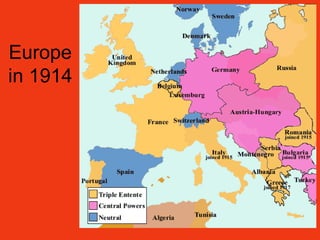
Europe
in 1914
CANADA IN WWI
1. Causes of WWI
2. Canada’s Response
3. War on Land / Battles in Europe
4. Warfare in Air / Sea
5. The War at Home
6. Building Peace
The period before WWI was the high-water mark of imperial
feeling, an era when “imperialism” was not a dirty word.
- historian Daniel Francis
Part 1 - Causesof WWI
1. Europeanshad forgotten what war waslike
2. Militarism
3. Alliancesystems
4. Nationalism
5. Imperialism
6. Assassination of Franz Ferdinand
War WasForgotten
The last war involving a major European
nation had ended in 1878, and the last war
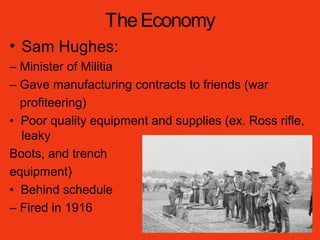
that involved all European nations had
ended in 1815
Militarism
• Many European nations were militaristic.
• Most of them had large standing armies,
and because of conscription (compulsory
service in the armed forces), most men
had some military experience.
• Because most wars in the 1800s had
been short, gov’ts felt wars were a good
way to settle international disputes.
AllianceSystem
• European nations had divided themselves into
2 alliance systems
• An attack against one member of an alliance
was treated as an attack against all members
of that alliance
• Although this system was supposed to deter
confrontation, it actually ↑ the likelihood of an
international crisis
WWI AllianceSystem
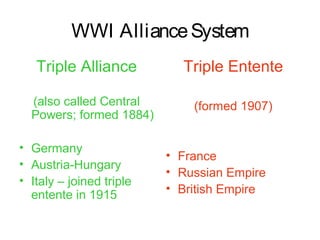
Triple Alliance
(also called Central
Powers; formed 1884)
• Germany
• Austria-Hungary
• Italy – joined triple
entente in 1915
Triple Entente
(formed 1907)
• France
• Russian Empire
• British Empire
Nationalism
• Europeans felt strong devotion to their
countries
• Many believed they had legitimate
grievances with other nations
• And had the right to promote their
international goals at the expense of
others
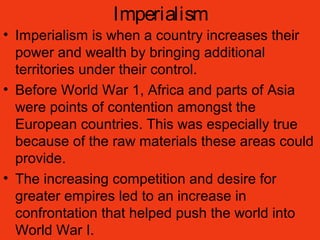
Imperialism
• Imperialism is when a country increases their
power and wealth by bringing additional
territories under their control.
• Before World War 1, Africa and parts of Asia
were points of contention amongst the
European countries. This was especially true
because of the raw materials these areas could
provide.
• The increasing competition and desire for
greater empires led to an increase in
confrontation that helped push the world into
World War I.
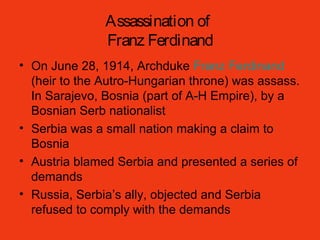
Assassination of
Franz Ferdinand
• On June 28, 1914, Archduke Franz Ferdinand
(heir to the Autro-Hungarian throne) was assass.
In Sarajevo, Bosnia (part of A-H Empire), by a
Bosnian Serb nationalist
• Serbia was a small nation making a claim to
Bosnia
• Austria blamed Serbia and presented a series of
demands
• Russia, Serbia’s ally, objected and Serbia
refused to comply with the demands
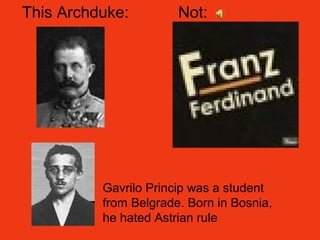
Not:This Archduke:
Gavrilo Princip was a student
from Belgrade. Born in Bosnia,
he hated Astrian rule
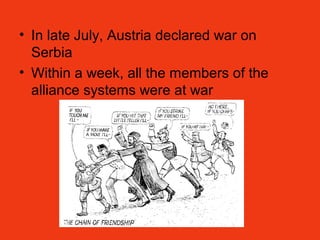
• In late July, Austria declared war on
Serbia
• Within a week, all the members of the
alliance systems were at war
World Leaders
• Canada – PM Robert Borden
• Great Britain – PM David Lloyd George
• France – PM Georges Clemenceau
• Russia – Czar Nicholas II
• United States – President Woodrow Wilson
• Germany – Kaiser Wilhelm II
• Austria-Hungary – Emperor Franz Joseph
Chain Reaction
• Break-down of diplomacy, outbreak of violence,
nations commit to going to war
• July 28: Austria-Hungary declares war on Serbia
• July 30: Russia mobilizes its army to defend Serbia
• August 1: Germany declares war on Russia; France
mobilizes army
• August 3: Germany declares war on France
(Schlieffen Plan – attack France, via Belgium, then
focus on Russia)
• August 4: Germany invades Belgium on way to
France; Britain declares war on Germany
How Can I remember thecausesof
Wwi?
• M
• A
• N
• I
• A
Part 2 – Canada’sResponse
1. Roleof government
2. War Measuresact
3. Mobilizing
4. TheEconomy
Roleof Government
1. Britain still controlled Canada’s foreign policy:
– When Britain declared war on Germany, Canada
was included automatically.
2. War Measures Act:
– A law meant to ensure “security, defence, peace,
order, and welfare of Canada”
– Gave government immense control over country:
3. Business, transportation, manufacturing,
trade, production, etc.
4. Limit civil liberties (ex. habeas corpus
suspended)
5. “Enemy aliens”: recent immigrants from
Germany and Austria- Hungary could be
deported or imprisoned:
– Carry special ID cards and report regularly to
registration officers
– Over 8000 held in internment camps
– Mail censored
– Publications in “enemy” languages banned
Enemy Aliens
• When war broke out, the Cnd gov’t was faced with
what to do with the 500,000 German, Austrian, and
Hungarian people who were residents, and even
citizens of Canada.
• There were fears of sabotage, and suspicion of spies.
• People demanded that the enemy aliens be fired from
their jobs and locked up.
• The gov’t used the War MeasuresAct to place
restrictions on enemy aliens. They could be arrested
or searched, and many were sent to internment camps
in remote areas. (In reality, the majority interned were
Ukrainians)
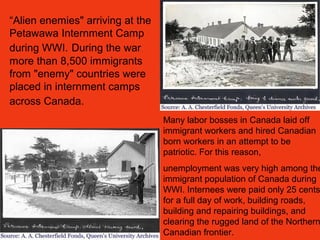
“Alien enemies" arriving at the
Petawawa Internment Camp
during WWI. During the war
more than 8,500 immigrants
from "enemy" countries were
placed in internment camps
across Canada.
Many labor bosses in Canada laid off
immigrant workers and hired Canadian
born workers in an attempt to be
patriotic. For this reason,
unemployment was very high among the
immigrant population of Canada during
WWI. Internees were paid only 25 cents
for a full day of work, building roads,
building and repairing buildings, and
clearing the rugged land of the Northern
Canadian frontier.
Mobilizing Troops
• Enlistment:
– 30,000 Canadians enlisted in the first month
– Reasons: British patriotism, adventure, honour,
travel, a job
– Women – nurses or ambulance drivers
– Minorities – at first not allowed to enlist; eventually
accepted
– Training: Valcartier, Quebec training centre
• Brought Canadians together, developed unity/
identity
• Canadian Expeditionary Force (CEF)
TheEconomy
• Sam Hughes:
– Minister of Militia
– Gave manufacturing contracts to friends (war
profiteering)
• Poor quality equipment and supplies (ex. Ross rifle,
leaky
Boots, and trench
equipment)
• Behind schedule
– Fired in 1916
Part 3 - War on Land / Battles
1. ThePlans
2. Marching off to War
3. “Back by Christmas”
4. Ypres
5. Somme
6. Vimy Ridge
7. Passchendaele
8. Canada’s100 Days
http://www.richthofen.com/ww1sum/
Theplans
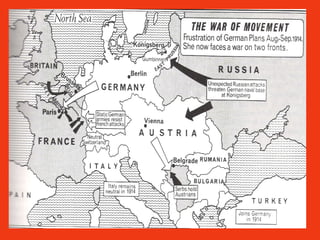
• Germany -The Schlieffen Plan
• France – Plan XVII
• Austria-Hungary – Plans B & R
• Russia – Plans G, A, & 19
• Britain – no plan, but keen to protect interests
• Canada – joined Britain automatically
• Belgium – defend German invasion
• Serbia – strike against Austria-Hungary
• United States – neutral until 1917
The Schlieffen Plan
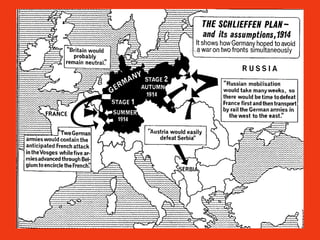
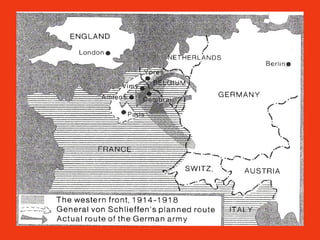
• Developed by Count Alfred von Schlieffen (General)
• Move rapidly on France because Russia would take a
long time to mobilize – avoid a 2 front war
• Mislead France and attack from north (Belgium) to fall
on Paris from the west – take 6 weeks
• Then turn all armies on Russia
• Gamble: Britain would not object invasion of Belgium
• But they did. Germany turned south too soon, failed as
they faced France, British Empire (Canada)
• Instead of short campaign, became a horrible war – 4
years of trench warfare begun.
France – Plan XVII
• Purpose was to reclaim Alsace and Lorraine
from Germany – entirely offensive
• Made use of belief in mystical élan vital (a
powerful fighting) within every Frenchman
• Advanced on German territory, not planning for
attack through Belgium
• Also underestimating strength of German army
almost let to devastation and thrown on
defense
Austria-Hungary – Plans B & R
(assumed war would be limited to Serbia)
Balkans
• 3 armies to invade
Serbia
• 3 guarding Russian
border
• Committed to Schl. Plan
and sent most armies to
the west to help
Germany
Russia
• Revised plan B
• 4 to Russia, 2 to Serbia
Russia – Plans G & 19
• G – assumed German full-scaled on them –
false
• Allow them to come into its borders, but win
once fully mobilized – like Napoleon
• 19 – French pressed for more “O” strategy
• Now assumed Germany would ‘go west’ first
• Russia would advance on East Prussia
(Poland)
Britain – no plan
• Had no particular desire for war to break out
and no plans for expansion
• Keen to protect interests, trading links with
empire
• Once war broke out, Asquith’s admin. Came to
aid of Belgium and France
Canada
• Although Canada had become a political union
in 1867, Britain still controlled the foreign policy
of all its dominions
• When Britain declared war on Germany,
Canada, along with the rest of the BE, was
automatically at war.
United States – neutral until 1917
• Determined to stay neutral
• Huge leap in exports to Allies led to a vested
interest
• Germany’s aggressive tactics frowned upon
• Sub warfare brought US to war (Lusitania &
Sussex)
• Wilson proposed plan once peace was esta. –
Fourteen Points & he pushed for League of
Nations to secure ongoing peace -
Marching off to war
• Most English-speaking Can were of British origin, and
supported the war out of patriotism
• PM Borden offered 25,000 troops, but more than
30,000 volunteered in the first month
• Most thought it would be short and home by Xmas
• Adventure and heroism tempted some
• Others had no job
• Women were not welcome at first, but some did join
as nurses and ambulance drivers
• Initially, Aboriginal people were not accepted and also
reluctant to take African-, and Japanese-Canadians
“back by christmas”
• The war effort revitalized the economy
• Sam Hughes, min. of militia, was in charge of
recruitment
• The first Canadian Expeditionary Force set sail in Oct
1914 to train in England and off to France
• The first to arrive were the Princess Patricia’s
Canadian Light Infantry in Dec 1914.
• Wartime training brought Canadians together for the
first time and began to develop a national identity, a
sense of being Canadian
• CEF fought as a separate unit, adding to nat. idnt.
Sam Hughes
• As minister of militia he oversaw the whole operation
• Men were armed with Ross rifle – designed for
precision, it jammed in mud and overheated when
fired rapidly
• Signed big contracts with friends for shells, but small
numbers made & poor quality – exploded before being
fired, killing gun crews
• Boots fell apart in rain – made of pressed cardboard
• He was dismissed in 1916, not before being knighted.
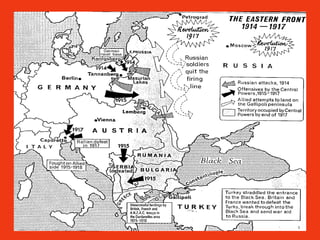
• The war in Western Europe had ground to a halt. In N.
France the two sides dug into trenches and faced
each other across a barren ‘no man’s land’ of barbed
wire and pockmarked craters.
• One of the most brutal stalemates in history, one that
cost millions of lives without advancing more than a
few km in either direction.
• Back to contents page.
ypres
• Modern warfare was born at Ypres, Belgium, on April
22 1915.
• German army released more than 5,700 cylinders of
chlorine gas into the wind
• A sickly greenish-yellow cloud wafted across no man’s
land, burning their throats and lungs
• Canadian troops rushed in to stop the German
advance
• The line was held again on April 24 with a second gas
attack.
• More than 6,000 Can were dead, missing or wounded
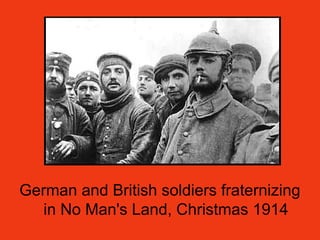
German and British soldiers fraternizing
in No Man's Land, Christmas 1914
• "Just you think," wrote one soldier to his family, "that
while you were eating your turkey I was out talking
with the very men I had been trying to kill a few hours
before!"
• At Christmas 1914 and again at Christmas 1915,
enemy shook hands with enemy in No Man's Land,
exchanged souvenirs, even played football. The truce
between the trenches extended over two-thirds of the
British line. There were similar cease-fires in the
French and Belgian sectors.
• The outraged staffs on both sides eventually put an
end to these illegal truces. Soldiers were threatened
with court-martial and even execution if they dared to
do such a thing ever again.
Somme
• A ‘Big Push’ was launched in July 1916 along the
Somme River – 100,000 troops were to advance
across no man’s land in broad daylight into German
fire – with obvious consequences
• Slaughter – 57,000 British soldiers were killed,
wounded, or missing – heaviest single-day loss ever
by a Brit. Army
• The 1st
Newf. Reg. suffered same fate – of 790 who
went over, only 68 answered roll call the next morning
• July 1, 1916 remembered as the darkest day in
Newfoundland history
• “the Battle of the Somme was less a battle than it was
a meat grinder” - Will Ferguson
• In 3 months of long-drawn-out warfare, the Allies lost
well over half a million men
• It had become a war of attrition, where the goal was
not to defeat the enemy but simply to outlast him, to
kill more of his men than he did yours
http://www.richthofen.com/ww1sum/
Vimy ridge
• Vimy Ridge was a key high ground in N. France
• Germany had taken control of it in1914 and attacks by
the French and British to reclaim it were unsuccessful
• It was Canada’s turn – preparations were careful and
meticulous
• Easter Monday – April 9 , 1917, all 4 div. of the Can
Corps advanced together
• In the cold, wet winds and driving snow and sleet the
Canadians took the hill – captured more guns, ground,
and prisoners than any British offensive
• Called “the most perfectly organized and most
successful battle of the whole war”
• It was Canada’s greatest victory, and hailed as a
‘nation-making moment’ that involved Canadians from
every region
• “We went up Vimy Ridge as Albertans and Nova
Scotians. We came down as Canadians”
• After that battle, Canadians were used as storm
troopers, brought in to head the assault in one great
battle after another
• Arthur Currie, the key strategist behind Vimy, was
given command of the entire Canadian Corps – one of
the greatest generals of the war
• Virtual tour of Vimy Ridge: http://www.vac-
acc.gc.ca/remembers/sub.cfm?
source=memorials/ww1mem/vimy/vtour
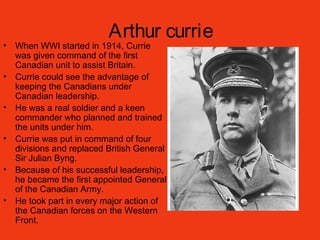
Arthur currie
• When WWI started in 1914, Currie
was given command of the first
Canadian unit to assist Britain.
• Currie could see the advantage of
keeping the Canadians under
Canadian leadership.
• He was a real soldier and a keen
commander who planned and trained
the units under him.
• Currie was put in command of four
divisions and replaced British General
Sir Julian Byng.
• Because of his successful leadership,
he became the first appointed General
of the Canadian Army.
• He took part in every major action of
the Canadian forces on the Western
Front.
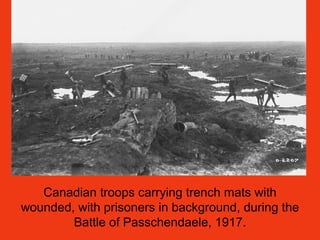
passchendaele
• Perhaps the most horrific of all (Oct 1917)
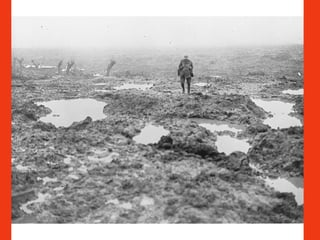
• A marshland in Belgium, it became a ‘bottomless mire’
from artillery and heavy rains
• Wounded soldiers drowned, and guns and supplies
disappeared into the soup of mud – waist-deep
• British lost 68,000 in a month, then called Currie in
• Two weeks later, Nov 6, the ridge was taken costing
almost 16,000 Canadian lives
• 500,000 lives from both sides
Canadian troops carrying trench mats with
wounded, with prisoners in background, during the
Battle of Passchendaele, 1917.
Thegerman drive- 1918
• Spring 1918, mounted a series of grand offensives to
break the Allied front
• The plan was to separate the Allied armies and force a
decision in the west before the Americans arrived – it
nearly succeeded
• Blows in the vicinity of Ypres, Soissons and Reims –
reached the Marne & within 42 miles of Paris
• Build up of American troops provided needed
reserves, while the German morale was shattered
Canada’s100 days
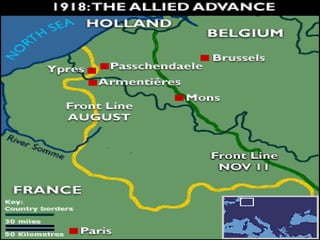
• The final 3 months of the war Aug-Nov 1918
• Canadians acted as a “spearhead to victory”
• Flanked by French & Auzzies, Canadians broke
German lines at Amiens – has been called the most
crucial battle of the war
• Advanced 13 km in one day – stalemate of trench
warfare was over, it was now a quick-running, open
battle, of speed and strategy
• Led by Gen. Currie, 5,000 Germans captured in 1st
day
alone – Aug 8 “Black Day” for German army
• At Amiens, the tide had turned
• Next important battles were won at Arras, Cambrai, &
Valenciennes
November 11
• Currie shifts fronts to the famed Hindenburg Line – a
series of entrenched fortifications that had taken the
Germans 2 years to build – their main line of defence
• Successive attacks broke through German defences
between Aug 26 & Sept 2, though Canadians suffered
11,400 casualties – Currie ‘one of the finest feats in
history’
• Capture of Cambrai by Oct 11 and continued to
overcome opposition before reaching Mons in Belgium
at the time of the armistice
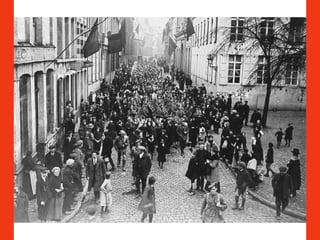
• On the 11th
hour of the 11th
day of the 11th
month
Germany surrended and the Great war came to an
end
Warfare
1. Life in the Trenches
2. Canadians in the Air
3. Canadians at Sea
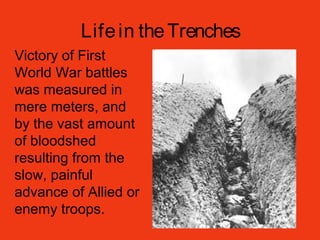
Lifein theTrenches
Victory of First
World War battles
was measured in
mere meters, and
by the vast amount
of bloodshed
resulting from the
slow, painful
advance of Allied or
enemy troops.
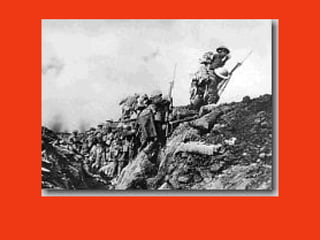
• The complex system of trenches that created
the 1,030-kilometres long Western Front was
set up into three distinct lines: defense (the
front line), support and reserve.
• Soldiers went up the line in shifts, generally
spending four to six days on the front line, then
moved back to the support section spending
the same amount of time there, and, finally,
spending an equal amount of time on the
reserve line.
• Sometimes, less than 90 metres separated you
from the enemy.
• The trenches were ditches, often muddy and
water-soaked, protected by metres of barbed
wire necessary to encourage enemy troops into
open areas where they would be prey for
machine guns.
• Sandbags reinforced the trenches, and troops
often used corrugated iron, wood and anything
else at hand to build up their lines.
• Communications lines connected the front lines
to the second and then reserve trenches
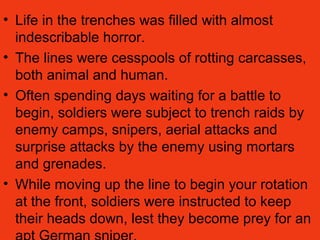
• Life in the trenches was filled with almost
indescribable horror.
• The lines were cesspools of rotting carcasses,
both animal and human.
• Often spending days waiting for a battle to
begin, soldiers were subject to trench raids by
enemy camps, snipers, aerial attacks and
surprise attacks by the enemy using mortars
and grenades.
• While moving up the line to begin your rotation
at the front, soldiers were instructed to keep
their heads down, lest they become prey for an
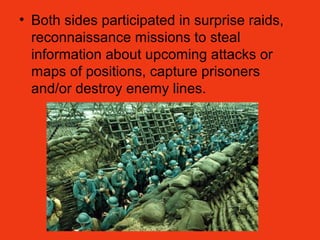
• Both sides participated in surprise raids,
reconnaissance missions to steal
information about upcoming attacks or
maps of positions, capture prisoners
and/or destroy enemy lines.
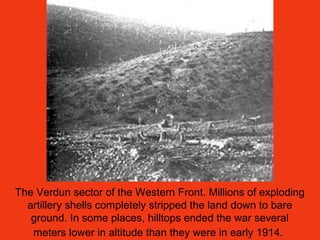
The Verdun sector of the Western Front. Millions of exploding
artillery shells completely stripped the land down to bare
ground. In some places, hilltops ended the war several
meters lower in altitude than they were in early 1914.
Canadiansin theAir
• The airplane, regarded by military authorities in 1914
as little more than a novelty, became over the next
four years a military necessity.
• Remarkable technical advances in aerial warfare
enabled the aircraft to fulfill every expanding functions.
• In the early stages of the war aircraft were used
largely for reconnaissance, to observe enemy troop
movements and spot artillery, and to obtain
photographs and motion pictures.
• Then came the bombers and fighters as airmen
sought to destroy railroad centres and industrial
targets far behind enemy lines, to destroy Zeppelin
bases, and to hunt submarines at sea.
• The fighter pilot was one of the elite, one of the
most daring, and his job was one of the most
dangerous. What started out as a hazardous
adventure developed into a science of killing.
• One third of all the fliers died in combat, among
them 1,600 Canadians.
• Canadian airmen played a particularly
significant and brilliant role in the air. No less
than 25,000 Canadians served with the British
air service as pilots, observers and mechanics,
in every theatre of the war.
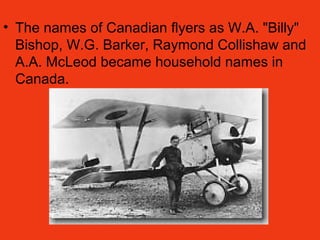
• The names of Canadian flyers as W.A. "Billy"
Bishop, W.G. Barker, Raymond Collishaw and
A.A. McLeod became household names in
Canada.
Canadiansat Sea
• When the war began in 1914 Canada had an
embryonic naval service consisting of less than
350 men and two ships, HMCS Rainbow and
HMCS Niobe.
• It was decided that Canada's war effort would
be best concentrated on the army and,
therefore, the protection of Canada's coasts
and shipping in Canadian waters was handed
over to the Royal Navy.
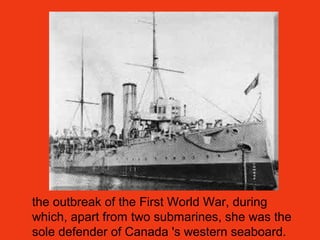
the outbreak of the First World War, during
which, apart from two submarines, she was the
sole defender of Canada 's western seaboard.
• The share of the Royal Canadian Navy in
defence though small was, nevertheless,
important.
• The R.C.N. assumed responsibility for such
services as examining and directing shipping in
Canadian ports; radio-telegraph services, vital
to the Admiralty's intelligence system; operation
of an auxiliary fleet which engaged in mine
sweeping and patrolling operations.
• In 1916, when the threat of submarine warfare
spread to North American waters, the Canadian
government undertook, at the request of the
British Admiralty, to build up a patrol force of
• The struggle at sea was chiefly between the
British effort to strangle Germany by naval
blockade; and the German attempt to cut off
Britain's source of food and supply by
submarine warfare.
• Vigilance of the British navy kept most of the
German fleet bottled up in home ports, and at
the same time British warships freed the seas
of German commerce raiders.
• Deprived of the use of surface ships Germany
increasingly resorted to submarine warfare to
bring Britain to her knees.
• The German U-boat fleet preyed on enemy and
often neutral ships, sank merchantmen on
sight, and threatened the supply lines on which
the survival of the Allies depended.
• Protests from the United States brought a
reluctant promise in 1915 not to sink ships
without warning, but this greatly reduced the
effectiveness of the submarine as a weapon.
• By the end of 1916 the British blockade was
beginning to be felt severely in Germany.
• The policy was initially spectacularly effective.
Allied shipping losses mounted, reaching a
peak in April 1917 of 869,000 tons.
• However, the submarine campaign did not
achieve the expected speedy victory. New
anti-submarine devices, together with the
allied adoption of the convoy system,
gradually overcame the submarine menace.
• On the other hand, by the middle of 1918, the
effects of the British blockade were such that
Germany could not continue the war for much
longer.
Part 5 - TheWar at Home
1. Sacrifice/ Rationing
2. Rolesof Women / Suffrage
3. Propaganda
4. First Nations
5. (Part 6) - Conscription
Sacrifice/rationing
• To finance the war effort, cost-saving measures
needed to be implemented in Canada
• Canadians were faced with food rations – to
conserve supplies. (meatless fridays)
• In farming areas students were dismissed early
from school to help bring in the harvest.
• Daylight savings time was introduced to save
on energy consumption.
• People organized community fund raisers to
help fund the war effort.
• By 1918, the war effort was costing Canada
about $2.5 million daily($38 million today).
• Canadians were urged to buy Victory Bonds –
which Canadians could cash in for a profit once
the war was over.
• 1917, govt introduced income tax – a measure
that was supposed to be temporary – between
1-15% of income.
• A corporate tax was also introduced, charging
businesses 4% of their revenues.
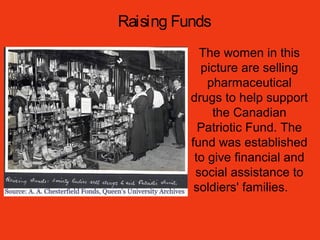
Raising Funds
The women in this
picture are selling
pharmaceutical
drugs to help support
the Canadian
Patriotic Fund. The
fund was established
to give financial and
social assistance to
soldiers' families.
Propaganda
• During the war propaganda was everywhere:
films, magazines, radio, and posters, appealing
to peoples sense of patriotism.
• It was used to encourage people to join the
army, buy Victory Bonds, ration (consume less),
and support the govt.
• It often distorted the truth; realities of war (# of
casualties, portrayal of German troops)
• This fuelled prejudice on the home front.
Roleof Women
Read p. 46 & 47, take notes on:
•Women and the War
•Suffrage Is Granted to Women
First Nations
•Read p. 48 and answer Questions 1 & 2 in your
textbook.
TheHalifax Explosion
Answer in your notebook:
•Do you think the Halifax explosion might have
made people think differently about the war?
Explain.
Part 6 - Conscription
Part 6 - Building Peace
1. Fourteen Points
2. Treaty of Versailles
- perhaps the most important international
agreement of the 20th
century.
- reps from the Allied Powers met at the
Paris Peace Conference in early 1919 to
decide what would happen to the defeated
countries.
- The goal was to create an agreement to
prevent another war from occuring.
Fourteen Points
• U.S. President Woodrow Wilson released a
document called the Fourteen Points
• He took the document to Paris and tried to convince
the Europeans that these points could be the basis
for a lasting peace.
• Main points:
1. countries should work together (internationalism)
2. for ethnic groups to create new countries based on
their nationalist desires (self-determination).
3. How German lands should be dealt.
4. Austro-Hungarian empire should cease to exist.
Treaty of Versailles(summary)
1. The War Guilt Clause.
2. Alsace-Lorraine returned to France.
3. Poland given strip of land to create sea
access (from Germany) – Polish Corridor.
4. All Central Powers was forced to surrender all
of its colonies to the League of Nations.
5. German army limited to 100,000 men; navy
and air force also restricted in size.
6. Germany was forced to surrender its entire
merchant fleet as compensation to the Allies
for shipping losses during the war.
7. The west bank of the Rhine River Valley was
to be de-militarized (border between France &
Germany). Allied armies occupied the
Rhineland for 15 years, but it remained
German.
8. Unification between Austria & Germany was
forbidden.
9. Germany was to pay money and goods to
Britain, France and Belgium to repair
damages from the war.
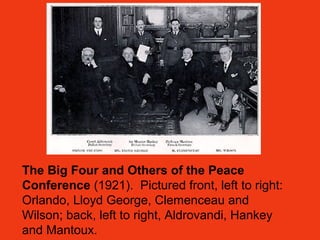
The Big Four and Others of the Peace
Conference (1921). Pictured front, left to right:
Orlando, Lloyd George, Clemenceau and
Wilson; back, left to right, Aldrovandi, Hankey
and Mantoux.
3 MAJORPROBLEMS CAUSEDBY
THESEPROVISIONS
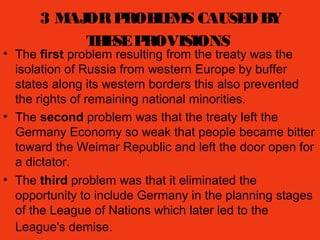
• The first problem resulting from the treaty was the
isolation of Russia from western Europe by buffer
states along its western borders this also prevented
the rights of remaining national minorities.
• The second problem was that the treaty left the
Germany Economy so weak that people became bitter
toward the Weimar Republic and left the door open for
a dictator.
• The third problem was that it eliminated the
opportunity to include Germany in the planning stages
of the League of Nations which later led to the
League's demise.
How did WWI and theTreaty of Versailles
changeor re-establish abalanceof power?
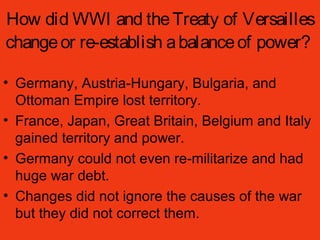
• Germany, Austria-Hungary, Bulgaria, and
Ottoman Empire lost territory.
• France, Japan, Great Britain, Belgium and Italy
gained territory and power.
• Germany could not even re-militarize and had
huge war debt.
• Changes did not ignore the causes of the war
but they did not correct them.
New Nationscreated:
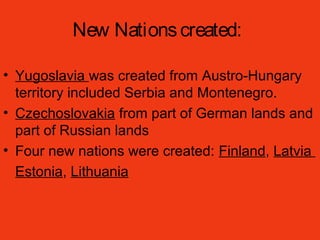
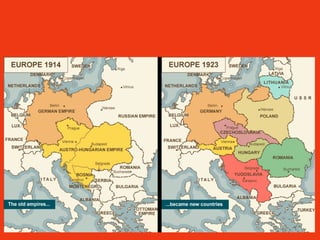
• Yugoslavia was created from Austro-Hungary
territory included Serbia and Montenegro.
• Czechoslovakia from part of German lands and
part of Russian lands
• Four new nations were created: Finland, Latvia
Estonia, Lithuania
The League of Nations was created by
the Treaty of Versailles
• MAIN PURPOSE OF THE LEAGUE OF NATIONS:
Maintain peace. Members pledged not to go to
war and submit disputes to arbitration by the
World Court.
• WEAKNESSES: was powerless to enforce
decisions or punish. the members did not take
the League seriously mostly because the major
nations did not join.
•
MAJORNATIONS THATDIDNOTJOIN
• United States because of the isolationists in the US
Senate who were afraid we would be involved in
another war. Even though the League was proposed
by President Woodrow Wilson in his Fourteen Points
the United States never ratified the Treaty of
Versailles and therefore never joined the League.
• USSRjoined later because they were not initially
invited because of their separate peace treaty with
Germany. (Treaty of Brest-Litov)
• Germany was not invited at first because of their war
guilt but joined later.(United States, Germany, Russia
as well as others)

Canada in World War I

  • 1.
  • 2.
  • 3.
    CANADA IN WWI 1.Causes of WWI 2. Canada’s Response 3. War on Land / Battles in Europe 4. Warfare in Air / Sea 5. The War at Home 6. Building Peace The period before WWI was the high-water mark of imperial feeling, an era when “imperialism” was not a dirty word. - historian Daniel Francis
  • 4.
    Part 1 -Causesof WWI 1. Europeanshad forgotten what war waslike 2. Militarism 3. Alliancesystems 4. Nationalism 5. Imperialism 6. Assassination of Franz Ferdinand
  • 5.
    War WasForgotten The lastwar involving a major European nation had ended in 1878, and the last war that involved all European nations had ended in 1815
  • 6.
    Militarism • Many Europeannations were militaristic. • Most of them had large standing armies, and because of conscription (compulsory service in the armed forces), most men had some military experience. • Because most wars in the 1800s had been short, gov’ts felt wars were a good way to settle international disputes.
  • 7.
    AllianceSystem • European nationshad divided themselves into 2 alliance systems • An attack against one member of an alliance was treated as an attack against all members of that alliance • Although this system was supposed to deter confrontation, it actually ↑ the likelihood of an international crisis
  • 8.
    WWI AllianceSystem Triple Alliance (alsocalled Central Powers; formed 1884) • Germany • Austria-Hungary • Italy – joined triple entente in 1915 Triple Entente (formed 1907) • France • Russian Empire • British Empire
  • 9.
    Nationalism • Europeans feltstrong devotion to their countries • Many believed they had legitimate grievances with other nations • And had the right to promote their international goals at the expense of others
  • 10.
    Imperialism • Imperialism iswhen a country increases their power and wealth by bringing additional territories under their control. • Before World War 1, Africa and parts of Asia were points of contention amongst the European countries. This was especially true because of the raw materials these areas could provide. • The increasing competition and desire for greater empires led to an increase in confrontation that helped push the world into World War I.
  • 11.
    Assassination of Franz Ferdinand •On June 28, 1914, Archduke Franz Ferdinand (heir to the Autro-Hungarian throne) was assass. In Sarajevo, Bosnia (part of A-H Empire), by a Bosnian Serb nationalist • Serbia was a small nation making a claim to Bosnia • Austria blamed Serbia and presented a series of demands • Russia, Serbia’s ally, objected and Serbia refused to comply with the demands
  • 12.
    Not:This Archduke: Gavrilo Principwas a student from Belgrade. Born in Bosnia, he hated Astrian rule
  • 13.
    • In lateJuly, Austria declared war on Serbia • Within a week, all the members of the alliance systems were at war
  • 14.
    World Leaders • Canada– PM Robert Borden • Great Britain – PM David Lloyd George • France – PM Georges Clemenceau • Russia – Czar Nicholas II • United States – President Woodrow Wilson • Germany – Kaiser Wilhelm II • Austria-Hungary – Emperor Franz Joseph
  • 15.
    Chain Reaction • Break-downof diplomacy, outbreak of violence, nations commit to going to war • July 28: Austria-Hungary declares war on Serbia • July 30: Russia mobilizes its army to defend Serbia • August 1: Germany declares war on Russia; France mobilizes army • August 3: Germany declares war on France (Schlieffen Plan – attack France, via Belgium, then focus on Russia) • August 4: Germany invades Belgium on way to France; Britain declares war on Germany
  • 16.
    How Can Iremember thecausesof Wwi? • M • A • N • I • A
  • 17.
    Part 2 –Canada’sResponse 1. Roleof government 2. War Measuresact 3. Mobilizing 4. TheEconomy
  • 18.
    Roleof Government 1. Britainstill controlled Canada’s foreign policy: – When Britain declared war on Germany, Canada was included automatically. 2. War Measures Act: – A law meant to ensure “security, defence, peace, order, and welfare of Canada” – Gave government immense control over country:
  • 19.
    3. Business, transportation,manufacturing, trade, production, etc. 4. Limit civil liberties (ex. habeas corpus suspended) 5. “Enemy aliens”: recent immigrants from Germany and Austria- Hungary could be deported or imprisoned: – Carry special ID cards and report regularly to registration officers – Over 8000 held in internment camps – Mail censored – Publications in “enemy” languages banned
  • 20.
    Enemy Aliens • Whenwar broke out, the Cnd gov’t was faced with what to do with the 500,000 German, Austrian, and Hungarian people who were residents, and even citizens of Canada. • There were fears of sabotage, and suspicion of spies. • People demanded that the enemy aliens be fired from their jobs and locked up. • The gov’t used the War MeasuresAct to place restrictions on enemy aliens. They could be arrested or searched, and many were sent to internment camps in remote areas. (In reality, the majority interned were Ukrainians)
  • 21.
    “Alien enemies" arrivingat the Petawawa Internment Camp during WWI. During the war more than 8,500 immigrants from "enemy" countries were placed in internment camps across Canada. Many labor bosses in Canada laid off immigrant workers and hired Canadian born workers in an attempt to be patriotic. For this reason, unemployment was very high among the immigrant population of Canada during WWI. Internees were paid only 25 cents for a full day of work, building roads, building and repairing buildings, and clearing the rugged land of the Northern Canadian frontier.
  • 22.
    Mobilizing Troops • Enlistment: –30,000 Canadians enlisted in the first month – Reasons: British patriotism, adventure, honour, travel, a job – Women – nurses or ambulance drivers – Minorities – at first not allowed to enlist; eventually accepted – Training: Valcartier, Quebec training centre • Brought Canadians together, developed unity/ identity • Canadian Expeditionary Force (CEF)
  • 23.
    TheEconomy • Sam Hughes: –Minister of Militia – Gave manufacturing contracts to friends (war profiteering) • Poor quality equipment and supplies (ex. Ross rifle, leaky Boots, and trench equipment) • Behind schedule – Fired in 1916
  • 24.
    Part 3 -War on Land / Battles 1. ThePlans 2. Marching off to War 3. “Back by Christmas” 4. Ypres 5. Somme 6. Vimy Ridge 7. Passchendaele 8. Canada’s100 Days http://www.richthofen.com/ww1sum/
  • 25.
    Theplans • Germany -TheSchlieffen Plan • France – Plan XVII • Austria-Hungary – Plans B & R • Russia – Plans G, A, & 19 • Britain – no plan, but keen to protect interests • Canada – joined Britain automatically • Belgium – defend German invasion • Serbia – strike against Austria-Hungary • United States – neutral until 1917
  • 26.
    The Schlieffen Plan •Developed by Count Alfred von Schlieffen (General) • Move rapidly on France because Russia would take a long time to mobilize – avoid a 2 front war • Mislead France and attack from north (Belgium) to fall on Paris from the west – take 6 weeks • Then turn all armies on Russia • Gamble: Britain would not object invasion of Belgium • But they did. Germany turned south too soon, failed as they faced France, British Empire (Canada) • Instead of short campaign, became a horrible war – 4 years of trench warfare begun.
  • 29.
    France – PlanXVII • Purpose was to reclaim Alsace and Lorraine from Germany – entirely offensive • Made use of belief in mystical élan vital (a powerful fighting) within every Frenchman • Advanced on German territory, not planning for attack through Belgium • Also underestimating strength of German army almost let to devastation and thrown on defense
  • 30.
    Austria-Hungary – PlansB & R (assumed war would be limited to Serbia) Balkans • 3 armies to invade Serbia • 3 guarding Russian border • Committed to Schl. Plan and sent most armies to the west to help Germany Russia • Revised plan B • 4 to Russia, 2 to Serbia
  • 31.
    Russia – PlansG & 19 • G – assumed German full-scaled on them – false • Allow them to come into its borders, but win once fully mobilized – like Napoleon • 19 – French pressed for more “O” strategy • Now assumed Germany would ‘go west’ first • Russia would advance on East Prussia (Poland)
  • 34.
    Britain – noplan • Had no particular desire for war to break out and no plans for expansion • Keen to protect interests, trading links with empire • Once war broke out, Asquith’s admin. Came to aid of Belgium and France
  • 35.
    Canada • Although Canadahad become a political union in 1867, Britain still controlled the foreign policy of all its dominions • When Britain declared war on Germany, Canada, along with the rest of the BE, was automatically at war.
  • 36.
    United States –neutral until 1917 • Determined to stay neutral • Huge leap in exports to Allies led to a vested interest • Germany’s aggressive tactics frowned upon • Sub warfare brought US to war (Lusitania & Sussex) • Wilson proposed plan once peace was esta. – Fourteen Points & he pushed for League of Nations to secure ongoing peace -
  • 37.
    Marching off towar • Most English-speaking Can were of British origin, and supported the war out of patriotism • PM Borden offered 25,000 troops, but more than 30,000 volunteered in the first month • Most thought it would be short and home by Xmas • Adventure and heroism tempted some • Others had no job • Women were not welcome at first, but some did join as nurses and ambulance drivers • Initially, Aboriginal people were not accepted and also reluctant to take African-, and Japanese-Canadians
  • 38.
    “back by christmas” •The war effort revitalized the economy • Sam Hughes, min. of militia, was in charge of recruitment • The first Canadian Expeditionary Force set sail in Oct 1914 to train in England and off to France • The first to arrive were the Princess Patricia’s Canadian Light Infantry in Dec 1914. • Wartime training brought Canadians together for the first time and began to develop a national identity, a sense of being Canadian • CEF fought as a separate unit, adding to nat. idnt.
  • 39.
    Sam Hughes • Asminister of militia he oversaw the whole operation • Men were armed with Ross rifle – designed for precision, it jammed in mud and overheated when fired rapidly • Signed big contracts with friends for shells, but small numbers made & poor quality – exploded before being fired, killing gun crews • Boots fell apart in rain – made of pressed cardboard • He was dismissed in 1916, not before being knighted.
  • 40.
    • The warin Western Europe had ground to a halt. In N. France the two sides dug into trenches and faced each other across a barren ‘no man’s land’ of barbed wire and pockmarked craters. • One of the most brutal stalemates in history, one that cost millions of lives without advancing more than a few km in either direction. • Back to contents page.
  • 41.
    ypres • Modern warfarewas born at Ypres, Belgium, on April 22 1915. • German army released more than 5,700 cylinders of chlorine gas into the wind • A sickly greenish-yellow cloud wafted across no man’s land, burning their throats and lungs • Canadian troops rushed in to stop the German advance • The line was held again on April 24 with a second gas attack. • More than 6,000 Can were dead, missing or wounded
  • 42.
    German and Britishsoldiers fraternizing in No Man's Land, Christmas 1914
  • 43.
    • "Just youthink," wrote one soldier to his family, "that while you were eating your turkey I was out talking with the very men I had been trying to kill a few hours before!" • At Christmas 1914 and again at Christmas 1915, enemy shook hands with enemy in No Man's Land, exchanged souvenirs, even played football. The truce between the trenches extended over two-thirds of the British line. There were similar cease-fires in the French and Belgian sectors. • The outraged staffs on both sides eventually put an end to these illegal truces. Soldiers were threatened with court-martial and even execution if they dared to do such a thing ever again.
  • 44.
    Somme • A ‘BigPush’ was launched in July 1916 along the Somme River – 100,000 troops were to advance across no man’s land in broad daylight into German fire – with obvious consequences • Slaughter – 57,000 British soldiers were killed, wounded, or missing – heaviest single-day loss ever by a Brit. Army • The 1st Newf. Reg. suffered same fate – of 790 who went over, only 68 answered roll call the next morning • July 1, 1916 remembered as the darkest day in Newfoundland history
  • 46.
    • “the Battleof the Somme was less a battle than it was a meat grinder” - Will Ferguson • In 3 months of long-drawn-out warfare, the Allies lost well over half a million men • It had become a war of attrition, where the goal was not to defeat the enemy but simply to outlast him, to kill more of his men than he did yours http://www.richthofen.com/ww1sum/
  • 47.
    Vimy ridge • VimyRidge was a key high ground in N. France • Germany had taken control of it in1914 and attacks by the French and British to reclaim it were unsuccessful • It was Canada’s turn – preparations were careful and meticulous • Easter Monday – April 9 , 1917, all 4 div. of the Can Corps advanced together • In the cold, wet winds and driving snow and sleet the Canadians took the hill – captured more guns, ground, and prisoners than any British offensive • Called “the most perfectly organized and most successful battle of the whole war”
  • 48.
    • It wasCanada’s greatest victory, and hailed as a ‘nation-making moment’ that involved Canadians from every region • “We went up Vimy Ridge as Albertans and Nova Scotians. We came down as Canadians” • After that battle, Canadians were used as storm troopers, brought in to head the assault in one great battle after another • Arthur Currie, the key strategist behind Vimy, was given command of the entire Canadian Corps – one of the greatest generals of the war • Virtual tour of Vimy Ridge: http://www.vac- acc.gc.ca/remembers/sub.cfm? source=memorials/ww1mem/vimy/vtour
  • 49.
    Arthur currie • WhenWWI started in 1914, Currie was given command of the first Canadian unit to assist Britain. • Currie could see the advantage of keeping the Canadians under Canadian leadership. • He was a real soldier and a keen commander who planned and trained the units under him. • Currie was put in command of four divisions and replaced British General Sir Julian Byng. • Because of his successful leadership, he became the first appointed General of the Canadian Army. • He took part in every major action of the Canadian forces on the Western Front.
  • 50.
    passchendaele • Perhaps themost horrific of all (Oct 1917) • A marshland in Belgium, it became a ‘bottomless mire’ from artillery and heavy rains • Wounded soldiers drowned, and guns and supplies disappeared into the soup of mud – waist-deep • British lost 68,000 in a month, then called Currie in • Two weeks later, Nov 6, the ridge was taken costing almost 16,000 Canadian lives • 500,000 lives from both sides
  • 51.
    Canadian troops carryingtrench mats with wounded, with prisoners in background, during the Battle of Passchendaele, 1917.
  • 52.
    Thegerman drive- 1918 •Spring 1918, mounted a series of grand offensives to break the Allied front • The plan was to separate the Allied armies and force a decision in the west before the Americans arrived – it nearly succeeded • Blows in the vicinity of Ypres, Soissons and Reims – reached the Marne & within 42 miles of Paris • Build up of American troops provided needed reserves, while the German morale was shattered
  • 53.
    Canada’s100 days • Thefinal 3 months of the war Aug-Nov 1918 • Canadians acted as a “spearhead to victory” • Flanked by French & Auzzies, Canadians broke German lines at Amiens – has been called the most crucial battle of the war • Advanced 13 km in one day – stalemate of trench warfare was over, it was now a quick-running, open battle, of speed and strategy • Led by Gen. Currie, 5,000 Germans captured in 1st day alone – Aug 8 “Black Day” for German army • At Amiens, the tide had turned • Next important battles were won at Arras, Cambrai, & Valenciennes
  • 54.
    November 11 • Currieshifts fronts to the famed Hindenburg Line – a series of entrenched fortifications that had taken the Germans 2 years to build – their main line of defence • Successive attacks broke through German defences between Aug 26 & Sept 2, though Canadians suffered 11,400 casualties – Currie ‘one of the finest feats in history’ • Capture of Cambrai by Oct 11 and continued to overcome opposition before reaching Mons in Belgium at the time of the armistice • On the 11th hour of the 11th day of the 11th month Germany surrended and the Great war came to an end
  • 57.
    Warfare 1. Life inthe Trenches 2. Canadians in the Air 3. Canadians at Sea
  • 58.
    Lifein theTrenches Victory ofFirst World War battles was measured in mere meters, and by the vast amount of bloodshed resulting from the slow, painful advance of Allied or enemy troops.
  • 59.
    • The complexsystem of trenches that created the 1,030-kilometres long Western Front was set up into three distinct lines: defense (the front line), support and reserve. • Soldiers went up the line in shifts, generally spending four to six days on the front line, then moved back to the support section spending the same amount of time there, and, finally, spending an equal amount of time on the reserve line.
  • 60.
    • Sometimes, lessthan 90 metres separated you from the enemy. • The trenches were ditches, often muddy and water-soaked, protected by metres of barbed wire necessary to encourage enemy troops into open areas where they would be prey for machine guns. • Sandbags reinforced the trenches, and troops often used corrugated iron, wood and anything else at hand to build up their lines. • Communications lines connected the front lines to the second and then reserve trenches
  • 61.
    • Life inthe trenches was filled with almost indescribable horror. • The lines were cesspools of rotting carcasses, both animal and human. • Often spending days waiting for a battle to begin, soldiers were subject to trench raids by enemy camps, snipers, aerial attacks and surprise attacks by the enemy using mortars and grenades. • While moving up the line to begin your rotation at the front, soldiers were instructed to keep their heads down, lest they become prey for an
  • 62.
    • Both sidesparticipated in surprise raids, reconnaissance missions to steal information about upcoming attacks or maps of positions, capture prisoners and/or destroy enemy lines.
  • 63.
    The Verdun sectorof the Western Front. Millions of exploding artillery shells completely stripped the land down to bare ground. In some places, hilltops ended the war several meters lower in altitude than they were in early 1914.
  • 65.
    Canadiansin theAir • Theairplane, regarded by military authorities in 1914 as little more than a novelty, became over the next four years a military necessity. • Remarkable technical advances in aerial warfare enabled the aircraft to fulfill every expanding functions. • In the early stages of the war aircraft were used largely for reconnaissance, to observe enemy troop movements and spot artillery, and to obtain photographs and motion pictures. • Then came the bombers and fighters as airmen sought to destroy railroad centres and industrial targets far behind enemy lines, to destroy Zeppelin bases, and to hunt submarines at sea.
  • 66.
    • The fighterpilot was one of the elite, one of the most daring, and his job was one of the most dangerous. What started out as a hazardous adventure developed into a science of killing. • One third of all the fliers died in combat, among them 1,600 Canadians. • Canadian airmen played a particularly significant and brilliant role in the air. No less than 25,000 Canadians served with the British air service as pilots, observers and mechanics, in every theatre of the war.
  • 67.
    • The namesof Canadian flyers as W.A. "Billy" Bishop, W.G. Barker, Raymond Collishaw and A.A. McLeod became household names in Canada.
  • 68.
    Canadiansat Sea • Whenthe war began in 1914 Canada had an embryonic naval service consisting of less than 350 men and two ships, HMCS Rainbow and HMCS Niobe. • It was decided that Canada's war effort would be best concentrated on the army and, therefore, the protection of Canada's coasts and shipping in Canadian waters was handed over to the Royal Navy.
  • 69.
    the outbreak ofthe First World War, during which, apart from two submarines, she was the sole defender of Canada 's western seaboard.
  • 70.
    • The shareof the Royal Canadian Navy in defence though small was, nevertheless, important. • The R.C.N. assumed responsibility for such services as examining and directing shipping in Canadian ports; radio-telegraph services, vital to the Admiralty's intelligence system; operation of an auxiliary fleet which engaged in mine sweeping and patrolling operations. • In 1916, when the threat of submarine warfare spread to North American waters, the Canadian government undertook, at the request of the British Admiralty, to build up a patrol force of
  • 71.
    • The struggleat sea was chiefly between the British effort to strangle Germany by naval blockade; and the German attempt to cut off Britain's source of food and supply by submarine warfare. • Vigilance of the British navy kept most of the German fleet bottled up in home ports, and at the same time British warships freed the seas of German commerce raiders. • Deprived of the use of surface ships Germany increasingly resorted to submarine warfare to bring Britain to her knees.
  • 72.
    • The GermanU-boat fleet preyed on enemy and often neutral ships, sank merchantmen on sight, and threatened the supply lines on which the survival of the Allies depended. • Protests from the United States brought a reluctant promise in 1915 not to sink ships without warning, but this greatly reduced the effectiveness of the submarine as a weapon. • By the end of 1916 the British blockade was beginning to be felt severely in Germany. • The policy was initially spectacularly effective. Allied shipping losses mounted, reaching a peak in April 1917 of 869,000 tons.
  • 73.
    • However, thesubmarine campaign did not achieve the expected speedy victory. New anti-submarine devices, together with the allied adoption of the convoy system, gradually overcame the submarine menace. • On the other hand, by the middle of 1918, the effects of the British blockade were such that Germany could not continue the war for much longer.
  • 74.
    Part 5 -TheWar at Home 1. Sacrifice/ Rationing 2. Rolesof Women / Suffrage 3. Propaganda 4. First Nations 5. (Part 6) - Conscription
  • 75.
    Sacrifice/rationing • To financethe war effort, cost-saving measures needed to be implemented in Canada • Canadians were faced with food rations – to conserve supplies. (meatless fridays) • In farming areas students were dismissed early from school to help bring in the harvest. • Daylight savings time was introduced to save on energy consumption. • People organized community fund raisers to help fund the war effort.
  • 76.
    • By 1918,the war effort was costing Canada about $2.5 million daily($38 million today). • Canadians were urged to buy Victory Bonds – which Canadians could cash in for a profit once the war was over. • 1917, govt introduced income tax – a measure that was supposed to be temporary – between 1-15% of income. • A corporate tax was also introduced, charging businesses 4% of their revenues.
  • 77.
    Raising Funds The womenin this picture are selling pharmaceutical drugs to help support the Canadian Patriotic Fund. The fund was established to give financial and social assistance to soldiers' families.
  • 78.
    Propaganda • During thewar propaganda was everywhere: films, magazines, radio, and posters, appealing to peoples sense of patriotism. • It was used to encourage people to join the army, buy Victory Bonds, ration (consume less), and support the govt. • It often distorted the truth; realities of war (# of casualties, portrayal of German troops) • This fuelled prejudice on the home front.
  • 79.
    Roleof Women Read p.46 & 47, take notes on: •Women and the War •Suffrage Is Granted to Women First Nations •Read p. 48 and answer Questions 1 & 2 in your textbook. TheHalifax Explosion Answer in your notebook: •Do you think the Halifax explosion might have made people think differently about the war? Explain.
  • 80.
    Part 6 -Conscription
  • 81.
    Part 6 -Building Peace 1. Fourteen Points 2. Treaty of Versailles - perhaps the most important international agreement of the 20th century. - reps from the Allied Powers met at the Paris Peace Conference in early 1919 to decide what would happen to the defeated countries. - The goal was to create an agreement to prevent another war from occuring.
  • 82.
    Fourteen Points • U.S.President Woodrow Wilson released a document called the Fourteen Points • He took the document to Paris and tried to convince the Europeans that these points could be the basis for a lasting peace. • Main points: 1. countries should work together (internationalism) 2. for ethnic groups to create new countries based on their nationalist desires (self-determination). 3. How German lands should be dealt. 4. Austro-Hungarian empire should cease to exist.
  • 83.
    Treaty of Versailles(summary) 1.The War Guilt Clause. 2. Alsace-Lorraine returned to France. 3. Poland given strip of land to create sea access (from Germany) – Polish Corridor. 4. All Central Powers was forced to surrender all of its colonies to the League of Nations. 5. German army limited to 100,000 men; navy and air force also restricted in size. 6. Germany was forced to surrender its entire merchant fleet as compensation to the Allies for shipping losses during the war.
  • 84.
    7. The westbank of the Rhine River Valley was to be de-militarized (border between France & Germany). Allied armies occupied the Rhineland for 15 years, but it remained German. 8. Unification between Austria & Germany was forbidden. 9. Germany was to pay money and goods to Britain, France and Belgium to repair damages from the war.
  • 85.
    The Big Fourand Others of the Peace Conference (1921). Pictured front, left to right: Orlando, Lloyd George, Clemenceau and Wilson; back, left to right, Aldrovandi, Hankey and Mantoux.
  • 86.
    3 MAJORPROBLEMS CAUSEDBY THESEPROVISIONS •The first problem resulting from the treaty was the isolation of Russia from western Europe by buffer states along its western borders this also prevented the rights of remaining national minorities. • The second problem was that the treaty left the Germany Economy so weak that people became bitter toward the Weimar Republic and left the door open for a dictator. • The third problem was that it eliminated the opportunity to include Germany in the planning stages of the League of Nations which later led to the League's demise.
  • 87.
    How did WWIand theTreaty of Versailles changeor re-establish abalanceof power? • Germany, Austria-Hungary, Bulgaria, and Ottoman Empire lost territory. • France, Japan, Great Britain, Belgium and Italy gained territory and power. • Germany could not even re-militarize and had huge war debt. • Changes did not ignore the causes of the war but they did not correct them.
  • 88.
    New Nationscreated: • Yugoslaviawas created from Austro-Hungary territory included Serbia and Montenegro. • Czechoslovakia from part of German lands and part of Russian lands • Four new nations were created: Finland, Latvia Estonia, Lithuania
  • 90.
    The League ofNations was created by the Treaty of Versailles • MAIN PURPOSE OF THE LEAGUE OF NATIONS: Maintain peace. Members pledged not to go to war and submit disputes to arbitration by the World Court. • WEAKNESSES: was powerless to enforce decisions or punish. the members did not take the League seriously mostly because the major nations did not join. •
  • 91.
    MAJORNATIONS THATDIDNOTJOIN • UnitedStates because of the isolationists in the US Senate who were afraid we would be involved in another war. Even though the League was proposed by President Woodrow Wilson in his Fourteen Points the United States never ratified the Treaty of Versailles and therefore never joined the League. • USSRjoined later because they were not initially invited because of their separate peace treaty with Germany. (Treaty of Brest-Litov) • Germany was not invited at first because of their war guilt but joined later.(United States, Germany, Russia as well as others)