Old English Period
Old English (450-1150 A.D)
f4egf4ergfreg54gffcf33wfdThe Ang
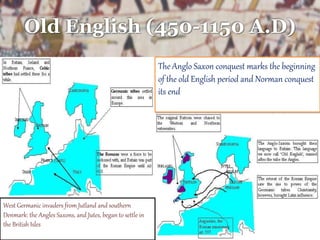
The Anglo Saxon conquest marks the beginning
of the old English period and Norman conquest
its end
West Germanic invaders from Jutland and southern
Denmark: the Angles Saxons, and Jutes, began to settle in
the British Isles
Old English Dialects
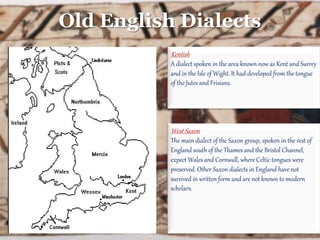
Kentish
A dialect spoken in the area known now as Kent and Surrey
and in the Isle of Wight. It had developed from the tongue
of the Jutes and Frisians.
West Saxon
The main dialect of the Saxon group, spoken in the rest of
England south of the Thames and the Bristol Channel,
expect Wales and Cornwall, where Celtic tongues were
preserved. Other Saxon dialects in England have not
survived in written form and are not known to modern
scholars.
Old English Dialects
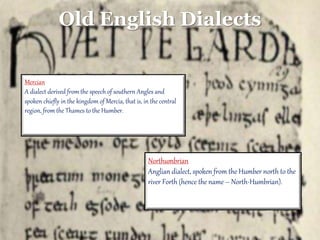
Mercian
A dialect derived from the speech of southern Angles and
spoken chiefly in the kingdom of Mercia, that is, in the central
region, from the Thames to the Humber.
Northumbrian
Anglian dialect, spoken from the Humber north to the
river Forth (hence the name – North-Humbrian).
Old English
Grammar
•Old English had a very complicated grammatical system, with a number of different
declensions of the noun and a three gender system, and with two declensions of the
adjectives.
•This period has often been described as the period of “full inflections”, since the
inflections(grammatical endings)of nouns, adjectives and verbs were preserved in full.
•Being highly inflected, Old English had a relatively free word order(syntax).Inflections
make meaning less dependent on word order.
•In Old English we find four cases, Nominative, Accusative, Gentive, and the Dative
case.
Old English Pronunciation
Old English was more or less phonetic in character, its spelling representing
its pronunciation fairly closely
The two major sound change on Old English were mutation and gradation
Old English Spelling
•The Germanic tribes used a particular kind of alphabet called the runic Alphabet.
The typical Runic symbols were not in modern english spelling, but they are used in phonetic
script.
•The old english spelling was phonetic in character, each letter representing a sound and it
contained no silent letters.
•Old english has seven vowels a,e,i,o,u,y (a+e)was the speciality of Old English
•Old English remained a phonetic language without the discrepancy between spelling and
pronunciation, which is conspicuous in Modern English.
Old English Vocabulary
•The period is characterized by homogeneous Anglo-Saxon language, remarkable for its high degree of purity, with only a
small amount of Latin loan words , followed by some Norse elements, consequent on the Norse invasion.
•The Old English word stock was enriched by Indo-European words, Celtic element, Latin influence and the Scandinavian
influence.
Indo-European words:
These include words denoting close family relations, the words man and tree, words associated with nature and universe
such as moon, sun ,earth, fire, star etc, words relating to fundamental concepts in farming and cultivation, names of basic
weapons like the shield, and names of basic colures such as red and yellow.
The Celtic Element of Old English
The Anglo – Saxon, however, preserved the Celtic names of cities and towns and rivers and
mountain and some words referring to natural features of landscape. Place names like Kent,
London, Cornwall York and the first syllable of Winchester, salisbury, Worcester, river name
like Thames, Avon, Wye, Dover are all traceable to a Celtic source.
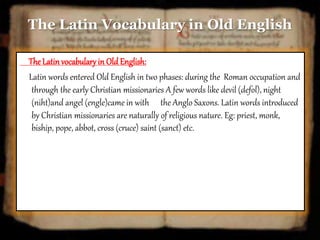
The Latin Vocabulary in Old English
The Latin vocabulary in Old English:
Latin words entered Old English in two phases: during the Roman occupation and
through the early Christian missionaries A few words like devil (defol), night
(niht)and angel (engle)came in with the Anglo Saxons. Latin words introduced
by Christian missionaries are naturally of religious nature. Eg: priest, monk,
biship, pope, abbot, cross (cruce) saint (sanct) etc.
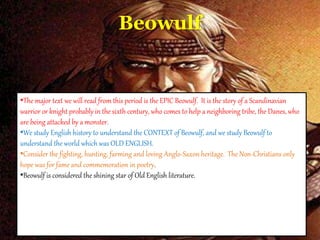
Beowulf
•The major text we will read from this period is the EPIC Beowulf. It is the story of a Scandinavian
warrior or knight probably in the sixth century, who comes to help a neighboring tribe, the Danes, who
are being attacked by a monster.
•We study English history to understand the CONTEXT of Beowulf, and we study Beowulf to
understand the world which was OLD ENGLISH.
•Consider the fighting, hunting, farming and loving Anglo-Saxon heritage. The Non-Christians only
hope was for fame and commemoration in poetry.
•Beowulf is considered the shining star of Old English literature.
References
 Alexander, Michael 1983. Old English Literature. Macmillan History of
English Literature.
 Godden, Malcolm and Michael Lapidge (eds) 1991. The Cambridge
companion to Old English literature.
 Mitchell, Bruce 1995. An invitation to Old English and Anglo-Saxon
England.
 Freeborn, Dennis 2006. From Old English to Standard English. 3rd
edition.
 Mitchell, Bruce and Fred Robinson 1998. Beowulf. An edition.

Lecture 3: Old English Period

  • 1.
  • 2.
    Old English (450-1150A.D) f4egf4ergfreg54gffcf33wfdThe Ang The Anglo Saxon conquest marks the beginning of the old English period and Norman conquest its end West Germanic invaders from Jutland and southern Denmark: the Angles Saxons, and Jutes, began to settle in the British Isles
  • 3.
    Old English Dialects Kentish Adialect spoken in the area known now as Kent and Surrey and in the Isle of Wight. It had developed from the tongue of the Jutes and Frisians. West Saxon The main dialect of the Saxon group, spoken in the rest of England south of the Thames and the Bristol Channel, expect Wales and Cornwall, where Celtic tongues were preserved. Other Saxon dialects in England have not survived in written form and are not known to modern scholars.
  • 4.
    Old English Dialects Mercian Adialect derived from the speech of southern Angles and spoken chiefly in the kingdom of Mercia, that is, in the central region, from the Thames to the Humber. Northumbrian Anglian dialect, spoken from the Humber north to the river Forth (hence the name – North-Humbrian).
  • 5.
    Old English Grammar •Old Englishhad a very complicated grammatical system, with a number of different declensions of the noun and a three gender system, and with two declensions of the adjectives. •This period has often been described as the period of “full inflections”, since the inflections(grammatical endings)of nouns, adjectives and verbs were preserved in full. •Being highly inflected, Old English had a relatively free word order(syntax).Inflections make meaning less dependent on word order. •In Old English we find four cases, Nominative, Accusative, Gentive, and the Dative case.
  • 6.
    Old English Pronunciation OldEnglish was more or less phonetic in character, its spelling representing its pronunciation fairly closely The two major sound change on Old English were mutation and gradation
  • 7.
    Old English Spelling •TheGermanic tribes used a particular kind of alphabet called the runic Alphabet. The typical Runic symbols were not in modern english spelling, but they are used in phonetic script. •The old english spelling was phonetic in character, each letter representing a sound and it contained no silent letters. •Old english has seven vowels a,e,i,o,u,y (a+e)was the speciality of Old English •Old English remained a phonetic language without the discrepancy between spelling and pronunciation, which is conspicuous in Modern English.
  • 8.
    Old English Vocabulary •Theperiod is characterized by homogeneous Anglo-Saxon language, remarkable for its high degree of purity, with only a small amount of Latin loan words , followed by some Norse elements, consequent on the Norse invasion. •The Old English word stock was enriched by Indo-European words, Celtic element, Latin influence and the Scandinavian influence. Indo-European words: These include words denoting close family relations, the words man and tree, words associated with nature and universe such as moon, sun ,earth, fire, star etc, words relating to fundamental concepts in farming and cultivation, names of basic weapons like the shield, and names of basic colures such as red and yellow.
  • 9.
    The Celtic Elementof Old English The Anglo – Saxon, however, preserved the Celtic names of cities and towns and rivers and mountain and some words referring to natural features of landscape. Place names like Kent, London, Cornwall York and the first syllable of Winchester, salisbury, Worcester, river name like Thames, Avon, Wye, Dover are all traceable to a Celtic source.
  • 10.
    The Latin Vocabularyin Old English The Latin vocabulary in Old English: Latin words entered Old English in two phases: during the Roman occupation and through the early Christian missionaries A few words like devil (defol), night (niht)and angel (engle)came in with the Anglo Saxons. Latin words introduced by Christian missionaries are naturally of religious nature. Eg: priest, monk, biship, pope, abbot, cross (cruce) saint (sanct) etc.
  • 11.
    Beowulf •The major textwe will read from this period is the EPIC Beowulf. It is the story of a Scandinavian warrior or knight probably in the sixth century, who comes to help a neighboring tribe, the Danes, who are being attacked by a monster. •We study English history to understand the CONTEXT of Beowulf, and we study Beowulf to understand the world which was OLD ENGLISH. •Consider the fighting, hunting, farming and loving Anglo-Saxon heritage. The Non-Christians only hope was for fame and commemoration in poetry. •Beowulf is considered the shining star of Old English literature.
  • 12.
    References  Alexander, Michael1983. Old English Literature. Macmillan History of English Literature.  Godden, Malcolm and Michael Lapidge (eds) 1991. The Cambridge companion to Old English literature.  Mitchell, Bruce 1995. An invitation to Old English and Anglo-Saxon England.  Freeborn, Dennis 2006. From Old English to Standard English. 3rd edition.  Mitchell, Bruce and Fred Robinson 1998. Beowulf. An edition.

Editor's Notes

  • #2 Today’s lecture is devoted to Old English Period. (Anglo-Saxon period)
  • #3 The Romans faced many problems from attacks by various tribes, including the Huns. In 410, the last of the Roman legions left Britain, which meant that the island was left open for attack or occupation by various tribes. From about 449, these so-called Germanic tribes started attacking and migrating to Britain. 
  • #4 Let’s talk about Old English Dialects. There were four of them: Kentish - A dialect spoken in the area known now as Kent and Surrey and in the Isle of Wight. It had developed from the tongue of the Jutes and Frisians. West Saxon - The main dialect of the Saxon group, spoken in the rest of England south of the Thames and the Bristol Channel, expect Wales and Cornwall, where Celtic tongues were preserved. Other Saxon dialects in England have not survived in written form and are not known to modern scholars.
  • #5 Mercian - A dialect derived from the speech of southern Angles and spoken chiefly in the kingdom of Mercia, that is, in the central region, from the Thames to the Humber. Northumbrian - Anglian dialect, spoken from the Humber north to the river Forth (hence the name – North-Humbrian).
  • #6 Old English had a very complicated grammatical system, with a number of different declensions of the noun and a three gender system, and with two declensions of the adjectives. This period has often been described as the period of “full inflections”, since the inflections(grammatical endings)of nouns, adjectives and verbs were preserved in full. Being highly inflected, Old English had a relatively free word order(syntax). Inflections make meaning less dependent on word order. In Old English we find four cases, Nominative, Accusative, Gentive, and Dative.
  • #7 Old English was more or less phonetic in character, its spelling representing its pronunciation fairly closely
  • #8 The Germanic tribes used a particular kind of alphabet called the runic Alphabet. The typical Runic symbols were not in modern english spelling, but they are used in phonetic script. The old english spelling was phonetic in character, each letter representing a sound and it contained no silent letters. Old english has seven vowels a,e,i,o,u,y (a+e) was the speciality of Old English Old English remained a phonetic language without the discrepancy between spelling and pronunciation, which is conspicuous in Modern English.
  • #9 The period is characterized by homogeneous Anglo-Saxon language, remarkable for its high degree of purity, with only a small amount of Latin loan words, followed by some Norse elements, consequent on the Norse invasion. The Old English word stock was enriched by Indo-European words, Celtic element, Latin influence and the Scandinavian influence. Thanks to this period, the English language collected some Indo-european words. These include words denoting close family relations, the words man and tree, words associated with nature and universe such as moon, sun, earth, fire, star etc, words relating to fundamental concepts in farming and cultivation, names of basic weapons like the shield, and names of basic colures such as red and yellow.
  • #10 Now let’s talk abouot the Celtic element of Old English. The Anglo – Saxon, however, preserved the Celtic names of cities and towns and rivers and mountain and some words referring to natural features of landscape. Place names like Kent, London, Cornwall York and the first syllable of Winchester, salisbury, Worcester, river name like Thames, Avon, Wye, Dover are all traceable to a Celtic source.
  • #11 Now we are going to talk about the Latin vocabulary in Old English. Latin words entered Old English in two phases: during the Roman occupation and through the early Christian missionaries. A few words like devil (defol), night (niht)and angel (engle)came in with the Anglo Saxons. Latin words introduced by Christian missionaries are naturally of religious nature. Eg: priest, monk, biship, pope, abbot, cross (cruce) saint (sanct) etc.
  • #12 Have you know before about Beowulf? The major text we will read from this period is the EPIC Beowulf. It is the story of a Scandinavian warrior or knight probably in the sixth century, who comes to help a neighboring tribe, the Danes, who are being attacked by a monster. We study English history to understand the CONTEXT of Beowulf, and we study Beowulf to understand the world which was OLD ENGLISH. Consider the fighting, hunting, farming and loving Anglo-Saxon heritage. The Non-Christians only hope was for fame and commemoration in poetry. Beowulf is considered the shining star of Old English literature.
  • #13 The following resourses helped in preparing this lecture. Thank you for your attention!