Chapter 2
Part 1:
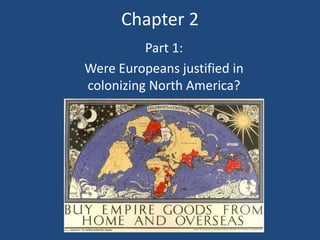
Were Europeans justified in
colonizing North America?
Introduction
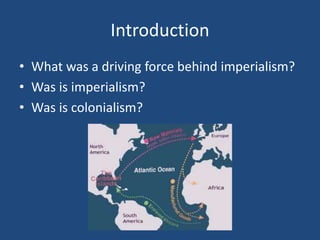
• What was a driving force behind imperialism?
• Was is imperialism?
• Was is colonialism?
Carving Up the World
• Which regions of North America did each
European Empire have control of in the late
17th century? Fig. 2-2
• British –
• Dutch –
• French –
• Portugese –
• Russian –
• Spanish –
Add colonies from p.46-50
• The Spanish and Portugese were among the first
Europeans to esta trade and claim territories
overseas.
• The Pope gave his consent to treaties (1494 &
1529)that gave Spain control of the Americas and
the Philippines, and Portugal was entitled to
Africa, Asia, and Brazil.
• Protestant European nations were frustrated and
refused to recognize the terms of the treaties.
• The other nations needed to find somewhere else.
What Were the Factors Behind
Imperialism in North America?
Part 2
Introduction
• Colonies in N.A. were ruled by a governor from
the Empire (or home country).
• The governor made decisions for the colony.
• Colonies were expected to help the Empire get
rich by providing resources.
• In the Thirteen Colonies, trade was controlled by
laws called Navigation Acts.
• On the left side: What were the terms of the
Navigation Acts (1700s)?
1.) Prejudice
• Definition?
• European colonists felt superior to other people –
ethnocentrism.
• Colonists viewed the “New World” as an
uninhabited land.
• Took pride in taming the “wilderness” of N.A.
• Did not understand why F.N. would not accept
change.
2.) Slavery
• The Spanish and Portuguese were the first
Europeans to engage in slavery in the Americas by
forcing Indigenous people to work for them, but
overwork, massacres, and disease drastically
reduced their populations.
• By mid 1700s the West African slave trade brought
thousands of Africans to the Americas to work on
sugar cane, tobacco, and cotton plantations.
• Many Europeans believed that slavery was
acceptable.
• Read p.52-3.
3.) Triangle Trade
• From West Africa to Caribbean & 13 Colonies
– slaves
• From Caribbean & 13 Colonies to England –
sugar, rum, fish, fur, and lumber
• From England to Africa – manufactured goods
to acquire more slaves
• Most people in Britain benefited from slavery
economically.
What is the link between
imperialism & conflict?
Part 3
(Read this section in your textbook and
write notes to help you have a better
understanding)
An Imbalance of Powers
War of the Grand Alliance
War of the Spanish Succession
War of the Austrian Succession
How did the wars affect North
America?
• Make a timeline of the events of the Seven
Years War from your textbook.
• All the events from the start of the war to the
Quebec Act and Royal Proclamation of 1763.
• Include dates, title, and description for each
event.

Chapter 2 part 1 and 2

  • 1.
    Chapter 2 Part 1: WereEuropeans justified in colonizing North America?
  • 2.
    Introduction • What wasa driving force behind imperialism? • Was is imperialism? • Was is colonialism?
  • 3.
    Carving Up theWorld • Which regions of North America did each European Empire have control of in the late 17th century? Fig. 2-2 • British – • Dutch – • French – • Portugese – • Russian – • Spanish – Add colonies from p.46-50
  • 4.
    • The Spanishand Portugese were among the first Europeans to esta trade and claim territories overseas. • The Pope gave his consent to treaties (1494 & 1529)that gave Spain control of the Americas and the Philippines, and Portugal was entitled to Africa, Asia, and Brazil. • Protestant European nations were frustrated and refused to recognize the terms of the treaties. • The other nations needed to find somewhere else.
  • 5.
    What Were theFactors Behind Imperialism in North America? Part 2
  • 6.
    Introduction • Colonies inN.A. were ruled by a governor from the Empire (or home country). • The governor made decisions for the colony. • Colonies were expected to help the Empire get rich by providing resources. • In the Thirteen Colonies, trade was controlled by laws called Navigation Acts. • On the left side: What were the terms of the Navigation Acts (1700s)?
  • 7.
    1.) Prejudice • Definition? •European colonists felt superior to other people – ethnocentrism. • Colonists viewed the “New World” as an uninhabited land. • Took pride in taming the “wilderness” of N.A. • Did not understand why F.N. would not accept change.
  • 8.
    2.) Slavery • TheSpanish and Portuguese were the first Europeans to engage in slavery in the Americas by forcing Indigenous people to work for them, but overwork, massacres, and disease drastically reduced their populations. • By mid 1700s the West African slave trade brought thousands of Africans to the Americas to work on sugar cane, tobacco, and cotton plantations. • Many Europeans believed that slavery was acceptable. • Read p.52-3.
  • 9.
    3.) Triangle Trade •From West Africa to Caribbean & 13 Colonies – slaves • From Caribbean & 13 Colonies to England – sugar, rum, fish, fur, and lumber • From England to Africa – manufactured goods to acquire more slaves • Most people in Britain benefited from slavery economically.
  • 10.
    What is thelink between imperialism & conflict? Part 3 (Read this section in your textbook and write notes to help you have a better understanding)
  • 11.
  • 12.
    War of theGrand Alliance
  • 13.
    War of theSpanish Succession
  • 14.
    War of theAustrian Succession
  • 15.
    How did thewars affect North America? • Make a timeline of the events of the Seven Years War from your textbook. • All the events from the start of the war to the Quebec Act and Royal Proclamation of 1763. • Include dates, title, and description for each event.