
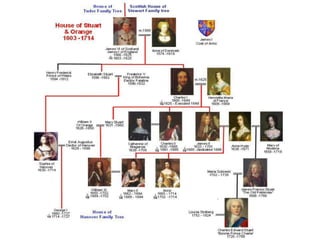

The Stuart
Dynasty
The Stuarts were the first kings of the United Kingdom. King
James I of England who began the period was also King James
VI of Scotland, thus combining the two thrones for the first time.
The Stuart dynasty reigned in England and Scotland from 1603
to 1714, a period which saw a flourishing Court culture but also
much upheaval and instability, of plague, fire and war.
It was an age of intense religious debate and radical politics.
Both contributed to a bloody civil war in the mid-seventeenth
century between Crown and Parliament (the Cavaliers and the
Roundheads), resulting in a parliamentary victory for Oliver
Cromwell and the dramatic execution of King Charles I.
There was a short-lived republic, the first time that the country
had experienced such an event. The Restoration of the Crown
was soon followed by another 'Glorious' Revolution.
The Line of the Stuarts stretched from 1603
to 1714 AD. The following are the English
rulers of this period:
• 1) James I (1603-1625 A.D)
• 2) Charles I (1625-1649 AD)
• 3) Commonwealth Interlude (1649-1660)
• 4) Charles II (1660-1685 AD)
• 5) James II (1685-1688 AD)
• 6) William and Mary (1689-1702 AD)
• 7) Queen Anne (1702-1714 AD)
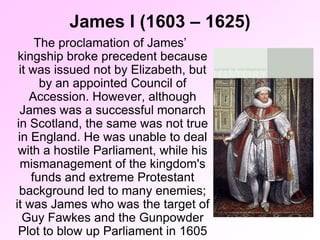
James I (1603 – 1625)
The proclamation of James’
kingship broke precedent because
it was issued not by Elizabeth, but
by an appointed Council of
Accession. However, although
James was a successful monarch
in Scotland, the same was not true
in England. He was unable to deal
with a hostile Parliament, while his
mismanagement of the kingdom's
funds and extreme Protestant
background led to many enemies;
it was James who was the target of
Guy Fawkes and the Gunpowder
Plot to blow up Parliament in 1605
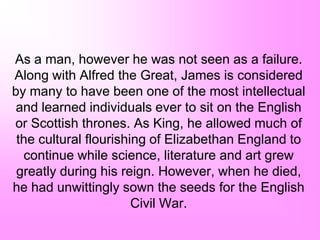
As a man, however he was not seen as a failure.
Along with Alfred the Great, James is considered
by many to have been one of the most intellectual
and learned individuals ever to sit on the English
or Scottish thrones. As King, he allowed much of
the cultural flourishing of Elizabethan England to
continue while science, literature and art grew
greatly during his reign. However, when he died,
he had unwittingly sown the seeds for the English
Civil War.
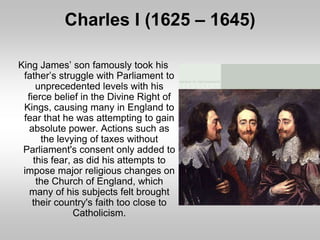
Charles I (1625 – 1645)
King James’ son famously took his
father’s struggle with Parliament to
unprecedented levels with his
fierce belief in the Divine Right of
Kings, causing many in England to
fear that he was attempting to gain
absolute power. Actions such as
the levying of taxes without
Parliament's consent only added to
this fear, as did his attempts to
impose major religious changes on
the Church of England, which
many of his subjects felt brought
their country's faith too close to
Catholicism.
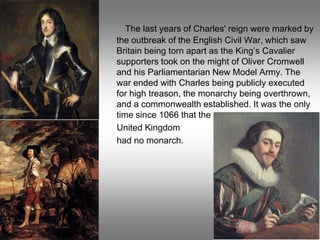
The last years of Charles' reign were marked by
the outbreak of the English Civil War, which saw
Britain being torn apart as the King’s Cavalier
supporters took on the might of Oliver Cromwell
and his Parliamentarian New Model Army. The
war ended with Charles being publicly executed
for high treason, the monarchy being overthrown,
and a commonwealth established. It was the only
time since 1066 that the
United Kingdom
had no monarch.
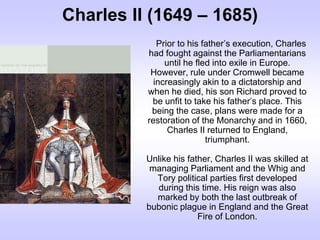
Charles II (1649 – 1685)
Prior to his father’s execution, Charles
had fought against the Parliamentarians
until he fled into exile in Europe.
However, rule under Cromwell became
increasingly akin to a dictatorship and
when he died, his son Richard proved to
be unfit to take his father’s place. This
being the case, plans were made for a
restoration of the Monarchy and in 1660,
Charles II returned to England,
triumphant.
Unlike his father, Charles II was skilled at
managing Parliament and the Whig and
Tory political parties first developed
during this time. His reign was also
marked by both the last outbreak of
bubonic plague in England and the Great
Fire of London.
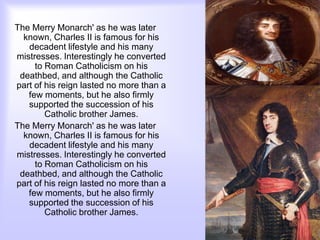
The Merry Monarch' as he was later
known, Charles II is famous for his
decadent lifestyle and his many
mistresses. Interestingly he converted
to Roman Catholicism on his
deathbed, and although the Catholic
part of his reign lasted no more than a
few moments, but he also firmly
supported the succession of his
Catholic brother James.
The Merry Monarch' as he was later
known, Charles II is famous for his
decadent lifestyle and his many
mistresses. Interestingly he converted
to Roman Catholicism on his
deathbed, and although the Catholic
part of his reign lasted no more than a
few moments, but he also firmly
supported the succession of his
Catholic brother James.
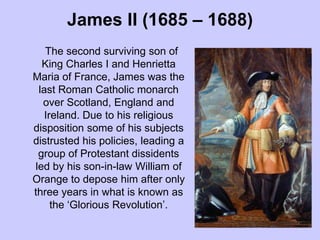
James II (1685 – 1688)
The second surviving son of
King Charles I and Henrietta
Maria of France, James was the
last Roman Catholic monarch
over Scotland, England and
Ireland. Due to his religious
disposition some of his subjects
distrusted his policies, leading a
group of Protestant dissidents
led by his son-in-law William of
Orange to depose him after only
three years in what is known as
the ‘Glorious Revolution’.
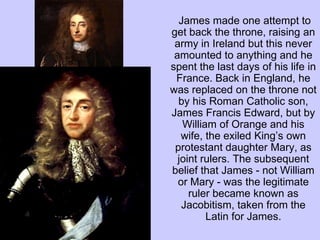
James made one attempt to
get back the throne, raising an
army in Ireland but this never
amounted to anything and he
spent the last days of his life in
France. Back in England, he
was replaced on the throne not
by his Roman Catholic son,
James Francis Edward, but by
William of Orange and his
wife, the exiled King’s own
protestant daughter Mary, as
joint rulers. The subsequent
belief that James - not William
or Mary - was the legitimate
ruler became known as
Jacobitism, taken from the
Latin for James.
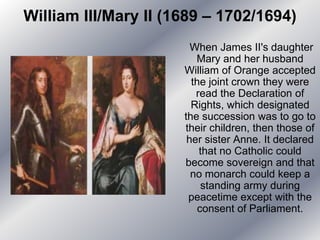
William III/Mary II (1689 – 1702/1694)
When James II's daughter
Mary and her husband
William of Orange accepted
the joint crown they were
read the Declaration of
Rights, which designated
the succession was to go to
their children, then those of
her sister Anne. It declared
that no Catholic could
become sovereign and that
no monarch could keep a
standing army during
peacetime except with the
consent of Parliament.
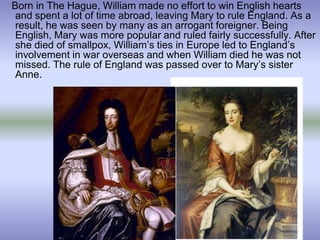
Born in The Hague, William made no effort to win English hearts
and spent a lot of time abroad, leaving Mary to rule England. As a
result, he was seen by many as an arrogant foreigner. Being
English, Mary was more popular and ruled fairly successfully. After
she died of smallpox, William’s ties in Europe led to England’s
involvement in war overseas and when William died he was not
missed. The rule of England was passed over to Mary’s sister
Anne.
Queen Anne (1702 – 1714)
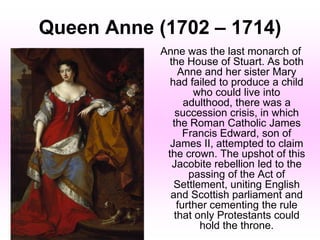
Anne was the last monarch of
the House of Stuart. As both
Anne and her sister Mary
had failed to produce a child
who could live into
adulthood, there was a
succession crisis, in which
the Roman Catholic James
Francis Edward, son of
James II, attempted to claim
the crown. The upshot of this
Jacobite rebellion led to the
passing of the Act of
Settlement, uniting English
and Scottish parliament and
further cementing the rule
that only Protestants could
hold the throne.
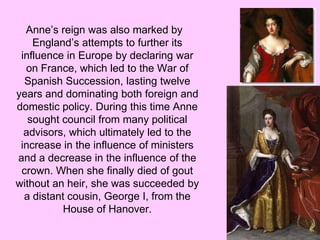
Anne’s reign was also marked by
England’s attempts to further its
influence in Europe by declaring war
on France, which led to the War of
Spanish Succession, lasting twelve
years and dominating both foreign and
domestic policy. During this time Anne
sought council from many political
advisors, which ultimately led to the
increase in the influence of ministers
and a decrease in the influence of the
crown. When she finally died of gout
without an heir, she was succeeded by
a distant cousin, George I, from the
House of Hanover.
The Royal House of Stuart ruled England, Ireland
and Scotland by way of 7 monarchs for 111
years, from 1603 until 1714.
During the years between 1649 until 1660 there
was an 11 year gap during which the monarchy
had been overthrown and leadership was by a de
facto council of state.
It was during the Stuart Dynasty that the
Jacobean (1603 - 1714) and Caroline (1625 -
1642) eras existed.
Stuart
Stuart

Stuart

  • 1.
  • 2.
    The Stuarts werethe first kings of the United Kingdom. King James I of England who began the period was also King James VI of Scotland, thus combining the two thrones for the first time. The Stuart dynasty reigned in England and Scotland from 1603 to 1714, a period which saw a flourishing Court culture but also much upheaval and instability, of plague, fire and war. It was an age of intense religious debate and radical politics. Both contributed to a bloody civil war in the mid-seventeenth century between Crown and Parliament (the Cavaliers and the Roundheads), resulting in a parliamentary victory for Oliver Cromwell and the dramatic execution of King Charles I. There was a short-lived republic, the first time that the country had experienced such an event. The Restoration of the Crown was soon followed by another 'Glorious' Revolution.
  • 3.
    The Line ofthe Stuarts stretched from 1603 to 1714 AD. The following are the English rulers of this period: • 1) James I (1603-1625 A.D) • 2) Charles I (1625-1649 AD) • 3) Commonwealth Interlude (1649-1660) • 4) Charles II (1660-1685 AD) • 5) James II (1685-1688 AD) • 6) William and Mary (1689-1702 AD) • 7) Queen Anne (1702-1714 AD)
  • 4.
    James I (1603– 1625) The proclamation of James’ kingship broke precedent because it was issued not by Elizabeth, but by an appointed Council of Accession. However, although James was a successful monarch in Scotland, the same was not true in England. He was unable to deal with a hostile Parliament, while his mismanagement of the kingdom's funds and extreme Protestant background led to many enemies; it was James who was the target of Guy Fawkes and the Gunpowder Plot to blow up Parliament in 1605
  • 5.
    As a man,however he was not seen as a failure. Along with Alfred the Great, James is considered by many to have been one of the most intellectual and learned individuals ever to sit on the English or Scottish thrones. As King, he allowed much of the cultural flourishing of Elizabethan England to continue while science, literature and art grew greatly during his reign. However, when he died, he had unwittingly sown the seeds for the English Civil War.
  • 6.
    Charles I (1625– 1645) King James’ son famously took his father’s struggle with Parliament to unprecedented levels with his fierce belief in the Divine Right of Kings, causing many in England to fear that he was attempting to gain absolute power. Actions such as the levying of taxes without Parliament's consent only added to this fear, as did his attempts to impose major religious changes on the Church of England, which many of his subjects felt brought their country's faith too close to Catholicism.
  • 7.
    The last yearsof Charles' reign were marked by the outbreak of the English Civil War, which saw Britain being torn apart as the King’s Cavalier supporters took on the might of Oliver Cromwell and his Parliamentarian New Model Army. The war ended with Charles being publicly executed for high treason, the monarchy being overthrown, and a commonwealth established. It was the only time since 1066 that the United Kingdom had no monarch.
  • 8.
    Charles II (1649– 1685) Prior to his father’s execution, Charles had fought against the Parliamentarians until he fled into exile in Europe. However, rule under Cromwell became increasingly akin to a dictatorship and when he died, his son Richard proved to be unfit to take his father’s place. This being the case, plans were made for a restoration of the Monarchy and in 1660, Charles II returned to England, triumphant. Unlike his father, Charles II was skilled at managing Parliament and the Whig and Tory political parties first developed during this time. His reign was also marked by both the last outbreak of bubonic plague in England and the Great Fire of London.
  • 9.
    The Merry Monarch'as he was later known, Charles II is famous for his decadent lifestyle and his many mistresses. Interestingly he converted to Roman Catholicism on his deathbed, and although the Catholic part of his reign lasted no more than a few moments, but he also firmly supported the succession of his Catholic brother James. The Merry Monarch' as he was later known, Charles II is famous for his decadent lifestyle and his many mistresses. Interestingly he converted to Roman Catholicism on his deathbed, and although the Catholic part of his reign lasted no more than a few moments, but he also firmly supported the succession of his Catholic brother James.
  • 10.
    James II (1685– 1688) The second surviving son of King Charles I and Henrietta Maria of France, James was the last Roman Catholic monarch over Scotland, England and Ireland. Due to his religious disposition some of his subjects distrusted his policies, leading a group of Protestant dissidents led by his son-in-law William of Orange to depose him after only three years in what is known as the ‘Glorious Revolution’.
  • 11.
    James made oneattempt to get back the throne, raising an army in Ireland but this never amounted to anything and he spent the last days of his life in France. Back in England, he was replaced on the throne not by his Roman Catholic son, James Francis Edward, but by William of Orange and his wife, the exiled King’s own protestant daughter Mary, as joint rulers. The subsequent belief that James - not William or Mary - was the legitimate ruler became known as Jacobitism, taken from the Latin for James.
  • 12.
    William III/Mary II(1689 – 1702/1694) When James II's daughter Mary and her husband William of Orange accepted the joint crown they were read the Declaration of Rights, which designated the succession was to go to their children, then those of her sister Anne. It declared that no Catholic could become sovereign and that no monarch could keep a standing army during peacetime except with the consent of Parliament.
  • 13.
    Born in TheHague, William made no effort to win English hearts and spent a lot of time abroad, leaving Mary to rule England. As a result, he was seen by many as an arrogant foreigner. Being English, Mary was more popular and ruled fairly successfully. After she died of smallpox, William’s ties in Europe led to England’s involvement in war overseas and when William died he was not missed. The rule of England was passed over to Mary’s sister Anne.
  • 14.
    Queen Anne (1702– 1714) Anne was the last monarch of the House of Stuart. As both Anne and her sister Mary had failed to produce a child who could live into adulthood, there was a succession crisis, in which the Roman Catholic James Francis Edward, son of James II, attempted to claim the crown. The upshot of this Jacobite rebellion led to the passing of the Act of Settlement, uniting English and Scottish parliament and further cementing the rule that only Protestants could hold the throne.
  • 15.
    Anne’s reign wasalso marked by England’s attempts to further its influence in Europe by declaring war on France, which led to the War of Spanish Succession, lasting twelve years and dominating both foreign and domestic policy. During this time Anne sought council from many political advisors, which ultimately led to the increase in the influence of ministers and a decrease in the influence of the crown. When she finally died of gout without an heir, she was succeeded by a distant cousin, George I, from the House of Hanover.
  • 16.
    The Royal Houseof Stuart ruled England, Ireland and Scotland by way of 7 monarchs for 111 years, from 1603 until 1714. During the years between 1649 until 1660 there was an 11 year gap during which the monarchy had been overthrown and leadership was by a de facto council of state. It was during the Stuart Dynasty that the Jacobean (1603 - 1714) and Caroline (1625 - 1642) eras existed.