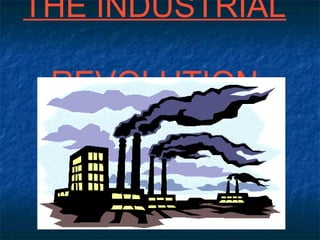
THE INDUSTRIAL
REVOLUTION
Industrial
Revolution?
 Revolutions: some violent, others due to
new inventions
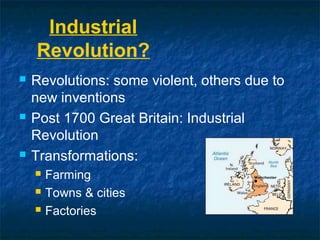
 Post 1700 Great Britain: Industrial
Revolution
 Transformations:
 Farming
 Towns & cities
 Factories
Industrial Revolution
 Wealth and social organization
 Problems:
 Factory working conditions
 Dirty, crowded, diseased cities
 Child labour
 Long term problems: exploitation, global
warming, ozone layer
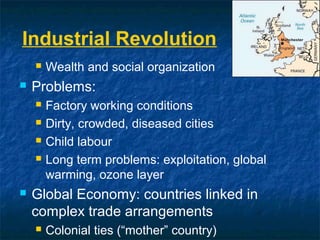
 Global Economy: countries linked in
complex trade arrangements
 Colonial ties (“mother” country)
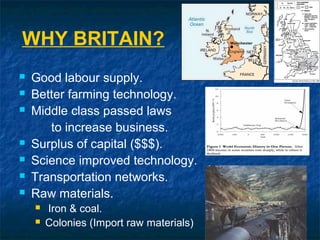
WHY BRITAIN?
 Good labour supply.
 Better farming technology.
 Middle class passed laws
to increase business.
 Surplus of capital ($$$).
 Science improved technology.
 Transportation networks.
 Raw materials.
 Iron & coal.
 Colonies (Import raw materials)
An Agricultural RevolutionAn Agricultural Revolution
 Strip farming (inefficient) – moved to enclosure (more
profitable)
 Commons:
 Divided into private properties
 Wealthy obtained the land – could pay the fees
 Enclosures hurt poor farmers
 Lose place to: graze sheep & cows, collect crucial
supplies
 Forced to sell land to the wealthy
 Often move to city for work = cities full of
unemployed farmers & families
 “The Midlands” (Manchester, Liverpool) grew to
huge cities
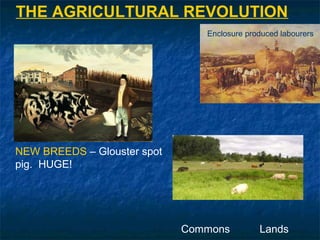
THE AGRICULTURAL REVOLUTION
NEW BREEDS – Glouster spot
pig. HUGE!
Enclosure produced labourers
Commons Lands
An Agricultural RevolutionAn Agricultural Revolution
 Enclosures changed attitude towards
farming
 Business & profit vs. survival
 Changes in large-scale farming: new
plants & animals, mechanization
 Agricultural Revolution: helped create &
support Industrial Revolution
New Breeds
 Better animals = more profits
 Positives: hardier, less likely to catch
disease
 Negative: more expensive (poorer farmers
couldn’t compete)
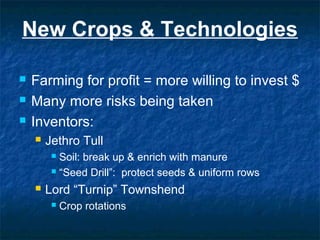
New Crops & Technologies
 Farming for profit = more willing to invest $
 Many more risks being taken
 Inventors:
 Jethro Tull
 Soil: break up & enrich with manure
 “Seed Drill”: protect seeds & uniform rows
 Lord “Turnip” Townshend
 Crop rotations
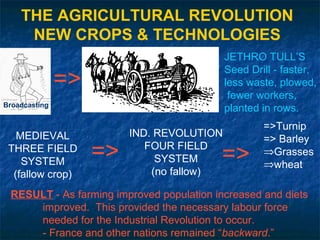
THE AGRICULTURAL REVOLUTION
NEW CROPS & TECHNOLOGIES
=>
JETHRO TULL’S
Seed Drill - faster,
less waste, plowed,
fewer workers,
planted in rows.Broadcasting
MEDIEVAL
THREE FIELD
SYSTEM
(fallow crop)
=>
IND. REVOLUTION
FOUR FIELD
SYSTEM
(no fallow)
=>Turnip
=> Barley
⇒Grasses
⇒wheat
=>
RESULT - As farming improved population increased and diets
improved. This provided the necessary labour force
needed for the Industrial Revolution to occur.
- France and other nations remained “backward.”
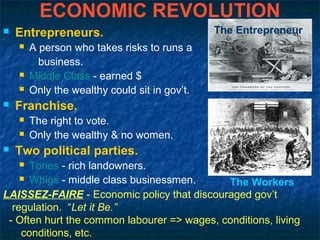
ECONOMIC REVOLUTION
 Entrepreneurs.
 A person who takes risks to runs a
business.
 Middle Class - earned $
 Only the wealthy could sit in gov’t.
 Franchise.
 The right to vote.
 Only the wealthy & no women.
 Two political parties.
 Tories - rich landowners.
 Whigs - middle class businessmen.
LAISSEZ-FAIRE - Economic policy that discouraged gov’t
regulation. “Let it Be.”
- Often hurt the common labourer => wages, conditions, living
conditions, etc.
The Entrepreneur
The Workers
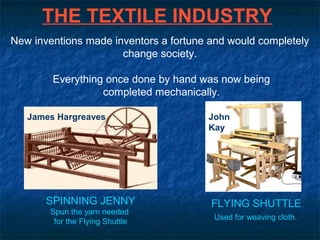
THE TEXTILE INDUSTRY
SPINNING JENNY
Spun the yarn needed
for the Flying Shuttle
FLYING SHUTTLE
Used for weaving cloth.
John
Kay
James Hargreaves
New inventions made inventors a fortune and would completely
change society.
Everything once done by hand was now being
completed mechanically.
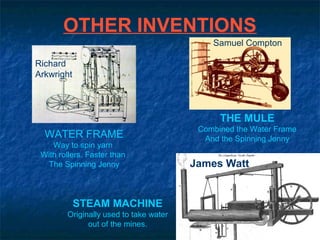
OTHER INVENTIONS
WATER FRAME
Way to spin yarn
With rollers. Faster than
The Spinning Jenny
Richard
Arkwright
THE MULE
Combined the Water Frame
And the Spinning Jenny
STEAM MACHINE
Originally used to take water
out of the mines.
Samuel Compton
James Watt
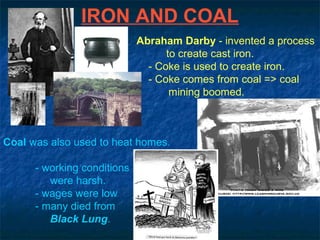
IRON AND COAL
Abraham Darby - invented a process
to create cast iron.
- Coke is used to create iron.
- Coke comes from coal => coal
mining boomed.
Coal was also used to heat homes.
- working conditions
were harsh.
- wages were low
- many died from
Black Lung.
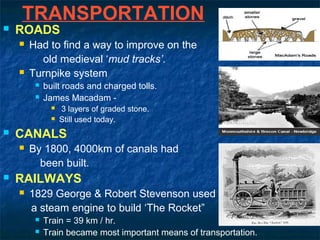
TRANSPORTATION
 ROADS
 Had to find a way to improve on the
old medieval ‘mud tracks’.
 Turnpike system
 built roads and charged tolls.
 James Macadam -
 3 layers of graded stone.
 Still used today.
 CANALS
 By 1800, 4000km of canals had
been built.
 RAILWAYS
 1829 George & Robert Stevenson used
a steam engine to build ‘The Rocket”
 Train = 39 km / hr.
 Train became most important means of transportation.
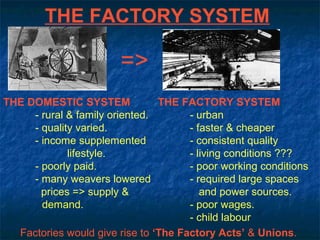
THE FACTORY SYSTEM
THE DOMESTIC SYSTEM
- rural & family oriented.
- quality varied.
- income supplemented
lifestyle.
- poorly paid.
- many weavers lowered
prices => supply &
demand.
=>
THE FACTORY SYSTEM
- urban
- faster & cheaper
- consistent quality
- living conditions ???
- poor working conditions
- required large spaces
and power sources.
- poor wages.
- child labour
Factories would give rise to ‘The Factory Acts’ & Unions.
Transportation – from MarketTransportation – from Market
to Marketto Market
 Transportation of goods crucial
 1700 England: poor infrastructure
 Transportation Strategies:
 Turnpike System: private companies build &
charge tolls
 Engineer: James Macadam
 Roads would not become muddy
 3 layers of graded stone
 Much quicker transportation of goods & information
Transportation – from MarketTransportation – from Market
to Marketto Market
 Canals: networks of narrow artificial channels
 Reduced cost of shipping by ¾
 Early 19th
C: 4000 km of canals
 Railways: most important means of
transportation
 Steam engine locomotives
 1829: “Rocket” traveled 39 km/hr
 Late 1800s: railway lines in Europe & N. America
Mechanization and the Factory System
 Cottage Industry: products made in
houses
 Financed by capitalists
 Spinning & weaving → clothiers sold finished
goods
 Advantages:
 Family & community
 Disadvantages:
 Poor pay, long hours
 Not specialized
 “Law of Supply & Demand”: little power
The Factory Age
 New inventions = lose cottage system
 Need factories for power & space
 New cities & housing developments
 Factories house all stages of
manufacturing
 Low wages, poor working conditions
Child LabourChild Labour
 Industrialization brought injustices for children
 Poor:
 Education not mandatory: couldn’t read or write
 Families needed every member to provide
 Labour:
 Small size: textiles, mine shafts, chimney cleaner
 Exposed to pollution
 Deafening noise
 Buy poor food
 Work overtime shifts
 Physical abuse
Child LabourChild Labour
 Results:
 Growth stunted
 Bodies deformed
 1830s: British government becomes
interested in working conditions
 Interviewed child labourers & survivers
The Factory ActsThe Factory Acts
 Social Reformers try to improve working
conditions
 Guilds formed (medieval)
 Look after interests of members
 Band together: less isolation & more influence
 Governments declared them illegal
 Parliament controlled by rich & powerful
 Laissez-faire: no government regulation
The Factory ActsThe Factory Acts
 “Factory Acts” eventually written
 1802: children couldn’t work >12 hours
straight in cotton mills
 1819: illegal to hire child <9 years in textile
industry
 No inspectors, other industries not protected
 1824: early form of labour unions legalized
 Middle & Upper classes: working class
should work as much as possible
 Worry of “evil” occupations ex. drinking &
gambling
Society & CultureSociety & Culture
 Britain: rigid social system
 Born into social groups
 Upper Class (“Society”): right schools,
churches, etc.
 Middle Class/Working Class: grew during
industrial revolution
 Father: worked in professions, business person,
military
 Lower Middle Class: white collar workers,
teachers below University level
 Working Class: worked in trades or factory
Women in the Industrial Age
 Mostly in cottage industry, but eventually
declined
 Options:
 Countryside:
 Servants, farms
 Factories
 Changes:
 Cash money of own = independence
 Middle & upper class = pampered by servants
Society & Culture
 The Poor
 Slums in cities
 Streets & sewers not built
 Crime & disease common
 Not enough “Poor Law” relief for
thousands
 Charity often poorly distributed
 Workhouses turned to in desperation
 1800s: numerical information about
society gathered
Society and Culture
 Population on the Move
 countryside → city
 Europe → overseas colonies (ex. Canada)
 Promoted by land speculators
 The Irish Potato Famine
 Potato: staple food
 1840s: Irish peasants grew & ate them
 1845: Disease = loss of potatoes
 hunger
 left homelands, move to industrial cities or colonies
Society and Culture
 The Clearances
 In Scotland: Landlords rid of tenants
(“crofters”) to use land for raising sheep
 Farms burned to prevent return
 Move to industrial cities or colonies

Ch 5 ind. rev.

  • 1.
  • 2.
    Industrial Revolution?  Revolutions: someviolent, others due to new inventions  Post 1700 Great Britain: Industrial Revolution  Transformations:  Farming  Towns & cities  Factories
  • 3.
    Industrial Revolution  Wealthand social organization  Problems:  Factory working conditions  Dirty, crowded, diseased cities  Child labour  Long term problems: exploitation, global warming, ozone layer  Global Economy: countries linked in complex trade arrangements  Colonial ties (“mother” country)
  • 4.
    WHY BRITAIN?  Goodlabour supply.  Better farming technology.  Middle class passed laws to increase business.  Surplus of capital ($$$).  Science improved technology.  Transportation networks.  Raw materials.  Iron & coal.  Colonies (Import raw materials)
  • 5.
    An Agricultural RevolutionAnAgricultural Revolution  Strip farming (inefficient) – moved to enclosure (more profitable)  Commons:  Divided into private properties  Wealthy obtained the land – could pay the fees  Enclosures hurt poor farmers  Lose place to: graze sheep & cows, collect crucial supplies  Forced to sell land to the wealthy  Often move to city for work = cities full of unemployed farmers & families  “The Midlands” (Manchester, Liverpool) grew to huge cities
  • 6.
    THE AGRICULTURAL REVOLUTION NEWBREEDS – Glouster spot pig. HUGE! Enclosure produced labourers Commons Lands
  • 7.
    An Agricultural RevolutionAnAgricultural Revolution  Enclosures changed attitude towards farming  Business & profit vs. survival  Changes in large-scale farming: new plants & animals, mechanization  Agricultural Revolution: helped create & support Industrial Revolution
  • 8.
    New Breeds  Betteranimals = more profits  Positives: hardier, less likely to catch disease  Negative: more expensive (poorer farmers couldn’t compete)
  • 9.
    New Crops &Technologies  Farming for profit = more willing to invest $  Many more risks being taken  Inventors:  Jethro Tull  Soil: break up & enrich with manure  “Seed Drill”: protect seeds & uniform rows  Lord “Turnip” Townshend  Crop rotations
  • 10.
    THE AGRICULTURAL REVOLUTION NEWCROPS & TECHNOLOGIES => JETHRO TULL’S Seed Drill - faster, less waste, plowed, fewer workers, planted in rows.Broadcasting MEDIEVAL THREE FIELD SYSTEM (fallow crop) => IND. REVOLUTION FOUR FIELD SYSTEM (no fallow) =>Turnip => Barley ⇒Grasses ⇒wheat => RESULT - As farming improved population increased and diets improved. This provided the necessary labour force needed for the Industrial Revolution to occur. - France and other nations remained “backward.”
  • 11.
    ECONOMIC REVOLUTION  Entrepreneurs. A person who takes risks to runs a business.  Middle Class - earned $  Only the wealthy could sit in gov’t.  Franchise.  The right to vote.  Only the wealthy & no women.  Two political parties.  Tories - rich landowners.  Whigs - middle class businessmen. LAISSEZ-FAIRE - Economic policy that discouraged gov’t regulation. “Let it Be.” - Often hurt the common labourer => wages, conditions, living conditions, etc. The Entrepreneur The Workers
  • 12.
    THE TEXTILE INDUSTRY SPINNINGJENNY Spun the yarn needed for the Flying Shuttle FLYING SHUTTLE Used for weaving cloth. John Kay James Hargreaves New inventions made inventors a fortune and would completely change society. Everything once done by hand was now being completed mechanically.
  • 13.
    OTHER INVENTIONS WATER FRAME Wayto spin yarn With rollers. Faster than The Spinning Jenny Richard Arkwright THE MULE Combined the Water Frame And the Spinning Jenny STEAM MACHINE Originally used to take water out of the mines. Samuel Compton James Watt
  • 14.
    IRON AND COAL AbrahamDarby - invented a process to create cast iron. - Coke is used to create iron. - Coke comes from coal => coal mining boomed. Coal was also used to heat homes. - working conditions were harsh. - wages were low - many died from Black Lung.
  • 15.
    TRANSPORTATION  ROADS  Hadto find a way to improve on the old medieval ‘mud tracks’.  Turnpike system  built roads and charged tolls.  James Macadam -  3 layers of graded stone.  Still used today.  CANALS  By 1800, 4000km of canals had been built.  RAILWAYS  1829 George & Robert Stevenson used a steam engine to build ‘The Rocket”  Train = 39 km / hr.  Train became most important means of transportation.
  • 16.
    THE FACTORY SYSTEM THEDOMESTIC SYSTEM - rural & family oriented. - quality varied. - income supplemented lifestyle. - poorly paid. - many weavers lowered prices => supply & demand. => THE FACTORY SYSTEM - urban - faster & cheaper - consistent quality - living conditions ??? - poor working conditions - required large spaces and power sources. - poor wages. - child labour Factories would give rise to ‘The Factory Acts’ & Unions.
  • 17.
    Transportation – fromMarketTransportation – from Market to Marketto Market  Transportation of goods crucial  1700 England: poor infrastructure  Transportation Strategies:  Turnpike System: private companies build & charge tolls  Engineer: James Macadam  Roads would not become muddy  3 layers of graded stone  Much quicker transportation of goods & information
  • 18.
    Transportation – fromMarketTransportation – from Market to Marketto Market  Canals: networks of narrow artificial channels  Reduced cost of shipping by ¾  Early 19th C: 4000 km of canals  Railways: most important means of transportation  Steam engine locomotives  1829: “Rocket” traveled 39 km/hr  Late 1800s: railway lines in Europe & N. America
  • 19.
    Mechanization and theFactory System  Cottage Industry: products made in houses  Financed by capitalists  Spinning & weaving → clothiers sold finished goods  Advantages:  Family & community  Disadvantages:  Poor pay, long hours  Not specialized  “Law of Supply & Demand”: little power
  • 20.
    The Factory Age New inventions = lose cottage system  Need factories for power & space  New cities & housing developments  Factories house all stages of manufacturing  Low wages, poor working conditions
  • 21.
    Child LabourChild Labour Industrialization brought injustices for children  Poor:  Education not mandatory: couldn’t read or write  Families needed every member to provide  Labour:  Small size: textiles, mine shafts, chimney cleaner  Exposed to pollution  Deafening noise  Buy poor food  Work overtime shifts  Physical abuse
  • 22.
    Child LabourChild Labour Results:  Growth stunted  Bodies deformed  1830s: British government becomes interested in working conditions  Interviewed child labourers & survivers
  • 23.
    The Factory ActsTheFactory Acts  Social Reformers try to improve working conditions  Guilds formed (medieval)  Look after interests of members  Band together: less isolation & more influence  Governments declared them illegal  Parliament controlled by rich & powerful  Laissez-faire: no government regulation
  • 24.
    The Factory ActsTheFactory Acts  “Factory Acts” eventually written  1802: children couldn’t work >12 hours straight in cotton mills  1819: illegal to hire child <9 years in textile industry  No inspectors, other industries not protected  1824: early form of labour unions legalized  Middle & Upper classes: working class should work as much as possible  Worry of “evil” occupations ex. drinking & gambling
  • 25.
    Society & CultureSociety& Culture  Britain: rigid social system  Born into social groups  Upper Class (“Society”): right schools, churches, etc.  Middle Class/Working Class: grew during industrial revolution  Father: worked in professions, business person, military  Lower Middle Class: white collar workers, teachers below University level  Working Class: worked in trades or factory
  • 26.
    Women in theIndustrial Age  Mostly in cottage industry, but eventually declined  Options:  Countryside:  Servants, farms  Factories  Changes:  Cash money of own = independence  Middle & upper class = pampered by servants
  • 27.
    Society & Culture The Poor  Slums in cities  Streets & sewers not built  Crime & disease common  Not enough “Poor Law” relief for thousands  Charity often poorly distributed  Workhouses turned to in desperation  1800s: numerical information about society gathered
  • 28.
    Society and Culture Population on the Move  countryside → city  Europe → overseas colonies (ex. Canada)  Promoted by land speculators  The Irish Potato Famine  Potato: staple food  1840s: Irish peasants grew & ate them  1845: Disease = loss of potatoes  hunger  left homelands, move to industrial cities or colonies
  • 29.
    Society and Culture The Clearances  In Scotland: Landlords rid of tenants (“crofters”) to use land for raising sheep  Farms burned to prevent return  Move to industrial cities or colonies