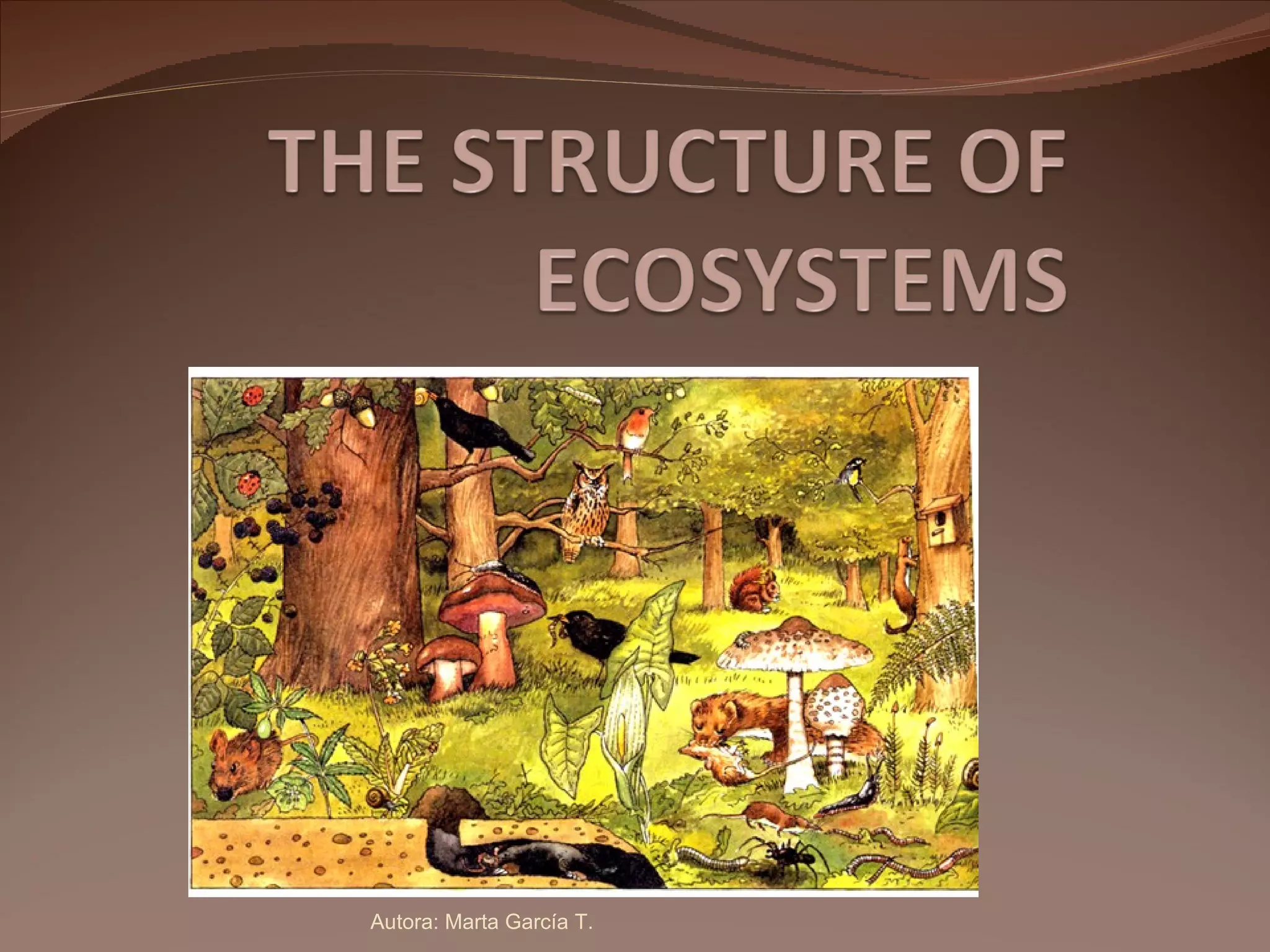
Autora: Marta García T.
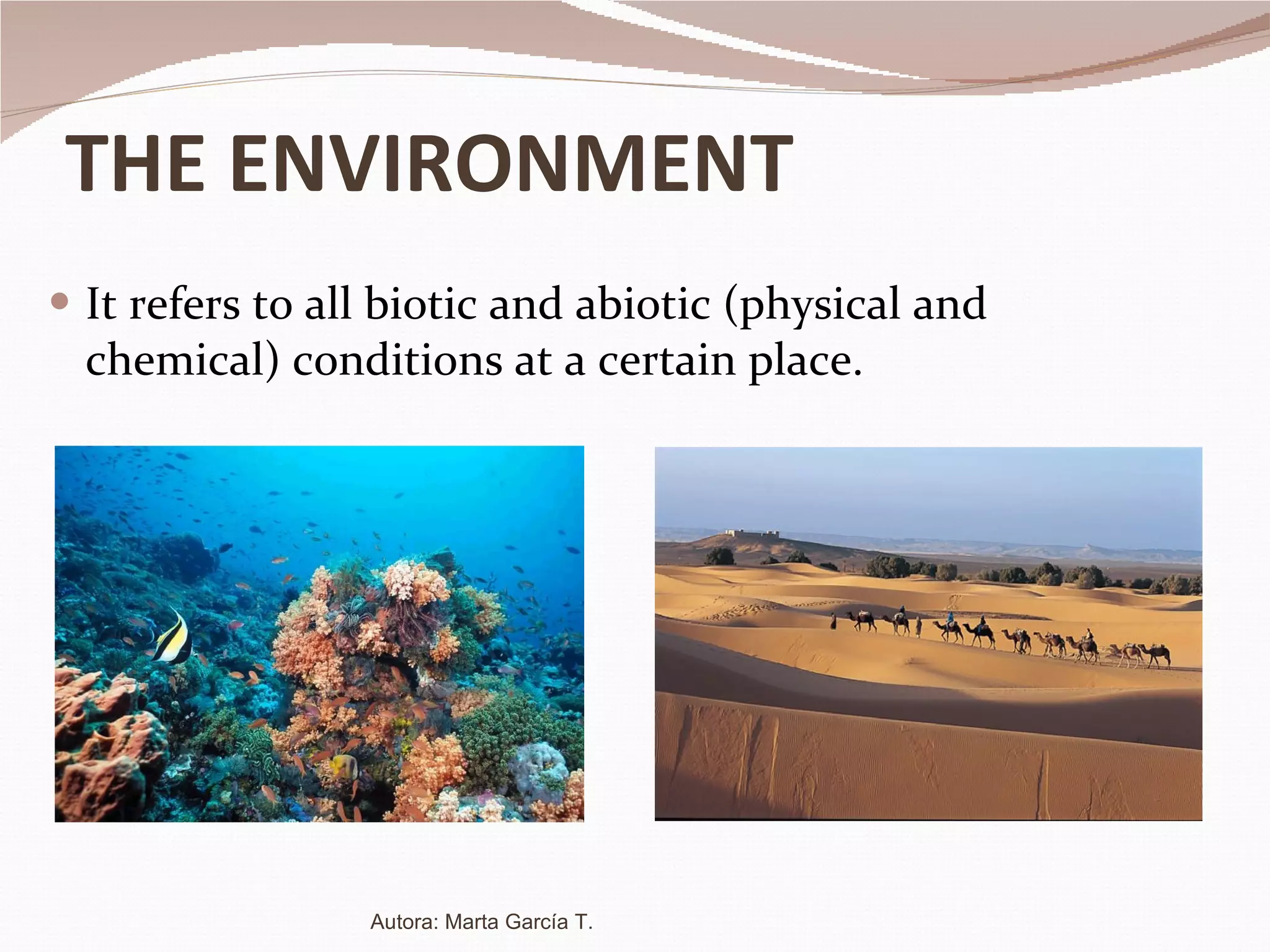
THE ENVIRONMENT It refers to all biotic and abiotic (physical and chemical) conditions at a certain place. Autora: Marta García T.
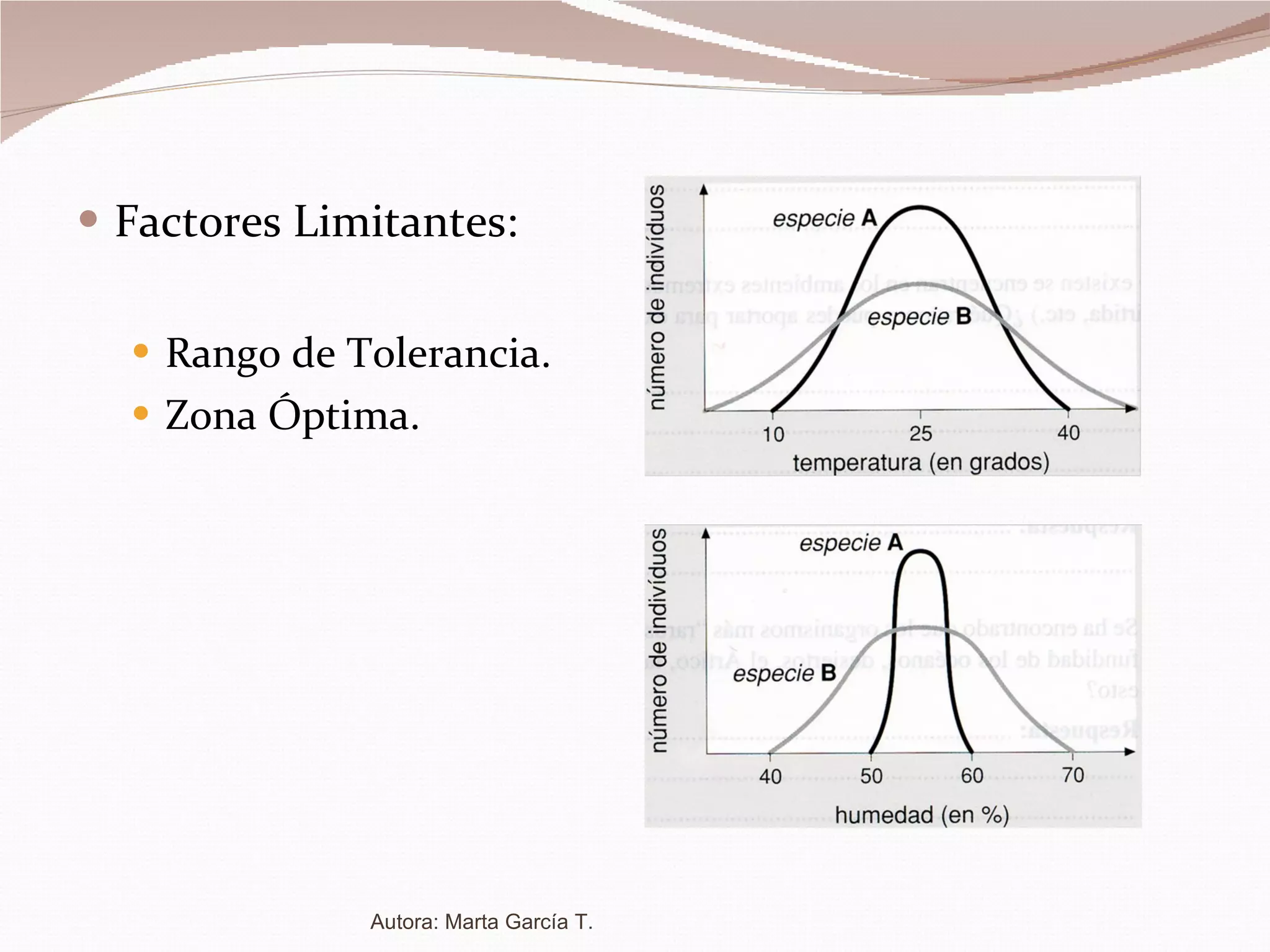
Factores Limitantes: Rango de Tolerancia. Zona Óptima. Autora: Marta García T.
BIOTIC FACTORS Autora: Marta García T.
BIOTIC RELATIONS Are interactions among the living things in an ecosystem. There are two types: Intraspecific Relations : among organisms of the same species. 2. Intersepecific Relations:  among organisms of different species. Autora: Marta García T.
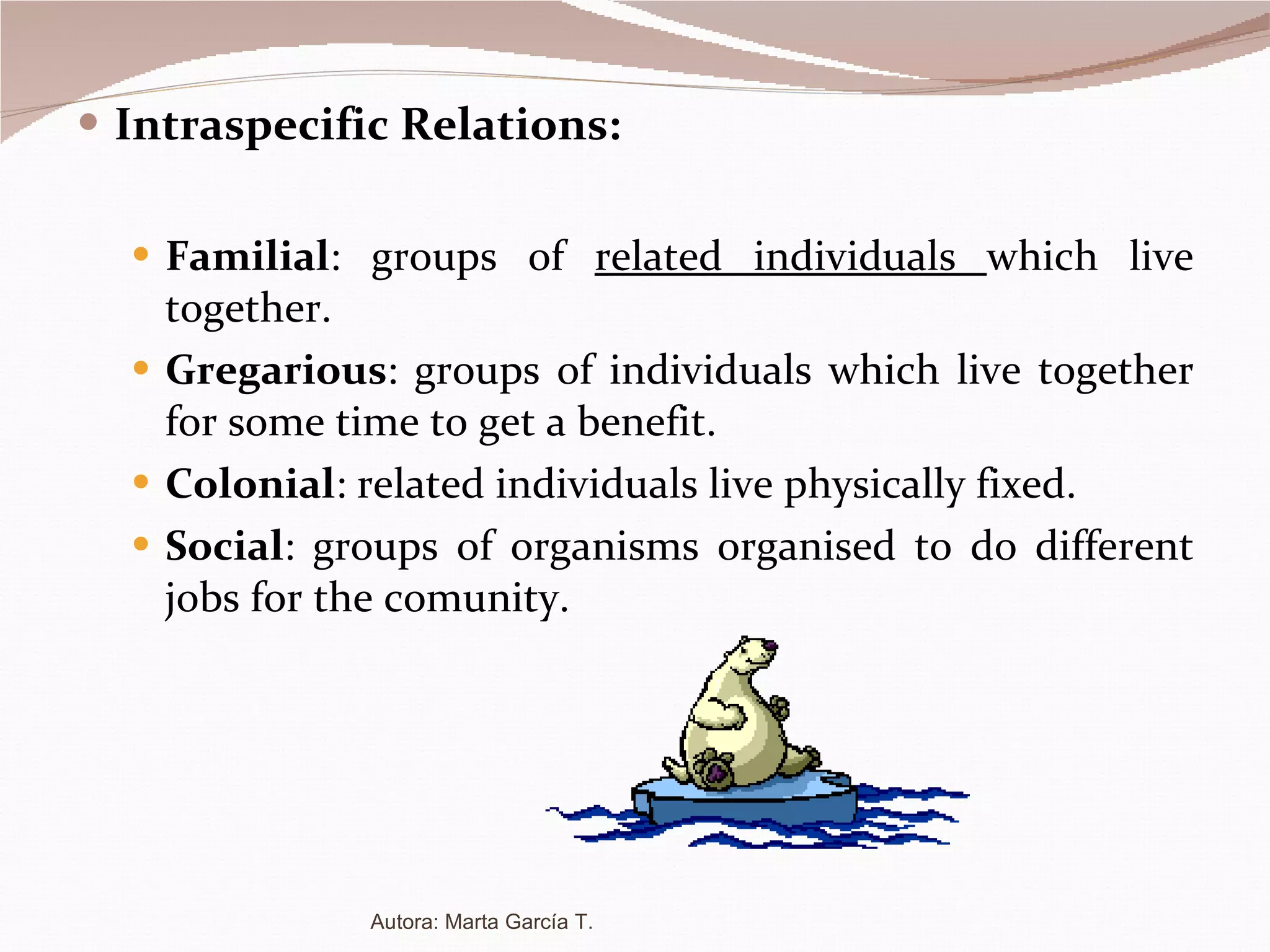
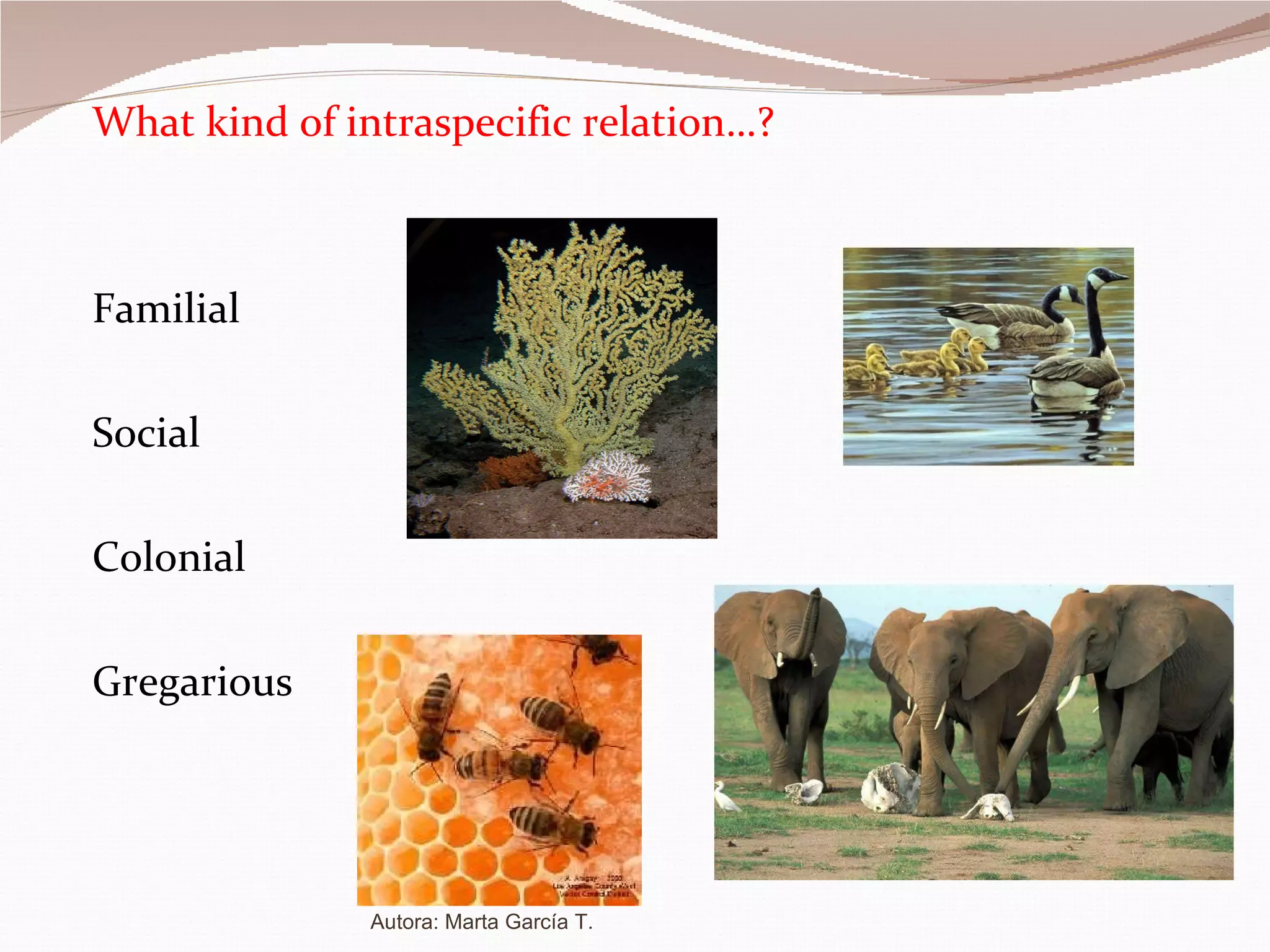
Intraspecific Relations: Familial : groups of  related individuals  which live together. Gregarious : groups of individuals which live together for some time to get a benefit. Colonial : related individuals live physically fixed. Social : groups of organisms organised to do different jobs for the comunity. Autora: Marta García T.
What kind of intraspecific relation…? Familial Social Colonial Gregarious Autora: Marta García T.
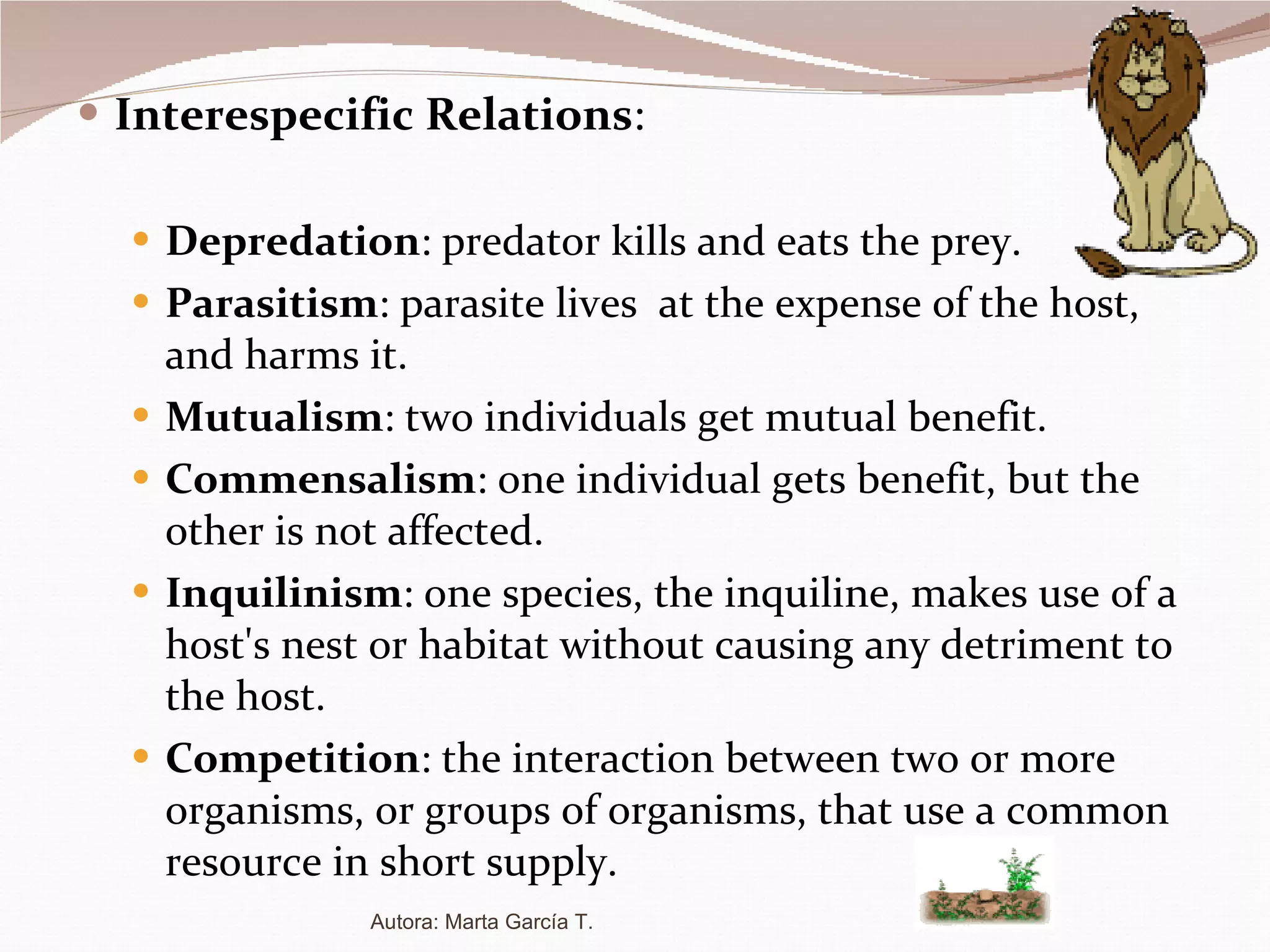
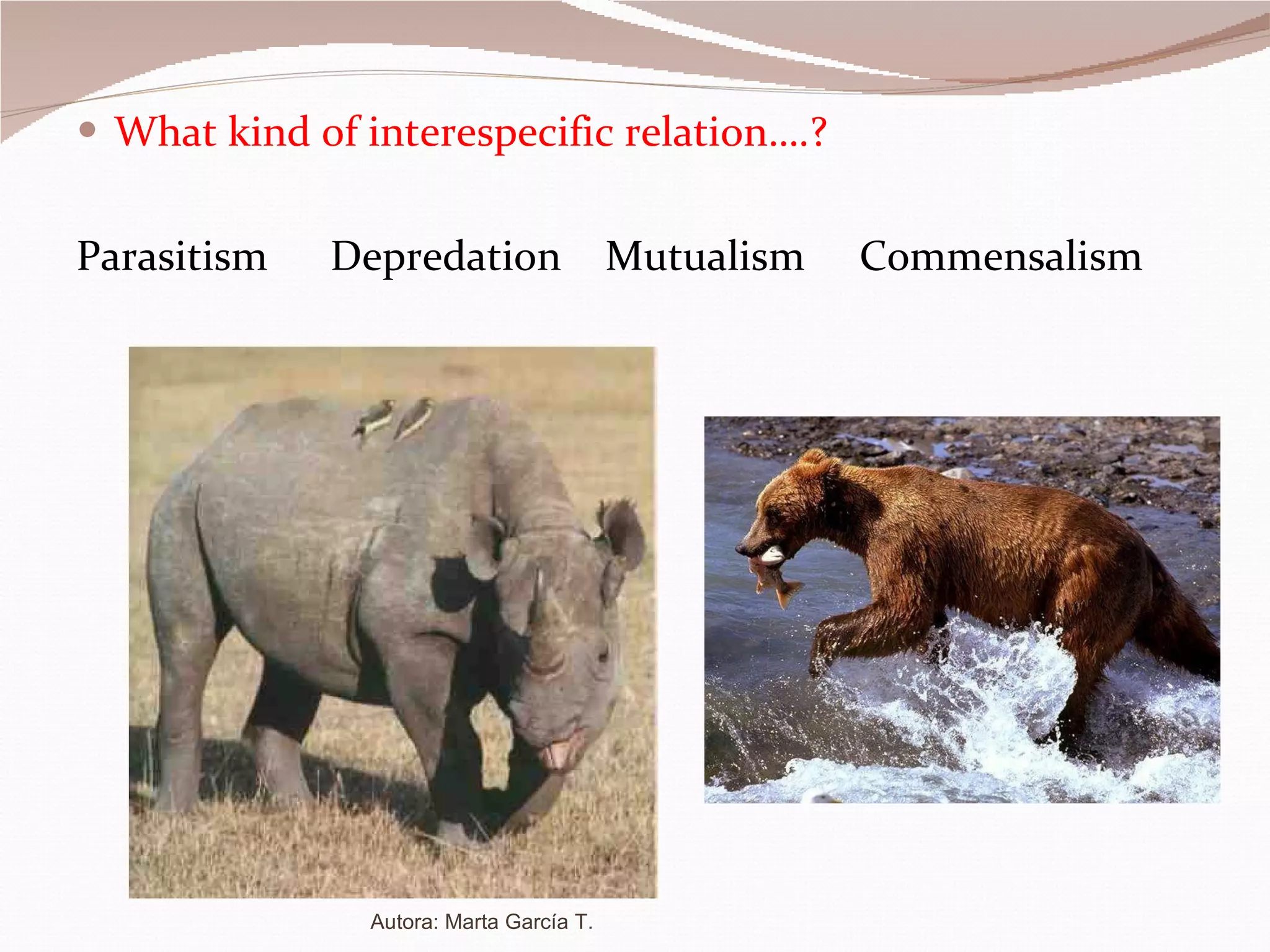
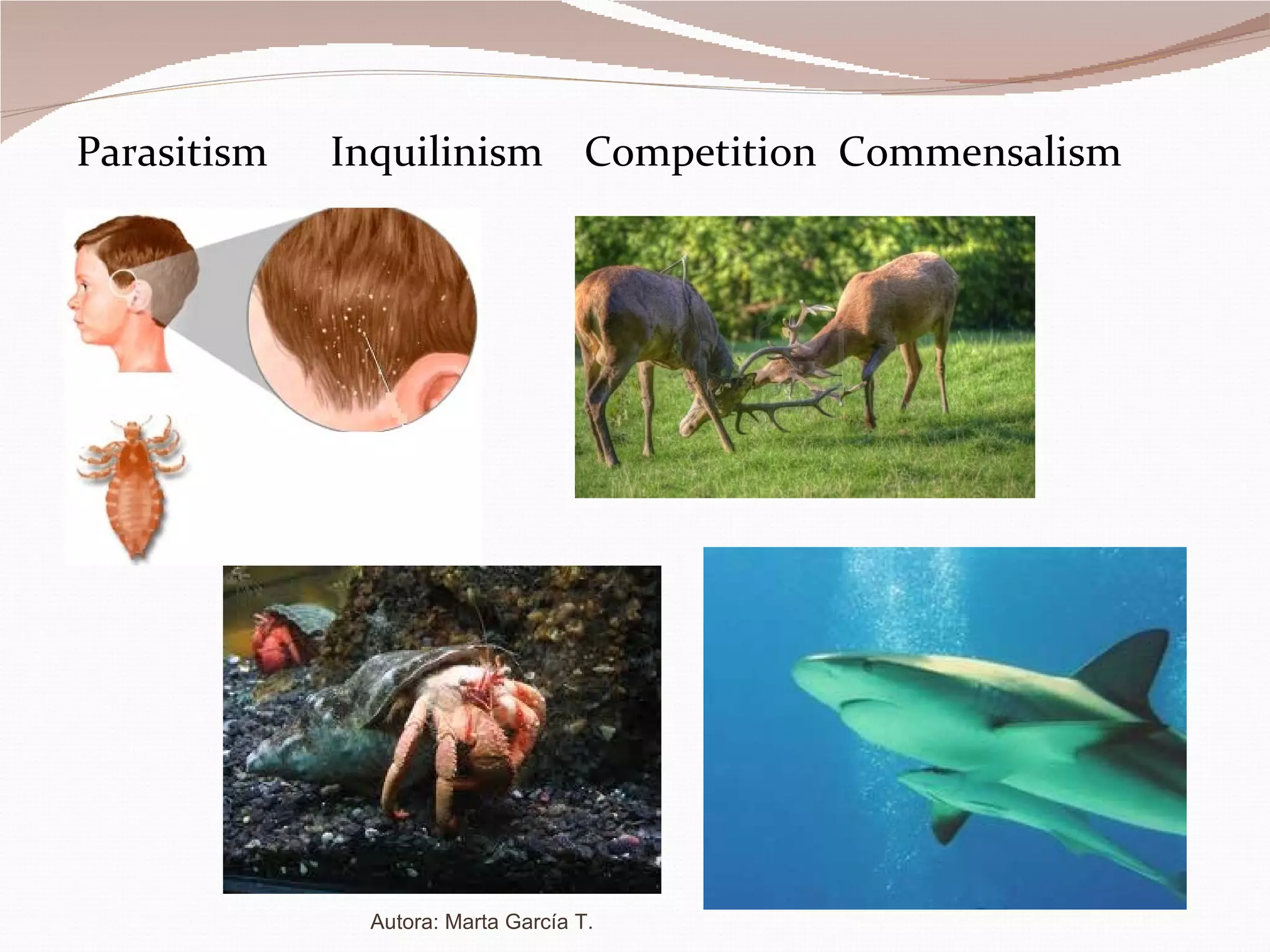
Interespecific Relations : Depredation : predator kills and eats the prey. Parasitism : parasite lives  at the expense of the host, and harms it. Mutualism : two individuals get mutual benefit. Commensalism : one individual gets benefit, but the other is not affected. Inquilinism :  one species, the inquiline, makes use of a host's nest or habitat without causing any detriment to the host. Competition : the interaction between two or more organisms, or groups of organisms, that use a common resource in short supply. Autora: Marta García T.
What kind of interespecific relation….? Parasitism Depredation   Mutualism   Commensalism Autora: Marta García T.
Parasitism Inquilinism Competition  Commensalism Autora: Marta García T.
Autora: Marta García T.
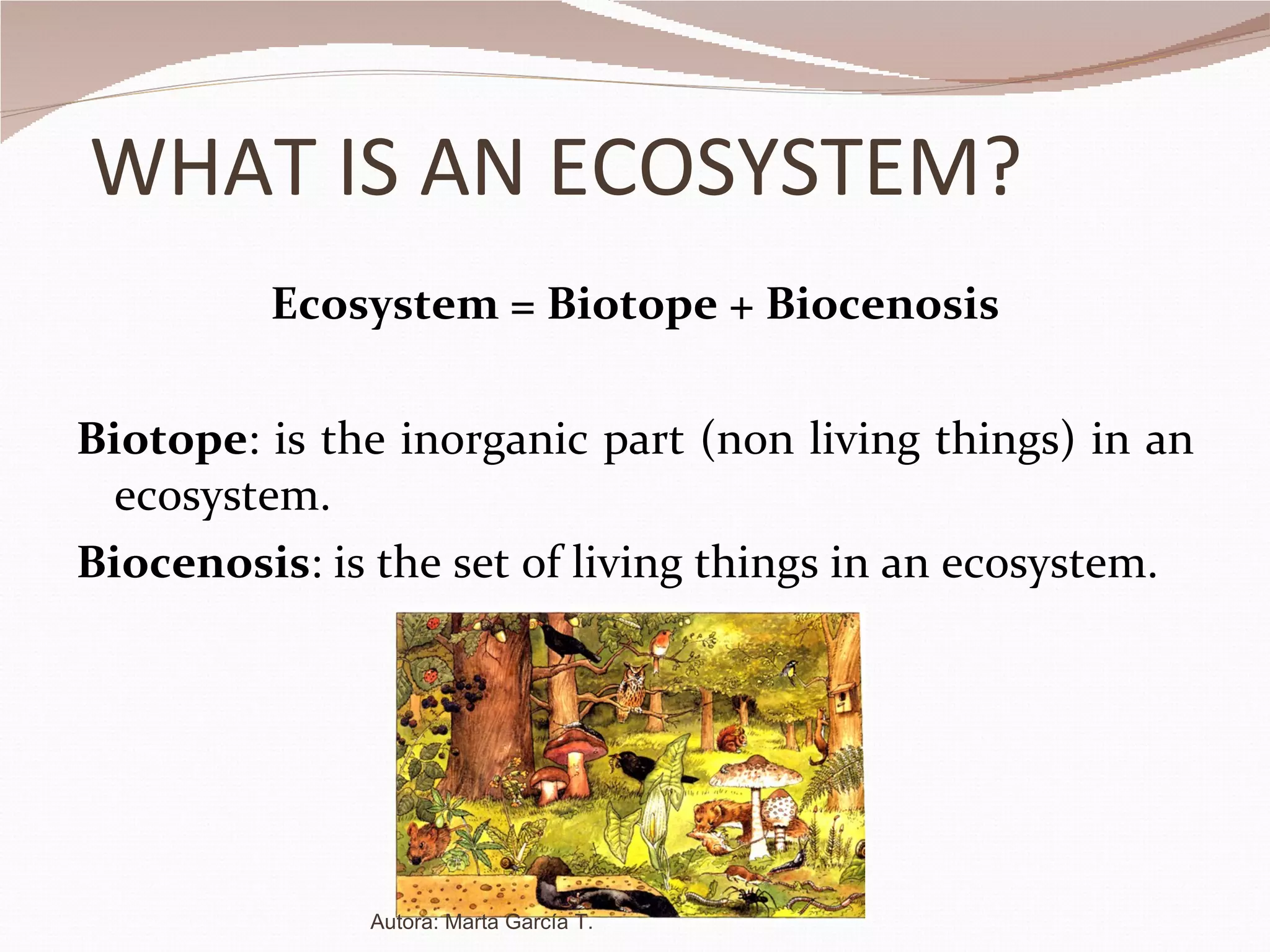
WHAT IS AN ECOSYSTEM? Ecosystem = Biotope + Biocenosis Biotope : is the inorganic part (non living things) in an ecosystem. Biocenosis : is the set of living things in an ecosystem. Autora: Marta García T.
Biomes  are the large-scale ecosystems of the world (desert, rainforest, tundra, taiga, grassland, mediterranean forest and deciduous forest). http://recursos.cnice.mec.es/biosfera/alumno/2ESO/Energia_ecosistemas/actividad3.htm Biosphere  includes all the living things of the world. Ecosphere  includes all the ecosystems of the world. Autora: Marta García T.
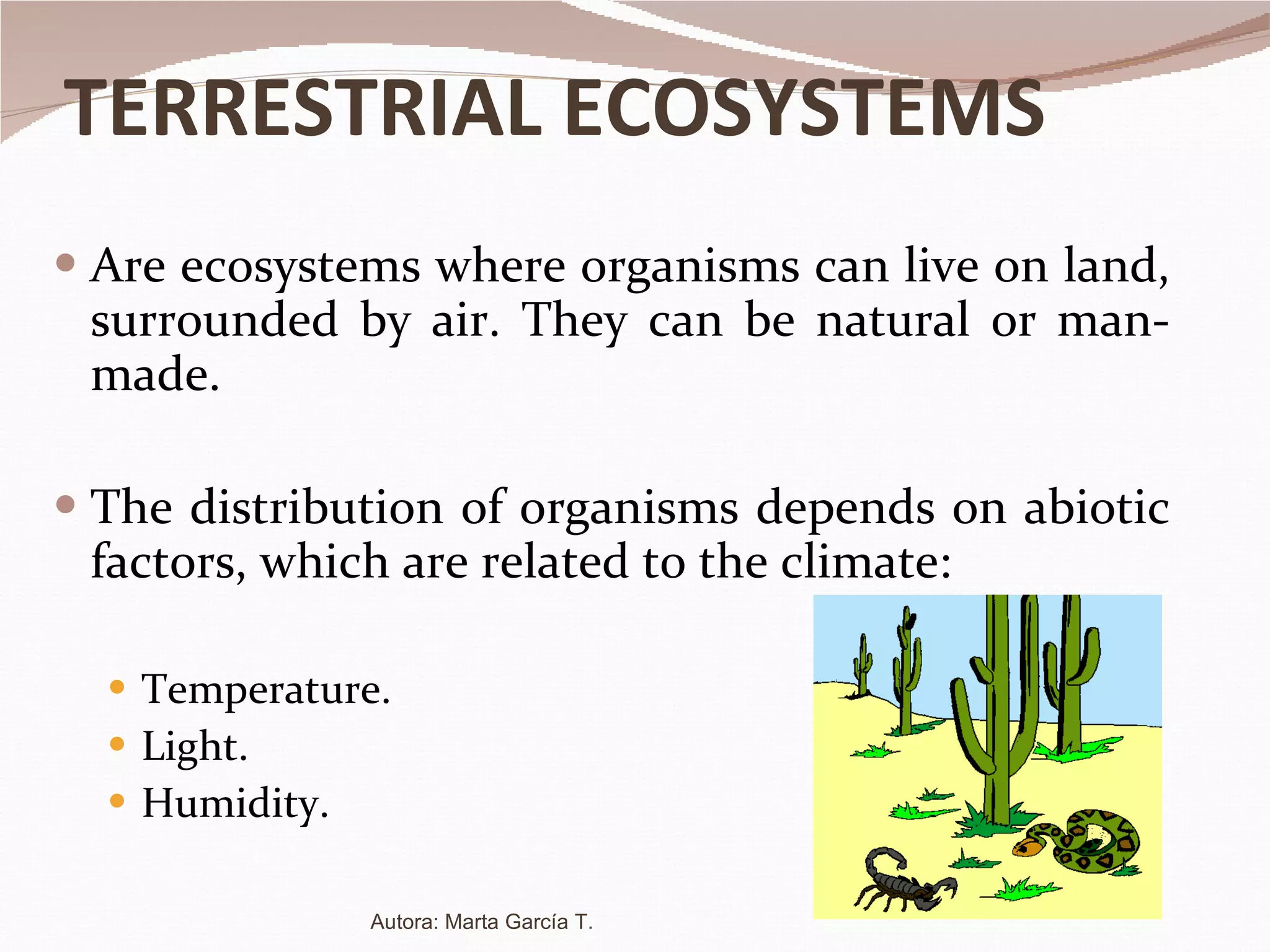
TERRESTRIAL ECOSYSTEMS Are ecosystems where organisms can live on land, surrounded by air. They can be natural or man-made. The distribution of organisms depends on abiotic factors, which are related to the climate: Temperature. Light. Humidity. Autora: Marta García T.
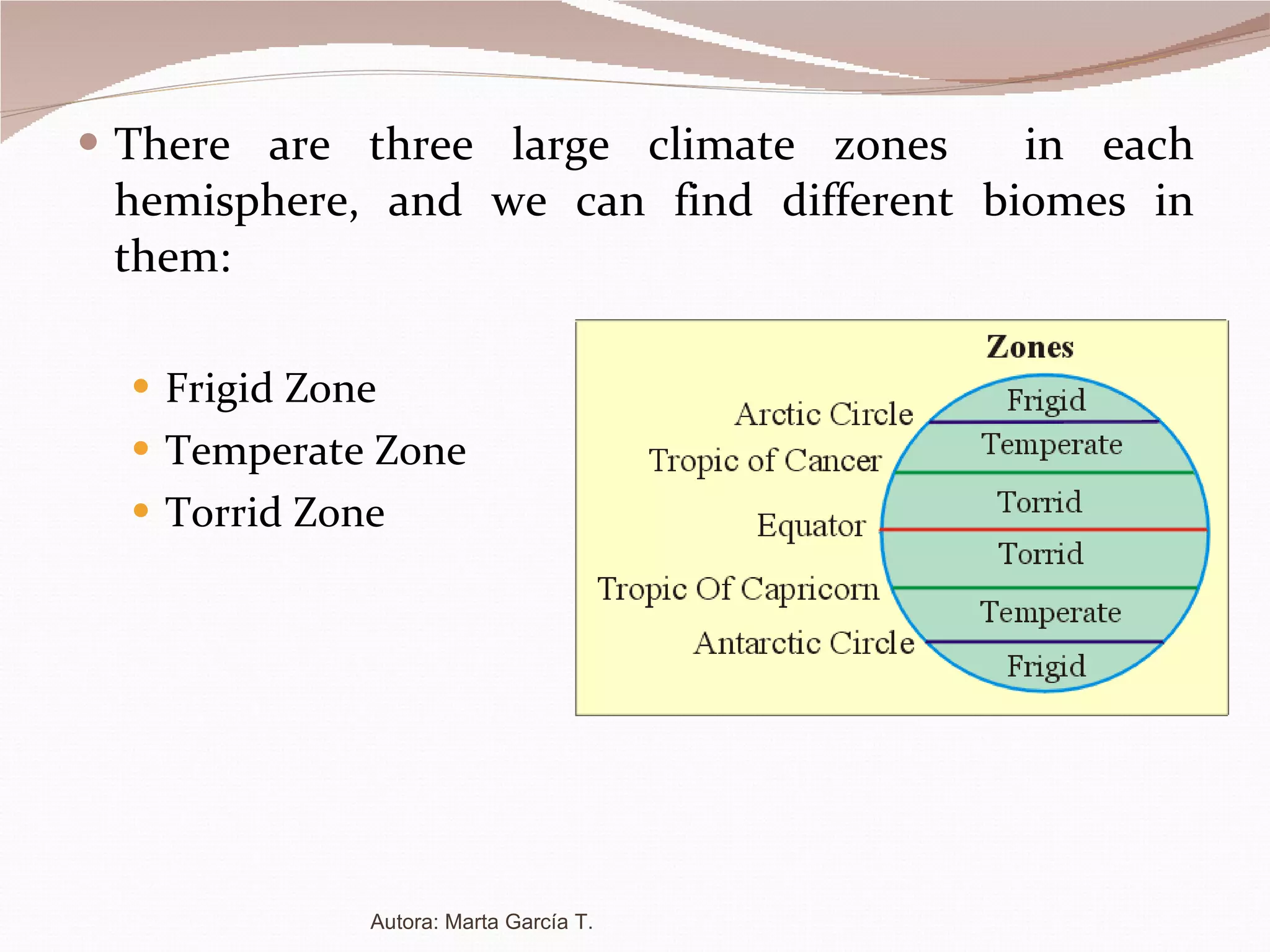
There are three large climate zones  in each hemisphere, and we can find different biomes in them: Frigid Zone Temperate Zone Torrid Zone Autora: Marta García T.
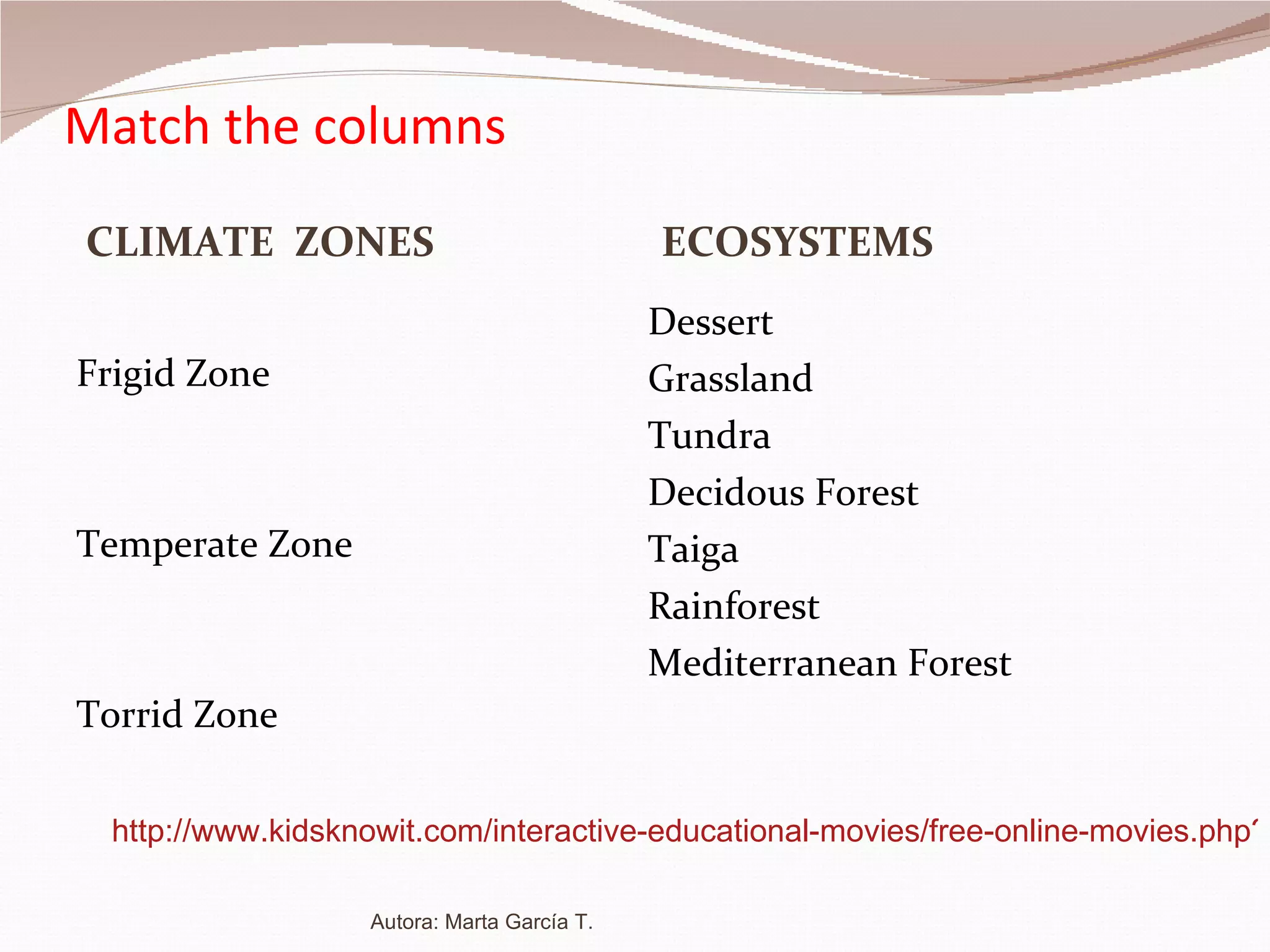
Match the columns CLIMATE  ZONES ECOSYSTEMS Frigid Zone Temperate Zone Torrid Zone Dessert Grassland Tundra Decidous Forest Taiga Rainforest Mediterranean Forest http://www.kidsknowit.com/interactive-educational-movies/free-online-movies.php?movie=biomes Autora: Marta García T.
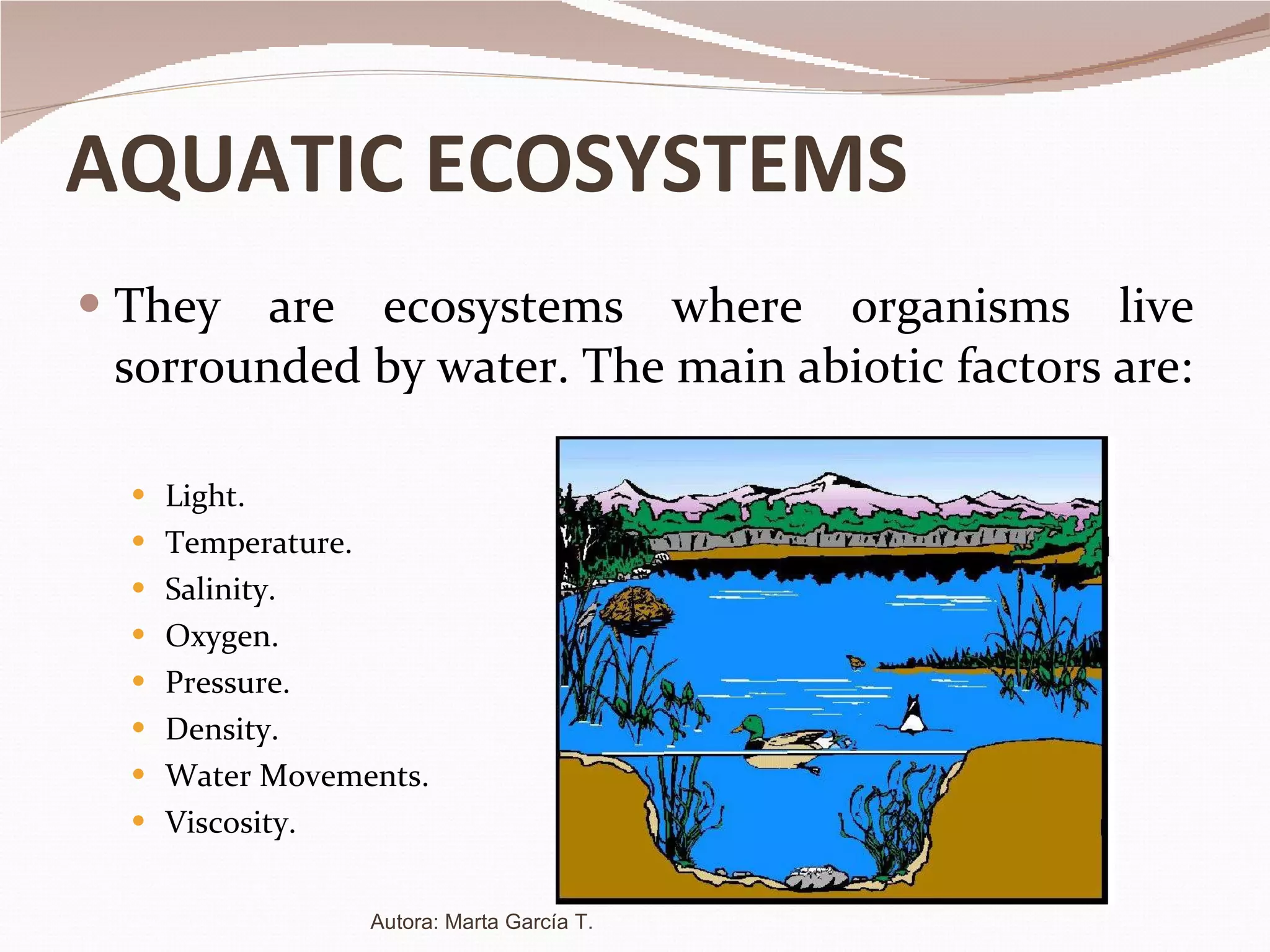
AQUATIC ECOSYSTEMS They are ecosystems where organisms live sorrounded by water. The main abiotic factors are: Light. Temperature. Salinity. Oxygen. Pressure. Density. Water Movements. Viscosity. Autora: Marta García T.
How do you think these factors vary with depth?   Ligth __________ with depth.   Pressure __________ with depth.   Temperature __________ with depth.   Oxygen __________ with depth. Autora: Marta García T.
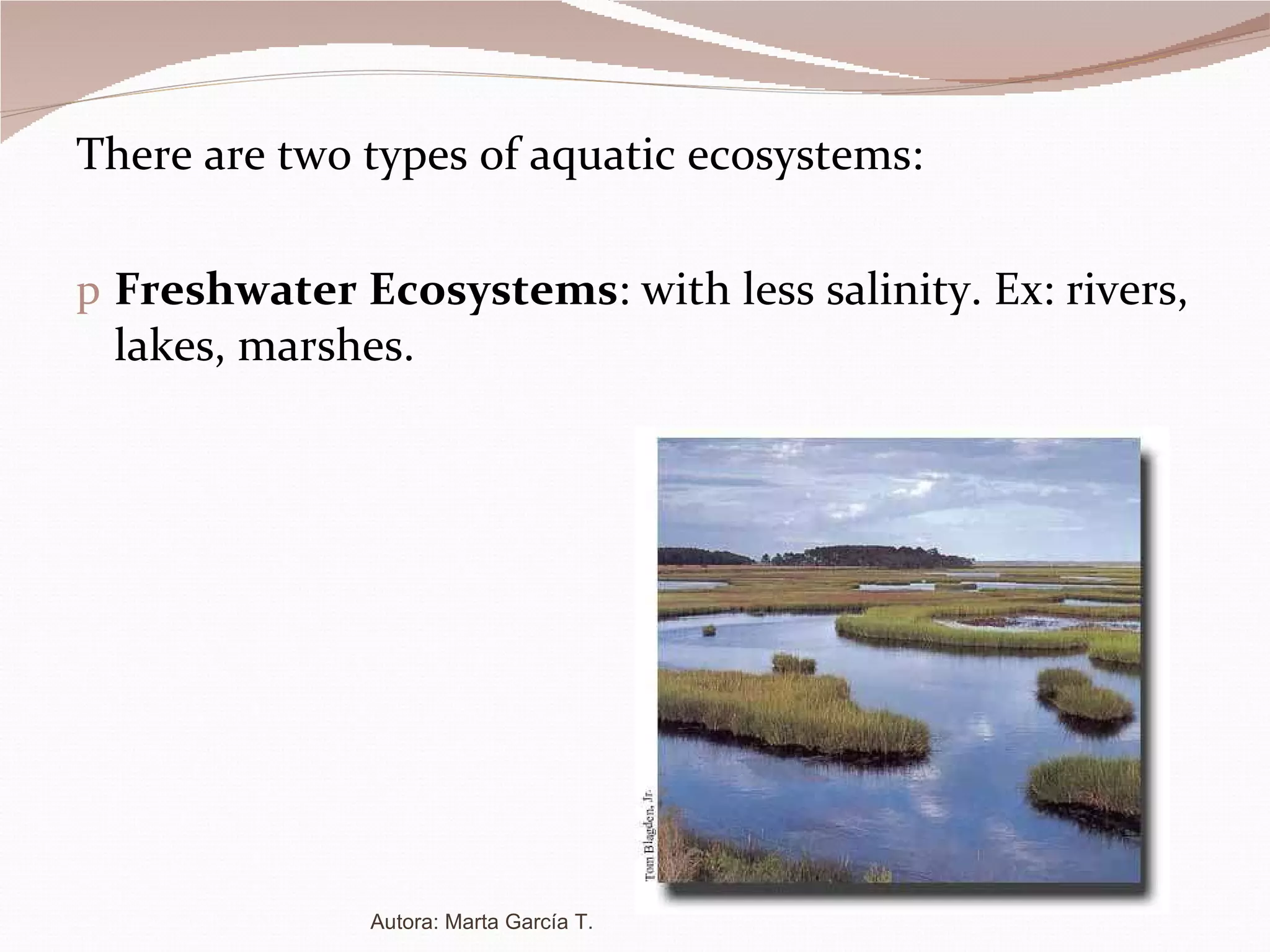
There are two types of aquatic ecosystems: Freshwater   Ecosystems : with less salinity. Ex: rivers, lakes, marshes. Autora: Marta García T.
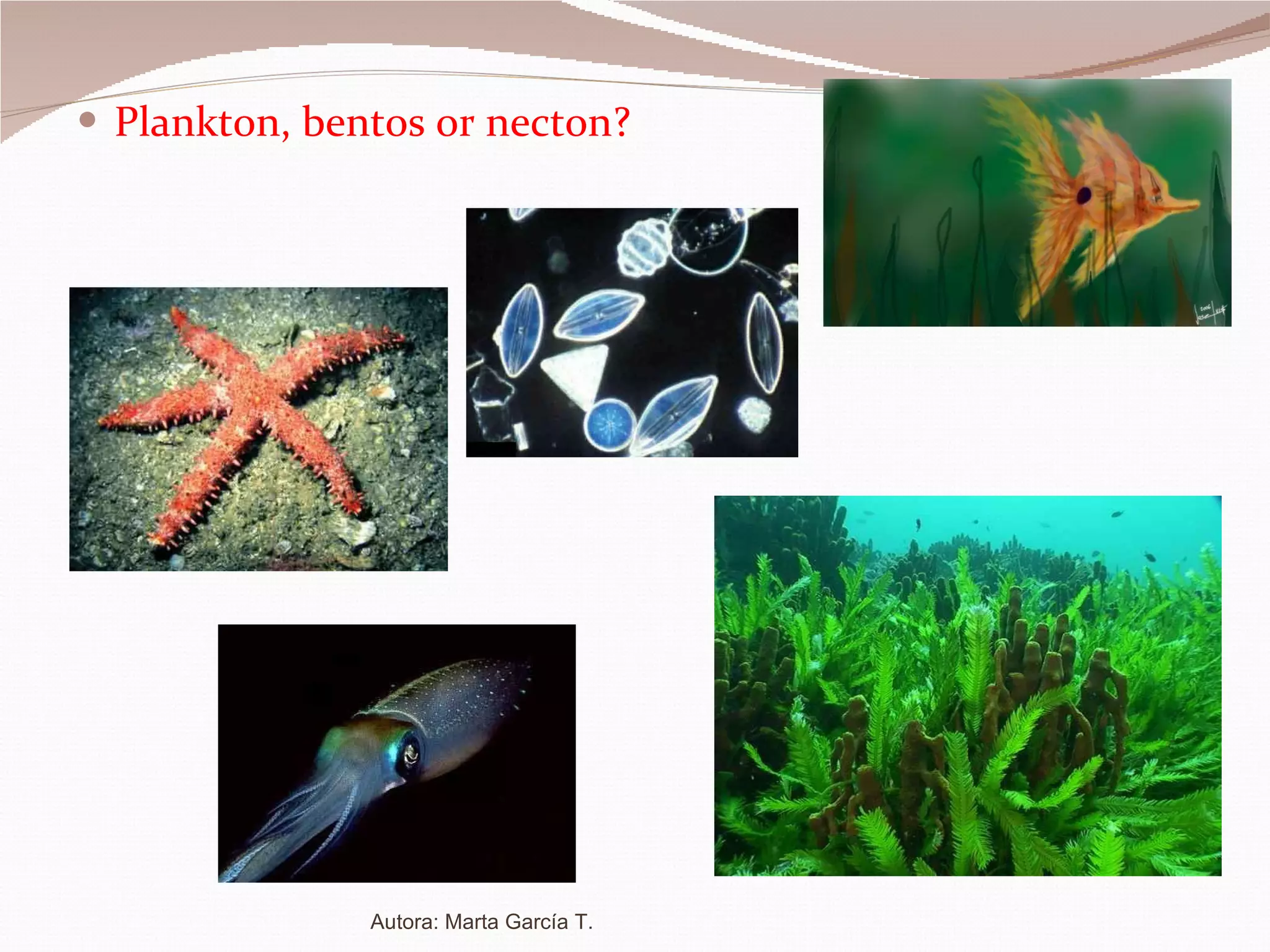
2. Marine   Ecosystems : more salty. We can find three types of organisms: Plankton : tiny plants and animals of the ocean that serve as food for ocean creatures. Necton : animals that can move freely up and down in the water. Bentos : plants and animals who live on the ocean floor. Autora: Marta García T.
Plankton, bentos or necton? Autora: Marta García T.
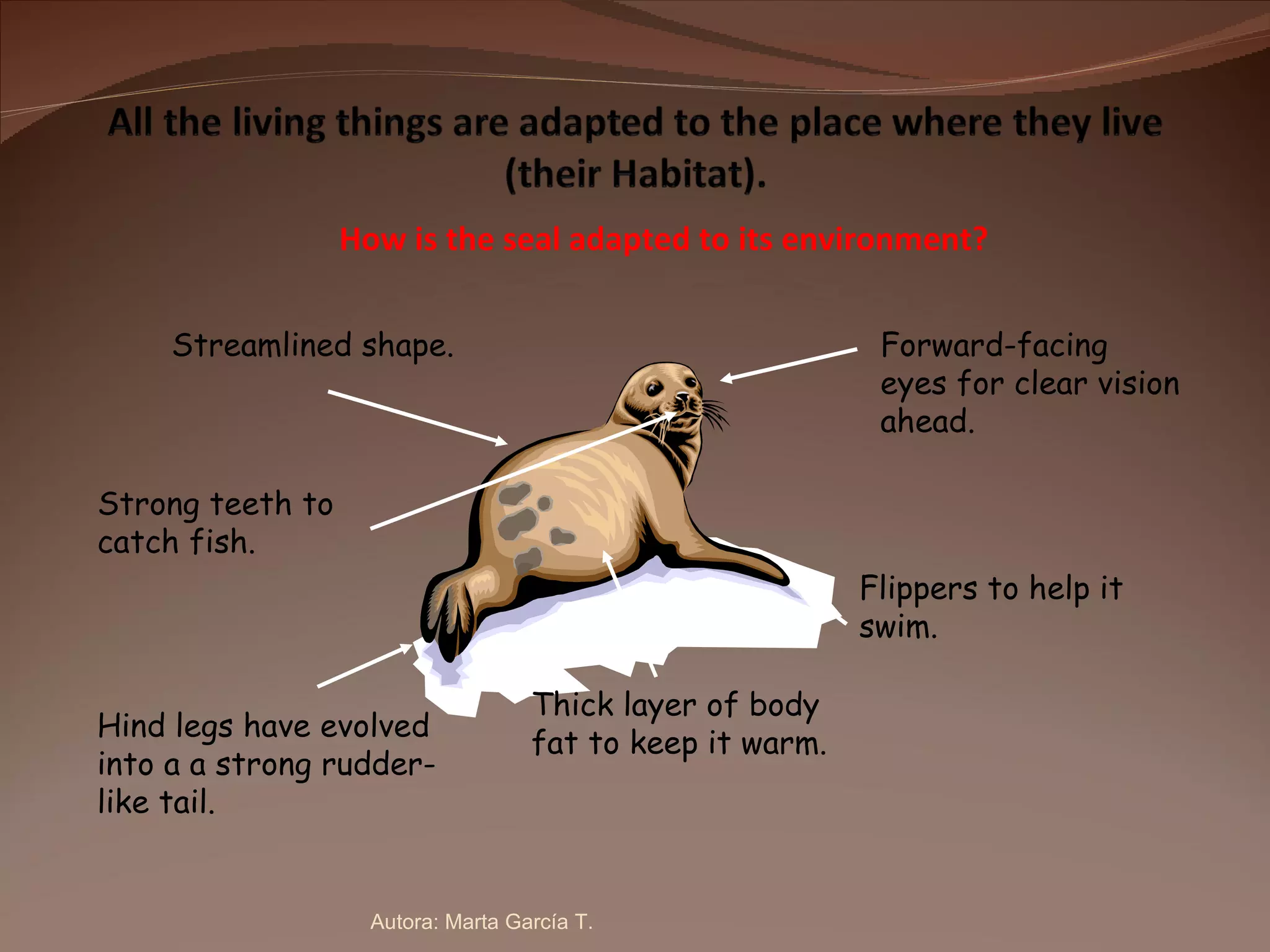
Flippers to help it swim. Streamlined shape. Thick layer of body fat to keep it warm. Strong teeth to catch fish. Forward-facing eyes for clear vision ahead. Hind legs have evolved into a a strong rudder-like tail. How is the seal adapted to its environment? Autora: Marta García T.
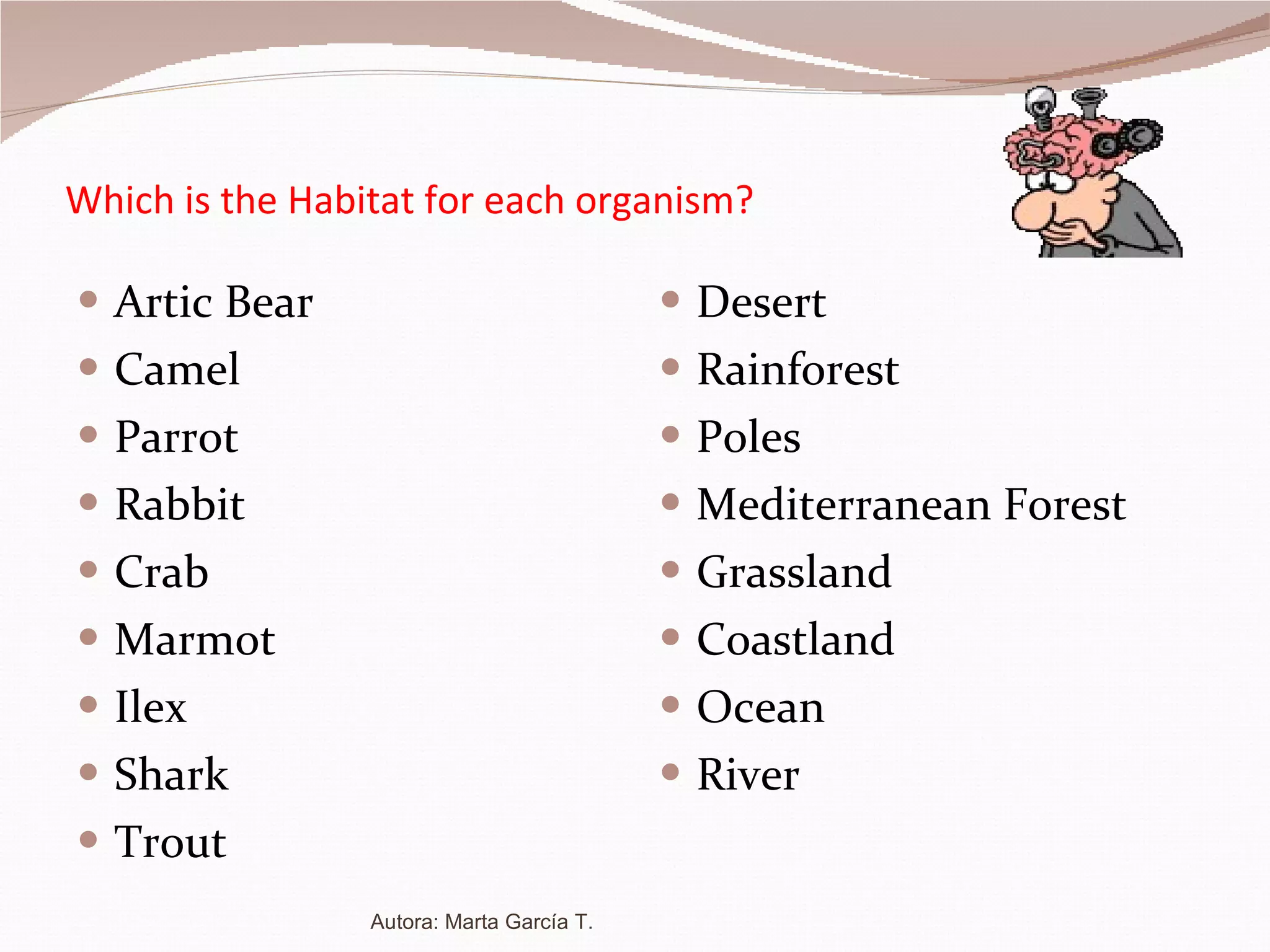
Which is the Habitat for each organism? Artic Bear Camel Parrot Rabbit Crab Marmot Ilex Shark Trout Desert Rainforest Poles Mediterranean Forest Grassland Coastland Ocean River Autora: Marta García T.
Autora: Marta García T.
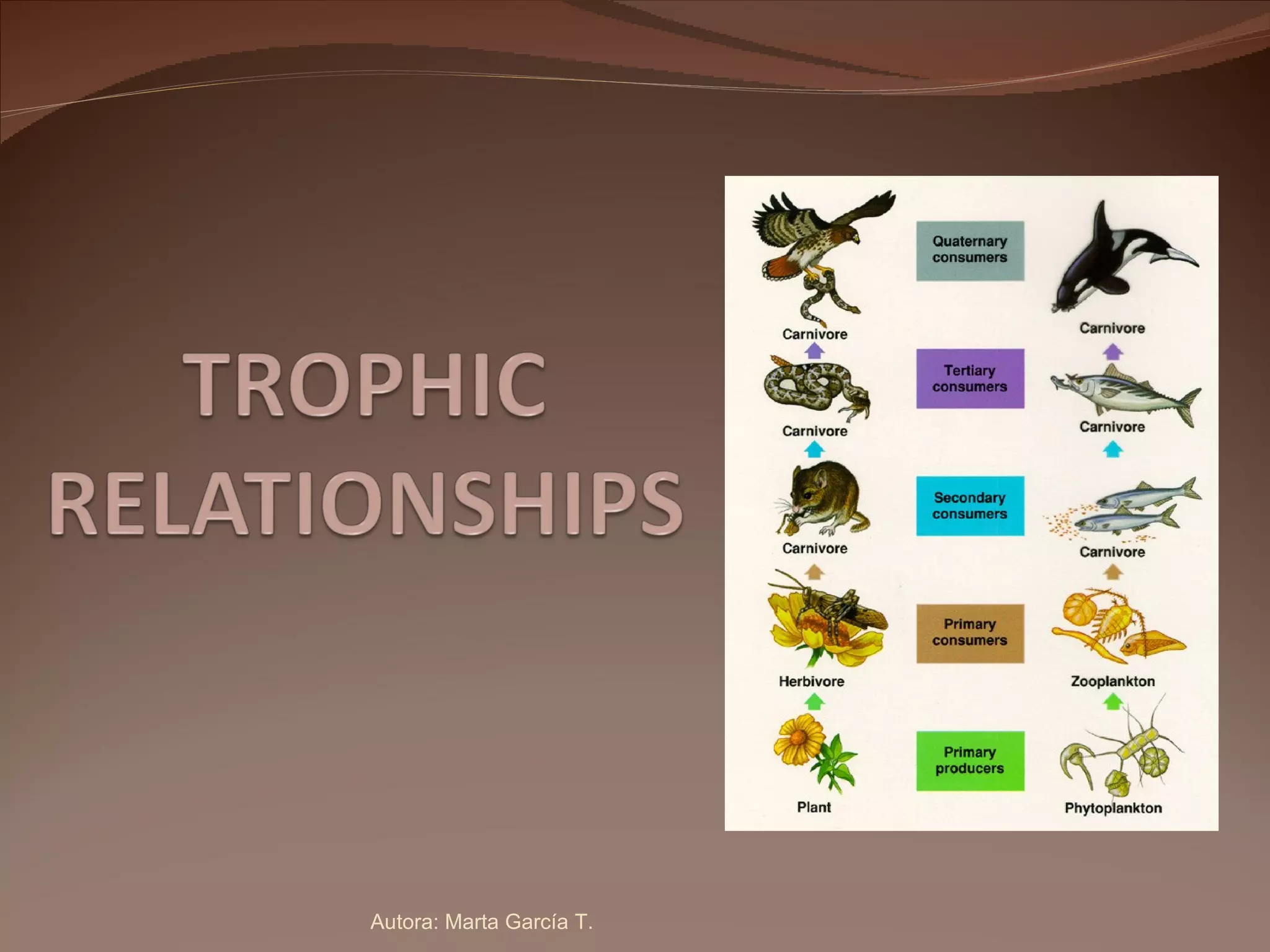
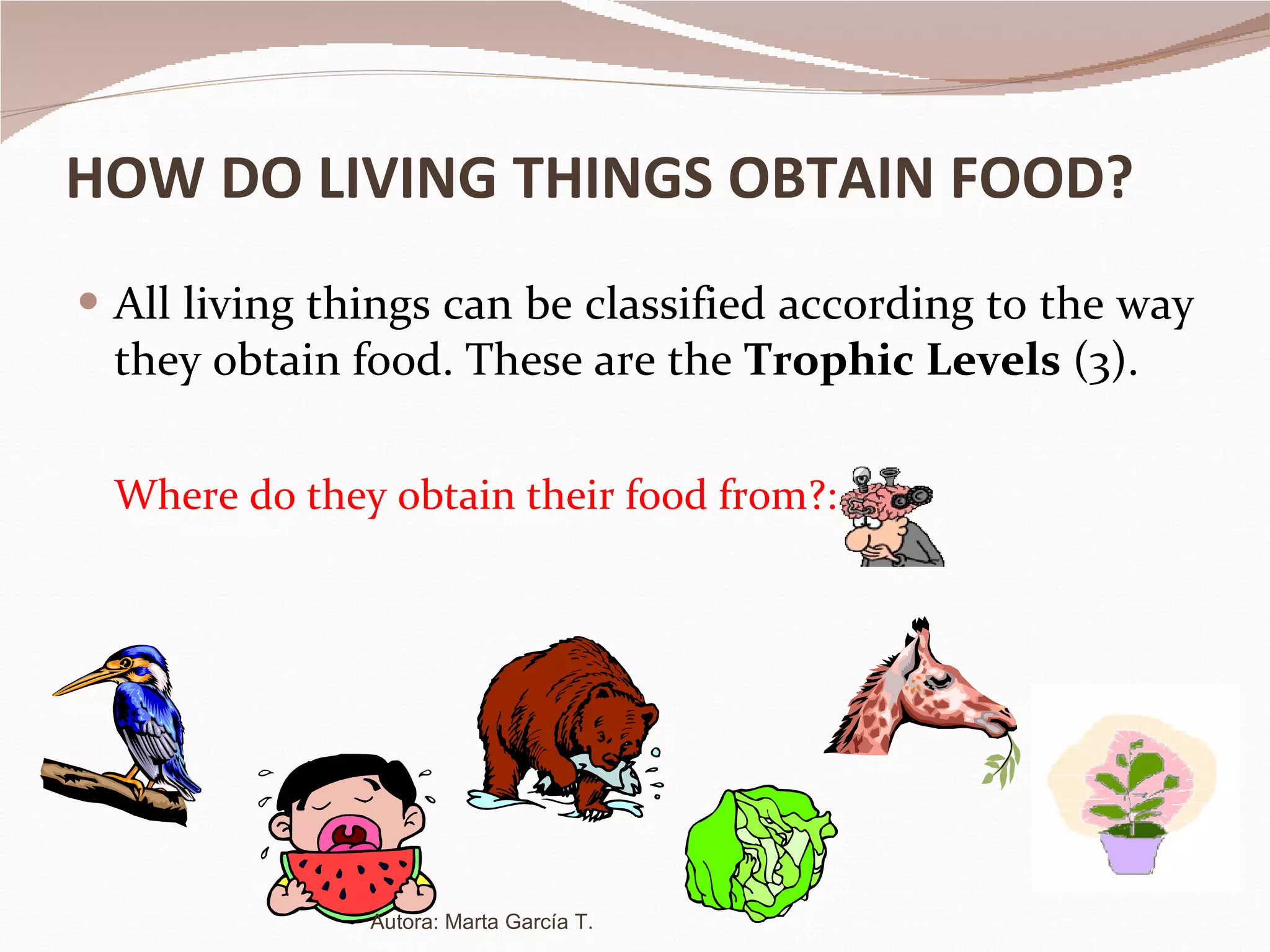
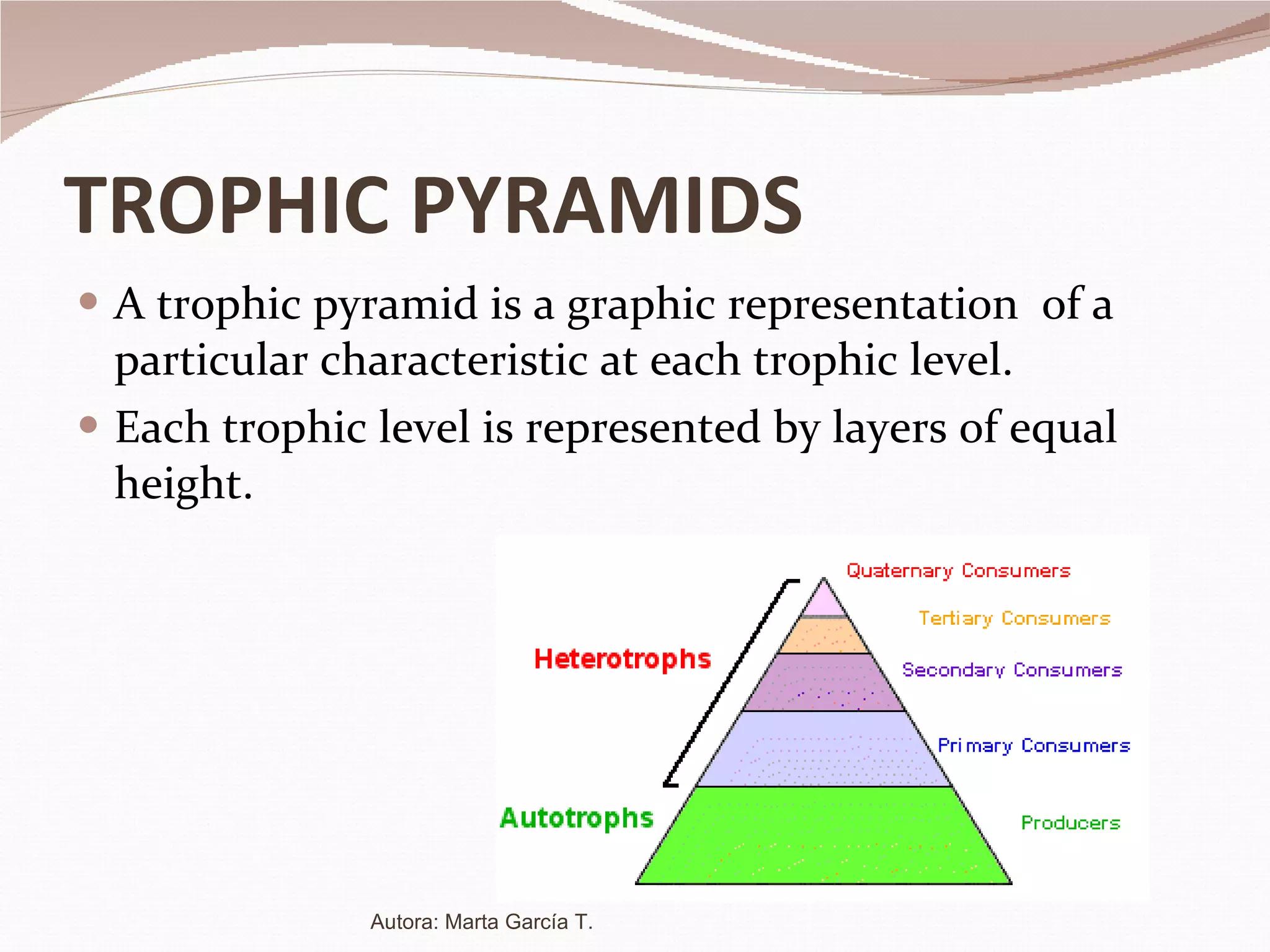
HOW DO LIVING THINGS OBTAIN FOOD? All living things can be classified according to the way they obtain food. These are the  Trophic Levels  (3). Where do they obtain their food from?: Autora: Marta García T.
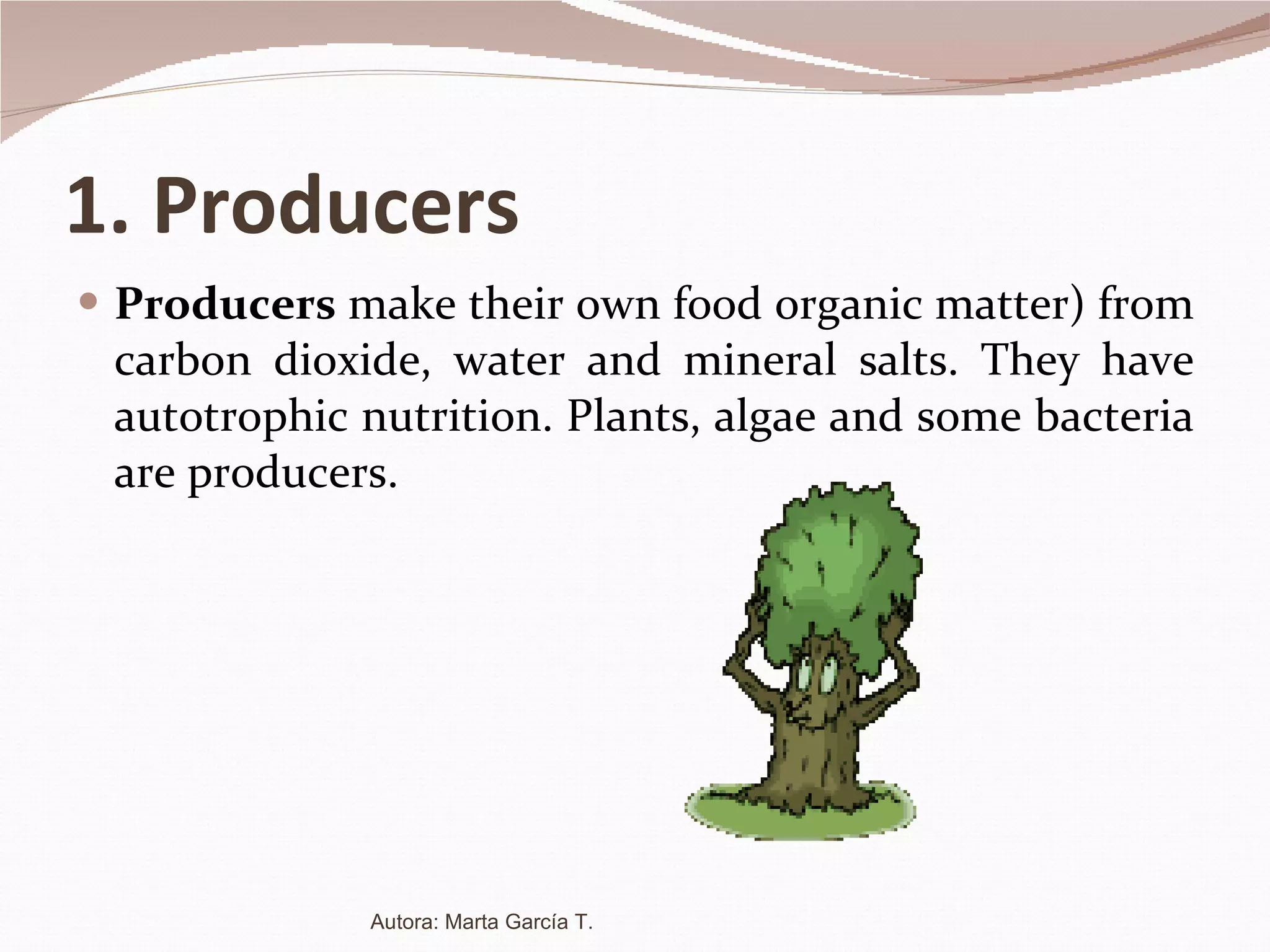
1. Producers Producers  make their own food organic matter) from carbon dioxide, water and mineral salts. They have autotrophic nutrition. Plants, algae and some bacteria are producers. Autora: Marta García T.
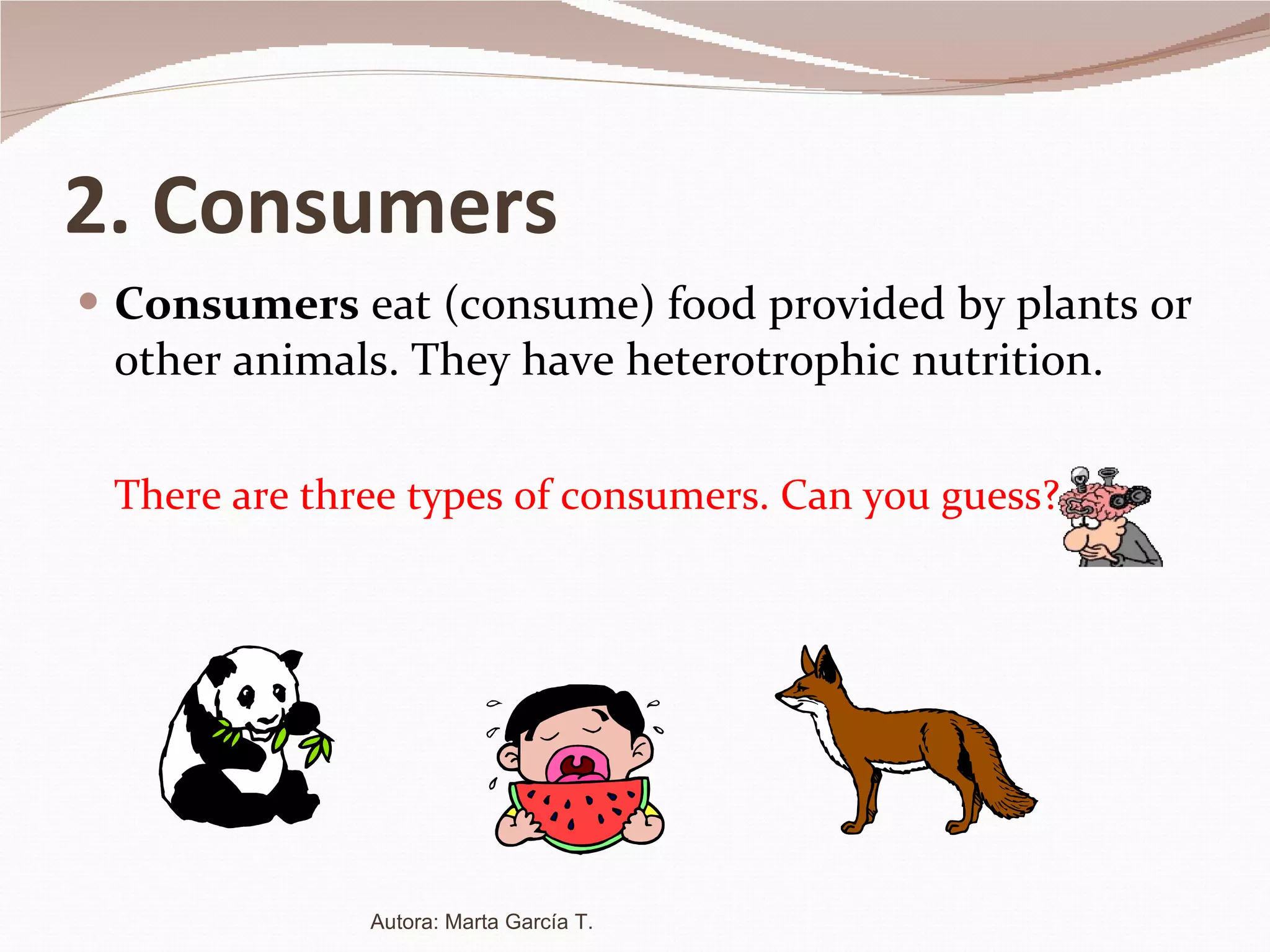
2. Consumers Consumers  eat (consume) food provided by plants or other animals. They have heterotrophic nutrition.  There are three types of consumers. Can you guess? Autora: Marta García T.
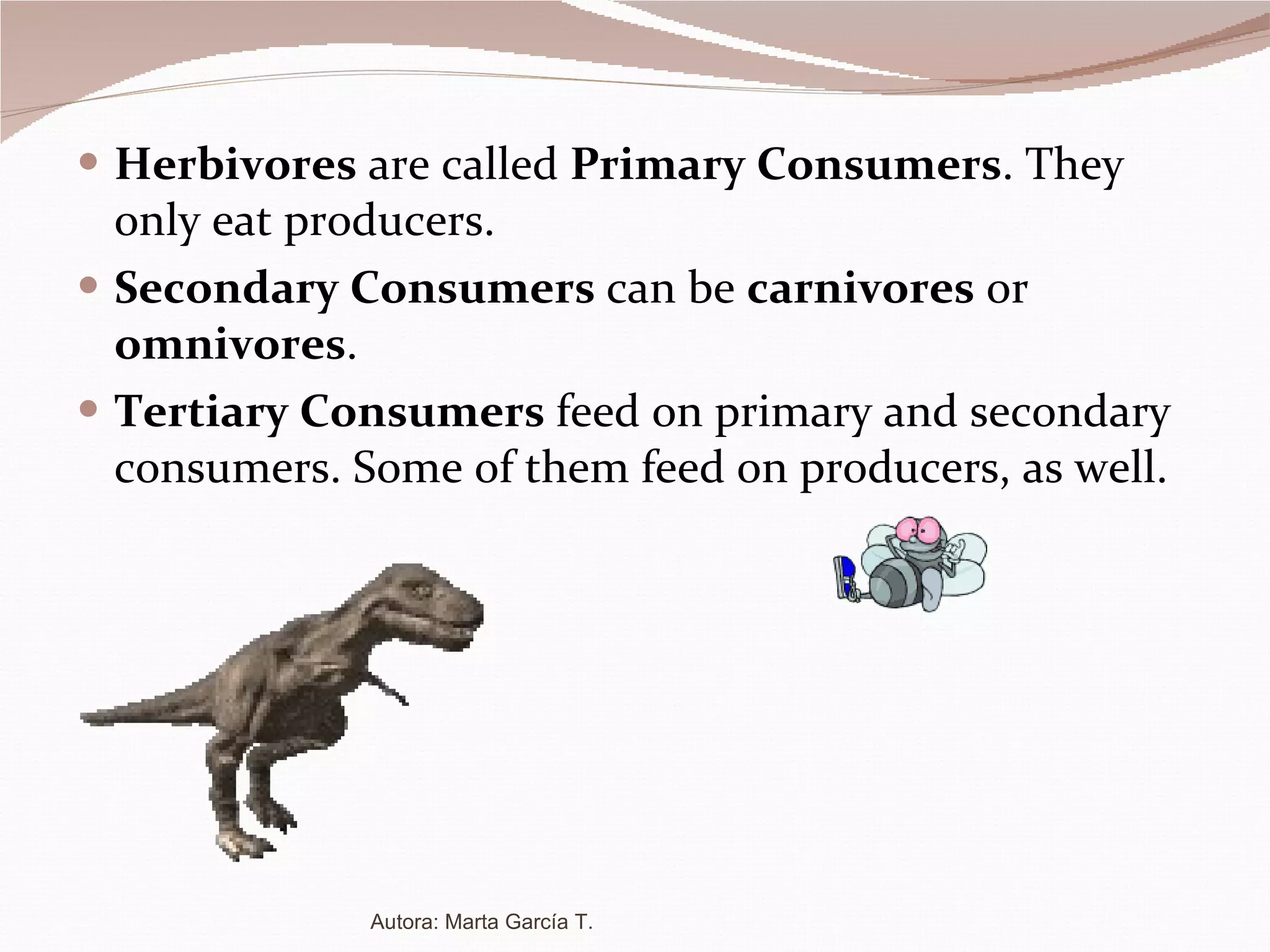
Herbivores  are called  Primary Consumers . They only eat producers. Secondary Consumers  can be  carnivores  or  omnivores . Tertiary Consumers  feed on primary and secondary consumers. Some of them feed on producers, as well. Autora: Marta García T.
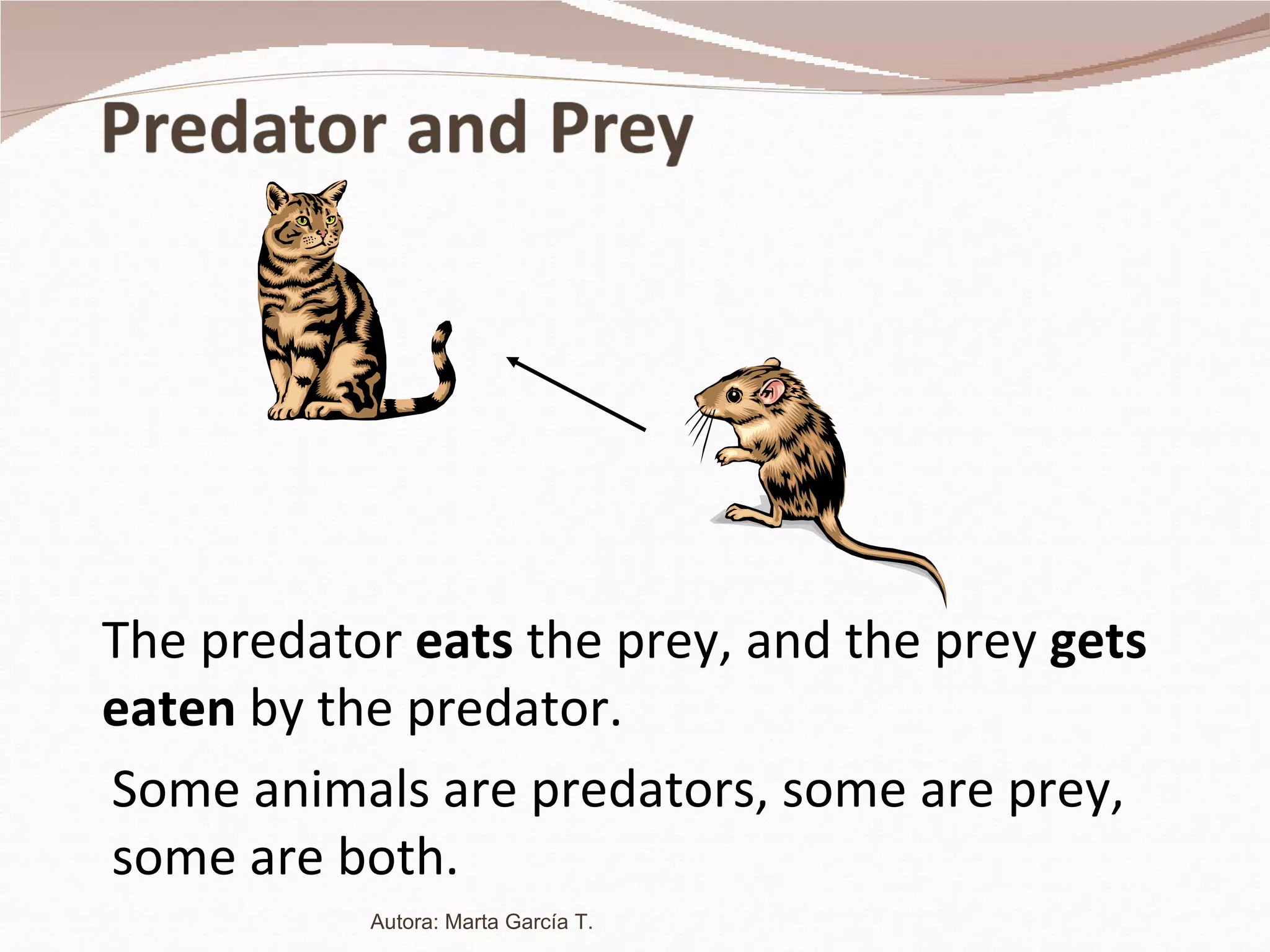
Some animals are predators, some are prey, some are both. The predator  eats  the prey, and the prey  gets eaten  by the predator. Autora: Marta García T.
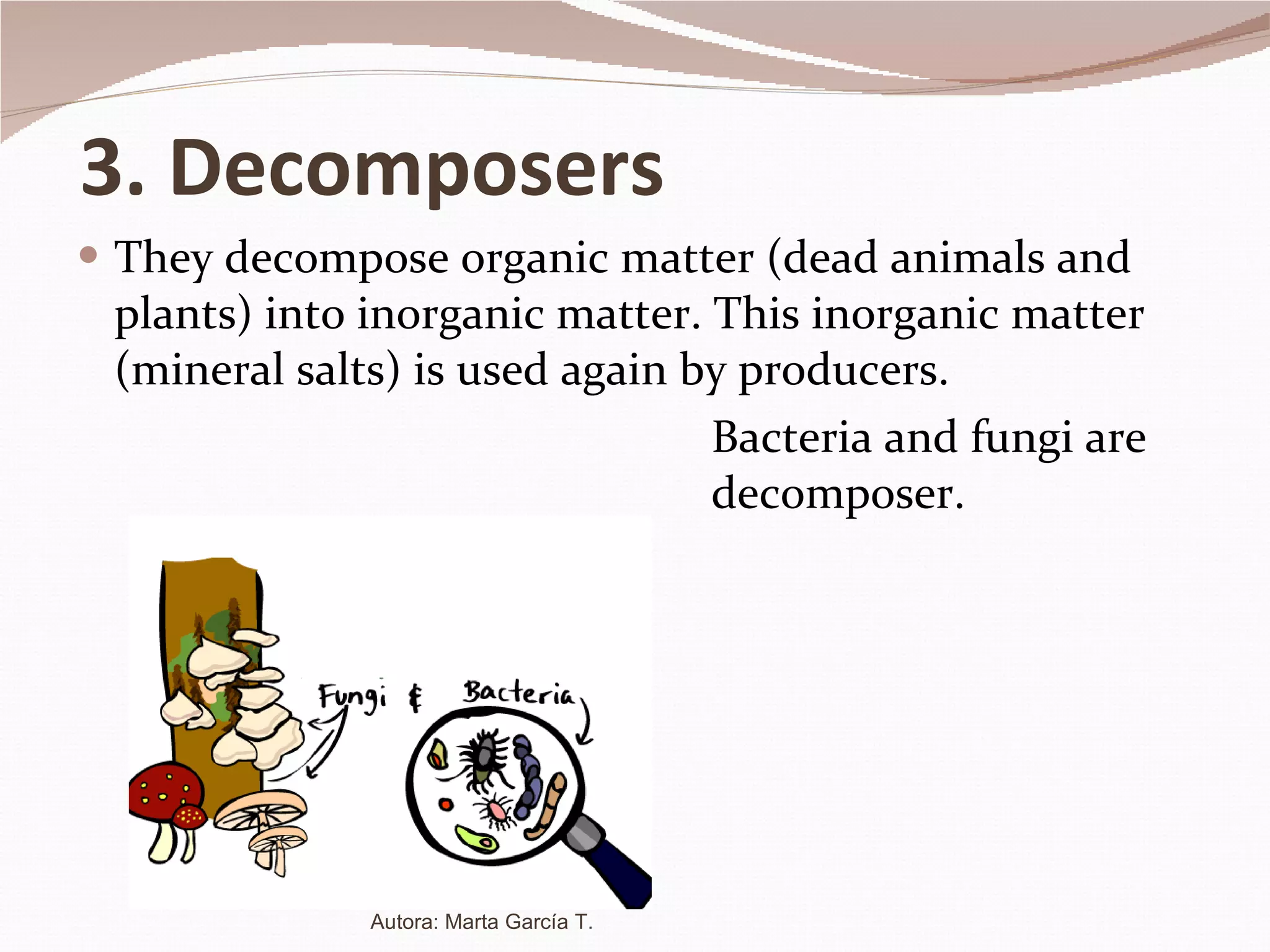
3. Decomposers They decompose organic matter (dead animals and plants) into inorganic matter. This inorganic matter (mineral salts) is used again by producers. Bacteria and fungi are  decomposer. Autora: Marta García T.
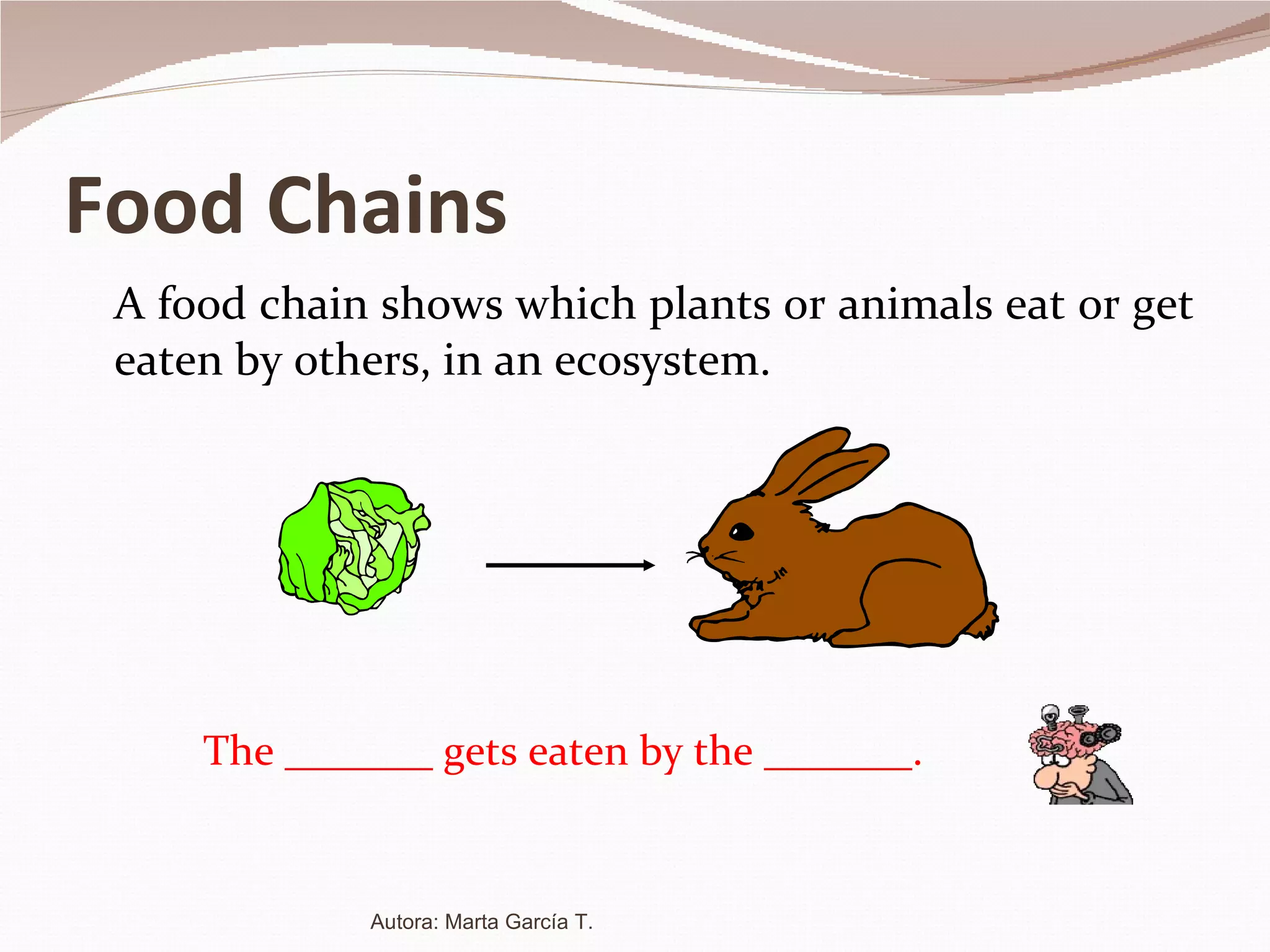
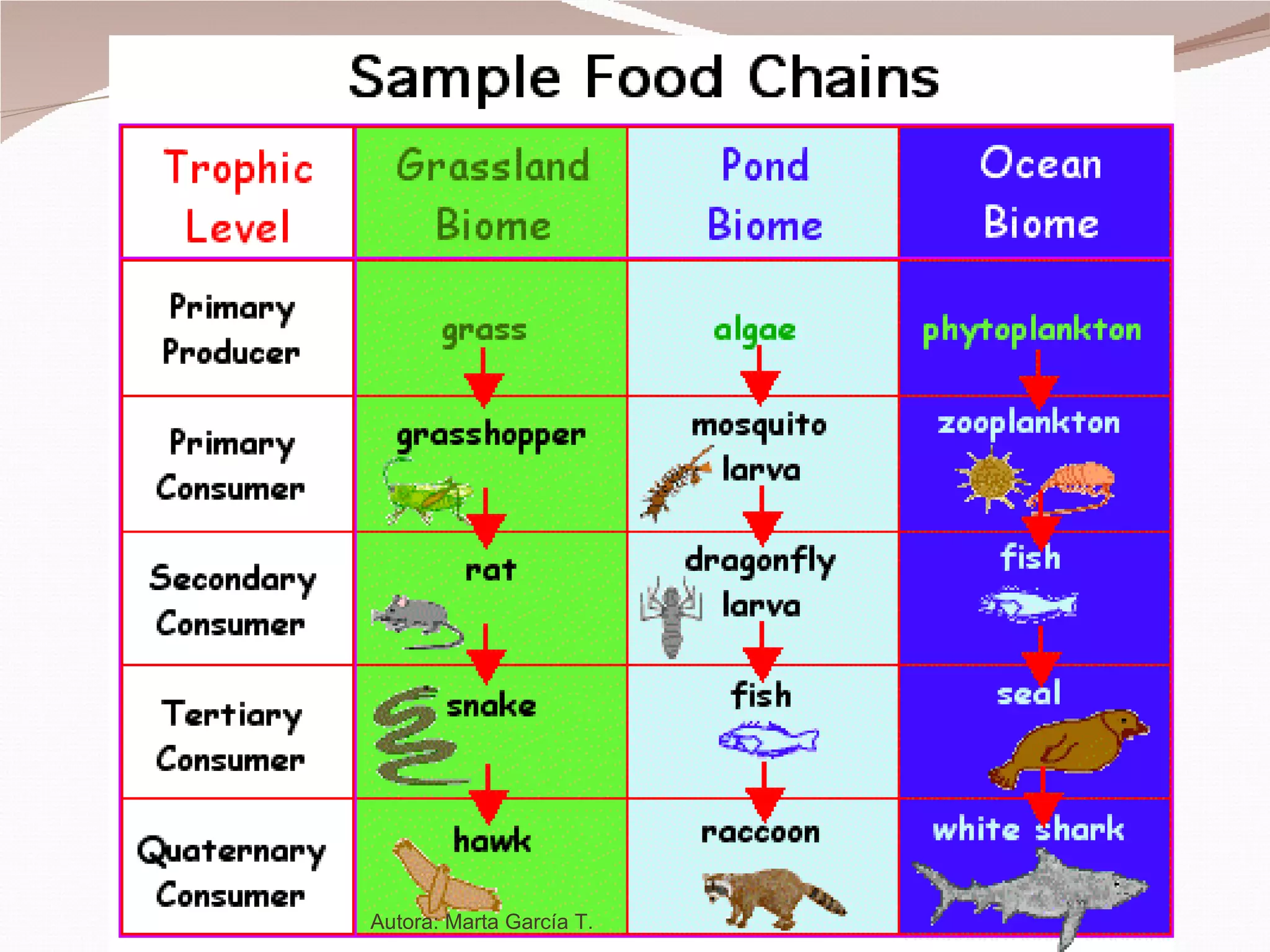
Food   Chains A food chain shows which plants or animals eat or get eaten by others, in an ecosystem. The _______ gets eaten by the _______. Autora: Marta García T.
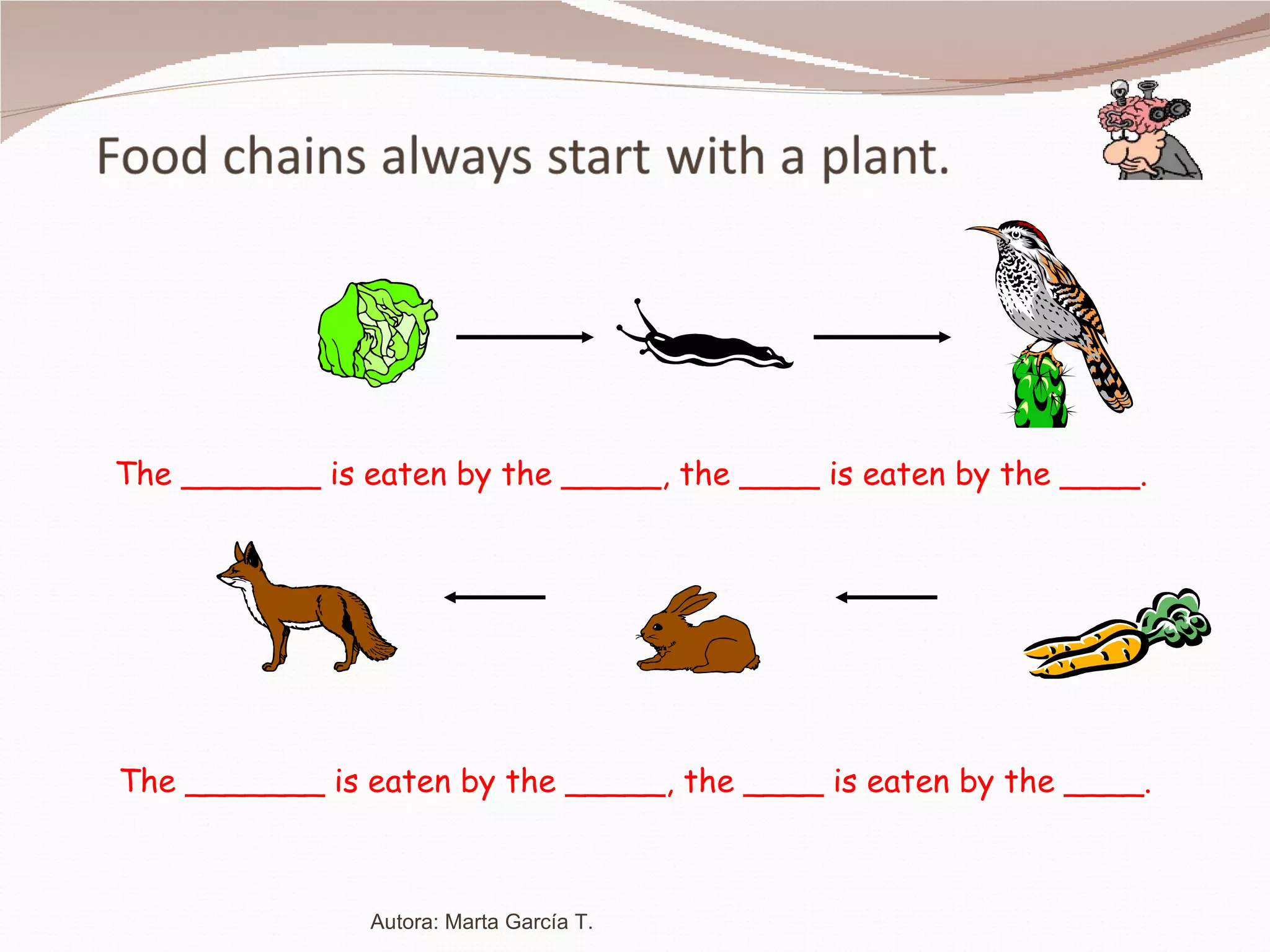
The _______ is eaten by the _____, the ____ is eaten by the ____. The _______ is eaten by the _____, the ____ is eaten by the ____. Autora: Marta García T.
Autora: Marta García T.
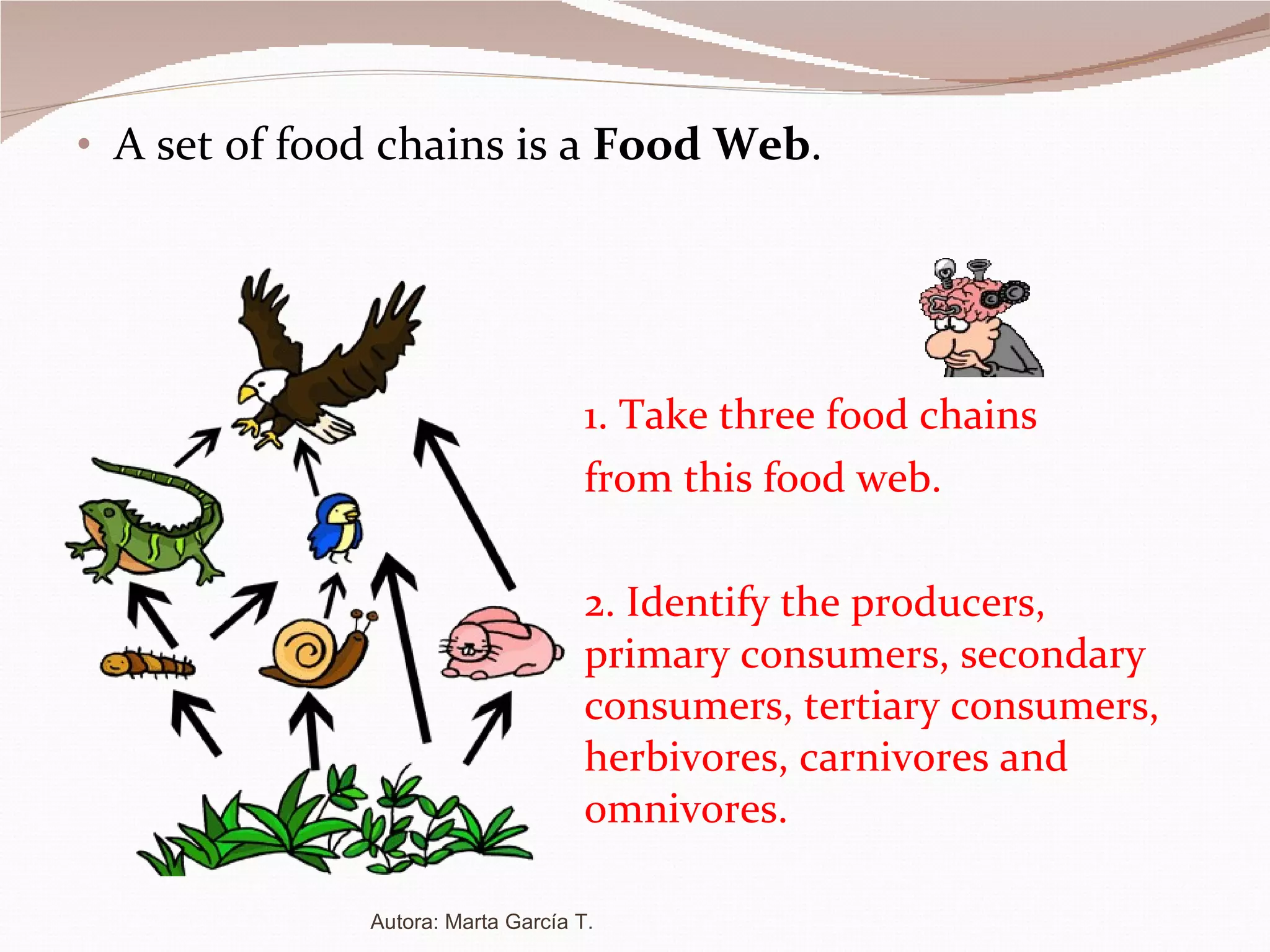
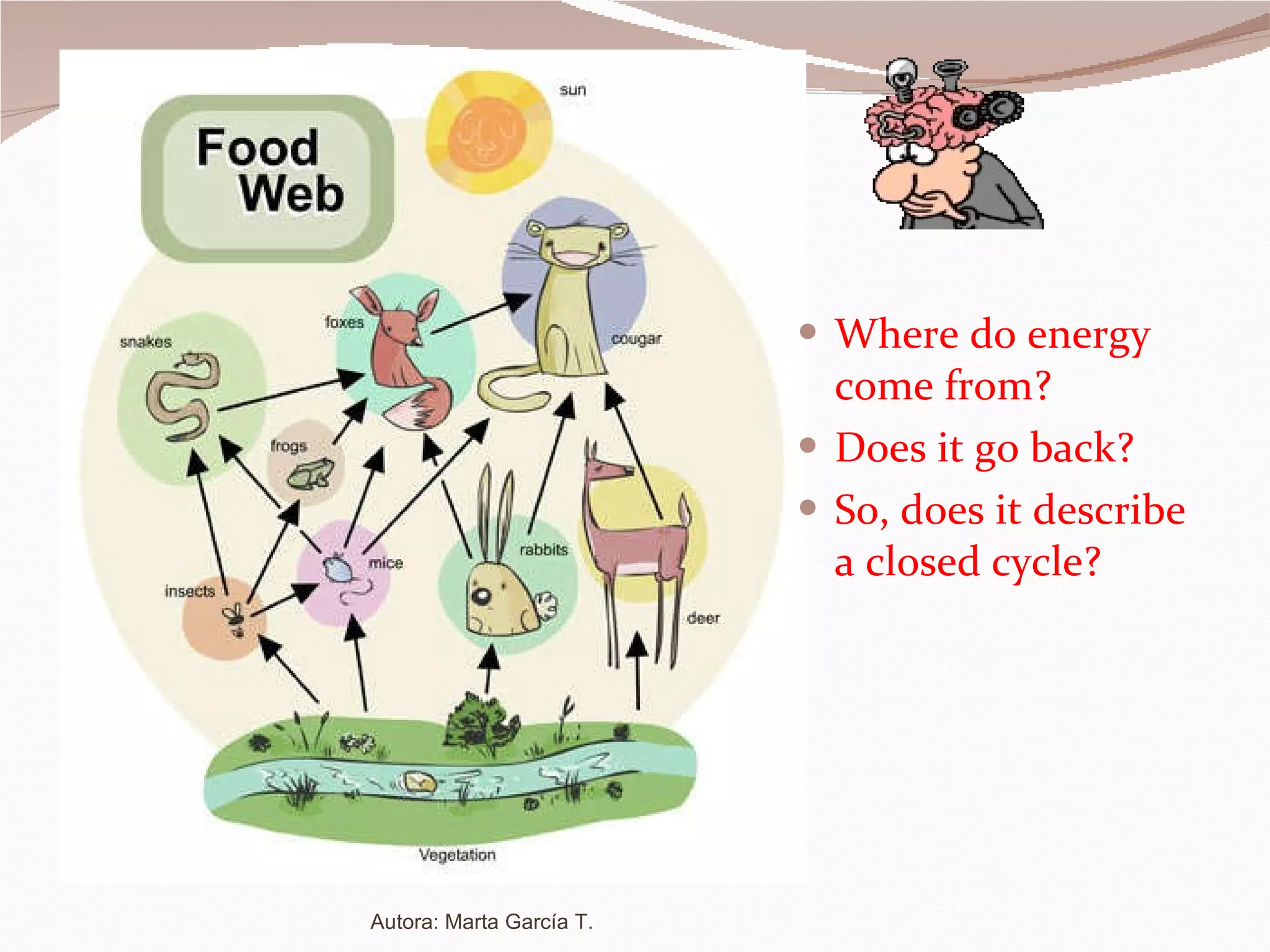
A set of food chains is a  Food Web . 1. Take three food chains  from this food web. 2. Identify the producers,  primary consumers, secondary  consumers, tertiary consumers,  herbivores, carnivores and  omnivores. Autora: Marta García T.
When a member of the trophic web varies in number, the others organisms get affected as well. http://puzzling.caret.cam.ac.uk/game.php?game=foodchain 	http://www.ngfl_cymru.org.uk/vtc/Phase3delivery/Wales/Science/Keystage4/Livingthingsand/Feedingrelation/Introduction/default.htm Autora: Marta García T.
Autora: Marta García T.
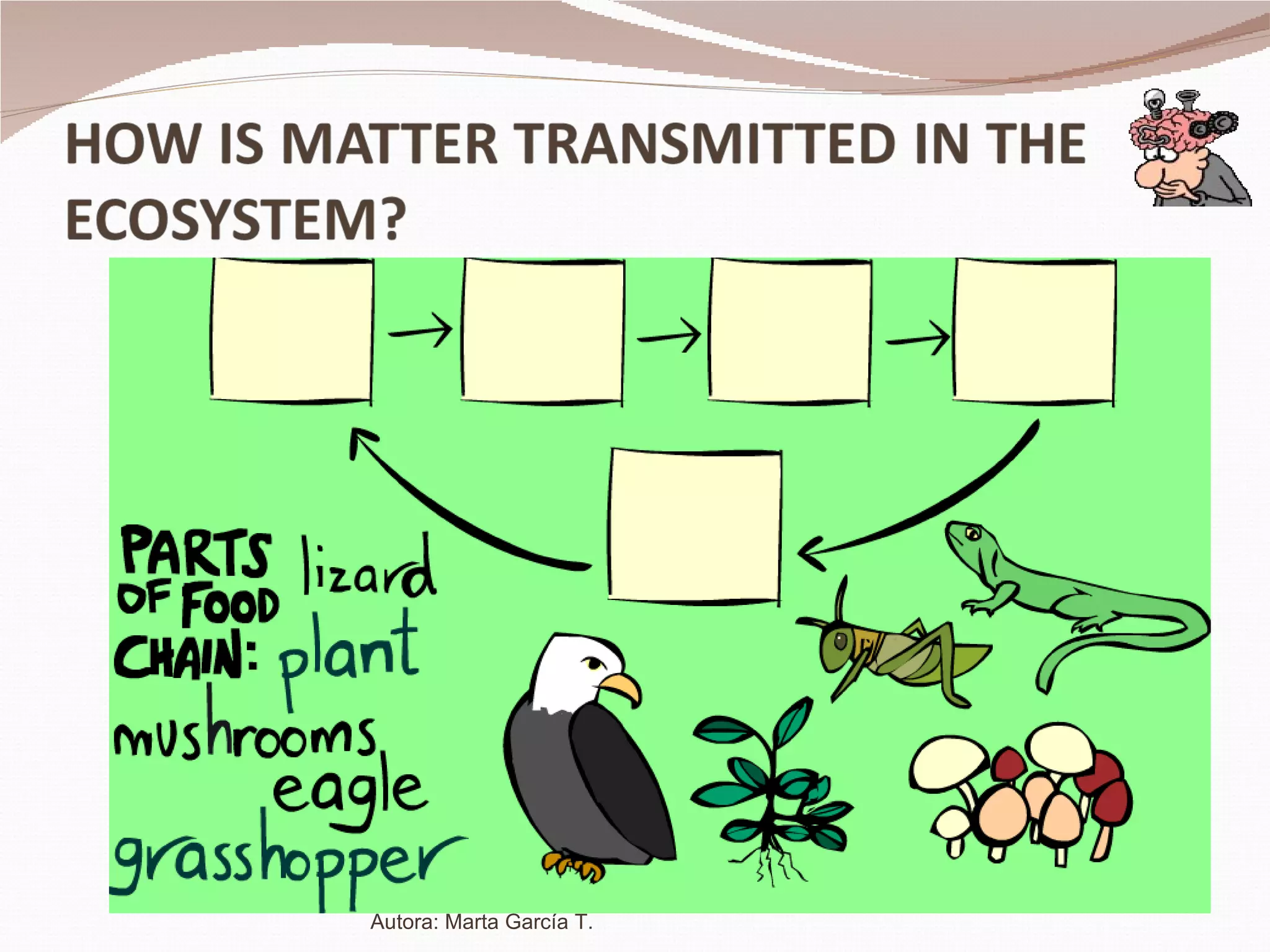
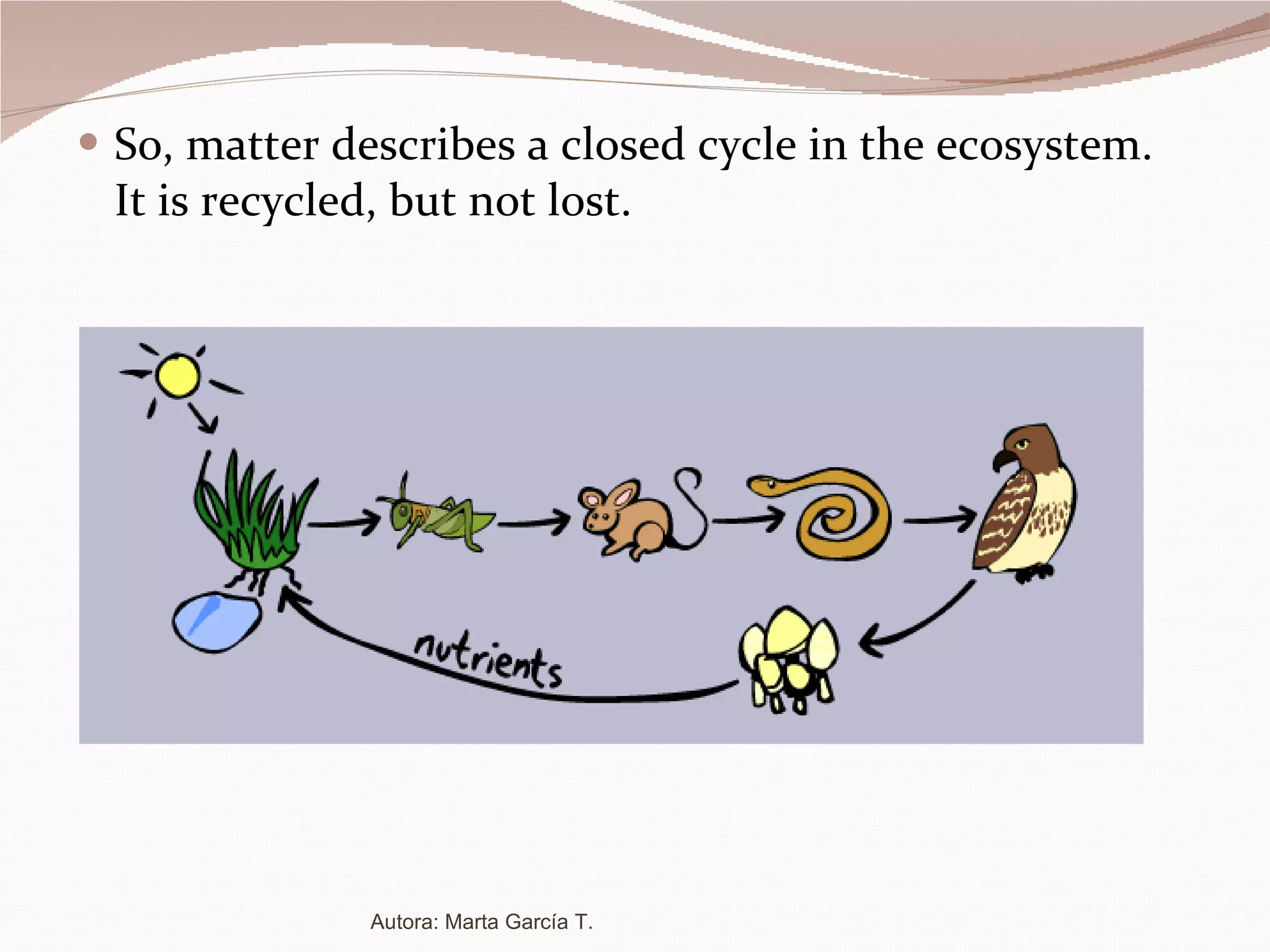
So, matter describes a closed cycle in the ecosystem. It is recycled, but not lost. Autora: Marta García T.
HOW IS ENERGY TRANSMITTED IN THE ECOSYSTEM? Energy gets into the food chain from the sun, and pass through the trophic levels. But it cannot be recycled, because all living things consume energy. So, some energy gets lost as heat. Autora: Marta García T.
Where do energy come from? Does it go back? So, does it describe a closed cycle? Autora: Marta García T.
TROPHIC   PYRAMIDS A trophic pyramid is a graphic representation  of a particular characteristic at each trophic level. Each trophic level is represented by layers of equal height. Autora: Marta García T.
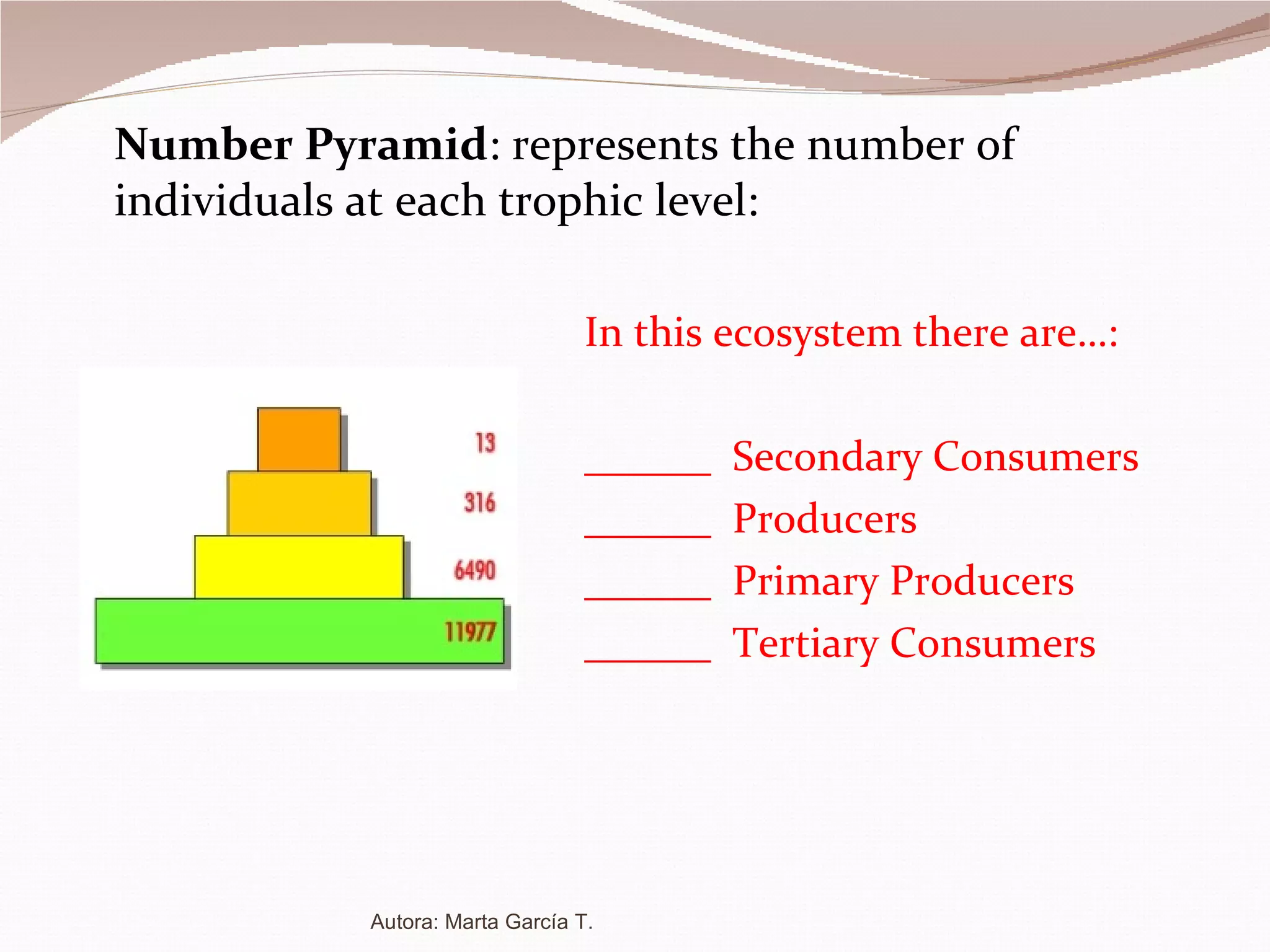
Number Pyramid : represents the number of individuals at each trophic level: In this ecosystem there are…: ______  Secondary Consumers ______  Producers ______  Primary Producers ______  Tertiary Consumers Autora: Marta García T.
Draw this ecosystem’s number pyramid: Grass and trees: 10.000 Butterflies and Grasshoppers: 500 Rabbits: 50 Rats: 50 Snakes: 10 Eagles: 2 Autora: Marta García T.
Biomass Pyramid :  shows the biomass at each trophic level of a food chain. Energy Pyramid : shows the energy contained in each trophic level. Can you think of ecosystems where…: Number Pyramid could be inverted? Biomass Pyramid could be inverted? Energy Pyramid could be inverted? Autora: Marta García T.
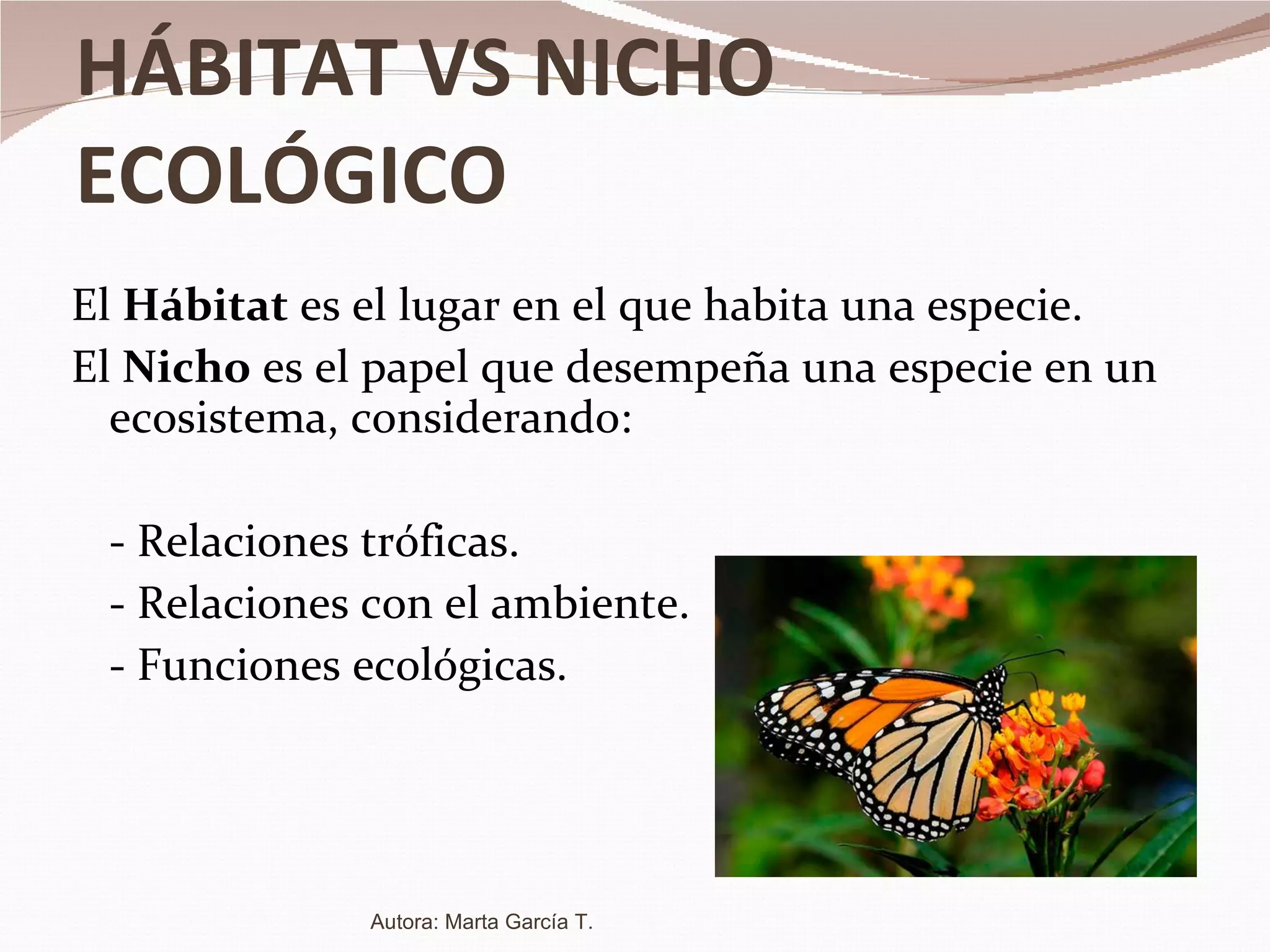
HÁBITAT VS NICHO ECOLÓGICO El  Hábitat  es el lugar en el que habita una especie. El  Nicho  es el papel que desempeña una especie en un ecosistema, considerando: - Relaciones tróficas. - Relaciones con el ambiente. - Funciones ecológicas. Autora: Marta García T.
Autora: Marta García T.
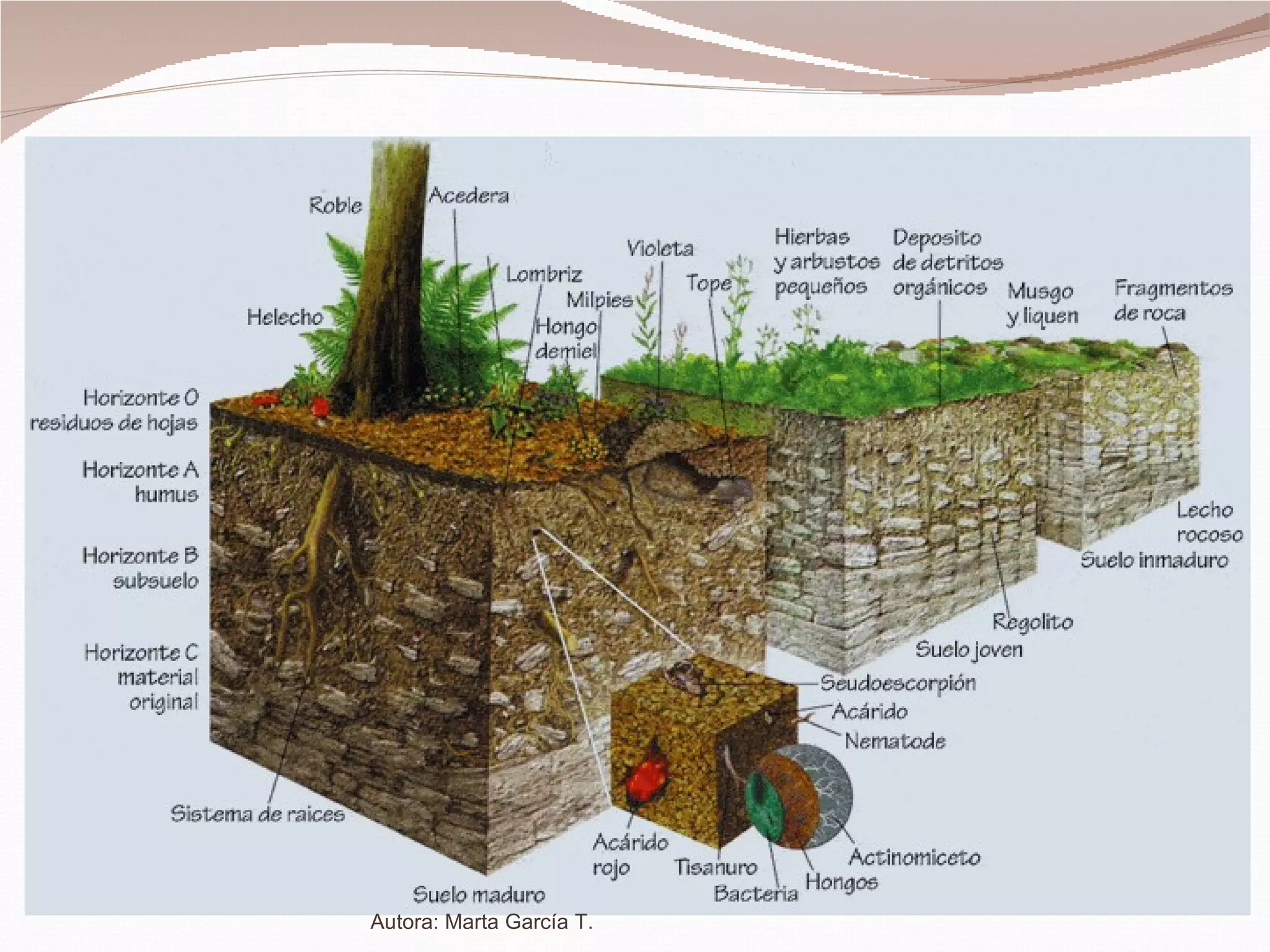
Es la capa más superficial de la corteza terrestre, interfase entre la geosfera, la atmósfera, la hidrosfera  y la biosfera. Componentes: Inorgánicos: agua, gases, arenas, gravas, arcillas, y sales minerales. Orgánicos: seres vivos y humus (materia orgánica en descomposición). Autora: Marta García T.
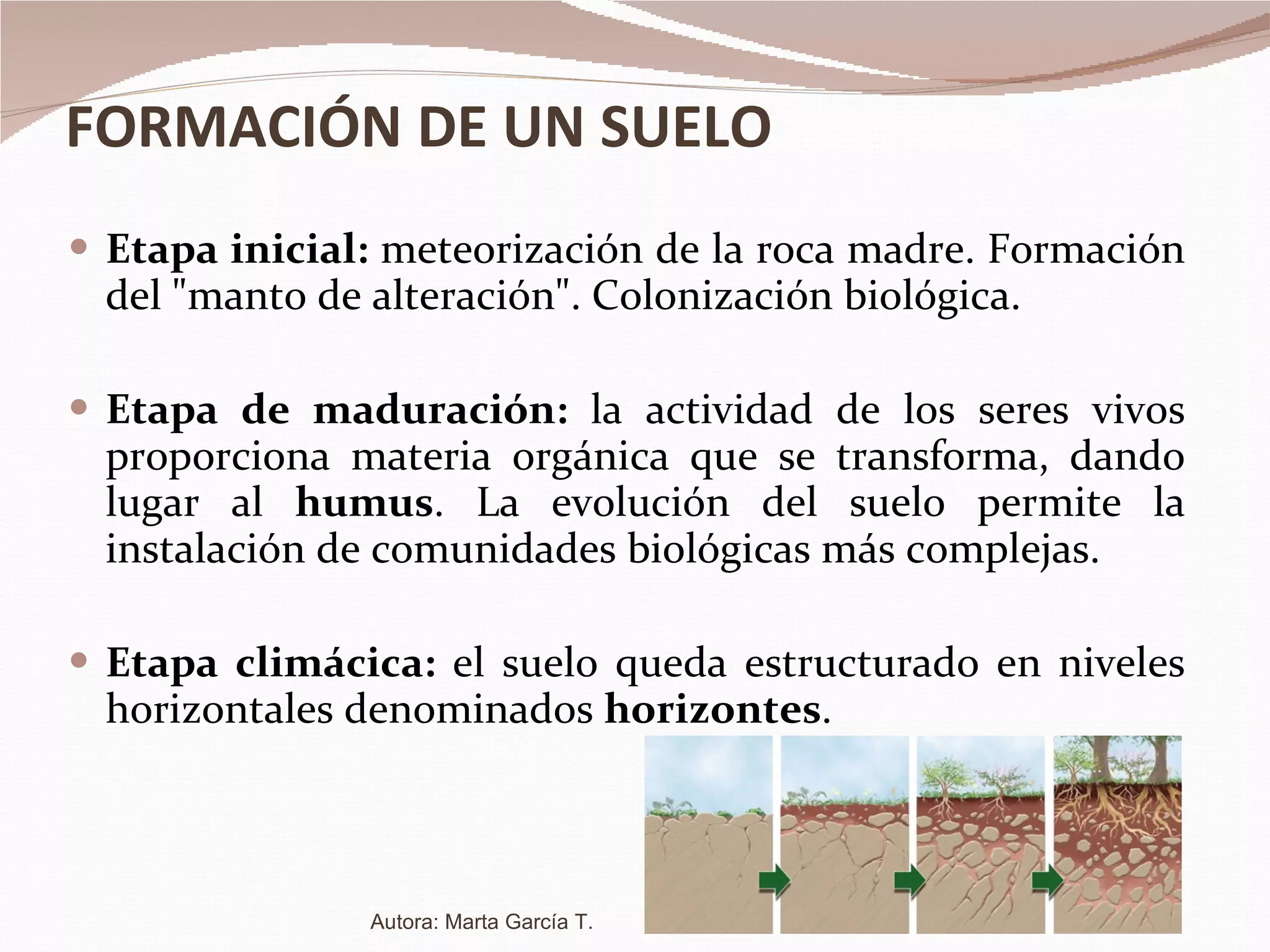
FORMACIÓN DE UN SUELO Etapa inicial:  meteorización de la roca madre. Formación del "manto de alteración". Colonización biológica.  Etapa de maduración:  la actividad de los seres vivos proporciona materia orgánica que se transforma, dando lugar al  humus . La evolución del suelo permite la instalación de comunidades biológicas más complejas. Etapa climácica:  el suelo queda estructurado en niveles horizontales denominados  horizontes .  Autora: Marta García T.
Autora: Marta García T.
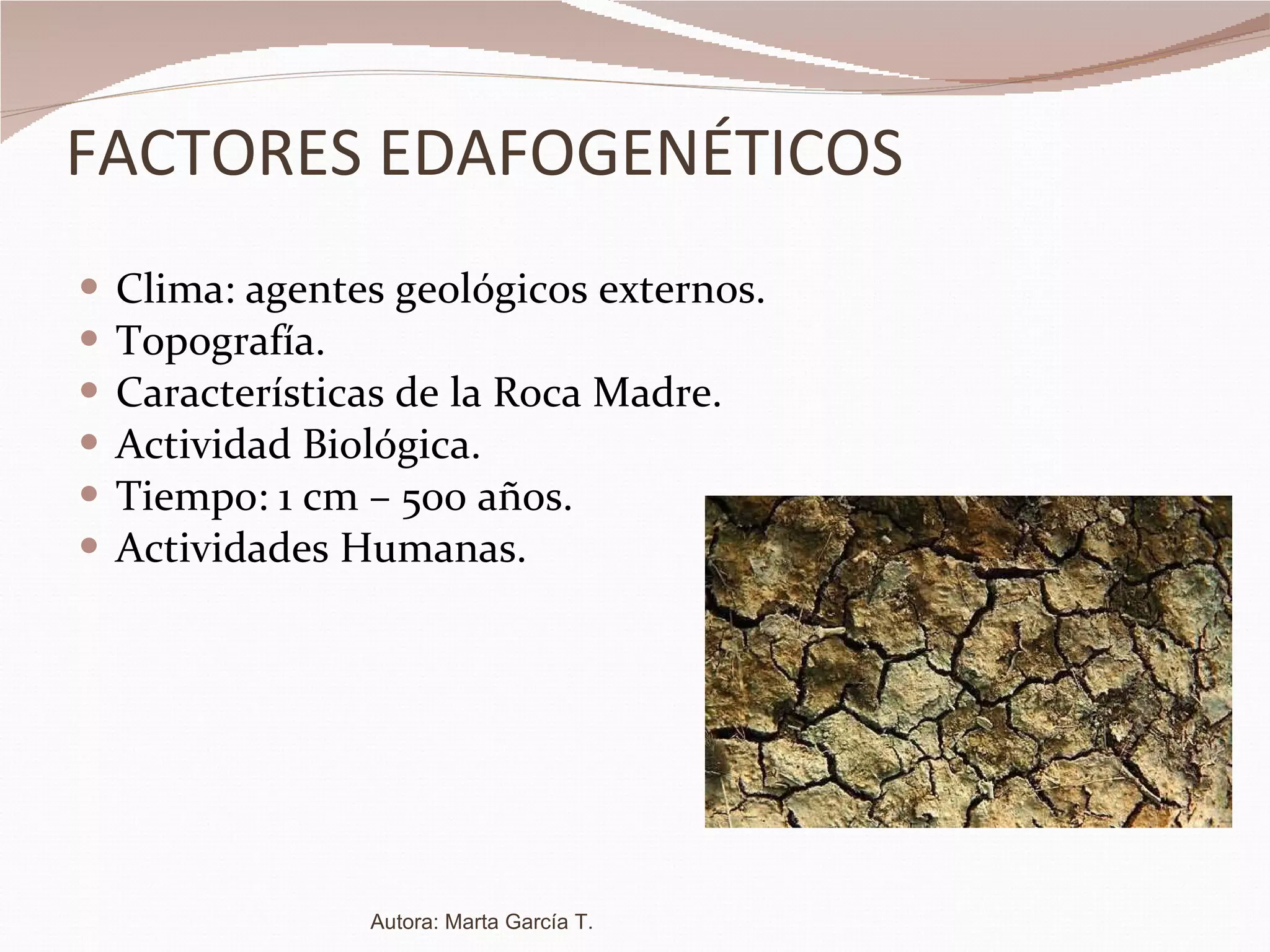
FACTORES EDAFOGENÉTICOS Clima: agentes geológicos externos. Topografía. Características de la Roca Madre. Actividad Biológica. Tiempo: 1 cm – 500 años. Actividades Humanas. Autora: Marta García T.
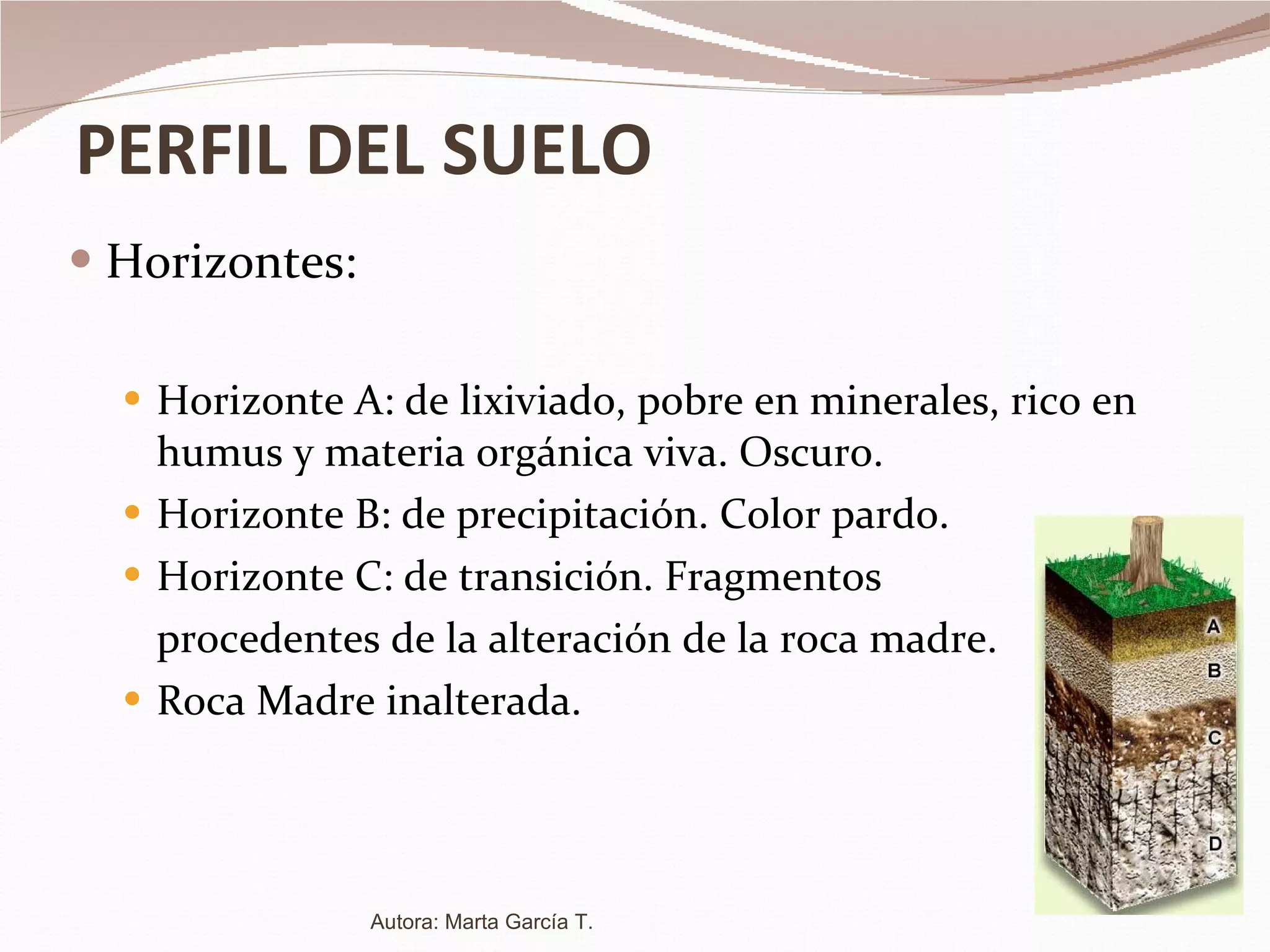
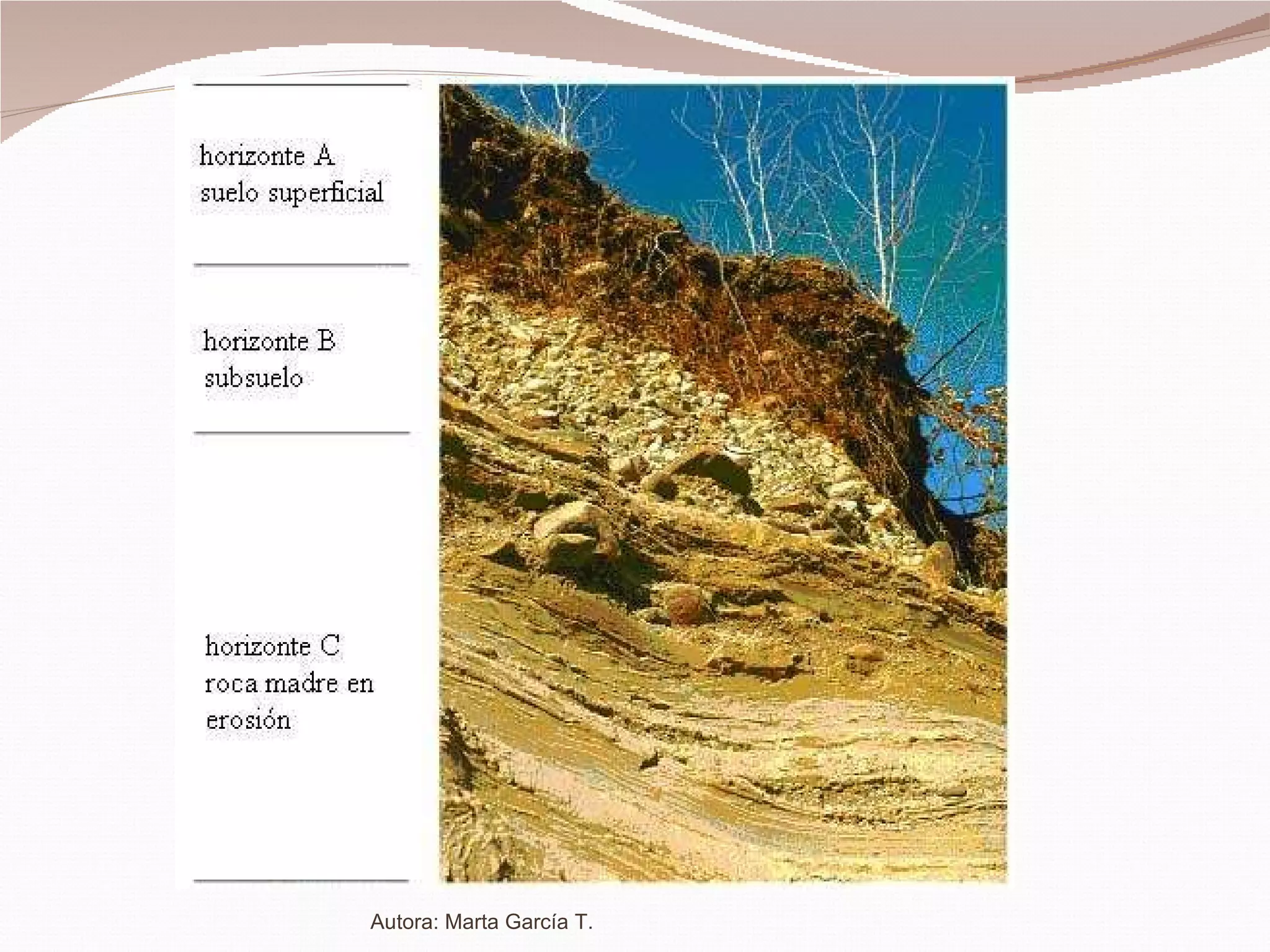
PERFIL DEL SUELO Horizontes: Horizonte A: de lixiviado, pobre en minerales, rico en humus y materia orgánica viva. Oscuro. Horizonte B: de precipitación. Color pardo. Horizonte C: de transición. Fragmentos  procedentes de la alteración de la roca madre. Roca Madre inalterada. Autora: Marta García T.
Autora: Marta García T.
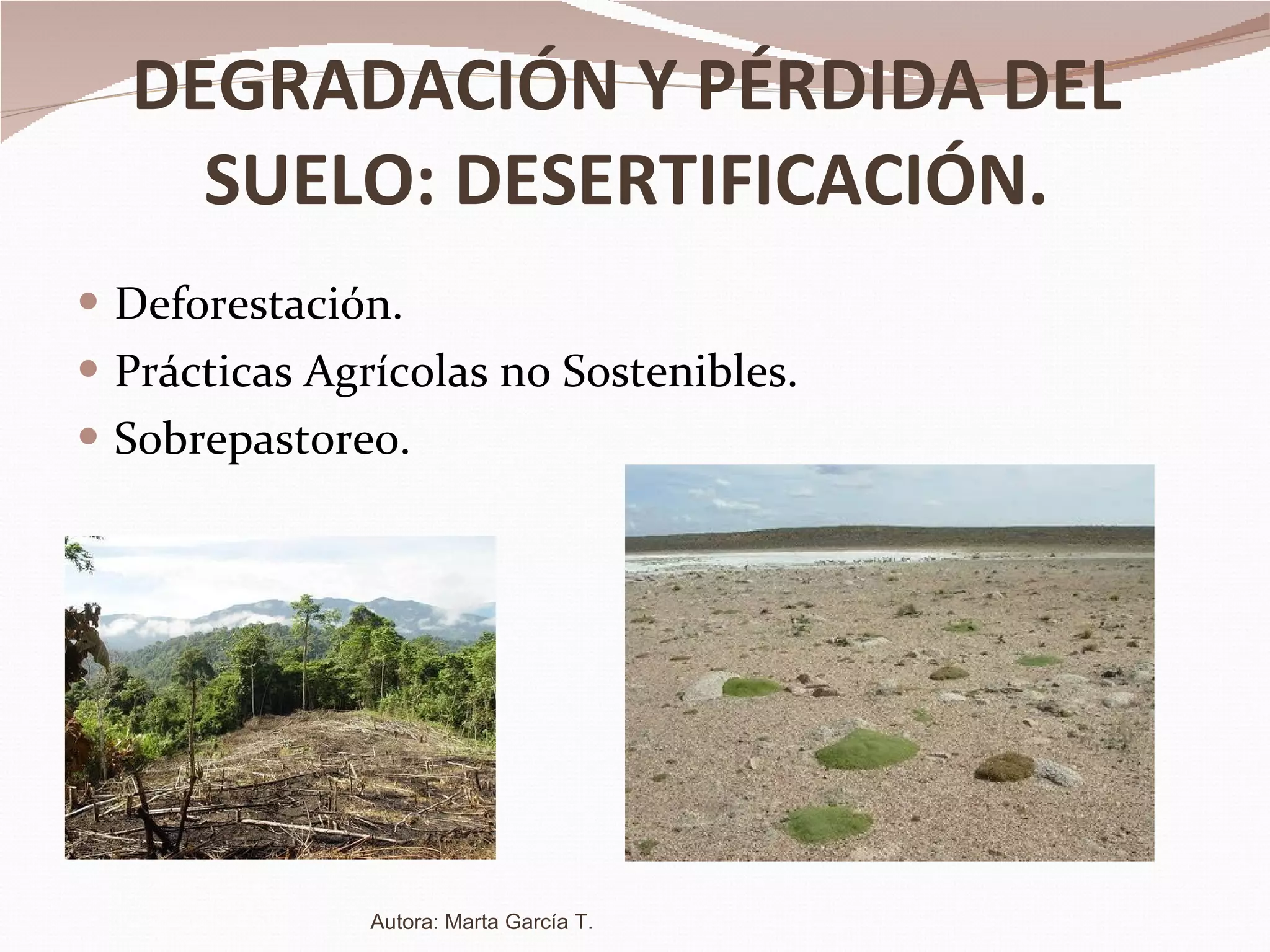
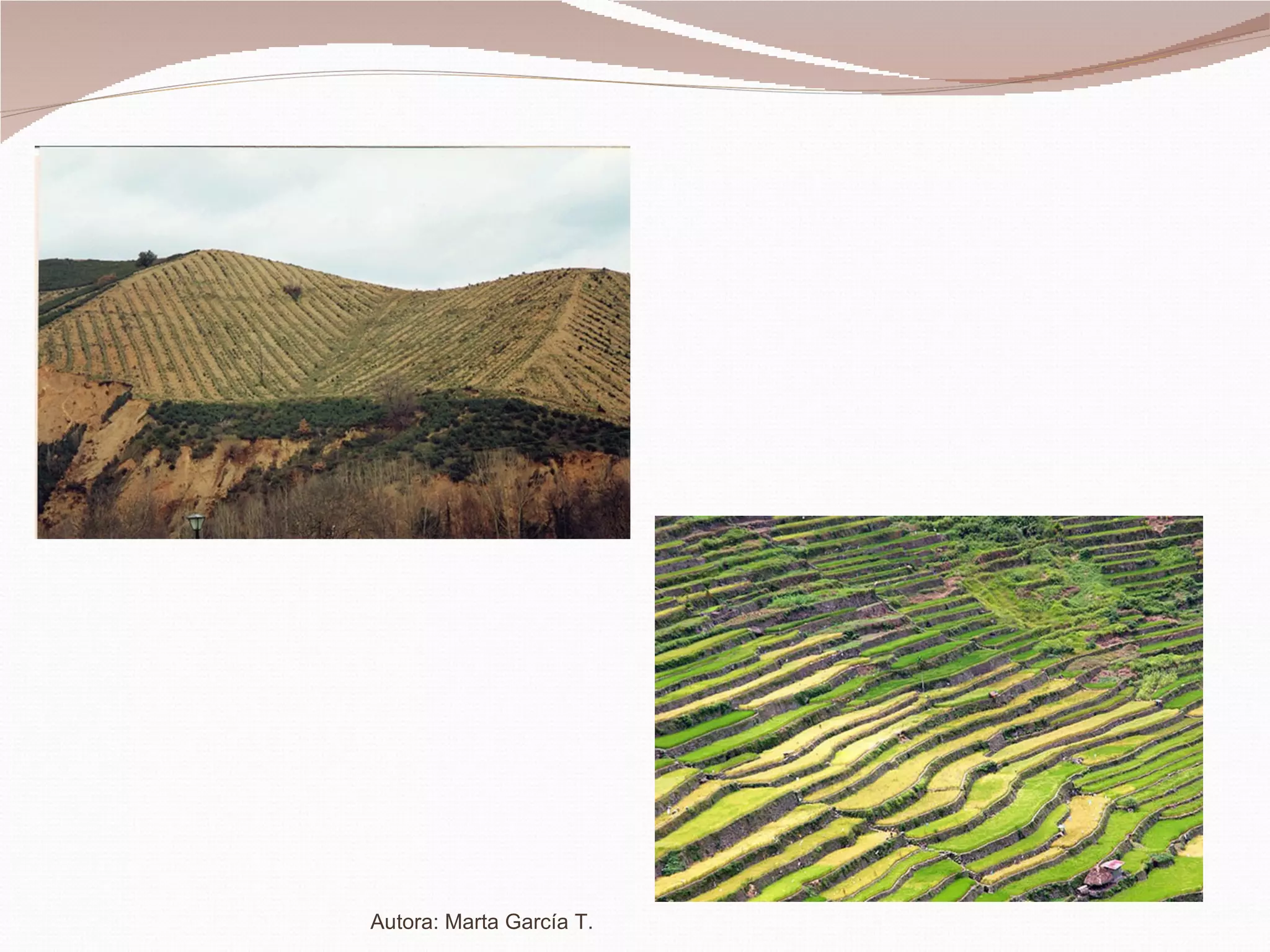
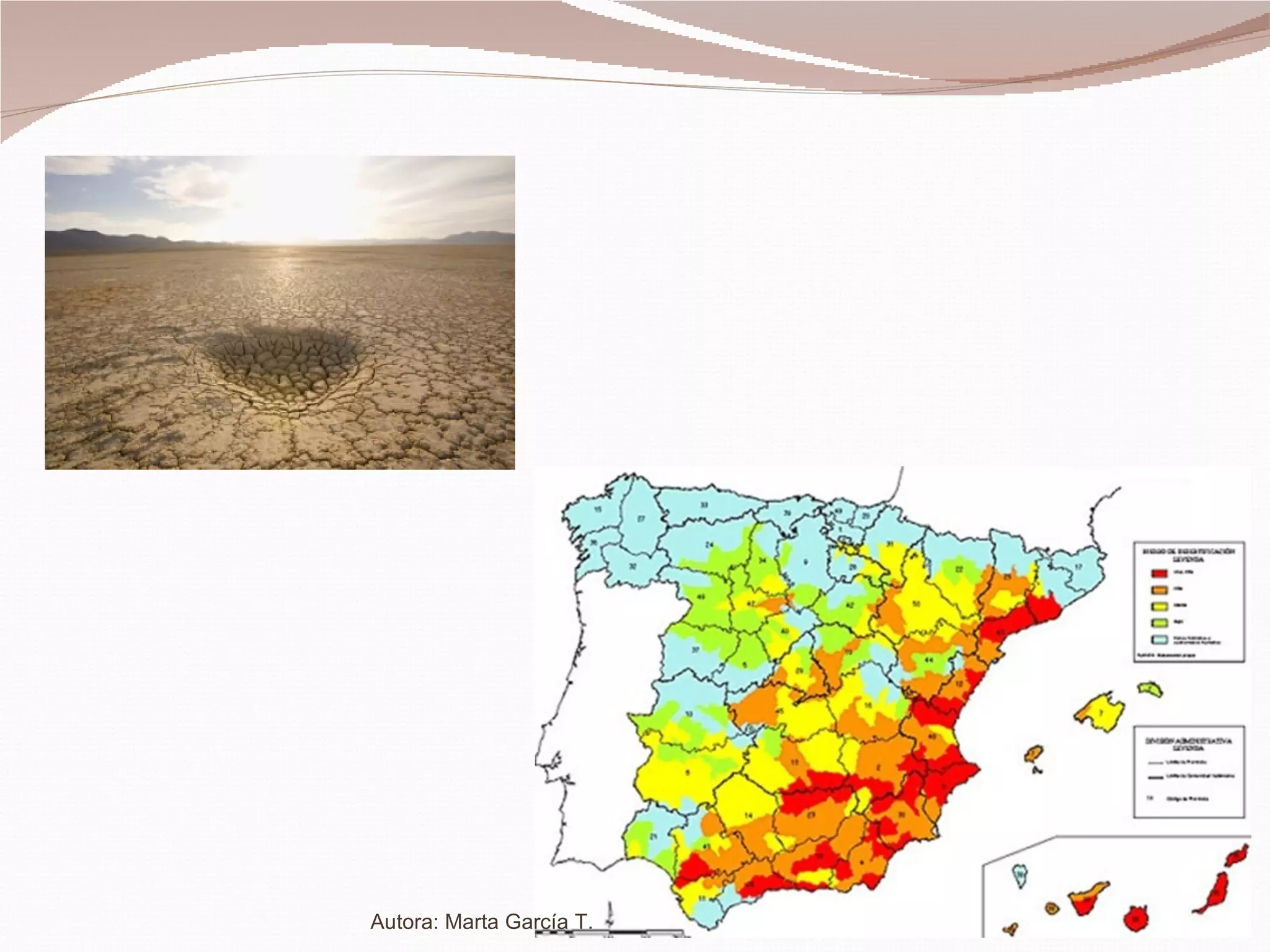
DEGRADACIÓN Y PÉRDIDA DEL SUELO: DESERTIFICACIÓN. Deforestación. Prácticas Agrícolas no Sostenibles. Sobrepastoreo. Autora: Marta García T.
Autora: Marta García T.
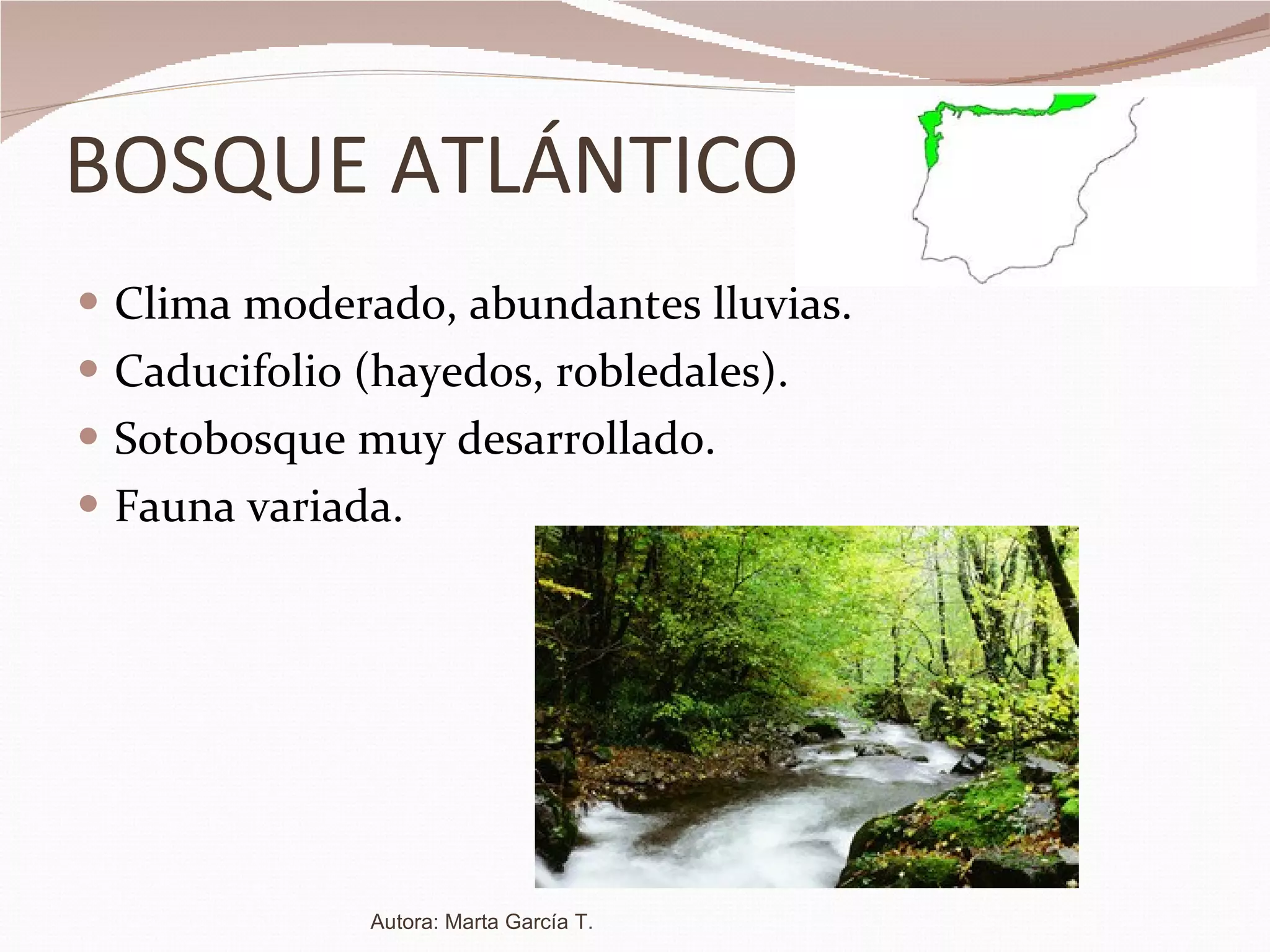
BOSQUE ATLÁNTICO Clima moderado, abundantes lluvias. Caducifolio (hayedos, robledales). Sotobosque muy desarrollado. Fauna variada. Autora: Marta García T.
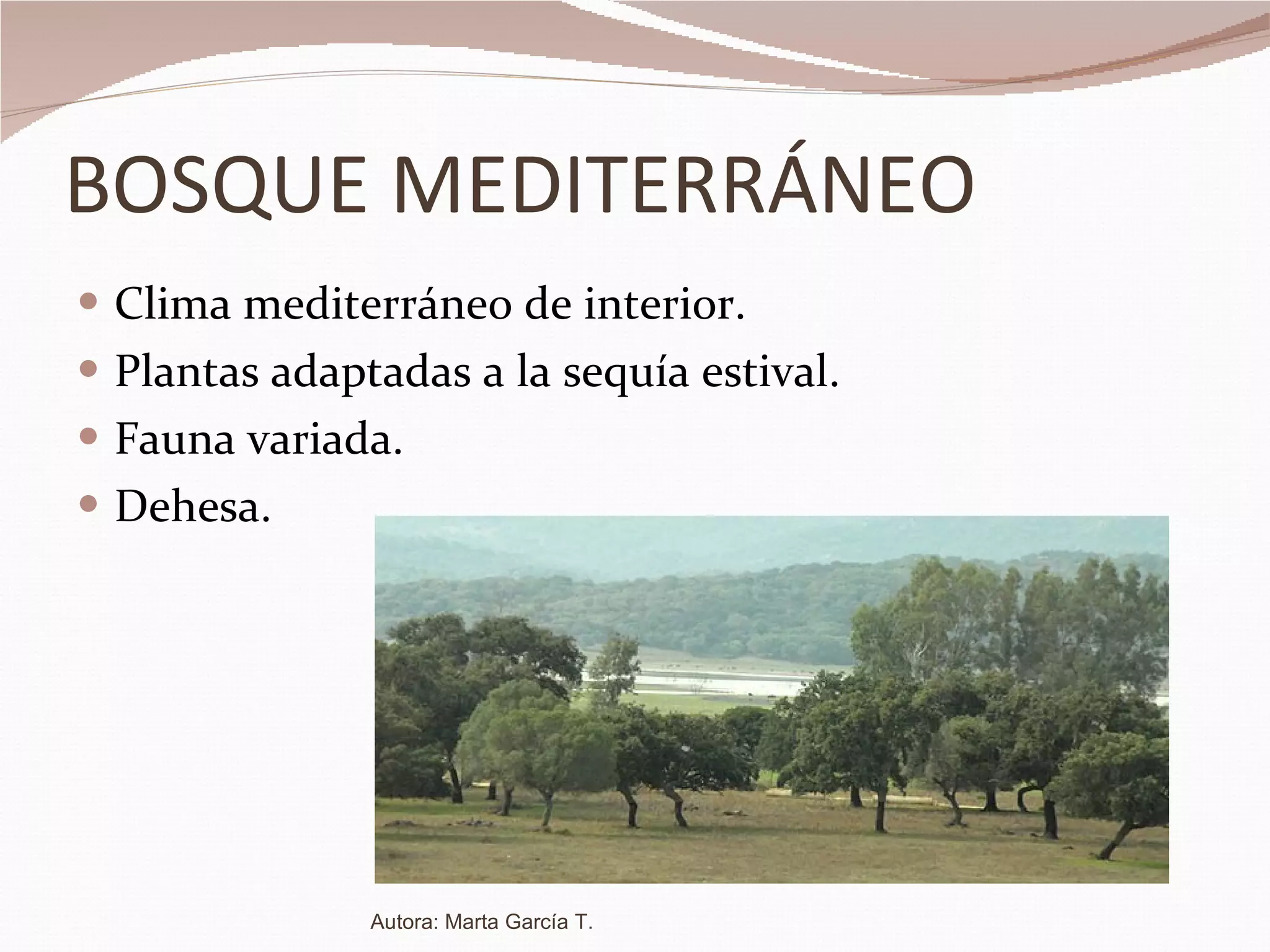
BOSQUE MEDITERRÁNEO Clima mediterráneo de interior. Plantas adaptadas a la sequía estival. Fauna variada. Dehesa. Autora: Marta García T.
Autora: Marta García T.
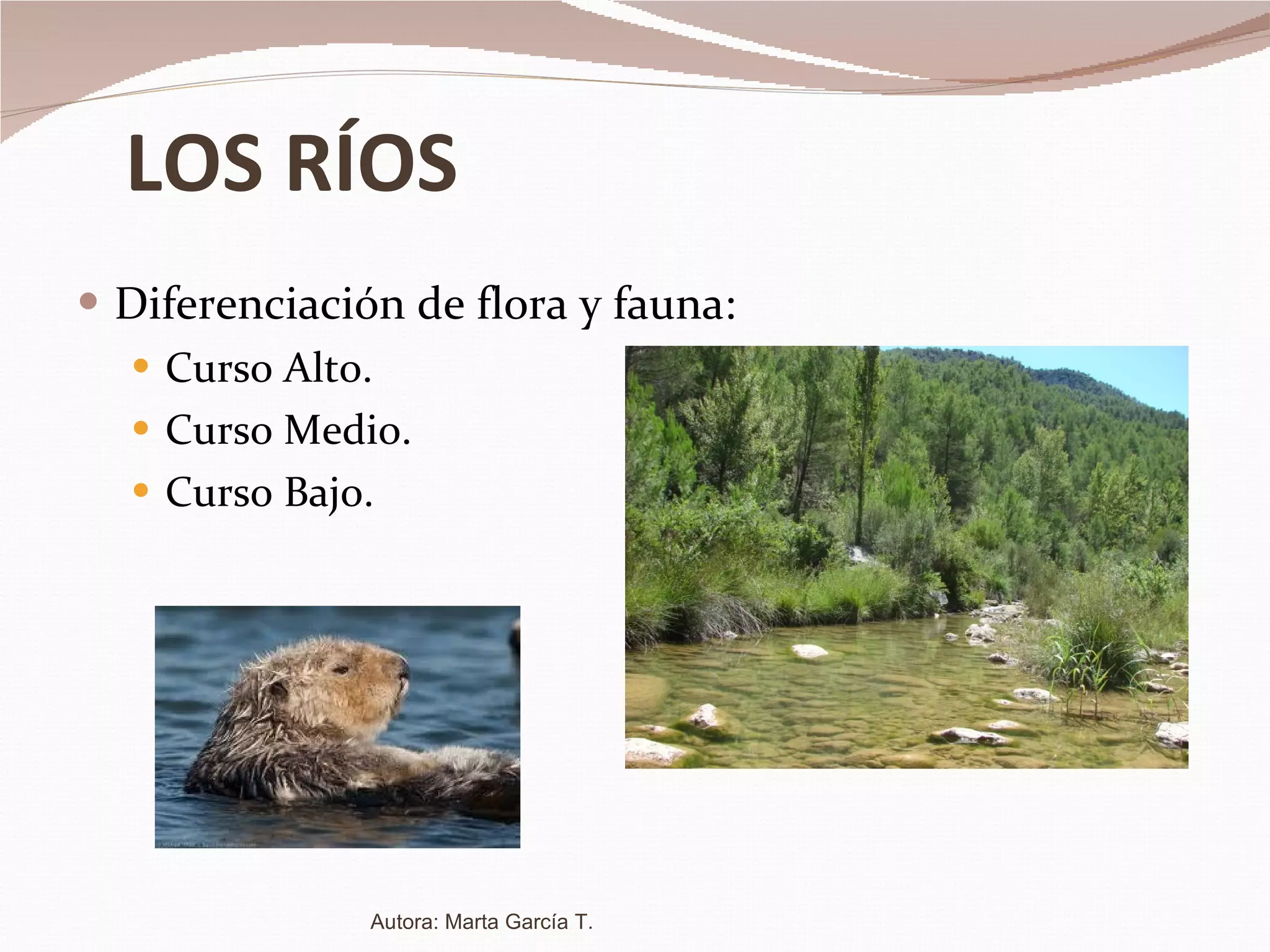
LOS RÍOS Diferenciación de flora y fauna: Curso Alto. Curso Medio. Curso Bajo. Autora: Marta García T.
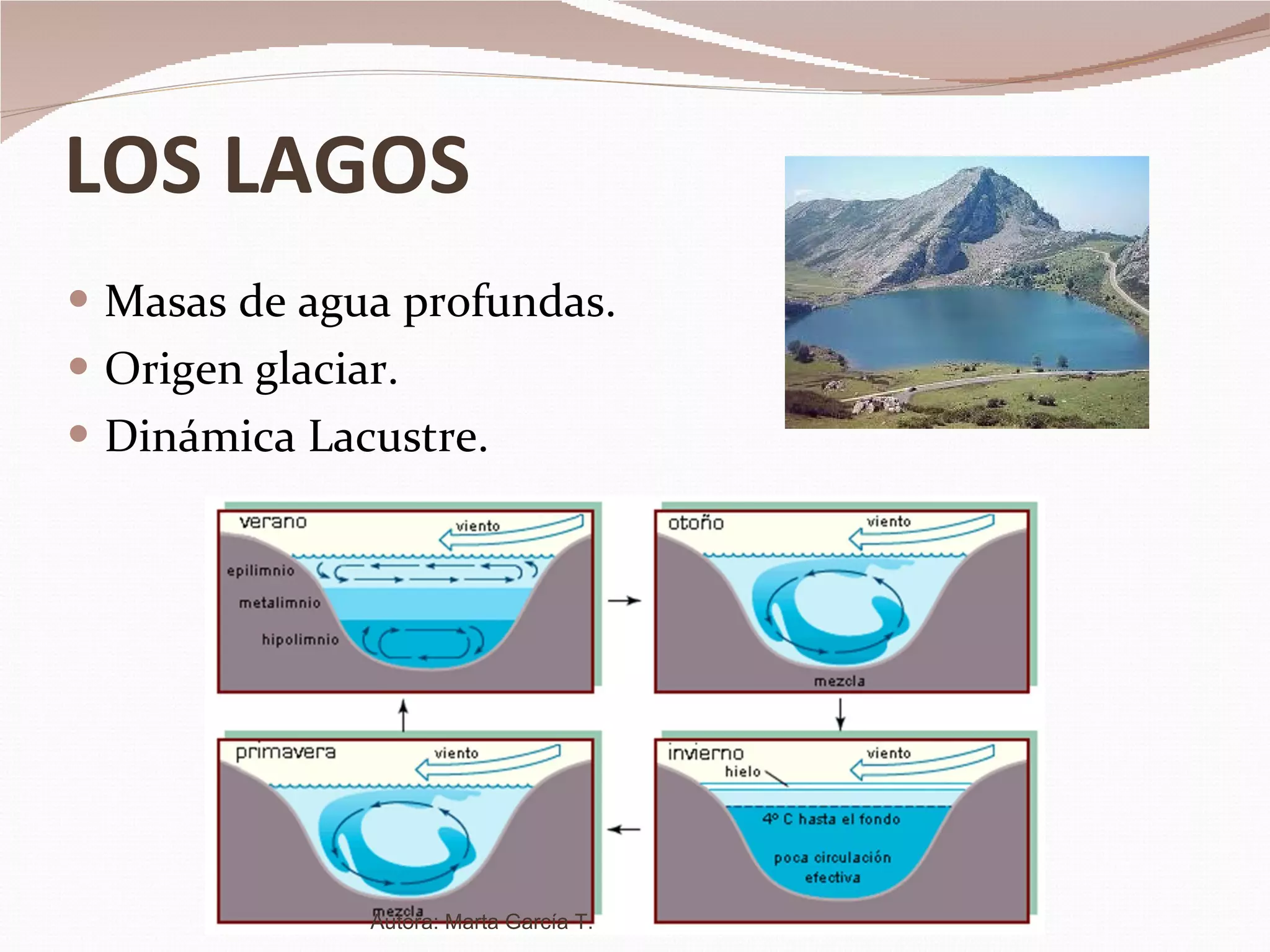
LOS LAGOS Masas de agua profundas. Origen glaciar. Dinámica Lacustre. Autora: Marta García T.
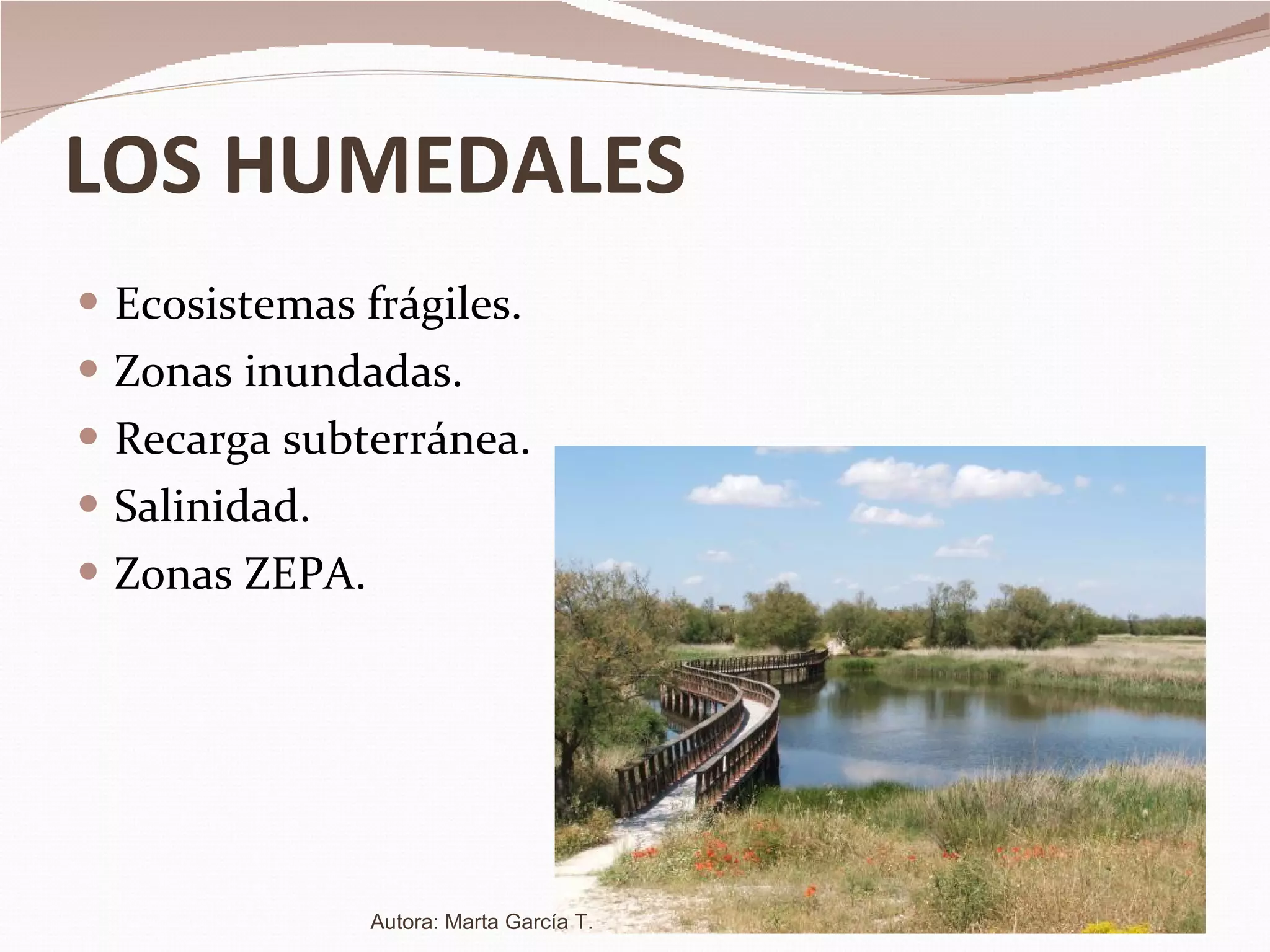
LOS HUMEDALES Ecosistemas frágiles. Zonas inundadas. Recarga subterránea. Salinidad. Zonas ZEPA. Autora: Marta García T.
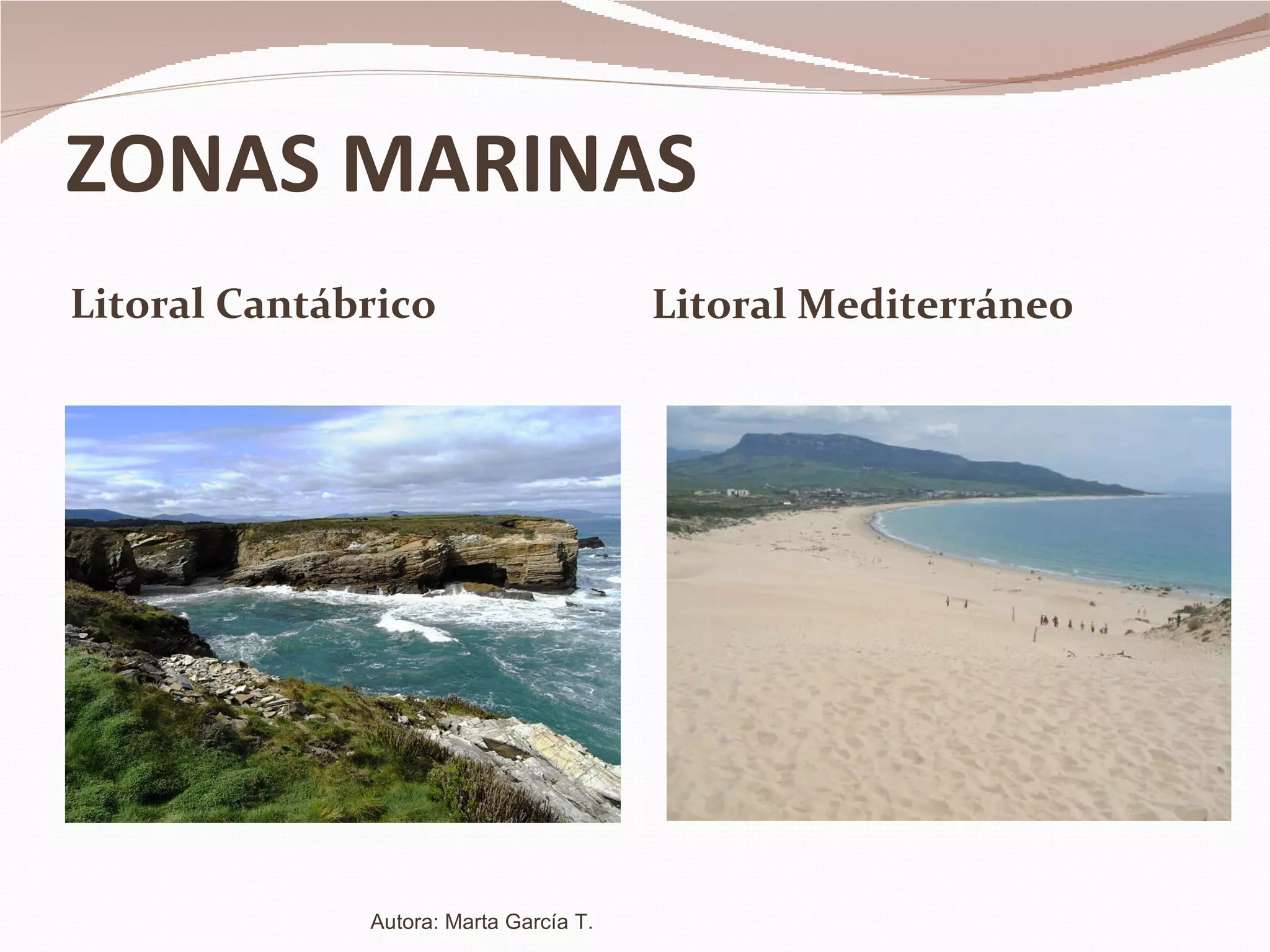
ZONAS MARINAS Litoral Cantábrico Litoral Mediterráneo Autora: Marta García T.
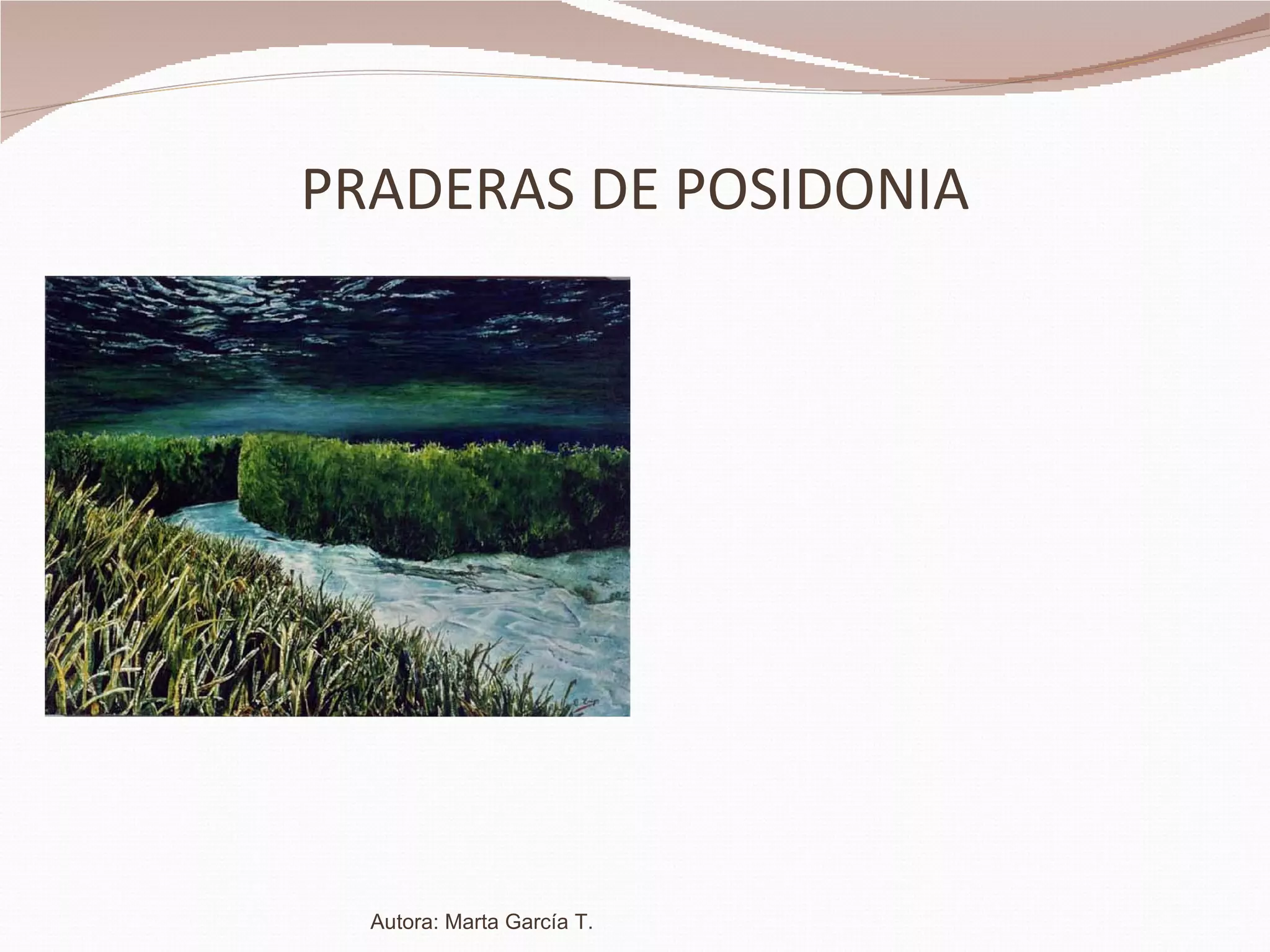
PRADERAS DE POSIDONIA Autora: Marta García T.

The structure of ecosystems

  • 1.
  • 2.
    THE ENVIRONMENT Itrefers to all biotic and abiotic (physical and chemical) conditions at a certain place. Autora: Marta García T.
  • 3.
    Factores Limitantes: Rangode Tolerancia. Zona Óptima. Autora: Marta García T.
  • 4.
    BIOTIC FACTORS Autora:Marta García T.
  • 5.
    BIOTIC RELATIONS Areinteractions among the living things in an ecosystem. There are two types: Intraspecific Relations : among organisms of the same species. 2. Intersepecific Relations: among organisms of different species. Autora: Marta García T.
  • 6.
    Intraspecific Relations: Familial: groups of related individuals which live together. Gregarious : groups of individuals which live together for some time to get a benefit. Colonial : related individuals live physically fixed. Social : groups of organisms organised to do different jobs for the comunity. Autora: Marta García T.
  • 7.
    What kind ofintraspecific relation…? Familial Social Colonial Gregarious Autora: Marta García T.
  • 8.
    Interespecific Relations :Depredation : predator kills and eats the prey. Parasitism : parasite lives at the expense of the host, and harms it. Mutualism : two individuals get mutual benefit. Commensalism : one individual gets benefit, but the other is not affected. Inquilinism : one species, the inquiline, makes use of a host's nest or habitat without causing any detriment to the host. Competition : the interaction between two or more organisms, or groups of organisms, that use a common resource in short supply. Autora: Marta García T.
  • 9.
    What kind ofinterespecific relation….? Parasitism Depredation Mutualism Commensalism Autora: Marta García T.
  • 10.
    Parasitism Inquilinism Competition Commensalism Autora: Marta García T.
  • 11.
  • 12.
    WHAT IS ANECOSYSTEM? Ecosystem = Biotope + Biocenosis Biotope : is the inorganic part (non living things) in an ecosystem. Biocenosis : is the set of living things in an ecosystem. Autora: Marta García T.
  • 13.
    Biomes arethe large-scale ecosystems of the world (desert, rainforest, tundra, taiga, grassland, mediterranean forest and deciduous forest). http://recursos.cnice.mec.es/biosfera/alumno/2ESO/Energia_ecosistemas/actividad3.htm Biosphere includes all the living things of the world. Ecosphere includes all the ecosystems of the world. Autora: Marta García T.
  • 14.
    TERRESTRIAL ECOSYSTEMS Areecosystems where organisms can live on land, surrounded by air. They can be natural or man-made. The distribution of organisms depends on abiotic factors, which are related to the climate: Temperature. Light. Humidity. Autora: Marta García T.
  • 15.
    There are threelarge climate zones in each hemisphere, and we can find different biomes in them: Frigid Zone Temperate Zone Torrid Zone Autora: Marta García T.
  • 16.
    Match the columnsCLIMATE ZONES ECOSYSTEMS Frigid Zone Temperate Zone Torrid Zone Dessert Grassland Tundra Decidous Forest Taiga Rainforest Mediterranean Forest http://www.kidsknowit.com/interactive-educational-movies/free-online-movies.php?movie=biomes Autora: Marta García T.
  • 17.
    AQUATIC ECOSYSTEMS Theyare ecosystems where organisms live sorrounded by water. The main abiotic factors are: Light. Temperature. Salinity. Oxygen. Pressure. Density. Water Movements. Viscosity. Autora: Marta García T.
  • 18.
    How do youthink these factors vary with depth? Ligth __________ with depth. Pressure __________ with depth. Temperature __________ with depth. Oxygen __________ with depth. Autora: Marta García T.
  • 19.
    There are twotypes of aquatic ecosystems: Freshwater Ecosystems : with less salinity. Ex: rivers, lakes, marshes. Autora: Marta García T.
  • 20.
    2. Marine Ecosystems : more salty. We can find three types of organisms: Plankton : tiny plants and animals of the ocean that serve as food for ocean creatures. Necton : animals that can move freely up and down in the water. Bentos : plants and animals who live on the ocean floor. Autora: Marta García T.
  • 21.
    Plankton, bentos ornecton? Autora: Marta García T.
  • 22.
    Flippers to helpit swim. Streamlined shape. Thick layer of body fat to keep it warm. Strong teeth to catch fish. Forward-facing eyes for clear vision ahead. Hind legs have evolved into a a strong rudder-like tail. How is the seal adapted to its environment? Autora: Marta García T.
  • 23.
    Which is theHabitat for each organism? Artic Bear Camel Parrot Rabbit Crab Marmot Ilex Shark Trout Desert Rainforest Poles Mediterranean Forest Grassland Coastland Ocean River Autora: Marta García T.
  • 24.
  • 25.
    HOW DO LIVINGTHINGS OBTAIN FOOD? All living things can be classified according to the way they obtain food. These are the Trophic Levels (3). Where do they obtain their food from?: Autora: Marta García T.
  • 26.
    1. Producers Producers make their own food organic matter) from carbon dioxide, water and mineral salts. They have autotrophic nutrition. Plants, algae and some bacteria are producers. Autora: Marta García T.
  • 27.
    2. Consumers Consumers eat (consume) food provided by plants or other animals. They have heterotrophic nutrition. There are three types of consumers. Can you guess? Autora: Marta García T.
  • 28.
    Herbivores arecalled Primary Consumers . They only eat producers. Secondary Consumers can be carnivores or omnivores . Tertiary Consumers feed on primary and secondary consumers. Some of them feed on producers, as well. Autora: Marta García T.
  • 29.
    Some animals arepredators, some are prey, some are both. The predator eats the prey, and the prey gets eaten by the predator. Autora: Marta García T.
  • 30.
    3. Decomposers Theydecompose organic matter (dead animals and plants) into inorganic matter. This inorganic matter (mineral salts) is used again by producers. Bacteria and fungi are decomposer. Autora: Marta García T.
  • 31.
    Food Chains A food chain shows which plants or animals eat or get eaten by others, in an ecosystem. The _______ gets eaten by the _______. Autora: Marta García T.
  • 32.
    The _______ iseaten by the _____, the ____ is eaten by the ____. The _______ is eaten by the _____, the ____ is eaten by the ____. Autora: Marta García T.
  • 33.
  • 34.
    A set offood chains is a Food Web . 1. Take three food chains from this food web. 2. Identify the producers, primary consumers, secondary consumers, tertiary consumers, herbivores, carnivores and omnivores. Autora: Marta García T.
  • 35.
    When a memberof the trophic web varies in number, the others organisms get affected as well. http://puzzling.caret.cam.ac.uk/game.php?game=foodchain http://www.ngfl_cymru.org.uk/vtc/Phase3delivery/Wales/Science/Keystage4/Livingthingsand/Feedingrelation/Introduction/default.htm Autora: Marta García T.
  • 36.
  • 37.
    So, matter describesa closed cycle in the ecosystem. It is recycled, but not lost. Autora: Marta García T.
  • 38.
    HOW IS ENERGYTRANSMITTED IN THE ECOSYSTEM? Energy gets into the food chain from the sun, and pass through the trophic levels. But it cannot be recycled, because all living things consume energy. So, some energy gets lost as heat. Autora: Marta García T.
  • 39.
    Where do energycome from? Does it go back? So, does it describe a closed cycle? Autora: Marta García T.
  • 40.
    TROPHIC PYRAMIDS A trophic pyramid is a graphic representation of a particular characteristic at each trophic level. Each trophic level is represented by layers of equal height. Autora: Marta García T.
  • 41.
    Number Pyramid :represents the number of individuals at each trophic level: In this ecosystem there are…: ______ Secondary Consumers ______ Producers ______ Primary Producers ______ Tertiary Consumers Autora: Marta García T.
  • 42.
    Draw this ecosystem’snumber pyramid: Grass and trees: 10.000 Butterflies and Grasshoppers: 500 Rabbits: 50 Rats: 50 Snakes: 10 Eagles: 2 Autora: Marta García T.
  • 43.
    Biomass Pyramid : shows the biomass at each trophic level of a food chain. Energy Pyramid : shows the energy contained in each trophic level. Can you think of ecosystems where…: Number Pyramid could be inverted? Biomass Pyramid could be inverted? Energy Pyramid could be inverted? Autora: Marta García T.
  • 44.
    HÁBITAT VS NICHOECOLÓGICO El Hábitat es el lugar en el que habita una especie. El Nicho es el papel que desempeña una especie en un ecosistema, considerando: - Relaciones tróficas. - Relaciones con el ambiente. - Funciones ecológicas. Autora: Marta García T.
  • 45.
  • 46.
    Es la capamás superficial de la corteza terrestre, interfase entre la geosfera, la atmósfera, la hidrosfera y la biosfera. Componentes: Inorgánicos: agua, gases, arenas, gravas, arcillas, y sales minerales. Orgánicos: seres vivos y humus (materia orgánica en descomposición). Autora: Marta García T.
  • 47.
    FORMACIÓN DE UNSUELO Etapa inicial: meteorización de la roca madre. Formación del "manto de alteración". Colonización biológica. Etapa de maduración: la actividad de los seres vivos proporciona materia orgánica que se transforma, dando lugar al humus . La evolución del suelo permite la instalación de comunidades biológicas más complejas. Etapa climácica: el suelo queda estructurado en niveles horizontales denominados horizontes . Autora: Marta García T.
  • 48.
  • 49.
    FACTORES EDAFOGENÉTICOS Clima:agentes geológicos externos. Topografía. Características de la Roca Madre. Actividad Biológica. Tiempo: 1 cm – 500 años. Actividades Humanas. Autora: Marta García T.
  • 50.
    PERFIL DEL SUELOHorizontes: Horizonte A: de lixiviado, pobre en minerales, rico en humus y materia orgánica viva. Oscuro. Horizonte B: de precipitación. Color pardo. Horizonte C: de transición. Fragmentos procedentes de la alteración de la roca madre. Roca Madre inalterada. Autora: Marta García T.
  • 51.
  • 52.
    DEGRADACIÓN Y PÉRDIDADEL SUELO: DESERTIFICACIÓN. Deforestación. Prácticas Agrícolas no Sostenibles. Sobrepastoreo. Autora: Marta García T.
  • 53.
  • 54.
  • 55.
  • 56.
    BOSQUE ATLÁNTICO Climamoderado, abundantes lluvias. Caducifolio (hayedos, robledales). Sotobosque muy desarrollado. Fauna variada. Autora: Marta García T.
  • 57.
    BOSQUE MEDITERRÁNEO Climamediterráneo de interior. Plantas adaptadas a la sequía estival. Fauna variada. Dehesa. Autora: Marta García T.
  • 58.
  • 59.
    LOS RÍOS Diferenciaciónde flora y fauna: Curso Alto. Curso Medio. Curso Bajo. Autora: Marta García T.
  • 60.
    LOS LAGOS Masasde agua profundas. Origen glaciar. Dinámica Lacustre. Autora: Marta García T.
  • 61.
    LOS HUMEDALES Ecosistemasfrágiles. Zonas inundadas. Recarga subterránea. Salinidad. Zonas ZEPA. Autora: Marta García T.
  • 62.
    ZONAS MARINAS LitoralCantábrico Litoral Mediterráneo Autora: Marta García T.
  • 63.
    PRADERAS DE POSIDONIAAutora: Marta García T.