HUMAN NUTRITION
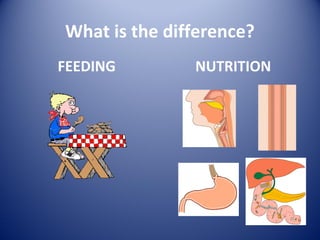
What is the difference?
FEEDING NUTRITION
HUMAN NUTRITIONHUMAN NUTRITION
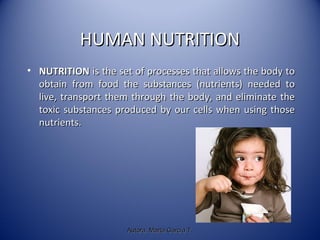
• NUTRITIONNUTRITION is the set of processes that allows the body tois the set of processes that allows the body to
obtain from food the substances (nutrients) needed toobtain from food the substances (nutrients) needed to
live, transport them through the body, and eliminate thelive, transport them through the body, and eliminate the
toxic substances produced by our cells when using thosetoxic substances produced by our cells when using those
nutrients.nutrients.
Autora: Marta García T.Autora: Marta García T.
SYSTEMS INVOLVED IN NUTRITIONSYSTEMS INVOLVED IN NUTRITION
Autora: Marta García T.Autora: Marta García T.
SYSTEMS INVOLVED IN NUTRITIONSYSTEMS INVOLVED IN NUTRITION
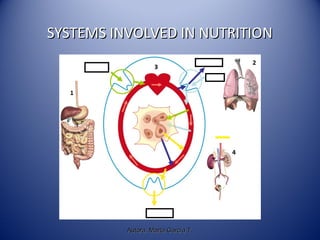
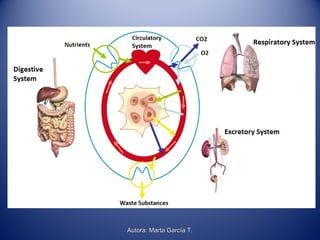
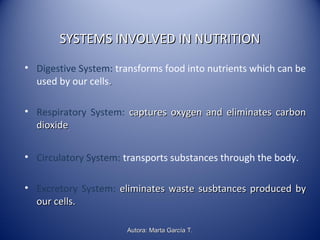
• Digestive System: transforms food into nutrients which can be
used by our cells..
• Respiratory System: captures oxygen and eliminates carboncaptures oxygen and eliminates carbon
dioxidedioxide..
• Circulatory System: transports substances through the body.
• Excretory System: eliminates waste susbtances produced byeliminates waste susbtances produced by
our cells.our cells.
Autora: Marta García T.Autora: Marta García T.
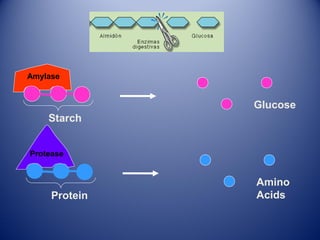
Amylase
Starch
Glucose
Protease
Protein
Amino
Acids
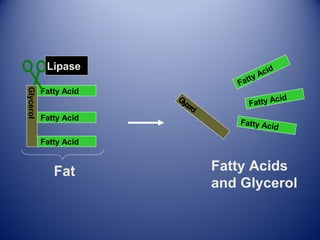
Glycerol
Fatty Acid
Fatty Acid
Fatty Acid
Glycerol
Fatty Acid
Fatty Acid
Fatty Acid
Lipase
Fat Fatty Acids
and Glycerol
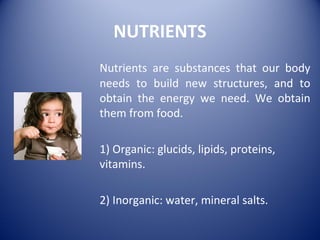
NUTRIENTS
Nutrients are substances that our body
needs to build new structures, and to
obtain the energy we need. We obtain
them from food.
1) Organic: glucids, lipids, proteins,
vitamins.
2) Inorganic: water, mineral salts.
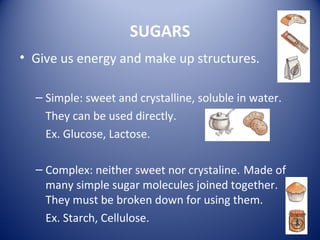
SUGARS
• Give us energy and make up structures.
– Simple: sweet and crystalline, soluble in water.
They can be used directly.
Ex. Glucose, Lactose.
– Complex: neither sweet nor crystaline. Made of
many simple sugar molecules joined together.
They must be broken down for using them.
Ex. Starch, Cellulose.
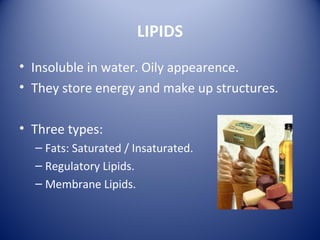
LIPIDS
• Insoluble in water. Oily appearence.
• They store energy and make up structures.
• Three types:
– Fats: Saturated / Insaturated.
– Regulatory Lipids.
– Membrane Lipids.
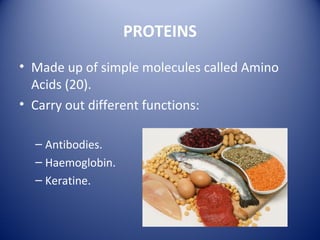
PROTEINS
• Made up of simple molecules called Amino
Acids (20).
• Carry out different functions:
– Antibodies.
– Haemoglobin.
– Keratine.
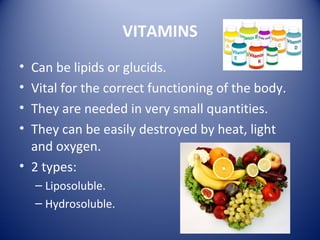
VITAMINS
• Can be lipids or glucids.
• Vital for the correct functioning of the body.
• They are needed in very small quantities.
• They can be easily destroyed by heat, light
and oxygen.
• 2 types:
– Liposoluble.
– Hydrosoluble.
MINERAL SALTS
• Make up structures, carry out chemical reactions,
trasmit the nervous impulse.
• Present in fruits, vegetables and water.
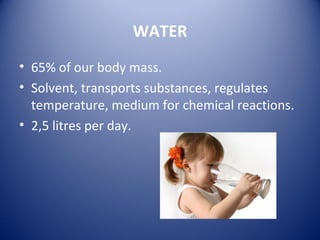
WATER
• 65% of our body mass.
• Solvent, transports substances, regulates
temperature, medium for chemical reactions.
• 2,5 litres per day.
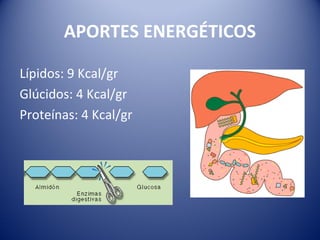
APORTES ENERGÉTICOS
Lípidos: 9 Kcal/gr
Glúcidos: 4 Kcal/gr
Proteínas: 4 Kcal/gr
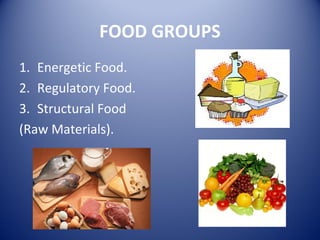
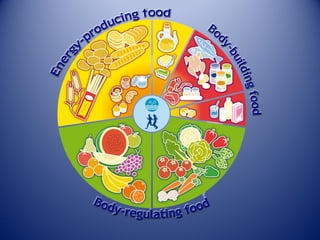
FOOD GROUPS
1. Energetic Food.
2. Regulatory Food.
3. Structural Food
(Raw Materials).
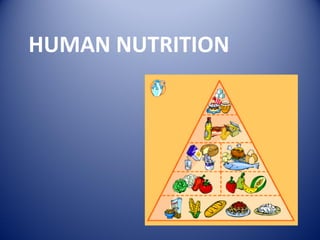
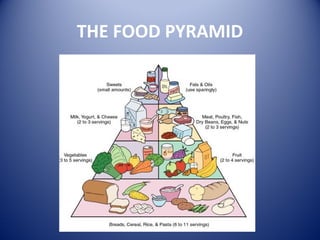
THE FOOD PYRAMID
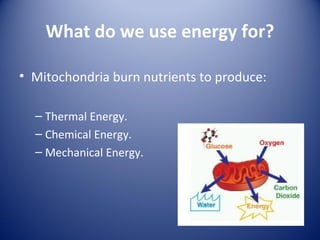
What do we use energy for?
• Mitochondria burn nutrients to produce:
– Thermal Energy.
– Chemical Energy.
– Mechanical Energy.
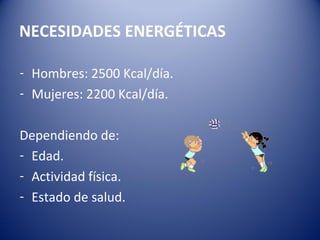
NECESIDADES ENERGÉTICAS
- Hombres: 2500 Kcal/día.
- Mujeres: 2200 Kcal/día.
Dependiendo de:
- Edad.
- Actividad física.
- Estado de salud.
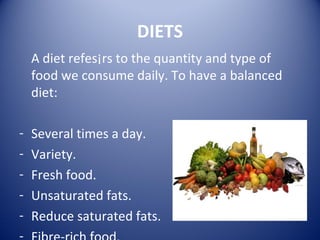
DIETS
A diet refes¡rs to the quantity and type of
food we consume daily. To have a balanced
diet:
- Several times a day.
- Variety.
- Fresh food.
- Unsaturated fats.
- Reduce saturated fats.
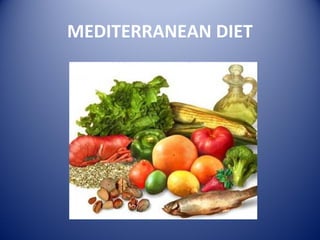
MEDITERRANEAN DIET
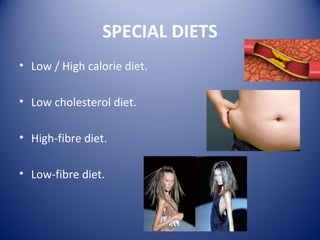
SPECIAL DIETS
• Low / High calorie diet.
• Low cholesterol diet.
• High-fibre diet.
• Low-fibre diet.
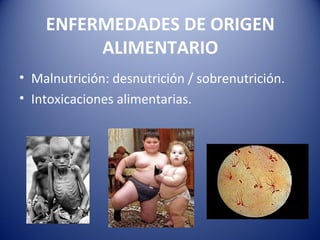
ENFERMEDADES DE ORIGEN
ALIMENTARIO
• Malnutrición: desnutrición / sobrenutrición.
• Intoxicaciones alimentarias.
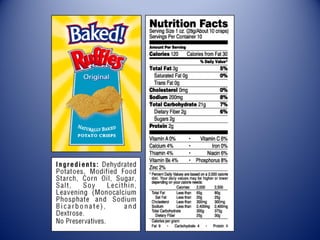
Food Labels
• Quantity.
• Nutritional information.
• Dates: Best-before / Expiration date.
• Ingredients.
• Storage instructions.
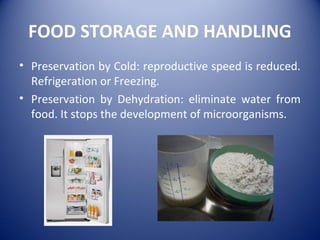
FOOD STORAGE AND HANDLING
• Preservation by Cold: reproductive speed is reduced.
Refrigeration or Freezing.
• Preservation by Dehydration: eliminate water from
food. It stops the development of microorganisms.
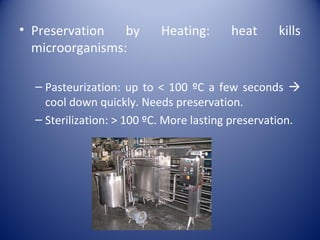
• Preservation by Heating: heat kills
microorganisms:
– Pasteurization: up to < 100 ºC a few seconds 
cool down quickly. Needs preservation.
– Sterilization: > 100 ºC. More lasting preservation.
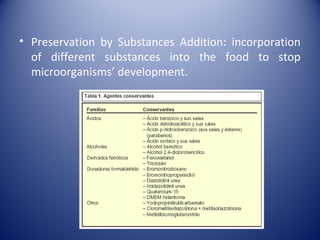
• Preservation by Substances Addition: incorporation
of different substances into the food to stop
microorganisms’ development.
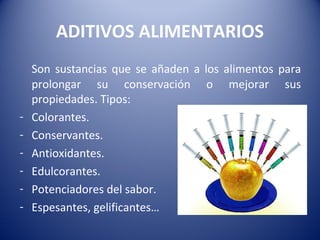
ADITIVOS ALIMENTARIOS
Son sustancias que se añaden a los alimentos para
prolongar su conservación o mejorar sus
propiedades. Tipos:
- Colorantes.
- Conservantes.
- Antioxidantes.
- Edulcorantes.
- Potenciadores del sabor.
- Espesantes, gelificantes…
Human nutrition

Human nutrition

  • 1.
  • 2.
    What is thedifference? FEEDING NUTRITION
  • 3.
    HUMAN NUTRITIONHUMAN NUTRITION •NUTRITIONNUTRITION is the set of processes that allows the body tois the set of processes that allows the body to obtain from food the substances (nutrients) needed toobtain from food the substances (nutrients) needed to live, transport them through the body, and eliminate thelive, transport them through the body, and eliminate the toxic substances produced by our cells when using thosetoxic substances produced by our cells when using those nutrients.nutrients. Autora: Marta García T.Autora: Marta García T.
  • 4.
    SYSTEMS INVOLVED INNUTRITIONSYSTEMS INVOLVED IN NUTRITION Autora: Marta García T.Autora: Marta García T.
  • 5.
    Autora: Marta GarcíaT.Autora: Marta García T.
  • 6.
    SYSTEMS INVOLVED INNUTRITIONSYSTEMS INVOLVED IN NUTRITION • Digestive System: transforms food into nutrients which can be used by our cells.. • Respiratory System: captures oxygen and eliminates carboncaptures oxygen and eliminates carbon dioxidedioxide.. • Circulatory System: transports substances through the body. • Excretory System: eliminates waste susbtances produced byeliminates waste susbtances produced by our cells.our cells. Autora: Marta García T.Autora: Marta García T.
  • 7.
  • 8.
    Glycerol Fatty Acid Fatty Acid FattyAcid Glycerol Fatty Acid Fatty Acid Fatty Acid Lipase Fat Fatty Acids and Glycerol
  • 9.
    NUTRIENTS Nutrients are substancesthat our body needs to build new structures, and to obtain the energy we need. We obtain them from food. 1) Organic: glucids, lipids, proteins, vitamins. 2) Inorganic: water, mineral salts.
  • 10.
    SUGARS • Give usenergy and make up structures. – Simple: sweet and crystalline, soluble in water. They can be used directly. Ex. Glucose, Lactose. – Complex: neither sweet nor crystaline. Made of many simple sugar molecules joined together. They must be broken down for using them. Ex. Starch, Cellulose.
  • 11.
    LIPIDS • Insoluble inwater. Oily appearence. • They store energy and make up structures. • Three types: – Fats: Saturated / Insaturated. – Regulatory Lipids. – Membrane Lipids.
  • 12.
    PROTEINS • Made upof simple molecules called Amino Acids (20). • Carry out different functions: – Antibodies. – Haemoglobin. – Keratine.
  • 13.
    VITAMINS • Can belipids or glucids. • Vital for the correct functioning of the body. • They are needed in very small quantities. • They can be easily destroyed by heat, light and oxygen. • 2 types: – Liposoluble. – Hydrosoluble.
  • 14.
    MINERAL SALTS • Makeup structures, carry out chemical reactions, trasmit the nervous impulse. • Present in fruits, vegetables and water.
  • 15.
    WATER • 65% ofour body mass. • Solvent, transports substances, regulates temperature, medium for chemical reactions. • 2,5 litres per day.
  • 16.
    APORTES ENERGÉTICOS Lípidos: 9Kcal/gr Glúcidos: 4 Kcal/gr Proteínas: 4 Kcal/gr
  • 17.
    FOOD GROUPS 1. EnergeticFood. 2. Regulatory Food. 3. Structural Food (Raw Materials).
  • 19.
  • 20.
    What do weuse energy for? • Mitochondria burn nutrients to produce: – Thermal Energy. – Chemical Energy. – Mechanical Energy.
  • 21.
    NECESIDADES ENERGÉTICAS - Hombres:2500 Kcal/día. - Mujeres: 2200 Kcal/día. Dependiendo de: - Edad. - Actividad física. - Estado de salud.
  • 22.
    DIETS A diet refes¡rsto the quantity and type of food we consume daily. To have a balanced diet: - Several times a day. - Variety. - Fresh food. - Unsaturated fats. - Reduce saturated fats.
  • 23.
  • 24.
    SPECIAL DIETS • Low/ High calorie diet. • Low cholesterol diet. • High-fibre diet. • Low-fibre diet.
  • 25.
    ENFERMEDADES DE ORIGEN ALIMENTARIO •Malnutrición: desnutrición / sobrenutrición. • Intoxicaciones alimentarias.
  • 26.
    Food Labels • Quantity. •Nutritional information. • Dates: Best-before / Expiration date. • Ingredients. • Storage instructions.
  • 28.
    FOOD STORAGE ANDHANDLING • Preservation by Cold: reproductive speed is reduced. Refrigeration or Freezing. • Preservation by Dehydration: eliminate water from food. It stops the development of microorganisms.
  • 29.
    • Preservation byHeating: heat kills microorganisms: – Pasteurization: up to < 100 ºC a few seconds  cool down quickly. Needs preservation. – Sterilization: > 100 ºC. More lasting preservation.
  • 30.
    • Preservation bySubstances Addition: incorporation of different substances into the food to stop microorganisms’ development.
  • 31.
    ADITIVOS ALIMENTARIOS Son sustanciasque se añaden a los alimentos para prolongar su conservación o mejorar sus propiedades. Tipos: - Colorantes. - Conservantes. - Antioxidantes. - Edulcorantes. - Potenciadores del sabor. - Espesantes, gelificantes…