Ecosystem
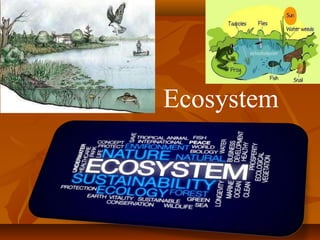
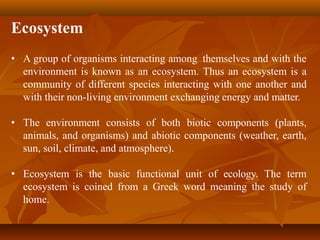
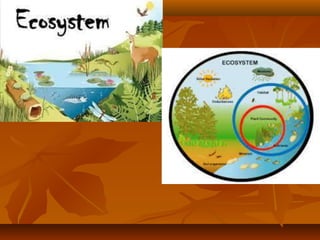
Ecosystem
• A group of organisms interacting among themselves and with the
environment is known as an ecosystem. Thus an ecosystem is a
community of different species interacting with one another and
with their non-living environment exchanging energy and matter.
• The environment consists of both biotic components (plants,
animals, and organisms) and abiotic components (weather, earth,
sun, soil, climate, and atmosphere).
• Ecosystem is the basic functional unit of ecology. The term
ecosystem is coined from a Greek word meaning the study of
home.
Cont.….
• Example: Animals cannot synthesis their food, they depend
on the plants either directly or indirectly.
• According to Woodbury: An ecosystem is a complex in which
habitat, plants, and animals are considered as one interesting
unit, the materials, and energy of one passing in and out of the
others.
Structure And Function of An Ecosystem
• The structure of an ecosystem is basically a description of the
organisms and physical features of the environment including
the amount and distribution of nutrients in a particular habitat.
• From the structural point of view, all ecosystems consist of
the following basic components:
1. Abiotic components
2. Biotic components
Cont.…..
• It refers to the particular pattern of interrelationships
that exists between organisms in an ecosystem.
1. Abiotic Components
• Abiotic component of the ecosystem includes basic inorganic
elements and compounds, such as soil, water, oxygen, calcium
carbonates, phosphates, and a variety of organic compounds
(by-products of organic activities or death).
• It also includes such physical factors and ingredients as
moisture, wind currents, and solar radiation. The radiant
energy of the sun is the only significant energy source for any
ecosystem.
2. Biotic Components
• The biotic components include all living organisms present in
the environmental system.
• From a nutrition point of view, the biotic components can be
grouped into two basic components: Autotrophic
components, and Heterotrophic components
• The autotrophic components include all green plants which
fix the radiant energy of the sun and manufacture food from
inorganic substances.
• The heterotrophic components include non-green plants and
all animals which take food from autotrophs.
• So biotic components of an ecosystem can be
described under the following three heads:
• Producers (Autotrophic components),
• Consumers, and
• Decomposers or reducers
1. Producers
• The producers are the autotrophic elements–chiefly green plants.
They use the energy of the sun in the photosynthetic process
whereby carbon dioxide is adapted and the light energy is
converted into chemical energy. The chemical energy is actually
locked up in the energy-rich carbon compounds. Oxygen
evolved as a byproduct of photosynthesis.
• This is used in respiration by all living things. Algae and other
hydrophytes of a pond, grasses of the field, and trees of the
forests are examples of producers.
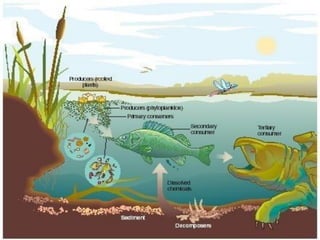
2. Consumers
• Those living members of the ecosystem who consume the
food synthesized by producers are called consumers.
• All kinds of animals included under this category that is
found in an ecosystem. There are different classes or
categories of consumers that are discussed in the following:
■ Primary consumers: Those who are dependent on producers
or green plants for their food called primary consumers
(purely herbivorous). e.g. Insects, rabbits, cows, goats for the
terrestrial ecosystems.
Secondary consumers: Those animals are adapted to
consume herbivores as well as plants as their food
called secondary consumers. They are carnivores and
omnivores. e.g. sparrow, crow, fox etc.
Tertiary consumers: These are the top carnivores
which prey upon secondary consumers as well as
other carnivores, omnivores and herbivores. Lions,
tigers, hawk, vulture etc. are considered as tertiary
or top consumers.
3. Decomposers and transformers
• Decomposers attack the dead remains of producers and
consumers and degrade complex organic substances into
simpler compounds.
• The simple organic matters are then attacked by another
kind of bacteria, the transformers which change these
organic compounds into the inorganic forms that are
suitable for reuse by producers of green plants.
• The decomposers and transformers play very important
role in maintaining the dynamic nature of ecosystems.
FUNCTION OFAN ECOSYSTEM
• Action of biotic and abiotic components with the help of solar
energy through the ecosystem is called the function of the
ecosystem.
• The synthesis and maintenance processes involve energy
exchange and this energy comes from the sun.
• Thus, in any ecosystem we have the following functional
components:
• 1. Inorganic constituents (air, water, and mineral salts)
• 2. Organisms (plants, animals, and microbes), and
• 3. Energy input that enters from outside (the sun)
ENERGY FLOW IN THE ECOSYSTEMS
• Energy is the most essential requirement for all living organisms. Solar
energy is the only source of our planet earth.
• Solar energy is transformed into chemical energy in photosynthesis by the
plants (called primary producers). This is the most essential step to provide
energy for all other living organisms in the ecosystem.
• Some amount of chemical energy is used by the plants for their growth and
the remaining is transferred to consumers by the process of eating.
• Thus the energy enters the ecosystems through photosynthesis and passes
through the different trophic levels and feeding levels.
FOREST ECOSYSTEM
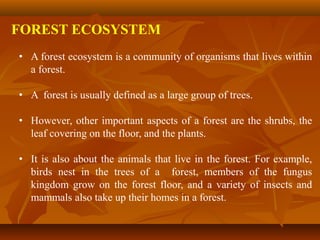
• A forest ecosystem is a community of organisms that lives within
a forest.
• A forest is usually defined as a large group of trees.
• However, other important aspects of a forest are the shrubs, the
leaf covering on the floor, and the plants.
• It is also about the animals that live in the forest. For example,
birds nest in the trees of a forest, members of the fungus
kingdom grow on the forest floor, and a variety of insects and
mammals also take up their homes in a forest.
GRASSLAND ECOSYSTEM
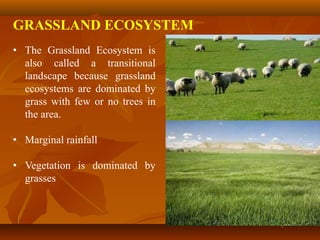
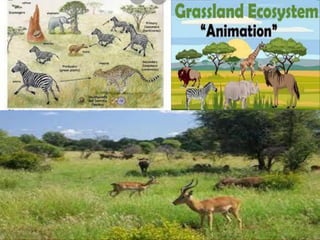
• The Grassland Ecosystem is
also called a transitional
landscape because grassland
ecosystems are dominated by
grass with few or no trees in
the area.
• Marginal rainfall
• Vegetation is dominated by
grasses
DESERT ECOSYSTEM
• A desert ecosystem is defined by the interactions between
organisms and the climate in which they live. Also, any other
abiotic factors influence the habitat.
• Deserts are arid regions that are generally associated with
warm temperatures.
• Deserts can be found on every continent, with the largest
deserts located in Antarctica, the Arctic, Northern Africa, and
the Middle East.
• The largest desert on earth is the Antarctic desert, covering
the continent of Antarctica with a size of around 5.5 million
square miles.
AQUATIC ECOSYSTEM
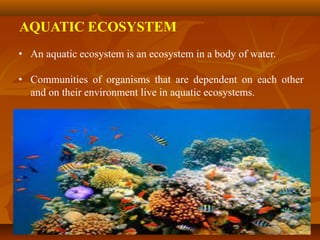
• An aquatic ecosystem is an ecosystem in a body of water.
• Communities of organisms that are dependent on each other
and on their environment live in aquatic ecosystems.
FOOD CHAIN
• “The sequence of eating and being eaten in an ecosystem is
known as food chain” (or)
• “Transfer of food energy from the plants through a series of
organisms is known as food chain”
• When the organisms die, they are all decomposed by
microorganisms into nutrients that can again be used by
plants. At each and every transfer, nearly 80-90% of energy
is lost as heat.
FOOD WEB
• The interlocking pattern of various food chains in an
ecosystem is known as the food web.
• In a food web many food chains are interconnected, where
different types of organisms are connected at different
trophic levels so that there is a number of opportunities for
eating and being eaten at each trophic level.
ECOLOGICAL SUCCESSION
• Ecological succession is a series of progressive changes in the
species that make up a community over time.
• In an area one community may be replaced by another
community or by a series of communities.
• Thus the progressive replacement of one community by
another tillthe development of a stable community in a
particular area is called ecological succession.
• It is the sequential process of rebuilding of an ecosystem
when a disaster destroys it.
ECOLOGICAL SUCCESSION
ECOSYSTEM Classification Structure & Functioning (1).pdf

ECOSYSTEM Classification Structure & Functioning (1).pdf

  • 1.
  • 2.
    Ecosystem • A groupof organisms interacting among themselves and with the environment is known as an ecosystem. Thus an ecosystem is a community of different species interacting with one another and with their non-living environment exchanging energy and matter. • The environment consists of both biotic components (plants, animals, and organisms) and abiotic components (weather, earth, sun, soil, climate, and atmosphere). • Ecosystem is the basic functional unit of ecology. The term ecosystem is coined from a Greek word meaning the study of home.
  • 3.
    Cont.…. • Example: Animalscannot synthesis their food, they depend on the plants either directly or indirectly. • According to Woodbury: An ecosystem is a complex in which habitat, plants, and animals are considered as one interesting unit, the materials, and energy of one passing in and out of the others.
  • 4.
    Structure And Functionof An Ecosystem • The structure of an ecosystem is basically a description of the organisms and physical features of the environment including the amount and distribution of nutrients in a particular habitat. • From the structural point of view, all ecosystems consist of the following basic components: 1. Abiotic components 2. Biotic components
  • 5.
    Cont.….. • It refersto the particular pattern of interrelationships that exists between organisms in an ecosystem.
  • 7.
    1. Abiotic Components •Abiotic component of the ecosystem includes basic inorganic elements and compounds, such as soil, water, oxygen, calcium carbonates, phosphates, and a variety of organic compounds (by-products of organic activities or death). • It also includes such physical factors and ingredients as moisture, wind currents, and solar radiation. The radiant energy of the sun is the only significant energy source for any ecosystem.
  • 8.
    2. Biotic Components •The biotic components include all living organisms present in the environmental system. • From a nutrition point of view, the biotic components can be grouped into two basic components: Autotrophic components, and Heterotrophic components • The autotrophic components include all green plants which fix the radiant energy of the sun and manufacture food from inorganic substances. • The heterotrophic components include non-green plants and all animals which take food from autotrophs.
  • 9.
    • So bioticcomponents of an ecosystem can be described under the following three heads: • Producers (Autotrophic components), • Consumers, and • Decomposers or reducers
  • 10.
    1. Producers • Theproducers are the autotrophic elements–chiefly green plants. They use the energy of the sun in the photosynthetic process whereby carbon dioxide is adapted and the light energy is converted into chemical energy. The chemical energy is actually locked up in the energy-rich carbon compounds. Oxygen evolved as a byproduct of photosynthesis. • This is used in respiration by all living things. Algae and other hydrophytes of a pond, grasses of the field, and trees of the forests are examples of producers.
  • 11.
    2. Consumers • Thoseliving members of the ecosystem who consume the food synthesized by producers are called consumers. • All kinds of animals included under this category that is found in an ecosystem. There are different classes or categories of consumers that are discussed in the following: ■ Primary consumers: Those who are dependent on producers or green plants for their food called primary consumers (purely herbivorous). e.g. Insects, rabbits, cows, goats for the terrestrial ecosystems.
  • 12.
    Secondary consumers: Thoseanimals are adapted to consume herbivores as well as plants as their food called secondary consumers. They are carnivores and omnivores. e.g. sparrow, crow, fox etc. Tertiary consumers: These are the top carnivores which prey upon secondary consumers as well as other carnivores, omnivores and herbivores. Lions, tigers, hawk, vulture etc. are considered as tertiary or top consumers.
  • 13.
    3. Decomposers andtransformers • Decomposers attack the dead remains of producers and consumers and degrade complex organic substances into simpler compounds. • The simple organic matters are then attacked by another kind of bacteria, the transformers which change these organic compounds into the inorganic forms that are suitable for reuse by producers of green plants. • The decomposers and transformers play very important role in maintaining the dynamic nature of ecosystems.
  • 15.
    FUNCTION OFAN ECOSYSTEM •Action of biotic and abiotic components with the help of solar energy through the ecosystem is called the function of the ecosystem. • The synthesis and maintenance processes involve energy exchange and this energy comes from the sun. • Thus, in any ecosystem we have the following functional components: • 1. Inorganic constituents (air, water, and mineral salts) • 2. Organisms (plants, animals, and microbes), and • 3. Energy input that enters from outside (the sun)
  • 16.
    ENERGY FLOW INTHE ECOSYSTEMS • Energy is the most essential requirement for all living organisms. Solar energy is the only source of our planet earth. • Solar energy is transformed into chemical energy in photosynthesis by the plants (called primary producers). This is the most essential step to provide energy for all other living organisms in the ecosystem. • Some amount of chemical energy is used by the plants for their growth and the remaining is transferred to consumers by the process of eating. • Thus the energy enters the ecosystems through photosynthesis and passes through the different trophic levels and feeding levels.
  • 20.
    FOREST ECOSYSTEM • Aforest ecosystem is a community of organisms that lives within a forest. • A forest is usually defined as a large group of trees. • However, other important aspects of a forest are the shrubs, the leaf covering on the floor, and the plants. • It is also about the animals that live in the forest. For example, birds nest in the trees of a forest, members of the fungus kingdom grow on the forest floor, and a variety of insects and mammals also take up their homes in a forest.
  • 22.
    GRASSLAND ECOSYSTEM • TheGrassland Ecosystem is also called a transitional landscape because grassland ecosystems are dominated by grass with few or no trees in the area. • Marginal rainfall • Vegetation is dominated by grasses
  • 24.
    DESERT ECOSYSTEM • Adesert ecosystem is defined by the interactions between organisms and the climate in which they live. Also, any other abiotic factors influence the habitat. • Deserts are arid regions that are generally associated with warm temperatures. • Deserts can be found on every continent, with the largest deserts located in Antarctica, the Arctic, Northern Africa, and the Middle East. • The largest desert on earth is the Antarctic desert, covering the continent of Antarctica with a size of around 5.5 million square miles.
  • 26.
    AQUATIC ECOSYSTEM • Anaquatic ecosystem is an ecosystem in a body of water. • Communities of organisms that are dependent on each other and on their environment live in aquatic ecosystems.
  • 28.
    FOOD CHAIN • “Thesequence of eating and being eaten in an ecosystem is known as food chain” (or) • “Transfer of food energy from the plants through a series of organisms is known as food chain” • When the organisms die, they are all decomposed by microorganisms into nutrients that can again be used by plants. At each and every transfer, nearly 80-90% of energy is lost as heat.
  • 30.
    FOOD WEB • Theinterlocking pattern of various food chains in an ecosystem is known as the food web. • In a food web many food chains are interconnected, where different types of organisms are connected at different trophic levels so that there is a number of opportunities for eating and being eaten at each trophic level.
  • 32.
    ECOLOGICAL SUCCESSION • Ecologicalsuccession is a series of progressive changes in the species that make up a community over time. • In an area one community may be replaced by another community or by a series of communities. • Thus the progressive replacement of one community by another tillthe development of a stable community in a particular area is called ecological succession. • It is the sequential process of rebuilding of an ecosystem when a disaster destroys it.
  • 33.