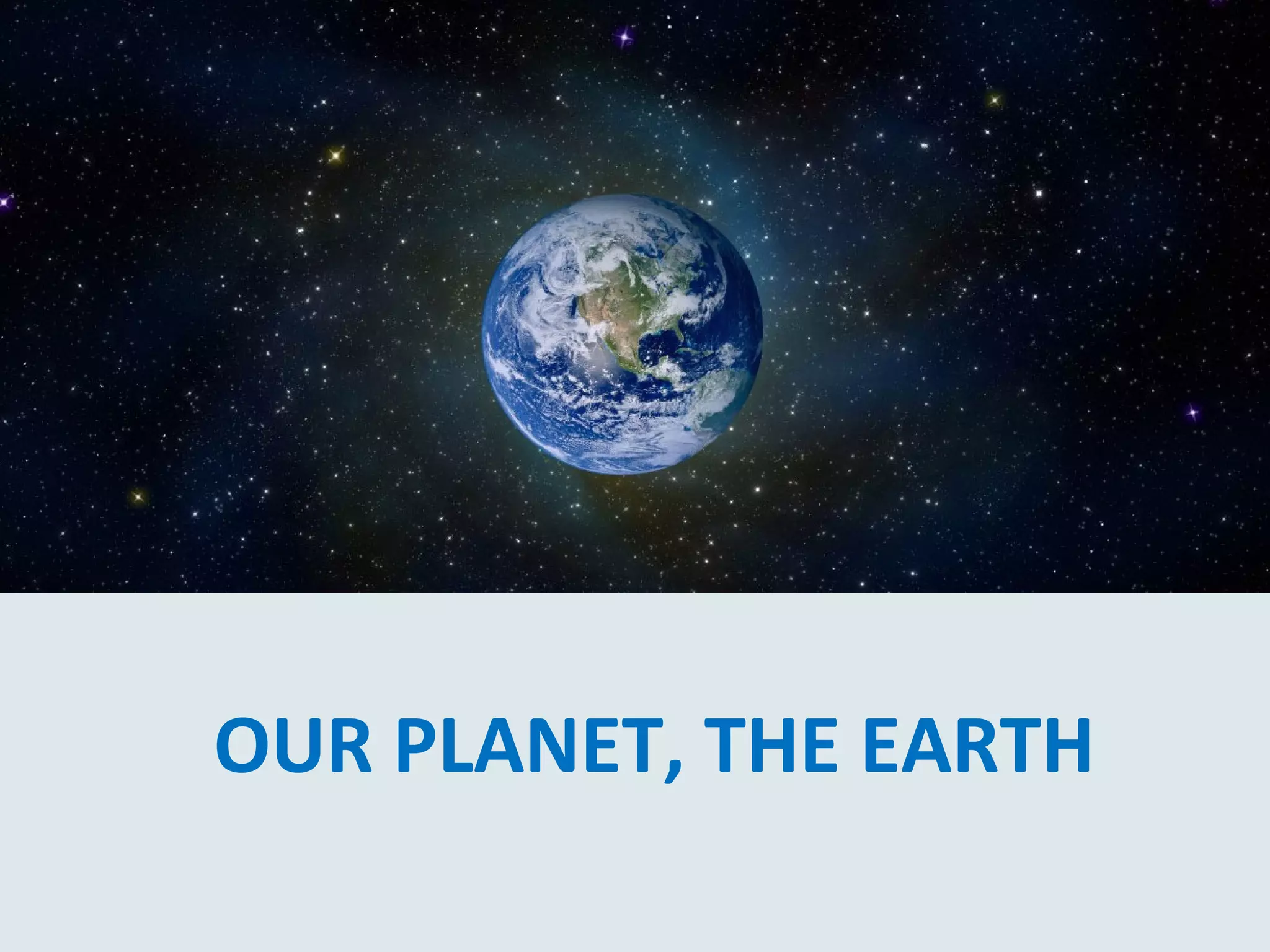
OUR PLANET, THE EARTH
The Earth’s Features
• It is a rocky planet.
• Its atmosphere contains oxygen.
• Its average temperature is 15 ºC.
• Water: solid, liquid, gas: water cycle.
• A natural satellite: The Moon  produces
tides.
• Life exists.
THE EARTH IN THE UNIVERSE
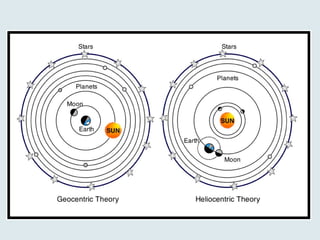
Look at these two images, and find the
differences.
Which one do you think is correct?
https://www.youtube.com/embed/Oc6yPFoqLF4?wmode=transparent
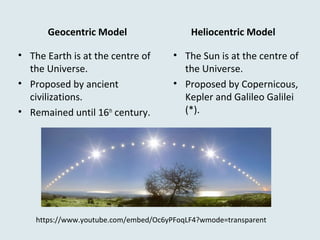
Geocentric Model
• The Earth is at the centre of
the Universe.
• Proposed by ancient
civilizations.
• Remained until 16th
century.
Heliocentric Model
• The Sun is at the centre of
the Universe.
• Proposed by Copernicous,
Kepler and Galileo Galilei
(*).
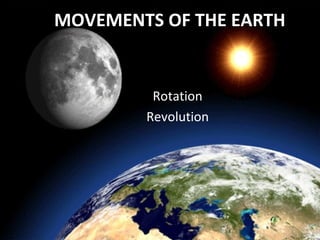
Rotation
Revolution
MOVEMENTS OF THE EARTH
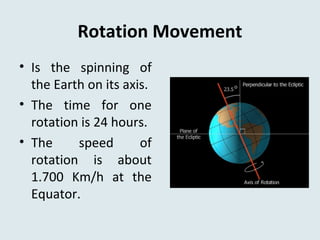
Rotation Movement
• Is the spinning of
the Earth on its axis.
• The time for one
rotation is 24 hours.
• The speed of
rotation is about
1.700 Km/h at the
Equator.
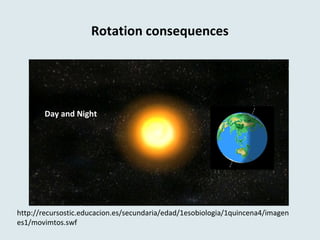
Rotation consequences
Day and Night
http://recursostic.educacion.es/secundaria/edad/1esobiologia/1quincena4/imagen
es1/movimtos.swf
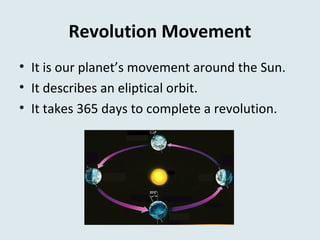
Revolution Movement
• It is our planet’s movement around the Sun.
• It describes an eliptical orbit.
• It takes 365 days to complete a revolution.
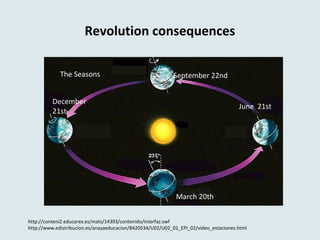
Revolution consequences
June 21st
December
21st
September 22nd
March 20th
The Seasons
http://conteni2.educarex.es/mats/14393/contenido/interfaz.swf
http://www.edistribucion.es/anayaeducacion/8420534/U02/U02_01_EPI_02/video_estaciones.html
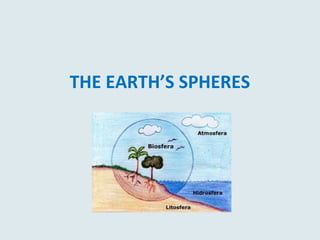
THE EARTH’S SPHERES
GEOSPHERE
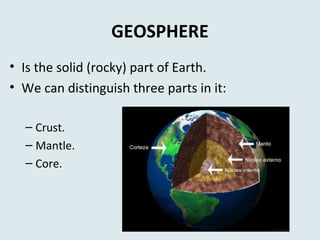
• Is the solid (rocky) part of Earth.
• We can distinguish three parts in it:
– Crust.
– Mantle.
– Core.
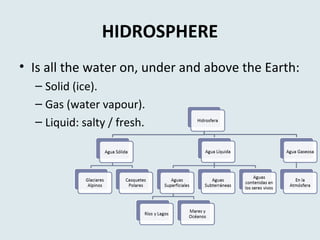
HIDROSPHERE
• Is all the water on, under and above the Earth:
– Solid (ice).
– Gas (water vapour).
– Liquid: salty / fresh.
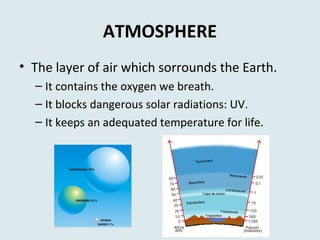
ATMOSPHERE
• The layer of air which sorrounds the Earth.
– It contains the oxygen we breath.
– It blocks dangerous solar radiations: UV.
– It keeps an adequated temperature for life.
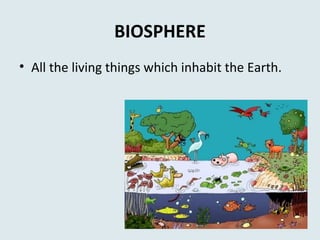
BIOSPHERE
• All the living things which inhabit the Earth.
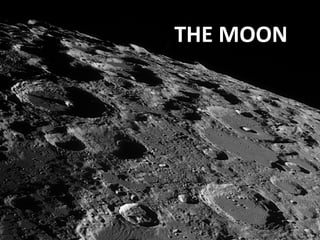
THE MOON
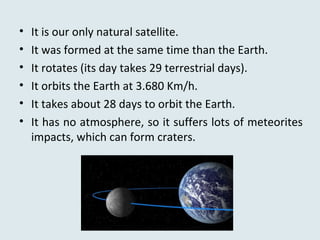
• It is our only natural satellite.
• It was formed at the same time than the Earth.
• It rotates (its day takes 29 terrestrial days).
• It orbits the Earth at 3.680 Km/h.
• It takes about 28 days to orbit the Earth.
• It has no atmosphere, so it suffers lots of meteorites
impacts, which can form craters.
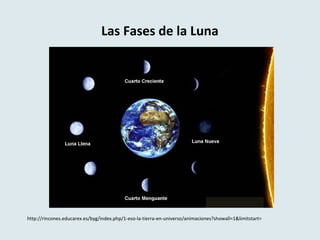
Las Fases de la Luna
http://rincones.educarex.es/byg/index.php/1-eso-la-tierra-en-universo/animaciones?showall=1&limitstart=
ECLIPSES
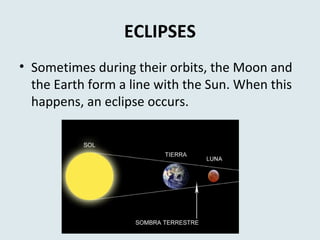
• Sometimes during their orbits, the Moon and
the Earth form a line with the Sun. When this
happens, an eclipse occurs.
LUNAR ECLIPSE
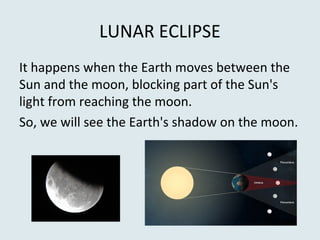
It happens when the Earth moves between the
Sun and the moon, blocking part of the Sun's
light from reaching the moon.
So, we will see the Earth's shadow on the moon.
SOLAR ECLIPSE
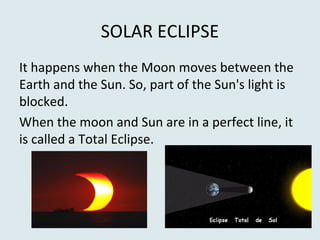
It happens when the Moon moves between the
Earth and the Sun. So, part of the Sun's light is
blocked.
When the moon and Sun are in a perfect line, it
is called a Total Eclipse.

Our planet, the Earth

  • 1.
  • 2.
    The Earth’s Features •It is a rocky planet. • Its atmosphere contains oxygen. • Its average temperature is 15 ºC. • Water: solid, liquid, gas: water cycle. • A natural satellite: The Moon  produces tides. • Life exists.
  • 3.
    THE EARTH INTHE UNIVERSE Look at these two images, and find the differences. Which one do you think is correct?
  • 5.
    https://www.youtube.com/embed/Oc6yPFoqLF4?wmode=transparent Geocentric Model • TheEarth is at the centre of the Universe. • Proposed by ancient civilizations. • Remained until 16th century. Heliocentric Model • The Sun is at the centre of the Universe. • Proposed by Copernicous, Kepler and Galileo Galilei (*).
  • 6.
  • 7.
    Rotation Movement • Isthe spinning of the Earth on its axis. • The time for one rotation is 24 hours. • The speed of rotation is about 1.700 Km/h at the Equator.
  • 8.
    Rotation consequences Day andNight http://recursostic.educacion.es/secundaria/edad/1esobiologia/1quincena4/imagen es1/movimtos.swf
  • 9.
    Revolution Movement • Itis our planet’s movement around the Sun. • It describes an eliptical orbit. • It takes 365 days to complete a revolution.
  • 10.
    Revolution consequences June 21st December 21st September22nd March 20th The Seasons http://conteni2.educarex.es/mats/14393/contenido/interfaz.swf http://www.edistribucion.es/anayaeducacion/8420534/U02/U02_01_EPI_02/video_estaciones.html
  • 11.
  • 12.
    GEOSPHERE • Is thesolid (rocky) part of Earth. • We can distinguish three parts in it: – Crust. – Mantle. – Core.
  • 13.
    HIDROSPHERE • Is allthe water on, under and above the Earth: – Solid (ice). – Gas (water vapour). – Liquid: salty / fresh.
  • 14.
    ATMOSPHERE • The layerof air which sorrounds the Earth. – It contains the oxygen we breath. – It blocks dangerous solar radiations: UV. – It keeps an adequated temperature for life.
  • 15.
    BIOSPHERE • All theliving things which inhabit the Earth.
  • 16.
  • 17.
    • It isour only natural satellite. • It was formed at the same time than the Earth. • It rotates (its day takes 29 terrestrial days). • It orbits the Earth at 3.680 Km/h. • It takes about 28 days to orbit the Earth. • It has no atmosphere, so it suffers lots of meteorites impacts, which can form craters.
  • 18.
    Las Fases dela Luna http://rincones.educarex.es/byg/index.php/1-eso-la-tierra-en-universo/animaciones?showall=1&limitstart=
  • 19.
    ECLIPSES • Sometimes duringtheir orbits, the Moon and the Earth form a line with the Sun. When this happens, an eclipse occurs.
  • 20.
    LUNAR ECLIPSE It happenswhen the Earth moves between the Sun and the moon, blocking part of the Sun's light from reaching the moon. So, we will see the Earth's shadow on the moon.
  • 21.
    SOLAR ECLIPSE It happenswhen the Moon moves between the Earth and the Sun. So, part of the Sun's light is blocked. When the moon and Sun are in a perfect line, it is called a Total Eclipse.