The Biosphere


  Jessica Henderson
NCSCOS Goals and Objectives
Objective 5.01
      Investigate and analyze the
interrelationships among organisms,
populations, communities and ecosystems
           Techniques of field ecology
Biosphere
• Ecosystems were originally distributed over
  the globe and how climates determined the
  characteristics of the major biomes, such as
  forests, deserts and grasslands.

• Each of the biomes are mixed with its own
  species which adapt to the environmental
  conditions.
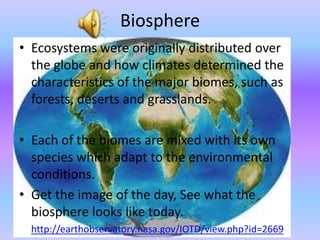
• Get the image of the day, See what the
  biosphere looks like today.
  http://earthobservatory.nasa.gov/IOTD/view.php?id=2669
Biosphere and The Climate
• Climate
  -> the prevailing weather conditions in a particular
  region.
Climate is dictated by temperature and rainfall.
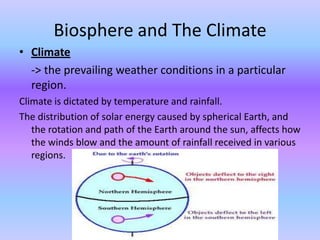
The distribution of solar energy caused by spherical Earth, and
   the rotation and path of the Earth around the sun, affects how
   the winds blow and the amount of rainfall received in various
   regions.
Patterns of biome distribution

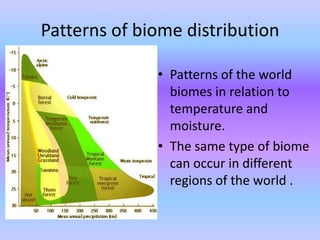
              • Patterns of the world
                biomes in relation to
                temperature and
                moisture.
              • The same type of biome
                can occur in different
                regions of the world .
Terrestrial Ecosystems
• Biomes of the World (video).
   http://www.youtube.com/watch?v=WZGCZY47YS0&feature=related

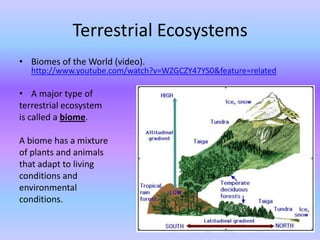
• A major type of
terrestrial ecosystem
is called a biome.

A biome has a mixture
of plants and animals
that adapt to living
conditions and
environmental
conditions.
Tundra
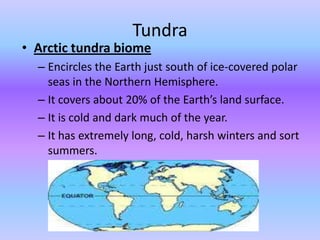
• Arctic tundra biome
  – Encircles the Earth just south of ice-covered polar
    seas in the Northern Hemisphere.
  – It covers about 20% of the Earth’s land surface.
  – It is cold and dark much of the year.
  – It has extremely long, cold, harsh winters and sort
    summers.
Taiga
• The Taiga or boreal forest exists the south of the
tundra and covers 11% of the Earth’s landmasses.

The taiga consist of two forests:
     1. Coniferous Forest

     2. Temperate Deciduous

            Continue on….
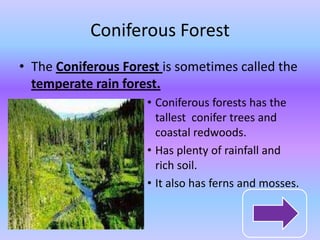
Coniferous Forest
• The Coniferous Forest is sometimes called the
  temperate rain forest.
                     • Coniferous forests has the
                       tallest conifer trees and
                       coastal redwoods.
                     • Has plenty of rainfall and
                       rich soil.
                     • It also has ferns and mosses.
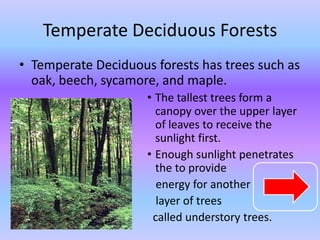
Temperate Deciduous Forests
• Temperate Deciduous forests has trees such as
  oak, beech, sycamore, and maple.
                     • The tallest trees form a
                       canopy over the upper layer
                       of leaves to receive the
                       sunlight first.
                     • Enough sunlight penetrates
                       the to provide
                       energy for another
                       layer of trees
                      called understory trees.
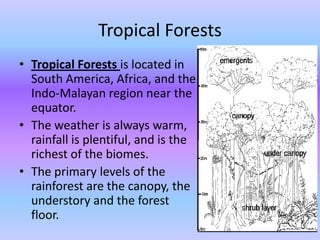
Tropical Forests
• Tropical Forests is located in
  South America, Africa, and the
  Indo-Malayan region near the
  equator.
• The weather is always warm,
  rainfall is plentiful, and is the
  richest of the biomes.
• The primary levels of the
  rainforest are the canopy, the
  understory and the forest
  floor.
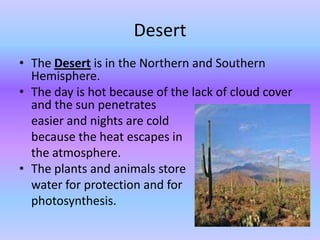
Desert
• The Desert is in the Northern and Southern
  Hemisphere.
• The day is hot because of the lack of cloud cover
  and the sun penetrates
  easier and nights are cold
  because the heat escapes in
  the atmosphere.
• The plants and animals store
  water for protection and for
  photosynthesis.

Biosphere powerpoint

  • 1.
    The Biosphere Jessica Henderson
  • 2.
    NCSCOS Goals andObjectives Objective 5.01 Investigate and analyze the interrelationships among organisms, populations, communities and ecosystems Techniques of field ecology
  • 3.
    Biosphere • Ecosystems wereoriginally distributed over the globe and how climates determined the characteristics of the major biomes, such as forests, deserts and grasslands. • Each of the biomes are mixed with its own species which adapt to the environmental conditions. • Get the image of the day, See what the biosphere looks like today. http://earthobservatory.nasa.gov/IOTD/view.php?id=2669
  • 4.
    Biosphere and TheClimate • Climate -> the prevailing weather conditions in a particular region. Climate is dictated by temperature and rainfall. The distribution of solar energy caused by spherical Earth, and the rotation and path of the Earth around the sun, affects how the winds blow and the amount of rainfall received in various regions.
  • 5.
    Patterns of biomedistribution • Patterns of the world biomes in relation to temperature and moisture. • The same type of biome can occur in different regions of the world .
  • 6.
    Terrestrial Ecosystems • Biomesof the World (video). http://www.youtube.com/watch?v=WZGCZY47YS0&feature=related • A major type of terrestrial ecosystem is called a biome. A biome has a mixture of plants and animals that adapt to living conditions and environmental conditions.
  • 7.
    Tundra • Arctic tundrabiome – Encircles the Earth just south of ice-covered polar seas in the Northern Hemisphere. – It covers about 20% of the Earth’s land surface. – It is cold and dark much of the year. – It has extremely long, cold, harsh winters and sort summers.
  • 8.
    Taiga • The Taigaor boreal forest exists the south of the tundra and covers 11% of the Earth’s landmasses. The taiga consist of two forests: 1. Coniferous Forest 2. Temperate Deciduous Continue on….
  • 9.
    Coniferous Forest • TheConiferous Forest is sometimes called the temperate rain forest. • Coniferous forests has the tallest conifer trees and coastal redwoods. • Has plenty of rainfall and rich soil. • It also has ferns and mosses.
  • 10.
    Temperate Deciduous Forests •Temperate Deciduous forests has trees such as oak, beech, sycamore, and maple. • The tallest trees form a canopy over the upper layer of leaves to receive the sunlight first. • Enough sunlight penetrates the to provide energy for another layer of trees called understory trees.
  • 11.
    Tropical Forests • TropicalForests is located in South America, Africa, and the Indo-Malayan region near the equator. • The weather is always warm, rainfall is plentiful, and is the richest of the biomes. • The primary levels of the rainforest are the canopy, the understory and the forest floor.
  • 12.
    Desert • The Desertis in the Northern and Southern Hemisphere. • The day is hot because of the lack of cloud cover and the sun penetrates easier and nights are cold because the heat escapes in the atmosphere. • The plants and animals store water for protection and for photosynthesis.