Ecology 1: Ecosystems
Levels of Organization Organism Ex. an elephant Population A group of individuals in the same species, living and interacting in one area Ex. a herd of elephants in the Serengeti Community Multiple populations interacting in one area Ex. grazing antelope, elephants and giraffes in the Serengeti Ecosystem All  populations in one area interacting with each other and their non-living environment. Ex. the Serengeti (all organisms plus climate, nutrients, etc.)
Levels of Organization Biosphere All areas of the earth from the ocean depths to the atmosphere that support life.
Ecological roles Autotrophs -  Producer   makes own food (through photosynthesis or chemosynthesis) Heterotrophs -  Consumer   must eat other organisms for food;  primary (mouse), secondary (fox), tertiary (bobcat) Herbivore  (eats plants)  Carnivore  (eats meat)  Omnivore  (eats both) Detritivore Organisms that feed on animals remains and dead material (crabs, earthworms) Decomposer An organism (ex. fungi or bacteria) that completes the final breakdown of materials in an ecosystem End of 3.1
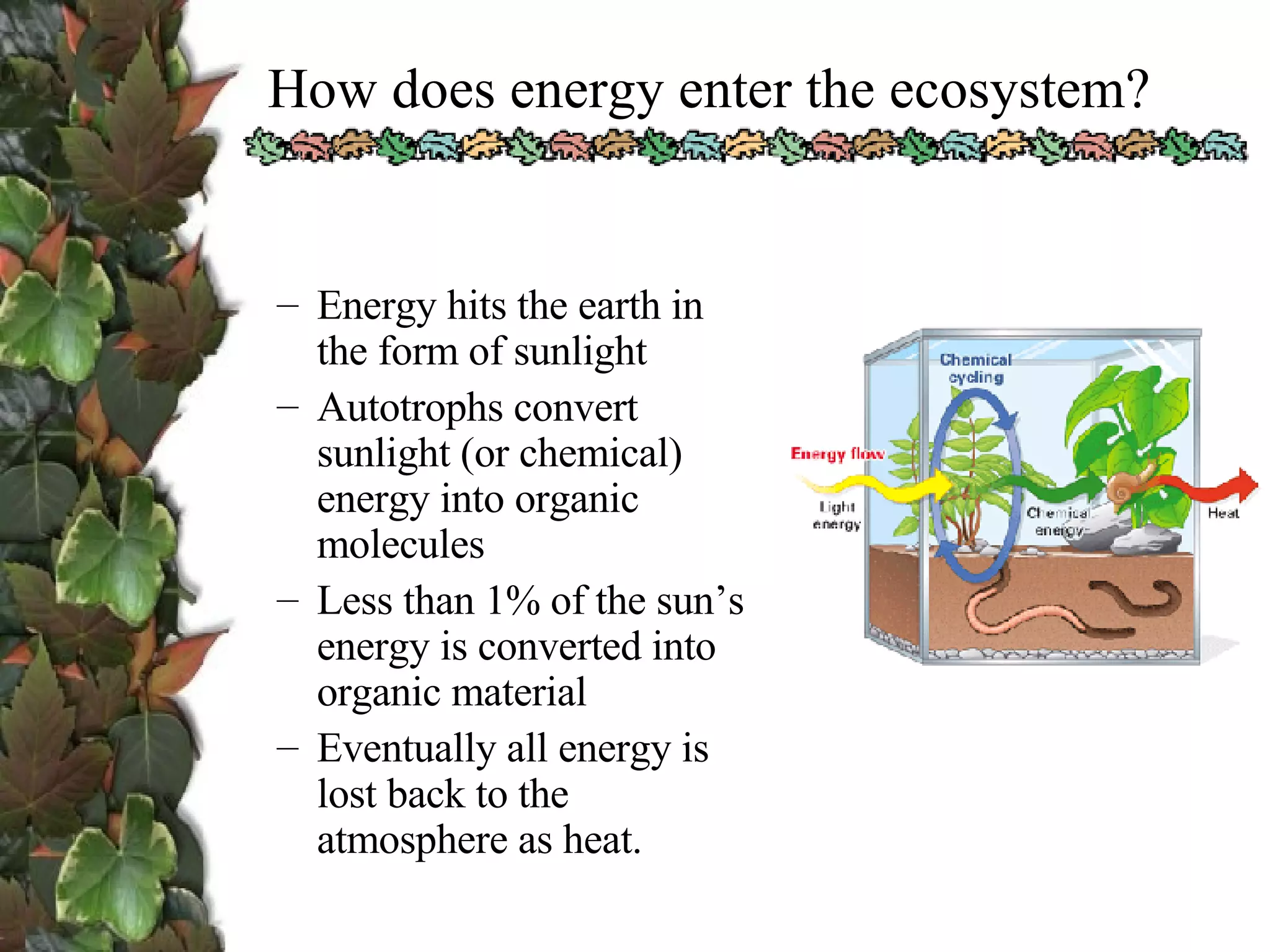
How does energy enter the ecosystem? Energy hits the earth in the form of sunlight Autotrophs convert sunlight (or chemical) energy into organic molecules  Less than 1% of the sun’s energy is converted into organic material Eventually all energy is lost back to the atmosphere as heat.
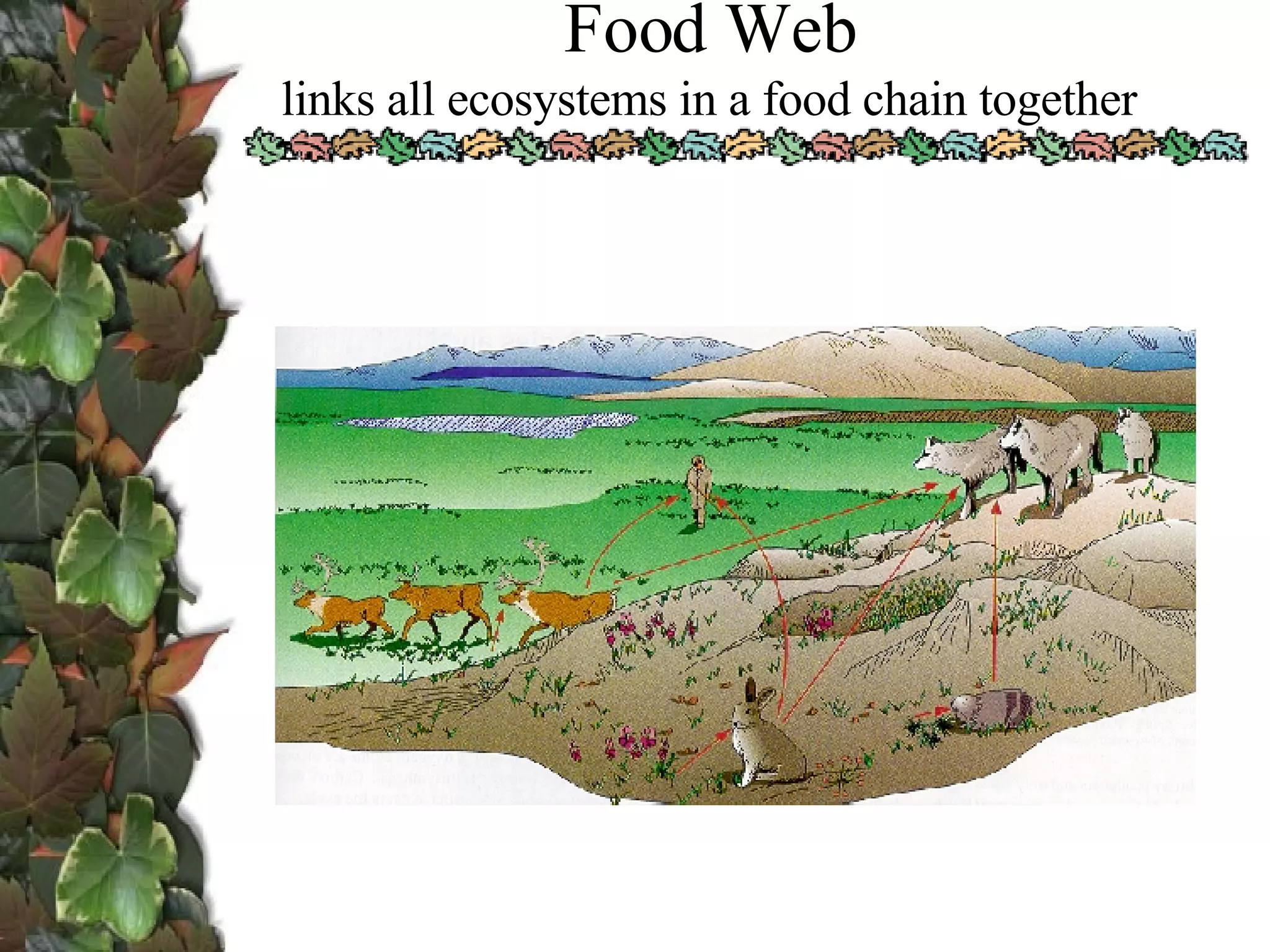
How does energy move through an ecosystem? Energy trapped in autotrophs ( producers ) then gets transferred to heterotrophs ( consumers ) as one organism eats another The easiest way to show this is by using a  food chain, food web, or food pyramid. Food chain – series of steps in which organisms transfer energy by eating and being eaten.
Food Web links all ecosystems in a food chain together
Food Pyramids A food pyramid is designed to show the organisms in an ecosystem, grouped by their feeding position or  trophic level   (1 st =prod, 2 nd =herbivores, etc) Both food chains and food pyramids show that  only 10% of the energy at one trophic level makes it to the next trophic level  (from the 2 nd  law of thermodynamics).
Primary Productivity Therefore, the ecosystems with the most productive producers have the most levels (ex. rain forest) In most cases, there are only 3-4 levels. End of 3.2 The rate at which new organic material is created in an ecosystem by producers is called the  Primary Productivity The more energy entering the food chain (from producers), the more that can pass up through the levels (only 10% moves up at each level), and as result, the more levels there can be.
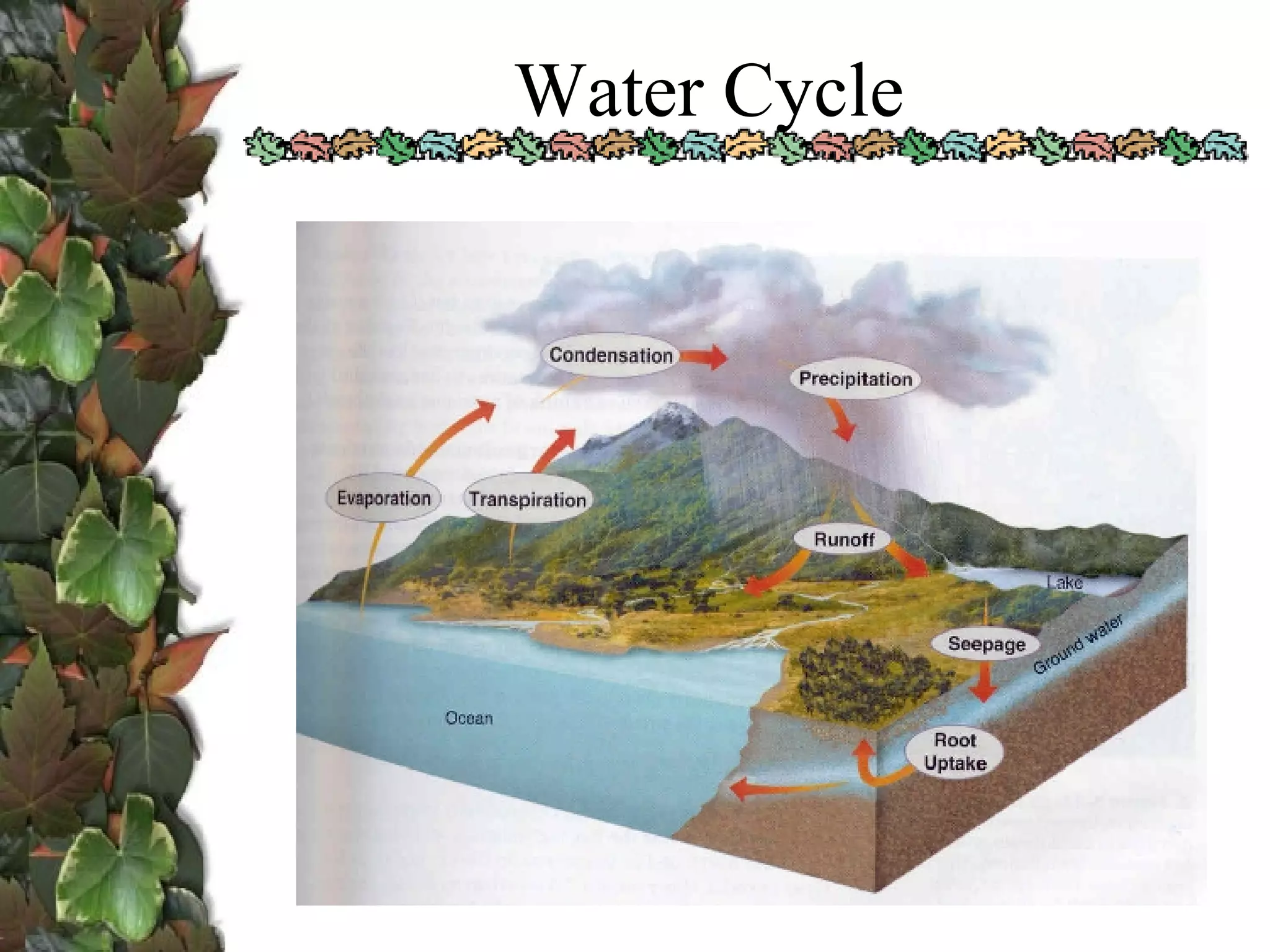
How do nutrients cycle? Energy  follows a ONE-WAY path Sun   living organisms   heat   atmosphere Matter  CYCLES through living organisms endlessly Biogeochemical cycles Water Carbon and Oxygen Nitrogen
Water Cycle
Carbon and Oxygen Cycle
Nitrogen Cycle
Niches Niches vs Habitats A  habitat  is the location where a species  lives .  Ex. tall grassland/prairie A  niche  includes all of the species’ requirements  plus  its role in the ecosystem. It is determined by all the the abiotic and biotic factors relevant to the species. Ex. Top predator in prairie areas where gophers live, and the temperature is never below freezing.
Niche differences Organisms can be identified as either Generalists Organisms with a  broad  niche Eat lots of types of food Live in many types of environments Ex. house mice Specialists Organisms with a  narrow  niche Eat a narrow range of food items Live in few, specific types of habitats Ex. panda bear
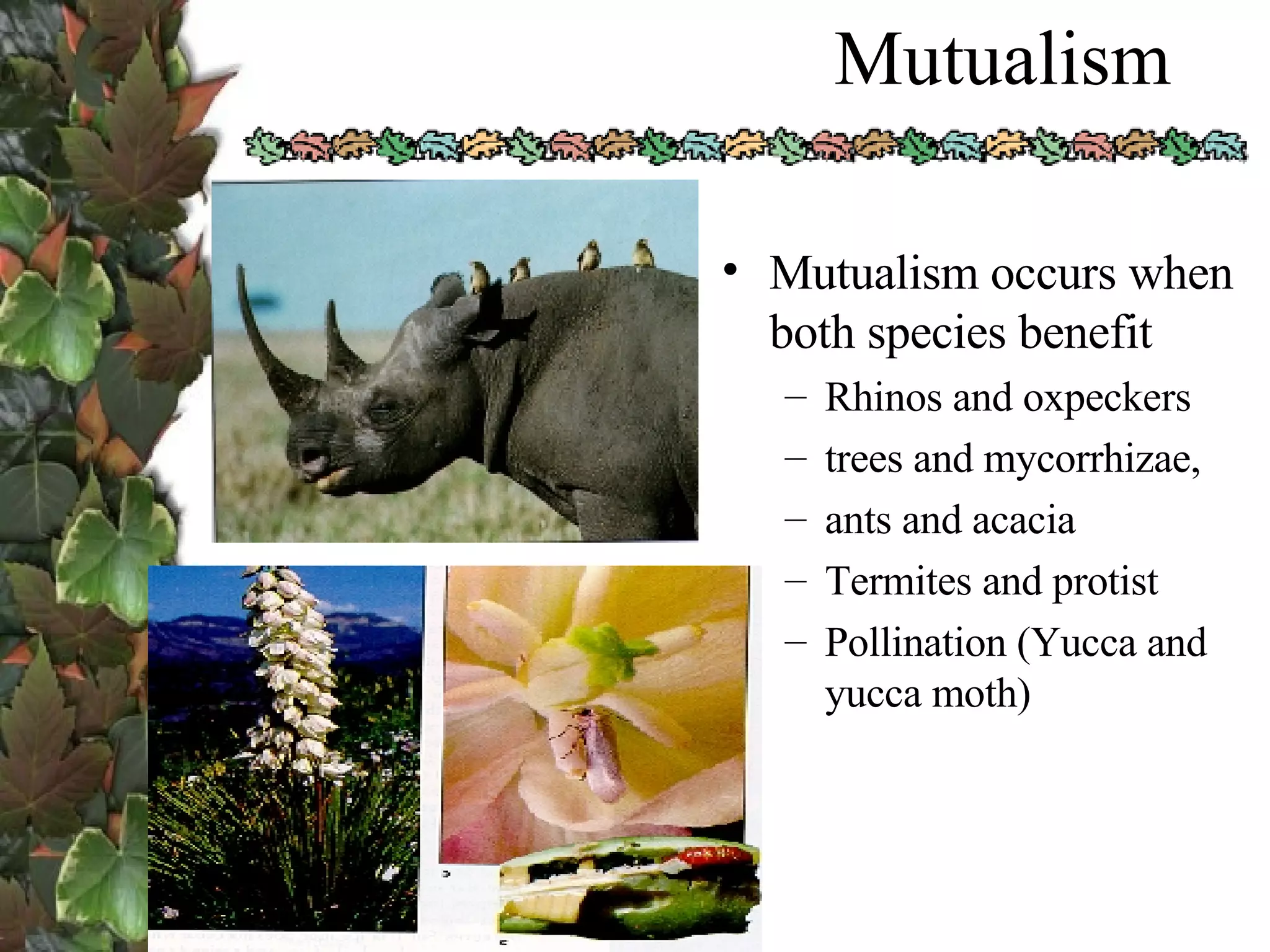
Mutualism Mutualism occurs when both species benefit Rhinos and oxpeckers trees and mycorrhizae, ants and acacia Termites and protist Pollination (Yucca and yucca moth)
Parasitism one organism feeds on/lives on another species typically  host  is bigger than parasite parasites usually do not kill host (weaken them) parasites need host for food, shelter, etc. ex. fleas on dog, tapeworm in human, mistletoe, lamprey
Commensalism Commensalism occurs when one species benefits, and the other neither benefits, or is harmed examples: clownfish and anemones epiphytes and trees Cattle egrets and ungulates
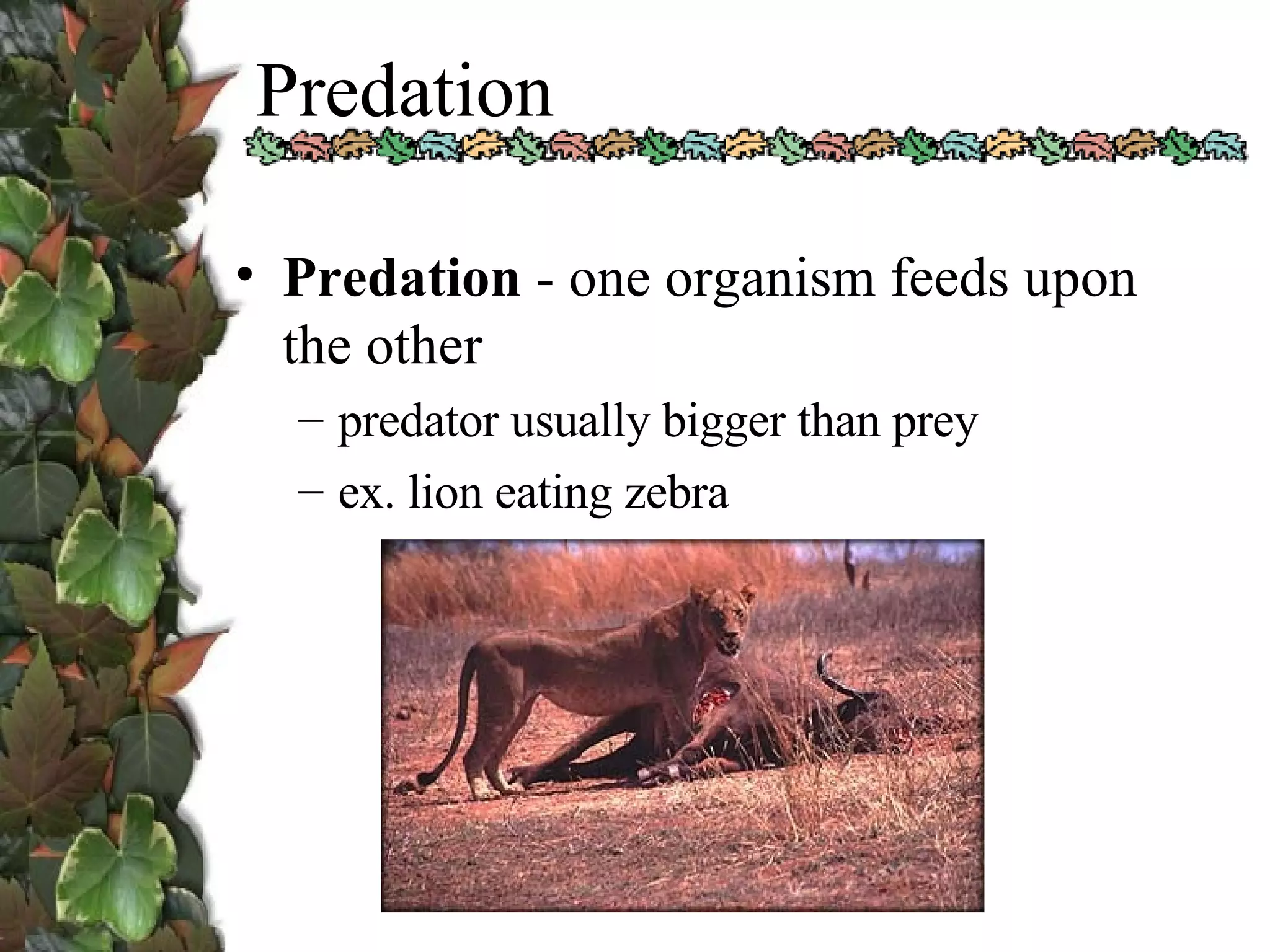
Predation Predation  - one organism feeds upon the other predator usually bigger than prey ex. lion eating zebra
Prey Strategies
Competition When two species use the same resources, they are said to compete and their interaction =  competition . ex. lions and hyenas compete for food in Africa Competition does not necessarily involve contact; interaction may be only by means of effects on the resources. No two organisms can occupy exactly  the same niche at the same time
What determines where species can live? All species have requirements for many factors/conditions.  Abiotic  factors – non-living factors; ex. temperature, precipitation, pH Biotic  factors – other species; ex. prey species, competing species For each of these factors, species exhibit a  range of tolerance .  For example, a fish species may only be found within a pH range of 4.5 to 6 in lakes.
Biomes A major terrestrial community that is found in different areas with similar climate is called a  biome .  A biome’s structure and appearance are similar throughout its distribution. The world’s biomes are tropical rain forest, tropical dry forest, temperate woodland and shrubland (Chaparral), temperate deciduous forest, boreal/coniferous forest (taiga), desert, temperate grassland, tropical grassland (savanna), and tundra.
Biome distribution
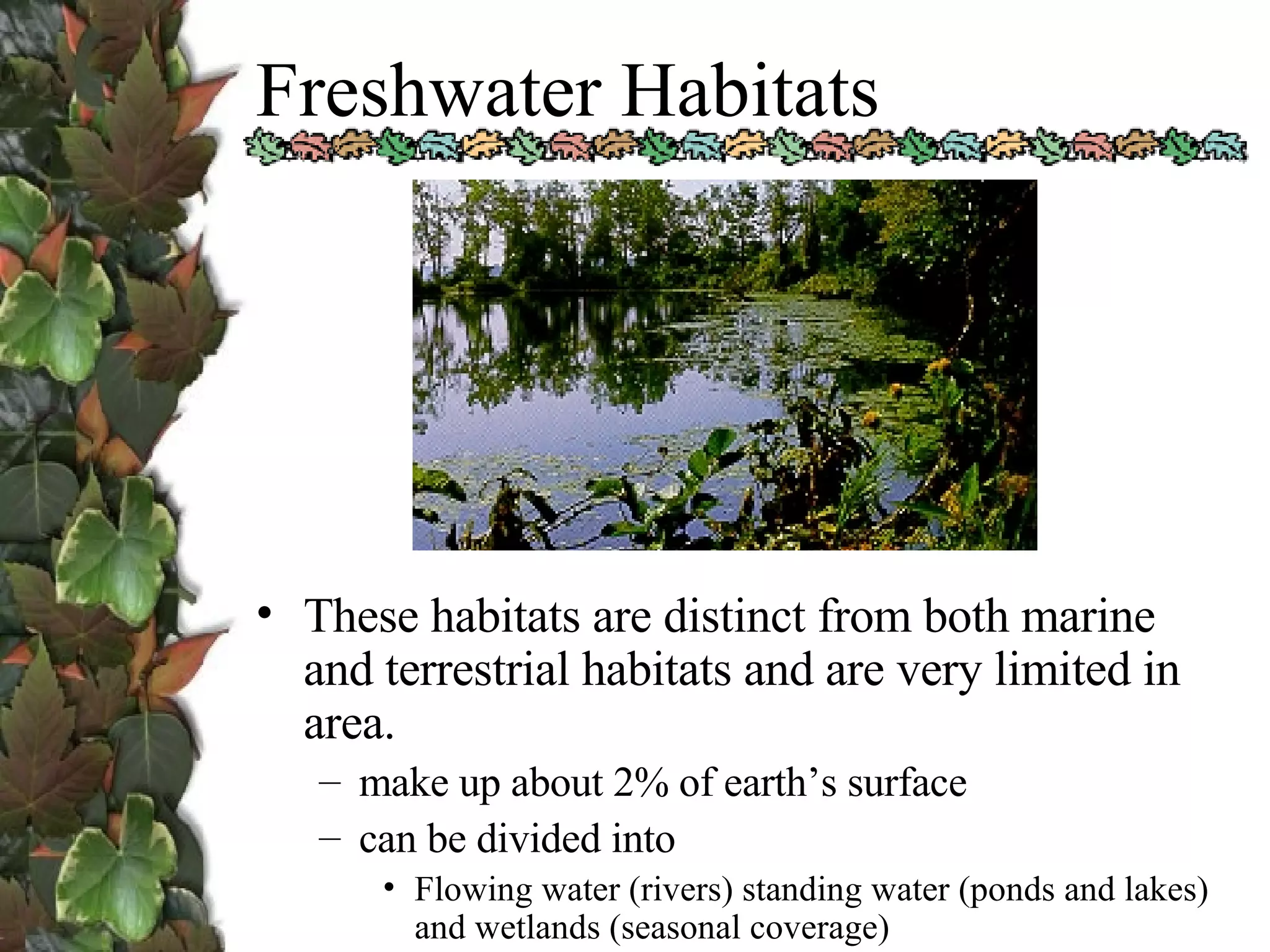
Freshwater Habitats These habitats  are distinct from both marine and terrestrial habitats and are very limited in area. make up about 2% of earth’s surface can be divided into Flowing water (rivers) standing water (ponds and lakes) and wetlands (seasonal coverage)
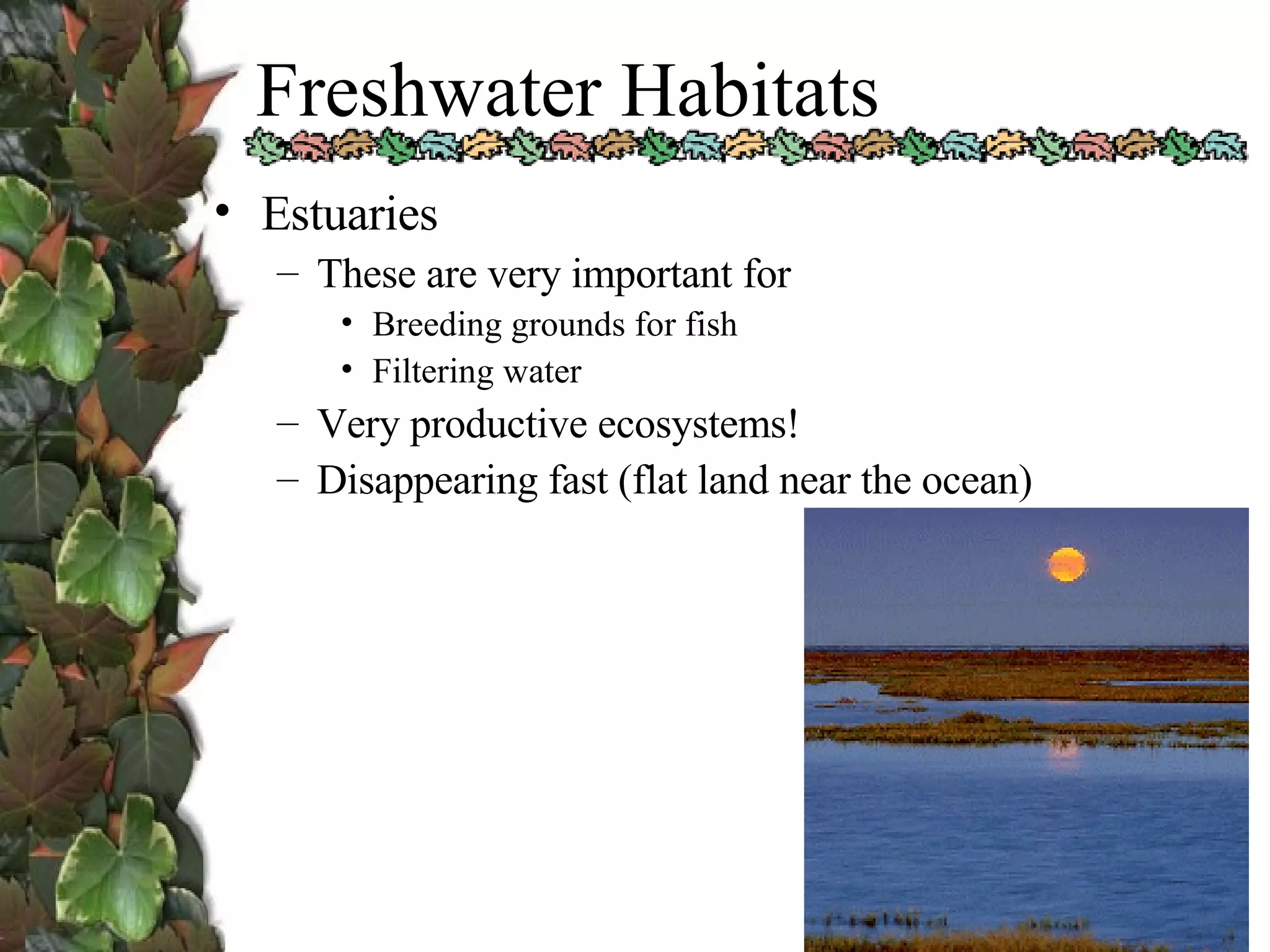
Freshwater Habitats Estuaries These are very important for Breeding grounds for fish Filtering water Very productive ecosystems! Disappearing fast (flat land near the ocean)
Ocean 75% of earth’s surface Continental shelf  - shallow ocean waters - smallest area; large number of species (kelp forests) Intertidal zones Along our coast Species can tolerate being in and out of water Sea stars, algae, sea anemones Coral Reefs The “rain forests” of the ocean High diversity In tropical waters
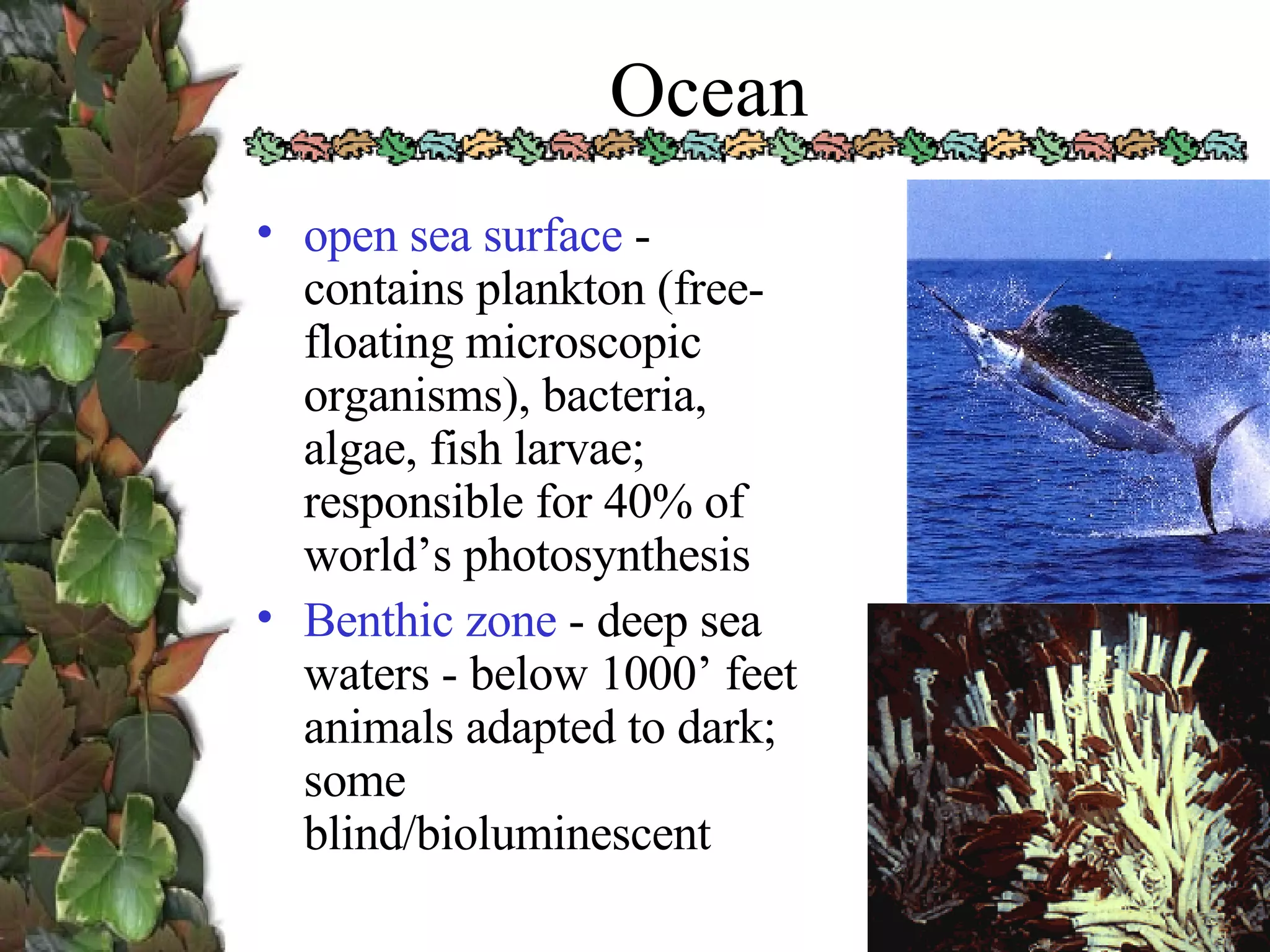
Ocean open sea surface  - contains plankton (free-floating microscopic organisms), bacteria, algae, fish larvae; responsible for 40% of world’s photosynthesis  Benthic zone  - deep sea waters - below 1000’ feet animals adapted to dark; some blind/bioluminescent
What happens when ecosystems are disturbed? When a disturbance impacts an ecosystem, it recovers through a process known as  succession.   Succession on newly formed habitat is called  primary succession .  No remaining organisms or soil Examples, lava flow, sand dune, glacier retreat It can take 1000+ years from sand dune to forest.

Ecology 1

  • 1.
  • 2.
    Levels of OrganizationOrganism Ex. an elephant Population A group of individuals in the same species, living and interacting in one area Ex. a herd of elephants in the Serengeti Community Multiple populations interacting in one area Ex. grazing antelope, elephants and giraffes in the Serengeti Ecosystem All populations in one area interacting with each other and their non-living environment. Ex. the Serengeti (all organisms plus climate, nutrients, etc.)
  • 3.
    Levels of OrganizationBiosphere All areas of the earth from the ocean depths to the atmosphere that support life.
  • 4.
    Ecological roles Autotrophs- Producer makes own food (through photosynthesis or chemosynthesis) Heterotrophs - Consumer must eat other organisms for food; primary (mouse), secondary (fox), tertiary (bobcat) Herbivore (eats plants) Carnivore (eats meat) Omnivore (eats both) Detritivore Organisms that feed on animals remains and dead material (crabs, earthworms) Decomposer An organism (ex. fungi or bacteria) that completes the final breakdown of materials in an ecosystem End of 3.1
  • 5.
    How does energyenter the ecosystem? Energy hits the earth in the form of sunlight Autotrophs convert sunlight (or chemical) energy into organic molecules Less than 1% of the sun’s energy is converted into organic material Eventually all energy is lost back to the atmosphere as heat.
  • 6.
    How does energymove through an ecosystem? Energy trapped in autotrophs ( producers ) then gets transferred to heterotrophs ( consumers ) as one organism eats another The easiest way to show this is by using a food chain, food web, or food pyramid. Food chain – series of steps in which organisms transfer energy by eating and being eaten.
  • 7.
    Food Web linksall ecosystems in a food chain together
  • 8.
    Food Pyramids Afood pyramid is designed to show the organisms in an ecosystem, grouped by their feeding position or trophic level (1 st =prod, 2 nd =herbivores, etc) Both food chains and food pyramids show that only 10% of the energy at one trophic level makes it to the next trophic level (from the 2 nd law of thermodynamics).
  • 9.
    Primary Productivity Therefore,the ecosystems with the most productive producers have the most levels (ex. rain forest) In most cases, there are only 3-4 levels. End of 3.2 The rate at which new organic material is created in an ecosystem by producers is called the Primary Productivity The more energy entering the food chain (from producers), the more that can pass up through the levels (only 10% moves up at each level), and as result, the more levels there can be.
  • 10.
    How do nutrientscycle? Energy follows a ONE-WAY path Sun  living organisms  heat  atmosphere Matter CYCLES through living organisms endlessly Biogeochemical cycles Water Carbon and Oxygen Nitrogen
  • 11.
  • 12.
  • 13.
  • 14.
    Niches Niches vsHabitats A habitat is the location where a species lives . Ex. tall grassland/prairie A niche includes all of the species’ requirements plus its role in the ecosystem. It is determined by all the the abiotic and biotic factors relevant to the species. Ex. Top predator in prairie areas where gophers live, and the temperature is never below freezing.
  • 15.
    Niche differences Organismscan be identified as either Generalists Organisms with a broad niche Eat lots of types of food Live in many types of environments Ex. house mice Specialists Organisms with a narrow niche Eat a narrow range of food items Live in few, specific types of habitats Ex. panda bear
  • 16.
    Mutualism Mutualism occurswhen both species benefit Rhinos and oxpeckers trees and mycorrhizae, ants and acacia Termites and protist Pollination (Yucca and yucca moth)
  • 17.
    Parasitism one organismfeeds on/lives on another species typically host is bigger than parasite parasites usually do not kill host (weaken them) parasites need host for food, shelter, etc. ex. fleas on dog, tapeworm in human, mistletoe, lamprey
  • 18.
    Commensalism Commensalism occurswhen one species benefits, and the other neither benefits, or is harmed examples: clownfish and anemones epiphytes and trees Cattle egrets and ungulates
  • 19.
    Predation Predation - one organism feeds upon the other predator usually bigger than prey ex. lion eating zebra
  • 20.
  • 21.
    Competition When twospecies use the same resources, they are said to compete and their interaction = competition . ex. lions and hyenas compete for food in Africa Competition does not necessarily involve contact; interaction may be only by means of effects on the resources. No two organisms can occupy exactly the same niche at the same time
  • 22.
    What determines wherespecies can live? All species have requirements for many factors/conditions. Abiotic factors – non-living factors; ex. temperature, precipitation, pH Biotic factors – other species; ex. prey species, competing species For each of these factors, species exhibit a range of tolerance . For example, a fish species may only be found within a pH range of 4.5 to 6 in lakes.
  • 23.
    Biomes A majorterrestrial community that is found in different areas with similar climate is called a biome . A biome’s structure and appearance are similar throughout its distribution. The world’s biomes are tropical rain forest, tropical dry forest, temperate woodland and shrubland (Chaparral), temperate deciduous forest, boreal/coniferous forest (taiga), desert, temperate grassland, tropical grassland (savanna), and tundra.
  • 24.
  • 25.
    Freshwater Habitats Thesehabitats are distinct from both marine and terrestrial habitats and are very limited in area. make up about 2% of earth’s surface can be divided into Flowing water (rivers) standing water (ponds and lakes) and wetlands (seasonal coverage)
  • 26.
    Freshwater Habitats EstuariesThese are very important for Breeding grounds for fish Filtering water Very productive ecosystems! Disappearing fast (flat land near the ocean)
  • 27.
    Ocean 75% ofearth’s surface Continental shelf - shallow ocean waters - smallest area; large number of species (kelp forests) Intertidal zones Along our coast Species can tolerate being in and out of water Sea stars, algae, sea anemones Coral Reefs The “rain forests” of the ocean High diversity In tropical waters
  • 28.
    Ocean open seasurface - contains plankton (free-floating microscopic organisms), bacteria, algae, fish larvae; responsible for 40% of world’s photosynthesis Benthic zone - deep sea waters - below 1000’ feet animals adapted to dark; some blind/bioluminescent
  • 29.
    What happens whenecosystems are disturbed? When a disturbance impacts an ecosystem, it recovers through a process known as succession. Succession on newly formed habitat is called primary succession . No remaining organisms or soil Examples, lava flow, sand dune, glacier retreat It can take 1000+ years from sand dune to forest.