Lec.1 what is ecology 
1
Origin of the word ā€œEcologyā€ 
What is ecology study? 
What ecology studying involves? 
Ecology definitions 
How ecology was born? (Recent history) 
Role of ecology in our lives in cities 
Types of Ecology 
Ecology levels of organization 
Lec.1 what is ecology 2
The word ECOLOGY was invented by the German scientist 
Ernst Haeckel in 1869. 
ļ‚§ It derived from Greek origins 
ļ‚§ OIKOS = household, home or a place to live 
ļ‚§ LOGOS = the study of… 
ļ‚§ Study of the ā€œhouse/environmentā€ in which we live. 
Lec.1 what is ecology 3
Non-living components in the environment… 
ļ‚§ light 
ļ‚§ water 
ļ‚§ wind 
ļ‚§ nutrients in soil 
ļ‚§ heat 
ļ‚§ solar radiation 
ļ‚§ atmosphere, etc. 
AND… 
Lec.1 what is ecology 
4
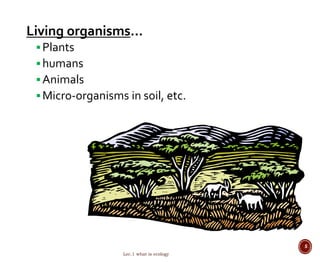
Living organisms… 
ļ‚§ Plants 
ļ‚§humans 
ļ‚§ Animals 
ļ‚§ Micro-organisms in soil, etc. 
Lec.1 what is ecology 
5
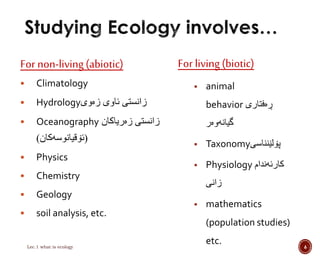
For non-living (abiotic) 
ļ‚§ Climatology 
ļ‚§ Hydrology زانستى Ų¦Ų§ŁˆŁ‰ Ų²Ū•ŁˆŁ‰ 
ļ‚§ Oceanography زانستى Ų²Ū•Ų±ŁŠŲ§ŁƒŲ§Ł† 
)Ų¦Ū†Ł‚ŁŠŲ§Ł†ŁˆŲ³Ū•ŁƒŲ§Ł†( 
ļ‚§ Physics 
ļ‚§ Chemistry 
ļ‚§ Geology 
ļ‚§ soil analysis, etc. 
For living (biotic) 
ļ‚§ animal 
behavior ڕەفتارى 
ŚÆŁŠŲ§Ł†Ū•ŁˆŪ•Ų± 
ļ‚§ Taxonomy Ł¾Ū†Ł„ŪŽŁ†Ł†Ų§Ų³Ł‰ 
ļ‚§ Physiology ŁƒŲ§Ų±Ų¦Ū•Ł†ŲÆŲ§Ł… 
زانى 
ļ‚§ mathematics 
(population studies) 
etc. 
Lec.1 what is ecology 6
Ecology can be defined as the study of relationships between 
organisms and their environments. Although it includes the study of 
environmental problems such as pollution. The science of ecology 
mainly involves research on the natural world from many 
viewpoints, using many techniques. 
Lec.1 what is ecology Tundra Caribou 7
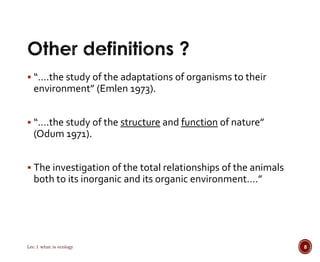
ļ‚§ ā€œā€¦.the study of the adaptations of organisms to their 
environmentā€ (Emlen 1973). 
ļ‚§ ā€œā€¦.the study of the structure and function of natureā€ 
(Odum 1971). 
ļ‚§ The investigation of the total relationships of the animals 
both to its inorganic and its organic environment….ā€ 
Lec.1 what is ecology 8
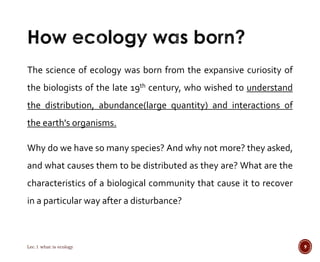
The science of ecology was born from the expansive curiosity of 
the biologists of the late 19th century, who wished to understand 
the distribution, abundance(large quantity) and interactions of 
the earth's organisms. 
Why do we have so many species? And why not more? they asked, 
and what causes them to be distributed as they are? What are the 
characteristics of a biological community that cause it to recover 
in a particular way after a disturbance? 
Lec.1 what is ecology 9
ļ‚§ Since humans have been students of ecology as long as we have 
existed as species. Then, our survival has depended upon how 
well we could observe variations in the environment and predict 
the response of organisms to those variations . 
ļ‚§ Modern ecology relies comprehensively on experiments, both in 
laboratory and in field settings. These techniques have proved 
useful in testing ecological theories, and in arriving at practical 
decisions concerning the management of natural resources. 
Lec.1 what is ecology 10
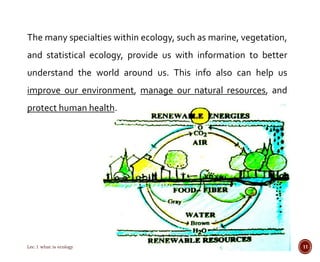
The many specialties within ecology, such as marine, vegetation, 
and statistical ecology, provide us with information to better 
understand the world around us. This info also can help us 
improve our environment, manage our natural resources, and 
protect human health. 
Lec.1 what is ecology 11
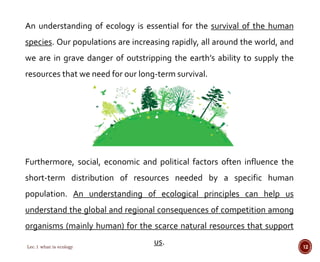
An understanding of ecology is essential for the survival of the human 
species. Our populations are increasing rapidly, all around the world, and 
we are in grave danger of outstripping the earth’s ability to supply the 
resources that we need for our long-term survival. 
Furthermore, social, economic and political factors often influence the 
short-term distribution of resources needed by a specific human 
population. An understanding of ecological principles can help us 
understand the global and regional consequences of competition among 
organisms (mainly human) for the scarce natural resources that support 
us. 
Lec.1 what is ecology 12
A. ORGANISMAL ECOLOGY - the study of individual organisms' 
behavior, physiology, morphology, etc. in response to 
environmental challenges. 
B. POPULATION ECOLOGY - the study of factors that affect and 
change the size and genetic composition of populations of 
organisms. 
C. COMMUNITY ECOLOGY - the study of how community structure 
and organization are changed by interactions among living 
organisms 
Lec.1 what is ecology 13
D. ECOSYSTEM ECOLOGY - the study of entire ecosystems, including 
the responses and changes in the community in response to the 
abiotic components of the ecosystem. This field is concerned with 
such large-scale topics as energy and nutrient cycling. 
D. LANDSCAPE ECOLOGY – study of the exchanges of energy, 
materials, organisms and other products of between ecosystems. 
E. GLOBAL ECOLOGY - the study of the effects of regional change in 
energy and matter exchange on the function and distribution of 
organisms across the biosphere. 
Lec.1 what is ecology 14
- a hierarchy of organization 
in the environment 
Lec.1 what is ecology 
15
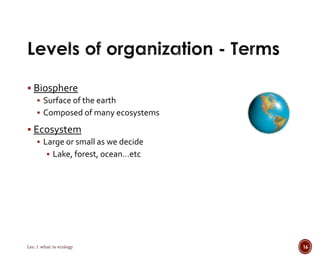
ļ‚§ Biosphere 
ļ‚§ Surface of the earth 
ļ‚§ Composed of many ecosystems 
ļ‚§ Ecosystem 
ļ‚§ Large or small as we decide 
ļ‚§ Lake, forest, ocean…etc 
Lec.1 what is ecology 16
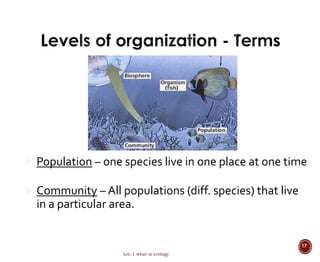
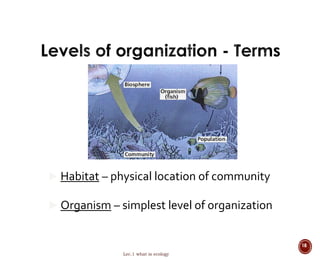
 Population – one species live in one place at one time 
 Community – All populations (diff. species) that live 
in a particular area. 
Lec.1 what is ecology 
17
 Habitat – physical location of community 
 Organism – simplest level of organization 
Lec.1 what is ecology 
18

Lecture 1.ecology

  • 1.
    Lec.1 what isecology 1
  • 2.
    Origin of theword ā€œEcologyā€ What is ecology study? What ecology studying involves? Ecology definitions How ecology was born? (Recent history) Role of ecology in our lives in cities Types of Ecology Ecology levels of organization Lec.1 what is ecology 2
  • 3.
    The word ECOLOGYwas invented by the German scientist Ernst Haeckel in 1869. ļ‚§ It derived from Greek origins ļ‚§ OIKOS = household, home or a place to live ļ‚§ LOGOS = the study of… ļ‚§ Study of the ā€œhouse/environmentā€ in which we live. Lec.1 what is ecology 3
  • 4.
    Non-living components inthe environment… ļ‚§ light ļ‚§ water ļ‚§ wind ļ‚§ nutrients in soil ļ‚§ heat ļ‚§ solar radiation ļ‚§ atmosphere, etc. AND… Lec.1 what is ecology 4
  • 5.
    Living organisms… ļ‚§Plants ļ‚§humans ļ‚§ Animals ļ‚§ Micro-organisms in soil, etc. Lec.1 what is ecology 5
  • 6.
    For non-living (abiotic) ļ‚§ Climatology ļ‚§ Hydrology زانستى Ų¦Ų§ŁˆŁ‰ Ų²Ū•ŁˆŁ‰ ļ‚§ Oceanography زانستى Ų²Ū•Ų±ŁŠŲ§ŁƒŲ§Ł† )Ų¦Ū†Ł‚ŁŠŲ§Ł†ŁˆŲ³Ū•ŁƒŲ§Ł†( ļ‚§ Physics ļ‚§ Chemistry ļ‚§ Geology ļ‚§ soil analysis, etc. For living (biotic) ļ‚§ animal behavior ڕەفتارى ŚÆŁŠŲ§Ł†Ū•ŁˆŪ•Ų± ļ‚§ Taxonomy Ł¾Ū†Ł„ŪŽŁ†Ł†Ų§Ų³Ł‰ ļ‚§ Physiology ŁƒŲ§Ų±Ų¦Ū•Ł†ŲÆŲ§Ł… زانى ļ‚§ mathematics (population studies) etc. Lec.1 what is ecology 6
  • 7.
    Ecology can bedefined as the study of relationships between organisms and their environments. Although it includes the study of environmental problems such as pollution. The science of ecology mainly involves research on the natural world from many viewpoints, using many techniques. Lec.1 what is ecology Tundra Caribou 7
  • 8.
    ļ‚§ ā€œā€¦.the studyof the adaptations of organisms to their environmentā€ (Emlen 1973). ļ‚§ ā€œā€¦.the study of the structure and function of natureā€ (Odum 1971). ļ‚§ The investigation of the total relationships of the animals both to its inorganic and its organic environment….ā€ Lec.1 what is ecology 8
  • 9.
    The science ofecology was born from the expansive curiosity of the biologists of the late 19th century, who wished to understand the distribution, abundance(large quantity) and interactions of the earth's organisms. Why do we have so many species? And why not more? they asked, and what causes them to be distributed as they are? What are the characteristics of a biological community that cause it to recover in a particular way after a disturbance? Lec.1 what is ecology 9
  • 10.
    ļ‚§ Since humanshave been students of ecology as long as we have existed as species. Then, our survival has depended upon how well we could observe variations in the environment and predict the response of organisms to those variations . ļ‚§ Modern ecology relies comprehensively on experiments, both in laboratory and in field settings. These techniques have proved useful in testing ecological theories, and in arriving at practical decisions concerning the management of natural resources. Lec.1 what is ecology 10
  • 11.
    The many specialtieswithin ecology, such as marine, vegetation, and statistical ecology, provide us with information to better understand the world around us. This info also can help us improve our environment, manage our natural resources, and protect human health. Lec.1 what is ecology 11
  • 12.
    An understanding ofecology is essential for the survival of the human species. Our populations are increasing rapidly, all around the world, and we are in grave danger of outstripping the earth’s ability to supply the resources that we need for our long-term survival. Furthermore, social, economic and political factors often influence the short-term distribution of resources needed by a specific human population. An understanding of ecological principles can help us understand the global and regional consequences of competition among organisms (mainly human) for the scarce natural resources that support us. Lec.1 what is ecology 12
  • 13.
    A. ORGANISMAL ECOLOGY- the study of individual organisms' behavior, physiology, morphology, etc. in response to environmental challenges. B. POPULATION ECOLOGY - the study of factors that affect and change the size and genetic composition of populations of organisms. C. COMMUNITY ECOLOGY - the study of how community structure and organization are changed by interactions among living organisms Lec.1 what is ecology 13
  • 14.
    D. ECOSYSTEM ECOLOGY- the study of entire ecosystems, including the responses and changes in the community in response to the abiotic components of the ecosystem. This field is concerned with such large-scale topics as energy and nutrient cycling. D. LANDSCAPE ECOLOGY – study of the exchanges of energy, materials, organisms and other products of between ecosystems. E. GLOBAL ECOLOGY - the study of the effects of regional change in energy and matter exchange on the function and distribution of organisms across the biosphere. Lec.1 what is ecology 14
  • 15.
    - a hierarchyof organization in the environment Lec.1 what is ecology 15
  • 16.
    ļ‚§ Biosphere ļ‚§Surface of the earth ļ‚§ Composed of many ecosystems ļ‚§ Ecosystem ļ‚§ Large or small as we decide ļ‚§ Lake, forest, ocean…etc Lec.1 what is ecology 16
  • 17.
     Population –one species live in one place at one time  Community – All populations (diff. species) that live in a particular area. Lec.1 what is ecology 17
  • 18.
     Habitat –physical location of community  Organism – simplest level of organization Lec.1 what is ecology 18