ECOSYSTEMS
What is an Ecosystem
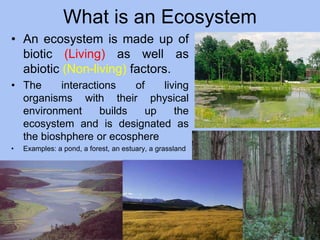
• An ecosystem is made up of
biotic (Living) as well as
abiotic (Non-living) factors.
• The interactions of living
organisms with their physical
environment builds up the
ecosystem and is designated as
the bioshphere or ecosphere
• Examples: a pond, a forest, an estuary, a grassland
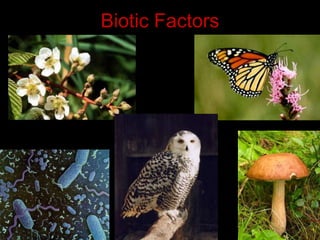
Biotic Factors
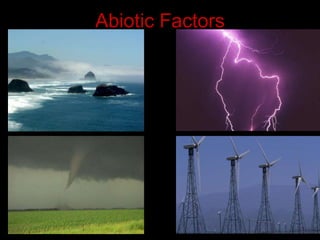
Abiotic Factors
ECOLOGY
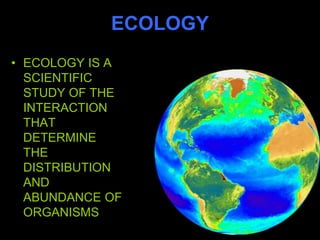
• ECOLOGY IS A
SCIENTIFIC
STUDY OF THE
INTERACTION
THAT
DETERMINE
THE
DISTRIBUTION
AND
ABUNDANCE OF
ORGANISMS
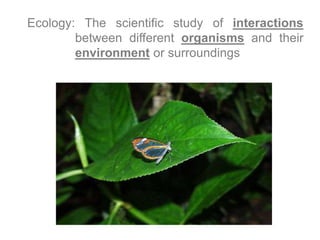
Ecology: The scientific study of interactions
between different organisms and their
environment or surroundings
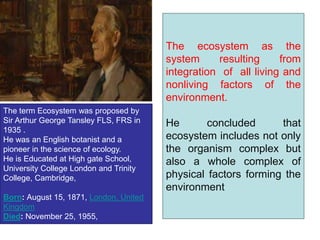
The term Ecosystem was proposed by
Sir Arthur George Tansley FLS, FRS in
1935 .
He was an English botanist and a
pioneer in the science of ecology.
He is Educated at High gate School,
University College London and Trinity
College, Cambridge,
Born: August 15, 1871, London, United
Kingdom
Died: November 25, 1955,
The ecosystem as the
system resulting from
integration of all living and
nonliving factors of the
environment.
He concluded that
ecosystem includes not only
the organism complex but
also a whole complex of
physical factors forming the
environment
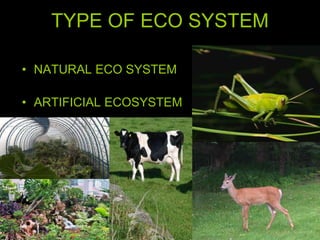
TYPE OF ECO SYSTEM
• NATURAL ECO SYSTEM
• ARTIFICIAL ECOSYSTEM
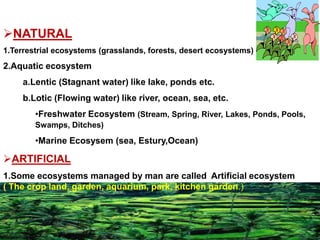
NATURAL
1.Terrestrial ecosystems (grasslands, forests, desert ecosystems)
2.Aquatic ecosystem
a.Lentic (Stagnant water) like lake, ponds etc.
b.Lotic (Flowing water) like river, ocean, sea, etc.
•Freshwater Ecosystem (Stream, Spring, River, Lakes, Ponds, Pools,
Swamps, Ditches)
•Marine Ecosysem (sea, Estury,Ocean)
ARTIFICIAL
1.Some ecosystems managed by man are called Artificial ecosystem
( The crop land, garden, aquarium, park, kitchen garden.)
STRUCTURE & FUNCTION OF ECOSYSTEM
• Two important aspects of the ecosystem are
Architectural (Structural) and Working process
(Functional)
• 1.The composition of biological community including
species numbers, biomass, life history and distribution
in space
• 2.The quantity and distribution of nonliving materials
like nutrients, water.
• 3.The condition of existence such as temperature, light
etc.
STRUCTURE AND FUNCTION OF
ECOSYSTEM
• Two important aspects of the ecosystem are working
process (Functional)
• 1.The rate of energy flow ie., production and respiration
rates of the community
• 2.The rate of material (nutrient) cycles
• 3.Biological regulation including both regulations of
organisms by environment (Photoperiodism) and
regulation of environment by the organisms (Nitrogen
fixing organisms)
An ecosystem consists of two main components
Abiotic or Non-living components.
1. Inorganic substances
2. Organic compounds
3. Climatic factors
Biotic or Living components.
1. Autotrophs or Producers
2. Heterotrophs or Consumers
3. Decomposers or Saprotrophs
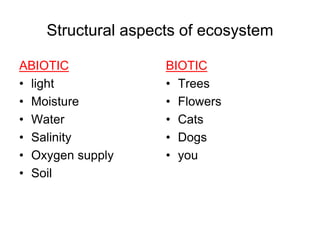
Structural aspects of ecosystem
ABIOTIC
• light
• Moisture
• Water
• Salinity
• Oxygen supply
• Soil
BIOTIC
• Trees
• Flowers
• Cats
• Dogs
• you
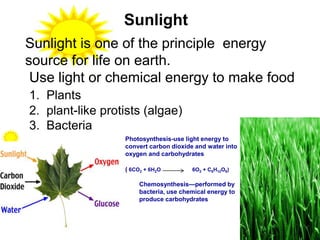
Sunlight
Sunlight is one of the principle energy
source for life on earth.
Use light or chemical energy to make food
1. Plants
2. plant-like protists (algae)
3. Bacteria
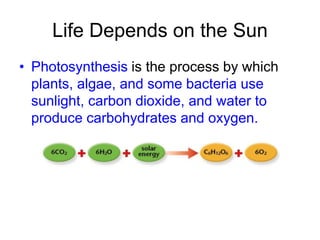
Photosynthesis-use light energy to
convert carbon dioxide and water into
oxygen and carbohydrates
( 6CO2 + 6H2O 6O2 + C6H12O6)
Chemosynthesis—performed by
bacteria, use chemical energy to
produce carbohydrates
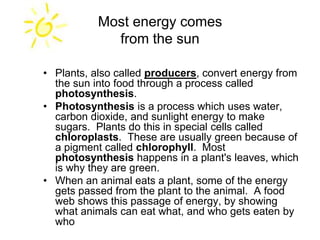
Most energy comes
from the sun
• Plants, also called producers, convert energy from
the sun into food through a process called
photosynthesis.
• Photosynthesis is a process which uses water,
carbon dioxide, and sunlight energy to make
sugars. Plants do this in special cells called
chloroplasts. These are usually green because of
a pigment called chlorophyll. Most
photosynthesis happens in a plant's leaves, which
is why they are green.
• When an animal eats a plant, some of the energy
gets passed from the plant to the animal. A food
web shows this passage of energy, by showing
what animals can eat what, and who gets eaten by
who
MOISTURE
• The amount of moisture in environment varies
from desert areas to lakes and oceans.
•
• All forms of life on earth requires water to live
and the abundance and the quality of water are
the main factor to determine what kind of
communities will develop in the environment
• In land environment the amount of available
moisture is a function of precipitation, humidity
and the evaporation rate
• In water environment the types of communities
depends of the availability of water
Water
• Three form of Water Solid, Liquid or gas.
• Large amount of heat is needed to change
the phases for this reasons temperature
changes in water tend to occur slowly and
changes in air temperature
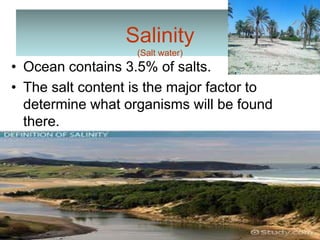
Salinity
(Salt water)
• Ocean contains 3.5% of salts.
• The salt content is the major factor to
determine what organisms will be found
there.
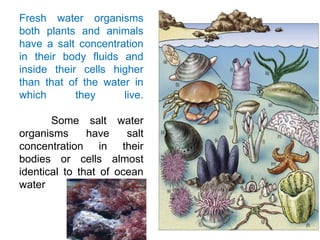
Fresh water organisms
both plants and animals
have a salt concentration
in their body fluids and
inside their cells higher
than that of the water in
which they live.
Some salt water
organisms have salt
concentration in their
bodies or cells almost
identical to that of ocean
water
Oceans
The ocean has many kinds of ecosystems. The
oceans are so large that the conditions in one
part of the ocean are very different from the
conditions in another part of the ocean.
Some ocean ecosystems are close to land and
receive more sunlight. In the deep sea, sunlight
cannot reach the ocean floor and the
ecosystems are quite different.
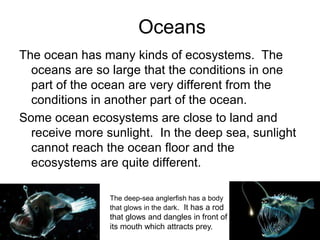
The deep-sea anglerfish has a body
that glows in the dark. It has a rod
that glows and dangles in front of
its mouth which attracts prey.
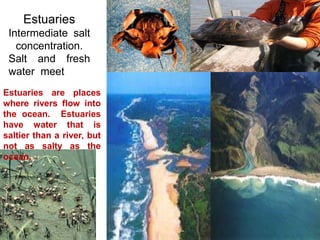
Estuaries
Intermediate salt
concentration.
Salt and fresh
water meet
Estuaries are places
where rivers flow into
the ocean. Estuaries
have water that is
saltier than a river, but
not as salty as the
ocean.
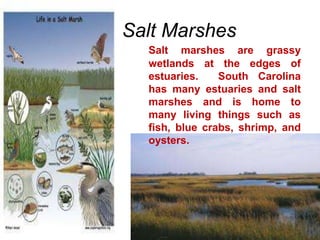
Salt Marshes
Salt marshes are grassy
wetlands at the edges of
estuaries. South Carolina
has many estuaries and salt
marshes and is home to
many living things such as
fish, blue crabs, shrimp, and
oysters.
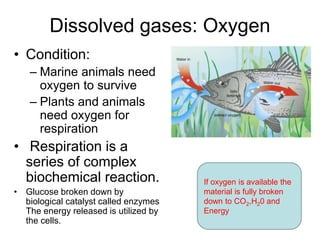
Dissolved gases: Oxygen
• Condition:
– Marine animals need
oxygen to survive
– Plants and animals
need oxygen for
respiration
• Respiration is a
series of complex
biochemical reaction.
• Glucose broken down by
biological catalyst called enzymes
The energy released is utilized by
the cells.
If oxygen is available the
material is fully broken
down to CO2,H20 and
Energy
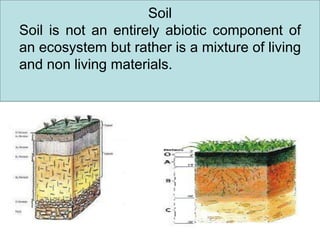
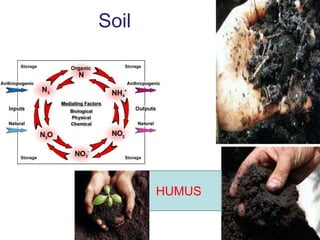
Soil
Soil is not an entirely abiotic component of
an ecosystem but rather is a mixture of living
and non living materials.
Soil
HUMUS
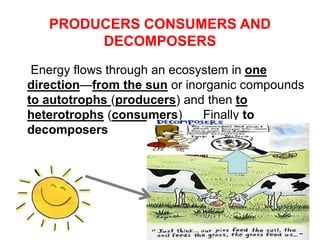
PRODUCERS CONSUMERS AND
DECOMPOSERS
Energy flows through an ecosystem in one
direction—from the sun or inorganic compounds
to autotrophs (producers) and then to
heterotrophs (consumers) Finally to
decomposers
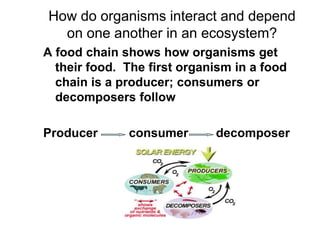
How do organisms interact and depend
on one another in an ecosystem?
A food chain shows how organisms get
their food. The first organism in a food
chain is a producer; consumers or
decomposers follow
Producer consumer decomposer
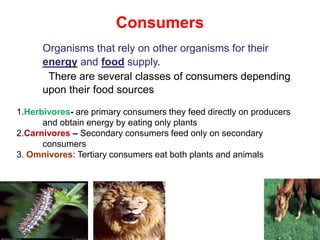
Consumers
Organisms that rely on other organisms for their
energy and food supply.
There are several classes of consumers depending
upon their food sources
1.Herbivores- are primary consumers they feed directly on producers
and obtain energy by eating only plants
2.Carnivores – Secondary consumers feed only on secondary
consumers
3. Omnivores: Tertiary consumers eat both plants and animals
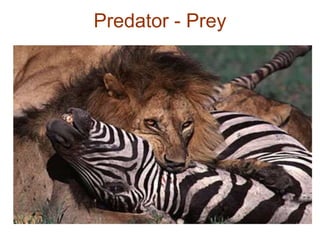
Predator - Prey
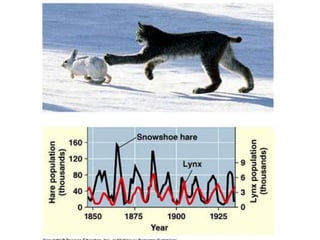
• Lions and zebras, for example
• One hunts and kills, the other gets killed and eaten
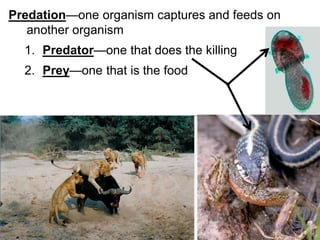
Predation—one organism captures and feeds on
another organism
1. Predator—one that does the killing
2. Prey—one that is the food
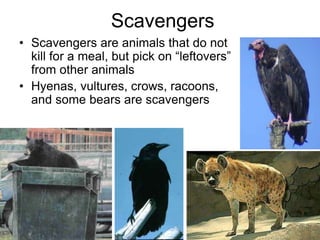
Scavengers
• Scavengers are animals that do not
kill for a meal, but pick on “leftovers”
from other animals
• Hyenas, vultures, crows, racoons,
and some bears are scavengers
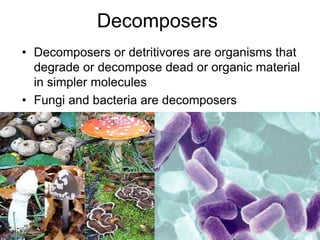
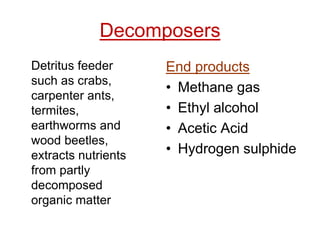
Decomposers
• Decomposers or detritivores are organisms that
degrade or decompose dead or organic material
in simpler molecules
• Fungi and bacteria are decomposers
Decomposers
Detritus feeder
such as crabs,
carpenter ants,
termites,
earthworms and
wood beetles,
extracts nutrients
from partly
decomposed
organic matter
End products
• Methane gas
• Ethyl alcohol
• Acetic Acid
• Hydrogen sulphide
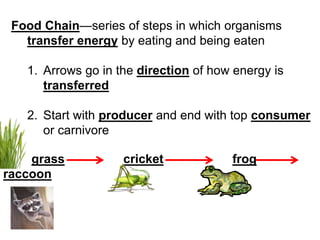
Food Chain—series of steps in which organisms
transfer energy by eating and being eaten
1. Arrows go in the direction of how energy is
transferred
2. Start with producer and end with top consumer
or carnivore
Ex: grass cricket frog
raccoon
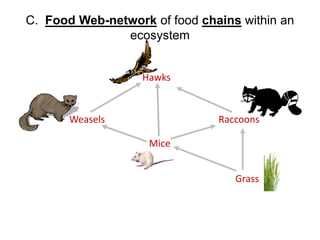
C. Food Web-network of food chains within an
ecosystem
Hawks
Weasels Raccoons
Mice
Grass
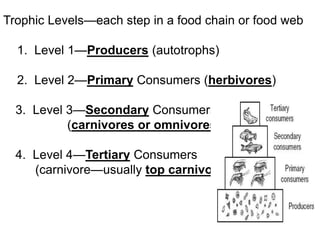
Trophic Levels—each step in a food chain or food web
1. Level 1—Producers (autotrophs)
2. Level 2—Primary Consumers (herbivores)
3. Level 3—Secondary Consumers
(carnivores or omnivores)
4. Level 4—Tertiary Consumers
(carnivore—usually top carnivore)
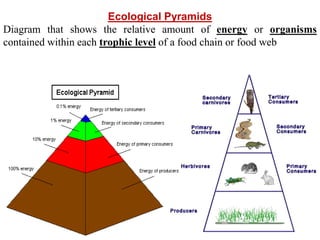
Ecological Pyramids
Diagram that shows the relative amount of energy or organisms
contained within each trophic level of a food chain or food web
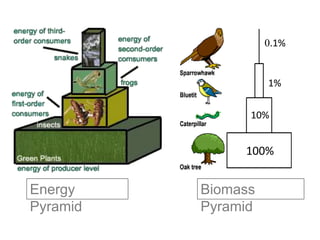
Energy
Pyramid
Biomass
Pyramid
100%
10%
1%
0.1%
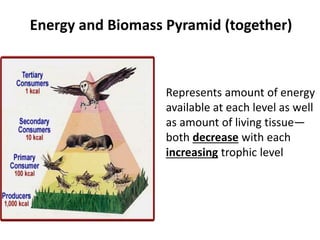
Represents amount of energy
available at each level as well
as amount of living tissue—
both decrease with each
increasing trophic level
Energy and Biomass Pyramid (together)
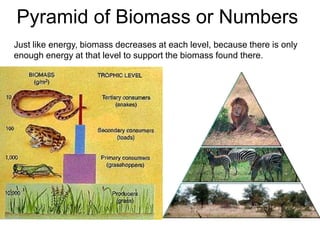
Pyramid of Biomass or Numbers
Just like energy, biomass decreases at each level, because there is only
enough energy at that level to support the biomass found there.
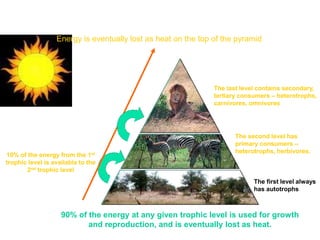
The first level always
has autotrophs
The second level has
primary consumers –
heterotrophs, herbivores.
The last level contains secondary,
tertiary consumers – heterotrophs,
carnivores, omnivores
10% of the energy from the 1st
trophic level is available to the
2nd trophic level
90% of the energy at any given trophic level is used for growth
and reproduction, and is eventually lost as heat.
Energy is eventually lost as heat on the top of the pyramid
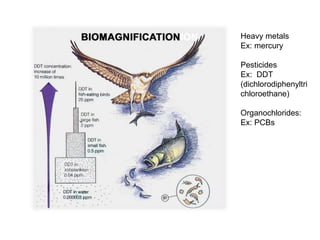
Heavy metals
Ex: mercury
Pesticides
Ex: DDT
(dichlorodiphenyltri
chloroethane)
Organochlorides:
Ex: PCBs
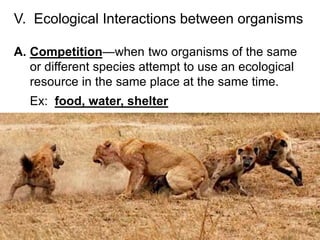
V. Ecological Interactions between organisms
A. Competition—when two organisms of the same
or different species attempt to use an ecological
resource in the same place at the same time.
Ex: food, water, shelter
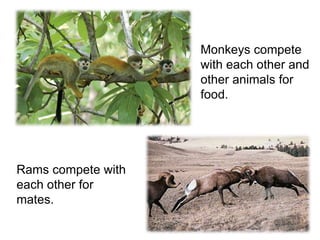
Monkeys compete
with each other and
other animals for
food.
Rams compete with
each other for
mates.
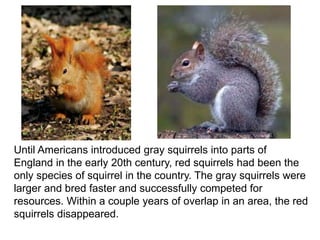
Until Americans introduced gray squirrels into parts of
England in the early 20th century, red squirrels had been the
only species of squirrel in the country. The gray squirrels were
larger and bred faster and successfully competed for
resources. Within a couple years of overlap in an area, the red
squirrels disappeared.
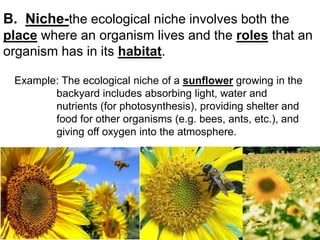
B. Niche-the ecological niche involves both the
place where an organism lives and the roles that an
organism has in its habitat.
Example: The ecological niche of a sunflower growing in the
backyard includes absorbing light, water and
nutrients (for photosynthesis), providing shelter and
food for other organisms (e.g. bees, ants, etc.), and
giving off oxygen into the atmosphere.
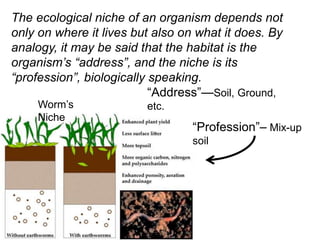
The ecological niche of an organism depends not
only on where it lives but also on what it does. By
analogy, it may be said that the habitat is the
organism’s “address”, and the niche is its
“profession”, biologically speaking.
Worm’s
Niche
“Address”—Soil, Ground,
etc.
“Profession”– Mix-up
soil
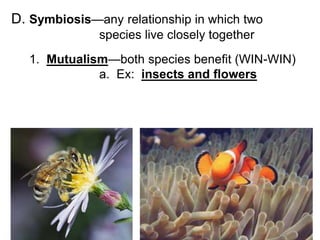
D. Symbiosis—any relationship in which two
species live closely together
1. Mutualism—both species benefit (WIN-WIN)
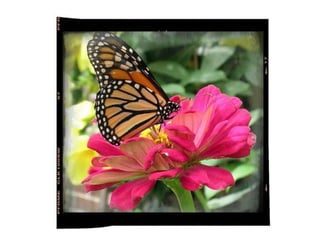
a. Ex: insects and flowers
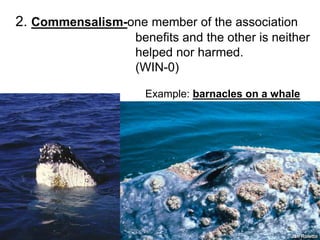
2. Commensalism-one member of the association
benefits and the other is neither
helped nor harmed.
(WIN-0)
Example: barnacles on a whale
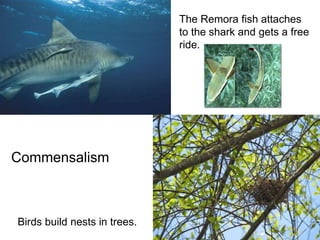
Commensalism
The Remora fish attaches
to the shark and gets a free
ride.
Birds build nests in trees.
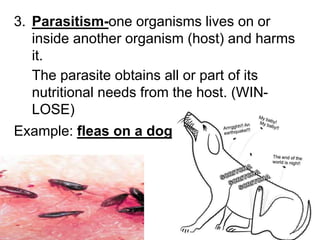
3. Parasitism-one organisms lives on or
inside another organism (host) and harms
it.
The parasite obtains all or part of its
nutritional needs from the host. (WIN-
LOSE)
Example: fleas on a dog
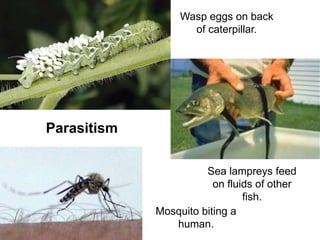
Parasitism
Wasp eggs on back
of caterpillar.
Mosquito biting a
human.
Sea lampreys feed
on fluids of other
fish.
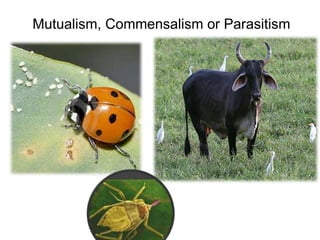
Mutualism, Commensalism or Parasitism
Food
Chain
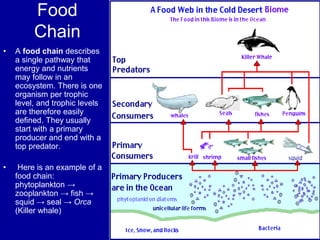
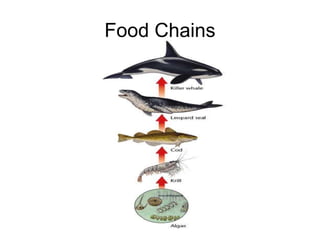
• A food chain describes
a single pathway that
energy and nutrients
may follow in an
ecosystem. There is one
organism per trophic
level, and trophic levels
are therefore easily
defined. They usually
start with a primary
producer and end with a
top predator.
• Here is an example of a
food chain:
phytoplankton →
zooplankton → fish →
squid → seal → Orca
(Killer whale)
Secondary, tertiary, quaternary
consumers
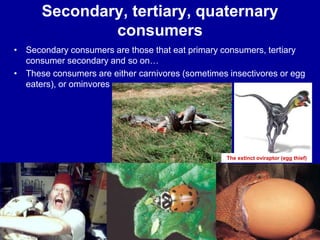
• Secondary consumers are those that eat primary consumers, tertiary
consumer secondary and so on…
• These consumers are either carnivores (sometimes insectivores or egg
eaters), or ominvores
The extinct oviraptor (egg thief)
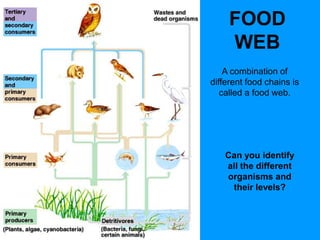
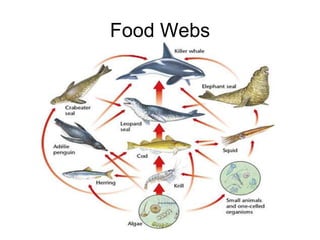
FOOD
WEB
A combination of
different food chains is
called a food web.
Can you identify
all the different
organisms and
their levels?
Matter Cycles
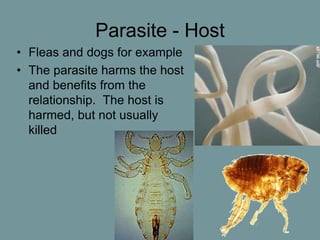
Parasite - Host
• Fleas and dogs for example
• The parasite harms the host
and benefits from the
relationship. The host is
harmed, but not usually
killed
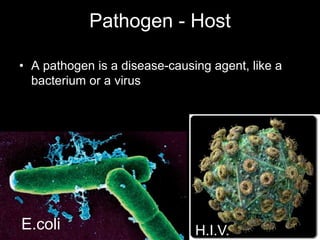
Pathogen - Host
• A pathogen is a disease-causing agent, like a
bacterium or a virus
E.coli H.I.V.
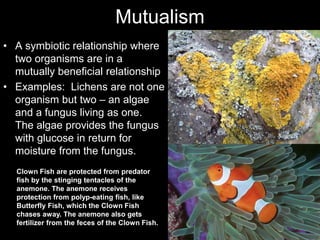
Mutualism
• A symbiotic relationship where
two organisms are in a
mutually beneficial relationship
• Examples: Lichens are not one
organism but two – an algae
and a fungus living as one.
The algae provides the fungus
with glucose in return for
moisture from the fungus.
Clown Fish are protected from predator
fish by the stinging tentacles of the
anemone. The anemone receives
protection from polyp-eating fish, like
Butterfly Fish, which the Clown Fish
chases away. The anemone also gets
fertilizer from the feces of the Clown Fish.
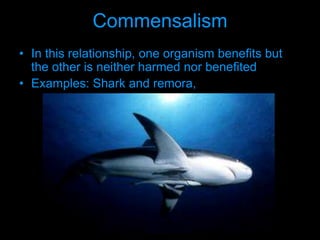
Commensalism
• In this relationship, one organism benefits but
the other is neither harmed nor benefited
• Examples: Shark and remora,
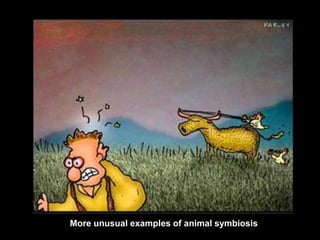
More unusual examples of animal symbiosis
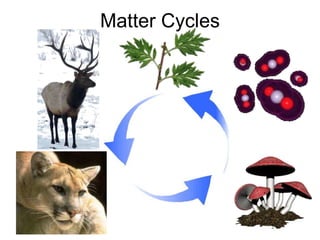
How nutrients cycle
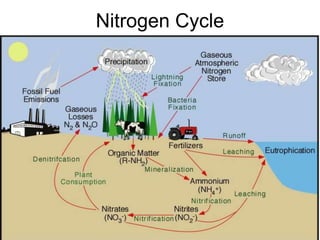
• Nitrogen cycle
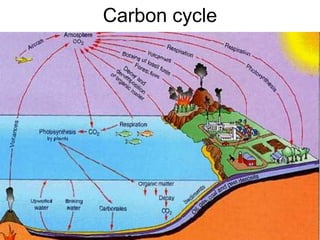
• Carbon cycle
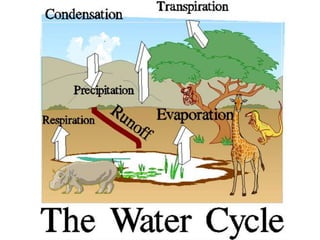
• Water Cycle
These are some of the various nutrient
cycles on Earth.
Nitrogen Cycle
Carbon cycle
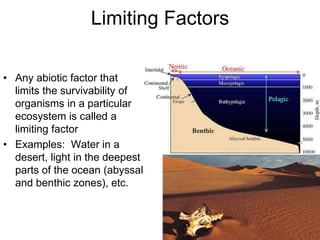
Limiting Factors
• Any abiotic factor that
limits the survivability of
organisms in a particular
ecosystem is called a
limiting factor
• Examples: Water in a
desert, light in the deepest
parts of the ocean (abyssal
and benthic zones), etc.
Food Webs
Food Chains
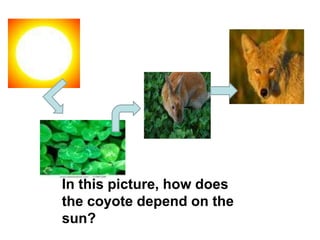
In this picture, how does
the coyote depend on the
sun?
Life Depends on the Sun
• Photosynthesis is the process by which
plants, algae, and some bacteria use
sunlight, carbon dioxide, and water to
produce carbohydrates and oxygen.
B. Energy Pyramid shows relative amount of energy available at
each trophic level
1. Organisms in a trophic level use the available
energy for life processes (such as growth,
photosynthesis, cellular respiration, metabolism,
etc.)and release some energy as heat
Remember: Every chemical process that happens in
your body releases heat as a byproduct (ex: burning
calories).
2. Rule of 10—only about 10% of the available energy
within a trophic level is transferred to the next
higher trophic level
C. Biomass Pyramid—represents the amount of living organic
matter at each trophic level
ECOLOGICAL SYSTEM

ECOLOGICAL SYSTEM

  • 1.
  • 2.
    What is anEcosystem • An ecosystem is made up of biotic (Living) as well as abiotic (Non-living) factors. • The interactions of living organisms with their physical environment builds up the ecosystem and is designated as the bioshphere or ecosphere • Examples: a pond, a forest, an estuary, a grassland
  • 3.
  • 4.
  • 5.
    ECOLOGY • ECOLOGY ISA SCIENTIFIC STUDY OF THE INTERACTION THAT DETERMINE THE DISTRIBUTION AND ABUNDANCE OF ORGANISMS
  • 6.
    Ecology: The scientificstudy of interactions between different organisms and their environment or surroundings
  • 7.
    The term Ecosystemwas proposed by Sir Arthur George Tansley FLS, FRS in 1935 . He was an English botanist and a pioneer in the science of ecology. He is Educated at High gate School, University College London and Trinity College, Cambridge, Born: August 15, 1871, London, United Kingdom Died: November 25, 1955, The ecosystem as the system resulting from integration of all living and nonliving factors of the environment. He concluded that ecosystem includes not only the organism complex but also a whole complex of physical factors forming the environment
  • 8.
    TYPE OF ECOSYSTEM • NATURAL ECO SYSTEM • ARTIFICIAL ECOSYSTEM
  • 9.
    NATURAL 1.Terrestrial ecosystems (grasslands,forests, desert ecosystems) 2.Aquatic ecosystem a.Lentic (Stagnant water) like lake, ponds etc. b.Lotic (Flowing water) like river, ocean, sea, etc. •Freshwater Ecosystem (Stream, Spring, River, Lakes, Ponds, Pools, Swamps, Ditches) •Marine Ecosysem (sea, Estury,Ocean) ARTIFICIAL 1.Some ecosystems managed by man are called Artificial ecosystem ( The crop land, garden, aquarium, park, kitchen garden.)
  • 10.
    STRUCTURE & FUNCTIONOF ECOSYSTEM • Two important aspects of the ecosystem are Architectural (Structural) and Working process (Functional) • 1.The composition of biological community including species numbers, biomass, life history and distribution in space • 2.The quantity and distribution of nonliving materials like nutrients, water. • 3.The condition of existence such as temperature, light etc.
  • 11.
    STRUCTURE AND FUNCTIONOF ECOSYSTEM • Two important aspects of the ecosystem are working process (Functional) • 1.The rate of energy flow ie., production and respiration rates of the community • 2.The rate of material (nutrient) cycles • 3.Biological regulation including both regulations of organisms by environment (Photoperiodism) and regulation of environment by the organisms (Nitrogen fixing organisms)
  • 12.
    An ecosystem consistsof two main components Abiotic or Non-living components. 1. Inorganic substances 2. Organic compounds 3. Climatic factors Biotic or Living components. 1. Autotrophs or Producers 2. Heterotrophs or Consumers 3. Decomposers or Saprotrophs
  • 13.
    Structural aspects ofecosystem ABIOTIC • light • Moisture • Water • Salinity • Oxygen supply • Soil BIOTIC • Trees • Flowers • Cats • Dogs • you
  • 14.
    Sunlight Sunlight is oneof the principle energy source for life on earth. Use light or chemical energy to make food 1. Plants 2. plant-like protists (algae) 3. Bacteria Photosynthesis-use light energy to convert carbon dioxide and water into oxygen and carbohydrates ( 6CO2 + 6H2O 6O2 + C6H12O6) Chemosynthesis—performed by bacteria, use chemical energy to produce carbohydrates
  • 15.
    Most energy comes fromthe sun • Plants, also called producers, convert energy from the sun into food through a process called photosynthesis. • Photosynthesis is a process which uses water, carbon dioxide, and sunlight energy to make sugars. Plants do this in special cells called chloroplasts. These are usually green because of a pigment called chlorophyll. Most photosynthesis happens in a plant's leaves, which is why they are green. • When an animal eats a plant, some of the energy gets passed from the plant to the animal. A food web shows this passage of energy, by showing what animals can eat what, and who gets eaten by who
  • 16.
    MOISTURE • The amountof moisture in environment varies from desert areas to lakes and oceans. • • All forms of life on earth requires water to live and the abundance and the quality of water are the main factor to determine what kind of communities will develop in the environment • In land environment the amount of available moisture is a function of precipitation, humidity and the evaporation rate • In water environment the types of communities depends of the availability of water
  • 17.
    Water • Three formof Water Solid, Liquid or gas. • Large amount of heat is needed to change the phases for this reasons temperature changes in water tend to occur slowly and changes in air temperature
  • 18.
    Salinity (Salt water) • Oceancontains 3.5% of salts. • The salt content is the major factor to determine what organisms will be found there.
  • 19.
    Fresh water organisms bothplants and animals have a salt concentration in their body fluids and inside their cells higher than that of the water in which they live. Some salt water organisms have salt concentration in their bodies or cells almost identical to that of ocean water
  • 20.
    Oceans The ocean hasmany kinds of ecosystems. The oceans are so large that the conditions in one part of the ocean are very different from the conditions in another part of the ocean. Some ocean ecosystems are close to land and receive more sunlight. In the deep sea, sunlight cannot reach the ocean floor and the ecosystems are quite different. The deep-sea anglerfish has a body that glows in the dark. It has a rod that glows and dangles in front of its mouth which attracts prey.
  • 21.
    Estuaries Intermediate salt concentration. Salt andfresh water meet Estuaries are places where rivers flow into the ocean. Estuaries have water that is saltier than a river, but not as salty as the ocean.
  • 22.
    Salt Marshes Salt marshesare grassy wetlands at the edges of estuaries. South Carolina has many estuaries and salt marshes and is home to many living things such as fish, blue crabs, shrimp, and oysters.
  • 23.
    Dissolved gases: Oxygen •Condition: – Marine animals need oxygen to survive – Plants and animals need oxygen for respiration • Respiration is a series of complex biochemical reaction. • Glucose broken down by biological catalyst called enzymes The energy released is utilized by the cells. If oxygen is available the material is fully broken down to CO2,H20 and Energy
  • 24.
    Soil Soil is notan entirely abiotic component of an ecosystem but rather is a mixture of living and non living materials.
  • 25.
  • 26.
    PRODUCERS CONSUMERS AND DECOMPOSERS Energyflows through an ecosystem in one direction—from the sun or inorganic compounds to autotrophs (producers) and then to heterotrophs (consumers) Finally to decomposers
  • 27.
    How do organismsinteract and depend on one another in an ecosystem? A food chain shows how organisms get their food. The first organism in a food chain is a producer; consumers or decomposers follow Producer consumer decomposer
  • 28.
    Consumers Organisms that relyon other organisms for their energy and food supply. There are several classes of consumers depending upon their food sources 1.Herbivores- are primary consumers they feed directly on producers and obtain energy by eating only plants 2.Carnivores – Secondary consumers feed only on secondary consumers 3. Omnivores: Tertiary consumers eat both plants and animals
  • 29.
    Predator - Prey •Lions and zebras, for example • One hunts and kills, the other gets killed and eaten
  • 30.
    Predation—one organism capturesand feeds on another organism 1. Predator—one that does the killing 2. Prey—one that is the food
  • 31.
    Scavengers • Scavengers areanimals that do not kill for a meal, but pick on “leftovers” from other animals • Hyenas, vultures, crows, racoons, and some bears are scavengers
  • 32.
    Decomposers • Decomposers ordetritivores are organisms that degrade or decompose dead or organic material in simpler molecules • Fungi and bacteria are decomposers
  • 33.
    Decomposers Detritus feeder such ascrabs, carpenter ants, termites, earthworms and wood beetles, extracts nutrients from partly decomposed organic matter End products • Methane gas • Ethyl alcohol • Acetic Acid • Hydrogen sulphide
  • 34.
    Food Chain—series ofsteps in which organisms transfer energy by eating and being eaten 1. Arrows go in the direction of how energy is transferred 2. Start with producer and end with top consumer or carnivore Ex: grass cricket frog raccoon
  • 35.
    C. Food Web-networkof food chains within an ecosystem Hawks Weasels Raccoons Mice Grass
  • 36.
    Trophic Levels—each stepin a food chain or food web 1. Level 1—Producers (autotrophs) 2. Level 2—Primary Consumers (herbivores) 3. Level 3—Secondary Consumers (carnivores or omnivores) 4. Level 4—Tertiary Consumers (carnivore—usually top carnivore)
  • 37.
    Ecological Pyramids Diagram thatshows the relative amount of energy or organisms contained within each trophic level of a food chain or food web
  • 38.
  • 39.
    Represents amount ofenergy available at each level as well as amount of living tissue— both decrease with each increasing trophic level Energy and Biomass Pyramid (together)
  • 40.
    Pyramid of Biomassor Numbers Just like energy, biomass decreases at each level, because there is only enough energy at that level to support the biomass found there.
  • 41.
    The first levelalways has autotrophs The second level has primary consumers – heterotrophs, herbivores. The last level contains secondary, tertiary consumers – heterotrophs, carnivores, omnivores 10% of the energy from the 1st trophic level is available to the 2nd trophic level 90% of the energy at any given trophic level is used for growth and reproduction, and is eventually lost as heat. Energy is eventually lost as heat on the top of the pyramid
  • 42.
    Heavy metals Ex: mercury Pesticides Ex:DDT (dichlorodiphenyltri chloroethane) Organochlorides: Ex: PCBs
  • 43.
    V. Ecological Interactionsbetween organisms A. Competition—when two organisms of the same or different species attempt to use an ecological resource in the same place at the same time. Ex: food, water, shelter
  • 44.
    Monkeys compete with eachother and other animals for food. Rams compete with each other for mates.
  • 45.
    Until Americans introducedgray squirrels into parts of England in the early 20th century, red squirrels had been the only species of squirrel in the country. The gray squirrels were larger and bred faster and successfully competed for resources. Within a couple years of overlap in an area, the red squirrels disappeared.
  • 46.
    B. Niche-the ecologicalniche involves both the place where an organism lives and the roles that an organism has in its habitat. Example: The ecological niche of a sunflower growing in the backyard includes absorbing light, water and nutrients (for photosynthesis), providing shelter and food for other organisms (e.g. bees, ants, etc.), and giving off oxygen into the atmosphere.
  • 47.
    The ecological nicheof an organism depends not only on where it lives but also on what it does. By analogy, it may be said that the habitat is the organism’s “address”, and the niche is its “profession”, biologically speaking. Worm’s Niche “Address”—Soil, Ground, etc. “Profession”– Mix-up soil
  • 49.
    D. Symbiosis—any relationshipin which two species live closely together 1. Mutualism—both species benefit (WIN-WIN) a. Ex: insects and flowers
  • 50.
    2. Commensalism-one memberof the association benefits and the other is neither helped nor harmed. (WIN-0) Example: barnacles on a whale
  • 51.
    Commensalism The Remora fishattaches to the shark and gets a free ride. Birds build nests in trees.
  • 52.
    3. Parasitism-one organismslives on or inside another organism (host) and harms it. The parasite obtains all or part of its nutritional needs from the host. (WIN- LOSE) Example: fleas on a dog
  • 53.
    Parasitism Wasp eggs onback of caterpillar. Mosquito biting a human. Sea lampreys feed on fluids of other fish.
  • 54.
  • 55.
    Food Chain • A foodchain describes a single pathway that energy and nutrients may follow in an ecosystem. There is one organism per trophic level, and trophic levels are therefore easily defined. They usually start with a primary producer and end with a top predator. • Here is an example of a food chain: phytoplankton → zooplankton → fish → squid → seal → Orca (Killer whale)
  • 56.
    Secondary, tertiary, quaternary consumers •Secondary consumers are those that eat primary consumers, tertiary consumer secondary and so on… • These consumers are either carnivores (sometimes insectivores or egg eaters), or ominvores The extinct oviraptor (egg thief)
  • 57.
    FOOD WEB A combination of differentfood chains is called a food web. Can you identify all the different organisms and their levels?
  • 58.
  • 59.
    Parasite - Host •Fleas and dogs for example • The parasite harms the host and benefits from the relationship. The host is harmed, but not usually killed
  • 60.
    Pathogen - Host •A pathogen is a disease-causing agent, like a bacterium or a virus E.coli H.I.V.
  • 61.
    Mutualism • A symbioticrelationship where two organisms are in a mutually beneficial relationship • Examples: Lichens are not one organism but two – an algae and a fungus living as one. The algae provides the fungus with glucose in return for moisture from the fungus. Clown Fish are protected from predator fish by the stinging tentacles of the anemone. The anemone receives protection from polyp-eating fish, like Butterfly Fish, which the Clown Fish chases away. The anemone also gets fertilizer from the feces of the Clown Fish.
  • 62.
    Commensalism • In thisrelationship, one organism benefits but the other is neither harmed nor benefited • Examples: Shark and remora,
  • 63.
    More unusual examplesof animal symbiosis
  • 64.
    How nutrients cycle •Nitrogen cycle • Carbon cycle • Water Cycle These are some of the various nutrient cycles on Earth.
  • 66.
  • 67.
  • 68.
    Limiting Factors • Anyabiotic factor that limits the survivability of organisms in a particular ecosystem is called a limiting factor • Examples: Water in a desert, light in the deepest parts of the ocean (abyssal and benthic zones), etc.
  • 69.
  • 70.
  • 71.
    In this picture,how does the coyote depend on the sun?
  • 72.
    Life Depends onthe Sun • Photosynthesis is the process by which plants, algae, and some bacteria use sunlight, carbon dioxide, and water to produce carbohydrates and oxygen.
  • 73.
    B. Energy Pyramidshows relative amount of energy available at each trophic level 1. Organisms in a trophic level use the available energy for life processes (such as growth, photosynthesis, cellular respiration, metabolism, etc.)and release some energy as heat Remember: Every chemical process that happens in your body releases heat as a byproduct (ex: burning calories). 2. Rule of 10—only about 10% of the available energy within a trophic level is transferred to the next higher trophic level C. Biomass Pyramid—represents the amount of living organic matter at each trophic level