ALL THE LIVING
THINGS
http://www.edistribucion.es/anayaeducacion/8420050/U03/U03_01_EPI_01/video_seres_vivos.html
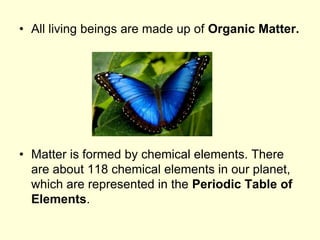
• All living beings are made up of Organic Matter.
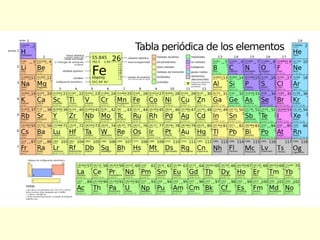
• Matter is formed by chemical elements. There
are about 118 chemical elements in our planet,
which are represented in the Periodic Table of
Elements.
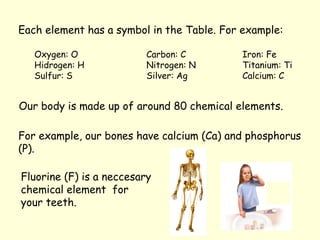
Each element has a symbol in the Table. For example:
Oxygen: O Carbon: C Iron: Fe
Hidrogen: H Nitrogen: N Titanium: Ti
Sulfur: S Silver: Ag Calcium: C
For example, our bones have calcium (Ca) and phosphorus
(P).
Fluorine (F) is a neccesary
chemical element for
your teeth.
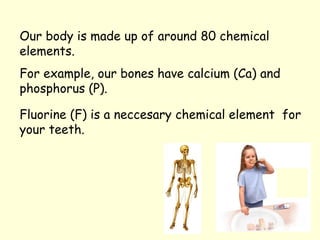
Our body is made up of around 80 chemical elements.
For example, our bones have calcium (Ca) and
phosphorus (P).
Fluorine (F) is a neccesary chemical element for
your teeth.
Our body is made up of around 80 chemical
elements.
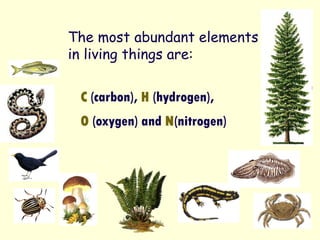
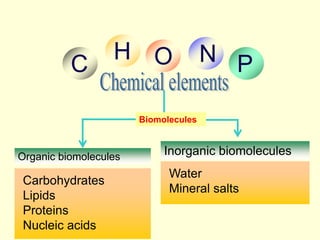
C (carbon), H (hydrogen),
O (oxygen) and N(nitrogen)
The most abundant elements
in living things are:
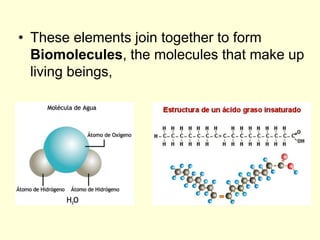
• These elements join together to form
Biomolecules, the molecules that make up
living beings,
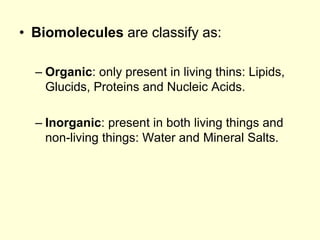
• Biomolecules are classify as:
– Organic: only present in living thins: Lipids,
Glucids, Proteins and Nucleic Acids.
– Inorganic: present in both living things and
non-living things: Water and Mineral Salts.
C
H O N P
Organic biomolecules
Carbohydrates
Lipids
Proteins
Nucleic acids
Inorganic biomolecules
Water
Mineral salts
Biomolecules
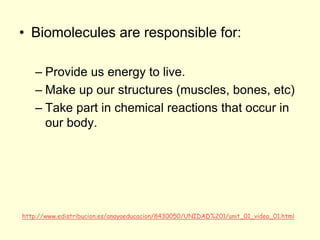
• Biomolecules are responsible for:
– Provide us energy to live.
– Make up our structures (muscles, bones, etc)
– Take part in chemical reactions that occur in
our body.
http://www.edistribucion.es/anayaeducacion/8430050/UNIDAD%201/unit_01_video_01.html
LIFE PROCESSES
Living things
• All living things carry out three vital
functions:
– Nutrition.
– Reproduction.
– Interaction with the enviroment.
1
All living things
need nutrition
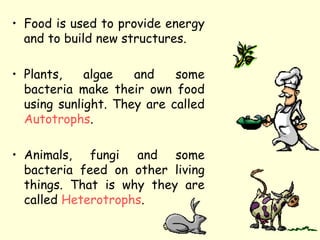
• Food is used to provide energy
and to build new structures.
• Plants, algae and some
bacteria make their own food
using sunlight. They are called
Autotrophs.
• Animals, fungi and some
bacteria feed on other living
things. That is why they are
called Heterotrophs.
2
All living things
reproduce
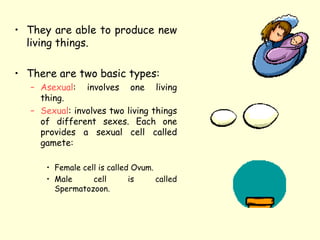
• They are able to produce new
living things.
• There are two basic types:
– Asexual: involves one living
thing.
– Sexual: involves two living things
of different sexes. Each one
provides a sexual cell called
gamete:
• Female cell is called Ovum.
• Male cell is called
Spermatozoon.
3
All living things
interact with
the enviroment.
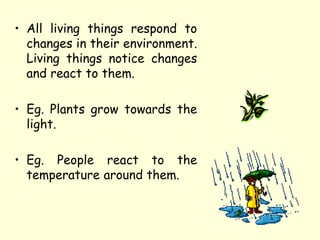
• All living things respond to
changes in their environment.
Living things notice changes
and react to them.
• Eg. Plants grow towards the
light.
• Eg. People react to the
temperature around them.
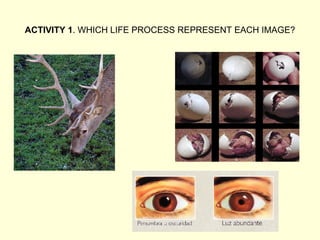
ACTIVITY 1. WHICH LIFE PROCESS REPRESENT EACH IMAGE?
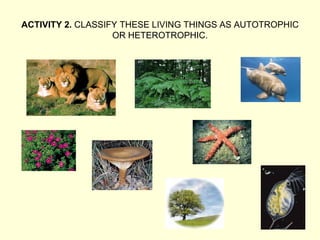
ACTIVITY 2. CLASSIFY THESE LIVING THINGS AS AUTOTROPHIC
OR HETEROTROPHIC.
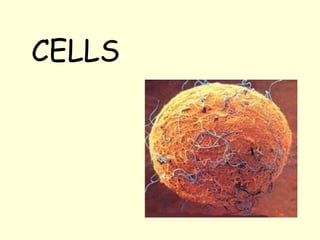
CELLS
WHAT ARE CELLS?
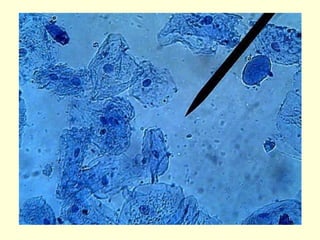
• Cells are the smallest unit of life. They
are the structural and functional units
for all living things.
– All living things are made up of one or more
cells.
– Cells carry out the three life processes.
– Cells come from other cells.
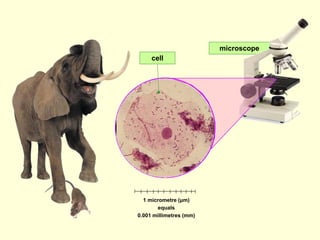
microscope
1 micrometre (μm)
equals
0.001 millimetres (mm)
cell
Parts of a Cell
Parts of a Cell
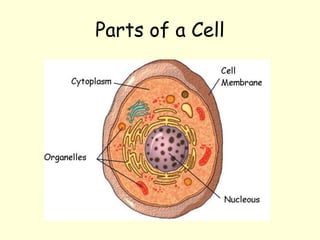
• The Cell Membrane covers the hole cell.
• The Cytoplasm is the inside of the cell.
It is a jelly-like substance. Organelles
are small structures in the cytoplasm,
and they are responsible for different
functions.
• The Nucleous: controls how cells work
and contains the hereditary information.
It is not in all cells types.
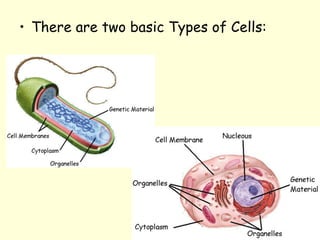
• There are two basic Types of Cells:
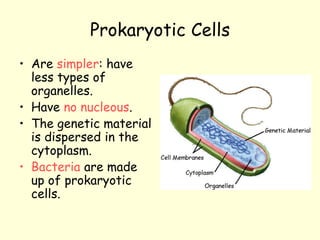
Prokaryotic Cells
• Are simpler: have
less types of
organelles.
• Have no nucleous.
• The genetic material
is dispersed in the
cytoplasm.
• Bacteria are made
up of prokaryotic
cells.
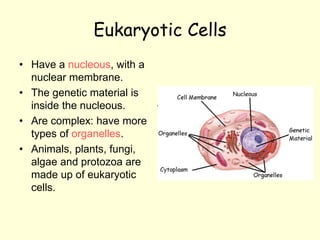
Eukaryotic Cells
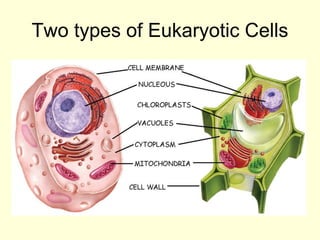
• Have a nucleous, with a
nuclear membrane.
• The genetic material is
inside the nucleous.
• Are complex: have more
types of organelles.
• Animals, plants, fungi,
algae and protozoa are
made up of eukaryotic
cells.
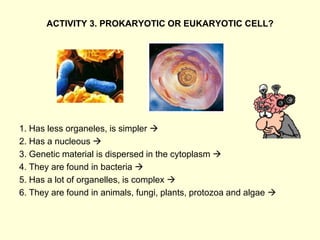
ACTIVITY 3. PROKARYOTIC OR EUKARYOTIC CELL?
1. Has less organeles, is simpler 
2. Has a nucleous 
3. Genetic material is dispersed in the cytoplasm 
4. They are found in bacteria 
5. Has a lot of organelles, is complex 
6. They are found in animals, fungi, plants, protozoa and algae 
Two types of Eukaryotic Cells
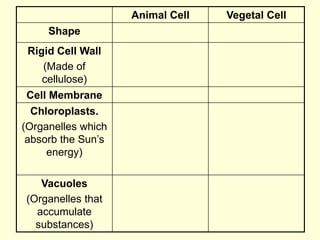
Animal Cell Vegetal Cell
Shape
Rigid Cell Wall
(Made of
cellulose)
Cell Membrane
Chloroplasts.
(Organelles which
absorb the Sun’s
energy)
Vacuoles
(Organelles that
accumulate
substances)
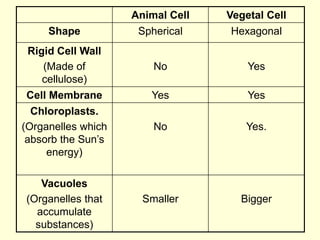
Animal Cell Vegetal Cell
Shape Spherical Hexagonal
Rigid Cell Wall
(Made of
cellulose)
No Yes
Cell Membrane Yes Yes
Chloroplasts.
(Organelles which
absorb the Sun’s
energy)
No Yes.
Vacuoles
(Organelles that
accumulate
substances)
Smaller Bigger
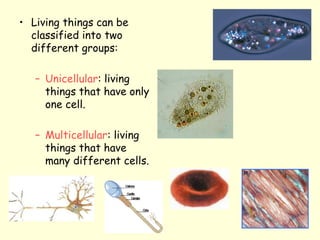
• Living things can be
classified into two
different groups:
– Unicellular: living
things that have only
one cell.
– Multicellular: living
things that have
many different cells.
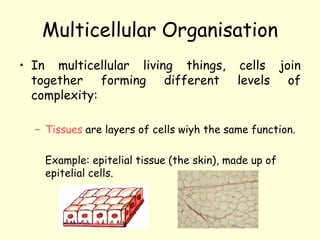
Multicellular Organisation
• In multicellular living things, cells join
together forming different levels of
complexity:
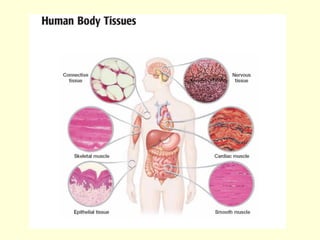
– Tissues are layers of cells wiyh the same function.
Example: epitelial tissue (the skin), made up of
epitelial cells.
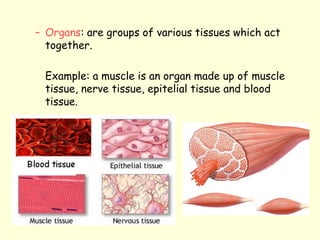
– Organs: are groups of various tissues which act
together.
Example: a muscle is an organ made up of muscle
tissue, nerve tissue, epitelial tissue and blood
tissue.
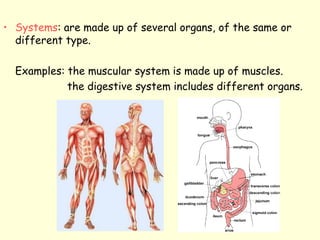
• Systems: are made up of several organs, of the same or
different type.
Examples: the muscular system is made up of muscles.
the digestive system includes different organs.
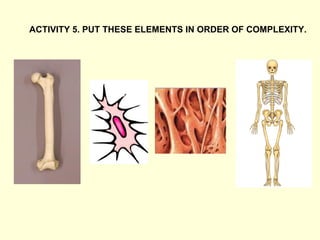
ACTIVITY 5. PUT THESE ELEMENTS IN ORDER OF COMPLEXITY.

The Living Things

  • 1.
  • 2.
    • All livingbeings are made up of Organic Matter. • Matter is formed by chemical elements. There are about 118 chemical elements in our planet, which are represented in the Periodic Table of Elements.
  • 4.
    Each element hasa symbol in the Table. For example: Oxygen: O Carbon: C Iron: Fe Hidrogen: H Nitrogen: N Titanium: Ti Sulfur: S Silver: Ag Calcium: C For example, our bones have calcium (Ca) and phosphorus (P). Fluorine (F) is a neccesary chemical element for your teeth. Our body is made up of around 80 chemical elements.
  • 5.
    For example, ourbones have calcium (Ca) and phosphorus (P). Fluorine (F) is a neccesary chemical element for your teeth. Our body is made up of around 80 chemical elements.
  • 6.
    C (carbon), H(hydrogen), O (oxygen) and N(nitrogen) The most abundant elements in living things are:
  • 7.
    • These elementsjoin together to form Biomolecules, the molecules that make up living beings,
  • 8.
    • Biomolecules areclassify as: – Organic: only present in living thins: Lipids, Glucids, Proteins and Nucleic Acids. – Inorganic: present in both living things and non-living things: Water and Mineral Salts.
  • 9.
    C H O NP Organic biomolecules Carbohydrates Lipids Proteins Nucleic acids Inorganic biomolecules Water Mineral salts Biomolecules
  • 10.
    • Biomolecules areresponsible for: – Provide us energy to live. – Make up our structures (muscles, bones, etc) – Take part in chemical reactions that occur in our body. http://www.edistribucion.es/anayaeducacion/8430050/UNIDAD%201/unit_01_video_01.html
  • 11.
  • 12.
    Living things • Allliving things carry out three vital functions: – Nutrition. – Reproduction. – Interaction with the enviroment.
  • 13.
  • 14.
    • Food isused to provide energy and to build new structures. • Plants, algae and some bacteria make their own food using sunlight. They are called Autotrophs. • Animals, fungi and some bacteria feed on other living things. That is why they are called Heterotrophs.
  • 15.
  • 16.
    • They areable to produce new living things. • There are two basic types: – Asexual: involves one living thing. – Sexual: involves two living things of different sexes. Each one provides a sexual cell called gamete: • Female cell is called Ovum. • Male cell is called Spermatozoon.
  • 17.
    3 All living things interactwith the enviroment.
  • 18.
    • All livingthings respond to changes in their environment. Living things notice changes and react to them. • Eg. Plants grow towards the light. • Eg. People react to the temperature around them.
  • 19.
    ACTIVITY 1. WHICHLIFE PROCESS REPRESENT EACH IMAGE?
  • 20.
    ACTIVITY 2. CLASSIFYTHESE LIVING THINGS AS AUTOTROPHIC OR HETEROTROPHIC.
  • 21.
  • 22.
    WHAT ARE CELLS? •Cells are the smallest unit of life. They are the structural and functional units for all living things. – All living things are made up of one or more cells. – Cells carry out the three life processes. – Cells come from other cells.
  • 23.
  • 24.
  • 25.
    Parts of aCell • The Cell Membrane covers the hole cell. • The Cytoplasm is the inside of the cell. It is a jelly-like substance. Organelles are small structures in the cytoplasm, and they are responsible for different functions. • The Nucleous: controls how cells work and contains the hereditary information. It is not in all cells types.
  • 27.
    • There aretwo basic Types of Cells:
  • 28.
    Prokaryotic Cells • Aresimpler: have less types of organelles. • Have no nucleous. • The genetic material is dispersed in the cytoplasm. • Bacteria are made up of prokaryotic cells.
  • 29.
    Eukaryotic Cells • Havea nucleous, with a nuclear membrane. • The genetic material is inside the nucleous. • Are complex: have more types of organelles. • Animals, plants, fungi, algae and protozoa are made up of eukaryotic cells.
  • 30.
    ACTIVITY 3. PROKARYOTICOR EUKARYOTIC CELL? 1. Has less organeles, is simpler  2. Has a nucleous  3. Genetic material is dispersed in the cytoplasm  4. They are found in bacteria  5. Has a lot of organelles, is complex  6. They are found in animals, fungi, plants, protozoa and algae 
  • 31.
    Two types ofEukaryotic Cells
  • 32.
    Animal Cell VegetalCell Shape Rigid Cell Wall (Made of cellulose) Cell Membrane Chloroplasts. (Organelles which absorb the Sun’s energy) Vacuoles (Organelles that accumulate substances)
  • 33.
    Animal Cell VegetalCell Shape Spherical Hexagonal Rigid Cell Wall (Made of cellulose) No Yes Cell Membrane Yes Yes Chloroplasts. (Organelles which absorb the Sun’s energy) No Yes. Vacuoles (Organelles that accumulate substances) Smaller Bigger
  • 34.
    • Living thingscan be classified into two different groups: – Unicellular: living things that have only one cell. – Multicellular: living things that have many different cells.
  • 35.
    Multicellular Organisation • Inmulticellular living things, cells join together forming different levels of complexity: – Tissues are layers of cells wiyh the same function. Example: epitelial tissue (the skin), made up of epitelial cells.
  • 37.
    – Organs: aregroups of various tissues which act together. Example: a muscle is an organ made up of muscle tissue, nerve tissue, epitelial tissue and blood tissue.
  • 38.
    • Systems: aremade up of several organs, of the same or different type. Examples: the muscular system is made up of muscles. the digestive system includes different organs.
  • 39.
    ACTIVITY 5. PUTTHESE ELEMENTS IN ORDER OF COMPLEXITY.