The Renaissance ~ 1400-1600
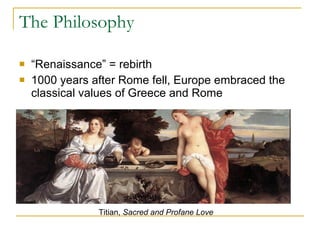
The Philosophy “ Renaissance” = rebirth 1000 years after Rome fell, Europe embraced the classical values of Greece and Rome Titian,  Sacred and Profane Love
Renaissance Man The shaper of his own destiny  (vs. a plaything of the supernatural) Individuals are valued Life is more than a preparation for the afterlife Optimistic, confident in their basic goodness and in the power of people to solve problems = Humanism (remember, from the Greeks?)
A Cultural Revolution Politics = democracy and nation-states Economics = capitalists and the middle class Religion = a move away from Church dominance towards the assertion of man + more personal faith  (  Protestant Reformation) Secular Learning supercedes superstition and ignorance Scientists observe and learn, rather than relying on old texts/knowledge
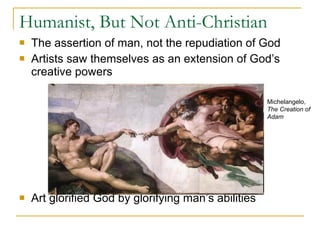
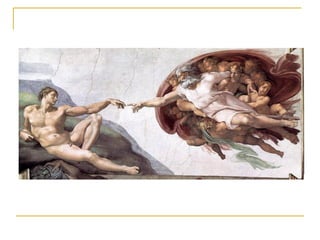
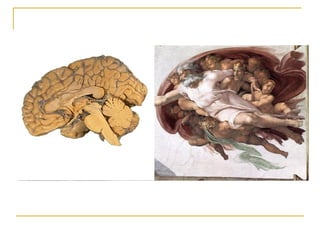
Humanist, But Not Anti-Christian The assertion of man, not the repudiation of God Artists saw themselves as an extension of God’s creative powers Art glorified God by glorifying man’s abilities Michelangelo,  The Creation of Adam
Renaissance Art A triumph of order and harmony. Re-mastered realism, three-dimensionality, balance, and perspective (were lost during Dark Ages) Sculptors portrayed idealized human bodies, balanced perfectly between motion and rest. All art forms took inspiration from ancient Greek and Roman works.
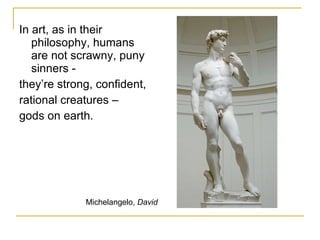
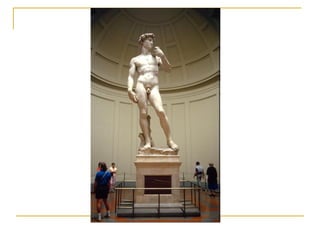
In art, as in their philosophy, humans are not scrawny, puny sinners -  they’re strong, confident, rational creatures –  gods on earth. Michelangelo,  David
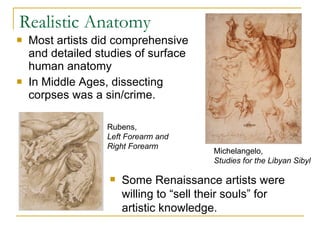
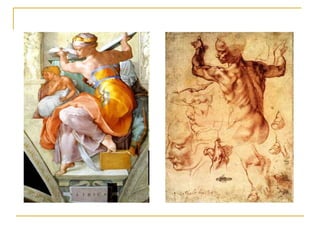
Realistic Anatomy Most artists did comprehensive and detailed studies of surface human anatomy In Middle Ages, dissecting corpses was a sin/crime. Michelangelo,  Studies for the Libyan Sibyl   Some Renaissance artists were willing to “sell their souls” for artistic knowledge. Rubens,  Left Forearm and Right Forearm
Themes in the Art Still a lot of Christian imagery Unlike medieval works, the art could exist for the sake of beauty/holiness, not just for education = Less symbols and halos to identify figures, but radiate purity and beauty. Democratic values = portraits of people besides just popes, kings, and saints.
Perspective (closer figures are larger, farther figures are smaller) Picture Frame = a window on the world from a specific point of view (a human perspective) Balance and symmetrical Statues stand with weight balanced on one leg or Designed around a central axis Madonnas flanked by Saints, balanced number Most of all, it’s beautiful.  Art for art’s sake. Qualities of Renaissance Art
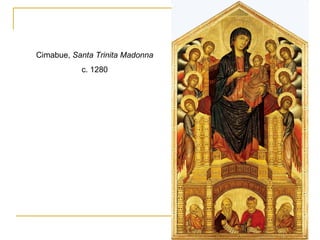
Cimabue,  Santa Trinita Madonna c. 1280
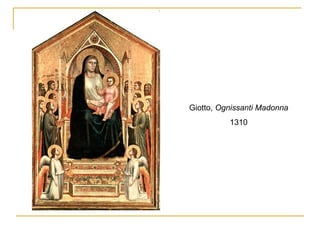
Giotto,  Ognissanti Madonna 1310
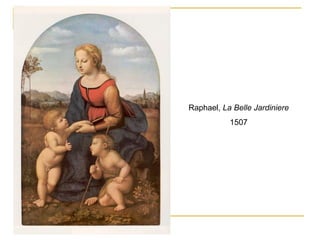
Raphael,  La Belle Jardiniere 1507
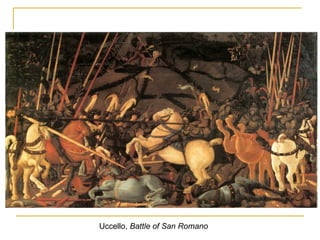
Uccello,  Battle of San Romano
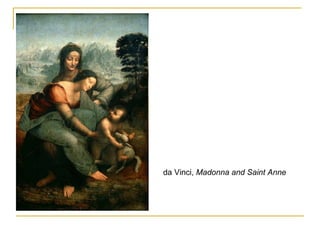
da Vinci,  Madonna and Saint Anne
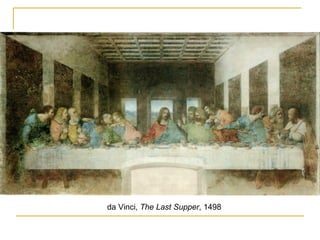
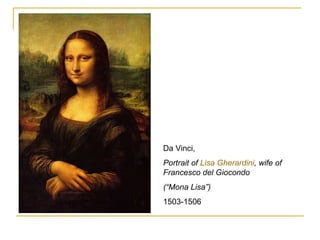
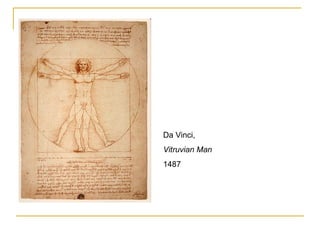
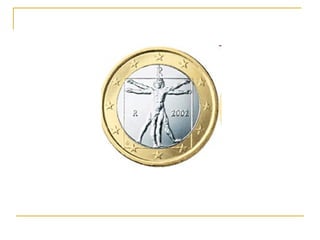
Top Italian Artworks to Know Da Vinci The Last Supper, Mona Lisa, Vitruvian Man
da Vinci,  The Last Supper , 1498
Da Vinci,  Portrait of  Lisa  Gherardini , wife of Francesco del Giocondo  (“Mona Lisa”) 1503-1506
Sfumato ( noun ) - from the Latin (via Italian)  fumare  ("to smoke"), a painting technique.  Sfumato  means that there are no harsh outlines (as in a coloring book) present; areas blend into one another through miniscule brushstrokes, which makes for a rather hazy, albeit more realistic, depiction of light and color.  http://arthistory.about.com/cs/glossaries/g/s_sfumato.htm
Da Vinci,  Vitruvian Man 1487
 
Top Italian Artworks to Know Da Vinci The Last Supper, Mona Lisa, Vitruvian Man Botticelli Primavera, The Birth of Venus
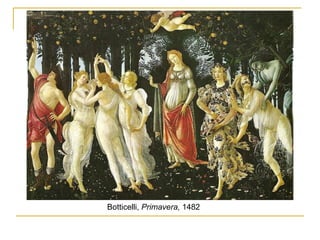
Botticelli,  Primavera,  1482
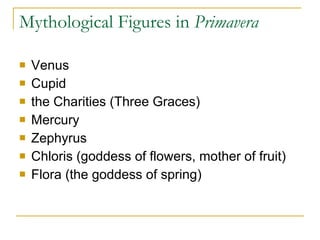
Mythological Figures in  Primavera Venus  Cupid  the Charities (Three Graces) Mercury Zephyrus Chloris (goddess of flowers, mother of fruit) Flora (the goddess of spring)
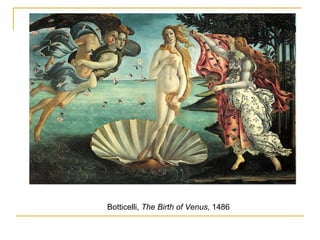
Botticelli,  The Birth of Venus,  1486
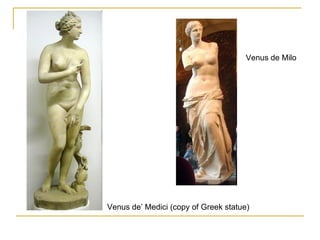
Venus de’ Medici (copy of Greek statue) Venus de Milo
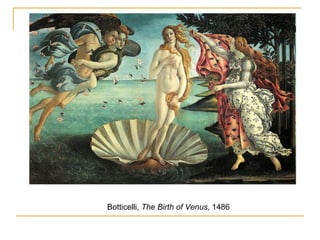
Botticelli,  The Birth of Venus,  1486
Top Italian Artworks to Know Da Vinci The Last Supper, Mona Lisa, Vitruvian Man Botticelli Primavera, The Birth of Venus Raphael The School of Athens, The Wedding of the Virgin, The Madonna of the Meadow
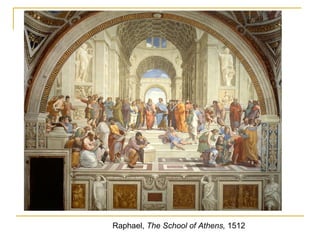
Raphael,  The School of Athens,  1512
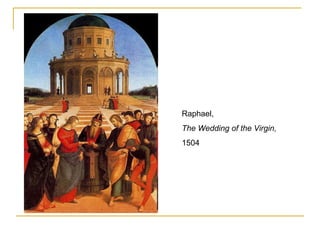
Raphael,  The Wedding of the Virgin,  1504
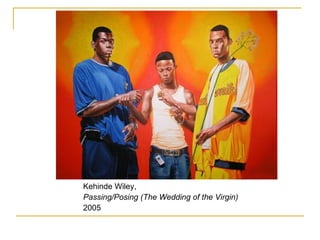
Kehinde Wiley,  Passing/Posing (The Wedding of the Virgin) 2005
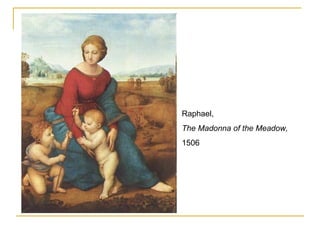
Raphael,  The Madonna of the Meadow,  1506
Top Italian Artworks to Know Da Vinci The Last Supper, Mona Lisa, Vitruvian Man Botticelli Primavera, The Birth of Venus Raphael The School of Athens, The Wedding of the Virgin, The Madonna of the Meadow Michelangelo David,  The Sistine Chapel , Piet à
Michelangelo Video Part 1 Part 2
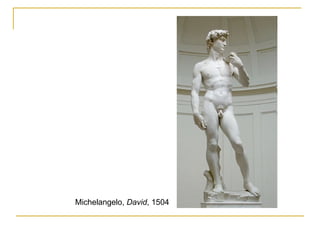
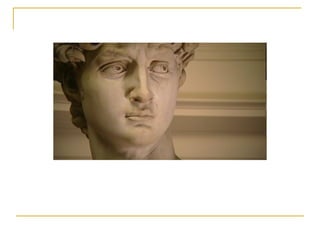
Michelangelo,  David , 1504
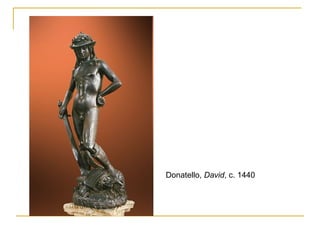
Donatello,  David , c. 1440


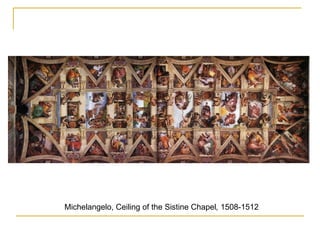
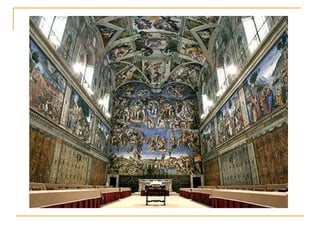
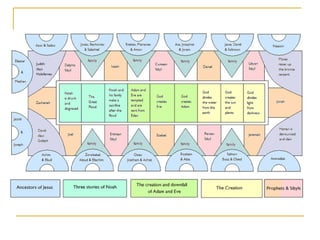
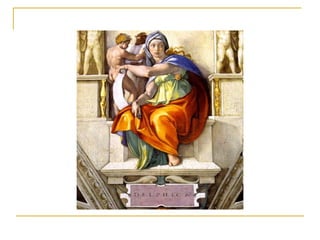
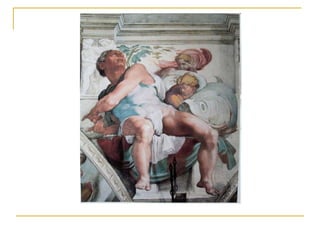
Michelangelo, Ceiling of the Sistine Chapel ,  1508-1512


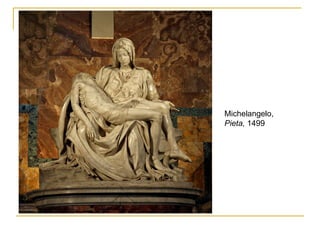
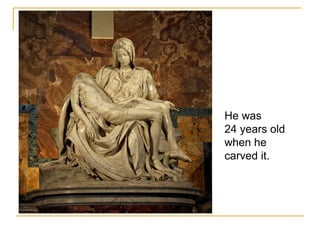
Michelangelo,  Pieta,  1499
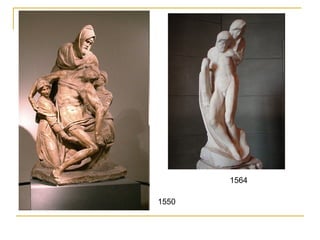
1550 1564
Michelangelo,  Pieta,  1499
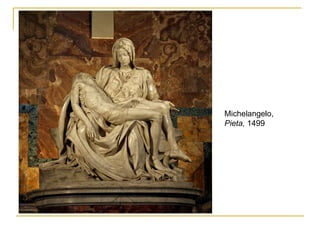
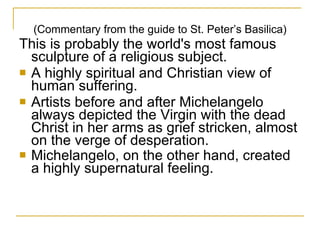
(Commentary from the guide to St. Peter’s Basilica) This is probably the world's most famous sculpture of a religious subject. A highly spiritual and Christian view of human suffering.  Artists before and after Michelangelo always depicted the Virgin with the dead Christ in her arms as grief stricken, almost on the verge of desperation.  Michelangelo, on the other hand, created a highly supernatural feeling.
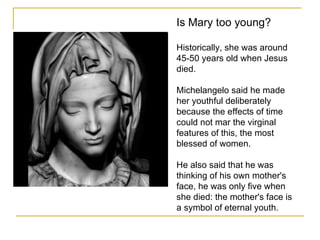
Is Mary too young? Historically, she was around 45-50 years old when Jesus died.  Michelangelo said he made her youthful deliberately because the effects of time could not mar the virginal features of this, the most blessed of women.  He also said that he was thinking of his own mother's face, he was only five when she died: the mother's face is a symbol of eternal youth.
It is the only piece of art he ever signed: MICHAELA[N]GELUS BONAROTUS FLORENTIN[US] FACIEBA[T]  (Michelangelo Buonarroti, Florentine, made this)
He was  24 years old when he  carved it.

The Renaissance

  • 1.
  • 2.
    The Philosophy “Renaissance” = rebirth 1000 years after Rome fell, Europe embraced the classical values of Greece and Rome Titian, Sacred and Profane Love
  • 3.
    Renaissance Man Theshaper of his own destiny (vs. a plaything of the supernatural) Individuals are valued Life is more than a preparation for the afterlife Optimistic, confident in their basic goodness and in the power of people to solve problems = Humanism (remember, from the Greeks?)
  • 4.
    A Cultural RevolutionPolitics = democracy and nation-states Economics = capitalists and the middle class Religion = a move away from Church dominance towards the assertion of man + more personal faith (  Protestant Reformation) Secular Learning supercedes superstition and ignorance Scientists observe and learn, rather than relying on old texts/knowledge
  • 5.
    Humanist, But NotAnti-Christian The assertion of man, not the repudiation of God Artists saw themselves as an extension of God’s creative powers Art glorified God by glorifying man’s abilities Michelangelo, The Creation of Adam
  • 6.
    Renaissance Art Atriumph of order and harmony. Re-mastered realism, three-dimensionality, balance, and perspective (were lost during Dark Ages) Sculptors portrayed idealized human bodies, balanced perfectly between motion and rest. All art forms took inspiration from ancient Greek and Roman works.
  • 7.
    In art, asin their philosophy, humans are not scrawny, puny sinners - they’re strong, confident, rational creatures – gods on earth. Michelangelo, David
  • 8.
    Realistic Anatomy Mostartists did comprehensive and detailed studies of surface human anatomy In Middle Ages, dissecting corpses was a sin/crime. Michelangelo, Studies for the Libyan Sibyl Some Renaissance artists were willing to “sell their souls” for artistic knowledge. Rubens, Left Forearm and Right Forearm
  • 9.
    Themes in theArt Still a lot of Christian imagery Unlike medieval works, the art could exist for the sake of beauty/holiness, not just for education = Less symbols and halos to identify figures, but radiate purity and beauty. Democratic values = portraits of people besides just popes, kings, and saints.
  • 10.
    Perspective (closer figuresare larger, farther figures are smaller) Picture Frame = a window on the world from a specific point of view (a human perspective) Balance and symmetrical Statues stand with weight balanced on one leg or Designed around a central axis Madonnas flanked by Saints, balanced number Most of all, it’s beautiful. Art for art’s sake. Qualities of Renaissance Art
  • 11.
    Cimabue, SantaTrinita Madonna c. 1280
  • 12.
    Giotto, OgnissantiMadonna 1310
  • 13.
    Raphael, LaBelle Jardiniere 1507
  • 14.
    Uccello, Battleof San Romano
  • 15.
    da Vinci, Madonna and Saint Anne
  • 16.
    Top Italian Artworksto Know Da Vinci The Last Supper, Mona Lisa, Vitruvian Man
  • 17.
    da Vinci, The Last Supper , 1498
  • 18.
    Da Vinci, Portrait of Lisa Gherardini , wife of Francesco del Giocondo (“Mona Lisa”) 1503-1506
  • 19.
    Sfumato ( noun) - from the Latin (via Italian) fumare ("to smoke"), a painting technique. Sfumato means that there are no harsh outlines (as in a coloring book) present; areas blend into one another through miniscule brushstrokes, which makes for a rather hazy, albeit more realistic, depiction of light and color. http://arthistory.about.com/cs/glossaries/g/s_sfumato.htm
  • 20.
    Da Vinci, Vitruvian Man 1487
  • 21.
  • 22.
    Top Italian Artworksto Know Da Vinci The Last Supper, Mona Lisa, Vitruvian Man Botticelli Primavera, The Birth of Venus
  • 23.
  • 24.
    Mythological Figures in Primavera Venus Cupid the Charities (Three Graces) Mercury Zephyrus Chloris (goddess of flowers, mother of fruit) Flora (the goddess of spring)
  • 25.
    Botticelli, TheBirth of Venus, 1486
  • 26.
    Venus de’ Medici(copy of Greek statue) Venus de Milo
  • 27.
    Botticelli, TheBirth of Venus, 1486
  • 28.
    Top Italian Artworksto Know Da Vinci The Last Supper, Mona Lisa, Vitruvian Man Botticelli Primavera, The Birth of Venus Raphael The School of Athens, The Wedding of the Virgin, The Madonna of the Meadow
  • 29.
    Raphael, TheSchool of Athens, 1512
  • 30.
    Raphael, TheWedding of the Virgin, 1504
  • 31.
    Kehinde Wiley, Passing/Posing (The Wedding of the Virgin) 2005
  • 32.
    Raphael, TheMadonna of the Meadow, 1506
  • 33.
    Top Italian Artworksto Know Da Vinci The Last Supper, Mona Lisa, Vitruvian Man Botticelli Primavera, The Birth of Venus Raphael The School of Athens, The Wedding of the Virgin, The Madonna of the Meadow Michelangelo David, The Sistine Chapel , Piet à
  • 34.
  • 35.
  • 36.
  • 37.
  • 38.
  • 39.
  • 40.
    Michelangelo, Ceiling ofthe Sistine Chapel , 1508-1512
  • 41.
  • 42.
  • 43.
  • 44.
  • 45.
  • 46.
  • 47.
  • 48.
  • 49.
  • 50.
  • 51.
  • 52.
  • 53.
    (Commentary from theguide to St. Peter’s Basilica) This is probably the world's most famous sculpture of a religious subject. A highly spiritual and Christian view of human suffering. Artists before and after Michelangelo always depicted the Virgin with the dead Christ in her arms as grief stricken, almost on the verge of desperation. Michelangelo, on the other hand, created a highly supernatural feeling.
  • 54.
    Is Mary tooyoung? Historically, she was around 45-50 years old when Jesus died. Michelangelo said he made her youthful deliberately because the effects of time could not mar the virginal features of this, the most blessed of women. He also said that he was thinking of his own mother's face, he was only five when she died: the mother's face is a symbol of eternal youth.
  • 55.
    It is theonly piece of art he ever signed: MICHAELA[N]GELUS BONAROTUS FLORENTIN[US] FACIEBA[T] (Michelangelo Buonarroti, Florentine, made this)
  • 56.
    He was 24 years old when he carved it.