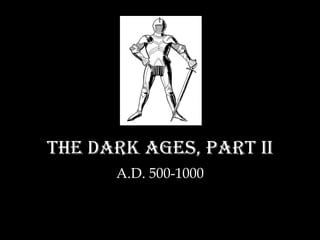
The Dark Ages, Part II A.D. 500-1000
Medieval Art Church funded Art, Art served the Church Early on, some questioned if it was okay to depict God/his creations at all (= “Iconoclasts”) (this continues in Muslim art, as we’ll see) By ~600, it was generally agreed that art embellished places of worship and educated the illiterate masses.
Altarpieces Almost every church had a painting on the main altar as a focus of worship.  Mary (the Madonna) was a cult figure & popular choice.
Altarpiece, Cologne, Germany
Formula for Altarpieces: Figures float in ethereal golden land The holy have gold plates behind their heads (i.e. halos) Faces are serene, generic, somber People pose stiffly, facing directly out or in profile (never in between) Saints have props to identify them (Peter = keys, Luke = a Gospel, Mark = a sword) The most important person = the biggest Pictures = symbols (ex: lion = Resurrection) Perspective and Realism don’t matter – it’s about telling a story with just the necessary parts
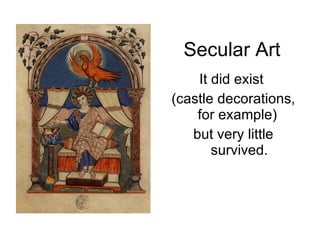
Secular Art It did exist  (castle decorations, for example)  but very little survived.
Was the Rest of the World Dark? Certainly not! Central America  – the Mayans and Toltecs were building cities and doing remarkable astronomical work China  – the T’ang dynasty florished, coming up with things like paper, clockwork, looms, windmills, and gun powder (all of which helped pull Europe out of the Dark Ages) Plus, right next to Europe, two cultures grew with unity, stability, and prosperity:
The Byzantine Empire Capital = Constantinople (today = Istanbul) Language, Literature, and Art were all Greek. Eastern Orthodox religion split eventually from the pope’s Latin church. The eastern half of the Roman Empire, but it didn’t fall when the western part did – it stuck around for another 1000 years.
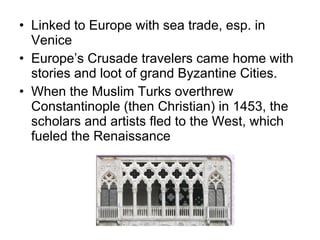
Linked to Europe with sea trade, esp. in Venice Europe’s Crusade travelers came home with stories and loot of grand Byzantine Cities. When the Muslim Turks overthrew Constantinople (then Christian) in 1453, the scholars and artists fled to the West, which fueled the Renaissance
St. Mark’s Basilica (Venice, Italy 1094 AD) Built in 828 in the Doge’s palace to house the relics of Mark stolen from Alexandria. Burned in 976, rebuilt as it stands now
 
 
Hagia Sophia (Istanbul, 537 AD) Was a basilica/ cathedral Then became a mosque Is now a museum
 
 
Hagia Sophia Interior
 
Hagia Sophia Mosaic (Detail)
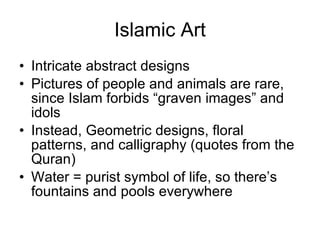
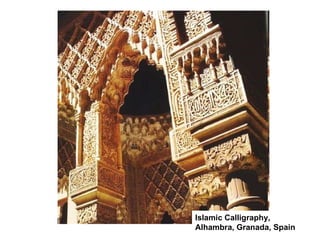
Islamic Art Intricate abstract designs Pictures of people and animals are rare, since Islam forbids “graven images” and idols Instead, Geometric designs, floral patterns, and calligraphy (quotes from the Quran) Water = purist symbol of life, so there’s fountains and pools everywhere
Interior Ceiling Mosaics, Blue Mosque, Istanbul
Islamic Calligraphy, Alhambra, Granada, Spain
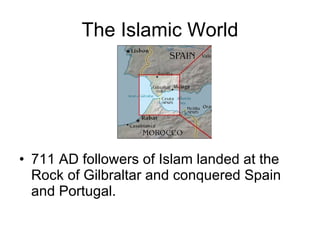
The Islamic World 711 AD followers of Islam landed at the Rock of Gilbraltar and conquered Spain and Portugal.
The Moors Spanish Muslims (= Moors) fostered higher learning and built some of Europe’s greatest cities while the rest of Europe was dawdling in the Dark Ages. Built mosques, palaces, public baths, paved streets lit with oil lamps at night, etc. Medicine, astronomy, literature, law, architecture, and math (al-jibra) flourished
Golden Age of Muslim Spain Uniquely, it had a spirit of tolerance and cooperation between Islam, Judaism, and Christianity. Didn’t last, though.  Christians eventually forced the Moors south, turning the mosques into cathedrals (and the minarets into bell towers) By 1492, Spain was completely Christian.
The Alhambra
Charlemagne (742?-814 AD) Charles the Great, king of the Franks On Christmas Day, 800 AD, the Pope crowned Charlemagne “Holy Roman Emperor” = United the core of Western Europe = Revived the faded glory of Ancient Rome
Created the “First Reich” from Germany to Sicily Created a mini-Renaissance, a Roman revival. Replaced trial-by-ordeal with trial-by-judge Built schools and churches Legend says his foot =  the  foot Ruled by the sword – would give the pagan tribal leaders a choice – convert or die. (Once ordered decapitation of 4,500 pagans in one day!) Church membership thrived!
Treaty of Verdun (843 AD) Split the Empire among his three heirs (Charles, Louis, and Lothair) Those regions became Germany, France, and the countries in-between. As Voltaire quipped, Charlemagne’s “Holy Roman Empire” was neither Holy nor Roman nor an Empire.

The dark Ages Part 2

  • 1.
    The Dark Ages,Part II A.D. 500-1000
  • 2.
    Medieval Art Churchfunded Art, Art served the Church Early on, some questioned if it was okay to depict God/his creations at all (= “Iconoclasts”) (this continues in Muslim art, as we’ll see) By ~600, it was generally agreed that art embellished places of worship and educated the illiterate masses.
  • 3.
    Altarpieces Almost everychurch had a painting on the main altar as a focus of worship. Mary (the Madonna) was a cult figure & popular choice.
  • 4.
  • 5.
    Formula for Altarpieces:Figures float in ethereal golden land The holy have gold plates behind their heads (i.e. halos) Faces are serene, generic, somber People pose stiffly, facing directly out or in profile (never in between) Saints have props to identify them (Peter = keys, Luke = a Gospel, Mark = a sword) The most important person = the biggest Pictures = symbols (ex: lion = Resurrection) Perspective and Realism don’t matter – it’s about telling a story with just the necessary parts
  • 6.
    Secular Art Itdid exist (castle decorations, for example) but very little survived.
  • 7.
    Was the Restof the World Dark? Certainly not! Central America – the Mayans and Toltecs were building cities and doing remarkable astronomical work China – the T’ang dynasty florished, coming up with things like paper, clockwork, looms, windmills, and gun powder (all of which helped pull Europe out of the Dark Ages) Plus, right next to Europe, two cultures grew with unity, stability, and prosperity:
  • 8.
    The Byzantine EmpireCapital = Constantinople (today = Istanbul) Language, Literature, and Art were all Greek. Eastern Orthodox religion split eventually from the pope’s Latin church. The eastern half of the Roman Empire, but it didn’t fall when the western part did – it stuck around for another 1000 years.
  • 9.
    Linked to Europewith sea trade, esp. in Venice Europe’s Crusade travelers came home with stories and loot of grand Byzantine Cities. When the Muslim Turks overthrew Constantinople (then Christian) in 1453, the scholars and artists fled to the West, which fueled the Renaissance
  • 10.
    St. Mark’s Basilica(Venice, Italy 1094 AD) Built in 828 in the Doge’s palace to house the relics of Mark stolen from Alexandria. Burned in 976, rebuilt as it stands now
  • 11.
  • 12.
  • 13.
    Hagia Sophia (Istanbul,537 AD) Was a basilica/ cathedral Then became a mosque Is now a museum
  • 14.
  • 15.
  • 16.
  • 17.
  • 18.
  • 19.
    Islamic Art Intricateabstract designs Pictures of people and animals are rare, since Islam forbids “graven images” and idols Instead, Geometric designs, floral patterns, and calligraphy (quotes from the Quran) Water = purist symbol of life, so there’s fountains and pools everywhere
  • 20.
    Interior Ceiling Mosaics,Blue Mosque, Istanbul
  • 21.
  • 22.
    The Islamic World711 AD followers of Islam landed at the Rock of Gilbraltar and conquered Spain and Portugal.
  • 23.
    The Moors SpanishMuslims (= Moors) fostered higher learning and built some of Europe’s greatest cities while the rest of Europe was dawdling in the Dark Ages. Built mosques, palaces, public baths, paved streets lit with oil lamps at night, etc. Medicine, astronomy, literature, law, architecture, and math (al-jibra) flourished
  • 24.
    Golden Age ofMuslim Spain Uniquely, it had a spirit of tolerance and cooperation between Islam, Judaism, and Christianity. Didn’t last, though. Christians eventually forced the Moors south, turning the mosques into cathedrals (and the minarets into bell towers) By 1492, Spain was completely Christian.
  • 25.
  • 26.
    Charlemagne (742?-814 AD)Charles the Great, king of the Franks On Christmas Day, 800 AD, the Pope crowned Charlemagne “Holy Roman Emperor” = United the core of Western Europe = Revived the faded glory of Ancient Rome
  • 27.
    Created the “FirstReich” from Germany to Sicily Created a mini-Renaissance, a Roman revival. Replaced trial-by-ordeal with trial-by-judge Built schools and churches Legend says his foot = the foot Ruled by the sword – would give the pagan tribal leaders a choice – convert or die. (Once ordered decapitation of 4,500 pagans in one day!) Church membership thrived!
  • 28.
    Treaty of Verdun(843 AD) Split the Empire among his three heirs (Charles, Louis, and Lothair) Those regions became Germany, France, and the countries in-between. As Voltaire quipped, Charlemagne’s “Holy Roman Empire” was neither Holy nor Roman nor an Empire.