The Italian Renaissance
Art and Civic Pride in Florence
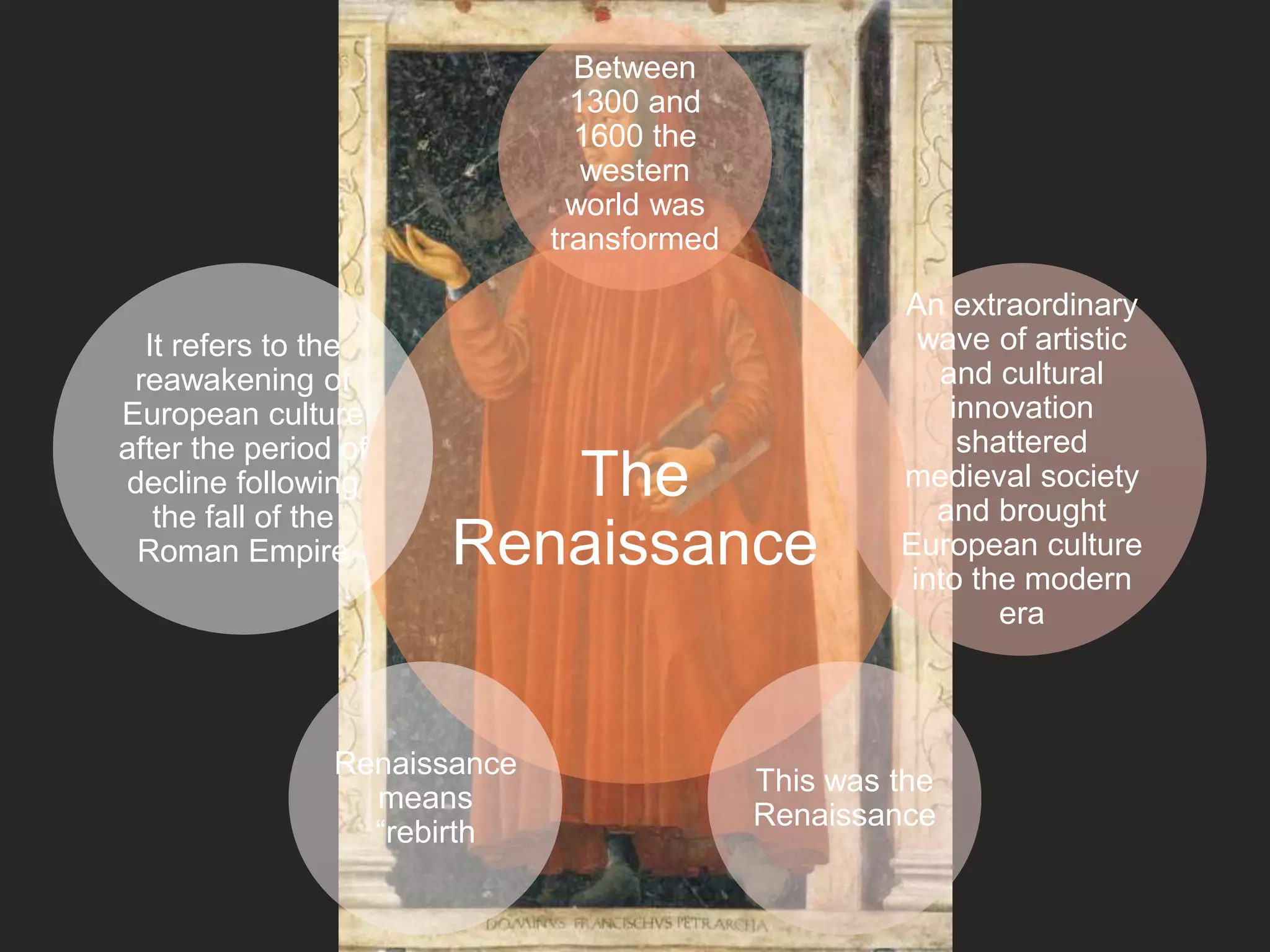
The
Renaissance
Between
1300 and
1600 the
western
world was
transformed
An extraordinary
wave of artistic
and cultural
innovation
shattered
medieval society
and brought
European culture
into the modern
era
This was the
Renaissance
Renaissance
means
“rebirth
It refers to the
reawakening of
European culture
after the period of
decline following
the fall of the
Roman Empire
People living during the Renaissance believed they were living in a new golden age that
rivaled the cultural and intellectual achievements of ancient Greece and Rome
To them, the long period of the Middle Ages was a “dark age” that had finally come to an
end
The birthplace of the Renaissance was Florence, a thriving commercial center, with a
government modeled on the great democracies of ancient Greece and Rome
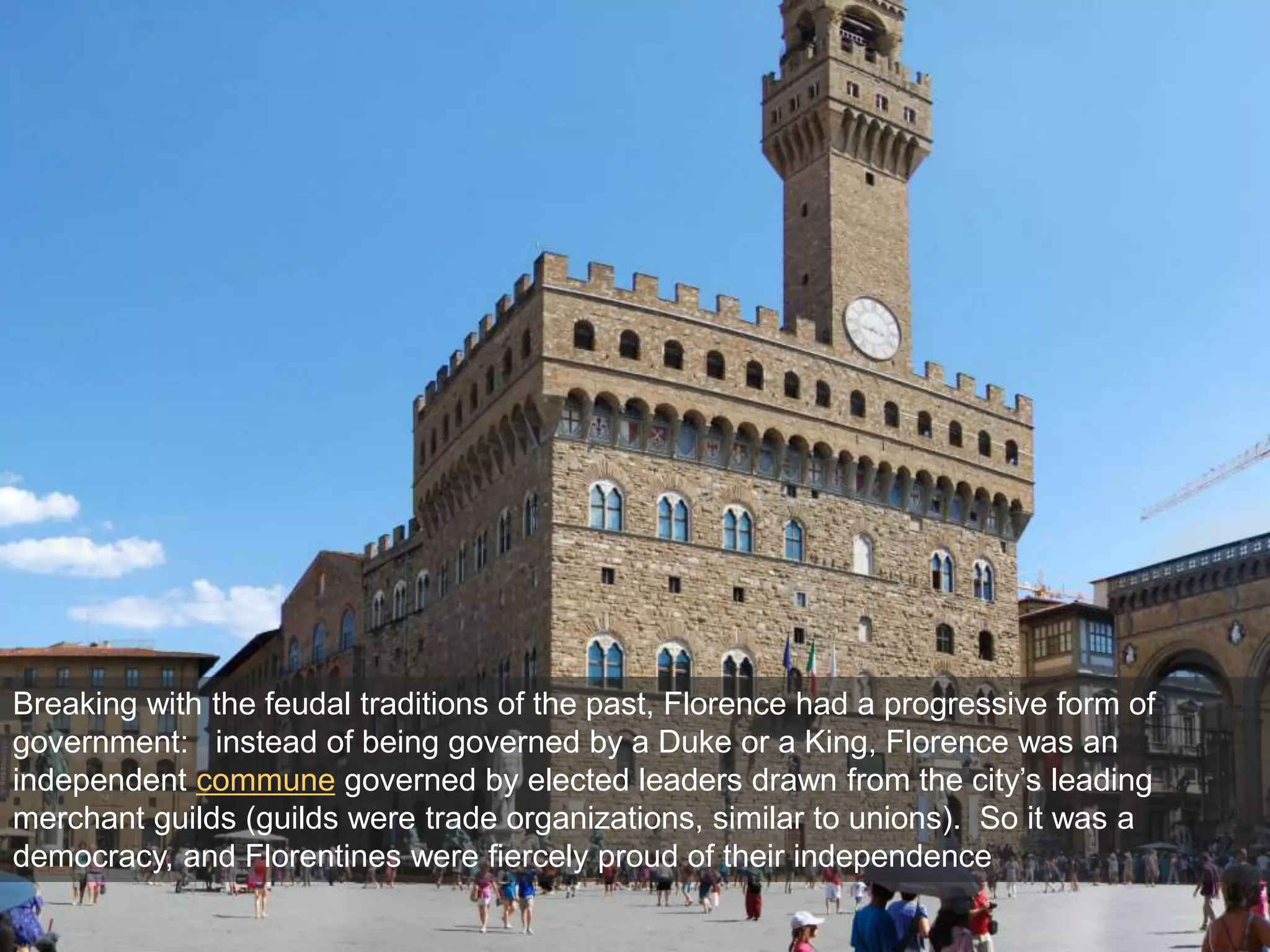
The Palazzo Segnoria
(or the Palazzo
Vecchio) served as
the Florentine seat of
government during
the Renaissance
This is where
Michelangelo’s
David was
displayed
Breaking with the feudal traditions of the past, Florence had a progressive form of
government: instead of being governed by a Duke or a King, Florence was an
independent commune governed by elected leaders drawn from the city’s leading
merchant guilds (guilds were trade organizations, similar to unions). So it was a
democracy, and Florentines were fiercely proud of their independence
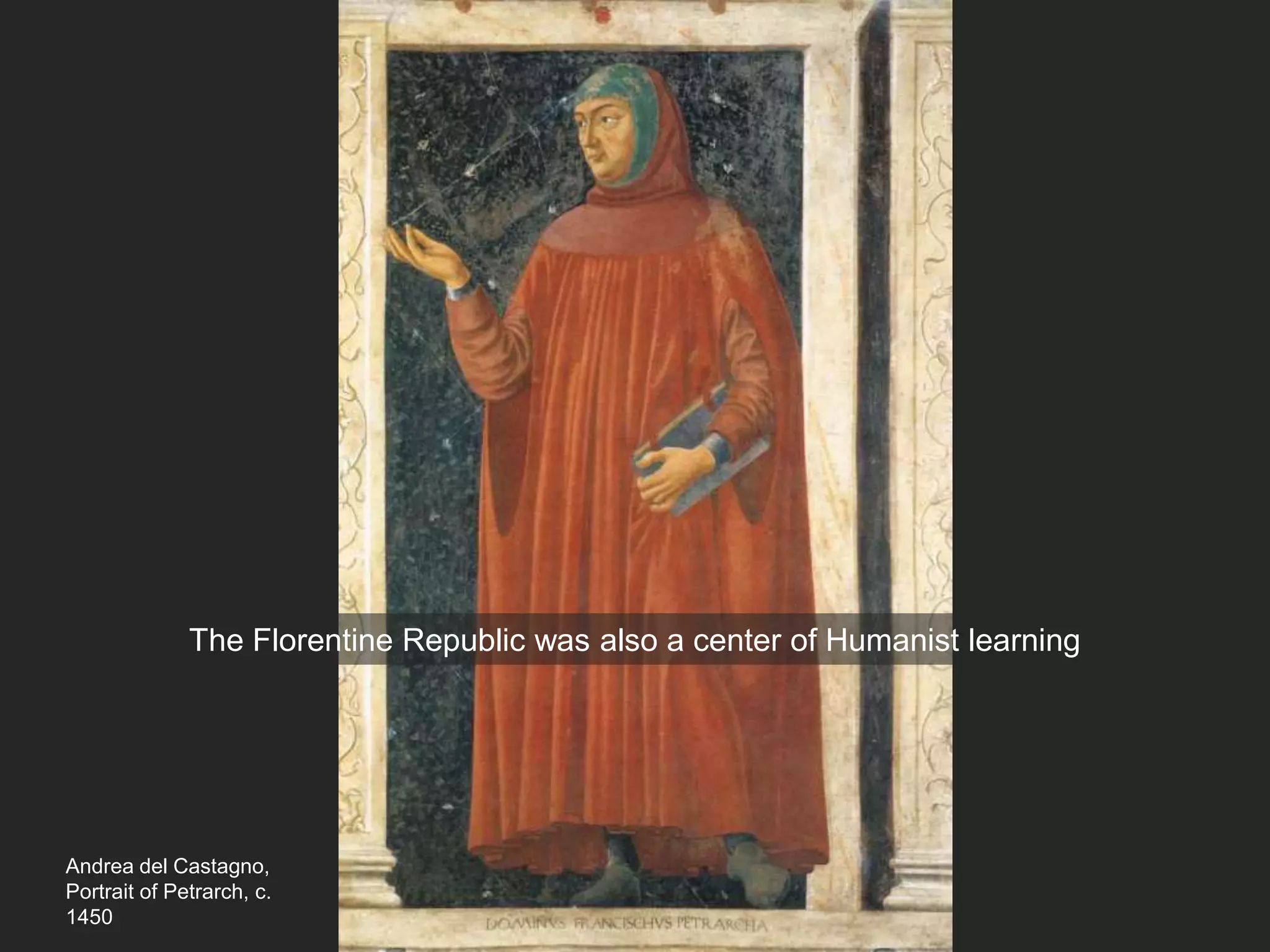
The Florentine Republic was also a center of Humanist learning
Andrea del Castagno,
Portrait of Petrarch, c.
1450
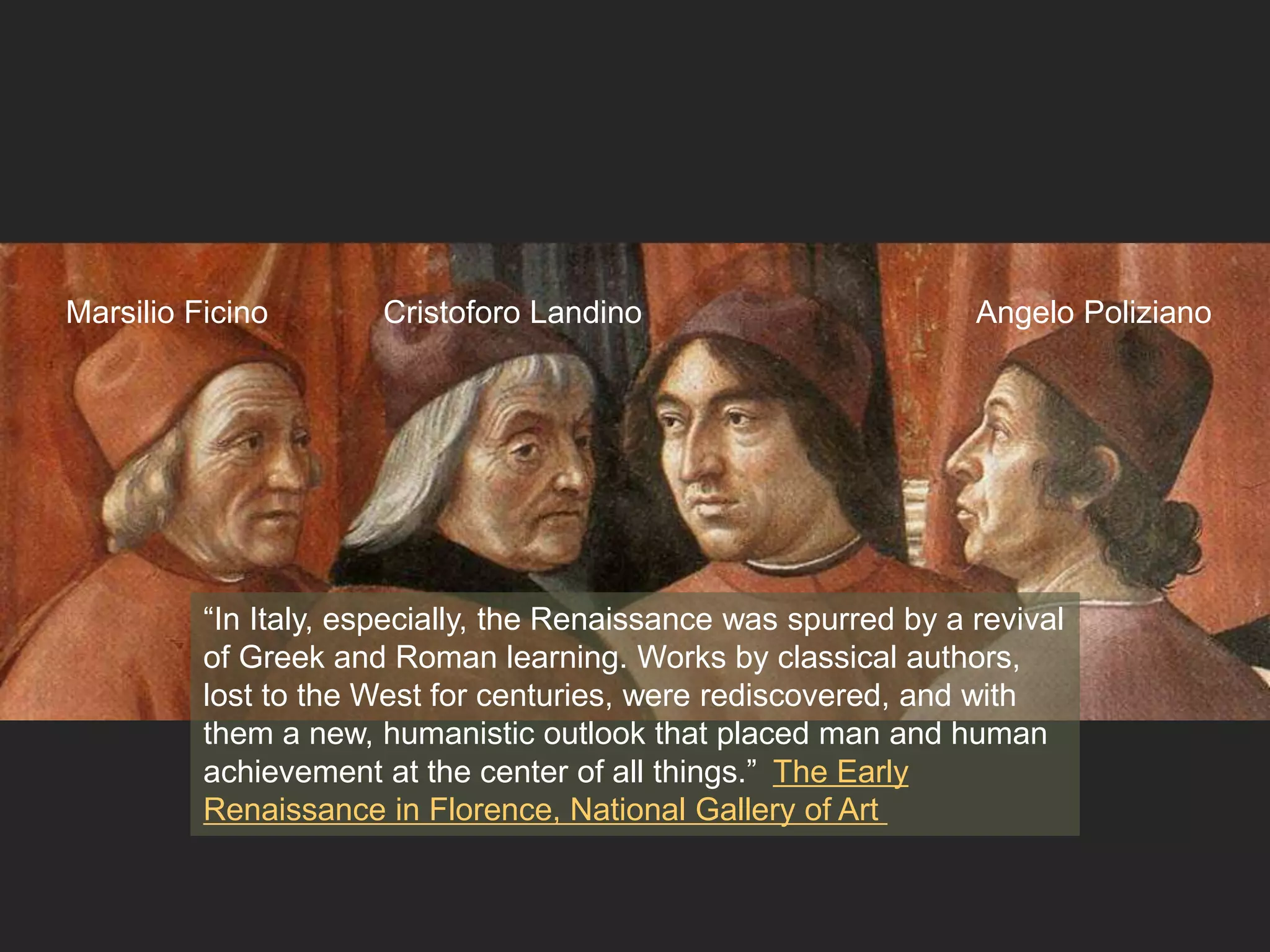
“In Italy, especially, the Renaissance was spurred by a revival
of Greek and Roman learning. Works by classical authors,
lost to the West for centuries, were rediscovered, and with
them a new, humanistic outlook that placed man and human
achievement at the center of all things.” The Early
Renaissance in Florence, National Gallery of Art
Marsilio Ficino Cristoforo Landino Angelo Poliziano
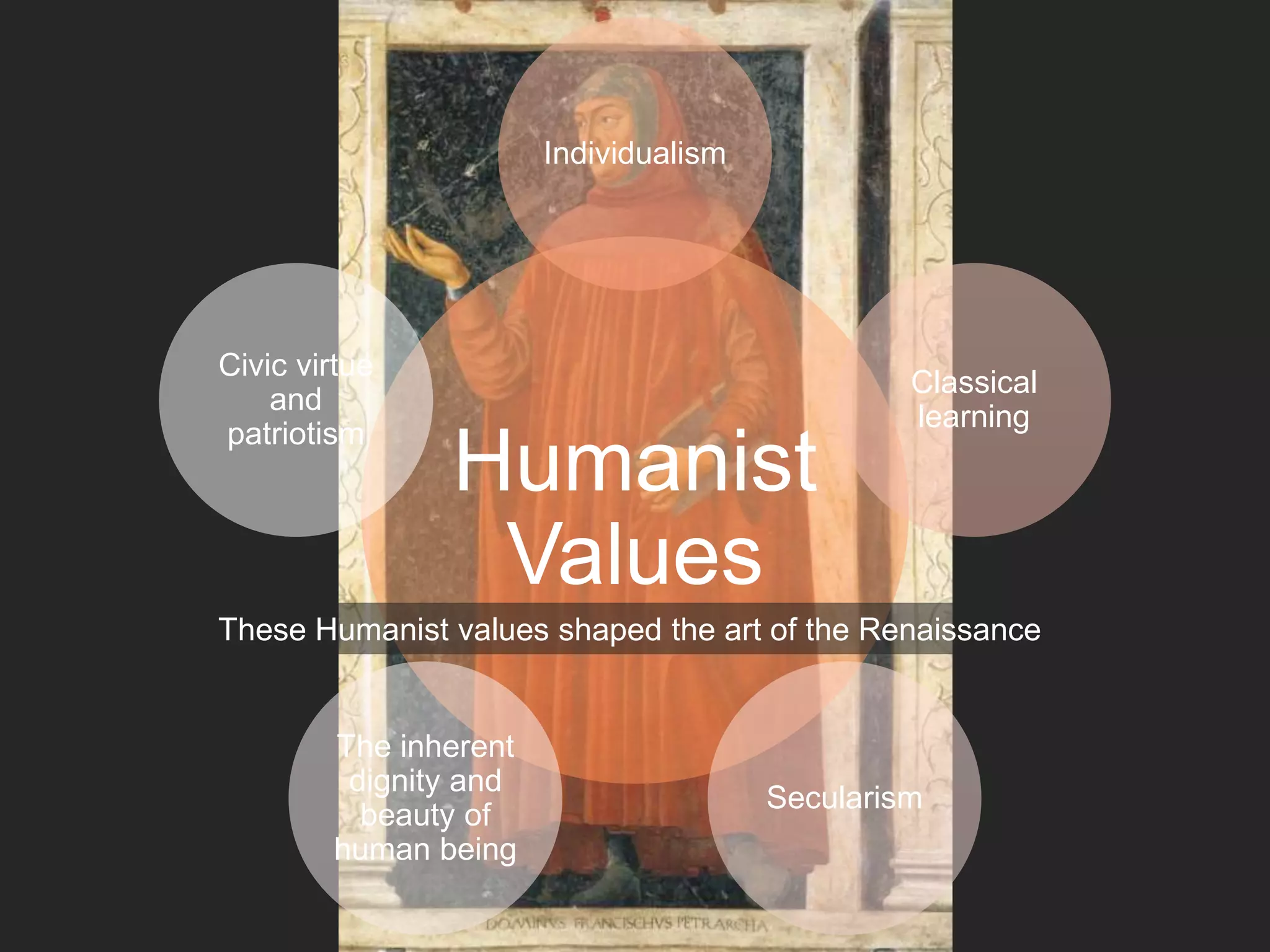
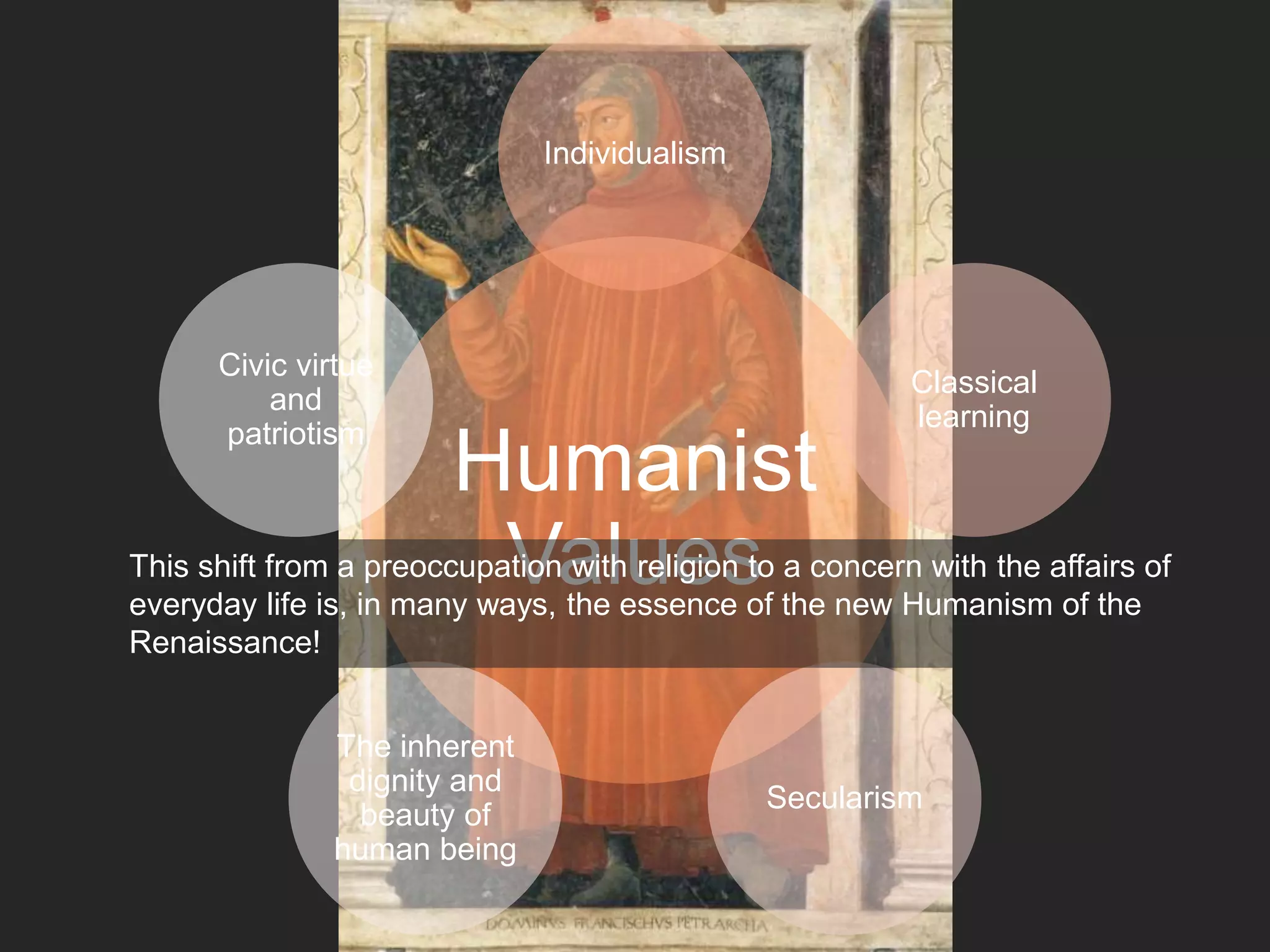
Humanist
Values
Individualism
Classical
learning
Secularism
The inherent
dignity and
beauty of
human being
Civic virtue
and
patriotism
These Humanist values shaped the art of the Renaissance
Francesco Sassetti Lorenzo de Medici
Florence was also home to a wealthy and well-educated merchant class
eager to advertise their status, learning, and civic pride through
commissioned works of art
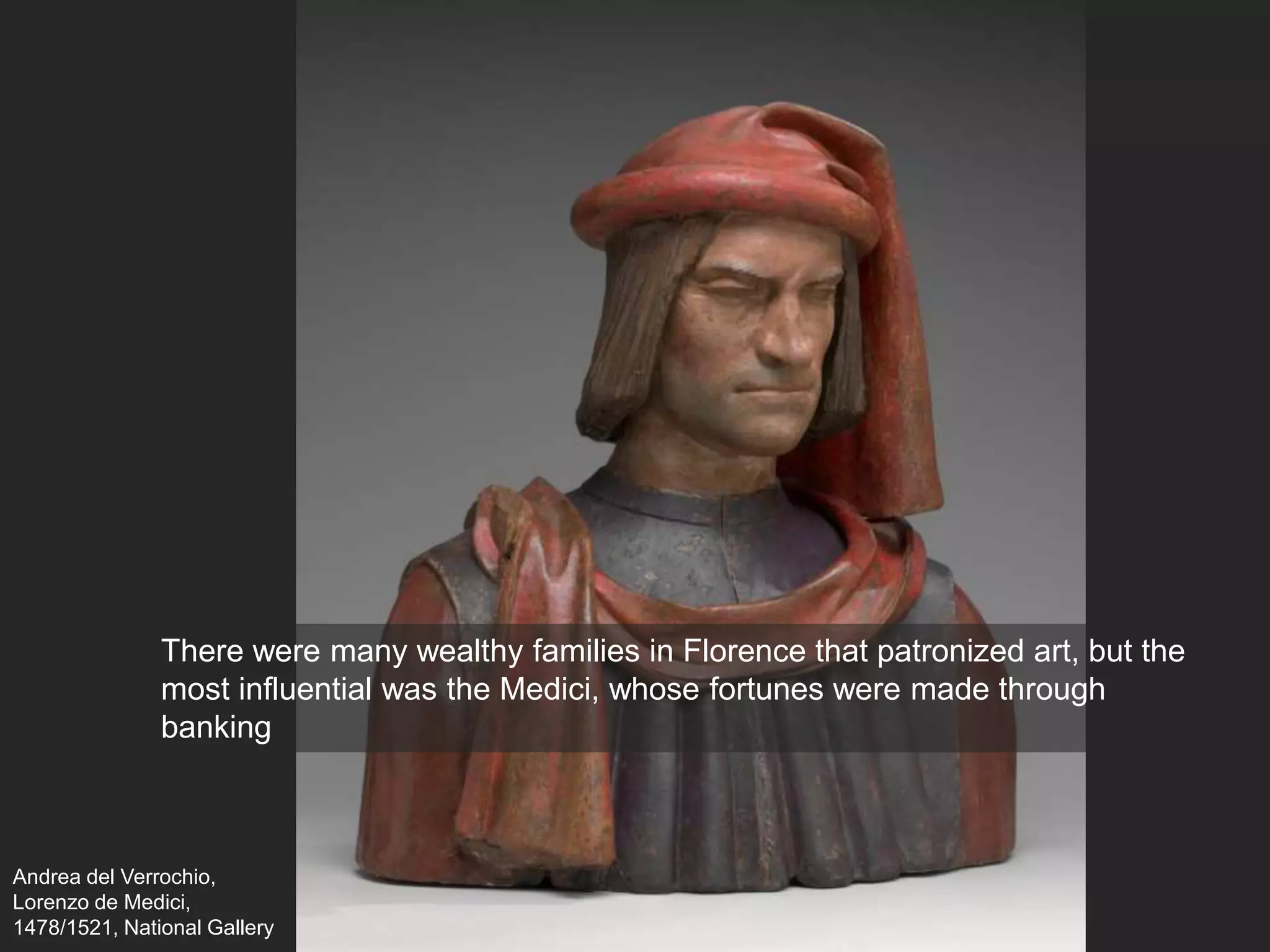
Andrea del Verrochio,
Lorenzo de Medici,
1478/1521, National Gallery
There were many wealthy families in Florence that patronized art, but the
most influential was the Medici, whose fortunes were made through
banking
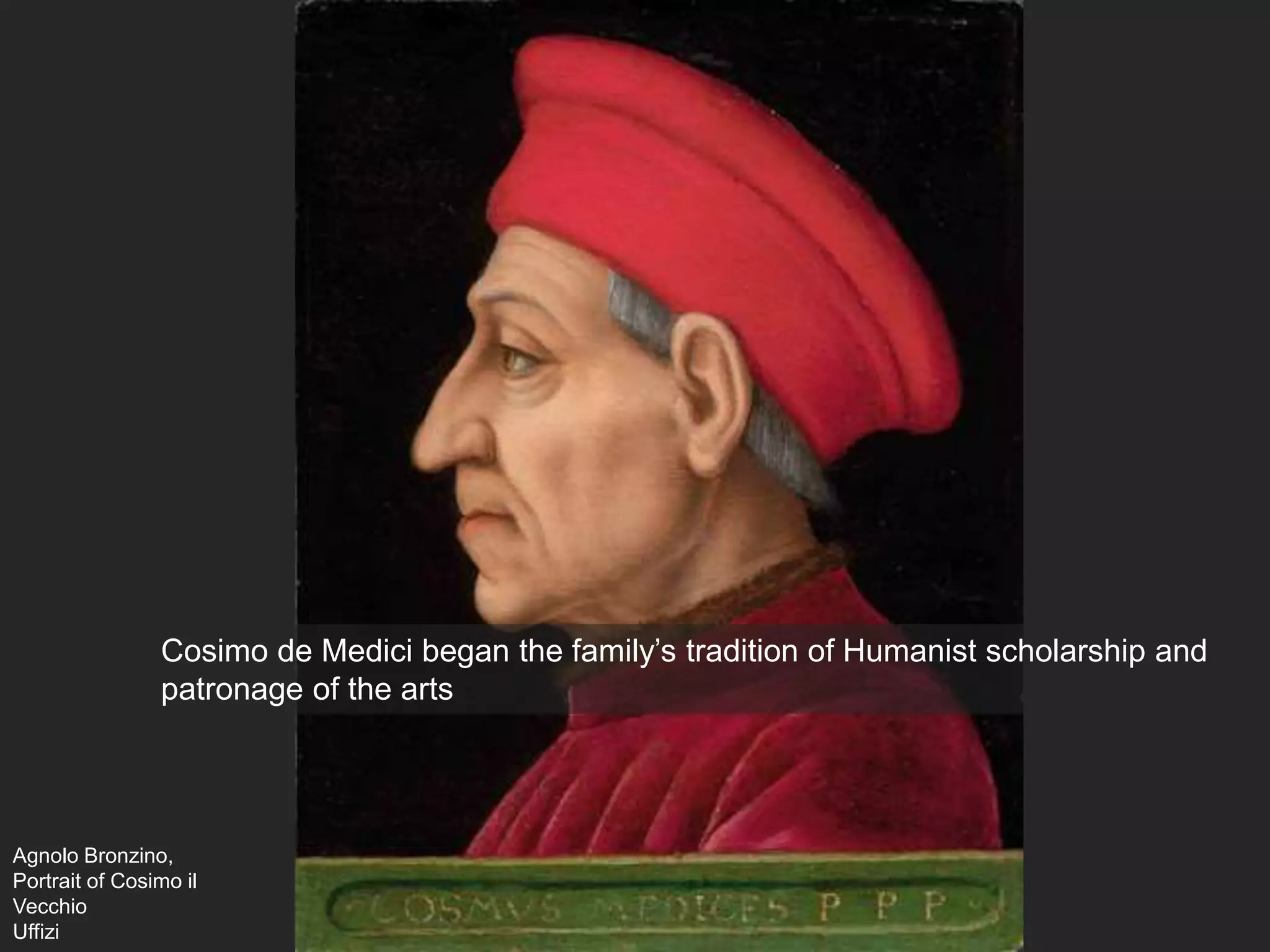
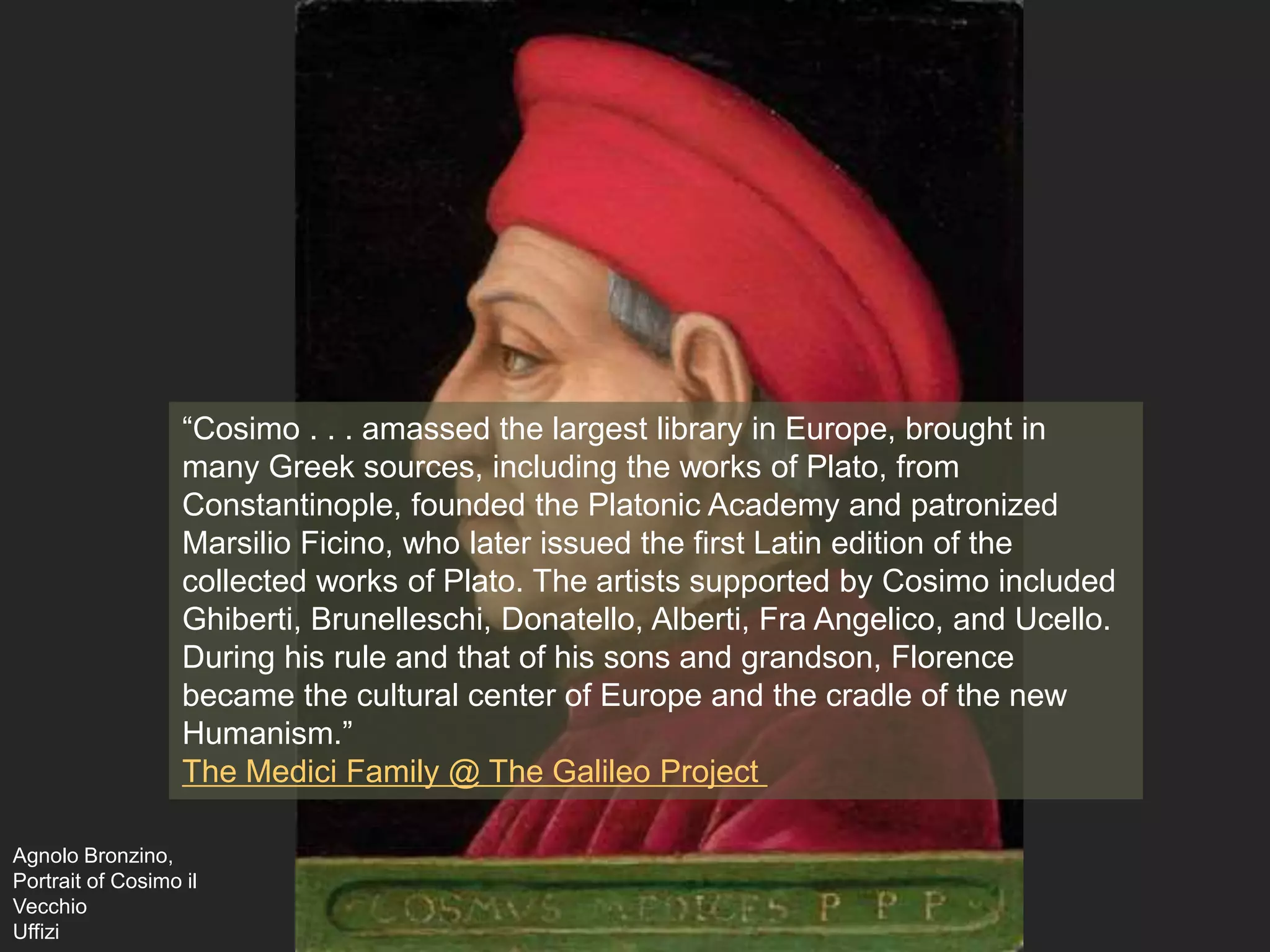
Agnolo Bronzino,
Portrait of Cosimo il
Vecchio
Uffizi
Cosimo de Medici began the family’s tradition of Humanist scholarship and
patronage of the arts
Agnolo Bronzino,
Portrait of Cosimo il
Vecchio
Uffizi
“Cosimo . . . amassed the largest library in Europe, brought in
many Greek sources, including the works of Plato, from
Constantinople, founded the Platonic Academy and patronized
Marsilio Ficino, who later issued the first Latin edition of the
collected works of Plato. The artists supported by Cosimo included
Ghiberti, Brunelleschi, Donatello, Alberti, Fra Angelico, and Ucello.
During his rule and that of his sons and grandson, Florence
became the cultural center of Europe and the cradle of the new
Humanism.”
The Medici Family @ The Galileo Project
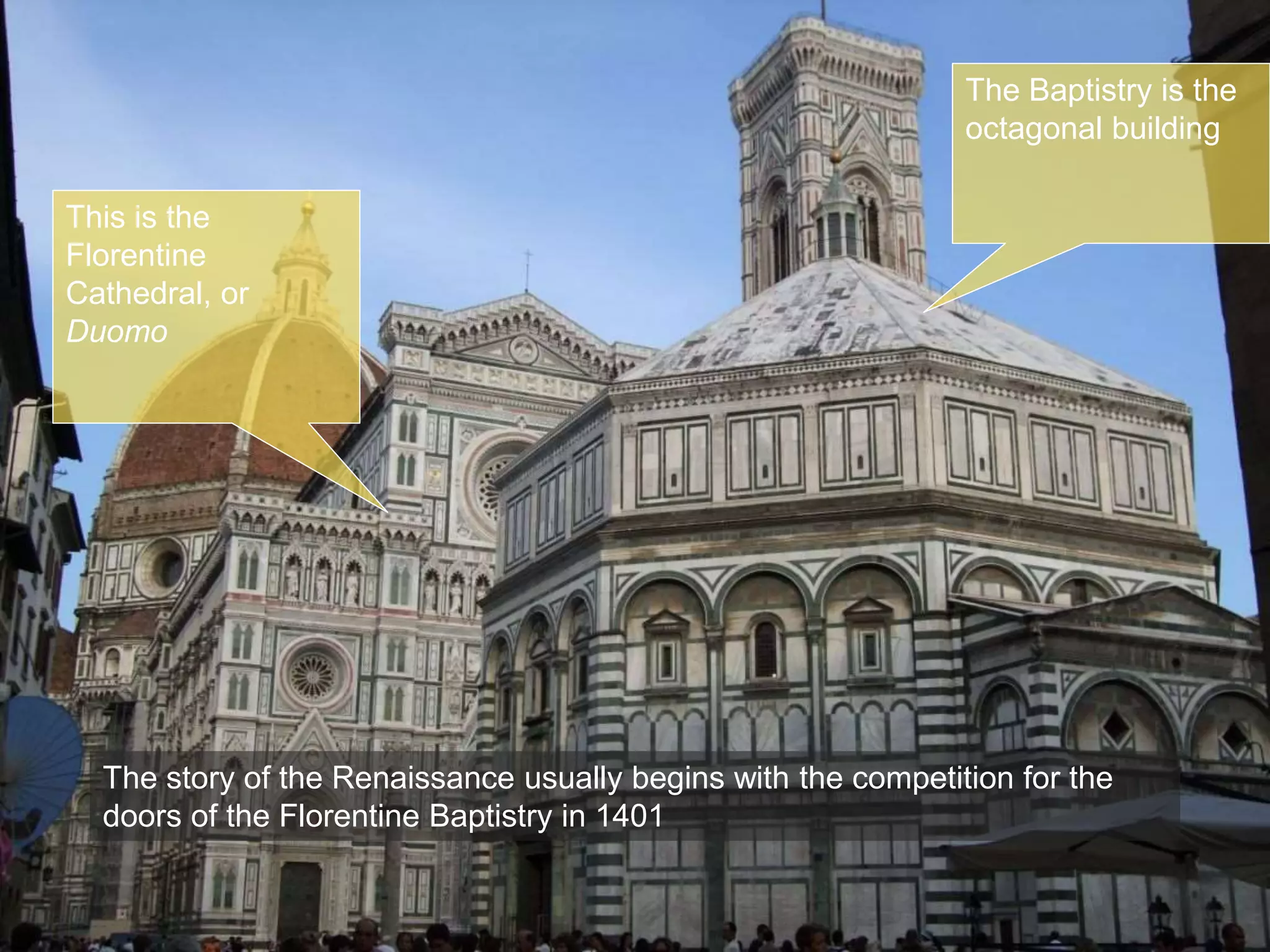
The story of the Renaissance usually begins with the competition for the
doors of the Florentine Baptistry in 1401
The Baptistry is the
octagonal building
This is the
Florentine
Cathedral, or
Duomo
Although the doors were for a religious building, it is significant that the
patron was not the church. The sponsor was the
the Arte di Calimara (the wool merchants guild), which which means there
were interests other than religion involved
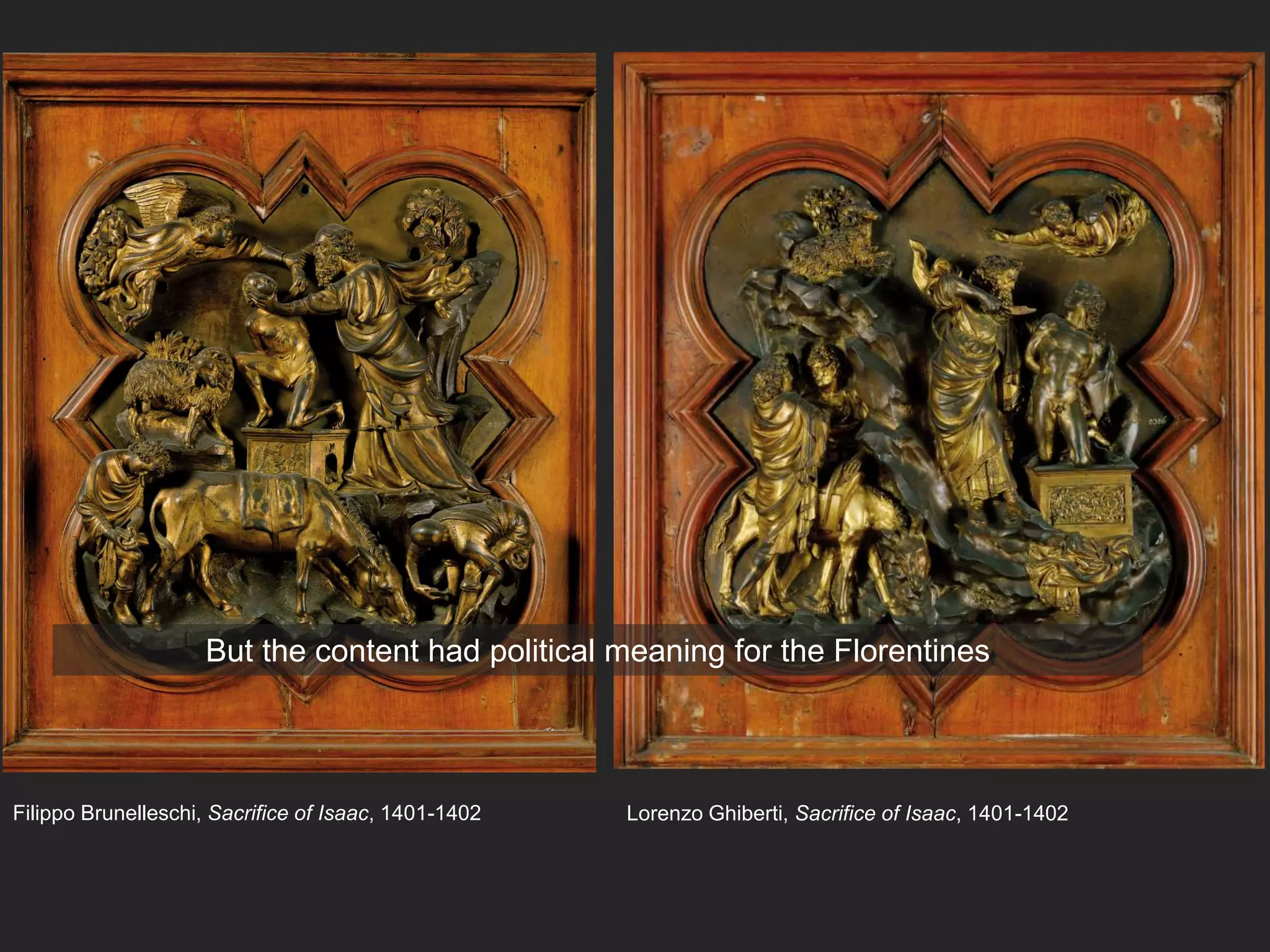
Lorenzo Ghiberti, Sacrifice of Isaac, 1401-1402Filippo Brunelleschi, Sacrifice of Isaac, 1401-1402
The finalists were Filippo Brunelleschi and Lorenzo Ghiberti, whose
competition panels survive
Lorenzo Ghiberti, Sacrifice of Isaac, 1401-1402Filippo Brunelleschi, Sacrifice of Isaac, 1401-1402
The subject matter chosen for the competition panels was the biblical story
of Abraham and Isaac
Lorenzo Ghiberti, Sacrifice of Isaac, 1401-1402Filippo Brunelleschi, Sacrifice of Isaac, 1401-1402
But the content had political meaning for the Florentines
At this moment, Florence was at war with the neighboring Duke of Milan
Democracy
Governed by a Duke
In the biblical story, God commanded Abraham to sacrifice his son as a test
of his faith – but at the last minute, an angel was sent to stop him
It took courage and self-sacrifice for Abraham to obey the Lord’s command,
but he was rewarded in the end for his faith
The Florentine’s were similarly called upon to make sacrifices, and to
remain steadfast in their faith in democracy. They were rewarded when the
Duke died unexpectedly while his armies prepared for battle, and the threat
of invasion miraculously disappeared
Democracy
Governed by a Duke
Lorenzo Ghiberti, Sacrifice of Isaac, 1401-1402Filippo Brunelleschi, Sacrifice of Isaac, 1401-1402
So the Old Testament story had special meaning for the Florentines, who
would have found their faith and patriotism confirmed by the outcome
Lorenzo Ghiberti, Sacrifice of Isaac, 1401-1402Filippo Brunelleschi, Sacrifice of Isaac, 1401-1402
The question is: are the panels about patriotism or faith?
Lorenzo Ghiberti, Sacrifice of Isaac, 1401-1402Filippo Brunelleschi, Sacrifice of Isaac, 1401-1402
In the context of Renaissance Florence, the story had both religious and
secular connotations -- for although the story comes from the Bible,
its meaning in 15th century Florence had as much to do with patriotism and
civic pride as it did with faith and God
Humanist
Values
Individualism
Classical
learning
Secularism
The inherent
dignity and
beauty of
human being
Civic virtue
and
patriotism
This shift from a preoccupation with religion to a concern with the affairs of
everyday life is, in many ways, the essence of the new Humanism of the
Renaissance!
Lorenzo Ghiberti, Sacrifice of Isaac, 1401-1402Filippo Brunelleschi, Sacrifice of Isaac, 1401-1402
Both panels also reflect the “rediscovery” of Classical culture, which was a
defining feature of the Renaissance
This can be seen in the meticulously rendered drapery, which shows a
convincing sense of the naturally proportioned bodies underneath
It can also be seen in the ideal nudity of Isaac, which recalls Greek statues
of male youths
It is as if both artists were saying “we want nothing to do with the art of
medieval Europe; we are now the descendants of ancient Greece and
Rome!”
That is how the Florentines saw themselves, and the classically influenced
style of the reliefs (made for a religious building!) confirmed this new self-
image.
The winner of the competition was Ghiberti
After completing his first set of doors he was called back to complete a
second set of bronze doors that were so magnificent Michelangelo
nicknamed them “the Gates of Paradise.”
The loser of the competition was Brunelleschi, who was so disheartened by
the setback he left Florence and went to Rome to study architecture
But when he returned he became the leading architect in Florence, and one
of the greatest architects of the Renaissance (you might want to remember
this story the next time you face a setback!)
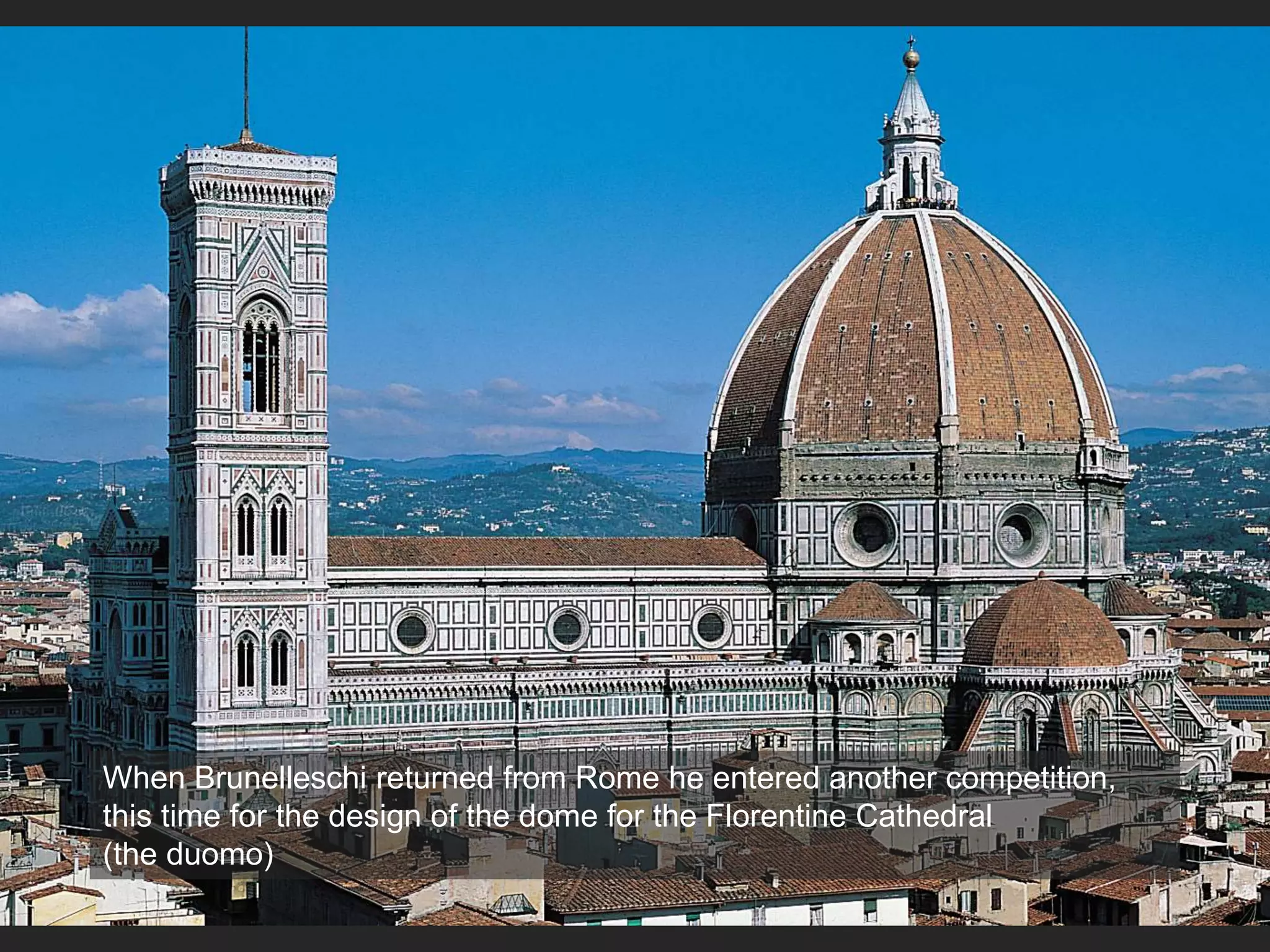
When Brunelleschi returned from Rome he entered another competition,
this time for the design of the dome for the Florentine Cathedral
(the duomo)
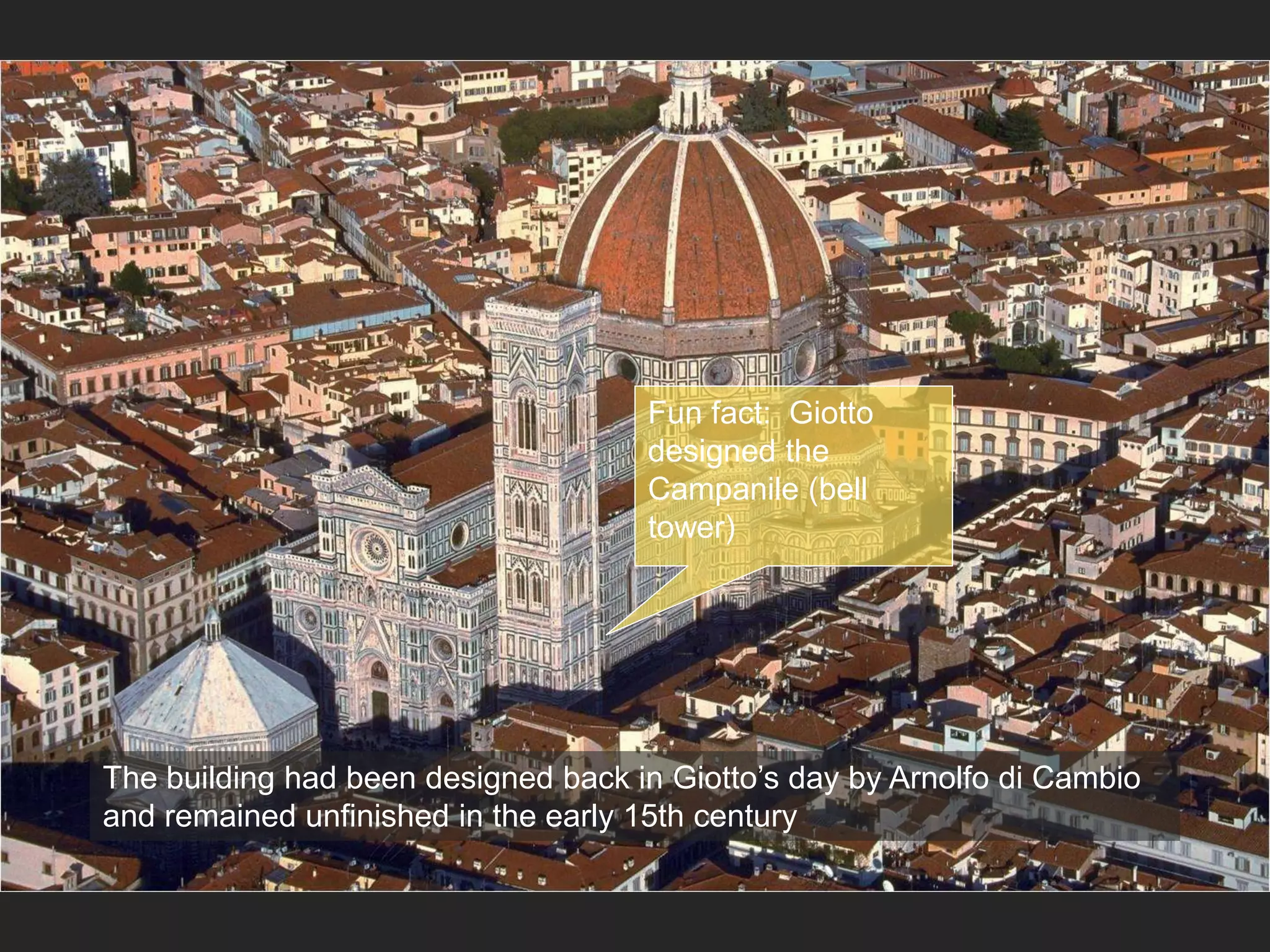
The building had been designed back in Giotto’s day by Arnolfo di Cambio
and remained unfinished in the early 15th century
Fun fact: Giotto
designed the
Campanile (bell
tower)
The great crossing, 140 feet in diameter, needed a dome – but nobody
knew how to do it!
Brunelleschi had just returned from Rome where he studied the Pantheon --
the largest domed structure in the world
The problem: how to build a dome large enough to span such a huge
amount of space
The solution: a self-supporting herringbone design of brick work, and the
ingenious idea of a double shell
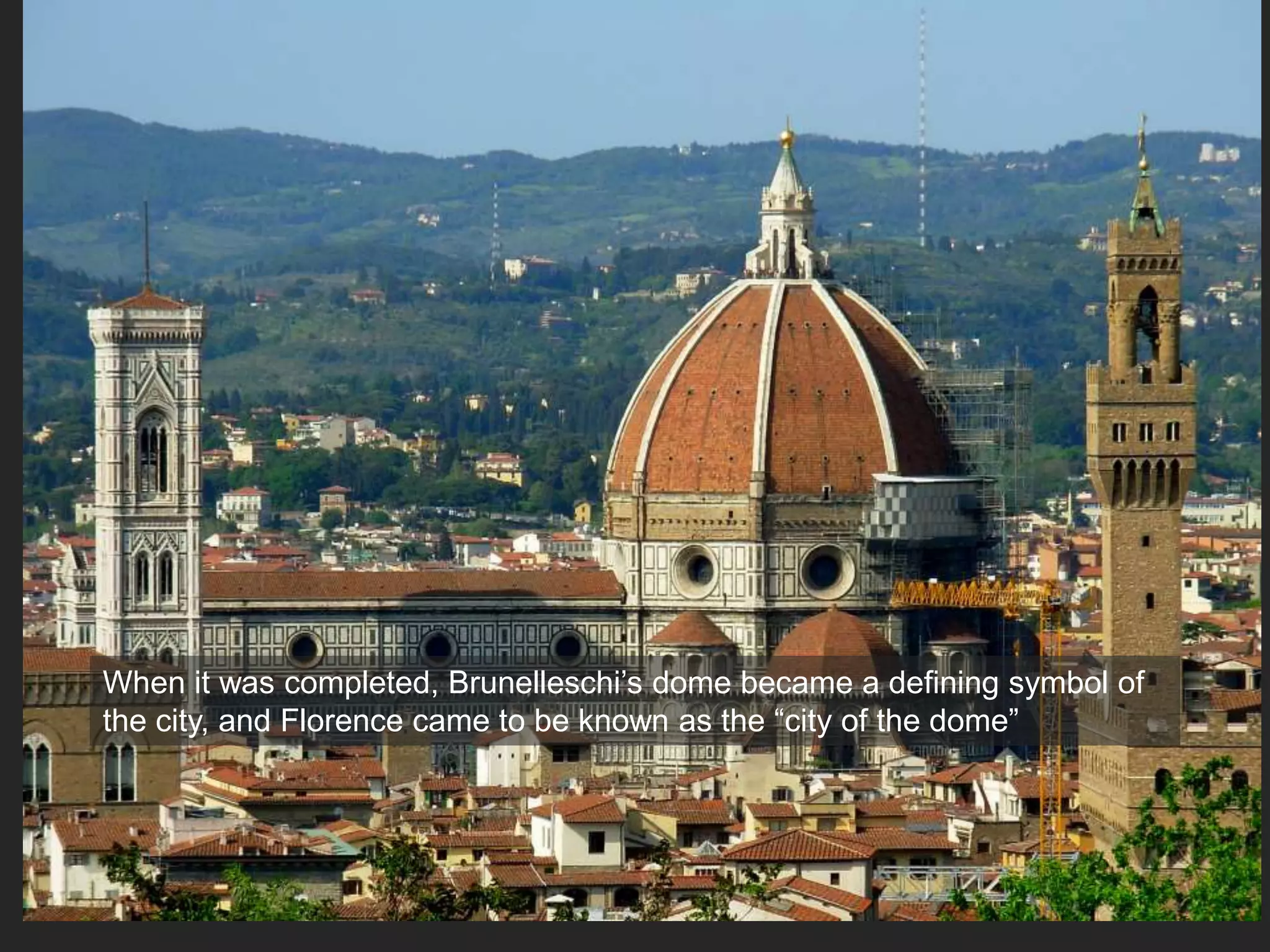
When it was completed, Brunelleschi’s dome became a defining symbol of
the city, and Florence came to be known as the “city of the dome”
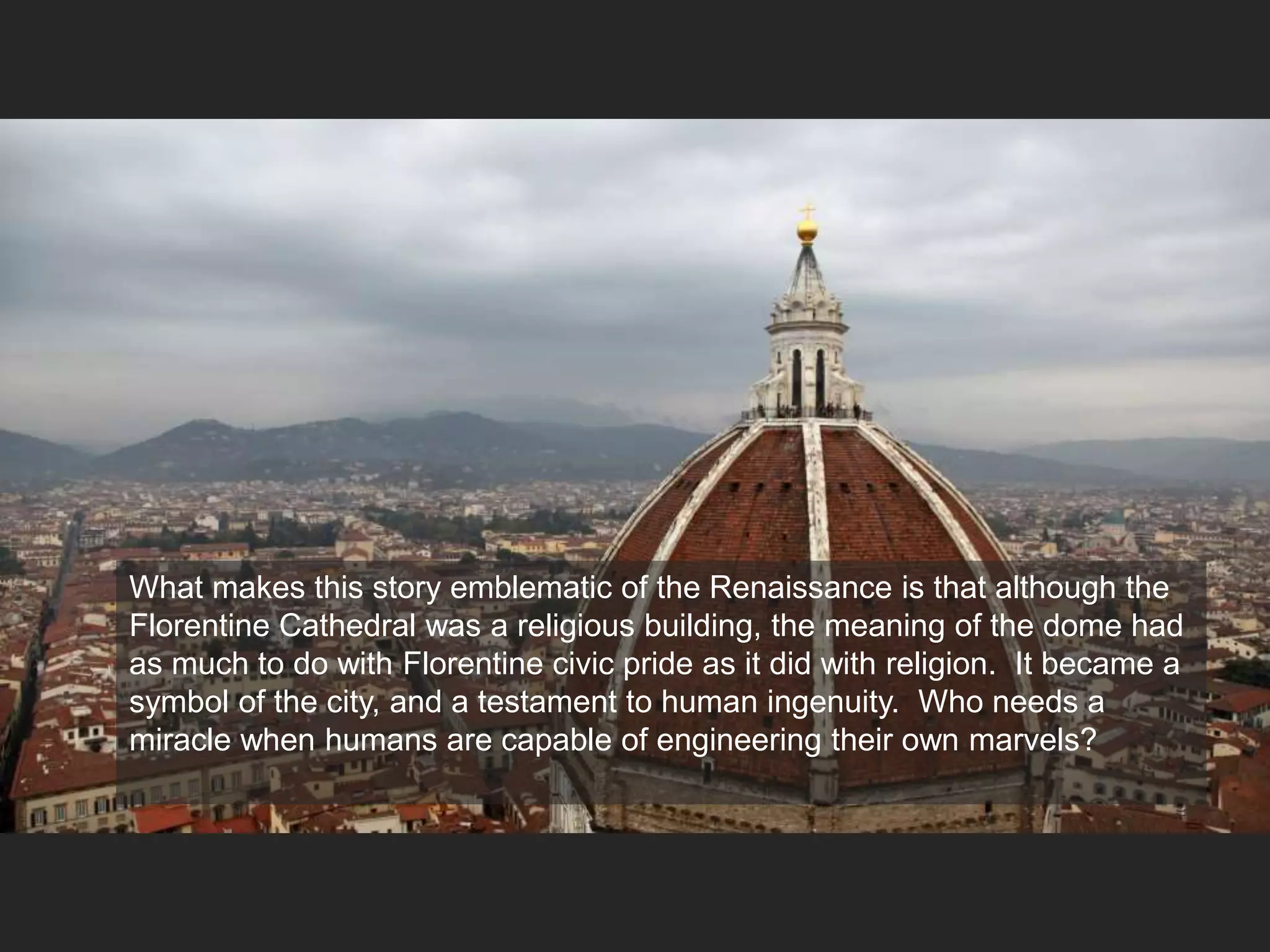
What makes this story emblematic of the Renaissance is that although the
Florentine Cathedral was a religious building, the meaning of the dome had
as much to do with Florentine civic pride as it did with religion. It became a
symbol of the city, and a testament to human ingenuity. Who needs a
miracle when humans are capable of engineering their own marvels?
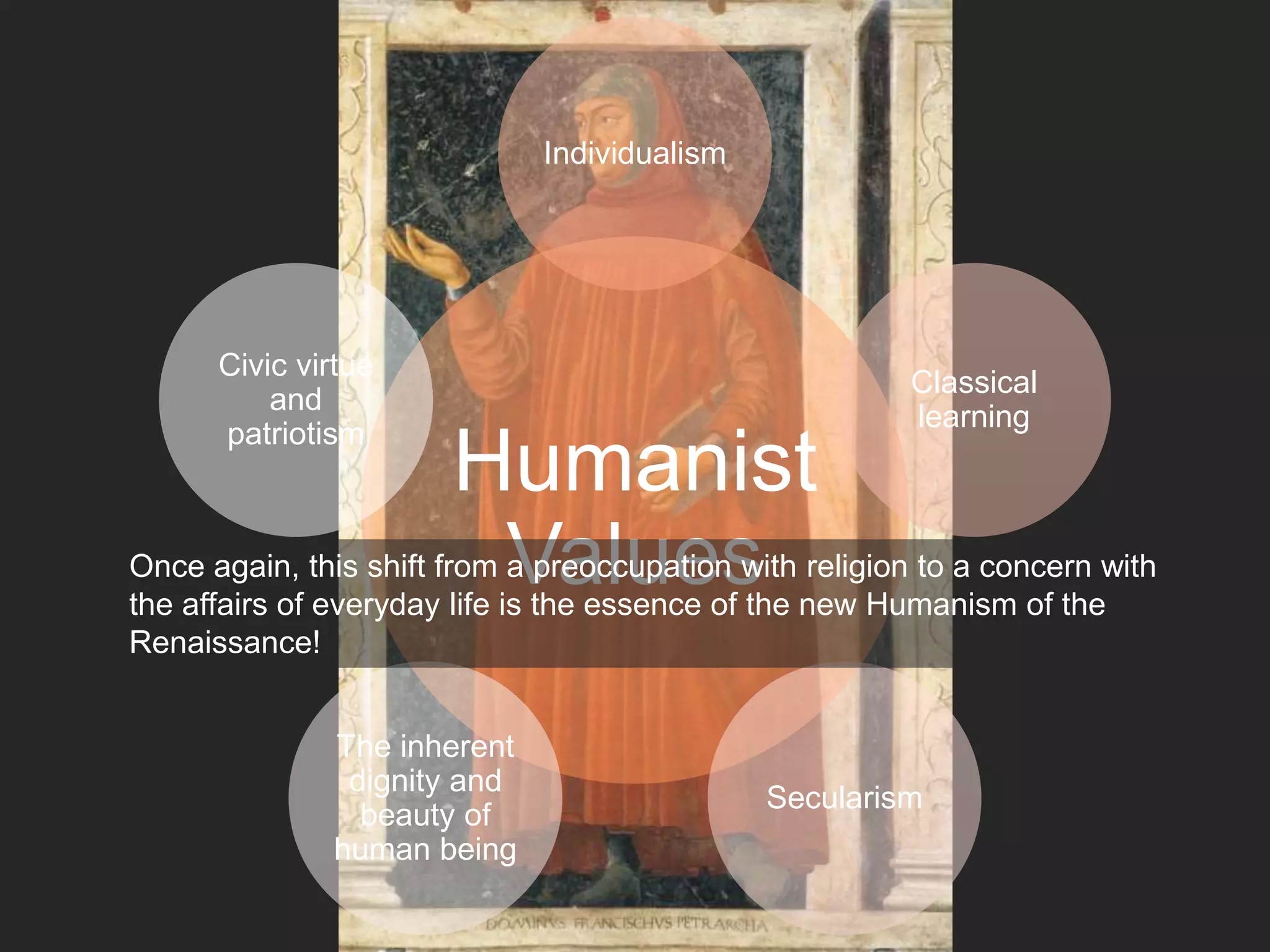
Humanist
Values
Individualism
Classical
learning
Secularism
The inherent
dignity and
beauty of
human being
Civic virtue
and
patriotism
Once again, this shift from a preoccupation with religion to a concern with
the affairs of everyday life is the essence of the new Humanism of the
Renaissance!

Italian Renaissance: Intro

  • 1.
    The Italian Renaissance Artand Civic Pride in Florence
  • 2.
    The Renaissance Between 1300 and 1600 the western worldwas transformed An extraordinary wave of artistic and cultural innovation shattered medieval society and brought European culture into the modern era This was the Renaissance Renaissance means “rebirth It refers to the reawakening of European culture after the period of decline following the fall of the Roman Empire
  • 3.
    People living duringthe Renaissance believed they were living in a new golden age that rivaled the cultural and intellectual achievements of ancient Greece and Rome
  • 4.
    To them, thelong period of the Middle Ages was a “dark age” that had finally come to an end
  • 5.
    The birthplace ofthe Renaissance was Florence, a thriving commercial center, with a government modeled on the great democracies of ancient Greece and Rome The Palazzo Segnoria (or the Palazzo Vecchio) served as the Florentine seat of government during the Renaissance
  • 6.
  • 7.
    Breaking with thefeudal traditions of the past, Florence had a progressive form of government: instead of being governed by a Duke or a King, Florence was an independent commune governed by elected leaders drawn from the city’s leading merchant guilds (guilds were trade organizations, similar to unions). So it was a democracy, and Florentines were fiercely proud of their independence
  • 8.
    The Florentine Republicwas also a center of Humanist learning Andrea del Castagno, Portrait of Petrarch, c. 1450
  • 9.
    “In Italy, especially,the Renaissance was spurred by a revival of Greek and Roman learning. Works by classical authors, lost to the West for centuries, were rediscovered, and with them a new, humanistic outlook that placed man and human achievement at the center of all things.” The Early Renaissance in Florence, National Gallery of Art Marsilio Ficino Cristoforo Landino Angelo Poliziano
  • 10.
    Humanist Values Individualism Classical learning Secularism The inherent dignity and beautyof human being Civic virtue and patriotism These Humanist values shaped the art of the Renaissance
  • 11.
    Francesco Sassetti Lorenzode Medici Florence was also home to a wealthy and well-educated merchant class eager to advertise their status, learning, and civic pride through commissioned works of art
  • 12.
    Andrea del Verrochio, Lorenzode Medici, 1478/1521, National Gallery There were many wealthy families in Florence that patronized art, but the most influential was the Medici, whose fortunes were made through banking
  • 13.
    Agnolo Bronzino, Portrait ofCosimo il Vecchio Uffizi Cosimo de Medici began the family’s tradition of Humanist scholarship and patronage of the arts
  • 14.
    Agnolo Bronzino, Portrait ofCosimo il Vecchio Uffizi “Cosimo . . . amassed the largest library in Europe, brought in many Greek sources, including the works of Plato, from Constantinople, founded the Platonic Academy and patronized Marsilio Ficino, who later issued the first Latin edition of the collected works of Plato. The artists supported by Cosimo included Ghiberti, Brunelleschi, Donatello, Alberti, Fra Angelico, and Ucello. During his rule and that of his sons and grandson, Florence became the cultural center of Europe and the cradle of the new Humanism.” The Medici Family @ The Galileo Project
  • 15.
    The story ofthe Renaissance usually begins with the competition for the doors of the Florentine Baptistry in 1401 The Baptistry is the octagonal building This is the Florentine Cathedral, or Duomo
  • 16.
    Although the doorswere for a religious building, it is significant that the patron was not the church. The sponsor was the the Arte di Calimara (the wool merchants guild), which which means there were interests other than religion involved
  • 17.
    Lorenzo Ghiberti, Sacrificeof Isaac, 1401-1402Filippo Brunelleschi, Sacrifice of Isaac, 1401-1402 The finalists were Filippo Brunelleschi and Lorenzo Ghiberti, whose competition panels survive
  • 18.
    Lorenzo Ghiberti, Sacrificeof Isaac, 1401-1402Filippo Brunelleschi, Sacrifice of Isaac, 1401-1402 The subject matter chosen for the competition panels was the biblical story of Abraham and Isaac
  • 19.
    Lorenzo Ghiberti, Sacrificeof Isaac, 1401-1402Filippo Brunelleschi, Sacrifice of Isaac, 1401-1402 But the content had political meaning for the Florentines
  • 20.
    At this moment,Florence was at war with the neighboring Duke of Milan Democracy Governed by a Duke
  • 21.
    In the biblicalstory, God commanded Abraham to sacrifice his son as a test of his faith – but at the last minute, an angel was sent to stop him
  • 22.
    It took courageand self-sacrifice for Abraham to obey the Lord’s command, but he was rewarded in the end for his faith
  • 23.
    The Florentine’s weresimilarly called upon to make sacrifices, and to remain steadfast in their faith in democracy. They were rewarded when the Duke died unexpectedly while his armies prepared for battle, and the threat of invasion miraculously disappeared Democracy Governed by a Duke
  • 24.
    Lorenzo Ghiberti, Sacrificeof Isaac, 1401-1402Filippo Brunelleschi, Sacrifice of Isaac, 1401-1402 So the Old Testament story had special meaning for the Florentines, who would have found their faith and patriotism confirmed by the outcome
  • 25.
    Lorenzo Ghiberti, Sacrificeof Isaac, 1401-1402Filippo Brunelleschi, Sacrifice of Isaac, 1401-1402 The question is: are the panels about patriotism or faith?
  • 26.
    Lorenzo Ghiberti, Sacrificeof Isaac, 1401-1402Filippo Brunelleschi, Sacrifice of Isaac, 1401-1402 In the context of Renaissance Florence, the story had both religious and secular connotations -- for although the story comes from the Bible, its meaning in 15th century Florence had as much to do with patriotism and civic pride as it did with faith and God
  • 27.
    Humanist Values Individualism Classical learning Secularism The inherent dignity and beautyof human being Civic virtue and patriotism This shift from a preoccupation with religion to a concern with the affairs of everyday life is, in many ways, the essence of the new Humanism of the Renaissance!
  • 28.
    Lorenzo Ghiberti, Sacrificeof Isaac, 1401-1402Filippo Brunelleschi, Sacrifice of Isaac, 1401-1402 Both panels also reflect the “rediscovery” of Classical culture, which was a defining feature of the Renaissance
  • 29.
    This can beseen in the meticulously rendered drapery, which shows a convincing sense of the naturally proportioned bodies underneath
  • 30.
    It can alsobe seen in the ideal nudity of Isaac, which recalls Greek statues of male youths
  • 31.
    It is asif both artists were saying “we want nothing to do with the art of medieval Europe; we are now the descendants of ancient Greece and Rome!”
  • 32.
    That is howthe Florentines saw themselves, and the classically influenced style of the reliefs (made for a religious building!) confirmed this new self- image.
  • 33.
    The winner ofthe competition was Ghiberti
  • 34.
    After completing hisfirst set of doors he was called back to complete a second set of bronze doors that were so magnificent Michelangelo nicknamed them “the Gates of Paradise.”
  • 35.
    The loser ofthe competition was Brunelleschi, who was so disheartened by the setback he left Florence and went to Rome to study architecture
  • 36.
    But when hereturned he became the leading architect in Florence, and one of the greatest architects of the Renaissance (you might want to remember this story the next time you face a setback!)
  • 37.
    When Brunelleschi returnedfrom Rome he entered another competition, this time for the design of the dome for the Florentine Cathedral (the duomo)
  • 38.
    The building hadbeen designed back in Giotto’s day by Arnolfo di Cambio and remained unfinished in the early 15th century Fun fact: Giotto designed the Campanile (bell tower)
  • 39.
    The great crossing,140 feet in diameter, needed a dome – but nobody knew how to do it!
  • 40.
    Brunelleschi had justreturned from Rome where he studied the Pantheon -- the largest domed structure in the world
  • 41.
    The problem: howto build a dome large enough to span such a huge amount of space
  • 42.
    The solution: aself-supporting herringbone design of brick work, and the ingenious idea of a double shell
  • 43.
    When it wascompleted, Brunelleschi’s dome became a defining symbol of the city, and Florence came to be known as the “city of the dome”
  • 44.
    What makes thisstory emblematic of the Renaissance is that although the Florentine Cathedral was a religious building, the meaning of the dome had as much to do with Florentine civic pride as it did with religion. It became a symbol of the city, and a testament to human ingenuity. Who needs a miracle when humans are capable of engineering their own marvels?
  • 45.
    Humanist Values Individualism Classical learning Secularism The inherent dignity and beautyof human being Civic virtue and patriotism Once again, this shift from a preoccupation with religion to a concern with the affairs of everyday life is the essence of the new Humanism of the Renaissance!