ART HISTORY 
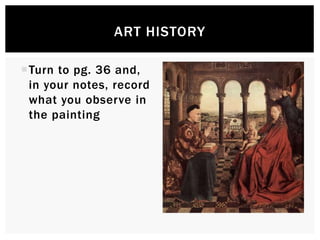
Turn to pg. 36 and, in 
your notes, record 
what you observe in 
the painting
ART HISTORY 
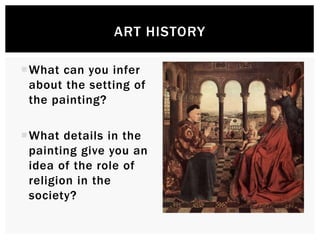
What can you infer 
about the setting of 
the painting? 
What details in the 
painting give you an 
idea of the role of 
religion in the 
society?
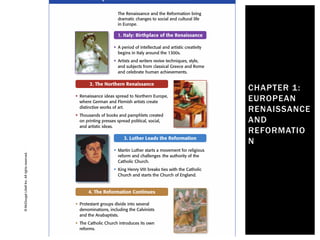
CHAPTER 1: 
EUROPEAN 
RENAISSANCE 
AND 
REFORMATIO 
N
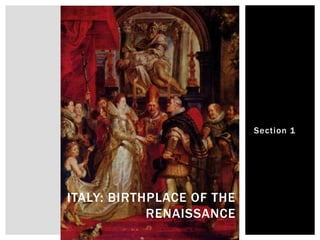
Section 1 
ITALY: BIRTHPLACE OF THE 
RENAISSANCE
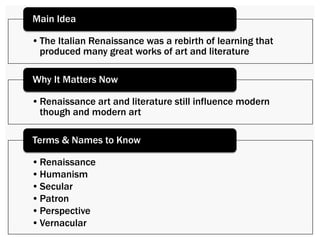
Main Idea 
• The Italian Renaissance was a rebirth of learning that 
produced many great works of art and literature 
Why It Matters Now 
• Renaissance art and literature still influence modern though 
and modern art 
Terms & Names to Know 
• Renaissance 
• Humanism 
• Secular 
• Patron 
• Perspective 
• Vernacular
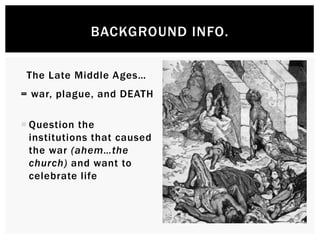
BACKGROUND INFO. 
The Late Middle Ages… 
= war, plague, and DEATH 
 Question the institutions 
that caused the war 
(ahem…the church) and 
want to celebrate life
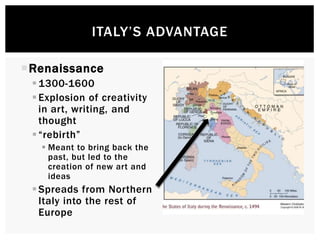
ITALY’S ADVANTAGE 
Renaissance 
 1300-1600 
 Explosion of creativity 
in art, writing, and 
thought 
 “rebirth” 
 Meant to bring back the 
past, but led to the 
creation of new art and 
ideas 
 Spreads from Northern 
Italy into the rest of 
Europe
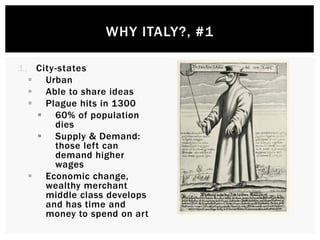
1. City-states 
WHY ITALY?, #1 
 Urban 
 Able to share ideas 
 Plague hits in 1300 
 60% of population 
dies 
 Supply & Demand: 
those left can demand 
higher wages 
 Economic change, 
wealthy merchant 
middle class develops 
and has time and money 
to spend on art
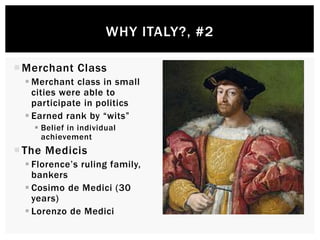
Merchant Class 
WHY ITALY?, #2 
Merchant class in small 
cities were able to 
participate in politics 
 Earned rank by “wits” 
 Belief in individual 
achievement 
 The Medicis 
 Florence’s ruling family, 
bankers 
 Cosimo de Medici (30 
years) 
 Lorenzo de Medici
WHY ITALY?, #3 
Classical Heritage 
 Snobs about medieval art 
 Inspiration from Roman 
ruins 
 Studied Latin manuscripts 
Greek manuscripts enter 
Rome in 1493 
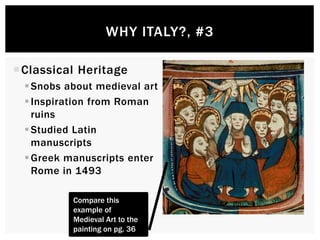
Compare this 
example of Medieval 
Art to the painting on 
pg. 36
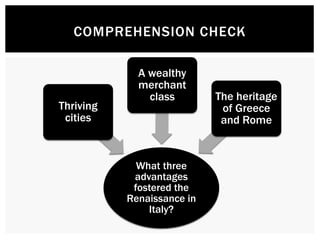
COMPREHENSION CHECK 
What three 
advantages 
fostered the 
Renaissance in 
Italy? 
Thriving 
cities 
A wealthy 
merchant 
class The heritage 
of Greece 
and Rome
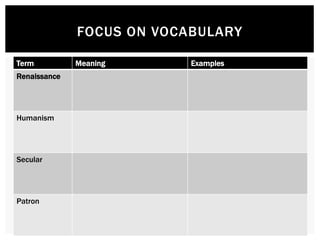
Term Meaning Examples 
Renaissance 
Humanism 
Secular 
Patron 
FOCUS ON VOCABULARY
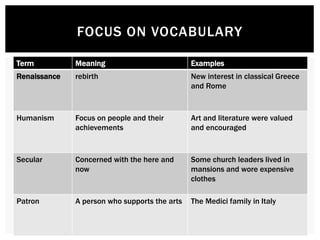
FOCUS ON VOCABULARY 
Term Meaning Examples 
Renaissance rebirth New interest in classical Greece 
and Rome 
Humanism Focus on people and their 
achievements 
Art and literature were valued and 
encouraged 
Secular Concerned with the here and 
now 
Some church leaders lived in 
mansions and wore expensive 
clothes 
Patron A person who supports the arts The Medici family in Italy
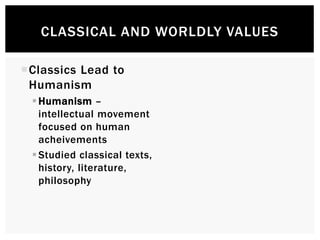
CLASSICAL AND WORLDLY VALUES 
Classics Lead to 
Humanism 
Humanism – 
intellectual movement 
focused on human 
achievements 
 Studied classical texts, 
history, literature, 
philosophy
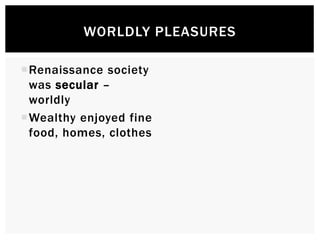
WORLDLY PLEASURES 
Renaissance society was secular – worldly 
Wealthy enjoyed fine food, homes, clothes 
Medieval Church Renaissance Church
PATRON OF THE ARTS 
Patron – a financial 
supporter of artists 
Church leaders spend 
money on artworks to 
beautify cities 
Wealthy merchants 
also patrons of the 
arts 
 portraits, public places
THE RENAISSANCE MAN 
Excels in many field; 
the classics, art, 
politics, combat 
Baldassare 
Castiglione’s The 
Courtier (1528) 
The book teaches 
how to become a 
“universal” person
THE RENAISSANCE WOMAN 
Upper-class, 
educated in classics, 
charming 
Expected to inspire 
art but not create it 
 Isabella d’Este, 
patron of artists, 
wields power in 
Mantua
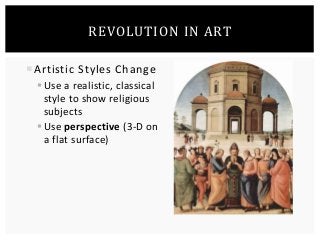
REVOLUTION IN ART 
Artistic Styles Change 
Use a realistic, classical 
style to show religious 
subjects 
Use perspective (3-D on 
a flat surface)
REVOLUTION IN ART 
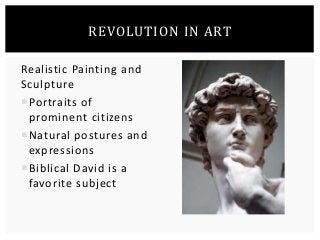
Realistic Painting and 
Sculpture 
Portraits of 
prominent citizens 
Natural postures and 
expressions 
Biblical David is a 
favorite subject
LEONARDO DA VINCI 
RENAISSANCE MAN 
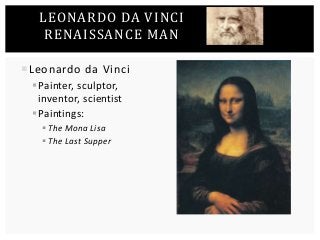
Leonardo da Vinci 
 Painter, sculptor, 
inventor, scientist 
 Paintings: 
 The Mona Lisa 
 The Last Supper
RAPHAEL SANZIO 
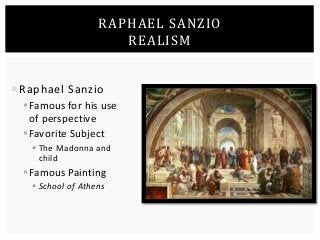
Raphael Sanzio 
 Famous for his use 
of perspective 
 Favorite Subject 
 The Madonna and 
child 
 Famous Painting 
 School of Athens 
REALISM
RENAISSANCE LADIES REPRESENT 
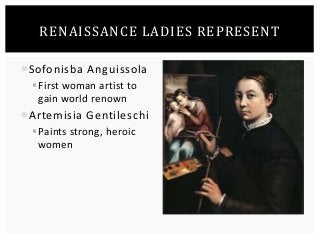
Sofonisba Anguissola 
 First woman artist to 
gain world renown 
Artemisia Gentileschi 
 Paints strong, heroic 
women
CHAPTER 1 
Sec t ion 1 
Complete your 
Ent rance 
Sl ip/Bel l Ringer
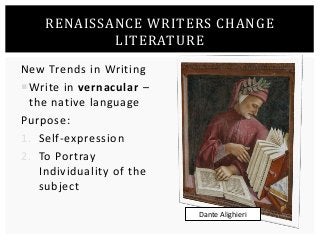
RENAISSANCE WRITERS CHANGE 
LITERATURE 
New Trends in Writing 
Write in vernacular – 
the native language 
Purpose: 
1. Self-expression 
2. To Portray 
Individuality of the 
subject 
Dante Alighieri
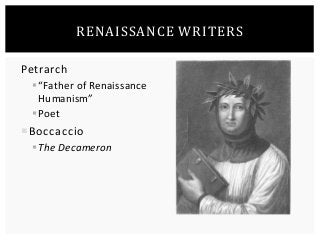
Petrarch 
RENAISSANCE WRITERS 
 “Father of Renaissance 
Humanism” 
 Poet 
Boccaccio 
 The Decameron
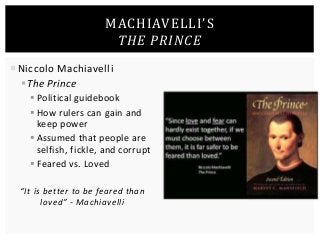
MACHIAVELLI’S 
THE PRINCE 
 Niccolo Machiavelli 
 The Prince 
 Political guidebook 
 How rulers can gain and 
keep power 
 Assumed that people are 
selfish, fickle, and corrupt 
 Feared vs. Loved 
“It is better to be feared than 
loved” - Machiavelli
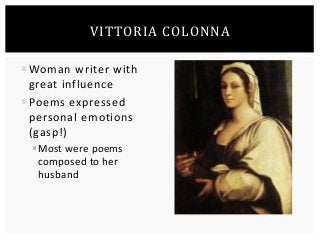
VITTORIA COLONNA 
Woman writer with 
great influence 
Poems expressed 
personal emotions 
(gasp!) 
Most were poems 
composed to her 
husband
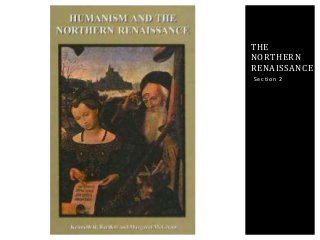
THE 
NORTHERN 
RENAISSANCE 
Sec t ion 2
Main Idea: In the 1400s, the 
idea of the Italian 
Renaissance began to spread 
to Northern Europe 
Why it Matters: Renaissance 
ideas such as the importance 
of the individual are a strong 
part of modern thought 
Terms and Names: - utopia, 
William Shakespeare, Johann 
Gutenburg
ADD THAT MAP! 
Glue the provided 
map into your notes 
for future usage!!!! 
Pay attention and 
follow directions 
when the teacher 
lady asks you to! 
!! 
!!!
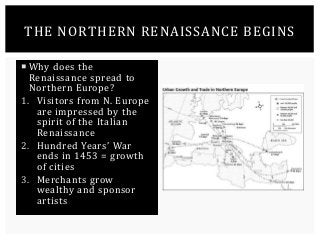
THE NORTHERN RENAISSANCE BEGINS 
 Why does the 
Renaissance spread to 
Northern Europe? 
1. Visitors from N. Europe 
are impressed by the 
spirit of the Italian 
Renaissance 
2. Hundred Years’ War 
ends in 1453 = growth 
of cities 
3. Merchants grow 
wealthy and sponsor 
artists
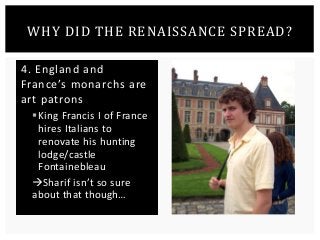
WHY DID THE RENAISSANCE SPREAD? 
4. England and 
France’s monarchs are 
art patrons 
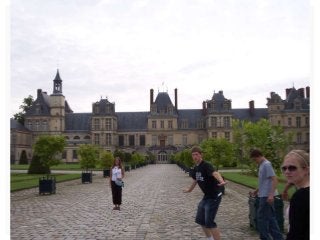
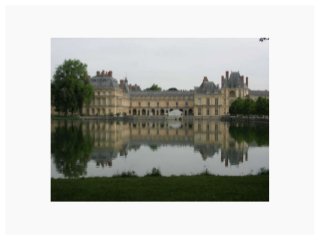
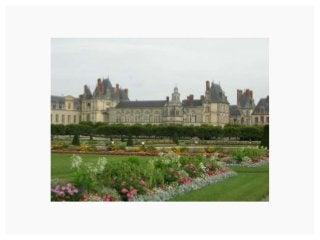
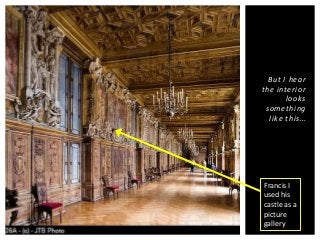
 King Francis I of France 
hires Italians to 
renovate his hunting 
lodge/castle 
Fontainebleau 
Sharif isn’t so sure 
about that though…
But I hear 
the interior 
looks 
something 
like t h is… 
Francis I 
used his 
castle as a 
picture 
gallery
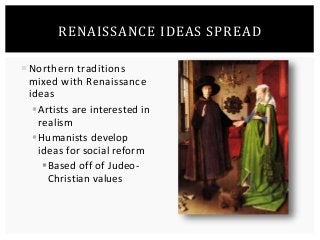
RENAISSANCE IDEAS SPREAD 
 Northern traditions 
mixed with Renaissance 
ideas 
Artists are interested in 
realism 
Humanists develop 
ideas for social reform 
 Based off of Judeo- 
Christian values
ARTISTIC IDEAS SPREAD 
Renaissance Styles 
Migrate North 
 Artists and writers move 
to northern Europe to 
escape war in Italy (1494) 
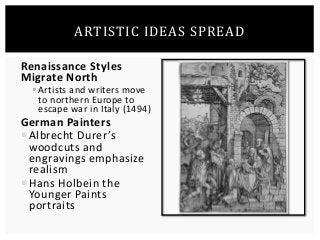
German Painters 
 Albrecht Durer ’s 
woodcuts and 
engravings emphasize 
realism 
Hans Holbein the 
Younger Paints 
portraits
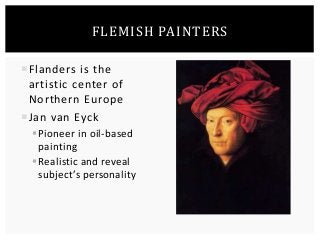
FLEMISH PAINTERS 
Flanders is the 
artistic center of 
Northern Europe 
 Jan van Eyck 
 Pioneer in oil-based 
painting 
 Realistic and reveal 
subject’s personality
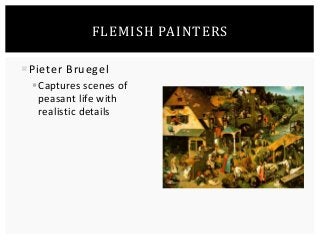
FLEMISH PAINTERS 
Pieter Bruegel 
 Captures scenes of 
peasant life with 
realistic details
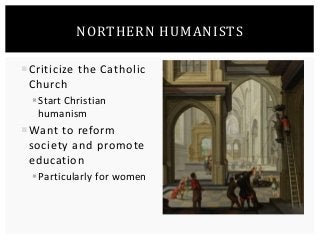
NORTHERN HUMANISTS 
Criticize the Catholic 
Church 
 Start Christian 
humanism 
Want to reform 
society and promote 
education 
 Particularly for women
THURSDAY, SEPTEMBER 25TH 
Daily Agenda 
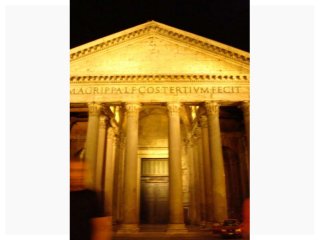
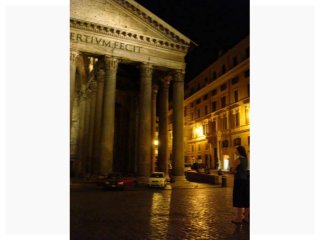
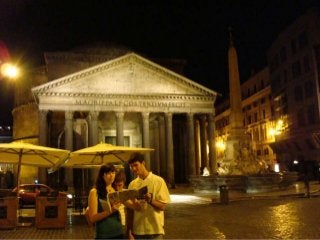
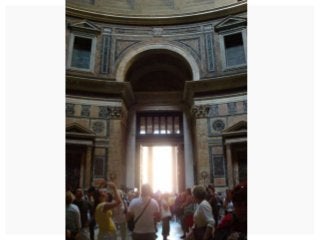
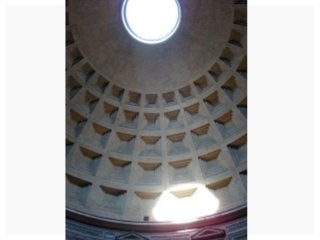
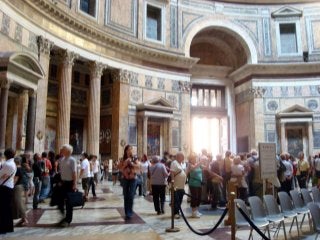
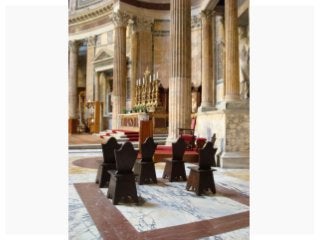
1. Pantheon pictures 
2. “Engineering an 
Empire” video 
3. Chapter 1 Notes Homework – Due 
Tomorrow 
1. Read 1.4 
2. Finish 1.4 reading 
packet
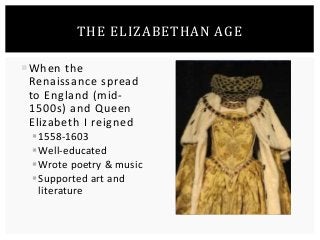
THE ELIZABETHAN AGE 
When the 
Renaissance spread 
to England (mid- 
1500s) and Queen 
Elizabeth I reigned 
 1558-1603 
Well-educated 
Wrote poetry & music 
 Supported art and 
literature
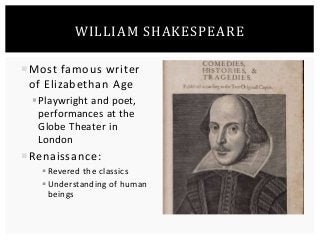
WILLIAM SHAKESPEARE 
Most famous writer 
of Elizabethan Age 
 Playwright and poet, 
performances at the 
Globe Theater in 
London 
Renaissance: 
 Revered the classics 
 Understanding of human 
beings
THE PRINTING PRESS 
Gutenburg's Printing Press 
 1440, Gutenburg creates the printing press 
 First book to be mass produced = the Bible 
 Inexpensive enough for many to be able to purchase a book
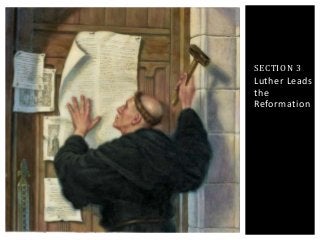
SECTION 3 
Luther Leads 
the 
Reformation
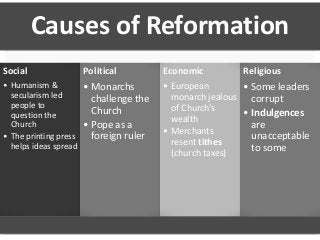
Causes of Reformation 
Social 
• Humanism & 
secularism led 
people to 
question the 
Church 
• The printing press 
helps ideas spread 
Political 
• Monarchs 
challenge the 
Church 
• Pope as a 
foreign ruler 
Economic 
• European 
monarch jealous 
of Church’s 
wealth 
• Merchants 
resent tithes 
(church taxes) 
Religious 
• Some leaders 
corrupt 
• Indulgences 
are 
unacceptable 
to some
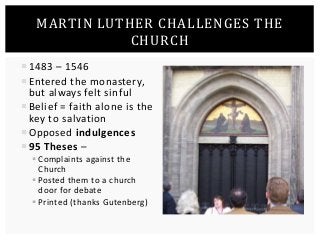
MARTIN LUTHER CHALLENGES THE 
CHURCH 
 1483 – 1546 
 Entered the monastery, 
but always felt sinful 
 Belief = faith alone is the 
key to salvation 
 Opposed indulgences 
 95 Theses – 
 Complaints against the 
Church 
 Posted them to a church 
door for debate 
 Printed (thanks Gutenberg)
SYNTHESIS ACTIVITY

Modern World History: Chapter 1

  • 1.
    ART HISTORY Turnto pg. 36 and, in your notes, record what you observe in the painting
  • 2.
    ART HISTORY Whatcan you infer about the setting of the painting? What details in the painting give you an idea of the role of religion in the society?
  • 3.
    CHAPTER 1: EUROPEAN RENAISSANCE AND REFORMATIO N
  • 4.
    Section 1 ITALY:BIRTHPLACE OF THE RENAISSANCE
  • 5.
    Main Idea •The Italian Renaissance was a rebirth of learning that produced many great works of art and literature Why It Matters Now • Renaissance art and literature still influence modern though and modern art Terms & Names to Know • Renaissance • Humanism • Secular • Patron • Perspective • Vernacular
  • 6.
    BACKGROUND INFO. TheLate Middle Ages… = war, plague, and DEATH  Question the institutions that caused the war (ahem…the church) and want to celebrate life
  • 8.
    ITALY’S ADVANTAGE Renaissance  1300-1600  Explosion of creativity in art, writing, and thought  “rebirth”  Meant to bring back the past, but led to the creation of new art and ideas  Spreads from Northern Italy into the rest of Europe
  • 9.
    1. City-states WHYITALY?, #1  Urban  Able to share ideas  Plague hits in 1300  60% of population dies  Supply & Demand: those left can demand higher wages  Economic change, wealthy merchant middle class develops and has time and money to spend on art
  • 10.
    Merchant Class WHYITALY?, #2 Merchant class in small cities were able to participate in politics  Earned rank by “wits”  Belief in individual achievement  The Medicis  Florence’s ruling family, bankers  Cosimo de Medici (30 years)  Lorenzo de Medici
  • 11.
    WHY ITALY?, #3 Classical Heritage  Snobs about medieval art  Inspiration from Roman ruins  Studied Latin manuscripts Greek manuscripts enter Rome in 1493 Compare this example of Medieval Art to the painting on pg. 36
  • 12.
    COMPREHENSION CHECK Whatthree advantages fostered the Renaissance in Italy? Thriving cities A wealthy merchant class The heritage of Greece and Rome
  • 13.
    Term Meaning Examples Renaissance Humanism Secular Patron FOCUS ON VOCABULARY
  • 14.
    FOCUS ON VOCABULARY Term Meaning Examples Renaissance rebirth New interest in classical Greece and Rome Humanism Focus on people and their achievements Art and literature were valued and encouraged Secular Concerned with the here and now Some church leaders lived in mansions and wore expensive clothes Patron A person who supports the arts The Medici family in Italy
  • 15.
    CLASSICAL AND WORLDLYVALUES Classics Lead to Humanism Humanism – intellectual movement focused on human achievements  Studied classical texts, history, literature, philosophy
  • 16.
    WORLDLY PLEASURES Renaissancesociety was secular – worldly Wealthy enjoyed fine food, homes, clothes Medieval Church Renaissance Church
  • 17.
    PATRON OF THEARTS Patron – a financial supporter of artists Church leaders spend money on artworks to beautify cities Wealthy merchants also patrons of the arts  portraits, public places
  • 18.
    THE RENAISSANCE MAN Excels in many field; the classics, art, politics, combat Baldassare Castiglione’s The Courtier (1528) The book teaches how to become a “universal” person
  • 19.
    THE RENAISSANCE WOMAN Upper-class, educated in classics, charming Expected to inspire art but not create it  Isabella d’Este, patron of artists, wields power in Mantua
  • 20.
    REVOLUTION IN ART Artistic Styles Change Use a realistic, classical style to show religious subjects Use perspective (3-D on a flat surface)
  • 21.
    REVOLUTION IN ART Realistic Painting and Sculpture Portraits of prominent citizens Natural postures and expressions Biblical David is a favorite subject
  • 22.
    LEONARDO DA VINCI RENAISSANCE MAN Leonardo da Vinci  Painter, sculptor, inventor, scientist  Paintings:  The Mona Lisa  The Last Supper
  • 23.
    RAPHAEL SANZIO RaphaelSanzio  Famous for his use of perspective  Favorite Subject  The Madonna and child  Famous Painting  School of Athens REALISM
  • 24.
    RENAISSANCE LADIES REPRESENT Sofonisba Anguissola  First woman artist to gain world renown Artemisia Gentileschi  Paints strong, heroic women
  • 25.
    CHAPTER 1 Sect ion 1 Complete your Ent rance Sl ip/Bel l Ringer
  • 26.
    RENAISSANCE WRITERS CHANGE LITERATURE New Trends in Writing Write in vernacular – the native language Purpose: 1. Self-expression 2. To Portray Individuality of the subject Dante Alighieri
  • 27.
    Petrarch RENAISSANCE WRITERS  “Father of Renaissance Humanism”  Poet Boccaccio  The Decameron
  • 28.
    MACHIAVELLI’S THE PRINCE  Niccolo Machiavelli  The Prince  Political guidebook  How rulers can gain and keep power  Assumed that people are selfish, fickle, and corrupt  Feared vs. Loved “It is better to be feared than loved” - Machiavelli
  • 29.
    VITTORIA COLONNA Womanwriter with great influence Poems expressed personal emotions (gasp!) Most were poems composed to her husband
  • 30.
  • 31.
    Main Idea: Inthe 1400s, the idea of the Italian Renaissance began to spread to Northern Europe Why it Matters: Renaissance ideas such as the importance of the individual are a strong part of modern thought Terms and Names: - utopia, William Shakespeare, Johann Gutenburg
  • 32.
    ADD THAT MAP! Glue the provided map into your notes for future usage!!!! Pay attention and follow directions when the teacher lady asks you to! !! !!!
  • 33.
    THE NORTHERN RENAISSANCEBEGINS  Why does the Renaissance spread to Northern Europe? 1. Visitors from N. Europe are impressed by the spirit of the Italian Renaissance 2. Hundred Years’ War ends in 1453 = growth of cities 3. Merchants grow wealthy and sponsor artists
  • 34.
    WHY DID THERENAISSANCE SPREAD? 4. England and France’s monarchs are art patrons  King Francis I of France hires Italians to renovate his hunting lodge/castle Fontainebleau Sharif isn’t so sure about that though…
  • 39.
    But I hear the interior looks something like t h is… Francis I used his castle as a picture gallery
  • 40.
    RENAISSANCE IDEAS SPREAD  Northern traditions mixed with Renaissance ideas Artists are interested in realism Humanists develop ideas for social reform  Based off of Judeo- Christian values
  • 41.
    ARTISTIC IDEAS SPREAD Renaissance Styles Migrate North  Artists and writers move to northern Europe to escape war in Italy (1494) German Painters  Albrecht Durer ’s woodcuts and engravings emphasize realism Hans Holbein the Younger Paints portraits
  • 42.
    FLEMISH PAINTERS Flandersis the artistic center of Northern Europe  Jan van Eyck  Pioneer in oil-based painting  Realistic and reveal subject’s personality
  • 43.
    FLEMISH PAINTERS PieterBruegel  Captures scenes of peasant life with realistic details
  • 44.
    NORTHERN HUMANISTS Criticizethe Catholic Church  Start Christian humanism Want to reform society and promote education  Particularly for women
  • 45.
    THURSDAY, SEPTEMBER 25TH Daily Agenda 1. Pantheon pictures 2. “Engineering an Empire” video 3. Chapter 1 Notes Homework – Due Tomorrow 1. Read 1.4 2. Finish 1.4 reading packet
  • 53.
    THE ELIZABETHAN AGE When the Renaissance spread to England (mid- 1500s) and Queen Elizabeth I reigned  1558-1603 Well-educated Wrote poetry & music  Supported art and literature
  • 54.
    WILLIAM SHAKESPEARE Mostfamous writer of Elizabethan Age  Playwright and poet, performances at the Globe Theater in London Renaissance:  Revered the classics  Understanding of human beings
  • 56.
    THE PRINTING PRESS Gutenburg's Printing Press  1440, Gutenburg creates the printing press  First book to be mass produced = the Bible  Inexpensive enough for many to be able to purchase a book
  • 57.
    SECTION 3 LutherLeads the Reformation
  • 58.
    Causes of Reformation Social • Humanism & secularism led people to question the Church • The printing press helps ideas spread Political • Monarchs challenge the Church • Pope as a foreign ruler Economic • European monarch jealous of Church’s wealth • Merchants resent tithes (church taxes) Religious • Some leaders corrupt • Indulgences are unacceptable to some
  • 59.
    MARTIN LUTHER CHALLENGESTHE CHURCH  1483 – 1546  Entered the monastery, but always felt sinful  Belief = faith alone is the key to salvation  Opposed indulgences  95 Theses –  Complaints against the Church  Posted them to a church door for debate  Printed (thanks Gutenberg)
  • 60.

Editor's Notes

  • #23 http://www.biography.com/people/leonardo-da-vinci-40396#synopsis
  • #57 http://www.history.com/topics/middle-ages/videos/mankind-the-story-of-all-of-us-the-printing-press