Kris Jacobson CIL 505 8/4/11 Adapted from Renaissance Connection
How Humanism Changes Renaissance Art Changes in art illustrate changes in the Renaissance view of people and their place in the world.
Middle Ages Middle Ages last from the 3rd Century through the 13 th  Century  Learning is centered around the church and religion Artistic subjects are religious
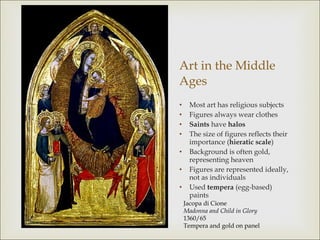
Art in the Middle Ages Most art has religious subjects Figures always wear clothes Saints  have  halos The size of figures reflects their importance ( hieratic scale ) Background is often gold, representing heaven Figures are represented ideally, not as individuals Used  tempera  (egg-based) paints Jacopa di Cione Madonna and Child in Glory 1360/65 Tempera and gold on panel
Begins in the 14 th  Century People begin to read the literature of  Classical  Greece and Rome People begin learning about government, philosophy and art from these  Classical  writings People began to study the natural world, astronomy, math, and engineering Humans and their relationship to the world become a major focus of art, science, and literature Artists created works outside of the church and began to sign their own works. Renaissance
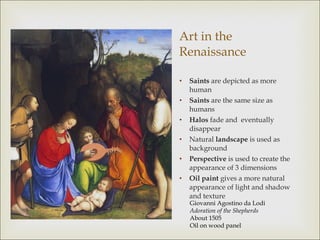
Art in the Renaissance Saints  are depicted as more human  Saints  are the same size as humans Halos  fade and  eventually disappear Natural  landscape  is used as background Perspective  is used to create the appearance of 3 dimensions Oil paint  gives a more natural appearance of light and shadow and texture Giovanni Agostino da Lodi Adoration of the Shepherds About 1505 Oil on wood panel
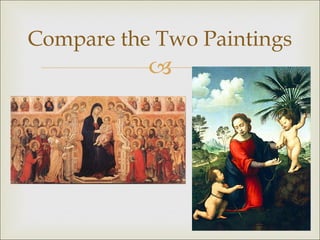
Compare the Two Paintings
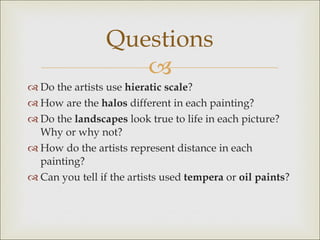
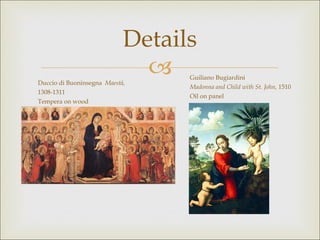
Do the artists use  hieratic scale ?  How are the  halos  different in each painting? Do the  landscapes  look true to life in each picture? Why or why not? How do the artists represent distance in each painting? Can you tell if the artists used  tempera  or  oil paints ? Questions
Details Duccio di Buoninsegna  Maestà, 1308-1311 Tempera on wood Guiliano Bugiardini Madonna and Child with St. John,  1510 Oil on panel

Humanism in Renaissance Art

  • 1.
    Kris Jacobson CIL505 8/4/11 Adapted from Renaissance Connection
  • 2.
    How Humanism ChangesRenaissance Art Changes in art illustrate changes in the Renaissance view of people and their place in the world.
  • 3.
    Middle Ages MiddleAges last from the 3rd Century through the 13 th Century Learning is centered around the church and religion Artistic subjects are religious
  • 4.
    Art in theMiddle Ages Most art has religious subjects Figures always wear clothes Saints have halos The size of figures reflects their importance ( hieratic scale ) Background is often gold, representing heaven Figures are represented ideally, not as individuals Used tempera (egg-based) paints Jacopa di Cione Madonna and Child in Glory 1360/65 Tempera and gold on panel
  • 5.
    Begins in the14 th Century People begin to read the literature of Classical Greece and Rome People begin learning about government, philosophy and art from these Classical writings People began to study the natural world, astronomy, math, and engineering Humans and their relationship to the world become a major focus of art, science, and literature Artists created works outside of the church and began to sign their own works. Renaissance
  • 6.
    Art in theRenaissance Saints are depicted as more human Saints are the same size as humans Halos fade and eventually disappear Natural landscape is used as background Perspective is used to create the appearance of 3 dimensions Oil paint gives a more natural appearance of light and shadow and texture Giovanni Agostino da Lodi Adoration of the Shepherds About 1505 Oil on wood panel
  • 7.
    Compare the TwoPaintings
  • 8.
    Do the artistsuse hieratic scale ? How are the halos different in each painting? Do the landscapes look true to life in each picture? Why or why not? How do the artists represent distance in each painting? Can you tell if the artists used tempera or oil paints ? Questions
  • 9.
    Details Duccio diBuoninsegna Maestà, 1308-1311 Tempera on wood Guiliano Bugiardini Madonna and Child with St. John, 1510 Oil on panel