Renaissance
Art
“An explosion of creativity and learning in
Europe in the 15th and 16th Centuries.”
Early
Renaissance
Social, Political, Economic, and Religious
Change in 15th Century
People were ready for change after 14th Century Wars, the
plague, and social upheaval
Change in Political power – the new monarchs exerted and
expanded their authority, including spending money on art
Emerging capitalism – trade, new credit, and exchange systems
created a network of enterprising European cities
The Pope makes Rome him home again
The birthplace of the Renaissance was Italy
The Renaissance quickly spread to other parts of
Europe, including Flanders in the North.
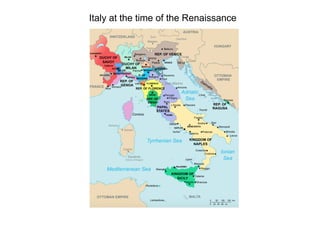
Italy at the time of the Renaissance
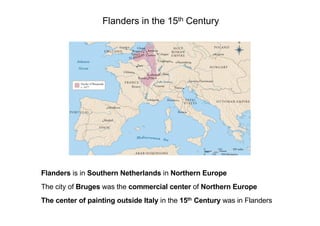
Flanders in the 15th Century
Flanders is in Southern Netherlands in Northern Europe
The city of Bruges was the commercial center of Northern Europe
The center of painting outside Italy in the 15th Century was in Flanders
Northern European Early Renaissance Art
vs.
Italian Early Renaissance Art
• Fresco Painting / Tempera Painting
• Classic Greek and Roman Themes
• Nude Figures
Northern European Early Renaissance Art
• Oil Painting (sharp detail)
• Portraits
• Symbolism
Humanism
Revival of classical learning and literature (interest in Ancient
Greek and Roman cultures)
Focus on Human Beings
education that drove development through the study of past
models of civic and personal virtue
value system that emphasized personal effort and
responsibility
physically and intellectually active life that was directed at a
common good as well as individual nobility
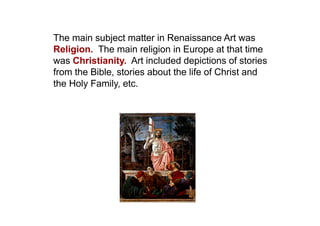
The main subject matter in Renaissance Art was
Religion. The main religion in Europe at that time
was Christianity. Art included depictions of stories
from the Bible, stories about the life of Christ and
the Holy Family, etc.
Classical Greek and Roman Themes
in Renaissance Art
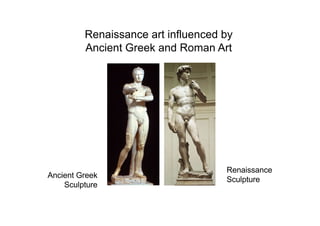
Renaissance art influenced by
Ancient Greek and Roman Art
Ancient Greek
Sculpture
Renaissance
Sculpture
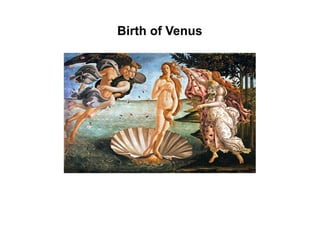
Birth of Venus
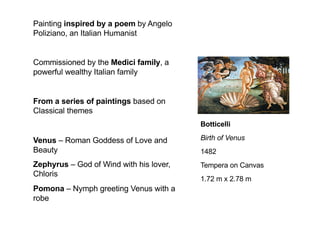
Botticelli
Birth of Venus
1482
Tempera on Canvas
1.72 m x 2.78 m
Painting inspired by a poem by Angelo
Poliziano, an Italian Humanist
Commissioned by the Medici family, a
powerful wealthy Italian family
From a series of paintings based on
Classical themes
Venus – Roman Goddess of Love and
Beauty
Zephyrus – God of Wind with his lover,
Chloris
Pomona – Nymph greeting Venus with a
robe
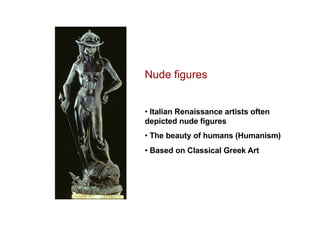
Nude figures
• Italian Renaissance artists often
depicted nude figures
• The beauty of humans (Humanism)
• Based on Classical Greek Art
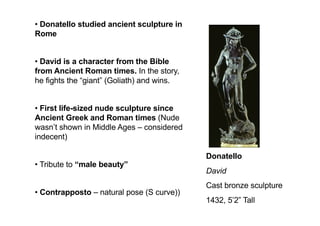
Donatello
David
Cast bronze sculpture
1432, 5’2” Tall
• Donatello studied ancient sculpture in
Rome
• David is a character from the Bible
from Ancient Roman times. In the story,
he fights the “giant” (Goliath) and wins.
• First life-sized nude sculpture since
Ancient Greek and Roman times (Nude
wasn’t shown in Middle Ages – considered
indecent)
• Tribute to “male beauty”
• Contrapposto – natural pose (S curve))
Composition during the Renaissance
Renaissance artists carefully planned their artworks,
making many sketches and plans in advance
of the final work
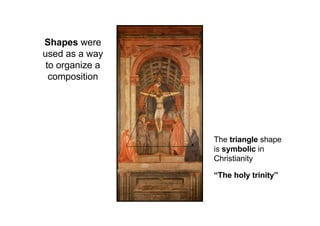
Shapes were
used as a way
to organize a
composition
The triangle shape
is symbolic in
Christianity
“The holy trinity”
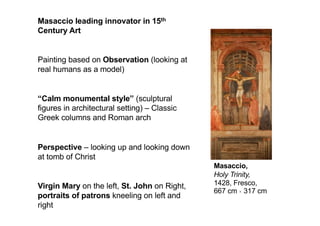
Masaccio,
Holy Trinity,
1428, Fresco,
667 cm × 317 cm
Masaccio leading innovator in 15th
Century Art
Painting based on Observation (looking at
real humans as a model)
“Calm monumental style” (sculptural
figures in architectural setting) – Classic
Greek columns and Roman arch
Perspective – looking up and looking down
at tomb of Christ
Virgin Mary on the left, St. John on Right,
portraits of patrons kneeling on left and
right
Perspective
Depicting the illusion of three-dimensional space on a
flat 2-D surface
Renaissance artists discovered ways to show space that
looked more real (one and two-point perspective)
Foreshortening – shortening the depth dimension to create
the illusion of depth
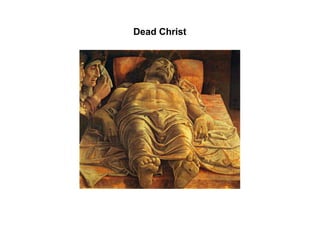
Dead Christ
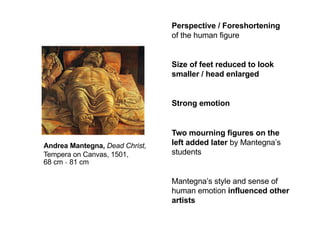
Andrea Mantegna, Dead Christ,
Tempera on Canvas, 1501,
68 cm × 81 cm
Perspective / Foreshortening
of the human figure
Size of feet reduced to look
smaller / head enlarged
Strong emotion
Two mourning figures on the
left added later by Mantegna’s
students
Mantegna’s style and sense of
human emotion influenced other
artists
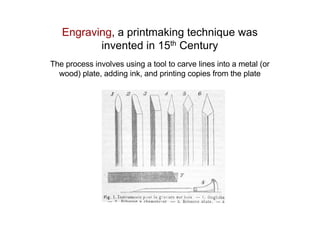
Engraving, a printmaking technique was
invented in 15th Century
The process involves using a tool to carve lines into a metal (or
wood) plate, adding ink, and printing copies from the plate
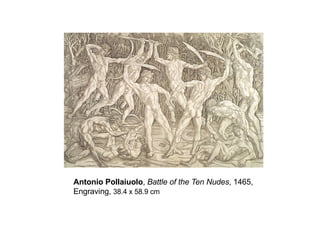
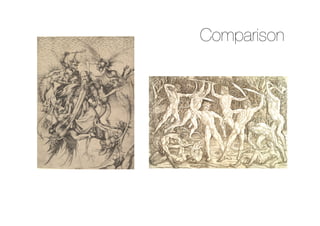
Antonio Pollaiuolo, Battle of the Ten Nudes, 1465,
Engraving, 38.4 x 58.9 cm
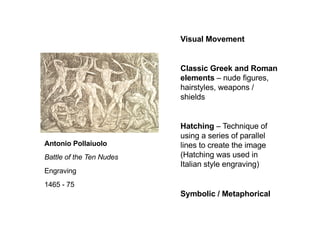
Visual Movement
Classic Greek and Roman
elements – nude figures,
hairstyles, weapons /
shields
Hatching – Technique of
using a series of parallel
lines to create the image
(Hatching was used in
Italian style engraving)
Symbolic / Metaphorical
Antonio Pollaiuolo
Battle of the Ten Nudes
Engraving
1465 - 75
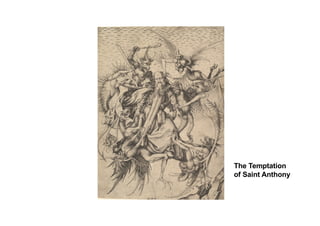
The Temptation
of Saint Anthony
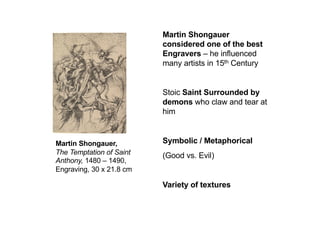
Martin Shongauer,
The Temptation of Saint
Anthony, 1480 – 1490,
Engraving, 30 x 21.8 cm
Martin Shongauer
considered one of the best
Engravers – he influenced
many artists in 15th Century
Stoic Saint Surrounded by
demons who claw and tear at
him
Symbolic / Metaphorical
(Good vs. Evil)
Variety of textures
Comparison
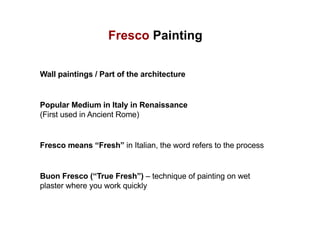
Fresco Painting
Wall paintings / Part of the architecture
Popular Medium in Italy in Renaissance
(First used in Ancient Rome)
Fresco means “Fresh” in Italian, the word refers to the process
Buon Fresco (“True Fresh”) – technique of painting on wet
plaster where you work quickly
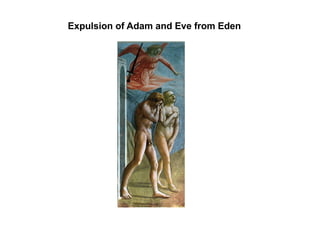
Expulsion of Adam and Eve from Eden
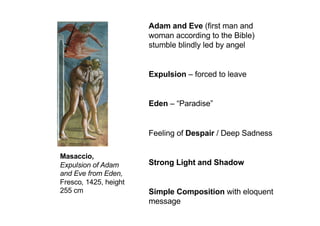
Masaccio,
Expulsion of Adam
and Eve from Eden,
Fresco, 1425, height
255 cm
Adam and Eve (first man and
woman according to the Bible)
stumble blindly led by angel
Expulsion – forced to leave
Eden – “Paradise”
Feeling of Despair / Deep Sadness
Strong Light and Shadow
Simple Composition with eloquent
message
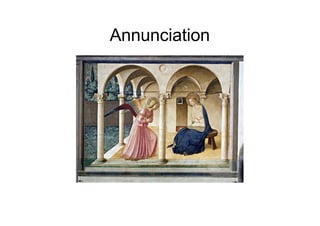
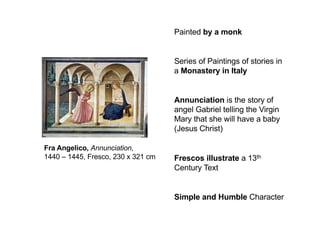
Annunciation
Painted by a monk
Series of Paintings of stories in
a Monastery in Italy
Annunciation is the story of
angel Gabriel telling the Virgin
Mary that she will have a baby
(Jesus Christ)
Frescos illustrate a 13th
Century Text
Simple and Humble Character
Fra Angelico, Annunciation,
1440 – 1445, Fresco, 230 x 321 cm
Patrons of the Arts
A person who donates money toward the Arts – for Society
Commission
To hire an artist to make art especially for you
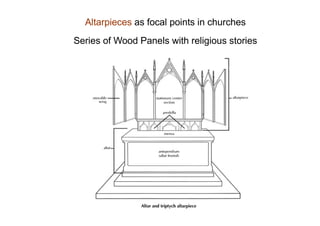
Altarpieces
Altarpieces as focal points in churches
Series of Wood Panels with religious stories
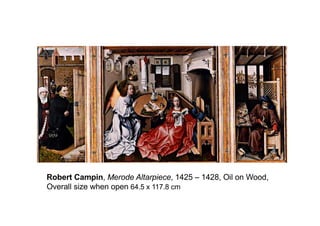
Robert Campin, Merode Altarpiece, 1425 – 1428, Oil on Wood,
Overall size when open 64.5 x 117.8 cm
Robert Campin, Merode
Altarpiece, 1425 – 1428,
Oil on Wood, Overall size
when open 64.5 x 117.8 cm
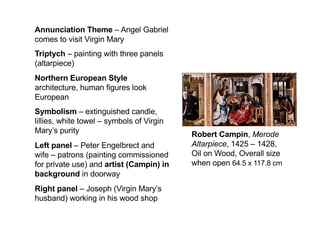
Annunciation Theme – Angel Gabriel
comes to visit Virgin Mary
Triptych – painting with three panels
(altarpiece)
Northern European Style
architecture, human figures look
European
Symbolism – extinguished candle,
lillies, white towel – symbols of Virgin
Mary’s purity
Left panel – Peter Engelbrect and
wife – patrons (painting commissioned
for private use) and artist (Campin) in
background in doorway
Right panel – Joseph (Virgin Mary’s
husband) working in his wood shop
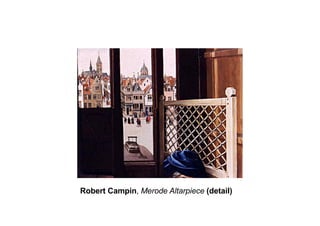
Robert Campin, Merode Altarpiece (detail)
Oil Painting
• Flemish Artist Jan van Eyck credited with inventing oil painting in
1400s
• Previously, artists used fresco and tempera paint, but those
mediums dry too quickly and difficult to create sharp details
• Jan van Eyck wanted his painting to look more realistic with vivid
details to “mimic nature” and to create symbolism
• Italians commissioned paintings from Northern European
artists – impressed by the technique and the style
Portraits
Tradition of the Romans
Immortality – Your image will live forever
Publicize their “Greatness”
Self-Portraits
Artists representing themselves
Jan Van Eyck,
Man in a Red
Turban, 1433,
Oil on Wood,
25.5 x 19 cm
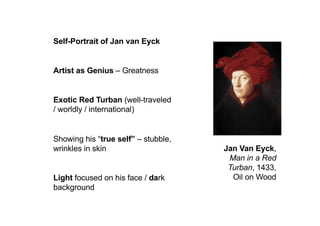
Jan Van Eyck,
Man in a Red
Turban, 1433,
Oil on Wood
Self-Portrait of Jan van Eyck
Artist as Genius – Greatness
Exotic Red Turban (well-traveled
/ worldly / international)
Showing his “true self” – stubble,
wrinkles in skin
Light focused on his face / dark
background
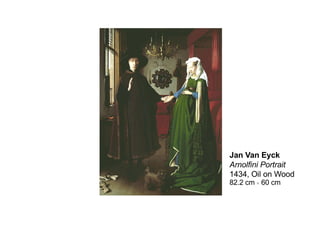
Jan Van Eyck
Arnolfini Portrait
1434, Oil on Wood
82.2 cm × 60 cm
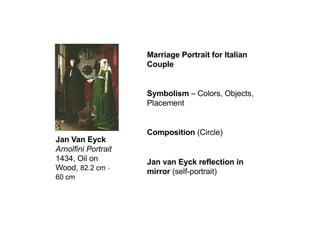
Jan Van Eyck
Arnolfini Portrait
1434, Oil on
Wood, 82.2 cm ×
60 cm
Marriage Portrait for Italian
Couple
Symbolism – Colors, Objects,
Placement
Composition (Circle)
Jan van Eyck reflection in
mirror (self-portrait)
Early Renaissance
Architecture
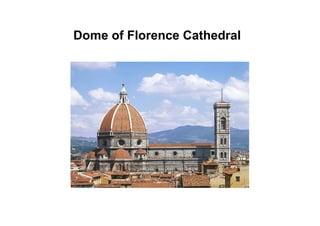
Dome of Florence Cathedral
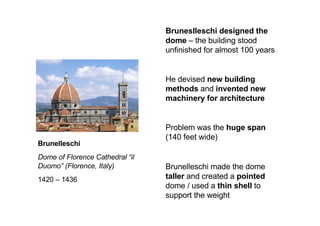
Brunelleschi
Dome of Florence Cathedral “il
Duomo” (Florence, Italy)
1420 – 1436
Bruneslleschi designed the
dome – the building stood
unfinished for almost 100 years
He devised new building
methods and invented new
machinery for architecture
Problem was the huge span
(140 feet wide)
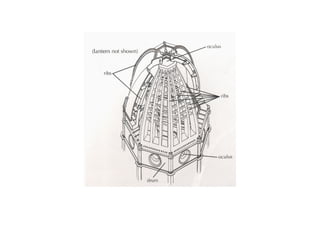
Brunelleschi made the dome
taller and created a pointed
dome / used a thin shell to
support the weight
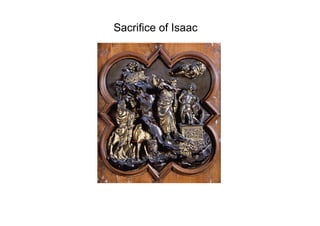
Sacrifice of Isaac
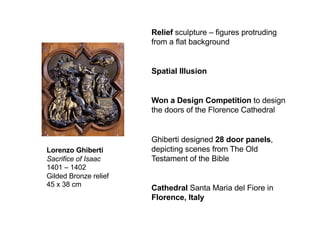
Lorenzo Ghiberti
Sacrifice of Isaac
1401 – 1402
Gilded Bronze relief
45 x 38 cm
Relief sculpture – figures protruding
from a flat background
Spatial Illusion
Won a Design Competition to design
the doors of the Florence Cathedral
Ghiberti designed 28 door panels,
depicting scenes from The Old
Testament of the Bible
Cathedral Santa Maria del Fiore in
Florence, Italy
High Renaissance
(Late Renaissance)
High Renaissance
By the 16th Century, Renaissance artists had
mastered all of the fundamental techniques of
visual illusionism, including linear and aerial
perspective, accurate proportions in depicting
human anatomy, and the use of light and shade.
Leonardo Da Vinci
(1452 - 1519)
Born in the small town of Vinci near Florence
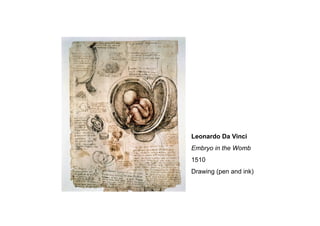
Leonardo Da Vinci
Embryo in the Womb
1510
Drawing (pen and ink)
Leonardo Da Vinci
Embryo in the Womb
1510
Drawing (pen and ink)
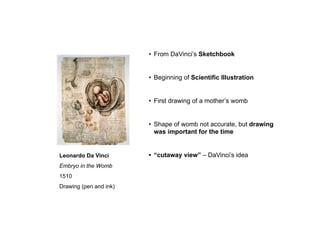
• From DaVinci’s Sketchbook
• Beginning of Scientific Illustration
• First drawing of a mother’s womb
• Shape of womb not accurate, but drawing
was important for the time
• “cutaway view” – DaVinci’s idea
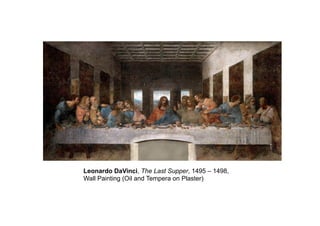
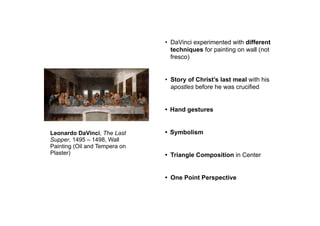
Leonardo DaVinci, The Last Supper, 1495 – 1498,
Wall Painting (Oil and Tempera on Plaster)
Leonardo DaVinci, The Last
Supper, 1495 – 1498, Wall
Painting (Oil and Tempera on
Plaster)
• DaVinci experimented with different
techniques for painting on wall (not
fresco)
• Story of Christ’s last meal with his
apostles before he was crucified
• Hand gestures
• Symbolism
• Triangle Composition in Center
• One Point Perspective
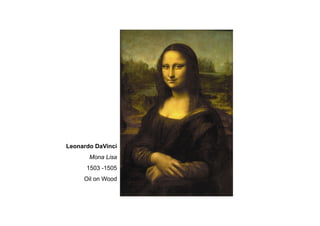
Leonardo DaVinci
Mona Lisa
1503 -1505
Oil on Wood
Leonardo DaVinci
Mona Lisa
1503 -1505
Oil on Wood
• Atmospheric Perspective (Background
is duller and less clear) – “Sfumato”
• Icon of Western Art (most recognized
painting)
• Mystery (Who is she? Why is she
smiling?
• Painting Cropped in Size - originally
larger
• Located in the Louvre Museum, Paris
Leonardo DaVinci
Mona Lisa
1503 -1505
Oil on Wood
Leonardo DaVinci
Mona Lisa
1503 -1505
Oil on Wood
• Atmospheric Perspective (Background
is duller and less clear) – “Sfumato”
• Icon of Western Art (most recognized
painting)
• Mystery (Who is she? Why is she
smiling?
• Painting Cropped in Size - originally
larger
• Located in the Louvre Museum, Paris
Michelangelo Buonarroti
(1475 - 1564)
DaVinci and Michelangelo debated which
medium was better – painting or sculpture?
DaVinci preferred painting and drawing because he could invent
and create illusions
Michelangelo preferred sculpture because it has three-
dimensions and therefore more “realistic”
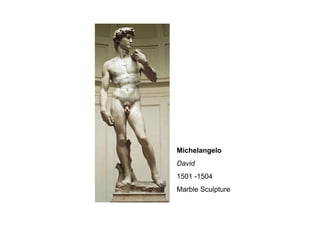
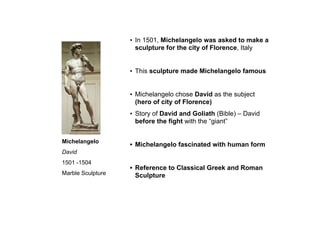
Michelangelo
David
1501 -1504
Marble Sculpture
Michelangelo
David
1501 -1504
Marble Sculpture
• In 1501, Michelangelo was asked to make a
sculpture for the city of Florence, Italy
• This sculpture made Michelangelo famous
• Michelangelo chose David as the subject
(hero of city of Florence)
• Story of David and Goliath (Bible) – David
before the fight with the “giant”
• Michelangelo fascinated with human form
• Reference to Classical Greek and Roman
Sculpture
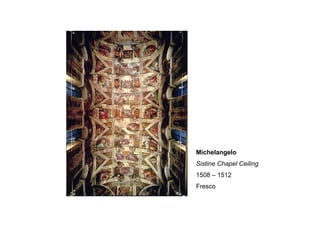
Michelangelo
Sistine Chapel Ceiling
1508 – 1512
Fresco
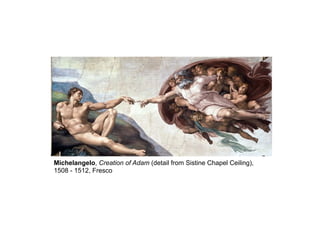
Michelangelo, Creation of Adam (detail from Sistine Chapel Ceiling),
1508 - 1512, Fresco
Raphael (Raffaello Sanzio da Urbino)
(1483 - 1520)
Born in Urbino, Italy
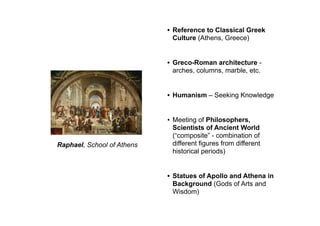
Raphael, School of Athens, 1509 – 1511, Fresco
Raphael, School of Athens
• Reference to Classical Greek
Culture (Athens, Greece)
• Greco-Roman architecture -
arches, columns, marble, etc.
• Humanism – Seeking Knowledge
• Meeting of Philosophers,
Scientists of Ancient World
(“composite” - combination of
different figures from different
historical periods)
• Statues of Apollo and Athena in
Background (Gods of Arts and
Wisdom)
Titian (Tiziano Vecelli)
(1485 - 1576)
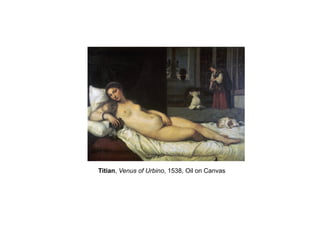
Titian, Venus of Urbino, 1538, Oil on Canvas
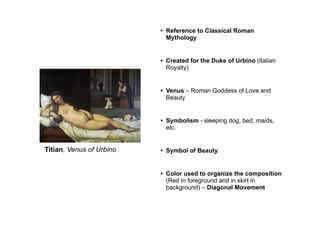
Titian, Venus of Urbino
• Reference to Classical Roman
Mythology
• Created for the Duke of Urbino (Italian
Royalty)
• Venus – Roman Goddess of Love and
Beauty
• Symbolism - sleeping dog, bed, maids,
etc.
• Symbol of Beauty
• Color used to organize the composition
(Red in foreground and in skirt in
background) – Diagonal Movement

Renaissance Art

  • 1.
  • 2.
    “An explosion ofcreativity and learning in Europe in the 15th and 16th Centuries.”
  • 3.
  • 4.
    Social, Political, Economic,and Religious Change in 15th Century People were ready for change after 14th Century Wars, the plague, and social upheaval Change in Political power – the new monarchs exerted and expanded their authority, including spending money on art Emerging capitalism – trade, new credit, and exchange systems created a network of enterprising European cities The Pope makes Rome him home again
  • 5.
    The birthplace ofthe Renaissance was Italy The Renaissance quickly spread to other parts of Europe, including Flanders in the North.
  • 6.
    Italy at thetime of the Renaissance
  • 7.
    Flanders in the15th Century Flanders is in Southern Netherlands in Northern Europe The city of Bruges was the commercial center of Northern Europe The center of painting outside Italy in the 15th Century was in Flanders
  • 8.
    Northern European EarlyRenaissance Art vs. Italian Early Renaissance Art
  • 9.
    Italian Early RenaissanceArt • Fresco Painting / Tempera Painting • Classic Greek and Roman Themes • Nude Figures Northern European Early Renaissance Art • Oil Painting (sharp detail) • Portraits • Symbolism
  • 10.
    Humanism Revival of classicallearning and literature (interest in Ancient Greek and Roman cultures) Focus on Human Beings education that drove development through the study of past models of civic and personal virtue value system that emphasized personal effort and responsibility physically and intellectually active life that was directed at a common good as well as individual nobility
  • 11.
    The main subjectmatter in Renaissance Art was Religion. The main religion in Europe at that time was Christianity. Art included depictions of stories from the Bible, stories about the life of Christ and the Holy Family, etc.
  • 12.
    Classical Greek andRoman Themes in Renaissance Art
  • 13.
    Renaissance art influencedby Ancient Greek and Roman Art Ancient Greek Sculpture Renaissance Sculpture
  • 14.
  • 15.
    Botticelli Birth of Venus 1482 Temperaon Canvas 1.72 m x 2.78 m Painting inspired by a poem by Angelo Poliziano, an Italian Humanist Commissioned by the Medici family, a powerful wealthy Italian family From a series of paintings based on Classical themes Venus – Roman Goddess of Love and Beauty Zephyrus – God of Wind with his lover, Chloris Pomona – Nymph greeting Venus with a robe
  • 16.
    Nude figures • ItalianRenaissance artists often depicted nude figures • The beauty of humans (Humanism) • Based on Classical Greek Art
  • 17.
    Donatello David Cast bronze sculpture 1432,5’2” Tall • Donatello studied ancient sculpture in Rome • David is a character from the Bible from Ancient Roman times. In the story, he fights the “giant” (Goliath) and wins. • First life-sized nude sculpture since Ancient Greek and Roman times (Nude wasn’t shown in Middle Ages – considered indecent) • Tribute to “male beauty” • Contrapposto – natural pose (S curve))
  • 18.
    Composition during theRenaissance Renaissance artists carefully planned their artworks, making many sketches and plans in advance of the final work
  • 19.
    Shapes were used asa way to organize a composition The triangle shape is symbolic in Christianity “The holy trinity”
  • 20.
    Masaccio, Holy Trinity, 1428, Fresco, 667cm × 317 cm Masaccio leading innovator in 15th Century Art Painting based on Observation (looking at real humans as a model) “Calm monumental style” (sculptural figures in architectural setting) – Classic Greek columns and Roman arch Perspective – looking up and looking down at tomb of Christ Virgin Mary on the left, St. John on Right, portraits of patrons kneeling on left and right
  • 21.
    Perspective Depicting the illusionof three-dimensional space on a flat 2-D surface Renaissance artists discovered ways to show space that looked more real (one and two-point perspective) Foreshortening – shortening the depth dimension to create the illusion of depth
  • 22.
  • 23.
    Andrea Mantegna, DeadChrist, Tempera on Canvas, 1501, 68 cm × 81 cm Perspective / Foreshortening of the human figure Size of feet reduced to look smaller / head enlarged Strong emotion Two mourning figures on the left added later by Mantegna’s students Mantegna’s style and sense of human emotion influenced other artists
  • 24.
    Engraving, a printmakingtechnique was invented in 15th Century The process involves using a tool to carve lines into a metal (or wood) plate, adding ink, and printing copies from the plate
  • 25.
    Antonio Pollaiuolo, Battleof the Ten Nudes, 1465, Engraving, 38.4 x 58.9 cm
  • 26.
    Visual Movement Classic Greekand Roman elements – nude figures, hairstyles, weapons / shields Hatching – Technique of using a series of parallel lines to create the image (Hatching was used in Italian style engraving) Symbolic / Metaphorical Antonio Pollaiuolo Battle of the Ten Nudes Engraving 1465 - 75
  • 27.
  • 28.
    Martin Shongauer, The Temptationof Saint Anthony, 1480 – 1490, Engraving, 30 x 21.8 cm Martin Shongauer considered one of the best Engravers – he influenced many artists in 15th Century Stoic Saint Surrounded by demons who claw and tear at him Symbolic / Metaphorical (Good vs. Evil) Variety of textures
  • 29.
  • 30.
    Fresco Painting Wall paintings/ Part of the architecture Popular Medium in Italy in Renaissance (First used in Ancient Rome) Fresco means “Fresh” in Italian, the word refers to the process Buon Fresco (“True Fresh”) – technique of painting on wet plaster where you work quickly
  • 31.
    Expulsion of Adamand Eve from Eden
  • 32.
    Masaccio, Expulsion of Adam andEve from Eden, Fresco, 1425, height 255 cm Adam and Eve (first man and woman according to the Bible) stumble blindly led by angel Expulsion – forced to leave Eden – “Paradise” Feeling of Despair / Deep Sadness Strong Light and Shadow Simple Composition with eloquent message
  • 33.
  • 34.
    Painted by amonk Series of Paintings of stories in a Monastery in Italy Annunciation is the story of angel Gabriel telling the Virgin Mary that she will have a baby (Jesus Christ) Frescos illustrate a 13th Century Text Simple and Humble Character Fra Angelico, Annunciation, 1440 – 1445, Fresco, 230 x 321 cm
  • 35.
    Patrons of theArts A person who donates money toward the Arts – for Society Commission To hire an artist to make art especially for you
  • 36.
  • 37.
    Altarpieces as focalpoints in churches Series of Wood Panels with religious stories
  • 38.
    Robert Campin, MerodeAltarpiece, 1425 – 1428, Oil on Wood, Overall size when open 64.5 x 117.8 cm
  • 39.
    Robert Campin, Merode Altarpiece,1425 – 1428, Oil on Wood, Overall size when open 64.5 x 117.8 cm Annunciation Theme – Angel Gabriel comes to visit Virgin Mary Triptych – painting with three panels (altarpiece) Northern European Style architecture, human figures look European Symbolism – extinguished candle, lillies, white towel – symbols of Virgin Mary’s purity Left panel – Peter Engelbrect and wife – patrons (painting commissioned for private use) and artist (Campin) in background in doorway Right panel – Joseph (Virgin Mary’s husband) working in his wood shop
  • 40.
    Robert Campin, MerodeAltarpiece (detail)
  • 41.
    Oil Painting • FlemishArtist Jan van Eyck credited with inventing oil painting in 1400s • Previously, artists used fresco and tempera paint, but those mediums dry too quickly and difficult to create sharp details • Jan van Eyck wanted his painting to look more realistic with vivid details to “mimic nature” and to create symbolism • Italians commissioned paintings from Northern European artists – impressed by the technique and the style
  • 42.
    Portraits Tradition of theRomans Immortality – Your image will live forever Publicize their “Greatness” Self-Portraits Artists representing themselves
  • 43.
    Jan Van Eyck, Manin a Red Turban, 1433, Oil on Wood, 25.5 x 19 cm
  • 44.
    Jan Van Eyck, Manin a Red Turban, 1433, Oil on Wood Self-Portrait of Jan van Eyck Artist as Genius – Greatness Exotic Red Turban (well-traveled / worldly / international) Showing his “true self” – stubble, wrinkles in skin Light focused on his face / dark background
  • 45.
    Jan Van Eyck ArnolfiniPortrait 1434, Oil on Wood 82.2 cm × 60 cm
  • 46.
    Jan Van Eyck ArnolfiniPortrait 1434, Oil on Wood, 82.2 cm × 60 cm Marriage Portrait for Italian Couple Symbolism – Colors, Objects, Placement Composition (Circle) Jan van Eyck reflection in mirror (self-portrait)
  • 47.
  • 48.
  • 49.
    Brunelleschi Dome of FlorenceCathedral “il Duomo” (Florence, Italy) 1420 – 1436 Bruneslleschi designed the dome – the building stood unfinished for almost 100 years He devised new building methods and invented new machinery for architecture Problem was the huge span (140 feet wide) Brunelleschi made the dome taller and created a pointed dome / used a thin shell to support the weight
  • 51.
  • 52.
    Lorenzo Ghiberti Sacrifice ofIsaac 1401 – 1402 Gilded Bronze relief 45 x 38 cm Relief sculpture – figures protruding from a flat background Spatial Illusion Won a Design Competition to design the doors of the Florence Cathedral Ghiberti designed 28 door panels, depicting scenes from The Old Testament of the Bible Cathedral Santa Maria del Fiore in Florence, Italy
  • 53.
  • 54.
    High Renaissance By the16th Century, Renaissance artists had mastered all of the fundamental techniques of visual illusionism, including linear and aerial perspective, accurate proportions in depicting human anatomy, and the use of light and shade.
  • 55.
    Leonardo Da Vinci (1452- 1519) Born in the small town of Vinci near Florence
  • 56.
    Leonardo Da Vinci Embryoin the Womb 1510 Drawing (pen and ink)
  • 57.
    Leonardo Da Vinci Embryoin the Womb 1510 Drawing (pen and ink) • From DaVinci’s Sketchbook • Beginning of Scientific Illustration • First drawing of a mother’s womb • Shape of womb not accurate, but drawing was important for the time • “cutaway view” – DaVinci’s idea
  • 58.
    Leonardo DaVinci, TheLast Supper, 1495 – 1498, Wall Painting (Oil and Tempera on Plaster)
  • 59.
    Leonardo DaVinci, TheLast Supper, 1495 – 1498, Wall Painting (Oil and Tempera on Plaster) • DaVinci experimented with different techniques for painting on wall (not fresco) • Story of Christ’s last meal with his apostles before he was crucified • Hand gestures • Symbolism • Triangle Composition in Center • One Point Perspective
  • 60.
  • 61.
    Leonardo DaVinci Mona Lisa 1503-1505 Oil on Wood • Atmospheric Perspective (Background is duller and less clear) – “Sfumato” • Icon of Western Art (most recognized painting) • Mystery (Who is she? Why is she smiling? • Painting Cropped in Size - originally larger • Located in the Louvre Museum, Paris
  • 62.
    Leonardo DaVinci Mona Lisa 1503-1505 Oil on Wood Leonardo DaVinci Mona Lisa 1503 -1505 Oil on Wood • Atmospheric Perspective (Background is duller and less clear) – “Sfumato” • Icon of Western Art (most recognized painting) • Mystery (Who is she? Why is she smiling? • Painting Cropped in Size - originally larger • Located in the Louvre Museum, Paris Michelangelo Buonarroti (1475 - 1564)
  • 63.
    DaVinci and Michelangelodebated which medium was better – painting or sculpture? DaVinci preferred painting and drawing because he could invent and create illusions Michelangelo preferred sculpture because it has three- dimensions and therefore more “realistic” Michelangelo David 1501 -1504 Marble Sculpture
  • 64.
    Michelangelo David 1501 -1504 Marble Sculpture •In 1501, Michelangelo was asked to make a sculpture for the city of Florence, Italy • This sculpture made Michelangelo famous • Michelangelo chose David as the subject (hero of city of Florence) • Story of David and Goliath (Bible) – David before the fight with the “giant” • Michelangelo fascinated with human form • Reference to Classical Greek and Roman Sculpture
  • 65.
  • 67.
    Michelangelo, Creation ofAdam (detail from Sistine Chapel Ceiling), 1508 - 1512, Fresco
  • 68.
    Raphael (Raffaello Sanzioda Urbino) (1483 - 1520) Born in Urbino, Italy
  • 69.
    Raphael, School ofAthens, 1509 – 1511, Fresco
  • 70.
    Raphael, School ofAthens • Reference to Classical Greek Culture (Athens, Greece) • Greco-Roman architecture - arches, columns, marble, etc. • Humanism – Seeking Knowledge • Meeting of Philosophers, Scientists of Ancient World (“composite” - combination of different figures from different historical periods) • Statues of Apollo and Athena in Background (Gods of Arts and Wisdom)
  • 71.
  • 72.
    Titian, Venus ofUrbino, 1538, Oil on Canvas
  • 73.
    Titian, Venus ofUrbino • Reference to Classical Roman Mythology • Created for the Duke of Urbino (Italian Royalty) • Venus – Roman Goddess of Love and Beauty • Symbolism - sleeping dog, bed, maids, etc. • Symbol of Beauty • Color used to organize the composition (Red in foreground and in skirt in background) – Diagonal Movement