University of the Punjab
Department of English Language & Literature
Lahore, Pakistan
Pragmatics
• Pragmatics studies :
– How utterances are used
– Its about interpreting what speakers mean
Sentences vs. Utterances
Sentence: A string of words put together by the grammatical rules
of a language
• Sentences are abstract idealizations, not physical events
Utterance: the use of a sentence, in a particular context
• Utterances are actual, physical events
Meaning of Sentence & Utterance
The meaning of a sentence can usually be derived from the
meaning of its words
Utterances can derive meaning from context which they
can‟t derive from their abstract form as sentences
The Interpretation of Messages
• Based on:
–knowledge of the meaning of the word
–knowledge about the context
Linguistic Context
• Linguistic context/ co-text :
– set of other words used in the same phrase or context
– As the word „pupil‟ is a homonym
– How do we know which meaning is intended?
• Usually by means of the linguistic context:
– If it is used in a sentence with words like „teacher‟,
„classmates‟ etc.
– we understand that pupil here means ?
– If it is used in a sentence with words like „eye‟,
„dilatation‟ we know that here it means ?
Physical Context
• Physical context:
– if the location will influence interpretation
• If you see a sign like this near a school:
– SLOW DOWN. PUPILS CROSSING THE STREET
– It does not mean that you have to slow down
because you could run over eye-pupils and reduce
them to a pulp
Language in Context
The intended meaning of whole exchanges depends on:
Context
Intentions
Shared knowledge, also
Cultural implications
If we don‟t have a context or some knowledge about a
situation, the meaning can be „invisible‟
Examples
A: I have a 14 year old son
B: Well that‟s right
A: I also have a dog
B: Oh, I‟m sorry
Can you understand the meaning of this exchange?
It would be hard to catch it,unless you know that A. is trying to
rent an apartment from B. B. doesn‟t accept pets
- have you seen Sam?
- the black car is over there.
This seemingly incoherent text can be easily understood if we
know that Sam owns a black car.
Deixis
• Deixis comes from Greek and it means ‘pointing’by
means of language
• words that cannot be interpreted alone, without being
put in a context if used without a shared knowledge
or a clear context can result very vague
• Person deixis: I, you, them
• Place deixis: Here, there, that,
• Time deixis: now
– You’ll have to bring them back by tomorrow,
because they aren’t here now and they need them
THEORIES
 Speech acts theory
 Relevance theory
 Cooperation theory
 Argumentation theory
SPEECH ACTS THEORY
Words do not have meaning by themselves
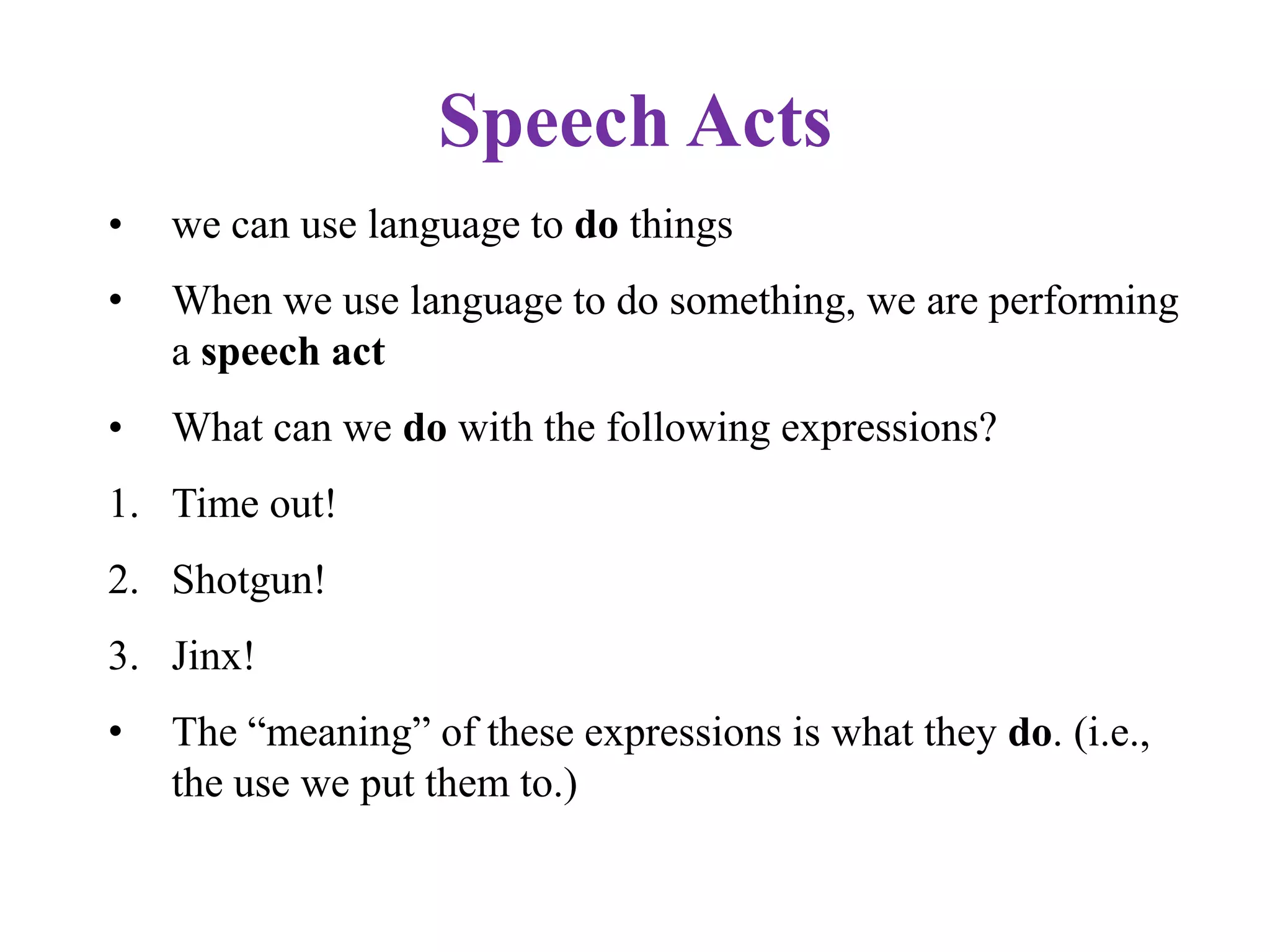
Speech Acts
• we can use language to do things
• When we use language to do something, we are performing
a speech act
• What can we do with the following expressions?
1. Time out!
2. Shotgun!
3. Jinx!
• The “meaning” of these expressions is what they do. (i.e.,
the use we put them to.)
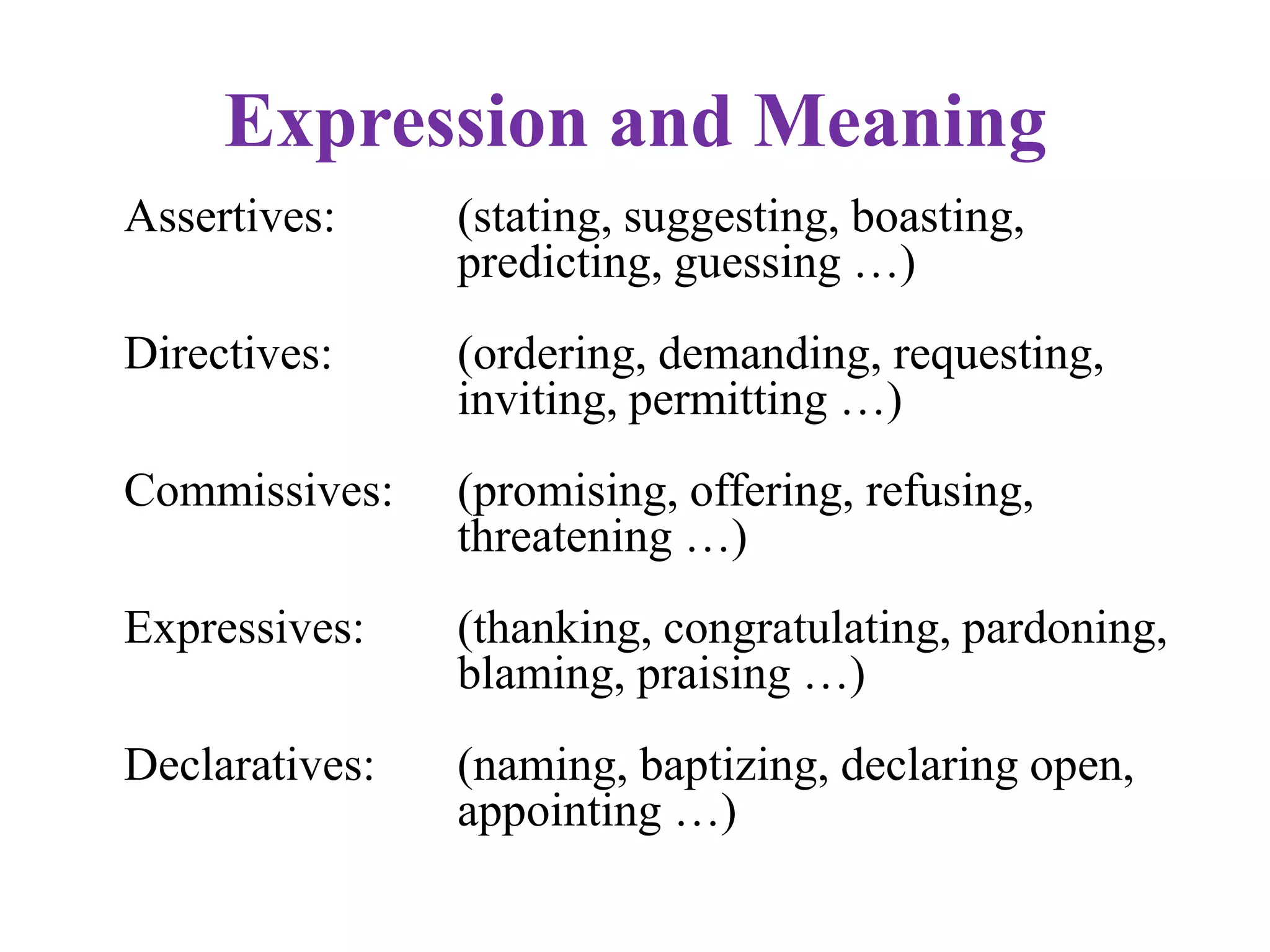
Expression and Meaning
Assertives: (stating, suggesting, boasting,
predicting, guessing …)
Directives: (ordering, demanding, requesting,
inviting, permitting …)
Commissives: (promising, offering, refusing,
threatening …)
Expressives: (thanking, congratulating, pardoning,
blaming, praising …)
Declaratives: (naming, baptizing, declaring open,
appointing …)
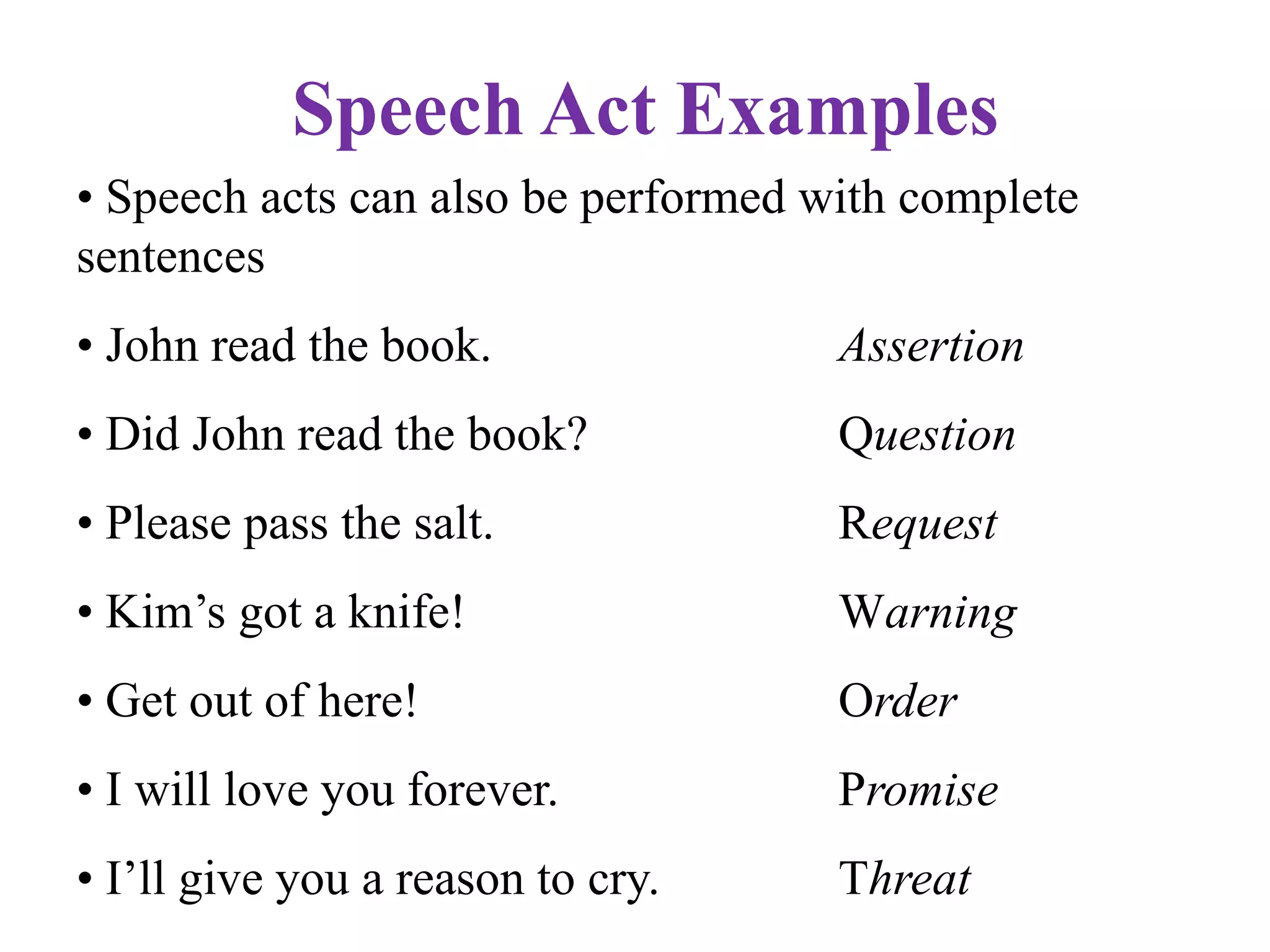
Speech Act Examples
• Speech acts can also be performed with complete
sentences
• John read the book. Assertion
• Did John read the book? Question
• Please pass the salt. Request
• Kim‟s got a knife! Warning
• Get out of here! Order
• I will love you forever. Promise
• I‟ll give you a reason to cry. Threat
Analysis of Speech Act
 Speech acts can be analysed by three
levels
- Locutionary act
- Perlocutionary act
- Illocutionary act
Locutionary Act
• Speaker„s utterance:
– The performance of an utterance
– Semantic and sintactic aspects
Example:
„close the window’
Illocutionary Act
• Speaker„s intention:
– Real intended meaning
Example:
The person who is talking is cold
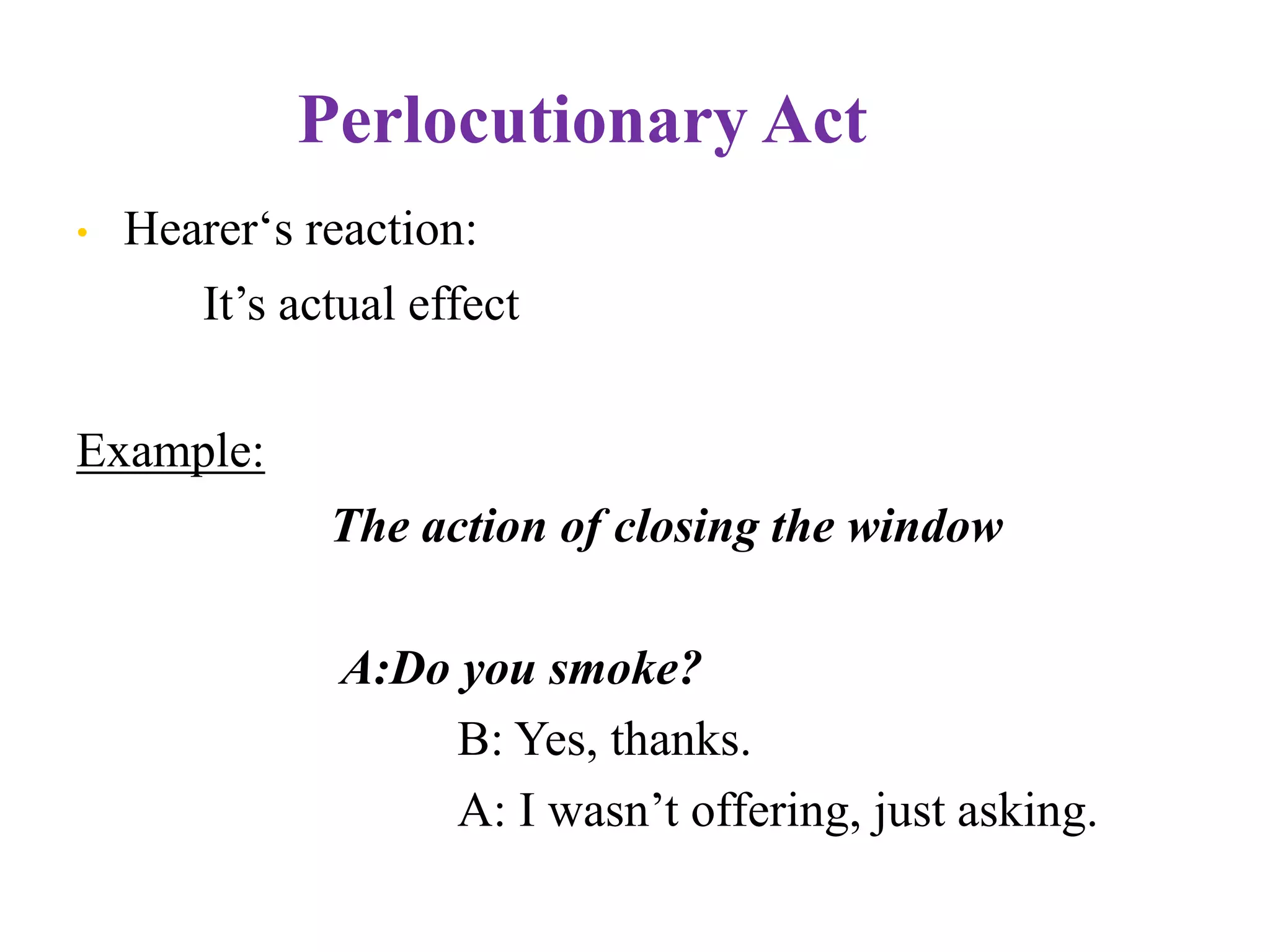
Perlocutionary Act
• Hearer„s reaction:
It‟s actual effect
Example:
The action of closing the window
A:Do you smoke?
B: Yes, thanks.
A: I wasn‟t offering, just asking.
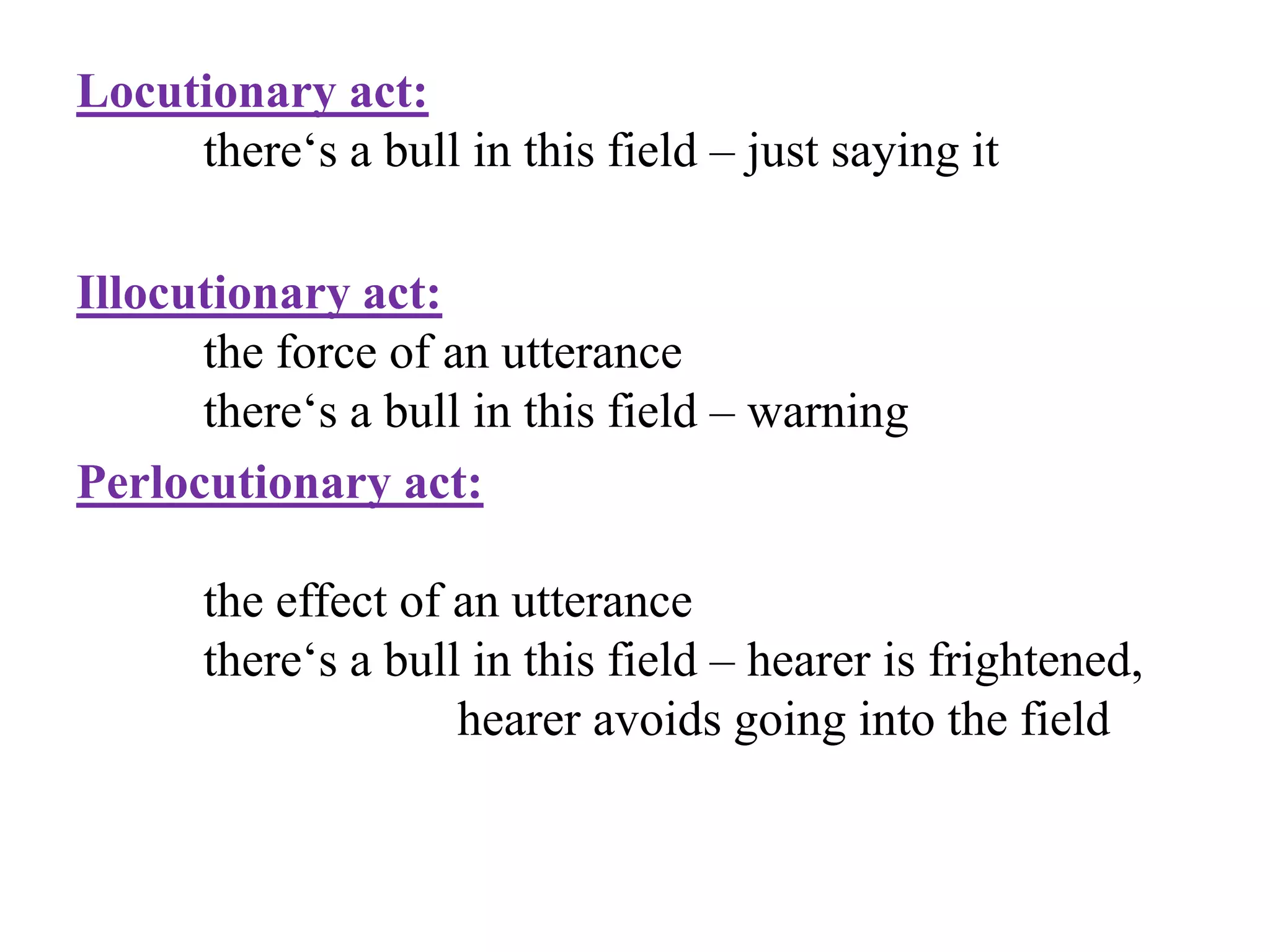
Locutionary act:
there„s a bull in this field – just saying it
Illocutionary act:
the force of an utterance
there„s a bull in this field – warning
Perlocutionary act:
the effect of an utterance
there„s a bull in this field – hearer is frightened,
hearer avoids going into the field
COOPERATION THEORY
The way in which people try
to make conversations work.
The co-operative Principle
• 4 Maxims (saying):
– quantity
– quality
– relation
– manner
The co-operative Principle
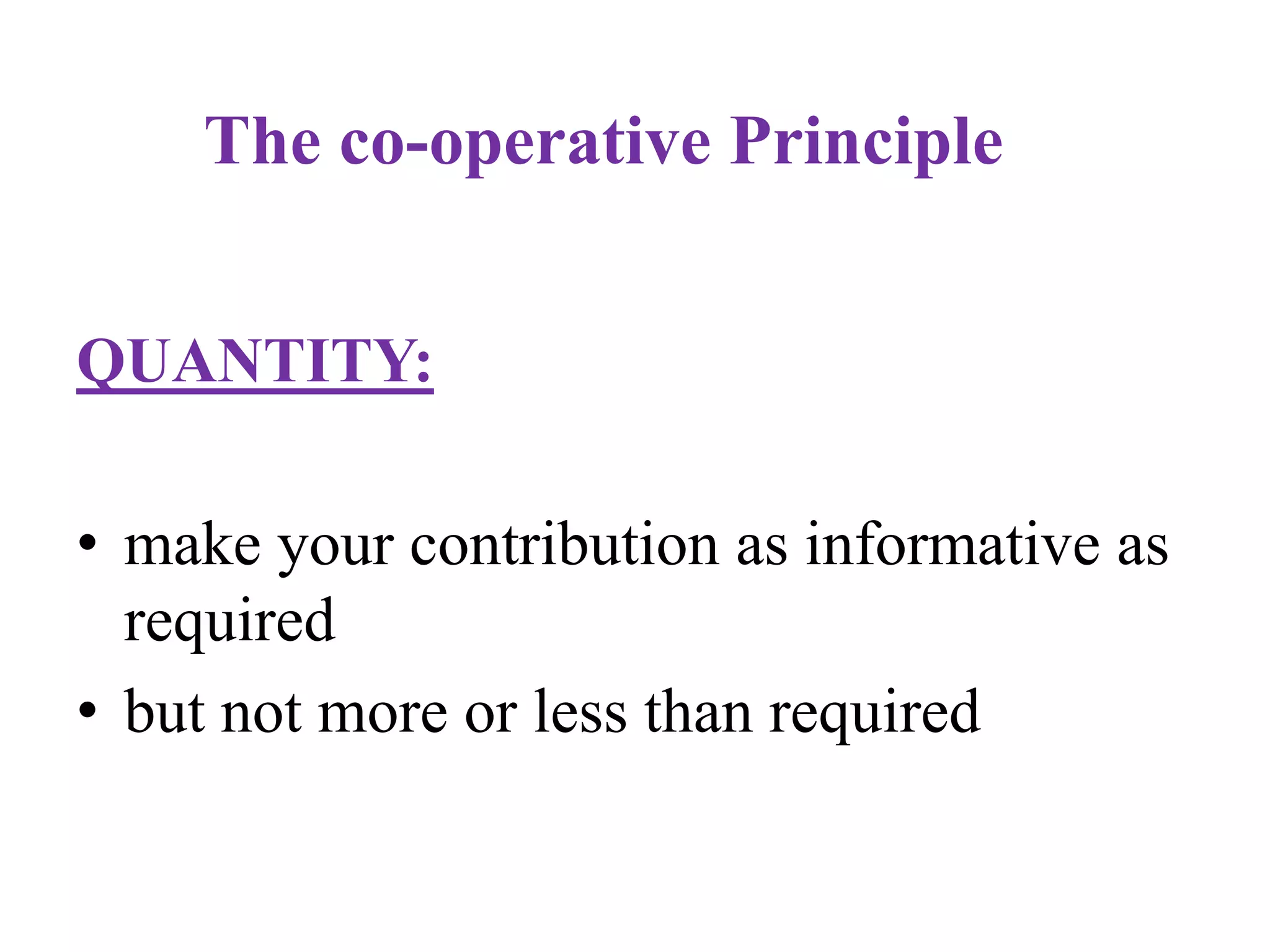
QUANTITY:
• make your contribution as informative as
required
• but not more or less than required
The co-operative Principle
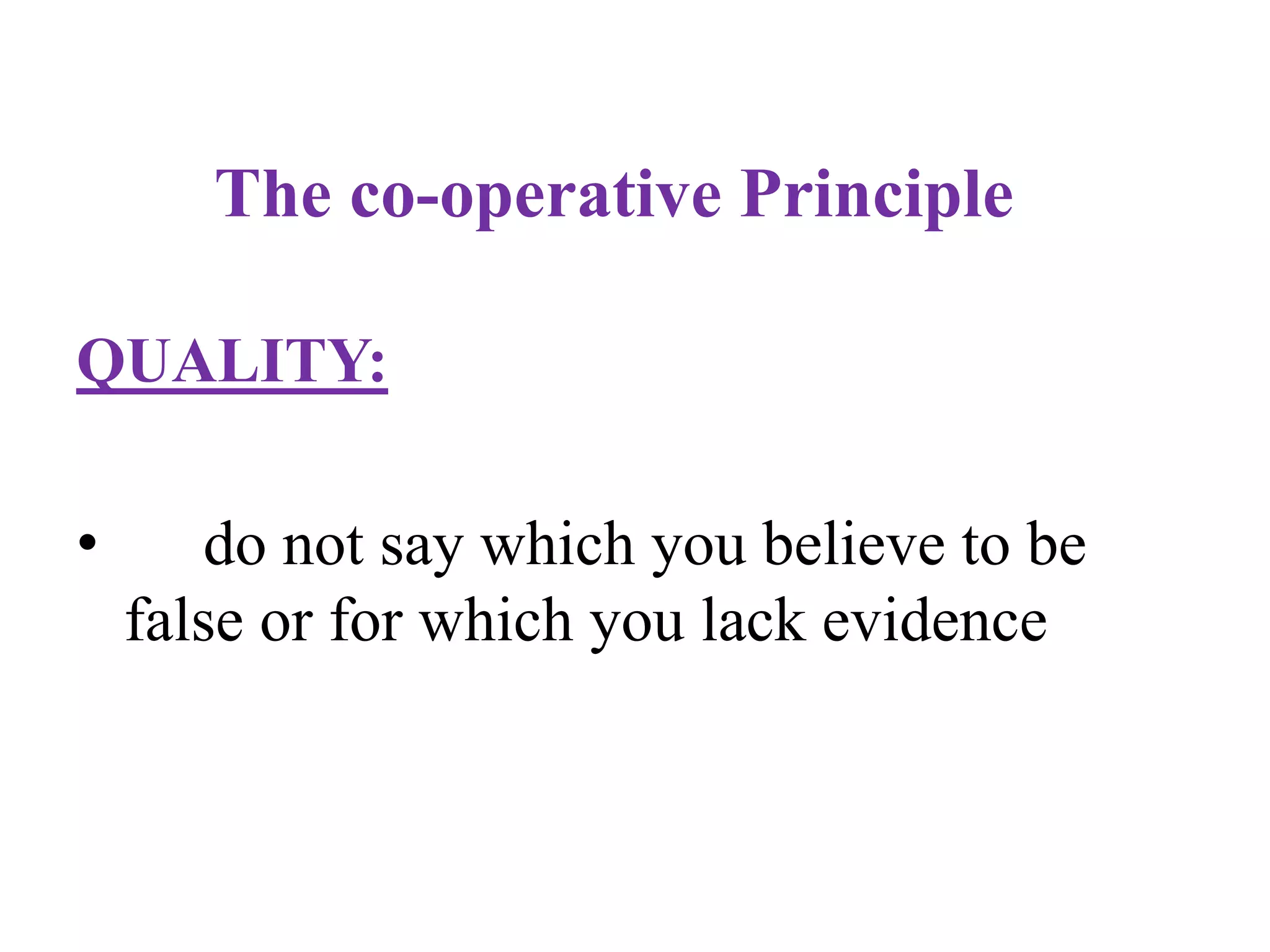
QUALITY:
• do not say which you believe to be
false or for which you lack evidence
The co-operative Principle
RELATION:
– be relevant
The co-operative Principle
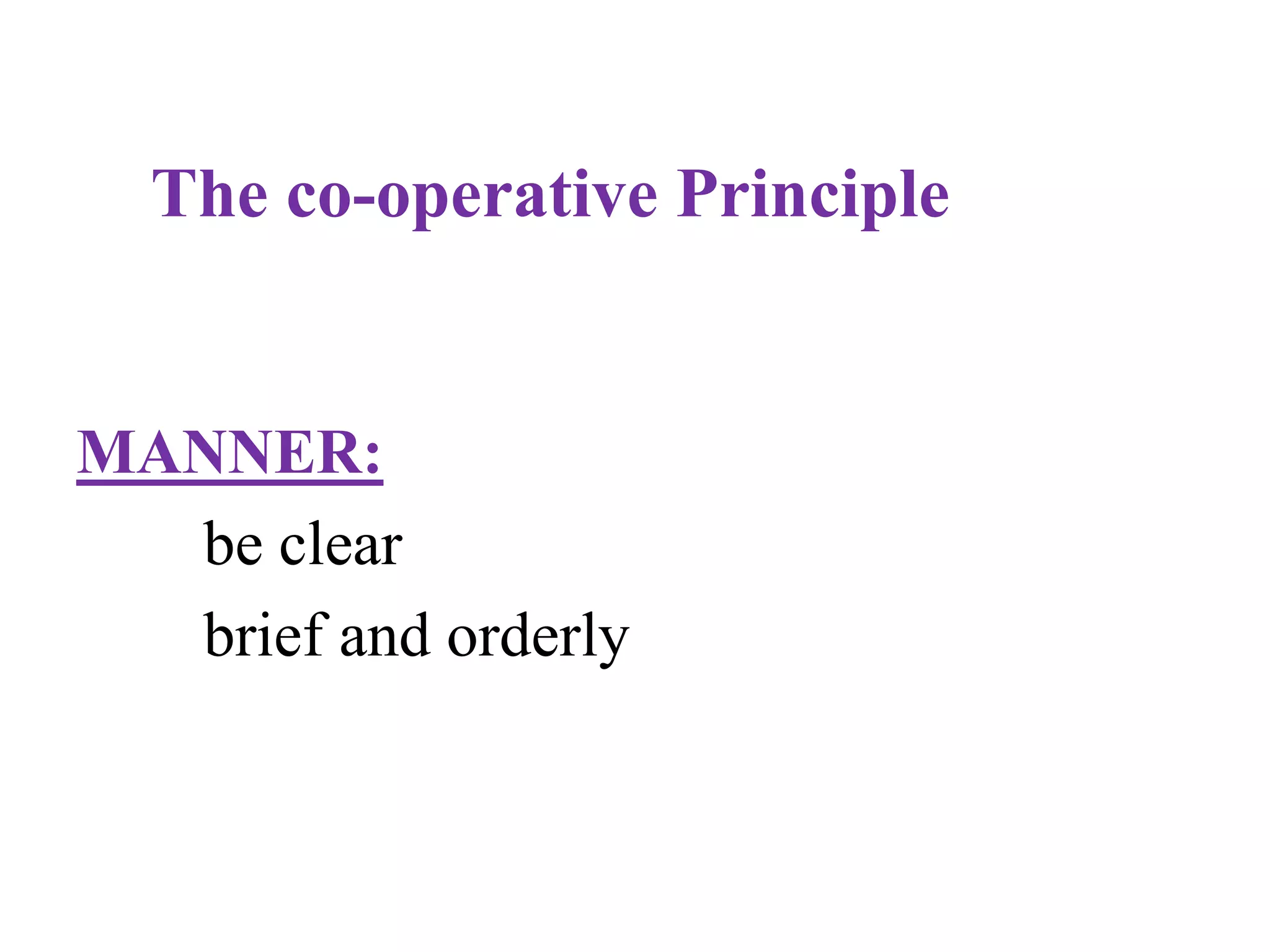
MANNER:
be clear
brief and orderly
PRAGMATIC ANALISYS
Related to the situation
Related to the context
Related to the people
Related to the information
RELATED TO THE SITUATION
We adapt our conversation to different
situations:
depending on the place and
the time where the speech occurs
RELATED TO THE PEOPLE
Depending on:
who you are with and
the relation between those people
the conversation will have different meaning
Example:
Ironic utterances with friends and
with unknown people
RELATED TO THE CONTEXT
With in the people, there are clues in the
context that allow us to notice that irony
(to say the opposite of what it actually means)
Example:
Facial expressions
RELATED TO THE INFORMATION
Presuppositions about the world-knowledge of
hearers; i.e
meanings that can be deducted by listeners
because they already know about that
information
Summary
• Pragmatics studies :
– the uses and the effects of language
• how it is based on the relationship established
between:
• utterance, context and interlocutors
– to understanding the language in a deeply way as
words do not have meaning by themselves
Pragmatics

Pragmatics

  • 1.
    University of thePunjab Department of English Language & Literature Lahore, Pakistan
  • 2.
    Pragmatics • Pragmatics studies: – How utterances are used – Its about interpreting what speakers mean
  • 3.
    Sentences vs. Utterances Sentence:A string of words put together by the grammatical rules of a language • Sentences are abstract idealizations, not physical events Utterance: the use of a sentence, in a particular context • Utterances are actual, physical events Meaning of Sentence & Utterance The meaning of a sentence can usually be derived from the meaning of its words Utterances can derive meaning from context which they can‟t derive from their abstract form as sentences
  • 4.
    The Interpretation ofMessages • Based on: –knowledge of the meaning of the word –knowledge about the context
  • 5.
    Linguistic Context • Linguisticcontext/ co-text : – set of other words used in the same phrase or context – As the word „pupil‟ is a homonym – How do we know which meaning is intended? • Usually by means of the linguistic context: – If it is used in a sentence with words like „teacher‟, „classmates‟ etc. – we understand that pupil here means ? – If it is used in a sentence with words like „eye‟, „dilatation‟ we know that here it means ?
  • 6.
    Physical Context • Physicalcontext: – if the location will influence interpretation • If you see a sign like this near a school: – SLOW DOWN. PUPILS CROSSING THE STREET – It does not mean that you have to slow down because you could run over eye-pupils and reduce them to a pulp
  • 7.
    Language in Context Theintended meaning of whole exchanges depends on: Context Intentions Shared knowledge, also Cultural implications If we don‟t have a context or some knowledge about a situation, the meaning can be „invisible‟
  • 8.
    Examples A: I havea 14 year old son B: Well that‟s right A: I also have a dog B: Oh, I‟m sorry Can you understand the meaning of this exchange? It would be hard to catch it,unless you know that A. is trying to rent an apartment from B. B. doesn‟t accept pets - have you seen Sam? - the black car is over there. This seemingly incoherent text can be easily understood if we know that Sam owns a black car.
  • 9.
    Deixis • Deixis comesfrom Greek and it means ‘pointing’by means of language • words that cannot be interpreted alone, without being put in a context if used without a shared knowledge or a clear context can result very vague • Person deixis: I, you, them • Place deixis: Here, there, that, • Time deixis: now – You’ll have to bring them back by tomorrow, because they aren’t here now and they need them
  • 10.
    THEORIES  Speech actstheory  Relevance theory  Cooperation theory  Argumentation theory
  • 11.
    SPEECH ACTS THEORY Wordsdo not have meaning by themselves
  • 12.
    Speech Acts • wecan use language to do things • When we use language to do something, we are performing a speech act • What can we do with the following expressions? 1. Time out! 2. Shotgun! 3. Jinx! • The “meaning” of these expressions is what they do. (i.e., the use we put them to.)
  • 13.
    Expression and Meaning Assertives:(stating, suggesting, boasting, predicting, guessing …) Directives: (ordering, demanding, requesting, inviting, permitting …) Commissives: (promising, offering, refusing, threatening …) Expressives: (thanking, congratulating, pardoning, blaming, praising …) Declaratives: (naming, baptizing, declaring open, appointing …)
  • 14.
    Speech Act Examples •Speech acts can also be performed with complete sentences • John read the book. Assertion • Did John read the book? Question • Please pass the salt. Request • Kim‟s got a knife! Warning • Get out of here! Order • I will love you forever. Promise • I‟ll give you a reason to cry. Threat
  • 15.
    Analysis of SpeechAct  Speech acts can be analysed by three levels - Locutionary act - Perlocutionary act - Illocutionary act
  • 16.
    Locutionary Act • Speaker„sutterance: – The performance of an utterance – Semantic and sintactic aspects Example: „close the window’
  • 17.
    Illocutionary Act • Speaker„sintention: – Real intended meaning Example: The person who is talking is cold
  • 18.
    Perlocutionary Act • Hearer„sreaction: It‟s actual effect Example: The action of closing the window A:Do you smoke? B: Yes, thanks. A: I wasn‟t offering, just asking.
  • 19.
    Locutionary act: there„s abull in this field – just saying it Illocutionary act: the force of an utterance there„s a bull in this field – warning Perlocutionary act: the effect of an utterance there„s a bull in this field – hearer is frightened, hearer avoids going into the field
  • 20.
    COOPERATION THEORY The wayin which people try to make conversations work.
  • 21.
    The co-operative Principle •4 Maxims (saying): – quantity – quality – relation – manner
  • 22.
    The co-operative Principle QUANTITY: •make your contribution as informative as required • but not more or less than required
  • 23.
    The co-operative Principle QUALITY: •do not say which you believe to be false or for which you lack evidence
  • 24.
  • 25.
  • 26.
    PRAGMATIC ANALISYS Related tothe situation Related to the context Related to the people Related to the information
  • 27.
    RELATED TO THESITUATION We adapt our conversation to different situations: depending on the place and the time where the speech occurs
  • 28.
    RELATED TO THEPEOPLE Depending on: who you are with and the relation between those people the conversation will have different meaning Example: Ironic utterances with friends and with unknown people
  • 29.
    RELATED TO THECONTEXT With in the people, there are clues in the context that allow us to notice that irony (to say the opposite of what it actually means) Example: Facial expressions
  • 30.
    RELATED TO THEINFORMATION Presuppositions about the world-knowledge of hearers; i.e meanings that can be deducted by listeners because they already know about that information
  • 31.
    Summary • Pragmatics studies: – the uses and the effects of language • how it is based on the relationship established between: • utterance, context and interlocutors – to understanding the language in a deeply way as words do not have meaning by themselves