Distiction betweeen
Constative and
Performative
Group-SAA
Shahnawaz shahid
Ali Furqan Syed
Abdul Rauf
Lahore InstItute of future educatIon, Lahore
3
Overview
 Introduction
 Constatives
 Functions of Constative Utterence
 Problem Constatives
 Performatives
 Implicit vs Explicit Performatives
 Functions of Performative Utterance
 Happy Performatives
 Unhappy Performatives
 Conclusin
 References
4
Distiction between Constative
and Performative
 Introduction
J.L Austin(1962)
How to Do Things With Words(Book Name)
“how to bridge the gap between language and reality”
 Austin tells us at the beginning of his famous 1955
Harvard lectures, published in his book , ‘ How to Do
Things with Words’. Austin begins his lectures by
politely remarking upon a "mistake" that a certain
traditional philosophical attitude toward language is
guilty of.
5
Conti...
 This mistake arises from the view that language is
preeminently the tool of constative assertion, that is, a
tool primarily interested in providing statements
about the world, which are characterizable as either
true or false.
 Austin proposes a second category of utterances that
are not subject to the truth/falsity conditions of
propositional knowledge. Rather, these exist as acts in
themselves, that is--as Austin dubs them as
performatives.
6
Constatives
These are certain utterances which do not denote an action.
They do not contain a performative verb that would direct
the other party to perform an action. As Austin says,
these constatives are used only in descriptions and
assertions e.g. somebody may say that "the window is
open".
 These contain following Characteristics:
 describe or report something
 are true or false
 uttering a constative is "just" saying something
7
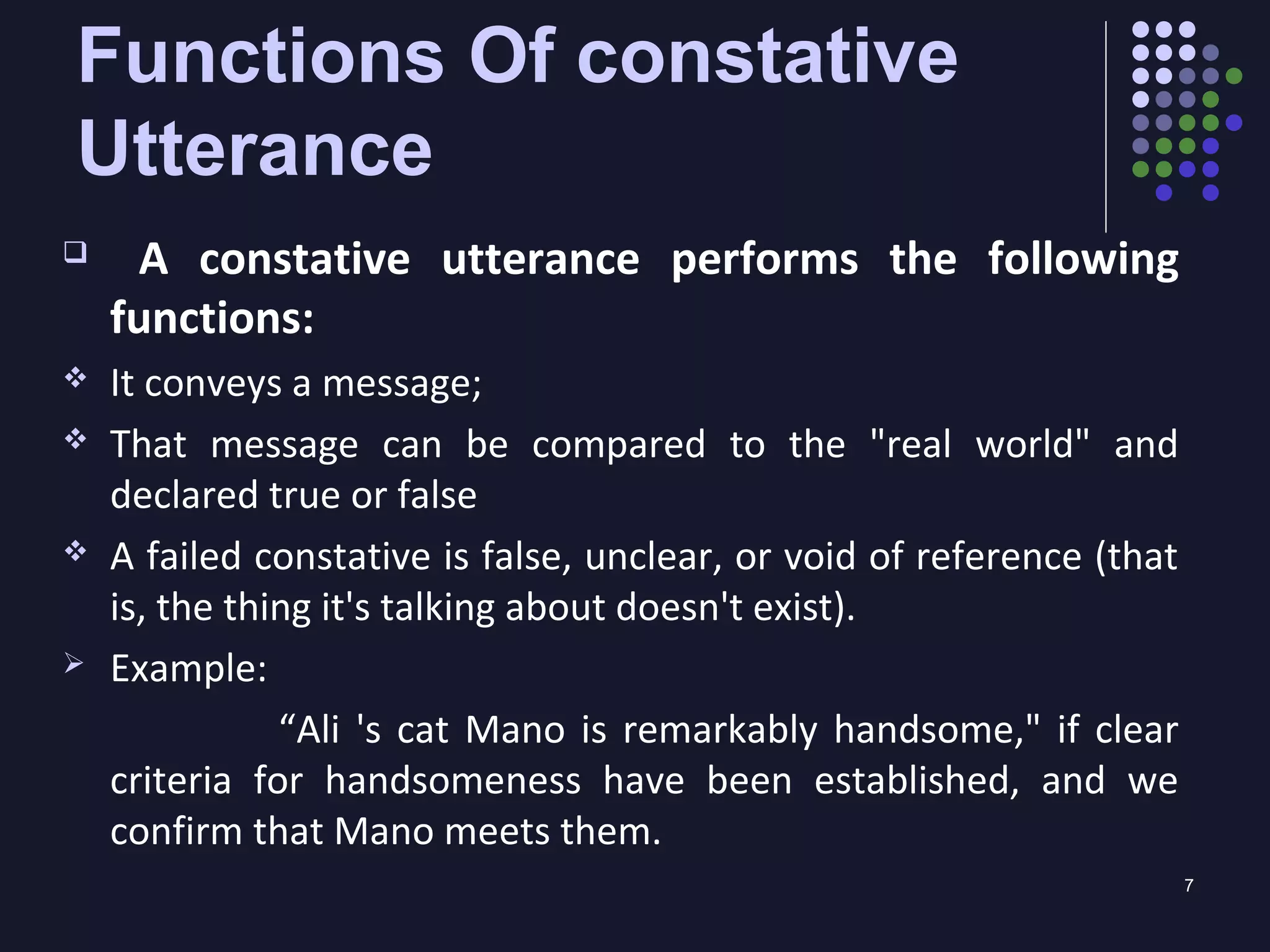
Functions Of constative
Utterance
 A constative utterance performs the following
functions:
 It conveys a message;
 That message can be compared to the "real world" and
declared true or false
 A failed constative is false, unclear, or void of reference (that
is, the thing it's talking about doesn't exist).
 Example:
“Ali 's cat Mano is remarkably handsome," if clear
criteria for handsomeness have been established, and we
confirm that Mano meets them.
8
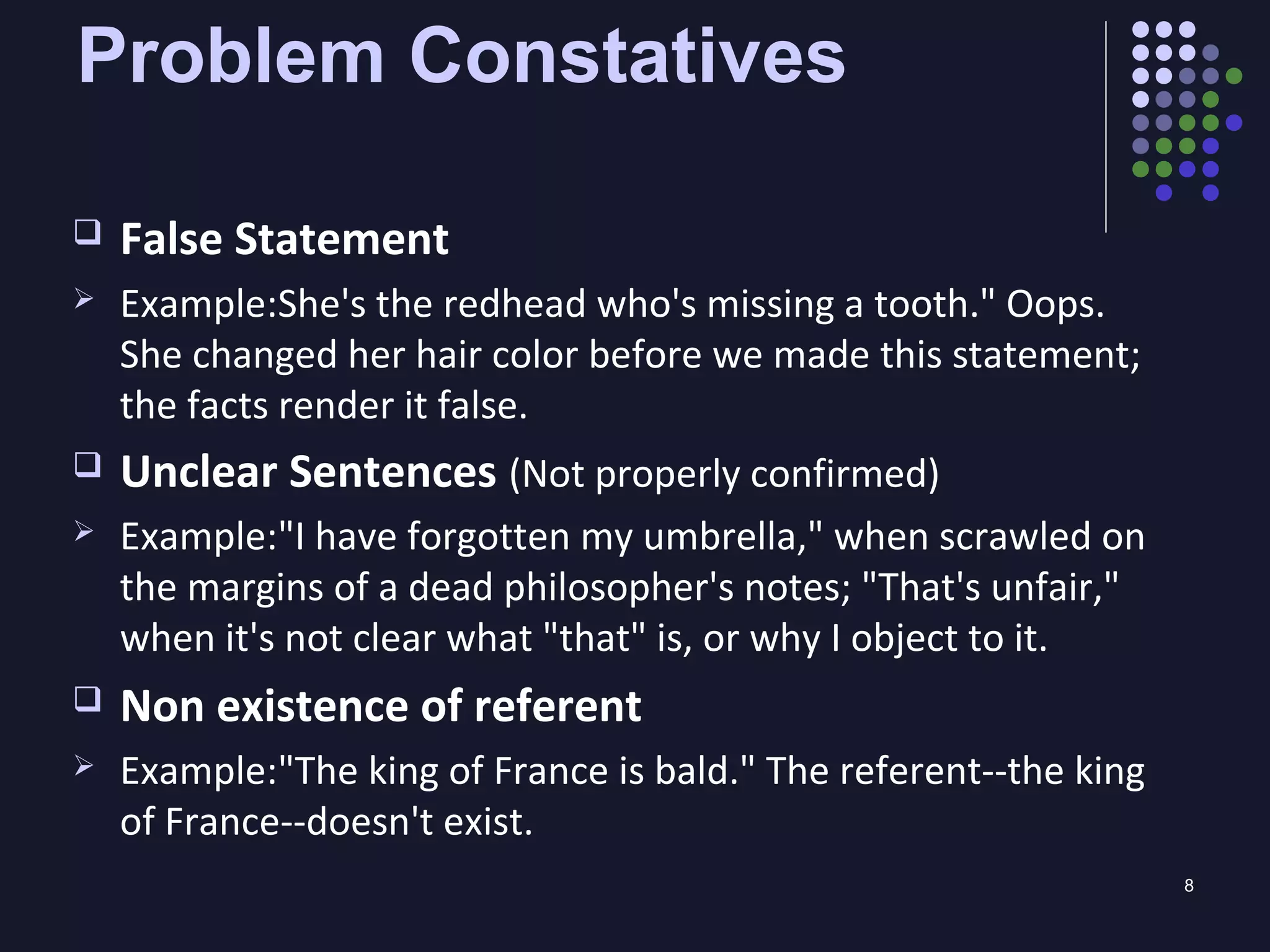
Problem Constatives
 False Statement
 Example:She's the redhead who's missing a tooth." Oops.
She changed her hair color before we made this statement;
the facts render it false.
 Unclear Sentences (Not properly confirmed)
 Example:"I have forgotten my umbrella," when scrawled on
the margins of a dead philosopher's notes; "That's unfair,"
when it's not clear what "that" is, or why I object to it.
 Non existence of referent
 Example:"The king of France is bald." The referent--the king
of France--doesn't exist.
9
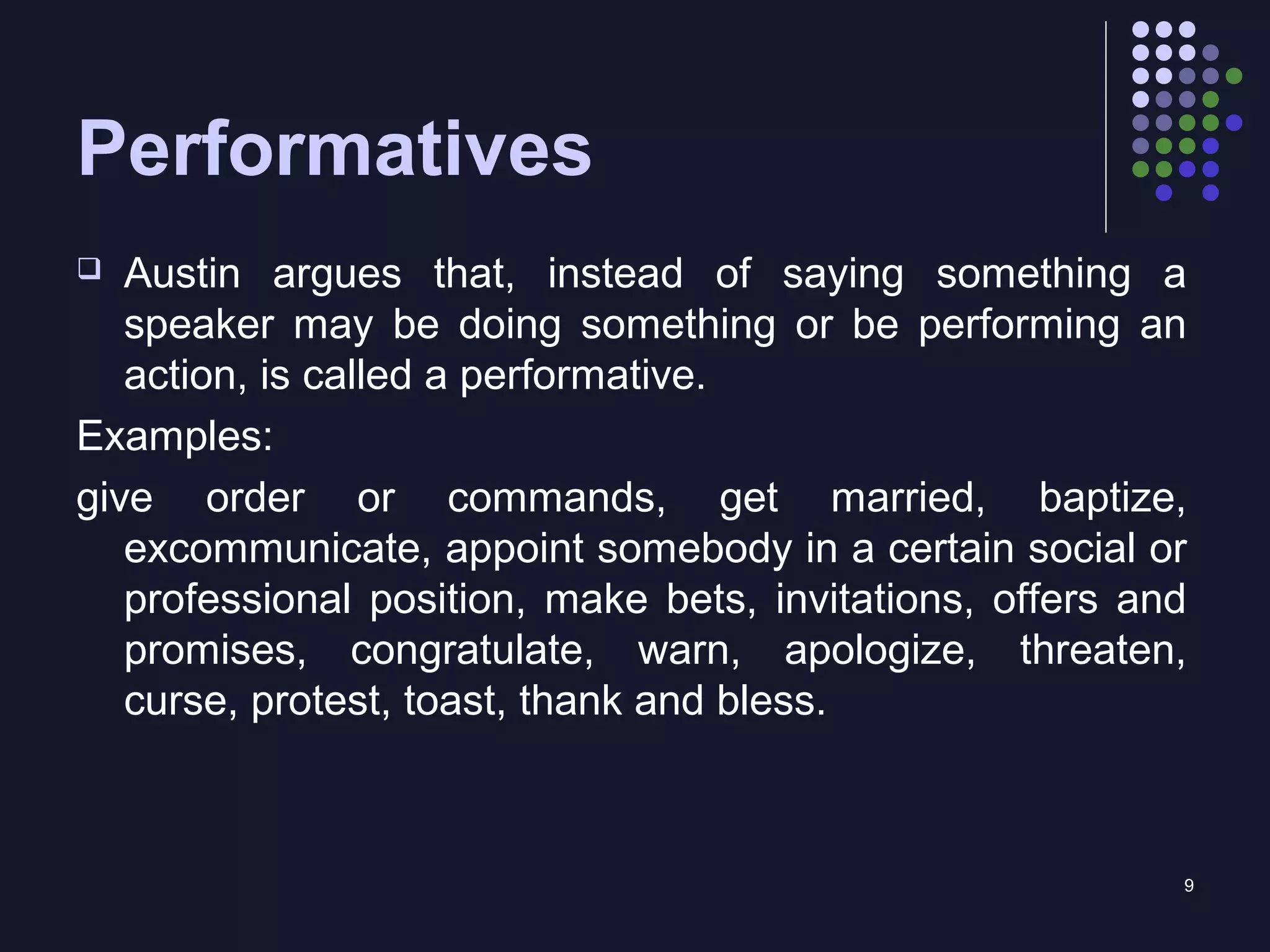
Performatives
 Austin argues that, instead of saying something a
speaker may be doing something or be performing an
action, is called a performative.
Examples:
give order or commands, get married, baptize,
excommunicate, appoint somebody in a certain social or
professional position, make bets, invitations, offers and
promises, congratulate, warn, apologize, threaten,
curse, protest, toast, thank and bless.
10
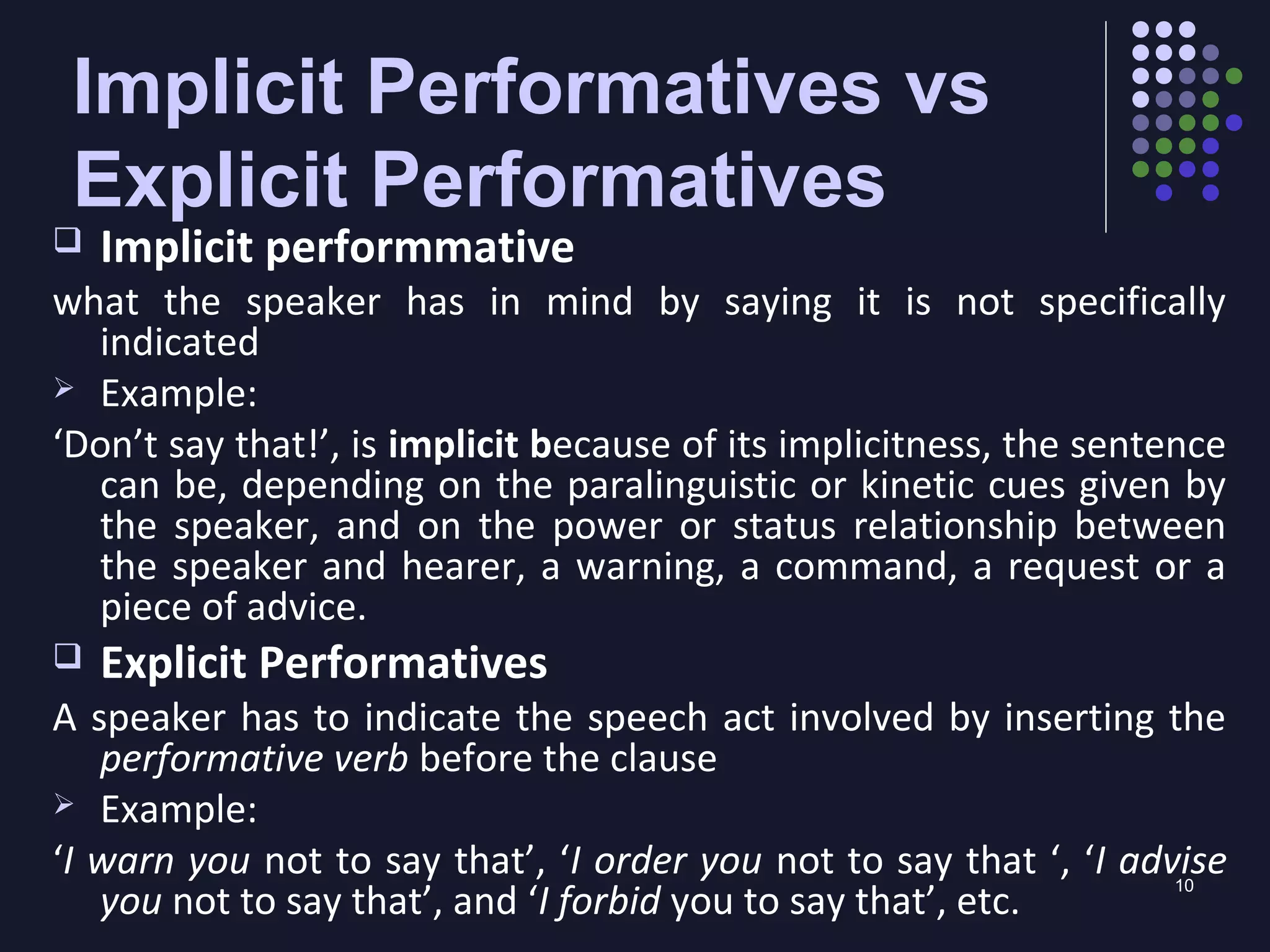
Implicit Performatives vs
Explicit Performatives
 Implicit performmative
what the speaker has in mind by saying it is not specifically
indicated
 Example:
‘Don’t say that!’, is implicit because of its implicitness, the sentence
can be, depending on the paralinguistic or kinetic cues given by
the speaker, and on the power or status relationship between
the speaker and hearer, a warning, a command, a request or a
piece of advice.
 Explicit Performatives
A speaker has to indicate the speech act involved by inserting the
performative verb before the clause
 Example:
‘I warn you not to say that’, ‘I order you not to say that ‘, ‘I advise
you not to say that’, and ‘I forbid you to say that’, etc.
11
Conti...
 A short list of performative verbs may comprise:
abolish, accept, acknowledge, acquit, admit, admonish,
advise, affirm, agree to, announce, answer, apologize,
ascribe, ask, assert, assess, assume, authorize, baptize,
beg, bet, bid, caution, charge, christen, claim, classify,
command, commiserate, compliment, concur,
congratulate, convict, counsel, declare, delegate, demand,
deny, describe, diagnose, disagree, donate, dub, excuse,
exempt, fire, forbid, grant, gua rantee, guess, hire etc
12
Functions of Performative
Utterance
 do not describe or report
Example:
I wish you A Happy Birthday
 are not true or false
(rather, are felicitous or infelicitous)
Example:
I bet you two pounds it will rain tomorrow
 uttering a performative is not "just" saying something (it
is doing something)
Example:
I now declare the meeting open.
13
Happy Performative vs
Unhappy Performatives
Happy Performatives (Well chosen and
appropriate)
"I promise to come to your Ball Party," when spoken by
someone who has been invited, to the host of a
scheduled party.
Unhappy Performatives (Not well Chosen and
Inappropriate)
"I promise to come to your Ball Party," spoken to several
hosts successively by a mendacious invitee.
14
Conclusion
In conclusion, we can refer back to our initial suggestion that
performatives are not simply the polar opposite of
constatives. As we have seen, Austin himself took care not to
reduce the two types of speech acts to a simple case of binary
opposition. But Austin's hypothesis, I have argued, is not
radical enough. His performative-constative distinction is
better explained along genetic lines, where the performative
is understood as the condition of possibility for more
specialized constative speech acts.
15
References
Austin. J.L. How to Do Things with Words. 1962. 2nd ed.
Cambridge: Harvard UP, 1975.
http://lib.uinmalang.ac.id/files/thesis/fullchapter/05320113.pdf
YULE, G. (1996): Pragmatics, Oxford, Oxford UniversityPress.
ELENA LOPEZ ALVERZ: Performative Speech Act Verbs in Present
Day English, Universidad Complutense de Madrid.
Thank You….
allah hafiz…
16

Constatives & performatives

  • 2.
    Distiction betweeen Constative and Performative Group-SAA Shahnawazshahid Ali Furqan Syed Abdul Rauf Lahore InstItute of future educatIon, Lahore
  • 3.
    3 Overview  Introduction  Constatives Functions of Constative Utterence  Problem Constatives  Performatives  Implicit vs Explicit Performatives  Functions of Performative Utterance  Happy Performatives  Unhappy Performatives  Conclusin  References
  • 4.
    4 Distiction between Constative andPerformative  Introduction J.L Austin(1962) How to Do Things With Words(Book Name) “how to bridge the gap between language and reality”  Austin tells us at the beginning of his famous 1955 Harvard lectures, published in his book , ‘ How to Do Things with Words’. Austin begins his lectures by politely remarking upon a "mistake" that a certain traditional philosophical attitude toward language is guilty of.
  • 5.
    5 Conti...  This mistakearises from the view that language is preeminently the tool of constative assertion, that is, a tool primarily interested in providing statements about the world, which are characterizable as either true or false.  Austin proposes a second category of utterances that are not subject to the truth/falsity conditions of propositional knowledge. Rather, these exist as acts in themselves, that is--as Austin dubs them as performatives.
  • 6.
    6 Constatives These are certainutterances which do not denote an action. They do not contain a performative verb that would direct the other party to perform an action. As Austin says, these constatives are used only in descriptions and assertions e.g. somebody may say that "the window is open".  These contain following Characteristics:  describe or report something  are true or false  uttering a constative is "just" saying something
  • 7.
    7 Functions Of constative Utterance A constative utterance performs the following functions:  It conveys a message;  That message can be compared to the "real world" and declared true or false  A failed constative is false, unclear, or void of reference (that is, the thing it's talking about doesn't exist).  Example: “Ali 's cat Mano is remarkably handsome," if clear criteria for handsomeness have been established, and we confirm that Mano meets them.
  • 8.
    8 Problem Constatives  FalseStatement  Example:She's the redhead who's missing a tooth." Oops. She changed her hair color before we made this statement; the facts render it false.  Unclear Sentences (Not properly confirmed)  Example:"I have forgotten my umbrella," when scrawled on the margins of a dead philosopher's notes; "That's unfair," when it's not clear what "that" is, or why I object to it.  Non existence of referent  Example:"The king of France is bald." The referent--the king of France--doesn't exist.
  • 9.
    9 Performatives  Austin arguesthat, instead of saying something a speaker may be doing something or be performing an action, is called a performative. Examples: give order or commands, get married, baptize, excommunicate, appoint somebody in a certain social or professional position, make bets, invitations, offers and promises, congratulate, warn, apologize, threaten, curse, protest, toast, thank and bless.
  • 10.
    10 Implicit Performatives vs ExplicitPerformatives  Implicit performmative what the speaker has in mind by saying it is not specifically indicated  Example: ‘Don’t say that!’, is implicit because of its implicitness, the sentence can be, depending on the paralinguistic or kinetic cues given by the speaker, and on the power or status relationship between the speaker and hearer, a warning, a command, a request or a piece of advice.  Explicit Performatives A speaker has to indicate the speech act involved by inserting the performative verb before the clause  Example: ‘I warn you not to say that’, ‘I order you not to say that ‘, ‘I advise you not to say that’, and ‘I forbid you to say that’, etc.
  • 11.
    11 Conti...  A shortlist of performative verbs may comprise: abolish, accept, acknowledge, acquit, admit, admonish, advise, affirm, agree to, announce, answer, apologize, ascribe, ask, assert, assess, assume, authorize, baptize, beg, bet, bid, caution, charge, christen, claim, classify, command, commiserate, compliment, concur, congratulate, convict, counsel, declare, delegate, demand, deny, describe, diagnose, disagree, donate, dub, excuse, exempt, fire, forbid, grant, gua rantee, guess, hire etc
  • 12.
    12 Functions of Performative Utterance do not describe or report Example: I wish you A Happy Birthday  are not true or false (rather, are felicitous or infelicitous) Example: I bet you two pounds it will rain tomorrow  uttering a performative is not "just" saying something (it is doing something) Example: I now declare the meeting open.
  • 13.
    13 Happy Performative vs UnhappyPerformatives Happy Performatives (Well chosen and appropriate) "I promise to come to your Ball Party," when spoken by someone who has been invited, to the host of a scheduled party. Unhappy Performatives (Not well Chosen and Inappropriate) "I promise to come to your Ball Party," spoken to several hosts successively by a mendacious invitee.
  • 14.
    14 Conclusion In conclusion, wecan refer back to our initial suggestion that performatives are not simply the polar opposite of constatives. As we have seen, Austin himself took care not to reduce the two types of speech acts to a simple case of binary opposition. But Austin's hypothesis, I have argued, is not radical enough. His performative-constative distinction is better explained along genetic lines, where the performative is understood as the condition of possibility for more specialized constative speech acts.
  • 15.
    15 References Austin. J.L. Howto Do Things with Words. 1962. 2nd ed. Cambridge: Harvard UP, 1975. http://lib.uinmalang.ac.id/files/thesis/fullchapter/05320113.pdf YULE, G. (1996): Pragmatics, Oxford, Oxford UniversityPress. ELENA LOPEZ ALVERZ: Performative Speech Act Verbs in Present Day English, Universidad Complutense de Madrid.
  • 16.

Editor's Notes

  • #5 The example uses conversational vocabulary and graphic devices (the dots) to simulate conversation and create a dramatic pause.
  • #6 The example uses conversational vocabulary and graphic devices (the dots) to simulate conversation and create a dramatic pause. Lexical density: A more conversational recasting of the events reported in the headline, such as Did you hear about Di’s butler – the one who wears old trainers – he’s resigning, Tense: The Longman Grammar of Spoken and Written English (LGSWE: 455) points out that the simple present is often used to refer to a future event which is ‘felt to be fixed and certain at the time of speech’. However, nearly all occurrences of present tense referring to future time occur in one of two related grammatical contexts – either with an accompanying time adverbial that explicitly refer to the future, or in a conditional or temporal adverbial clause that has future time reference. It would be unusual for someone in conversation to report an event which is about to happen/has happened using this tense.