Paralanguage: Nonverbal Communication “ People are more frightened of being lonely than of being hungry, or being deprived of sleep, or of having their sexual needs unfulfilled” (Frieda Fromm Reichmenn).
Paralanguage: Communication by means other than language .
Paralanguage includes Facial expressions Tones of voice Gestures Eye contact Spatial arrangements Patterns of touch Expressive movements Silence
Paralanguage : refers to  all  nonverbal communication actions (Kinesics and Proxemics)
Paralanguage i ncludes  intentional  and  unintentional  nonverbal messages
Paralanguage may be: Complementary Unconscious Learned
Universals and Cultural Variations eyebrow flash, the nose wrinkle basic emotions:  --happiness, sadness, disgust, fear, anger, and surprise
The functions of nonverbal communication  To repeat what was said verbally To complement what was said verbally To contradict what was said verbally To substitute for what would be said verbally To regulate and manage the communication event
Nonverbal communication divided into Kinesic and Proxemic acts Kinesics:  The study of nonverbal gestures, facial expressions, eye contact, and body posture Proxemics:  The study of the use of space, touch, and distance as features of nonverbal communication.
Inborn Nonverbal Actions Smiling  Crying
Universality versus Relativism Birdwhistell (1970) Emblems:   are gestures understood by participant of a communicative community to express a specific meaning
Cultural Specific Emblems Can you guess what the following gestures from Japan, France and Iran mean?
Could reflect social status and gender: In North America Dominance versus  subordination ---more space--- take less space ---stare at others --- less eye contact --- smile more--  smile less
Dangers of overgeneralizations Cannot assume everybody in a culture behaves the same way Infrequent actions should not be used to characterize a culture We should not ignore that nonverbal behaviors are part of complex communication processes
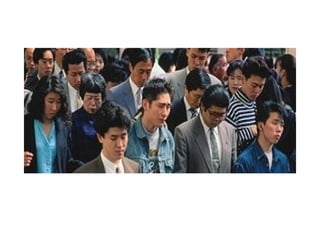
How do we communicate with those we don’t know? Leonard Zunin (The First Four Minutes, 1972) Three common behaviours: Which side of the path” look I acknowledge you” look Look—away priority”
Proxemics Edward, T Hall in 1963   refers to touch and issues of personal space
 
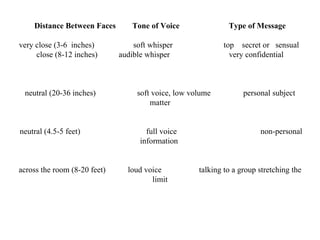
Distance Between Faces   Tone of Voice    Type of Message   very close (3-6  inches)    soft whisper    top  secret or  sensual  close (8-12 inches)    audible whisper    very confidential     neutral (20-36 inches)    soft voice, low volume    personal subject matter      neutral (4.5-5 feet)    full voice    non-personal information      across the room (8-20 feet)  loud voice    talking to a group stretching the limit


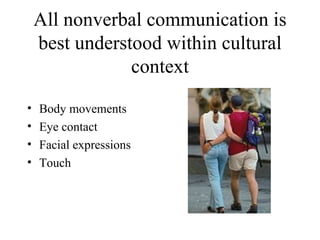
All nonverbal communication is best understood within cultural context Body movements Eye contact Facial expressions Touch
Silence also part of nonverbal communication Sends nonverbal clues during communication Culturally determined Igbo s of Nigeria
Do you think that by studying nonverbal patterns can help us identify our own ethnocentric attitudes?

Paralanguage a

  • 1.
    Paralanguage: Nonverbal Communication“ People are more frightened of being lonely than of being hungry, or being deprived of sleep, or of having their sexual needs unfulfilled” (Frieda Fromm Reichmenn).
  • 2.
    Paralanguage: Communication bymeans other than language .
  • 3.
    Paralanguage includes Facialexpressions Tones of voice Gestures Eye contact Spatial arrangements Patterns of touch Expressive movements Silence
  • 4.
    Paralanguage : refersto all nonverbal communication actions (Kinesics and Proxemics)
  • 5.
    Paralanguage i ncludes intentional and unintentional nonverbal messages
  • 6.
    Paralanguage may be:Complementary Unconscious Learned
  • 7.
    Universals and CulturalVariations eyebrow flash, the nose wrinkle basic emotions: --happiness, sadness, disgust, fear, anger, and surprise
  • 8.
    The functions ofnonverbal communication To repeat what was said verbally To complement what was said verbally To contradict what was said verbally To substitute for what would be said verbally To regulate and manage the communication event
  • 9.
    Nonverbal communication dividedinto Kinesic and Proxemic acts Kinesics: The study of nonverbal gestures, facial expressions, eye contact, and body posture Proxemics: The study of the use of space, touch, and distance as features of nonverbal communication.
  • 10.
  • 11.
    Universality versus RelativismBirdwhistell (1970) Emblems: are gestures understood by participant of a communicative community to express a specific meaning
  • 12.
    Cultural Specific EmblemsCan you guess what the following gestures from Japan, France and Iran mean?
  • 13.
    Could reflect socialstatus and gender: In North America Dominance versus subordination ---more space--- take less space ---stare at others --- less eye contact --- smile more-- smile less
  • 14.
    Dangers of overgeneralizationsCannot assume everybody in a culture behaves the same way Infrequent actions should not be used to characterize a culture We should not ignore that nonverbal behaviors are part of complex communication processes
  • 15.
    How do wecommunicate with those we don’t know? Leonard Zunin (The First Four Minutes, 1972) Three common behaviours: Which side of the path” look I acknowledge you” look Look—away priority”
  • 16.
    Proxemics Edward, THall in 1963 refers to touch and issues of personal space
  • 17.
  • 18.
    Distance Between Faces Tone of Voice Type of Message very close (3-6 inches) soft whisper top secret or sensual close (8-12 inches) audible whisper very confidential neutral (20-36 inches) soft voice, low volume personal subject matter neutral (4.5-5 feet) full voice non-personal information across the room (8-20 feet) loud voice talking to a group stretching the limit
  • 19.
  • 20.
  • 21.
  • 22.
  • 23.
    All nonverbal communicationis best understood within cultural context Body movements Eye contact Facial expressions Touch
  • 24.
    Silence also partof nonverbal communication Sends nonverbal clues during communication Culturally determined Igbo s of Nigeria
  • 25.
    Do you thinkthat by studying nonverbal patterns can help us identify our own ethnocentric attitudes?